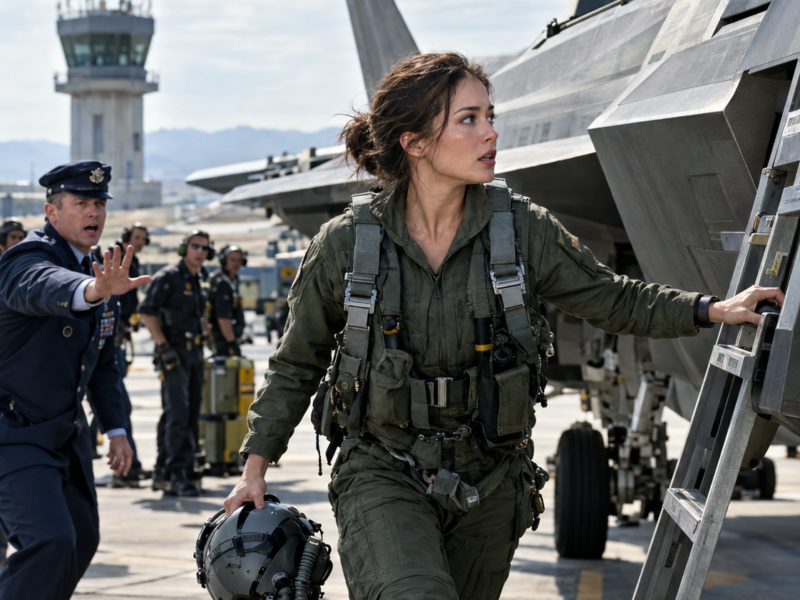
Colonel Mason humiliated Rebecca Hayes in front of an entire squadron, ordering the disgraced former pilot out of the hangar
Colonel Mason humiliated Rebecca Hayes in front of an entire squadron, ordering the disgraced former pilot out of the hangar—but when an F-22 Raptor suddenly powered up and announced her forgotten call sign, every armed guard, senior officer, and combat pilot snapped to attention.
Three years ago, the military had buried Captain Rebecca Hayes without a funeral.
Now, its most advanced fighter was calling her home.
The rain had turned the flight line at Nellis Air Force Base into a sheet of black glass. Beneath the hangar lights, an F-22 Raptor sat surrounded by maintenance crews, its angular wings reflecting the cold fluorescent glare. The smell of JP-8 fuel clung to the air, mixing with hot electronics and the metallic bite of the approaching storm.
Rebecca stood beside a rolling toolbox wearing faded jeans, scuffed work boots, and a gray maintenance jacket with a civilian contractor’s badge clipped to the pocket. Her dark hair was tied back, and a thin scar crossed her left wrist.
Nobody looking at her would have guessed she’d once flown an aircraft capable of crossing a combat zone before an enemy radar operator knew she was there.
Nobody was supposed to remember.
“Hey, sweetheart, the visitor entrance is on the other side.”
The voice belonged to Captain Derek Walsh, a broad-shouldered fighter pilot whose immaculate flight suit carried more squadron patches than Rebecca had seen on some veterans. He glanced at her toolbox and smirked.
“Unless you’re here to fix the coffee machine.”
Two technicians laughed.
Rebecca didn’t look up from the aircraft’s maintenance log.
“Coffee machines usually give clearer fault codes than military pilots.”
The laughter stopped.
Walsh’s smile tightened.
“What’s that supposed to mean?”
“Nothing, Captain.”
She closed the logbook and continued reading the diagnostic display.
The aircraft had failed a routine systems test forty minutes earlier. Its flight-control computers had rebooted unexpectedly, and three separate technicians had been unable to identify the cause. The squadron had summoned a specialist team, but the hangar’s chief engineer had asked Rebecca to look over the maintenance records while they waited.
She had agreed because the aircraft’s markings had caught her eye.
A black raven beneath the cockpit.
Her old squadron insignia.
Raven Flight.
Rebecca moved closer to the left landing gear. She didn’t touch anything. She simply crouched, following the hydraulic lines with her eyes until she spotted a faint crescent of fresh tool marks on a fastener near an access panel.
The maintenance record claimed that panel hadn’t been opened in eleven days.
Someone had worked on it recently.
More troubling, the fault log showed a brief interruption in the aircraft’s data connection immediately before the shutdown. It was too short to trigger the usual maintenance warning, but long enough to corrupt a systems check if the timing was right.
Rebecca straightened.
“Who authorized the last inspection of the flight-control interface?”
The chief technician, Sergeant Miller, glanced at her.
“That information is restricted.”
“Then ask someone authorized to read it.”
Walsh chuckled.
“You’ve been here ten minutes, and you’re already interrogating the maintenance crew?”
Rebecca pointed toward the display.
“Your diagnostic sequence is missing a verification step.”
Walsh folded his arms.
“We’ve got engineers with twenty years of experience working on this aircraft.”
“And the fault keeps returning.”
“Because it’s a software issue.”
“Maybe.”
She studied the recorded voltage trace.
“But the interruption begins before the software reports the fault. You’re treating the symptom as the cause.”
Miller stepped closer to the screen. His expression changed as he examined the timestamps.
“She’s right about the sequence.”
Walsh shot him a warning look.
“Don’t encourage her.”
Rebecca tapped a point on the trace.
“There’s another problem. Your restart procedure assumes the aircraft’s electrical buses have fully isolated after shutdown. The logs don’t establish that. If the fault is being deliberately triggered, another restart could make the evidence disappear.”
Nobody laughed this time.
Before Miller could answer, the hangar doors rolled open.
Colonel Mason entered with two senior officers and a pair of armed security personnel. His silver hair was perfectly combed, his uniform immaculate, and his expression carried the same cold authority Rebecca remembered from the last morning she’d worn wings.
He stopped when he saw her.
For a moment, something flickered behind his eyes.
Then it vanished.
“Captain Hayes.”
“Colonel.”
“You were told not to return to this installation without authorization.”
“I was invited by the maintenance chief.”
Mason turned toward Miller.
“Did you authorize her access to a restricted aircraft?”
The sergeant hesitated.
“I requested a preliminary review of the maintenance logs, sir.”
“By a civilian contractor whose military flight status was revoked.”
Rebecca remained still.
Mason stepped closer, lowering his voice just enough to make the humiliation deliberate.
“Your presence here is inappropriate. You lost the privilege of working with combat aircraft when you demonstrated that you couldn’t follow a direct order.”
The words struck harder than she allowed him to see.
Three years earlier, she’d heard those same words in a briefing room filled with officers who had once trusted her with their lives.
She could still remember the sound of her wings being removed from her uniform. The scrape of the colonel’s chair against the floor. The silence of the squadron when he declared her responsible for the disappearance of Lieutenant Daniel Cross.
Her wingman.
Her friend.
The man whose aircraft had vanished during a classified interception over the Pacific.
Rebecca had disobeyed an order to withdraw when his distress signal came through. She had turned into a storm that swallowed radar returns and tore the sky into white fragments.
She had returned alone.
The official investigation concluded that Cross had been lost in an aircraft explosion. Rebecca’s pursuit had been labeled reckless, her testimony inconsistent, and her flight status revoked.
Mason had signed the final order himself.
He had never asked why the flight recordings from that night were incomplete.
He had never explained why the radar data contradicted the official timeline.
And he had never told her why Cross’s final transmission had disappeared from the mission archive.
Rebecca had learned one thing from three years of civilian repair work: machines rarely lied in the same way twice. When a fault repeated itself, somebody had either misunderstood the system or altered it.
The F-22 was telling the same story.
She glanced at the suspicious panel one final time.
“Colonel, I recommend you suspend the restart sequence until an independent team examines the aircraft.”
Mason’s face hardened.
“You’re not in a position to recommend anything.”
“The fault isn’t consistent with ordinary component failure.”
“Enough.”
His voice echoed through the hangar.
“You will step away from that aircraft, surrender your temporary access badge, and leave this installation. Security will escort you to the gate.”
One of the guards moved toward her.
Rebecca unclipped her badge and placed it on the toolbox.
“Understood.”
She didn’t argue. She didn’t mention the altered fastener or the suspicious timing in the logs. She simply turned and walked toward the hangar doors.
Behind her, Walsh muttered something about disgraced pilots who couldn’t accept their careers were over.
Rebecca kept walking.
Outside, the rain had intensified. Thunder rolled across the Nevada mountains, and the wind carried the heavy rumble of aircraft engines from the far side of the base. She had almost reached the personnel corridor when an electronic chime sounded behind her.
Then another.
She stopped.
The sound came from the hangar.
A deep electrical hum rose beneath the storm, followed by the unmistakable clatter of relays engaging in sequence. The hangar lights flickered once, twice, then dimmed.
Someone shouted.
“Who restored power?”
Rebecca turned.
Inside the hangar, the F-22’s cockpit displays had illuminated.
Miller hurried toward the control station.
“We didn’t initiate a startup!”
The aircraft’s external power connection remained disconnected. The maintenance crew had verified that fact less than five minutes earlier.
Yet the displays continued to glow.
A low-frequency vibration passed through the concrete floor as the aircraft’s onboard systems activated. The overhead speakers crackled, filling the hangar with a burst of static.
Mason spun toward the technicians.
“Shut it down! Now!”
Miller reached for the emergency isolation controls.
The system rejected the command.
A red warning flashed across the diagnostic monitor.
UNAUTHORIZED SHUTDOWN REQUEST DENIED.
Walsh backed away from the console.
“What the hell is that?”
Rebecca felt the cold settle beneath her ribs.
The sequence on the screen wasn’t random. The system was completing a structured authentication routine, one she had seen only once before, during a classified flight-test program that had supposedly been discontinued.
She moved toward the hangar.
The armed guard caught her arm.
“Ma’am, you’re under orders to leave.”
“Look at the power readings.”
He glanced toward the aircraft.
Rebecca pointed to the display.
“The system is drawing power from an internal source. If you interrupt the wrong connection now, you could destroy whatever it’s trying to recover.”
The guard hesitated.
Mason heard her.
“Get her out of here!”
Before the guard could respond, every speaker in the hangar emitted a sharp burst of static.
Then a calm, synthetic voice spoke.
“Raven One. Authentication confirmed.”
The words seemed to drain the oxygen from the room.
Walsh stared at the cockpit.
Miller’s mouth fell open.
One of the senior officers took a step backward.
The F-22’s canopy remained closed, its cockpit glowing with pale green instrumentation. On the main display, a line of text appeared.
PILOT IDENTITY: CAPTAIN REBECCA HAYES.
Mason went completely still.
The aircraft spoke again.
“Welcome back, Captain Hayes.”
For one suspended second, nobody moved.
Then the secure communications channel opened, and a new transmission appeared on the screen.
CLASSIFIED FLIGHT RECORD RECOVERED.
Beneath it was the date of Rebecca’s final mission.
And a name the military had officially declared dead.
LIEUTENANT DANIEL CROSS — STATUS: ALIVE.
Rebecca stared at the display.
Three years of grief collapsed into a single, impossible truth.
Behind her, Mason whispered a command to the security team, but his voice had lost its authority.
Rebecca stepped toward the aircraft.
The display changed one final time.
PILOT AUTHENTICATION REQUIRED: RAVEN ONE.
She placed her palm against the access panel.
The system accepted her biometric signature instantly.
Across the hangar, every screen turned black.
Then the overhead speakers crackled with a human voice, weak and distorted by static.
“Rebecca… if you can hear me, don’t trust Mason.”
Her blood turned cold.
It was Daniel.
The colonel reached for his sidearm.
Before he could draw it, the aircraft transmitted one final identification across the hangar.
“RAVEN ONE — COMMAND AUTHORITY RESTORED.”
Every SEAL, pilot, senior officer, and armed guard in the hangar snapped into a rigid salute.
For three seconds, nobody dared move.
Captain Rebecca Hayes stood beneath the glowing cockpit of the F-22 Raptor, listening to the last fragments of Daniel Cross’s voice dissolve into static. Around her, armed guards held rigid salutes, seasoned pilots stared in disbelief, and Colonel Mason stood with one hand hovering near his sidearm.
Then the colonel found his voice.
“Everyone stand down! This aircraft has suffered a classified systems malfunction. Nobody is authorized to access its records.”
Rebecca slowly turned toward him.
“Then why does it recognize my biometric signature?”
Mason’s jaw tightened.
“Security, escort Captain Hayes off the flight line.”
Nobody moved.
A young security officer glanced at the glowing display, then at Rebecca.
“Sir, the aircraft just restored her command authentication.”
“That system is compromised!”
“With respect, sir, the system rejected your shutdown command.”
The colonel’s face darkened.
Rebecca watched him carefully. He wasn’t frightened by a malfunctioning aircraft. He was frightened by what it had revealed.
She had seen that expression once before—three years earlier, in the underground briefing room where the military had declared Daniel Cross dead and her career finished.
“Open the recovered flight record,” she said.
Mason stepped forward.
“Absolutely not.”
Rebecca didn’t raise her voice.
“Then explain why a dead pilot just spoke through your aircraft.”
A murmur swept through the hangar.
Colonel Mason looked toward the technicians.
“Disconnect the aircraft from every external network. Preserve the maintenance logs and initiate a full security lockdown.”
Sergeant Miller hesitated.
“Sir, the aircraft isn’t connected to an external network.”
“Then isolate its internal communications!”
“We’ve tried. The system is rejecting our commands.”
Rebecca approached the diagnostic console. She didn’t touch the controls yet. Instead, she studied the sequence of messages, watching the timestamps advance across the display.
The authentication routine had begun before the aircraft powered up. It had searched for a specific pilot identity, recovered a sealed record, and established a secure audio channel.
That wasn’t a random failure.
Someone had built a pathway for this exact event.
“Sergeant, show me the first recorded fault.”
Mason moved between her and the console.
“You no longer have the authority to issue orders here.”
Rebecca looked past him at Miller.
“Look at the timestamp.”
The sergeant leaned sideways to see the screen.
His expression changed.
“Colonel, the first fault occurred six minutes before the maintenance crew connected the diagnostic equipment.”
“That proves nothing.”
“The aircraft was in standby mode,” Miller continued. “Nobody was operating the flight systems.”
Rebecca pointed to a second entry.
“And this authentication request was generated eleven seconds before I entered the hangar.”
The room fell silent.
She examined the record again. The system hadn’t merely recognized her after she arrived. It had already been looking for her.
Someone had known she would return.
A metallic slam echoed from the far end of the hangar.
Everyone turned.
The enormous doors had begun closing automatically.
Red warning lights flashed above the exits.
“Security lockdown,” a computer announced.
Mason reached for his radio.
“Control, this is Colonel Mason. Cancel the lockdown immediately.”
Only static answered.
He tried another channel.
“Control, acknowledge!”
Nothing.
Rebecca watched the aircraft’s display. A new message had appeared beneath the recovered flight record.
SECONDARY ARCHIVE AVAILABLE.
ACCESS REQUIRES RAVEN ONE AND COMMAND OVERRIDE.
She glanced at Mason.
“What’s the secondary archive?”
“I don’t know.”
The answer came too quickly.
Rebecca noticed the colonel’s eyes move toward a small black control module beneath the console. His left hand tightened around his radio.
He knew.
She turned back to the screen.
“Sergeant Miller, can you display the authentication requirements without opening the archive?”
“I can try.”
“Don’t transmit anything. Just read the local status.”
Miller worked carefully through the diagnostic interface. A series of technical identifiers appeared, followed by a line that made him stop.
“Ma’am, the archive is marked as a flight-test recovery package.”
“Date?”
He swallowed.
“Three years ago.”
Rebecca felt her pulse quicken.
The date matched the mission over the Pacific.
The mission that had destroyed her career.
The mission that had supposedly ended with Daniel’s aircraft exploding in a storm.
“Open the record,” she said.
Mason stepped toward the console.
“No.”
This time, Rebecca faced him directly.
“If that archive contains evidence of a security breach, delaying access could endanger everyone on this base.”
“You’re a civilian contractor.”
“And you’re standing in front of an aircraft that just authenticated a pilot your own investigation erased.”
Mason’s expression hardened.
“You have no idea what you’re dealing with.”
“Then explain it to me.”
For the first time, he had no immediate answer.
A burst of static erupted from the speakers.
Daniel’s voice returned, weaker than before.
“Rebecca… can you hear me?”
She moved toward the communications panel.
“Daniel, I’m here.”
The reply came after several seconds.
“Listen carefully. They know the archive has opened.”
Rebecca stared at the display.
“Where are you?”
A rough breath came through the speakers.
“I don’t know exactly. I’ve been moved twice. They told me the mission was over, that everyone had been informed I was dead.”
His voice broke.
“Rebecca, I heard your testimony during the investigation. They played recordings of you saying you abandoned me.”
She closed her eyes for half a second.
“I never said that.”
“I know.”
The two words carried three years of pain.
“I watched the recording,” Daniel continued. “The timing was wrong. The audio had been cut. They removed the part where you received my distress call.”
Rebecca’s fingers curled against the edge of the console.
She remembered the investigation room. The officers who refused to meet her eyes. The mission logs that had mysteriously lost entire minutes. Mason insisting that her recollection had been distorted by stress.
Now Daniel was confirming what she had suspected all along.
The investigation hadn’t merely been careless.
It had been manipulated.
“Who did this to us?” she asked.
A warning tone sounded.
Daniel’s breathing quickened.
“I can’t tell you over this channel. They’re tracking the transmission.”
“Daniel, tell me where you are.”
“I have one thing you need to understand. Your aircraft didn’t malfunction tonight. Someone activated the recovery sequence because the archive was about to be erased.”
Rebecca looked at the screen.
A new countdown had appeared.
ARCHIVE PURGE INITIATED.
TIME REMAINING: 04:59.
Miller stared at it.
“Colonel, the system is preparing to delete the recovered data.”
Mason moved toward the console.
“Shut down the aircraft!”
Rebecca stepped into his path.
“If you cut power now, we lose the only evidence that Daniel is alive.”
“Move, Hayes.”
“No.”
The word was quiet, but it stopped him.
For an instant, they were back in that briefing room three years earlier. Mason stood before her in his immaculate uniform, convinced that rank could turn a lie into truth.
This time, Rebecca didn’t look away.
“You took my wings because I refused to leave him behind. I’m not making that mistake again.”
Mason leaned closer.
“You have no idea how many people could die if that archive becomes public.”
“Then you should have thought about that before burying it.”
The countdown reached four minutes.
Suddenly, the hangar’s communications panel emitted three sharp tones.
A new message appeared.
SECONDARY PILOT AUTHENTICATION DETECTED.
Rebecca frowned.
“Secondary pilot?”
Miller examined the screen.
“There’s another identity attached to the mission record.”
The display refreshed.
A name appeared.
COLONEL THOMAS MASON — MISSION AUTHORIZATION: CONFIRMED.
Rebecca slowly turned toward the man who had taken her wings.
Mason’s face had gone pale.
The aircraft spoke again.
“Command discrepancy detected.”
A second line appeared beneath his name.
MISSION ABORT ORDER: ISSUED BY COLONEL MASON.
Then a third.
RECORDED PILOT RESPONSE: ORDER ACKNOWLEDGED.
Rebecca’s stomach tightened.
The system was displaying a sequence that contradicted the official report. According to the record, Mason had ordered the mission aborted—and she had acknowledged that order.
But she had never received an abort command.
Not once.
The colonel stared at the display as if it had become a weapon pointed directly at him.
Daniel’s voice crackled through the speakers again.
“Rebecca, don’t let him delete the final recording.”
The countdown reached three minutes.
Then the hangar lights went out.
Emergency illumination bathed the aircraft in red. Somewhere beyond the closed doors, engines roared to life, and hurried footsteps echoed through the corridor.
Miller checked the console.
“We’ve lost the local diagnostic feed.”
Rebecca looked at the darkened display.
“No. We haven’t.”
She pointed to a small indicator beneath the main screen.
“The aircraft is still recording.”
A thin green line pulsed beneath the warning message.
The purge countdown continued.
Mason drew his sidearm.
“Step away from the console, Captain.”
Rebecca didn’t move.
Behind him, two armed guards raised their weapons—not toward her, but toward the far entrance, where someone had begun pounding against the locked doors.
Then Daniel spoke one last time.
“Rebecca… the person who signed the order to erase you is standing right beside Mason.”
The pounding stopped.
The hangar became utterly silent.
And a new name appeared on the aircraft’s display.
GENERAL ADRIAN VALE — INCOMING AUTHORITY OVERRIDE.
Rebecca looked toward the doors.
She knew that name.
Vale had chaired the classified investigation that ended her career.
And three years ago, he had personally assured her that Daniel Cross was dead.
The pounding against the hangar doors began again.
Colonel Mason kept his pistol trained on Rebecca while the F-22’s emergency lighting painted his face crimson. On the main display, the incoming authority override continued counting down.
GENERAL ADRIAN VALE — AUTHENTICATION REQUEST PENDING.
Sergeant Miller swallowed hard.
“Sir, the system is requesting confirmation from General Vale’s command credentials.”
Mason didn’t look at him.
“Reject it.”
“Colonel, I don’t have the authority to—”
“Reject it!”
Rebecca studied the screen. The aircraft wasn’t simply receiving an override request. It was comparing the incoming credentials against the recovered flight record, checking whether the person attempting to access the archive had authorization to alter the original mission data.
Someone had anticipated this moment.
Someone had designed the system to recognize the difference between a legitimate command and an attempt to bury evidence.
“Sergeant, what happens if the authentication fails?”
Miller glanced at the diagnostic panel.
“The archive remains locked until the system identifies an authorized pilot or a command officer.”
“And if the incoming credentials are rejected?”
“The system will preserve the record.”
A faint smile touched Rebecca’s lips.
Mason noticed.
“What’s so amusing?”
“Your problem, Colonel, is that you keep assuming the aircraft belongs to whoever gives the loudest order.”
Before he could answer, the hangar doors shuddered.
A voice came over the external loudspeakers.
“Colonel Mason, this is General Vale. Open the hangar immediately.”
Mason lowered his pistol slightly.
“General, we’re dealing with a compromised aircraft.”
“Then secure the aircraft and remove Hayes from the premises.”
Rebecca stared at the door.
Vale hadn’t asked whether anyone was injured. He hadn’t asked what the aircraft had recovered. He already knew she was there.
And he wanted her gone before the archive could be opened.
Mason reached for the console.
Rebecca moved first.
She struck the emergency communications switch with the heel of her hand.
The system emitted a sharp tone.
“Raven One, confirm identity.”
“Captain Rebecca Hayes. Authentication confirmed.”
Miller stared at her.
“Ma’am, what are you doing?”
“Making sure the recording survives.”
She looked at the console and spoke clearly.
“Preserve all recovered mission data. Deny external modification requests pending verification of the original flight authorization.”
The display flickered.
COMMAND ACCEPTED.
Mason lunged toward the panel, but the nearest security officer stepped between them.
“Sir, the aircraft has accepted her command.”
“Move!”
The guard hesitated.
Rebecca didn’t.
“Nobody touches that console until we know who initiated the purge.”
A deep metallic thud sounded overhead.
The hangar doors stopped moving.
Then every screen went black.
For one terrible second, Rebecca thought the system had died.
A low electrical hum returned from beneath the aircraft’s fuselage. The cockpit displays illuminated again, one after another, revealing a new message.
FLIGHT RECORD PRESERVED.
Miller released a breath.
Then the communications channel opened.
Daniel’s voice came through, clearer than before.
“Rebecca, you’ve got to listen to me. They’re not coming to recover the aircraft.”
She leaned toward the speaker.
“Then what are they coming for?”
“Anyone who knows what’s in that archive.”
A heavy silence followed.
Rebecca glanced at Mason. His pistol was still in his hand, but the confidence had disappeared from his face.
“Daniel, where are you?”
“An underground facility. I don’t know its designation. They keep the lights off most of the time. I’ve heard aircraft engines, but I’ve never seen the flight line.”
“Can you get out?”
“Not alone.”
The transmission crackled.
Then Daniel said something that made Rebecca’s chest tighten.
“They told me you were dead, too.”
She closed her eyes briefly.
For three years, she had lived with the belief that Daniel had died because she hadn’t been fast enough, skilled enough, or obedient enough to save him.
Now she understood that somebody had needed them both removed from the board.
“Hold on,” she whispered. “I’m coming.”
The channel went silent.
Mason finally lowered his weapon.
“You can’t possibly believe you’re going to rescue him.”
Rebecca turned toward him.
“I believe he’s alive.”
“You have no aircraft, no flight authorization, and no idea where he’s being held.”
“Then I’d better start finding answers.”
The hangar doors unlocked with a heavy mechanical clank.
General Vale entered surrounded by armed security personnel. He was in his late fifties, with silver hair, a narrow face, and the composed expression of a man accustomed to having every room fall silent when he walked into it.
His eyes settled on Rebecca.
“Captain Hayes. It’s been a long time.”
She didn’t return the greeting.
“Not long enough.”
Vale glanced at the F-22.
“Whatever you think you’ve discovered, you don’t understand the larger situation.”
“Then explain it.”
“The recovered files are classified beyond your current clearance.”
“Daniel Cross is alive.”
For the first time, Vale’s expression changed.
It lasted less than a second.
But Rebecca saw it.
He hadn’t been surprised by the name.
He had been surprised that she knew.
“Lieutenant Cross was lost during a classified operation,” Vale replied. “Any suggestion otherwise is speculation.”
“The aircraft has his authenticated voice on a secure channel.”
“Audio can be fabricated.”
“The original mission record says you authorized the investigation that declared him dead.”
Vale’s jaw tightened.
“And that is precisely why you must step away from this aircraft.”
Rebecca folded her arms.
“Why are you afraid of the recording?”
Vale turned to Mason.
“Remove her.”
Nobody moved.
The general looked around the hangar, realizing that the people who had once obeyed his orders without question were now watching the aircraft instead of him.
He leaned toward Mason and spoke quietly.
“Do you understand what you’ve allowed to happen?”
Mason’s answer was almost inaudible.
“I didn’t activate the system.”
“But you failed to stop it.”
Rebecca caught every word.
Before she could question him, an alarm sounded from the flight line.
A young airman ran through the entrance, rain dripping from his helmet.
“Emergency! An aircraft is requesting immediate landing clearance. Its communications are failing, and it’s approaching the restricted airspace.”
Mason snapped toward him.
“What aircraft?”
“An F-22, sir. Unknown identification. It’s transmitting an emergency code through the military network.”
The hangar erupted into motion.
Technicians hurried toward their stations. Security personnel cleared the central aisle. Vale ordered the operations center contacted, while Mason demanded the aircraft’s flight information.
Rebecca remained still until the airman added one final detail.
“Sir, the pilot is reporting a critical flight-control fault. The aircraft is struggling to maintain stable flight.”
She knew that tone of voice.
Not panic.
The desperate precision of someone who had already exhausted every normal option.
Rebecca moved toward the nearest communications station.
“How long until the aircraft reaches the approach?”
The airman looked at her, uncertain whether he should answer.
“Less than six minutes.”
“What are the wind conditions?”
“Crosswinds are increasing. There’s a storm cell moving across the western approach.”
“Visibility?”
“Degrading.”
She studied the incoming telemetry. The aircraft’s reported flight-control fault coincided with a sudden change in its recorded control response. The data was incomplete, but one pattern stood out: the system was repeatedly correcting in the wrong direction.
If the pilot trusted the faulty indications, each correction could make the instability worse.
“Tell the pilot to stop chasing the flight director’s corrections and cross-check the raw attitude and airspeed indications.”
Mason rounded on her.
“You are not authorized to transmit instructions to an aircraft.”
Rebecca kept her eyes on the display.
“Then authorize someone who understands what they’re looking at.”
The airman looked between them.
Vale stepped closer.
“Can you identify the aircraft?”
Rebecca examined the telemetry.
A familiar identifier flashed in the data stream.
RAVEN FLIGHT — AIRCRAFT 06.
Her throat tightened.
That aircraft had disappeared from active squadron records after her own mission. She had believed it had been dismantled or reassigned.
Now it was approaching Nellis with a failing control system, and somebody had deliberately kept its identity hidden.
The communications speaker crackled.
A strained male voice broke through.
“Nellis approach, this is Raven Six. Flight controls are becoming unresponsive. Request immediate landing clearance.”
Rebecca reached for the microphone.
Mason seized her wrist.
“I said you’re finished.”
She looked down at his hand, then into his eyes.
“Let go.”
Something in her voice made him hesitate.
The speaker crackled again.
“Nellis, I’m losing the left-side response. I can’t hold this much longer.”
Rebecca pulled free.
She keyed the microphone.
“Raven Six, this is Raven One. I have your telemetry.”
The reply came instantly.
“Raven One?”
A breathless silence.
Then the pilot spoke again.
“Captain Hayes? They told us you were never coming back.”
Rebecca looked at the F-22 standing beneath the red emergency lights.
“They were wrong.”
She turned to the operations crew.
“Get me the approach display. Now.”
Vale stepped into her path.
“If you transmit another instruction, you’ll be detained.”
Rebecca didn’t blink.
“Then detain me after the pilot lands.”
She returned to the microphone.
“Raven Six, listen carefully. Tell me what your instruments are showing, and don’t make another control correction until we’ve established which indications you can trust.”
The pilot’s breathing filled the channel.
“Captain, I’ve got less than four minutes.”
Rebecca glanced at the storm radar. The weather was deteriorating faster than the forecast predicted. Whatever was happening to the aircraft, the pilot was running out of time.
Then a new message appeared on the F-22’s display.
RAVEN SIX — PILOT IDENTITY VERIFIED.
EMERGENCY FLIGHT AUTHORITY TRANSFER AVAILABLE.
Rebecca stared at the screen.
Mason took one step backward.
Vale whispered something under his breath.
The aircraft was offering her control of the emergency response.
Not because of her rank.
Not because of the colonel’s permission.
Because the system recognized her as the pilot entrusted with Raven Flight’s original mission.
Rebecca reached for the microphone.
“Raven Six, this is Raven One. I’m taking control of your emergency coordination.”
The pilot’s answer came through the static.
“Understood, Raven One. I’ve been waiting three years to hear that voice.”
Rebecca’s fingers tightened around the microphone.
Then he added five words that changed everything.
“Captain, they’re following me home.”
On the radar display, two unidentified aircraft appeared behind Raven Six.
They were closing fast.
And neither was transmitting an identification code.
The two unidentified aircraft appeared on the radar less than thirty miles behind Raven Six.
Their transponders were silent. Their flight paths were precise, and they were closing on the crippled F-22 with a speed that left little room for coincidence.
Captain Rebecca Hayes leaned over the operations console, her eyes moving between the radar picture, the weather display, and Raven Six’s deteriorating telemetry.
“Confirm the contacts.”
The radar operator shook his head.
“No identification, ma’am. They’re not responding to military challenge signals.”
Colonel Mason stepped toward the display.
“Scramble an interception team.”
General Vale raised a hand.
“Negative. Nobody launches until I authorize it.”
Rebecca turned toward him.
“An aircraft with failing flight controls is being pursued by two unidentified contacts. What exactly are you waiting for?”
Vale’s expression hardened.
“You have no authority to make that assessment.”
“The radar picture doesn’t care about my rank.”
She pointed to the screen.
“Those aircraft aren’t trying to intercept Raven Six at a normal separation. They’re matching his route and compressing the distance. If they’re hostile, he’s already in danger. If they’re friendly, somebody needs to explain why they’re operating without identification.”
The radar operator looked toward Mason.
“She’s right about their closure rate, sir.”
Mason ignored him.
“Get Raven Six on the emergency channel.”
Rebecca keyed her microphone.
“Raven Six, this is Raven One. Report your current control response.”
Static answered.
Then the pilot’s voice emerged, strained and uneven.
“Flight controls are fluctuating. I’m getting inconsistent response from the left side, and the flight director keeps commanding corrections that don’t match the aircraft’s movement.”
Rebecca studied the telemetry. The reported fault was becoming more pronounced, but the available data didn’t establish its cause. She refused to guess.
“Cross-check your independent attitude and airspeed indications. Tell me whether the disagreement is confined to the flight director or present across your instruments.”
“Stand by.”
A burst of static followed.
Then Raven Six returned.
“Independent indications disagree with the flight director. I’ve got a stable attitude reference, but the commanded corrections are oscillating.”
Rebecca looked at the technical display.
The pattern was familiar—not from an ordinary systems failure, but from the classified flight-test program that had preceded her final mission. That aircraft had used a modified data interface designed to compare pilot inputs against a redundant control channel.
If that interface had been altered, the cockpit could present a misleading picture of the aircraft’s behavior.
But she couldn’t establish that from the telemetry alone.
“Raven Six, do not rely on the flight director alone. Follow your approved emergency checklist and use your verified independent indications. Report any change before making further adjustments.”
“Understood.”
Behind her, Vale spoke quietly to Mason.
“Shut down the recovery system. Immediately.”
Rebecca heard him.
She turned toward the F-22’s console.
The aircraft was still receiving data from Raven Six, and a new warning had appeared beneath the radar display.
REMOTE FLIGHT-DATA INTERFERENCE DETECTED.
She felt the pieces beginning to connect.
The mysterious maintenance fault. The recovered mission archive. The attempt to purge the records. Now a second F-22 was experiencing conflicting flight information while unidentified aircraft pursued it.
Someone wasn’t merely trying to conceal the past.
Someone was still operating the same system.
“Sergeant Miller, preserve that warning and its timestamp.”
Miller nodded.
“Already recording, ma’am.”
Vale snapped toward him.
“That is a direct order to stop.”
The sergeant hesitated.
Rebecca stepped between Vale and the console.
“General, if the warning is unrelated, the record will prove it. If it isn’t, deleting it could destroy evidence needed to understand the emergency.”
Vale’s eyes narrowed.
“You think a few lines of diagnostic data make you untouchable?”
“No. I think an aircraft in distress deserves better than a cover-up.”
For a moment, the general looked as though he might order her arrested.
Then the radar operator shouted.
“Contact One is changing course!”
Everyone turned toward the display.
The nearest unidentified aircraft had broken away from its previous path. It was moving toward Raven Six’s projected landing corridor.
The second contact remained behind the damaged F-22.
Rebecca felt the cold clarity of a familiar preflight instinct settle over her.
They weren’t simply following him.
They were positioning themselves to control where he could go.
“Raven Six, be advised: two unidentified aircraft are approaching your route. Do not engage. Continue prioritizing aircraft control and landing safety.”
“Copy, Raven One.”
His voice dropped.
“Captain, one of them just transmitted a message.”
Rebecca leaned toward the speaker.
“What did it say?”
The pilot hesitated.
“It used my name. Then it said, ‘The archive must remain buried.'”
The room went silent.
Mason looked at Vale.
Vale looked at the floor.
That was all Rebecca needed to see.
“General, I want those transmissions preserved.”
Vale said nothing.
“Now.”
The radar operator began saving the signal record.
Suddenly, Raven Six’s telemetry lurched. The attitude trace showed a sharp deviation, followed by a rapid series of corrections.
The pilot’s voice rose over the channel.
“I’m getting another control disagreement! Airspeed is dropping, and the aircraft isn’t responding the way it should.”
Rebecca examined the data. The numbers were deteriorating, but she resisted the temptation to turn incomplete information into certainty.
“Raven Six, confirm your aircraft’s response using your approved emergency procedures. Tell me whether the disagreement persists on the independent instruments.”
“Confirmed. The independent instruments remain usable, but the aircraft is getting harder to stabilize.”
“Understood. Keep your attention on flying the aircraft. We will coordinate the approach from here.”
She looked toward the operations director.
“Get the emergency runway team moving. Clear the approach, prepare the arresting equipment if required by the aircraft’s condition, and keep the runway response crews out of the landing corridor.”
The director immediately began issuing orders.
Mason stared at Rebecca as if he were seeing a stranger wearing the face of the pilot he’d dismissed three years earlier.
“You can’t possibly coordinate this from a hangar.”
Rebecca kept her eyes on the telemetry.
“Then stop wasting time telling me what I can’t do.”
A new alert appeared.
UNIDENTIFIED CONTACT — ACTIVE RADAR ILLUMINATION DETECTED.
The radar operator’s voice tightened.
“Ma’am, one of the contacts is illuminating Raven Six.”
Rebecca’s expression changed.
The aircraft was no longer merely being followed. Someone was applying direct pressure to a pilot whose aircraft was already struggling to maintain control.
“Raven Six, do you have any indication of an actual weapons launch?”
“Negative. No launch warning. But I’m receiving intermittent interference.”
“Understood. Don’t assume a launch unless your systems indicate one. Keep the emergency checklist moving.”
The storm rolled across the western horizon, swallowing the last traces of sunset. On the weather display, the leading edge of the storm had advanced beyond the latest forecast. Rain began striking the operations center windows, and thunder rolled over the base.
Raven Six was approaching the worst part of the weather.
Rebecca watched the distance shrink.
Twenty miles.
Eighteen.
Sixteen.
Then the communications channel filled with a burst of electronic noise.
“Raven One, I’m losing—”
The transmission broke.
“Raven Six, repeat your last.”
Nothing.
Rebecca tried again.
“Raven Six, this is Raven One. Acknowledge.”
Static.
The radar operator leaned over his console.
“We still have the aircraft return, but the telemetry feed is intermittent.”
Mason grabbed the emergency handset.
“Get me the tower!”
The tower answered almost immediately.
“Emergency operations, we have Raven Six on primary radar. The aircraft is descending toward the approach corridor.”
Rebecca studied the display.
The return was moving, but the missing telemetry left critical questions unanswered. She couldn’t know whether the pilot had regained control, whether the flight-control fault had worsened, or whether the unidentified aircraft had moved into his path.
She keyed the microphone again.
“Raven Six, if you can hear me, transmit any response. Even a single click.”
For several seconds, nothing happened.
Then the channel opened.
Three short clicks.
Rebecca exhaled.
“Copy, Raven Six. We have you.”
His voice followed, barely audible.
“Captain… one contact is gone.”
The radar operator checked the display.
“Confirmed. The lead contact has disappeared from our primary return.”
“Did it turn away?” Rebecca asked.
“Unable to determine. It could be interference or a loss of radar contact.”
She refused to accept an answer the evidence couldn’t support.
“Keep tracking the remaining contact. Do not assume the first aircraft has left the area.”
Then Raven Six spoke again.
“Raven One, I can see the runway lights.”
Rebecca looked at the approach display.
“Maintain your approved landing procedure. The runway team is ready.”
“Copy.”
His breathing was ragged.
“Rebecca?”
“I’m here.”
“They told me you were the reason I never came home.”
She gripped the edge of the console.
“They lied.”
A pause.
“I knew it.”
His voice cracked.
“I knew you wouldn’t leave me.”
For three years, Rebecca had carried the weight of an empty wing position, a missing aircraft, and an accusation she had never been able to disprove.
Now, somewhere above the storm, the man she had refused to abandon was fighting his way back toward the runway.
She watched the final approach indicators advance.
Then an alarm sounded.
The radar operator went pale.
“New contact! Low altitude, west of the runway!”
Rebecca spun toward the display.
The missing aircraft had reappeared.
It was positioned between Raven Six and the safest approach corridor.
And this time, it was transmitting a military identification code.
GENERAL ADRIAN VALE — AUTHORIZED INTERCEPT.
Rebecca slowly turned toward the general.
Vale’s face had become expressionless.
“You ordered them to intercept him.”
“I authorized a security operation.”
“With a damaged aircraft in the middle of a landing approach?”
“You have no understanding of the threat we’re containing.”
Rebecca stared at the radar display as Raven Six’s return edged toward the final approach.
“Then tell me what happens if he lands with that recording.”
Vale didn’t answer.
The aircraft’s communications channel crackled.
Daniel Cross’s voice emerged from the recovered archive, playing automatically through the operations center speakers.
“Rebecca, if you ever hear this, the original mission order was never an order to withdraw.”
Everyone froze.
Daniel continued.
“It was an order to leave me behind.”
Rebecca felt the room tilt around her.
On the radar, Raven Six was seconds from the approach.
Behind him, the unidentified aircraft changed course again.
And on the F-22’s display, a final warning appeared.
REMOTE INTERFERENCE SOURCE IDENTIFIED.
ORIGIN: NELLIS AIR FORCE BASE — OPERATIONS NETWORK.
The threat had never been outside the base.
It had been inside the room with them all along.
The enemy wasn’t coming for Raven Six anymore. It was already inside Nellis Air Force Base.
Captain Rebecca Hayes stared at the warning on the F-22’s display while the operations center erupted around her. Technicians scrambled between consoles, security officers shouted into radios, and Colonel Mason stood frozen beneath the red emergency lights.
REMOTE INTERFERENCE SOURCE IDENTIFIED: NELLIS AIR FORCE BASE — OPERATIONS NETWORK.
Rebecca understood the implication immediately. Someone had access to the systems coordinating the emergency response. Until they established which information remained trustworthy, every instruction sent to Raven Six could potentially put the pilot in greater danger.
“Disconnect the affected operations-network connection from the aircraft’s local diagnostic system. Preserve the logs first.”
Sergeant Miller looked at the console.
“Ma’am, we can isolate that connection, but we can’t guarantee the interference will stop.”
“Then we verify every indication independently. No assumptions.”
Miller nodded and began working.
General Vale stepped forward.
“Captain Hayes, you will stop issuing orders immediately.”
Rebecca turned toward him.
“Your network has been identified as the source of unauthorized interference while an aircraft is attempting an emergency landing. If you have an innocent explanation, now would be a good time to provide it.”
Vale’s expression remained cold.
“You have no idea what that information means.”
“Then explain it.”
He looked toward Mason.
The colonel lowered his eyes.
That small movement told Rebecca more than another hour of argument would have.
She returned to the communications console.
“Raven Six, this is Raven One. Confirm your current status.”
Static filled the room.
Then the pilot answered.
“Still airborne. Control response remains inconsistent. I have the runway in sight, but the weather is getting worse.”
Rebecca studied the approach display. The aircraft was dangerously close to the ground, and the available telemetry was incomplete. She couldn’t safely diagnose every fault from the operations center.
She could, however, make sure the pilot received clear information from verified sources.
“Raven Six, continue using your approved emergency procedures and the instruments you can independently verify. The runway is being prepared for your arrival. Report any change in control response.”
“Understood.”
A loud warning sounded from the radar station.
The remaining unidentified aircraft was approaching the restricted area.
The radar operator spoke rapidly.
“Contact is moving away from the runway, ma’am. It’s climbing and turning west.”
“Can we confirm its identity?”
“Negative. Its transmitted identification doesn’t match the flight record.”
Rebecca looked toward Vale.
“Who authorized that aircraft to enter the area?”
Vale said nothing.
For the first time, the general appeared less concerned about Rebecca’s questions than about the people hearing them.
She turned to the security commander.
“Preserve the communications recordings and restrict access to the affected system until the security team can verify its integrity.”
The commander looked at Mason.
The colonel remained silent.
Finally, the security commander nodded.
“Understood.”
Vale’s composure cracked.
“You cannot conduct a security investigation against a general officer on the word of a disgraced captain.”
Rebecca’s gaze never wavered.
“I’m not asking you to trust my word. I’m asking you to preserve the evidence.”
A new voice interrupted them.
“Raven Six is entering the final approach.”
Everyone turned toward the main display.
The aircraft’s return was moving toward the runway, but its telemetry continued to fluctuate. Outside, the storm had transformed the airfield into a blur of rain and reflected lights. Emergency vehicles waited beyond the runway boundary, their beacons glowing through the darkness.
Rebecca gripped the edge of the console.
“Raven Six, the tower has your approach. Continue your emergency checklist.”
The pilot’s voice came through, exhausted but steady.
“Copy, Raven One.”
Then, quietly, he added:
“I can see the lights.”
Rebecca watched the radar return descend.
For three years, she had imagined this moment differently. She had imagined finding Daniel in a hospital, or meeting his family to explain what happened, or standing at a memorial and finally making peace with the fact that she had done everything she could.
She had never imagined hearing his voice while a room full of senior officers waited to see whether he would survive.
The aircraft disappeared briefly behind a band of heavy precipitation.
The radar operator leaned forward.
“Lost visual confirmation.”
Rebecca’s pulse hammered.
“Do we still have primary radar?”
“Intermittent.”
“Keep tracking.”
Seconds stretched into an eternity.
Then the tower transmission broke through.
“Raven Six, runway is available. Emergency crews are standing by.”
The reply came faintly.
“Raven Six copies.”
A moment later, the aircraft reappeared on the display, aligned with the runway.
Rebecca released a breath she hadn’t realized she’d been holding.
“That’s it, Daniel. Bring it home.”
The tower’s voice sharpened.
“Raven Six, you are cleared to land.”
Silence followed.
Then a final transmission.
“Raven Six… landing.”
The radar return descended to runway level.
For two seconds, it remained steady.
Then it slowed.
The operations center erupted in relieved voices.
“Aircraft on the runway!”
“Emergency vehicles responding!”
“Raven Six is down!”
Rebecca closed her eyes.
Daniel was alive.
She had spent three years wondering whether she had failed him. Now she knew the truth was far worse—and that she had one chance to make sure it could never happen again.
She opened her eyes and turned toward Vale.
“The recording.”
Miller checked the console.
“Preserved, ma’am. The recovered mission data and the interference logs are secured.”
“Make redundant copies under the base’s approved evidence-preservation procedures. Notify the appropriate independent investigative authority.”
Vale stepped toward the exit.
Two security officers moved to intercept him.
“General Vale,” one said, “we need you to remain here pending clarification of the unauthorized command activity.”
Vale stared at them.
“Do you understand who you’re speaking to?”
“Yes, sir.”
“Then stand aside.”
Neither officer moved.
For the first time in years, rank wasn’t enough to make the room obey him.
Mason slowly placed his pistol on the nearest table.
Rebecca looked at him.
“Why?”
He didn’t answer immediately.
Then his shoulders sagged.
“After your mission, Vale told me Daniel’s aircraft had been destroyed. He showed me a report claiming you had abandoned your assigned position and compromised the operation.”
“You signed my grounding order.”
“Yes.”
“You testified that I had disobeyed an authenticated withdrawal command.”
Mason swallowed.
“I believed the evidence.”
Rebecca stepped closer.
“No. You believed the man who gave it to you.”
The colonel looked away.
He had once taught her to read the sky, to recognize when a perfect instrument reading concealed a dangerous condition, and to trust verified evidence over confident assurances.
Then, when it mattered most, he had abandoned every lesson he had taught her.
“I should have questioned the report,” he whispered.
“Yes, you should have.”
She didn’t offer forgiveness he hadn’t earned.
Behind them, the F-22’s cockpit display illuminated again.
The recovered archive had opened a final file.
Miller looked at the screen.
“Captain, there’s another recording.”
Rebecca turned.
The display showed the original mission date, followed by a sequence of authenticated communications. This time, the file included the complete transmission that had been missing from the official investigation.
Daniel’s voice came first.
“Raven One, I’m experiencing a systems failure. My aircraft is responding, but the data is inconsistent. Request permission to withdraw.”
Then Mason’s voice.
“Raven One, maintain your position. Do not abandon your wingman.”
Rebecca stared at the screen.
She remembered those words. They were the last legitimate instructions she had received before the storm swallowed Daniel’s aircraft.
The recording continued.
A second voice interrupted the channel.
General Vale.
“Raven One, disregard the previous instruction. Withdraw immediately. Do not attempt recovery.”
Then came Rebecca’s own voice.
“Negative. Raven Six is still transmitting. I will not leave him without confirmation.”
A long burst of static followed.
The recording ended with Daniel’s voice.
“Rebecca, I’m still here.”
The room fell silent.
There it was.
The truth.
She hadn’t abandoned Daniel.
She had refused to abandon him.
And someone had rewritten that act of loyalty into a crime.
Mason stared at the screen, his face drained of color.
Vale said nothing.
The evidence didn’t require Rebecca to shout, threaten, or demand respect. It simply existed, preserved in the very aircraft the people responsible had failed to silence.
Rebecca turned away from the console.
Outside, rain continued to sweep across the runway. Beyond the hangar, the first gray light of morning was beginning to appear over the Nevada mountains.
Daniel would need medical attention. The investigation would take time. There would be questions, hearings, and consequences that no single recording could resolve.
Her name would not be cleared in one dramatic moment.
But the lie had finally cracked.
As she walked toward the hangar doors, Sergeant Miller called after her.
“Captain Hayes?”
She stopped.
He stood beside the F-22, his expression respectful.
“What happens now?”
Rebecca looked back at the aircraft.
For years, she had believed the sky had been taken from her.
Now she understood that no official document could erase what she had learned there, what she had endured, or the promise she had made to the pilot who had trusted her.
“Now,” she said, “we find out how far the truth goes.”
The security commander approached her.
“Ma’am, the flight operations team has requested your presence. They want your statement, and Raven Six is asking to speak with you as soon as medical personnel clear him.”
Rebecca nodded.
Then a voice sounded from the F-22’s overhead speakers.
“Raven One. Authentication confirmed.”
Everyone in the hangar turned.
The cockpit display showed a single message.
PILOT STATUS: RESTORED PENDING REVIEW.
Below it appeared the words:
WELCOME HOME, CAPTAIN HAYES.
This time, nobody needed an order to stand at attention.
The pilots straightened. The technicians fell silent. The armed guards raised their hands in a crisp salute, and the officers who had watched her disgrace three years earlier stood before her without a word.
Rebecca returned the salute.
Not because she needed their approval.
Because she remembered the oath she had taken long before any of them had decided what her name was worth.
She walked out into the morning air as the distant roar of aircraft engines rolled across the base.
The sky above Nevada was clearing.
And for the first time in three years, Rebecca Hayes looked up without feeling that she had lost it.
They had taken her wings.
They had buried her name.
They had tried to erase the truth.
But they had forgotten one thing.
Some pilots don’t need permission to be remembered.
And sometimes, the most powerful voice in the room doesn’t belong to a general, a colonel, or a commander.
Sometimes, it belongs to a machine that remembers exactly who brought its wingman home.
THE END.









