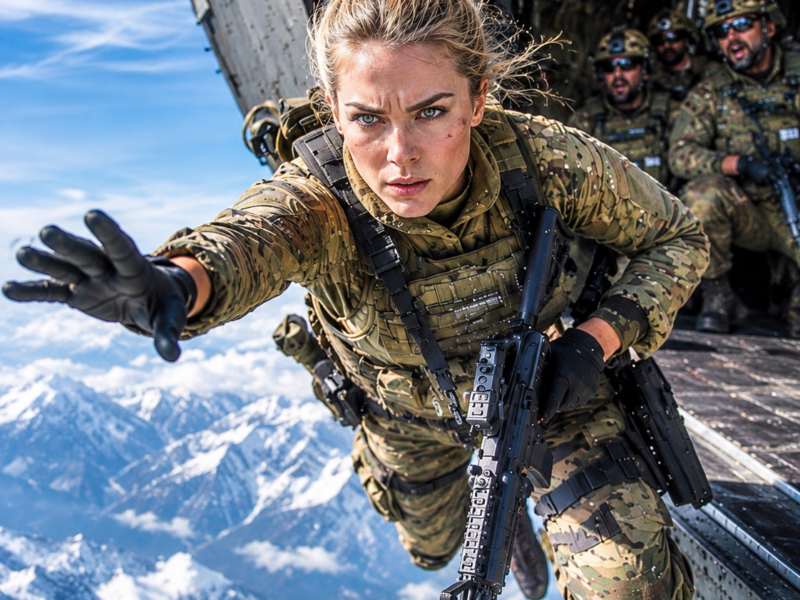
Colonel Marcus Vance looked Captain Emily Carter in the eyes, grabbed her tactical vest, and gave her two choices
The wind had stopped howling, but the silence in the valley was almost worse.
Captain Emily Carter lay motionless beneath a thick layer of snow, listening.
For several seconds, she couldn’t tell whether the pounding in her chest was coming from fear, pain, or the simple fact that she was still alive.
Then she moved her fingers.
They responded.
She moved her legs next. Pain shot through her left hip, but nothing felt broken. Her shoulder burned where the harness had twisted against it during the fall. Her face was numb, and her mouth tasted like blood.
But she was alive.
She had survived a fall that Colonel Marcus Vance had clearly intended to be fatal.
Emily slowly pushed herself upright. Snow slid from her jacket and helmet. Above her, the gray sky disappeared behind the steep walls of the Alaskan valley.
She looked toward the direction of the helicopter.
Nothing.
No aircraft. No rescue signal. No sign that anyone had even noticed she was gone.
She remembered Vance standing in the open doorway, his expression cold and almost bored.
“Fly or die.”
He hadn’t given her a parachute. He hadn’t ordered a rescue attempt. He had simply thrown her out.
Emily tightened her jaw.
There would be time to deal with Vance later.
Right now, there was a much bigger problem.
The enemy was preparing to take control of an American strategic communications facility. If they succeeded, American forces in the region could lose a critical source of intelligence and coordination. Worse, the enemy might use the captured communications equipment to send false information to American command.
And the operation was only two days away.
Emily checked her equipment.
Her radio was damaged. The emergency beacon had been compromised during the fall. Her navigation equipment was still functional, but its battery was running low.
She had a limited supply of food, no immediate support, and no reliable way to contact anyone.
She also knew the terrain better than almost anyone.
For years, she had flown through these valleys, studying the wind patterns, the ridgelines, the narrow passages, and the places where weather could change without warning.
That knowledge had just saved her life.
Now it might be the only thing that could save everyone else’s.
Emily stood, tested her injured hip, and began moving.
She headed toward the observation post.
The first thing Emily noticed when she reached the area was the silence.
There should have been signs of activity.
A radio check. Footprints. Equipment movement. Something.
Instead, the observation position looked abandoned.
She approached carefully, using the terrain to stay concealed. The small shelter had been damaged, and equipment was scattered across the snow.
Then she saw the body.
One American observer lay beside the entrance. Emily recognized the uniform and immediately understood that the situation was worse than she had hoped.
She checked for signs of life.
There were none.
She forced herself to look away.
The second observer was missing.
So was the long-range transmitter.
That was not a coincidence.
The transmitter could be used to communicate with forces outside the valley. In the wrong hands, it could become a weapon without firing a single shot.
Emily examined the ground.
Several sets of tracks led away from the position. Some were clearly made by military boots. Others suggested equipment had been dragged across the snow.
She followed them until the terrain became too exposed.
Then she stopped.
A ridge ahead offered a view of the lower valley. From there, she could see movement near a cluster of temporary structures.
At first, the figures were difficult to distinguish from the surrounding shadows.
Then one of them stepped into the open.
Emily recognized the equipment.
Volkov’s unit.
Colonel Adrien Volkov had built a reputation for patience and discipline. His people did not move carelessly. They studied their targets, prepared their positions, and waited for conditions that favored them.
The weather was buying him time.
When it cleared, his forces would move toward the communications facility.
Emily counted several figures and watched their movements.
She couldn’t see the missing American observer, but she had no doubt he was somewhere nearby.
And if Volkov had captured him alive, the man might be under pressure to reveal information about the observation network.
Emily needed to know what the enemy had learned.
She needed the transmitter.
And she needed a way to warn American command before the weather opened the route.
She backed away from the ridge.
One mistake could expose her position.
She had survived the fall. She wasn’t going to waste that second chance by rushing into an operation she didn’t understand.
At Fort Wright, Colonel Marcus Vance was having a very different kind of morning.
He stood inside his office, reading the report he had submitted the previous evening.
Captain Emily Carter had been lost during a routine aviation assignment, the report stated. The aircraft had encountered severe downdrafts. The pilot was presumed dead.
There was no mention of the open helicopter door.
No mention of the missing parachute.
No mention of the colonel’s own hands pushing her into the air.
Vance placed the report on his desk.
He had expected the paperwork to be the difficult part.
The rest, he believed, would take care of itself.
Lieutenant Briggs had witnessed the incident. That made him a potential problem. But Briggs had already signed the report.
The lieutenant hadn’t done it willingly.
Vance knew that.
But a signature was a signature.
Sergeant Kowalski was another matter.
Kowalski had been present in the helicopter. He had helped open the door. He had seen Carter standing there before the colonel shoved her out.
And he had heard her promise.
“I’ll walk out of that valley.”
Kowalski hadn’t forgotten those words.
Neither had Vance.
But the colonel believed that fear and rank would keep the sergeant quiet.
He had built his career on understanding how people behaved under pressure.
He had underestimated one thing.
Sometimes, a person could be frightened and still refuse to look away.
Two days after Emily’s fall, Sergeant Kowalski was reviewing a set of intelligence summaries when something caught his attention.
The information was incomplete.
There were reports of unusual movement in the valley. A possible communications disruption. An unexplained gap in the observation network.
None of it was enough to confirm an enemy operation.
But Kowalski knew what had been happening before Carter disappeared.
He remembered the assignment.
He remembered Vance’s instructions.
And he remembered the way the colonel had looked at Carter before pushing her out of the aircraft.
Kowalski pulled up the original mission details.
Then he compared them with the new intelligence.
The valley.
The communications facility.
The missing observer.
It was too much to dismiss.
He stood and walked toward the operations room.
Lieutenant Briggs was there.
“Sir,” Kowalski said quietly, “I think we need to look at Captain Carter’s mission again.”
Briggs looked up.
For a moment, neither man spoke.
Then Briggs closed the file in front of him.
“What did you find?”
“Something doesn’t add up.”
Briggs glanced toward the door.
“Not here.”
Kowalski followed him into the corridor.
The sergeant lowered his voice.
“I was there when she went out.”
Briggs stopped walking.
“I know.”
“I saw what happened.”
“I know that too.”
Kowalski looked directly at him.
“Then why did we sign that report?”
Briggs didn’t answer immediately.
He looked exhausted.
“Because I was ordered to.”
“That doesn’t change what happened.”
“No,” Briggs said. “It doesn’t.”
For the first time since the incident, the lieutenant seemed willing to say the truth aloud.
Kowalski took a breath.
“Then let’s find out whether she’s really dead.”
Emily had found the missing observer.
He was being held inside a temporary enemy position several hundred yards from the main staging area.
She could see him through a narrow gap between two structures.
His hands were restrained. His face was bruised. But he was alive.
That changed everything.
If she could reach him, she might learn what Volkov knew. She might also recover information about the transmitter.
But the position was guarded.
And the enemy was preparing for something.
Emily watched the camp for a long time, memorizing patterns of movement. She identified the places where guards repeatedly crossed paths and noted which sections of the terrain were exposed.
She had no intention of attempting a rescue without understanding the risks.
Her hip was getting worse.
She had been moving for hours without proper rest, and the cold was beginning to affect her concentration.
She needed food, shelter, and a better way to communicate.
Most importantly, she needed time.
That evening, she found a narrow recess beneath a rock formation. It offered some protection from the wind and enough cover to remain hidden.
She settled inside and checked her equipment again.
The radio was beyond repair.
The transmitter, however, might still be recoverable.
Emily remembered the layout of the observation post. She remembered where the equipment had been positioned and how the enemy had approached.
If Volkov had taken the transmitter, he would likely have moved it to a location where it could be protected and operated.
She began connecting the pieces.
The enemy had captured one observer.
The other was dead.
The transmitter was missing.
The communications facility was the ultimate target.
That meant the captured observer was valuable for more than interrogation. Volkov could potentially exploit his knowledge of American procedures to create confusion before the attack.
Emily looked toward the distant lights.
She couldn’t allow that to happen.
The next morning, Vance received a call from the operations office.
He listened without interrupting.
When the caller finished, he leaned back in his chair.
“What exactly are you telling me?”
The voice on the other end explained that new intelligence suggested hostile activity near the communications facility. The missing observation post was now considered a potential security breach.
Vance’s expression changed.
Not dramatically.
Just enough.
“Understood,” he said. “I’ll review the matter.”
He ended the call.
For the first time, he wondered whether Carter had actually died.
He dismissed the thought almost immediately.
The fall had been impossible to survive.
Even if she had somehow reached the ground alive, she would have had no way to escape the valley.
That was what he told himself.
But now the intelligence reports were becoming harder to ignore.
He opened Carter’s personnel file.
Twenty-eight years old.
Two hundred and forty hours flying the Alaskan valley.
Years of search-and-rescue experience.
A reputation for remaining calm when other pilots panicked.
Vance stared at the page.
He had known those qualifications when he selected her for the assignment.
In fact, that was part of the reason he had chosen her.
He had wanted to prove that confidence was not the same as competence.
He had wanted to make an example of her.
And now the possibility that she might have survived was becoming a problem he couldn’t control.
He picked up the phone.
“Get me Sergeant Kowalski.”
Kowalski entered the colonel’s office several minutes later.
Vance didn’t ask him to sit.
“Have you been discussing Captain Carter’s mission?”
Kowalski kept his expression neutral.
“I’ve been reviewing the intelligence, sir.”
“That wasn’t my question.”
“No, sir.”
Vance stepped around his desk.
“Let me make something clear. The official report states that Captain Carter was lost during the assignment. Any speculation beyond that is inappropriate.”
Kowalski looked at him.
“Understood, sir.”
“Do you?”
“Yes, sir.”
Vance studied him.
“Good. Because I don’t want to hear her name connected to these reports again.”
Kowalski turned to leave.
Then he stopped.
“Sir?”
Vance looked up.
“What?”
“If she’s alive, shouldn’t we be looking for her?”
For a moment, the room seemed to lose its air.
Vance’s eyes narrowed.
“Captain Carter is presumed dead.”
“Presumed,” Kowalski repeated.
The colonel’s voice hardened.
“That’s enough, Sergeant.”
Kowalski nodded once and left.
Vance remained standing.
The sergeant’s question had been simple.
But it had exposed something dangerous.
Kowalski wasn’t afraid enough anymore.
Emily moved before sunrise.
She had identified a route that would bring her closer to the enemy staging area without crossing the most exposed section of the valley.
Her goal was not to fight the entire unit.
That would have been impossible.
She needed to disrupt their plan, recover enough information to warn command, and get the captured observer out if an opportunity presented itself.
She approached the outer area slowly.
The wind had shifted.
That mattered.
It meant the enemy’s position could be observed from a different angle, but it also meant sounds might carry farther than expected.
Emily stopped whenever she heard movement.
She watched.
She waited.
And eventually, she noticed something she had missed the previous day.
A small group of soldiers had been moving equipment between two structures. One container appeared to have the dimensions of the missing transmitter’s transport case.
Emily couldn’t confirm its contents from a distance.
But it was enough to change her priorities.
She needed to get closer.
She waited until the group moved away.
Then she advanced toward the equipment area, using the uneven terrain to conceal her approach.
She reached the edge of the position and found a narrow opening between two storage structures.
From there, she could see the container.
Its markings matched the equipment used at the American observation post.
There was no longer any doubt.
Volkov had the transmitter.
Emily studied the area around it.
Two guards were positioned nearby. More soldiers moved through the camp at irregular intervals.
She couldn’t simply take the equipment and disappear.
But she could do something else.
She could learn how the enemy intended to use it.
A low voice carried from inside the nearest structure.
Emily froze.
She recognized the name.
“Volkov.”
Another voice responded.
The conversation continued in a language she understood only partially, but she caught enough to identify the situation.
The captured American observer was being questioned.
And Volkov wanted the communications facility taken before the weather changed again.
Emily’s stomach tightened.
They were running out of time.
Back at Fort Wright, Lieutenant Briggs had reached a decision.
He couldn’t continue pretending he hadn’t seen what happened.
He went to Kowalski’s quarters and closed the door behind him.
“I’ve been thinking about what you said,” Briggs began.
Kowalski looked up.
“About Carter?”
“Yes.”
The lieutenant removed a folded document from his jacket.
It was a copy of the original mission record.
“I kept this before the report was finalized.”
Kowalski took it.
The document contained the mission instructions and the original flight details.
There was something else.
A handwritten notation had been added to the copy, recording the circumstances surrounding the aircraft’s departure.
Briggs had not included it in the official report.
“You saw him push her out,” Kowalski said.
Briggs nodded.
“I did.”
“And you signed the report anyway.”
“Yes.”
The lieutenant looked down.
“I told myself I was following orders. I told myself there was nothing I could do.”
Kowalski placed the document on the table.
“Then do something now.”
Briggs looked at him.
“What if she’s alive?”
“Then we find her.”
“And if she’s not?”
Kowalski paused.
“Then we still tell the truth.”
That answer seemed to settle something between them.
Briggs nodded slowly.
“I’ll take this to the appropriate command authority.”
“Not Vance?”
“Not Vance.”
Emily finally found an opening.
The guards had shifted positions, and the temporary camp had become less organized as personnel prepared for the next phase of the operation.
She used the opportunity to move closer to the captured observer’s location.
The man was sitting against a wall, his hands bound.
When he saw her, his expression changed.
For one second, he seemed unable to believe what he was seeing.
Then Emily raised a finger to her lips.
He went still.
She moved close enough to speak quietly.
“Can you hear me?”
He nodded.
“What’s your name?”
“Staff Sergeant Miller.”
Emily recognized the name from the observation roster.
“I’m Captain Carter.”
His eyes widened.
“I thought you were dead.”
“So did they.”
She looked toward the entrance.
“How long have you been here?”
“Since yesterday morning.”
“Did they get anything from you?”
Miller hesitated.
“They know the observation schedule. They have the transmitter. They’re trying to work out how to use our communications procedures.”
“Do they know about the facility?”
“They know it’s the target.”
Emily felt her pulse quicken.
“How soon?”
Miller swallowed.
“Volkov said they’ll move when the weather clears. He thinks that’s tomorrow.”
Tomorrow.
Emily had less than a day.
She checked the restraints.
Miller leaned closer.
“Captain, there’s something else.”
“What?”
“They have a second team. They’re not just going after the facility.”
Emily looked at him.
“Where?”
“I don’t know. I heard them discussing a route to the north. Something about cutting off the support road.”
That was the missing piece.
Volkov wasn’t planning a straightforward attack.
He was preparing to isolate the facility.
If American reinforcements couldn’t reach it, the defenders might be left without support.
Emily looked at Miller.
“Can you move?”
“I think so.”
“Then we’re getting you out.”
Miller shook his head slightly.
“You can’t take them all.”
“I know.”
“There’s too many.”
“I know that too.”
She looked him directly in the eyes.
“But we don’t need to take them all.”
For the first time, Miller managed a faint smile.
“That’s a plan?”
“It’s the beginning of one.”
The weather changed just after midnight.
A wind began moving through the valley, carrying loose snow across the ground.
Emily knew the pattern.
The conditions were shifting toward the opening Volkov had been waiting for.
She also knew that the enemy would be watching the weather closely.
There would be no second chance once the operation began.
She needed to get a warning to American command.
The damaged radio was useless, but she had identified another possibility.
The missing transmitter had been taken from the observation post. If she could reach it, she might be able to send a message using the equipment’s existing configuration.
The problem was that Volkov controlled it.
And the equipment was inside the enemy position.
Emily returned to Miller.
“We’re going to move,” she whispered.
He nodded.
She had managed to free enough of his restraints to let him move carefully. He was weak, but he could stand.
They waited until the camp became quieter.
Then Emily led him away from the holding area.
Every step felt too loud.
Every shadow seemed to move.
They reached the outer structures without being detected, but a voice suddenly called from behind them.
Emily stopped.
Miller froze.
A guard was approaching.
There was no time to retreat.
Emily moved first.
The encounter was brief and silent, but it cost them precious seconds.
A light appeared farther down the camp.
Someone had noticed.
“Move,” Emily whispered.
They hurried toward the terrain beyond the structures.
Behind them, voices rose.
The enemy had discovered the escape.
Emily guided Miller toward the lower slope, avoiding the open ground.
They reached a narrow depression and took cover.
Miller was breathing hard.
“Where now?”
Emily looked back toward the transmitter.
“We can’t leave it.”
“Captain, they’re looking for us.”
“I know.”
“If they use that equipment—”
“They could send false information.”
Miller nodded.
“And the facility could lose its warning.”
Emily looked toward the camp.
“We have to stop that.”
The first warning reached Fort Wright just before dawn.
It wasn’t a complete message.
It was a fragment transmitted through an emergency channel, distorted by interference and cut off before the sender could identify themselves.
But it contained three details:
The communications facility was the target.
The enemy intended to move when the weather cleared.
A second team was preparing to isolate the support route.
The operations room went silent as the information was reviewed.
Kowalski stood beside Briggs.
“That’s her,” he said.
Briggs looked at the screen.
“We don’t know that.”
“The message matches what she would know.”
“Could be anyone.”
Kowalski turned toward him.
“Then let’s treat it as real.”
A senior officer entered the room.
“What’s the status?”
Briggs stepped forward.
“We have an incomplete warning from the valley. It suggests an imminent hostile operation against the communications facility.”
“Source?”
“Unknown.”
“Reliability?”
“Unconfirmed, sir. But the information is consistent with previous intelligence.”
The officer studied the report.
“Can we verify it?”
“Not yet.”
“Then prepare a response. Quietly. I want the facility alerted, and I want additional surveillance on the support route.”
Briggs nodded.
“Yes, sir.”
Kowalski watched the officer leave.
For the first time, the warning had reached someone who might act on it.
But it still wasn’t enough.
The transmitter remained in enemy hands.
And Emily was still in the valley.
Volkov received word of the escaped prisoner shortly after sunrise.
He stood beside a map table while one of his officers explained what had happened.
“The American observer is gone,” the officer said.
“And the other one?”
“We have no confirmation.”
Volkov looked at the map.
“Search the lower slope. Check the ridges. They cannot have gone far.”
The officer nodded.
Volkov turned toward the equipment container.
The American transmitter was positioned nearby.
He had intended to use it once the operation began, but the missing observer complicated matters.
The man knew enough to recognize suspicious communications.
Volkov would need to proceed carefully.
He studied the valley map again.
Then he noticed something.
A narrow route ran from the lower slope toward the transmitter position.
It was not the easiest approach.
But it was the one an experienced pilot familiar with the terrain might choose.
Volkov looked at his officer.
“Find the woman.”
Emily knew the search would tighten.
She and Miller had reached a sheltered area beyond the enemy’s immediate position. Miller was exhausted, and his injuries made it difficult for him to move quickly.
Emily gave him a moment to rest.
Then she studied the terrain.
The communications facility was several miles away.
The transmitter was behind them.
The enemy was searching the valley.
And the weather was clearing.
She had three choices.
She could continue toward American positions and hope someone would receive another warning.
She could attempt to reach the facility directly.
Or she could return to the transmitter and prevent Volkov from using it.
None of the choices was safe.
But leaving the transmitter in enemy hands would give Volkov another advantage.
Emily looked at Miller.
“Can you make it to a sheltered position?”
He nodded.
“Where?”
She pointed toward a protected area along the slope.
“Stay there. Keep low. If you hear aircraft, don’t move into the open until you know they’re American.”
“What about you?”
“I’m going back.”
Miller stared at her.
“Captain, that’s where they’re looking.”
“I know.”
“You’ve already done enough.”
Emily shook her head.
“Not yet.”
She checked his position one last time.
Then she turned toward the camp.
The return was slower.
Emily’s hip had stiffened, and every movement sent pain through her side. But she knew the terrain, and she used that knowledge to avoid the most exposed routes.
She watched the camp from a distance.
The transmitter remained in place.
Several soldiers were nearby.
Volkov himself was standing at the edge of the staging area, speaking with another officer.
Emily could see that the enemy was preparing to move.
There was no more time.
She waited for the moment when attention shifted toward the lower slope.
Then she moved closer.
A short distance from the equipment, she found a damaged cable running from the transmitter container.
She examined it.
The equipment was not fully operational yet.
That gave her an opportunity.
She didn’t need to defeat the entire unit.
She needed to prevent the transmitter from being used.
Emily worked quickly, using what she knew about the equipment from previous operations.
A sound behind her made her stop.
She turned.
A soldier stood several yards away.
For one frozen moment, neither moved.
Then the soldier raised his weapon.
Emily dropped behind the equipment container.
The first shot struck metal.
Voices erupted across the camp.
Emily moved away from the container, keeping low.
She had been discovered.
But she had also disrupted the transmitter’s connection.
Volkov shouted an order.
The soldiers began moving toward her position.
Emily ran.
Her injured hip protested with every step, but she kept moving toward the lower slope.
She reached a narrow cut in the terrain just as another burst of gunfire echoed behind her.
Then the ground gave way beneath her boots.
She slid down the steep snow-covered section, striking her shoulder against a rock before landing in a shallow depression.
For several seconds, she couldn’t breathe.
Then she heard voices above.
They were searching.
Emily forced herself to move.
She had stopped the transmitter from being used immediately.
But she hadn’t recovered it.
And Volkov still had a force ready to move against the facility.
At Fort Wright, the second warning arrived.
This one was clearer.
The transmitter had been compromised.
The enemy was preparing to move.
And the woman sending the message identified herself as Captain Emily Carter.
Briggs read the transmission twice.
Then he looked at Kowalski.
“She’s alive.”
Kowalski closed his eyes for a moment.
He had believed it.
But seeing her name in the report was different.
“She made it,” he whispered.
The senior officer took the message and immediately ordered a response.
“Get the facility on the line. Alert every available unit. I want the support route secured and the communications site placed on emergency footing.”
Briggs moved to the radio station.
Kowalski remained where he was.
The mission had changed.
They weren’t searching for a lost pilot anymore.
They were preparing to support a soldier who had been left behind.
And someone was going to have to answer for why.
Vance learned about Carter’s transmission less than an hour later.
He was alone in his office when the message appeared on his screen.
He read the name.
Then he read it again.
Captain Emily Carter.
Alive.
He stood so quickly that his chair rolled backward.
The report he had filed was no longer just inaccurate.
It was evidence of something far worse.
He picked up the phone.
“Get Briggs in here.”
There was no answer.
He tried again.
Then he called Kowalski.
Nothing.
The colonel stared at the screen.
He had spent two days believing the valley had solved his problem.
Instead, Carter had survived, recovered an American prisoner, disrupted the enemy’s communications plan, and sent a warning back to command.
She had done everything he had tried to prevent.
And now the truth was coming back toward him.
Emily reached the sheltered position where Miller was waiting.
He stood when he saw her.
“Captain!”
She raised a hand.
“Keep your voice down.”
He moved closer.
“Did you get the transmitter?”
“Not yet.”
“But you stopped them?”
“For now.”
Miller looked toward the distant camp.
“What happens next?”
Emily watched the valley.
The weather was clearing rapidly.
Somewhere beyond the ridge, American forces were beginning to move.
She could hear the distant sound of aircraft.
It was faint, but unmistakable.
For the first time since she had fallen from Vance’s helicopter, she allowed herself to believe that help was coming.
Miller followed her gaze.
“Is that ours?”
Emily listened again.
“Yes.”
The sound grew louder.
Then a second aircraft appeared beyond the ridge.
Emily stepped into a position where she could be seen.
She raised both arms.
The aircraft banked slightly.
A moment later, a radio transmission crackled through a signal she had almost forgotten was possible.
“Unknown ground personnel, identify yourself.”
Emily found the emergency handset she had been carrying.
She pressed the transmit button.
“Captain Emily Carter, United States Army. I’m with one surviving observer. We have enemy forces preparing an operation against the communications facility. Transmitter has been compromised. Request immediate extraction and support.”
There was a brief pause.
Then the voice returned.
“Captain Carter, confirm your identity.”
She gave her identification details.
Another pause.
Then:
“Captain Carter, we have you. Hold your position.”
Emily lowered the handset.
Miller looked at her.
“They know you’re alive.”
She nodded.
“Yes.”
For a moment, neither spoke.
Then Miller asked the question she had been carrying since she appeared in the enemy camp.
“Why did you come back for me?”
Emily looked at him.
“Because you were one of ours.”
That was all she said.
The first American response reached the valley before Volkov could begin his planned advance.
The warning had given command enough time to reposition personnel and secure the communications facility. The support route was monitored, and the defenders were placed on alert.
Volkov’s operation had lost its most important advantage: surprise.
His forces were now facing an American response they had not expected to encounter so quickly.
The missing transmitter was recovered during the subsequent operation, and the captured equipment was secured for examination.
The American observer survived.
The communications facility remained under American control.
And Emily Carter was finally brought out of the valley.
She was transported for medical evaluation, where doctors treated her injuries and confirmed that she had survived the fall without life-threatening damage.
Her first question was not about her own condition.
It was about Miller.
Her second was whether the facility was secure.
Only after receiving confirmation did she allow herself to rest.
Several days later, Emily was called to a meeting at Fort Wright.
She entered the room wearing a clean uniform, though her movements were still stiff.
The senior officers were already seated.
Briggs stood near the wall.
Kowalski was beside him.
And at the far end of the table sat Colonel Marcus Vance.
For a moment, Emily looked directly at him.
Vance returned her gaze.
He didn’t smile.
Neither did she.
The senior officer opened the meeting.
“Captain Carter, your actions in the valley prevented a hostile operation against a critical communications facility. You also recovered a missing American observer and provided information that allowed command to respond before the enemy could execute its plan.”
Emily stood at attention.
“Thank you, sir.”
The officer continued.
“We also have questions about the circumstances surrounding your initial assignment and disappearance.”
The room became very quiet.
Vance folded his hands.
Emily didn’t look away.
Briggs stepped forward.
“Sir, I need to make a statement.”
The senior officer nodded.
Briggs described what he had witnessed in the helicopter.
He explained that Carter had been pushed from the aircraft without a parachute or an extraction plan.
He admitted that he had signed a report that did not accurately describe what happened.
Then Kowalski spoke.
He confirmed the circumstances surrounding the flight and the colonel’s actions.
He also explained why he had remained silent initially.
When both men finished, the senior officer looked toward Vance.
“Colonel, do you wish to respond?”
Vance remained still.
“The mission was conducted under difficult conditions,” he said. “The captain’s survival was unexpected.”
“That isn’t what they alleged.”
Vance looked toward Briggs.
Then Kowalski.
Finally, he looked at Emily.
“You were given an assignment,” he said. “You were expected to perform it.”
Emily’s expression remained calm.
“I was given an assignment, sir. I was not given a parachute.”
No one spoke.
She continued.
“I was thrown from an aircraft. I was left without communications or extraction. I survived because I knew the terrain and had the training to respond. Then I discovered an imminent threat to an American facility.”
She paused.
“I did what the mission required.”
The senior officer looked at her for several seconds.
“Captain, do you have anything else to add?”
Emily glanced at Vance.
“Yes, sir.”
She spoke clearly.
“I don’t want this to become a question of whether I was tough enough to survive. That’s not the issue. The issue is that an officer used his authority to put a subordinate in a situation designed to kill her, then filed a report that concealed what happened.”
Her voice never rose.
“That can’t be allowed to become normal.”
The room remained silent.
The senior officer closed the file.
“Your statement has been recorded. The matter will be referred for a formal investigation.”
Vance said nothing.
For the first time, the colonel no longer controlled the story.
The investigation took weeks.
The flight records, mission instructions, witness statements, and discrepancies in the original report were examined.
Briggs cooperated fully.
Kowalski provided his account.
Emily submitted her statement and answered every question.
Vance was removed from operational command pending the outcome of the investigation.
The official review eventually found serious misconduct and deliberate misrepresentation in his handling of the assignment.
The consequences extended beyond his position.
The report became a formal record of how command authority had been abused and how the failure to challenge an unlawful order had placed a soldier’s life at risk.
For Emily, the outcome mattered.
But it wasn’t the reason she had returned.
She had returned because an American observer was missing.
Because a communications facility was in danger.
Because a group of soldiers were depending on someone to recognize the threat before it was too late.
She hadn’t known whether anyone would believe her.
She hadn’t known whether anyone would come.
She had simply refused to let the enemy have the last word.
A month later, Emily stood outside the operations building at Fort Wright.
The valley was still there on the maps.
The same ridgelines.
The same narrow passages.
The same unpredictable weather.
But she saw it differently now.
She had spent years studying the landscape from the cockpit. She had learned to respect its dangers and understand its patterns.
Now she knew exactly what it meant to be alone beneath those mountains, with no aircraft overhead and no guarantee that anyone was coming.
Kowalski approached.
“Captain.”
She turned.
“Sergeant.”
He hesitated.
“I wanted to apologize.”
Emily studied him.
“For what?”
“For helping open that door.”
He looked down.
“I knew something wasn’t right. I should have done more.”
Emily was quiet for a moment.
“You should have.”
Kowalski nodded.
“I know.”
“But you came forward afterward.”
“That doesn’t undo it.”
“No,” Emily said. “It doesn’t.”
She looked toward the distant runway.
“But it mattered.”
Kowalski seemed relieved, though not entirely.
“Would you fly that valley again?”
Emily looked at him.
“Of course.”
He gave a small, uncertain smile.
“After everything?”
“Especially after everything.”
She turned toward the building.
There were still missions to plan, aircraft to inspect, and soldiers who needed someone to bring them home.
The valley had not changed.
The weather had not become kinder.
And the risks were still real.
But Emily had learned something she would never forget.
A uniform did not make someone honorable.
A rank did not make someone right.
And survival was not always about being the strongest person in the room.
Sometimes, it was about staying calm when someone else had already decided you wouldn’t make it.
Sometimes, it was about knowing the terrain well enough to find a way through.
And sometimes, it was about refusing to abandon someone simply because the odds said you should.
Emily had been thrown from a helicopter and left to die.
She had walked back into the fight.
And when she finally returned home, she carried something more important than proof that she had survived.
She carried the truth.
The colonel had tried to make her disappear. Instead, she became the reason his actions could no longer be hidden.
The end.









