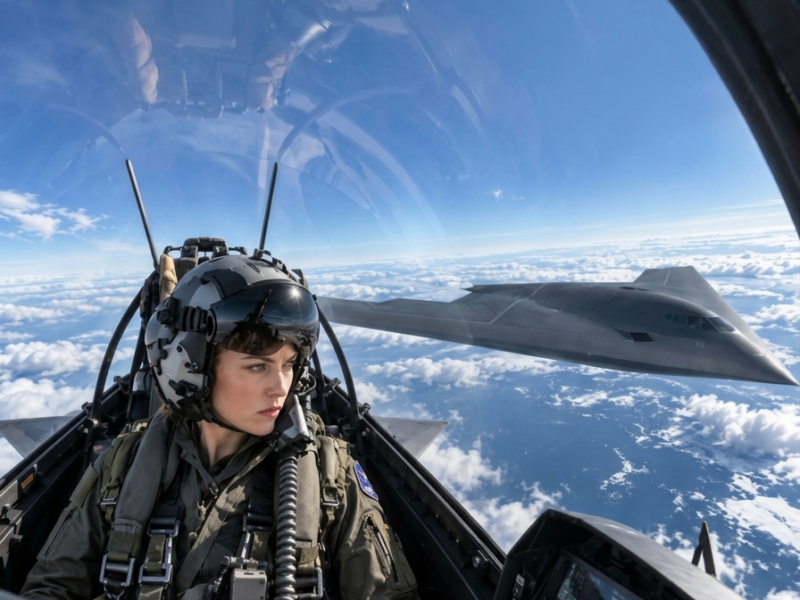
Colonel Hayes slammed my flight log onto the desk at Edwards Air Force Base and snarled, “You’re finished,”
The air in the debriefing room at Edwards Air Force Base felt thick enough to choke on. Fluorescent lights hummed overhead, casting a harsh, sickly glare over the polished metal table where Colonel Hayes stood. His face was flushed crimson, a pulsing vein tracing down his temple like a fuse ready to ignite.
He lifted my official flight log—a binder heavy with years of logged hours, altitude records, and hard-fought evaluations—and slammed it onto the desk. The sound cracked through the silent room like a pistol shot.
“You’re finished,” Hayes snarled, his voice a low, raspy growl.
I stood at strict attention, feet shoulder-width apart, eyes locked straight ahead, though my fists were clenched so tightly in my flight suit pockets that my nails bit into my palms. I forced my breathing to remain steady, refusing to give him the satisfaction of seeing me flinch.
“You disobeyed a direct order, Captain,” Hayes spat, stepping around the desk until he was inches from my face. I could smell the stale coffee and burnt tobacco on his breath. “You broke formation over Sector 4. You brought a multi-million-dollar airframe down below radar ceiling.”
“I was trying to save the aircraft, sir,” I replied, keeping my voice cold and level. “Engine two had a thermal runaway. If I hadn’t dropped into the canyon to cool the intakes with denser air, the turbine would have disintegrated in mid-air.”
“You destroyed government property!” he shouted, leaning closer, his spittle flecking my cheek. “You scraped forty feet of skin off the lower belly against a sandstone ridge!”
“I saved six people, Colonel,” I countered, finally letting my eyes meet his angry glare. “Every crew member on that transport walked away without a scratch. The airframe can be repaired. My crew couldn’t be replaced.”
Hayes sneered, pulling back slightly, his eyes narrowing into dark slits. “Your arrogance is going to cost you your wings, Emily. Just like it cost your old man.” He leaned in one last time, whispering with absolute malice: “You’re finished.”
The words landed harder than any physical blow. Flying wasn’t just my career; it was the only string connecting me to the past, the only legacy left of a father I had lost seventeen years ago.
Before I could reply, the heavy steel door of the debriefing room slammed open. A young radar technician, his uniform disheveled and his headset hanging loosely around his neck, stood in the doorway, breathing heavily.
“Colonel! You need to get to the main ops room now!” the technician gasped.
Hayes turned, scowling. “What is it, Miller? I’m in the middle of a disciplinary action.”
“Sir… the perimeter array just picked up a massive contact. Crossing into restricted airspace over the Mojave complex.”
“Identify it,” Hayes barked, turning back to gather his papers. “Probably a lost civilian pilot or an off-course drone.”
“It’s not a drone, sir,” Miller said, his voice shaking so badly his teeth clicked. “It’s a strategic bomber. And… sir, it’s broadcasting an old tactical callsign.”
Hayes paused, his hand freezing over my logbook. A strange, sharp silence filled the hallway outside. I watched the colonel’s face closely; for a fraction of a second, the deep red anger flushed out of his skin, leaving him pale under the flickering lights.
Without another word, Hayes swept past Miller and hurried down the corridor toward the Tactical Operations Center. I didn’t wait for permission. I stepped out of the room and followed right on his heels.
The ops center was pure chaos. Dozens of monitors lined the walls, tracking satellite feeds, weather patterns, and radar sweeps across the southwestern defense sector. Red warning lights were flashing along the primary tracking grid, bathing the room in a bloody, rhythmic pulse. Officers and civilian contractors were huddled around the main radar station, shouting over one another.
“Clear the floor!” Hayes ordered as he strode in.
The room quieted down immediately, though the blaring audio alarms kept wailing from the overhead speakers.
“What do we have?” Hayes demanded, leaning over the chief technician’s shoulder.
“Unknown contact, altitude forty thousand feet, speed Mach 0.85,” the technician reported rapidly, her fingers flying across the keyboard. “It appeared out of nowhere, Colonel. No transponder signal. No flight plan. No secondary identification ping. It literally materialized thirty miles inside the restricted boundary.”
“Did it launch from an airfield nearby?”
“Negative, sir. Satellite sweeps show no engine ignitions anywhere on the coast or inland tracks. It just… popped up on primary radar.”
“Zoom in on the target’s signature,” Hayes commanded.
The technician struck a key, and the primary vector bloomed on the main wall display. The radar cross-section was massive—far larger than any standard commercial airliner or modern fighter. The sweeping green arc illuminated a heavy delta-wing footprint.
“Sir, it’s transmitting a short-range HF broadcast,” the technician whispered, staring at her audio monitor. “It’s repeating a legacy tactical callsign on an emergency frequency.”
Hayes stepped closer to the glass screen. “What callsign?”
The technician swallowed hard, glancing nervously toward me before looking back at the screen. “Raven One, sir.”
My heart stopped in my chest.
The air left my lungs in an icy gasp. Raven One.
That was my father’s callsign. Major Arthur Vance. He had been a legendary test pilot at Edwards, a man who flew experimental platforms back when the desert was full of black-budget secrets. Seventeen years ago, during a night test over the Nevada test ranges, his aircraft had vanished from radar. No debris was ever recovered. No wreckage was found in the sand. After six months of silent searching, the Air Force had handed my mother a folded flag, declared him dead due to catastrophic equipment failure, and closed the file.
I had spent half my life carrying that loss like an anchor around my neck.
“Lock a tracking radar onto that target!” Hayes ordered, his voice suddenly sharp, elevated, and brittle. “Scramble two F-35s from the 412th! Intercept and identify immediately!”
“Sir, we have incoming audio from the contact,” the comms officer announced. “It’s unencrypted.”
“Patch it through,” Hayes said.
Static hissed through the ops room speakers—a dry, crackling sound like wind whipping across desert sand. Then, through the noise, came a voice.
It was low, worn by time, gravelly, but unmistakably masculine.
“Tell Emily I’m sorry.”
My knees nearly gave out beneath me. I had to reach out and grab the edge of a metal console to keep from falling. My name is Emily Vance, but on every official record, every military badge, every flight jacket I wore, I was registered as Captain A. Vance. Only my father had ever called me Emily.
“Cut the feed!” Hayes screamed, his face twisting into a mask of pure terror. “Cut the comms right now!”
“Sir, wait!” I stepped forward, shoving past a junior officer. “That’s my father! That’s Arthur Vance!”
“We don’t know who that is!” Hayes yelled back, spinning around to face me. His hands were shaking. “It’s a psychological operation! It’s a spoofed signal!”
“Then why are you afraid?” I yelled back, stepping directly into his personal space. “Look at yourself, Colonel! You’re terrified!”
For the first time since I had known the man, the arrogance was gone from his eyes. Beneath the harsh military posture, beneath the medals pinned to his dress shirt, there was only raw, unadulterated fear.
The static on the speakers cleared slightly, and the voice returned, echoing off the concrete walls of the operations center.
“Emily, if they tell you I died… they’re lying.”
Hayes stared at the concrete floor, his mouth slightly open, unable to utter a word.
“Target is dropping altitude fast!” the technician suddenly shouted. “It’s diving toward the deck! Heading three-two-zero!”
“Track it!” Hayes gasped, snapping out of his daze. “Don’t lose it!”
“It’s… sir, the target signature is breaking up!”
On the big screen, the single large delta-wing return flickered violently once, twice, and then vanished entirely. The red warning lights stopped flashing. The tracking grid returned to a calm, empty blue.
“Did it crash?” Hayes asked, his voice barely a whisper. “Did it hit the mountain?”
“No impact signature, sir,” the technician said, staring blankly at her screen. “No thermal bloom. It just… disappeared.”
A heavy silence settled over the room. Pilots, controllers, and technicians all stood frozen, looking at the empty grid. I stood near the main terminal, my hands trembling, my mind racing through a thousand impossible questions.
Then, the radar technician slowly turned around in her chair, her face drained of all color.
“Colonel…” she whispered, pointing a trembling finger at the monitor.
I stepped closer to look.
A new contact had just appeared on the screen, exactly where the bomber had vanished.
Then another appeared right beside it.
Then a third.
Three distinct, massive aircraft returns were now moving in formation across the desert sky, flying straight toward Edwards Air Force Base. And trailing across the bottom of the main radar terminal was a text line embedded within the contact’s automated transponder burst, displaying a message meant for only one person in the entire world:
YOUR FATHER WASN’T THE ONE THEY BURIED.
The operations center devolved into absolute pandemonium. Sirens began wailing across the base exterior, their long, mechanical groans cutting through the desert night. Red defense lights flickered across the tarmac outside as ground crews rushed to arm interceptors and secure the hangers.
“Scramble all alert fighters!” Colonel Hayes bellowed, his voice straining against the noise. “I want air-superiority weapons on those targets now! Set Defense Condition Two!”
“Colonel, stop!” I yelled, pulling myself onto the raised platform beside his command station. “They aren’t attacking! Look at their flight vectors!”
The three radar returns—all bearing the identical, impossible transponder signature of Raven One—were flying in an inverted V-formation at twenty thousand feet. They weren’t executing offensive maneuvers or diving on tactical assets. They were holding a steady, non-threatening pace of three hundred knots, tracing a wide arc around the base perimeter.
“I don’t care about their vectors, Captain!” Hayes snarled, pointing a shaking finger at the screen. “Those are unidentified heavy platforms sitting inside sovereign military airspace! That is an invasion vector!”
“They’re broadcasting my father’s code!” I argued, my voice ringing out over the sound of the alarms. “They asked for me! Give me an aircraft! Let me fly up there and make visual contact!”
Hayes turned on me, his eyes wide and bloodshot. “Are you insane? You’re under suspension! You’re stripped of flight status as of ten minutes ago! Security, remove Captain Vance from the floor!”
Two armed Air Force Security Forces airmen stepped forward, their hands resting on their sidearms.
“Don’t do this, Hayes,” I warned, stepping back as the guards approached. “You know what those planes are. You knew before they even crossed the border. That’s why you closed his file seventeen years ago.”
“Take her to the holding cell,” Hayes commanded coldly, turning his back on me to face the radar displays. “Lock her down until defense command arrives from Pentagon East.”
The guards took my arms. I didn’t fight them physically—doing so would give Hayes an excuse to bury me in a military prison forever. As they escorted me out of the ops room, I looked back at the main display screen. The three ghost signatures were still circling in the dark, waiting.
They dragged me down two flights of concrete stairs into the subterranean detention block beneath Building 1600. The holding room was small, cold, and smelled of industrial bleach and damp concrete. The heavy steel door slammed shut, the electronic lock clicking into place with a heavy, final thud.
I paced the floor like a caged animal. My flight suit was damp with sweat, my mind racing at a terrifying speed.
Seventeen years.
Seventeen years of believing my father had incinerated himself in an experimental cockpit over the Groom Lake dry lake beds. I remembered the funeral—the closed casket, the military brass standing in stiff uniforms, offering empty condolences about ‘sacrifice’ and ‘patriotism.’ I remembered holding my mother’s cold, trembling hand while the bugle played Taps into the chilly morning air.
It had all been a lie.
Suddenly, the heavy fluorescent light in the center of the cell ceiling flickered and died, plunging the room into pitch blackness.
I froze, backing my shoulders against the concrete wall. “Guard?”
There was no answer from the corridor outside. No footsteps. No radio chatter.
Then came a soft, metallic click from the door lock. The red indicator light on the card reader turned a solid, glowing green. The heavy door creaked open an inch.
I waited two heartbeats, my muscles coiled, before stepping forward and pushing the door fully open.
The hallway outside was bathed in low-density emergency red lighting. The two security guards who had been assigned to watch my cell were leaning motionless against the opposite wall, their eyes closed, breathing in deep, rhythmic cycles. A thin, sweet-smelling mist was lingering near the ceiling vents—a fast-acting, non-lethal aerosol knockout agent.
A shadow stepped out from the darkness near the stairwell.
The figure was wearing a dark flight suit, unbuttoned at the collar, with a worn, leather tactical harness stretched across his chest. He carried a compact electronic bypass tool in one hand. As he stepped beneath the red emergency light, I saw his face.
He had silver hair, cropped short, and a heavy scar running from the corner of his left eye down into his graying beard. He looked to be in his late fifties, his frame lean, weathered, and tough as iron.
He stopped five feet from me, his dark eyes searching my face with an intensity that made my throat tighten.
“You look just like your mother, Emily,” he said softly.
The voice. It was the same voice that had echoed through the ops room speakers just minutes ago.
My knees felt weak again, but anger surged up to replace the shock. “Who are you?” I demanded, my hands clenching into fists. “My father is dead. Who the hell are you?”
The man reached up to his chest harness, unclipped a small, brass object, and held it out to me.
It was an old, scratched dog tag. Engraved on the worn metal surface were two lines:
VANCE, ARTHUR E.
OFFICER ID: 884-91-AF
“I’m not Arthur, Emily,” the man said softly, his voice heavy with an old, aching grief. “My name is Colonel David Miller. I was your father’s wingman on the night Project Sundown went dark.”
I stared at the dog tag, then up into his scarred face. “If you aren’t him… why are you using his callsign? Why did you send that message?”
Miller looked down the empty red corridor, listening for sounds of pursuit, before turning back to me. “Because Arthur knew this day would come. He knew that if Hayes ever tried to purge the final records of the program, we had to get you out.”
“What program?” I demanded. “What was my father flying?”
“He wasn’t flying a jet, Emily,” Miller whispered, leaning closer. “He was flying a key. And the men who killed him are the same ones currently sitting in that command center upstairs.”
Miller led me through the maze of subterranean service corridors beneath the base, using a high-level clearance card to bypass secured fire doors and maintenance hatches. The sirens were still wailing above us, their muffled roars vibrating through the concrete walls.
“Where are we going?” I asked, keeping pace with his long, urgent strides.
“Hangar 18,” Miller replied without looking back. “We have about six minutes before the base security net overrides the localized lockdown I initiated.”
“Hangar 18 is a decommissioned storage facility,” I said. “It’s been locked down since the nineties.”
“That’s what the public records say,” Miller muttered, turning down a narrow metal staircase that descended deeper into the earth. “It’s actually the staging site for the remaining Aurora prototypes. The planes your father built with his own hands.”
We reached a massive blast door at the bottom of the stairs. Miller slotted his bypass device into the keypad terminal. A sequence of green code lines scrolled across the screen, and with a heavy hydraulic hiss, the five-ton steel doors slid slowly apart.
The air that blew out from the hangar smelled of dry desert dust, high-grade aviation fuel, and ozone.
I stepped inside and stopped dead in my tracks.
The hangar was enormous, illuminated by dim yellow sodium lamps hung high in the steel rafters. Sitting in the center of the vast floor were three massive, black, razor-sharp aircraft.
They looked like nothing in the current military inventory. They were long, needle-nosed delta platforms, built from a matte-black composite material that seemed to absorb the light around them. Their surfaces were completely smooth—no visible rivets, no seam lines, no canopy glass.
Standing around the nearest aircraft were four technicians in unmarked dark jumpsuits, performing rapid pre-flight checks on a running engine core that hummed with a low, sub-audible vibration that made my teeth ache.
“What are these?” I whispered, awestruck.
“Strategic reconnaissance platforms,” Miller said, walking toward the lead aircraft. “Project Sundown. Hypersonic, high-altitude penetration platforms designed to operate entirely outside the conventional radar spectrum.”
“Hypersonic?” I looked at the sleek, terrifying lines of the aircraft. “This technology… this is thirty years ahead of anything NAVAIR or the Air Force has deployed.”
“Because it was hidden,” Miller said, turning to face me. “In 2009, your father discovered that the defense contractors funding Sundown weren’t building these aircraft for national defense. They were selling the sensor packages and propulsion schematics to private military cartels overseas. Millions of dollars in black-budget funds were being funneled through shell corporations managed by officers inside this base.”
My mind put the pieces together instantly. “Colonel Hayes.”
“Hayes was a Major back then,” Miller said, his eyes darkening. “He was the chief logistics officer for the test wing. When your father found the paper trail, he gathered the flight telemetry disks and threatened to go straight to the Senate Select Committee on Intelligence.”
“So Hayes killed him,” I breathed, a cold, heavy stone settling in my gut.
“They sabotaged his control surfaces during a night flight over Nevada,” Miller said, his voice tight with suppressed rage. “They thought he crashed into the lake bed. But your father was smarter than them. He ejected over a blind spot in the radar coverage. He survived.”
I gasped, reaching out to grab Miller’s arm. “He survived? Where is he? Is he alive?”
Miller looked away, his eyes staring at the dark floor of the hangar. “He lived in hiding for six years, Emily. Working from the shadows, building a network of pilots and technicians who knew the truth. But his health had been ruined by the ejection at Mach 3. He died eleven years ago in a private clinic in northern Washington.”
Tears pricked the corners of my eyes, bitter and burning. “Then… who was on that radio transmission? Who spoke to me?”
“A synthesized digital recording,” Miller explained softly. “Arthur recorded hundreds of voice logs before he passed. He gave us specific instructions: if Hayes ever took action to silence you, if your name ever appeared on a purge roster, we were to bring the fleet back to Edwards and trigger the protocol.”
“Why?” I asked, brushing a tear off my cheek. “Why bring three black-project aircraft right into the lion’s den?”
“Because,” Miller said, stepping up to the side of the lead aircraft as a ladder descended from its belly, “the flight computer on this plane contains every document, every financial transaction, and every murder order signed by Hayes and his backers over the last twenty years. But it requires a two-factor authorization to unlock the data matrix.”
He looked at me, his eyes dead serious.
“The primary key was Arthur’s voice code, which we just broadcast over the base network. The secondary key is your biometric signature, Emily.”
Before I could process Miller’s words, the heavy blast doors at the far end of the hangar shuddered violently. A deafening explosion blew the primary lock mechanisms inward, sending a shower of sparks and steel fragments flying across the concrete floor.
Through the smoke, a dozen armed tactical officers from the base SWAT detail swarmed into the hangar, their rifle lights cutting through the haze. Behind them stood Colonel Hayes, a tactical headset strapped to his head, a drawn service pistol in his right hand.
“Hold your fire!” Hayes screamed, his voice echoed loudly off the steel roof. “Secure the aircraft! Kill anyone who moves near those cockpits!”
“Emily! Get in!” Miller yelled, shoving me toward the ventral access ladder of the lead delta aircraft.
“Cover the Captain!” one of the unmarked technicians shouted, drawing a sidearm and firing toward the advancing tactical team.
A chaotic gunfight erupted inside the enclosed space. Bullets whined off the thick steel girders and struck the concrete floor. I scrambled up the narrow ladder into the belly of the black aircraft, Miller right behind me.
The cockpit was unlike anything I had ever seen in my years as an Air Force pilot. There was no glass canopy, no traditional windows. Instead, the entire interior was surrounded by curved, high-definition panoramic displays that fed a three-hundred-and-sixty-degree real-time optical image of the hangar outside.
“Sit in the forward command chair!” Miller ordered, slamming the ventral hatch shut behind us and locking the manual pressure seal.
The heavy insulation of the hull instantly muffled the sound of gunfire outside. I strapped myself into the heavily padded ejection harness in the front seat, my eyes darting over the glowing, minimalist control interfaces.
“System power online,” a smooth, computer-generated voice announced through the cockpit speakers. “Biometric identification required for flight core authorization.”
A small glass panel on the center console illuminated with a soft blue light.
“Put your hand on the scanner, Emily!” Miller yelled from the rear operator seat, his fingers flying across his own tactical display. “Hayes’s men are setting thermal charges on the hangar doors! If they breach the hull, we’re done!”
I pressed my right palm flat against the cool glass scanner.
A thin red laser swept across my skin, analyzing my palm prints and sub-dermal capillary patterns.
“Biometric signature confirmed,” the automated voice stated. “Welcome, Captain Vance. Unlocking Project Sundown archives.”
Instantly, the panoramic screens surrounding us shifted. Thousands of lines of encrypted code, scanned paper documents, official military memos, and financial bank logs began scrolling down the displays at blinding speed. At the top of the main screen, a large red banner flickered to life:
EVIDENCE FILE: OPERATION SUNDOWN — AUTHORIZATION SIGNATURE: COLONEL THOMAS HAYES.
“We got it,” Miller breathed, laughing hysterically in the back seat. “We actually got the whole damned thing!”
Outside, through the optical display, I saw Hayes approaching the front of our aircraft, his face twisted in a mask of pure rage. He raised his pistol and fired three rounds directly at the forward camera housing. The heavy reinforced composite skin didn’t even chip.
Hayes stepped right up to the optical sensor, staring directly into the camera lens. He pulled a radio from his vest and switched to our closed-circuit frequency.
“You aren’t leaving this base alive, Vance!” Hayes screamed into the comms, his voice cracking with hysteria. “I have anti-aircraft missile batteries locked onto every runway! The moment those engines ignite, my crews will blow you out of the sky!”
I looked at the primary control interface. The throttle levers were sleek, matte-black carbon fiber, labeled with increments I had only ever read about in black-budget theory papers: SUB-SONIC, SUPER-SONIC, HYPERSONIC / SCRAMJET.
I grabbed the flight stick. It felt perfectly balanced, responsive, and alive beneath my fingers.
“He’s right about the missile batteries, Miller,” I said, a cold, sharp smile spreading across my face as the pilot in me took over. “If we use the runways, we’re sitting ducks.”
“Who said anything about using the runways?” Miller replied, pulling a primary power lever on his console.
The entire aircraft shuddered as its dual-cycle scramjet engines ignited deep within the fuselage. A low, thunderous roar filled the cockpit, making the air in my lungs vibrate.
On the main navigation display, a section of the hangar floor directly in front of our nose began to split open, revealing a hidden, steeply inclined launch tube running at a sixty-degree angle straight up through the rock above us.
“Father built an escape vector,” I whispered, my heart soaring.
“He built a way out for you, Emily,” Miller said. “Take the stick.”
I gripped the carbon-fiber throttles, taking a deep breath. I stared through the panoramic display at Hayes, who was looking up in horror as the ceiling ventilation doors above the launch tube opened, revealing the dark, star-filled desert night sky above.
“Colonel Hayes,” I said over the radio, my voice calm, clear, and ringing with absolute authority. “You said I was finished. But my father left me the final word.”
I slammed the throttles straight into full afterburner.
The acceleration was violent, instantaneous, and incredible.
The twin scramjet engines unleashed a mountain of thrust, pinning me back into the padded seat with four times the force of gravity. The interior panoramic screens blurred into a streak of red lights, grey concrete, and roaring flame as the black aircraft shot up the launch tube like a bullet through a rifle barrel.
In less than two seconds, we burst out of the desert bedrock, shattering the reinforced surface doors and soaring straight into the cool night air over Edwards Air Force Base.
“Passing ten thousand feet!” Miller shouted over the intercom, his voice distorted by the extreme G-forces. “Angle of attack seventy degrees! Speed Mach 1.5 and climbing!”
I pulled back slightly on the stick, leveling the aircraft off at thirty thousand feet as the lights of the base shrunk into a tiny cluster of yellow specks far below us.
On our tactical display, three red threat rings bloomed over the base.
“Surface-to-air missile launch!” Miller warned. “Four MIM-104 Patriot missiles in the air! Vectoring on our tail!”
I looked at the primary throttle console. Beyond the standard military afterburner notch was a sealed red gate labeled: SCRAMJET ENGAGE.
I flipped the safety cover up and slammed the throttles through the gate.
A surge of secondary power slammed through the airframe. The scramjet intakes opened, scooping in super-compressed atmospheric air and mixing it with liquid hydrogen fuel. The engine note shifted from a deep roar to a high-pitched, metallic scream that resonated in my bones.
Speed: Mach 3… Mach 4… Mach 5.2.
On the optical screens, the four incoming surface-to-air missiles didn’t even come close. They looked as if they were standing completely still in the sky before falling away into the night, their rocket motors exhausted, miles behind our expanding shockwave.
We zoomed higher and higher, leaving the dense atmosphere behind until the sky outside turned from deep blue to the absolute, velvety black of space. At eighty thousand feet, the blue curve of the Earth was visible below us, stretching out infinitely toward the horizon.
“Missiles defeated,” Miller reported, letting out a long, shuddering breath. “We are clean and clear. Zero radar contacts within five hundred miles.”
I eased the throttles back slightly, bringing the aircraft into a stable, super-cruising speed of Mach 3. The cockpit was blissfully quiet now, save for the gentle hum of the life support systems and the soft clicking of the data array.
“Where is the evidence going?” I asked, looking at the main communications terminal.
“Every major news network, the Department of Justice, and the Inspector General of the Armed Services,” Miller said, pointing to a green progress bar on his screen. “The broadcast started the second we cleared thirty thousand feet. It’s un-blockable, Emily. By tomorrow morning, Hayes and every officer involved in Operation Sundown will be in federal custody.”
I sat back in my seat, letting my hands rest lightly on the flight stick.
For seventeen years, I had flown in the shadow of a lie. I had carried the shame of an unjust crash, the weight of a ruined family name, and the constant fear that my own career would end in the same forgotten dust.
Now, flying at the very edge of the atmosphere, looking down at the world below, the sky felt wider, clearer, and more open than it ever had before.
A small light flickered on the primary audio console.
An automated file—embedded deep within the aircraft’s primary storage core—had unlocked upon reaching sixty thousand feet.
I reached out and pressed the play button.
The static was minimal this time. The voice came through the cockpit speakers clear, warm, and steady—the voice of a father speaking directly across time to his daughter.
“Emily… if you’re hearing this, it means you took the stick. It means you stayed true to the sky, no matter how hard they tried to pull you down. I couldn’t be there to watch you earn your wings, sweetheart. I couldn’t be there to walk you down the tarmac. But every line of this aircraft, every system I built, was designed to keep you safe when the world went dark.”
Tears finally spilled over my eyelashes, running down my cheeks and dripping onto my flight suit. But for the first time in my life, they weren’t tears of grief.
“Don’t look for me in the grave, Emily,” my father’s voice concluded softly. “Look for me in the air. Clear skies, Captain. She’s yours now.”
The recording ended with a gentle click.
I wiped my face with the back of my glove, looking out through the panoramic display at the first pink rays of dawn cutting across the eastern horizon. The sun was rising over the curve of the Earth, bathing the black nose of our aircraft in brilliant, golden light.
“Where to now, Captain?” Miller asked softly from the back seat.
I tightened my grip on the control stick, feeling the powerful, living beat of the aircraft beneath my hands, and turned the nose toward the morning sun.
“Anywhere we want, Colonel,” I replied. “Anywhere we want.”
The end.









