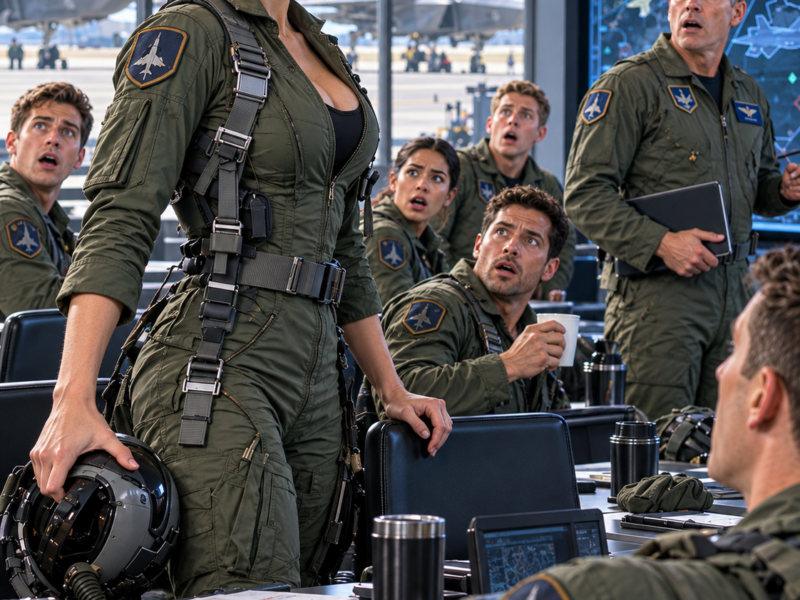
“Colonel Hawthorne ordered the entire briefing room silent when I gave him my call sign, then stared at me as if he were looking at a ghost
The name on the folder was Daniel Mercer.
For a moment, I forgot how to breathe.
Colonel Hawthorne noticed.
“Do you know him?”
I stared at the faded lettering.
“Yes, sir.”
“How?”
I reached for the folder, but stopped before touching it.
“He was my flight lead.”
Hawthorne watched me carefully.
“Was?”
I looked down.
“Daniel Mercer was the reason I came home from Maran Valley.”
The colonel slowly opened the folder.
Inside were several pages of old operational reports, photographs, and a personnel summary.
The paper had yellowed around the edges.
There was a photograph clipped to the first page.
A young man stood beside an aircraft, one hand resting on the canopy, his helmet tucked beneath his arm.
He was smiling.
Daniel had always smiled like that, as though the world had never given him a reason not to.
I hadn’t seen his face in eight years.
“His status was listed as missing,” Hawthorne said.
“Yes.”
“Your report says you were the only surviving pilot from the recovery operation.”
“That’s what they wanted the report to say.”
Hawthorne looked up.
“What does that mean?”
I closed my eyes briefly.
Then I told him.
Eight years earlier, I had been twenty-six and one of the youngest pilots assigned to a specialized flight unit.
I had been good at flying.
Not naturally fearless.
Not unusually gifted.
Just disciplined enough to know that confidence and competence were two different things.
Daniel Mercer had been my flight lead.
He was thirty-two, patient, demanding, and occasionally irritating.
He never praised a pilot just to make them feel better.
But when he said you had done something well, you believed him.
He was also the first person who had ever called me Mercy.
It happened during a training exercise.
I had taken an extra few seconds to verify a location before reporting it.
Another pilot complained that I was being overly cautious.
Daniel had shrugged.
“She’s not wasting time. She’s making sure nobody gets left behind.”
The nickname stayed.
Later, when our unit received a call sign assignment for a special operation, Daniel suggested Mercy Six.
I laughed when I heard it.
“You can’t be serious.”
He shrugged.
“Seems appropriate.”
“You know that’s going to make everyone expect me to rescue them.”
“Then don’t disappoint them.”
That was Daniel.
He could make a joke out of something that frightened everybody else.
The Maran Valley operation began as a routine extraction support mission.
A transport convoy had been hit during a withdrawal, and several personnel were trapped beyond a ridge.
Our assignment was to provide aerial support and help coordinate the recovery aircraft.
The weather was deteriorating.
The terrain was unforgiving.
And the radio traffic was becoming increasingly difficult to understand.
We were flying in a three-aircraft formation.
Daniel led.
I flew second.
A third pilot, Lieutenant Aaron Price, flew behind us.
We had been briefed on the risks.
Nobody expected the situation to deteriorate as quickly as it did.
The first call came from Major Hawthorne’s team.
Their transport vehicle had been struck.
Several people were injured.
They needed help.
Daniel acknowledged.
I remember hearing his voice over the radio.
“Mercy Six, maintain visual contact with the recovery corridor.”
“Copy.”
Then the weather shifted.
Visibility dropped.
The ridge disappeared beneath a thick bank of dust and smoke.
The ground team reported incoming fire.
We were instructed to maintain position until the recovery aircraft could reach them.
Daniel remained overhead.
I could see his aircraft through the haze.
Then a warning appeared on my instruments.
I reported it.
Daniel acknowledged.
A few seconds later, Aaron reported trouble as well.
We had two aircraft dealing with problems in a rapidly changing environment.
Daniel made the decision to move toward the ridge and assess the situation.
I followed.
Then the radio erupted.
A burst of static.
A warning from the ground team.
A sudden flash.
Daniel’s aircraft disappeared behind the ridge.
I called him.
Nothing.
I called again.
Still nothing.
Aaron’s voice came through.
“Mercy Six, I’ve got a problem.”
I turned toward his position.
His aircraft was losing stability.
He was trying to maintain control, but his situation was deteriorating.
I remember looking at the instruments and realizing that I had seconds to make a decision.
There were people on the ground.
Two aircraft were in trouble.
And Daniel was gone.
I requested assistance.
The response was delayed.
The radio channels were crowded.
Then Hawthorne’s voice came through.
He was injured.
He was trapped beneath the transport vehicle.
He needed someone to keep the recovery corridor clear.
I gave him my position.
“Mercy Six. I have your location. Stay with me, Major.”
Those were the words Hawthorne remembered.
I kept the aircraft overhead.
I relayed the ground team’s position.
I guided the recovery aircraft toward the safest available approach.
Then Aaron’s transmission broke through again.
“Elena, I can’t hold it.”
I looked toward the ridge.
Daniel was still missing.
Aaron was in trouble.
The recovery aircraft was approaching.
I had to choose where I could make the most difference.
I stayed with the ground team.
It was the decision that saved Hawthorne’s life.
It was also the decision I had questioned every night since.
Aaron’s aircraft disappeared from radar.
Then mine took a hit.
I felt the impact before I understood what had happened.
The aircraft shook.
An alarm sounded.
Smoke began entering the cockpit.
I tried to regain control.
For several seconds, I believed I could.
Then the controls stopped responding as they should.
I sent my final transmission.
“Mercy Six declaring emergency. Aircraft damaged. Attempting recovery.”
I don’t remember the impact clearly.
I remember the noise.
I remember dust.
I remember waking up with blood in my mouth and a broken canopy beside me.
And I remember the sky.
It looked impossibly blue.
I had survived the crash.
But I couldn’t move.
My left shoulder was injured, and my right leg was trapped beneath part of the cockpit structure.
I could hear someone calling for help.
It took me several minutes to understand that the voice was mine.
A recovery team found me later.
I was transported to a field hospital.
My injuries were severe enough that I spent weeks in medical care and months in rehabilitation.
When I finally asked about Daniel and Aaron, nobody gave me a clear answer.
Daniel was listed as missing.
Aaron was presumed lost.
I was told the aircraft wreckage had been located.
I was also told that the mission records were under review.
I kept asking questions.
The answers became shorter.
Then one day, an officer arrived with a document for me to sign.
It described the operation as a successful recovery effort with one surviving pilot.
I refused to sign.
The officer told me the report was being finalized.
I asked what happened to Daniel.
He said there was no confirmation.
I asked about Aaron.
He said the same thing.
Then he told me something I never forgot.
“Captain Voss, your responsibility is to recover. Not to reopen operational decisions that have already been reviewed.”
I was twenty-six.
I was injured.
I was grieving two men I had flown beside.
And I was being told that asking questions was somehow a failure of discipline.
I signed nothing.
But I also stopped asking publicly.
After rehabilitation, I was medically restricted from flying for a period.
The unit reassigned me to training and administrative duties.
Eventually, I requested a transfer.
I left operational aviation.
I moved between assignments.
I kept the notebook.
And I kept the photograph.
Three aircraft went into the valley.
Two returned.
That was the truth I could not make peace with.
When I finished, Hawthorne had not moved.
His hands rested on the open folder.
“Why didn’t you tell anyone here?”
“I didn’t think anyone wanted to hear it.”
“I would have.”
I looked at him.
“You weren’t here.”
He accepted that.
Then he pointed to Daniel’s photograph.
“Do you know whether he survived?”
I shook my head.
“No.”
“Have you tried to find him?”
“Every way I could without violating the restrictions on the file.”
Hawthorne leaned back.
“His personnel status changed twice after the mission.”
I looked at the paperwork.
“What do you mean?”
“Initially missing. Then presumed deceased. Then the record was amended to missing under restricted circumstances.”
My throat tightened.
“Why?”
“I don’t know.”
He turned another page.
There was a handwritten note in the margin.
The ink was darker than the surrounding text.
Possible recovery by ground personnel. Transfer destination unconfirmed.
I leaned forward.
“Who wrote that?”
Hawthorne checked the initials.
“Lieutenant Colonel James Rourke.”
I recognized the name.
Rourke had been the operations officer during the mission.
He had supervised the review afterward.
“Where is he now?” I asked.
“Retired.”
“Do you have a contact?”
Hawthorne closed the folder.
“I can get one.”
I looked at him.
“Sir, I need to know what happened to Daniel.”
He studied me for a long moment.
“Then we’ll find out what can be established. Properly.”
For the first time in eight years, someone had said we instead of you.
I didn’t realize how much I needed to hear it.
The next morning, Hawthorne requested a formal review of the Maran Valley records.
He contacted the appropriate command offices and submitted the relevant documents through official channels.
I provided my statement.
So did Hawthorne.
The request did not produce immediate answers.
It produced paperwork.
Then more paperwork.
There were questions about the original mission log, the missing aircraft, the recovery team, and the chain of custody for the reports.
Some records were incomplete.
Others were still restricted.
But the handwritten note about Daniel’s possible recovery was enough to justify further examination.
Meanwhile, the squadron continued its regular work.
I still attended briefings.
I still sat in the back row.
But something had changed.
People no longer looked at me as though they were trying to decide whether I belonged.
They looked at me with curiosity.
Some were respectful.
Some were uncomfortable.
And a few seemed almost disappointed that the quiet woman had turned out to have a history.
Travis Cole was one of them.
He avoided me for three days.
On the fourth, he approached me after a simulator session.
“Captain Voss.”
I turned.
“Captain Cole.”
He looked toward the empty briefing room.
“Can I talk to you?”
“About what?”
He shifted his weight.
“I owe you an apology.”
I waited.
He rubbed the back of his neck.
“What I said before the briefing. About you being a visitor.”
I remembered.
“Yes.”
“I didn’t know.”
I closed my notebook.
“Would it have mattered if you had?”
He frowned.
I continued.
“You didn’t know my history, so you made up a story about my character. That’s not the same as making a mistake about my qualifications.”
He looked down.
“You’re right.”
I wasn’t interested in making him suffer for an insult.
But I wasn’t going to make it easier for him to forget it either.
“You’re a good pilot, Cole. I’ve seen your training results.”
He looked surprised.
“But being good at flying doesn’t give you permission to decide who deserves respect.”
He nodded slowly.
“I understand.”
“Good.”
I walked past him.
A week later, the review office contacted Hawthorne.
They had located an archived medical transfer record from a field hospital operating near the valley.
The patient had been identified as an American military pilot.
The name was incomplete.
The date matched the mission.
The transfer destination was listed as a temporary medical facility outside the main operational area.
The receiving signature was illegible.
But there was a reference number.
Hawthorne called me into his office.
He placed the record on the desk.
I read it once.
Then again.
“Could this be Daniel?”
“It’s possible.”
I looked at the transfer date.
It was two days after the operation.
“Why wasn’t this included in the original report?”
“That’s what we’re trying to establish.”
He made another call.
The medical facility had since closed.
Its records had been transferred to a regional archive.
A request was submitted.
Three days passed.
Then five.
On the sixth day, I received a message from Hawthorne.
Come to my office. We have something.
I arrived before he had finished pouring his coffee.
He placed a photocopied medical record in front of me.
The patient’s name was Daniel Mercer.
I read the words slowly.
His date of birth matched.
His service number matched.
The record described multiple injuries, including a head injury and severe burns.
But the last page contained a note that made me grip the desk.
Patient transferred to long-term rehabilitation under civilian identity pending further assessment.
I looked up.
“Civilian identity?”
Hawthorne nodded.
“Apparently, he was moved into a rehabilitation program outside the military medical system.”
“Why?”
“We don’t know yet.”
“Was he alive?”
“At the time of transfer, yes.”
I looked back at the record.
Eight years.
Eight years of wondering whether Daniel had died in the valley.
Eight years of believing I had been the only one who came home.
And he might have survived.
“Where is he now?”
Hawthorne shook his head.
“The record ends there.”
I stared at him.
“Then we find the next record.”
“We’re working on it.”
“No, sir. We need to find him.”
Hawthorne leaned forward.
“Elena, I understand what this means to you. But we cannot simply start contacting people based on an incomplete file.”
I swallowed.
“He’s alive in this record.”
“Possibly. Eight years ago.”
I looked away.
He softened his voice.
“We’ll follow the record. I promise.”
That evening, I went home and opened the black notebook.
I turned to the photograph.
Three aircraft.
Two returned.
For the first time, I wondered whether I had misunderstood what the numbers meant.
Maybe two aircraft had returned.
Maybe one pilot had returned later.
And maybe somebody had decided that the distinction didn’t matter.
The next breakthrough came from an unexpected place.
Owen Brooks found me in the maintenance area two days later.
He looked unusually serious.
“Captain Voss, can I ask you something?”
“Of course.”
“I heard we’re reviewing the old Maran Valley operation.”
I looked at him.
“Where did you hear that?”
“Captain Cole mentioned it.”
I sighed.
“People need to stop discussing restricted matters in the hallway.”
Owen nodded.
“Understood.”
He hesitated.
“My father served at the regional medical facility near Maran Valley.”
I turned toward him.
“What was his name?”
“David Brooks. He retired about five years ago.”
I waited.
“He was a medical logistics officer. He used to talk about a pilot who came through their facility under a different name.”
My pulse quickened.
“What did he say?”
“Not much. Just that the pilot was badly injured and kept asking about another officer.”
“Did he know the name?”
Owen thought for a moment.
“I think he said Mercer.”
I held his gaze.
“Can you ask him?”
“Yes, ma’am.”
I didn’t sleep much that night.
The following afternoon, Owen called.
“My dad remembers him.”
I gripped the phone.
“What does he remember?”
“He says Daniel Mercer was transferred to a rehabilitation center in Colorado. He also remembers that Mercer kept asking about a woman pilot named Elena.”
I closed my eyes.
“Did he say anything else?”
“Yes.”
Owen hesitated.
“He said Daniel didn’t want anyone telling you he was alive until he knew whether you had made it home.”
The words settled slowly.
I sat down.
“Why?”
“My dad doesn’t know.”
“Can he help us find the center?”
“He kept some old contact information. He’s going to look.”
I thanked Owen and ended the call.
Then I sat in the quiet room, staring at my hands.
All those years, I had imagined Daniel dying alone.
I had imagined the last thing he heard was my voice disappearing into radio static.
I had imagined that the final decision I made in the valley had cost me the man who trusted me most.
But somewhere, perhaps, Daniel had been recovering.
And asking whether I was alive.
The following week, Hawthorne received authorization to pursue the medical record.
The rehabilitation center had been renamed twice.
Its archives had been moved.
A former administrator helped locate the original admission file.
Daniel Mercer had been admitted under the name David Miller.
The date matched.
The service number had been partially concealed, but the medical details were consistent.
The file also included an emergency contact.
My name.
My old phone number.
The number I had disconnected during my rehabilitation.
I stared at it for a long time.
“Did anyone try to contact me?” I asked.
Hawthorne checked the accompanying notes.
“There’s a record of two attempted calls.”
“Who made them?”
“Facility administration.”
“When?”
He read the dates.
“Four months after the mission.”
I looked at the page.
Four months after the mission, I was still in rehabilitation.
I had been transferred between medical facilities.
My family had been handling my correspondence.
My old unit had been instructed to route inquiries through official channels.
I had never received those calls.
“Was Daniel able to speak?”
“The file says he regained full communication several months later.”
I looked up.
“Then why didn’t he call again?”
Hawthorne didn’t answer.
We had finally reached the point where the records stopped being enough.
We needed to find Daniel himself.
A former administrator provided an address connected to his discharge paperwork.
It was in Colorado Springs.
The next morning, I requested leave.
Hawthorne approved it.
Before I left, he handed me a copy of the original medical record.
“Whatever you find, Elena, don’t forget that you’re not responsible for every decision made after that operation.”
I looked at him.
“I know.”
He held my gaze.
“Do you?”
I didn’t answer.
Because I wasn’t sure.
The flight to Colorado felt longer than any operational mission I had flown.
I looked out the window at the mountains and tried to imagine Daniel living somewhere beneath them.
Maybe he had a family.
Maybe he had forgotten me.
Maybe he was still angry.
Maybe he had spent eight years waiting for an explanation I had never been able to give.
The address led to a modest house on a quiet street.
There was a small garden in front.
A bicycle leaned against the garage.
A wind chime moved gently beneath the porch roof.
I stood at the gate for nearly ten minutes.
Then I walked up the path.
I knocked.
No answer.
I knocked again.
Footsteps sounded inside.
The door opened.
A man stood in the doorway.
He was older.
Thinner.
His right hand rested on a cane.
There were scars along the side of his neck, disappearing beneath his collar.
But I recognized his eyes.
Daniel stared at me.
Neither of us spoke.
Then he whispered my name.
“Elena?”
My throat tightened.
“Hello, Daniel.”
He held the doorframe.
For a moment, I thought he might fall.
Then he stepped backward.
“You’re alive.”
I almost smiled.
“Apparently.”
He covered his mouth with his hand.
His eyes filled.
I had imagined this moment a thousand times.
In some versions, I shouted at him.
In others, I cried.
Sometimes I turned around and walked away.
But standing in front of him, all I could think about was the fact that he was breathing.
He was standing.
He was here.
“Can I come in?” I asked.
He nodded.
The house was quiet.
A photograph of a mountain lake sat on the mantel.
There were books on the coffee table and a folded blanket over the couch.
A life had happened here.
Without me knowing.
Daniel lowered himself into a chair.
I remained standing.
“Why didn’t you contact me?”
He looked at his hands.
“I tried.”
“I know about the calls.”
“Not those.”
He swallowed.
“After I recovered, I contacted the unit. They told me you had left operational flying and were receiving treatment.”
“I did.”
“They said you didn’t want contact.”
I stared at him.
“Who told you that?”
“I don’t know. Someone in administration.”
“Did you believe them?”
He looked up.
“I didn’t know what to believe.”
I sat across from him.
For several minutes, we listened to the wind chime outside.
Then he said something I hadn’t expected.
“I thought you were dead.”
I looked at him.
“What?”
“After the aircraft went down, I lost consciousness. When I woke up, I was in a medical facility. I didn’t know whether the other aircraft had made it out.”
He paused.
“I asked about you every day.”
My eyes burned.
“Nobody told me you survived.”
“They told me you had been recovered, but I couldn’t confirm it.”
“Why didn’t you keep looking?”
“I did.”
His voice broke.
“I wrote letters. I asked people to check. Eventually, I was told you had moved on.”
I shook my head.
“I never moved on.”
He looked at me.
“Neither did I.”
The silence between us felt different now.
Not empty.
Full of everything we hadn’t been allowed to say.
I placed the medical record on the table.
“Why did they move you under a civilian identity?”
Daniel stared at the document.
Then he leaned back.
“Because I wasn’t supposed to survive.”
I frowned.
“What?”
He rubbed his forehead.
“After the crash, I was found by a local medical team. They moved me to the regional facility because the military transport couldn’t reach the area safely.”
He paused.
“I had a head injury. I was confused for weeks. I couldn’t remember my own name consistently.”
I listened.
“When I became stable enough to be transferred, the paperwork was incomplete. The unit was dealing with several casualties, and my identity wasn’t properly reconciled.”
“That explains the civilian identity.”
“Partly.”
He looked toward the window.
“There was another reason.”
I waited.
Daniel reached for a small box on the side table.
He opened it and removed a folded document.
It was a letter.
The paper was creased and worn.
“I wrote this while I was recovering.”
He placed it in front of me.
My name was on the envelope.
Elena.
The handwriting was uneven.
I opened it.
The first sentence was simple.
If you ever receive this, I need you to know that you made the right choice.
I stopped reading.
Daniel looked down.
“You chose to keep the recovery corridor open. You saved Hawthorne and the others. I knew that before the crash.”
I looked at him.
“How?”
“I heard your radio transmission.”
My eyes filled.
“I thought you were gone.”
“I was out of communication for a long time. But I wasn’t gone.”
He continued.
“I survived because the ground team found me. I didn’t want you spending the rest of your life believing you had abandoned me.”
I pressed the letter against the table.
“I spent eight years believing exactly that.”
Daniel closed his eyes.
“I’m sorry.”
For a moment, I couldn’t speak.
Then I asked the question I had carried through every year since Maran Valley.
“Did you ever blame me?”
He looked directly at me.
“No.”
The answer came immediately.
Not carefully.
Not after hesitation.
No.
I looked away.
“Because I blamed myself.”
“I know.”
“Every time I remembered leaving the ridge, I thought I should have gone back for you.”
Daniel leaned forward.
“Elena, listen to me. You had a damaged aircraft, two people in trouble, and a ground team waiting for evacuation. You made a decision with the information you had.”
“I left you.”
“You stayed where you could save the most people.”
He paused.
“And you did.”
I looked at him.
He continued.
“I was unconscious when the recovery team found me. I didn’t even know what day it was. But I remember your voice. I remember you saying you had our position.”
I covered my face.
For eight years, I had believed that voice was the last thing he heard before dying.
Now I knew it had been part of the reason he survived.
I began to cry.
Not quietly.
Not politely.
The kind of crying that comes when something you’ve held together for years finally has somewhere safe to fall.
Daniel didn’t touch me.
He waited.
Eventually, I lowered my hands.
“I’m angry,” I said.
“You should be.”
“At the people who closed the report. At the people who let us believe we were dead to each other. At myself for accepting it.”
He nodded.
“Me too.”
“And I’m angry that eight years are gone.”
His eyes filled again.
“I can’t give them back.”
“No.”
I looked at the photograph on the mantel.
A mountain lake.
A bright blue sky.
A place that looked peaceful enough to make you forget that the world could change in a single second.
“But maybe we can stop losing more.”
Daniel nodded.
“Maybe.”
We sat together until the light outside began to fade.
We talked about the mission.
We talked about the recovery.
We talked about the letters neither of us had received.
We talked about the years afterward.
He told me he had spent a long time in rehabilitation learning to walk without assistance.
He had eventually been medically retired.
He had moved to Colorado because the mountains reminded him of the places he had once loved.
I told him about my transfer.
The training assignments.
The years of sitting in briefing rooms and listening to pilots discuss things I used to do.
He didn’t ask why I had become quiet.
He already knew.
When I finally stood to leave, he looked worried.
“Will you come back?”
I looked at him.
“I don’t know what this becomes.”
“I understand.”
“But I don’t want to disappear again.”
He nodded.
“Neither do I.”
I walked to the door.
Then I turned.
“Daniel?”
“Yes?”
“Thank you for surviving.”
His face crumpled.
He looked down for a moment.
Then he nodded.
“Thank you for coming back.”
I returned to the squadron three days later.
Hawthorne was waiting in his office.
He didn’t ask for a report.
He looked at my face and understood.
“You found him.”
“Yes, sir.”
“How is he?”
“Alive. Retired. Still stubborn.”
Hawthorne smiled faintly.
“That sounds familiar.”
I placed the copy of Daniel’s letter on his desk.
He read the first paragraph.
Then he closed his eyes.
“I’ve carried that day for eight years,” he said.
“So have I.”
He stood and walked toward the window.
“I remember your voice. I remember believing I was going to die under that vehicle.”
He turned toward me.
“I also remember thinking that whoever was flying overhead had decided we were worth saving.”
I looked down.
“I wasn’t sure I had made the right choice.”
“You did.”
He spoke without hesitation.
“And I wish someone had told you that sooner.”
I nodded.
For a moment, neither of us spoke.
Then Hawthorne returned to his desk.
“The review isn’t finished. There are still questions about how the records were handled.”
“I know.”
“We’ll continue.”
“Yes, sir.”
He looked at me carefully.
“There’s another matter.”
I waited.
“The squadron has been discussing your transfer.”
My shoulders stiffened.
“What about it?”
“Your qualifications are excellent. Your performance has been strong. The training office wants to know whether you’d consider returning to operational flying.”
I stared at him.
For years, I had believed that part of my life was over.
Not because I lacked the ability.
Because every time I imagined entering a cockpit, I remembered the aircraft disappearing behind the ridge.
“I don’t know if I’m ready.”
Hawthorne nodded.
“Then don’t answer today.”
I returned to my room.
The black notebook was on my desk.
I opened it to the photograph.
Three aircraft.
Two returned.
I took a pen and wrote beneath the old words.
Three went in. Three pilots survived.
I stared at the sentence.
It wasn’t entirely accurate.
Not all of us had come home the same way.
Not all of us had returned to the lives we had before.
But all three pilots had survived the mission.
And for eight years, I had been the only one who didn’t know.
The following weeks were not easy.
Daniel and I began speaking regularly.
At first, our conversations were short.
A phone call.
A message.
A photograph of something ordinary.
He sent me a picture of the mountain lake near his house.
I sent him a photograph of the squadron aircraft lined up at sunrise.
Neither of us tried to pretend that eight years could be repaired with a few conversations.
We were careful.
Sometimes awkward.
Sometimes angry.
But we kept showing up.
The investigation into the records continued.
The review established that the original mission file had been assembled from incomplete information during a period of intense operational pressure.
Several reports had been entered late.
One medical transfer had been filed under the wrong administrative identity.
A subsequent summary had treated missing aircraft and missing personnel as equivalent outcomes.
There was no evidence that anyone had deliberately tried to erase Daniel.
But there had been failures.
Serious ones.
People had relied on assumptions instead of verifying what had happened.
And those assumptions had shaped two lives for eight years.
The final review corrected Daniel’s status and restored the accurate medical and operational record.
It also acknowledged that my decisions during the mission had contributed directly to the survival of the ground team.
When the report was finalized, Hawthorne gave me a copy.
I held it for a long time.
It was only paper.
But it was the first official document in eight years that described the mission without making me feel like I had failed.
A month later, I accepted a place in the advanced flight evaluation program.
I didn’t make an announcement.
I didn’t tell the squadron that I was proving something.
I simply showed up for the first session.
Travis Cole was already there.
He looked at me as I entered.
“Captain Voss.”
“Captain Cole.”
He hesitated.
“Good luck today.”
I nodded.
“Thank you.”
He glanced at the simulator.
“I’ve been thinking about what you said.”
“Which part?”
“About respect.”
I waited.
He continued.
“I used to think the best pilots were the ones who made the most noise.”
I almost smiled.
“And now?”
“Now I think I should spend more time listening.”
“That might make you a better pilot.”
He smiled.
“I hope so.”
The evaluation was demanding.
I made mistakes.
I asked questions.
I repeated exercises.
There were moments when old memories surfaced so sharply that I had to stop and breathe.
But I kept going.
On the final day, Hawthorne observed from the control room.
When the session ended, he entered the simulator bay.
“How do you feel?”
I looked at the controls.
“Tired.”
He smiled.
“Anything else?”
I thought about it.
“Like I belong here again.”
He nodded.
“Good.”
Several months later, Daniel came to visit the squadron.
I met him outside the hangar.
He walked slowly, using his cane, but his expression was lighter than it had been when I first found him.
Hawthorne came out to greet him.
For several seconds, the two men simply looked at each other.
Then Daniel held out his hand.
“Major Hawthorne.”
Hawthorne took it.
“Mercer.”
Daniel smiled.
“I hear you finally got promoted.”
“Someone had to keep the paperwork moving.”
They both laughed.
It was an ordinary exchange.
But watching them stand together, I felt something settle inside me.
Eight years earlier, one man had been trapped beneath a vehicle.
Another had disappeared behind a ridge.
And I had spent the rest of my life believing I had failed both of them.
Now they were standing in front of me.
Alive.
Changed.
Still here.
That evening, the squadron held a small gathering.
Nothing formal.
No speeches.
Just food, coffee, and people who had finally learned a little more about one another.
Owen approached me near the hangar doors.
“Captain Voss?”
“Yes?”
“I wanted to ask you something.”
“Go ahead.”
“When Colonel Hawthorne recognized your call sign, he looked like he’d seen a ghost.”
I glanced toward the room.
“He thought I was dead.”
Owen nodded.
Then he asked, “Does it feel strange having people know what happened?”
I considered the question.
“Yes.”
“Do you wish they’d never found out?”
I looked at the pilots laughing around the table.
At Cole listening instead of speaking.
At Hawthorne and Daniel talking quietly near the coffee machine.
Then I looked at the notebook in my hand.
“No,” I said. “I just wish I hadn’t needed to carry it alone for so long.”
Owen nodded.
He seemed to understand.
Later that night, I stepped outside.
The sky was clear.
The runway lights stretched into the distance, and the aircraft stood beneath the hangar lights.
Daniel came out a few minutes later.
He stood beside me.
“Thinking about flying?”
I looked toward the aircraft.
“Yes.”
“Are you scared?”
I smiled faintly.
“Of course.”
He nodded.
“Good.”
I turned toward him.
“Good?”
“Means you understand what it costs.”
I looked back at the runway.
For years, I had believed courage meant never hesitating.
Now I knew better.
Courage was sometimes sitting in the back row while people misunderstood you.
Sometimes it was telling the truth when nobody wanted to hear it.
And sometimes it was walking back toward the thing that had once taken everything from you.
Daniel touched the edge of the notebook.
“Are you keeping the photograph?”
I opened it.
Three aircraft lined up on the runway.
The old words were still visible.
Three went in. Two returned.
Beneath them was the sentence I had written.
Three went in. Three pilots survived.
I looked at the photograph one last time.
Then I closed the notebook.
“Yes,” I said. “But I’m not letting it be the only thing I remember.”
The next morning, I walked into the briefing room.
The back row was empty.
For the first time in six months, I didn’t sit there.
I took the chair beside the flight lead’s desk, opened my notebook, and looked toward the front of the room.
Hawthorne entered with his coffee.
He glanced at me and smiled.
“Morning, Mercy Six.”
I returned the smile.
“Morning, sir.”
Outside, the engines began to turn.
And this time, when I heard them, I didn’t think about the aircraft that had disappeared.
I thought about the people who had made it home.
The end.









