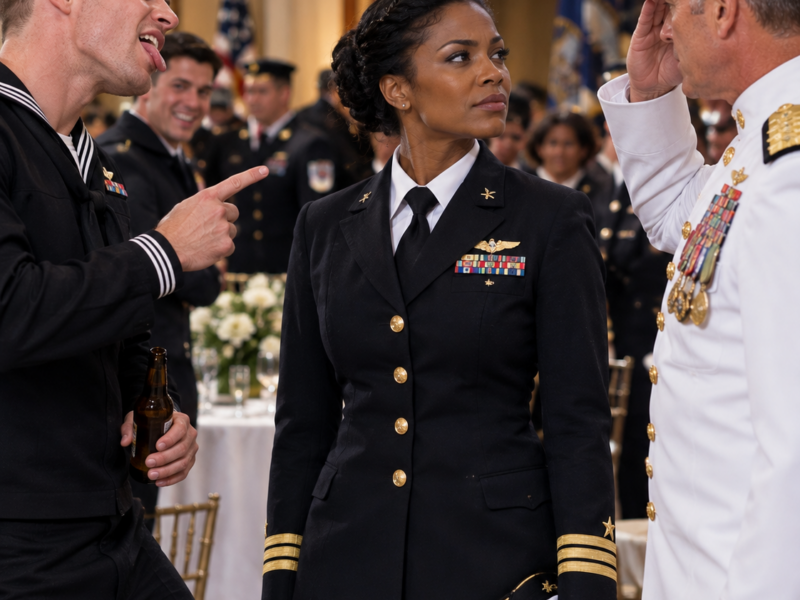
Cocky Navy SEAL Mocked a Black Woman’s Uniform — Then a 4-Star General Called Her “Commander”
The briefing room at Naval Station Norfolk had gone so quiet that Maya Johnson could hear the ventilation system humming above her head.
Chief Petty Officer Blake Turner stood beside the conference table, staring at the photograph she had placed in front of him. His earlier smirk had vanished. The confidence that had made him laugh at her uniform only minutes ago was draining from his face.
Across the table, Admiral Richard Lawson watched her phone.
Maya noticed.
He wasn’t looking at the photograph anymore. He wasn’t looking at Turner, either.
He was looking at the message.
Maya, don’t trust the general. He’s the reason I’m still hiding.
The sender’s account had been inactive for eleven years.
It belonged to her older brother, Nathan Johnson, a Navy intelligence officer officially declared dead after a classified operation overseas.
Maya had been twenty-one when the casualty notification arrived. Nathan had been thirty-four, brilliant, stubborn, and convinced that the truth mattered more than the people who wanted to bury it.
His body had never been recovered.
Now, after eleven years of silence, he had sent her a warning.
And the man he accused was standing six feet away.
“Commander,” Lawson said quietly, “put the phone down.”
It wasn’t a request.
Maya lifted her eyes.
“Why, sir?”
“Because this room is secured, and personal devices aren’t authorized during a classified investigation.”
“Then why did you watch the message arrive instead of asking what it said?”
Turner looked between them.
For the first time since she entered the room, he seemed to understand that he was no longer the most dangerous person present.
Lawson’s expression hardened.
“You’re tired. You’ve been reviewing the Black Harbor files for weeks. We can continue this discussion after you’ve had a chance to rest.”
“I’ve slept four hours in the last two days, sir. I’m still capable of reading a message.”
“Commander Johnson.”
“Admiral Lawson.”
The exchange lasted only seconds, but the temperature in the room seemed to drop.
Maya had learned something during seventeen years in uniform: the people who controlled a room rarely needed to raise their voices. They controlled access, timing, information, and the consequences of asking the wrong question.
Lawson had just tried to control all four.
She slipped the phone into her pocket.
“Of course, sir.”
He studied her face, apparently searching for a sign that she had accepted his explanation.
Maya gave him none.
“Chief Turner,” Lawson continued, “you will remain available for questioning. You will surrender your access credentials and refrain from contacting anyone connected to Operation Black Harbor until further notice.”
Turner stiffened.
“Sir, with respect, I have a team waiting for me.”
“They can wait.”
“May I ask what I’ve been accused of?”
“Nobody has accused you of anything yet.”
Maya glanced at the photograph on the table.
“That’s an interesting distinction.”
Lawson’s eyes flicked toward her.
“Commander, perhaps you’d like to explain the evidence before we make assumptions.”
“Gladly.”
She opened the sealed folder.
Inside were copies of flight authorization records, communications logs, and maintenance entries collected during her investigation. The documents had been arranged chronologically, not by rank or department. Maya cared about what happened, not who had signed the paperwork.
She placed the first page in front of Turner.
“Operation Black Harbor was scheduled to begin at 0210 on June fourteenth. The extraction team was assigned a landing zone at grid reference Sierra-Tango Four-Seven.”
Turner said nothing.
“At 2306 the previous evening, the coordinates were changed. The revised location placed the team approximately six miles from the authorized extraction point, inside an area that had been identified as hostile territory.”
“Communications error,” Turner said.
“That was the original explanation.”
“It was what we were told.”
“Then why did your credentials access the mission planning system forty-three minutes before the coordinates changed?”
Turner leaned forward.
“Because I was on duty.”
“Your duty log says you were inspecting equipment on the opposite side of the installation.”
“I had authorization to access the system.”
“From whom?”
He looked at Lawson.
The admiral folded his hands.
“Answer the commander.”
Turner’s jaw tightened.
“I don’t remember.”
“That’s unfortunate. The system remembers.”
Maya slid another document toward him. It showed a timestamp, an access record, and a credential identifier associated with Turner’s account.
“You entered the system at 2223. You downloaded a file labeled BLACK HARBOR FINAL. At 2306, the coordinates changed. At 0041, you entered the communications facility again.”
Turner shook his head.
“Those records don’t prove I changed anything.”
“No. They prove you accessed the system. That’s why I’m asking questions instead of making accusations.”
His eyes narrowed.
“You came here expecting me to be guilty.”
“I came here expecting the truth to be inconvenient.”
For a moment, Turner appeared ready to argue. Then his gaze dropped to the final page in the folder.
Maya watched his expression change.
It was subtle: a slight tightening around the mouth, a flicker in his eyes, a pause too long to be accidental.
She followed his gaze.
The page contained a list of accounts that had accessed the mission files. Most belonged to operations planners and communications personnel.
One belonged to a senior intelligence officer.
N. JOHNSON.
Her brother.
Maya felt the room tilt, but she kept her hand steady.
Nathan had been declared dead eleven years earlier. According to his personnel record, his credentials had been revoked shortly after his death.
Yet the account had accessed the Black Harbor archive three months ago.
Two days before the operation went wrong.
“Where did you get that name?” Turner whispered.
Maya didn’t answer immediately.
“Did you know my brother?”
Turner looked at Lawson again.
That was the second time he had sought the admiral’s protection.
And this time, Lawson noticed.
“Chief,” the admiral said, “you should think carefully before answering. Speculation about a deceased intelligence officer isn’t relevant to the present investigation.”
“Was he involved in Black Harbor?” Maya asked.
“No.”
The answer came too quickly.
She turned to Lawson.
“You haven’t examined the access logs.”
“I know Nathan Johnson’s service record.”
“Then you know his credentials were revoked eleven years ago.”
“Yes.”
“And you know someone used his account three months ago.”
Lawson’s silence lasted a fraction of a second.
It was enough.
Maya closed the folder.
“Who has administrative control over the archived intelligence accounts?”
“That information is restricted.”
“Restricted to whom?”
“People with the appropriate clearance.”
“I have the clearance.”
“Your clearance does not supersede operational authority.”
Maya nodded slowly.
“Understood.”
She had heard that phrase before. It was often used by people who hoped a procedural boundary would discourage anyone from approaching the truth.
But she wasn’t interested in winning an argument.
She was interested in finding the person who had changed the coordinates that sent two American operators to their deaths and left a third missing.
And now she had a reason to believe that person might also know what happened to her brother.
A knock interrupted the silence.
One of Lawson’s aides opened the door and stepped inside. He was a lieutenant commander with a tablet held tightly against his chest.
“Admiral, the security office has a situation.”
Lawson didn’t turn.
“Explain.”
“Commander Johnson’s access credentials were suspended six minutes ago.”
Maya stared at him.
“By whom?”
The aide glanced at his tablet.
“The request came from the joint operations authority.”
“Whose authorization was attached?”
He hesitated.
“Yours, sir.”
Nobody moved.
Lawson slowly extended his hand.
“Let me see that.”
The aide passed him the tablet.
Maya watched the admiral read the screen. His face remained controlled, but the fingers holding the device tightened around its edges.
“I didn’t authorize this,” he said.
The aide swallowed.
“Sir, the request carries your digital signature.”
“Then somebody forged it.”
“That’s what I thought, sir.”
Lawson looked up sharply.
“You thought?”
“The request originated from a terminal inside this facility. The security team is tracing the connection now.”
Maya felt the first genuine spark of fear since the message arrived.
Someone knew she was investigating Black Harbor.
Someone knew she had found Nathan’s account.
And someone had enough access to impersonate a four-star officer.
That wasn’t a simple cover-up. It was a breach at the heart of the command structure.
“Admiral,” she said, “I need an independent communications terminal.”
“No.”
“Sir, if someone is impersonating you—”
“I said no.”
The sharpness in his voice made the aide glance toward the door.
Lawson seemed to realize how his answer sounded. He lowered his tone.
“Until we determine whether the breach is genuine, nobody accesses the restricted network. That’s the safest course of action.”
“Then I’ll need a secure line that doesn’t connect to this facility.”
“Commander, you’re under my operational authority for the duration of this review.”
Maya looked at him for a long moment.
“With respect, sir, that may be precisely the problem.”
Turner made a small, involuntary sound.
Lawson’s face went cold.
“Careful.”
Maya stood.
“I intend to be.”
She gathered the folder, leaving the photograph of Turner beside the hangar with him.
As she passed the conference table, he spoke.
“Commander.”
She stopped.
Turner looked as though he had aged ten years in fifteen minutes.
“I didn’t change those coordinates.”
Maya turned back.
“Then tell me who did.”
His lips parted.
For a second, she thought he might finally answer.
Instead, he glanced at the admiral and whispered, “They told us the mission was already compromised. We were supposed to redirect the team before they reached the original landing zone.”
“Who told you?”
“I can’t.”
“Two people are dead.”
“I know.”
“One is missing.”
“I know!”
His voice cracked on the last word.
Turner looked down at his hands.
“They said it was necessary. They said the target couldn’t be allowed to leave the country.”
Maya felt her pulse quicken.
“What target?”
Turner raised his eyes.
Before he could answer, every screen in the room went black.
The lights remained on, but the wall monitors, tablets, and conference terminal shut down simultaneously.
The aide looked at his device.
“Network failure.”
Then Maya’s phone vibrated in her pocket.
She took it out.
A new message had arrived from Nathan’s account.
He’ll tell you I betrayed Black Harbor. He’ll tell you I died protecting classified intelligence. Neither is true.
A second message appeared.
Look beneath the old memorial plaque in Building Twelve. Come alone. You have twenty minutes.
Maya read it twice.
Then she looked up at Lawson.
He was watching her again.
This time, there was no attempt to hide it.
“What’s on your phone, Commander?”
Maya slid it into her pocket.
“Nothing you need to worry about, sir.”
For the first time, the admiral looked genuinely angry.
“You will not leave this facility without my authorization.”
Maya straightened her uniform.
“Then I suppose you should have thought about that before somebody started using your signature.”
She walked toward the door.
Two security personnel appeared in the corridor, moving quickly toward the briefing room. One carried a radio; the other held a sealed envelope.
“Commander Johnson?” the first asked.
“Yes.”
He glanced at Lawson, then back at her.
“We’ve been ordered to escort you to the security office.”
“By whom?”
He held out the envelope.
“Joint operations authority.”
Maya recognized the signature before she had even opened it.
Richard Lawson.
The same signature attached to the forged suspension order.
Inside was a single sheet of paper, bearing one sentence:
COMMANDER MAYA JOHNSON IS TO BE DETAINED PENDING INVESTIGATION.
Below it was a timestamp.
The order had been issued eleven minutes earlier.
Maya looked at the admiral standing in the doorway behind them.
He hadn’t moved.
His face had gone perfectly still.
And that was when she understood the most frightening possibility of all.
The person who had forged his signature might not be an outsider.
It might be someone who knew exactly how he would respond.
Someone who had anticipated every question she would ask.
Someone who wanted her removed before she could reach Building Twelve.
Maya folded the paper and handed it back.
“I’ll cooperate with a lawful security inquiry,” she said. “But I won’t surrender my phone or my investigative notes without documented authority and an independent witness.”
The security personnel exchanged a glance.
Lawson stepped forward.
“Commander, don’t make this worse.”
She met his eyes.
“Then tell me one thing, sir.”
“What?”
“Did you know Nathan Johnson was alive?”
For the first time, the admiral’s composure broke.
Only for a moment.
But Maya saw it.
His eyes widened almost imperceptibly, and his breath caught before he could stop it.
The answer wasn’t spoken.
It didn’t need to be.
Maya turned and walked in the opposite direction from the security office.
Behind her, someone shouted her name.
She kept moving.
At the far end of the corridor, an emergency exit stood beneath a red-lit sign. She pushed through it into the cold morning air and descended the metal stairs two at a time.
Her phone vibrated again.
Building Twelve. Memorial plaque. Hurry.
Then another message arrived.
And Maya? If you see the man in the gray uniform, don’t let him speak first.
She stopped halfway across the service yard.
A man stood beside Building Twelve, facing the memorial wall.
He wore a gray naval working uniform, his cap pulled low. His hands rested at his sides. He appeared to be reading the names engraved on the plaque.
Maya couldn’t see his face.
But she could see the small silver insignia pinned above his left pocket.
It belonged to an intelligence unit that had officially been disbanded eleven years ago.
The same year Nathan died.
The man turned his head.
Even from across the yard, Maya recognized the scar running from his temple to the edge of his jaw.
She had seen it in family photographs, in old deployment pictures, and once in a dream so vivid that she’d awakened calling her brother’s name.
Nathan Johnson lifted one hand.
Not a wave.
A warning.
Behind Maya, the emergency door slammed shut.
She looked back.
Two security officers were coming down the stairs.
When she turned toward the memorial again, Nathan was gone.
Only a small black envelope remained beneath the plaque.
Maya ran.
Inside the envelope was a photograph of her brother standing beside Admiral Lawson, both men much younger. On the back, Nathan had written a date and six words.
The operation began before I was declared dead.
Beneath the photograph was a brass key.
And on the key, etched in tiny letters, was the designation of a room that did not appear on any official building plan.
B-12: SUBLEVEL ACCESS.
Maya closed her fingers around it.
A radio crackled behind her.
“All security units, locate Commander Johnson immediately. She is considered compromised.”
Maya looked at the photograph one last time.
Her brother had been alive when the Navy declared him dead.
The mission that killed two operators had been altered by someone inside the command structure.
And the four-star officer who had saluted her that morning might have spent eleven years hiding the truth.
She slipped the key into her pocket and headed toward Building Twelve’s rear entrance.
Whatever waited beneath the memorial, she was going to find it.
Even if the man she trusted least in the Navy was the only person who could tell her why.
The key was colder than Maya Johnson expected.
She held it inside her closed fist as she crossed the service yard behind Building Twelve, keeping her pace steady despite the security alarm echoing somewhere beyond the hangars. The morning shift had barely begun, yet Naval Station Norfolk was already changing around her. Security personnel were checking identification at intersections. Two military police vehicles moved toward the main administrative complex. Somewhere overhead, a helicopter crossed the pale gray sky.
Someone had issued an order to find her.
Someone else had warned her to come alone.
And somewhere inside the base, her brother—the man she had mourned for eleven years—was either alive or someone had constructed an elaborate trap using the one person she could never stop looking for.
Maya reached the rear entrance of Building Twelve.
The building had once housed an intelligence support office. According to the public facility directory, it now contained storage rooms, archived equipment, and an administrative section scheduled for renovation. Most personnel had no reason to enter it.
She did.
The brass key carried the designation B-12: SUBLEVEL ACCESS.
There was no sublevel on the building’s official plans.
Maya checked the corridor behind her, then entered through an unlocked maintenance door.
The air smelled of dust, floor polish, and old electrical equipment. Fluorescent lights buzzed overhead. She passed a row of empty offices before reaching a service elevator whose control panel had been covered with a metal plate.
Someone had recently removed two screws from its lower edge.
She crouched and pulled the plate free.
Behind it was a narrow keyhole.
The brass key fit.
When she turned it, a small green indicator illuminated.
A quiet mechanical click came from inside the wall.
Maya stepped back.
A section of paneling beside the elevator slid open, revealing a keypad and a fingerprint reader. She stared at the device, her pulse quickening.
The key had opened the first lock.
It hadn’t opened the room.
She searched the panel for a manual release but found nothing. Then she noticed a small rectangular slot beneath the fingerprint reader.
A card reader.
Her brother’s photograph came to mind.
The message on its back had said the operation began before his death was declared. If Nathan had designed this access route, he might have anticipated that the brass key alone wouldn’t be enough.
Maya removed her military identification card.
She hesitated.
If the system recorded her access, whoever controlled the facility would know she had entered.
But they already wanted to detain her.
She inserted the card.
The panel flashed amber.
IDENTITY NOT AUTHORIZED.
A second message appeared.
LEGACY CREDENTIAL REQUIRED.
Maya drew a slow breath.
“Of course,” she whispered.
She removed the card and studied the reader. The technology was older than the equipment used throughout the rest of the building. It appeared to be part of a legacy security system, perhaps installed before the facility was renovated.
Then she remembered something from Nathan’s childhood.
When they were young, their father had given them matching metal identification tags as a joke. He called them their emergency credentials, claiming that if they ever got lost, they could use the numbers stamped on the tags to find their way home.
Maya still had hers.
It had remained in the bottom of a jewelry box for years, long after she had stopped wearing it.
She had brought it to Norfolk without thinking, tucked inside her wallet after finding it among her father’s belongings.
She removed the small metal tag and examined its worn surface.
A number was stamped into it.
Not a military service number.
A sequence she had once assumed was meaningless.
She entered it on the keypad.
The panel turned green.
LEGACY IDENTITY CONFIRMED.
The elevator doors opened.
Beyond them was not an elevator car but a narrow staircase descending into darkness.
Maya looked up at the ceiling camera.
Its red indicator was dark.
That frightened her more than if it had been watching.
She descended.
The stairwell ended at a steel door with no handle on the outside. A small screen illuminated when she approached.
B-12 — ARCHIVAL ACCESS
The brass key opened the second lock.
The door moved inward.
Maya stepped into a room that shouldn’t have existed.
Rows of metal cabinets lined the walls. A bank of aging servers hummed behind a glass partition. Several monitors displayed encrypted file directories, and a large table in the center of the room was covered with maps, photographs, and printed communications records.
A single desk lamp was switched on.
Beside it sat a photograph of Nathan.
He was older than the man in the image outside the memorial. His hair was shorter, his face leaner. He wore civilian clothes and stood beside a woman Maya had never seen before.
On the back of the photograph, someone had written:
BLACK HARBOR — ORIGINAL TEAM.
Maya moved closer.
There were six people in the picture.
Nathan stood second from the left. Beside him was Admiral Lawson, younger but unmistakable. A third man wore the uniform of a naval intelligence officer. The remaining three appeared to be civilian contractors.
Maya recognized one of the contractors from the Black Harbor documents.
His name was Adrian Vale.
He had been listed as a technical adviser who died in an overseas vehicle accident eleven years ago.
Two people in the photograph had supposedly died.
One had been officially declared dead without a recovered body.
And at least one had risen to the highest levels of military command.
Maya took out her phone and photographed the image.
Then she heard a voice behind her.
“You shouldn’t have come here.”
She spun around.
A man stood in the doorway.
Gray uniform. Silver insignia. Scar across the temple.
Nathan.
For several seconds, Maya couldn’t move.
Her brother looked at her as though he were seeing a ghost.
She had imagined this moment a thousand times. In her dreams, she ran to him. She struck him for leaving her. She demanded to know why he hadn’t called. She asked whether he had thought about their mother, who had died without ever learning what happened to her son.
In reality, Maya’s training held her still.
Her hand moved toward her waistband before she caught herself.
Nathan noticed.
“Easy, May.”
Nobody had called her May since she was twenty-one.
Her throat tightened.
“Don’t.”
He stopped.
“Don’t what?”
“Don’t say my name like you’ve been watching me grow up from somewhere in the shadows. Don’t act like you have the right to walk back into my life and expect me to be grateful.”
Nathan’s expression crumpled.
“I don’t expect that.”
“You were declared dead.”
“I know.”
“We buried an empty casket.”
“I know.”
“Mom died believing she had lost you.”
His eyes closed.
For the first time, he looked less like an intelligence officer and more like the older brother who had once taught her to ride a bicycle in their father’s driveway.
“I wanted to come home,” he said.
“Then why didn’t you?”
“Because the people who arranged my death were still watching our family.”
Maya felt anger rise beneath the shock.
“Eleven years?”
“Eleven years.”
“You couldn’t send a message? One line? Anything?”
“If I had contacted you, they would have known I was alive. They would have used you to find me.”
“You don’t get to decide that protecting me means erasing yourself.”
“No,” he said quietly. “I don’t.”
The admission unsettled her more than an excuse would have.
Maya lowered her hand.
“Tell me everything.”
Nathan glanced at the ceiling.
“Not here.”
“Then why bring me here?”
“Because this is the only place on the installation where I can show you the original record without going through the network.”
He crossed the room and opened one of the metal cabinets. Inside were several sealed storage cases and a compact data reader.
He removed a small black drive.
“Operation Black Harbor wasn’t supposed to be an extraction mission,” he said. “It was a recovery operation. The team was sent to retrieve a data package from a contractor who had discovered unauthorized intelligence transfers.”
“Transfers to whom?”
“That’s what we were trying to establish.”
“Who changed the coordinates?”
Nathan set the drive on the table.
“The person who changed them wanted the team to reach a different location. There was an informant there—someone who could identify the people behind the transfers.”
“Someone inside the operation?”
“Someone the official report never mentioned.”
Maya looked at the photograph again.
“Adrian Vale?”
Nathan nodded.
“He wasn’t a technical adviser. He coordinated the intelligence transfers. He’d been working with a private network that moved restricted operational information to buyers outside authorized channels.”
“Then why was he listed as dead?”
“Because the investigation threatened people who had spent years protecting that network.”
Maya felt the pieces begin to align.
“The two operators who died in Black Harbor—they were never supposed to reach the extraction point.”
“No. They were meant to be diverted. The plan was to make the mission appear compromised by enemy intelligence, then blame the field team for the failure.”
“And the missing operator?”
Nathan looked at her.
“Daniel Price discovered the coordinate change before deployment. He tried to warn his team, but his report was intercepted. He survived the ambush.”
“Where is he?”
“I don’t know.”
“You’re telling me he’s alive?”
“I’m telling you that the last evidence I saw indicated he had survived.”
“That’s not an answer.”
“It’s the only honest one I can give you.”
Maya looked down at the black drive.
“What does this contain?”
“The original mission file. The unaltered coordinates. The authorization chain. And a recording of the briefing where the change was ordered.”
“Who gave the order?”
Nathan didn’t answer.
She stared at him.
“Who?”
“You’re not ready to hear the name.”
Maya let out a short, disbelieving laugh.
“I’ve spent seventeen years in uniform, and I’ve just discovered that my supposedly dead brother has been hiding under a military installation. I think I’m ready.”
Nathan looked toward the steel door.
“No. You’re ready to fight. That’s different.”
A sudden electronic chime interrupted them.
One of the monitors had awakened.
A red warning appeared across the screen.
UNAUTHORIZED ACCESS DETECTED.
Nathan swore under his breath.
“Someone has entered the upper archive.”
“Can they get down here?”
“Not without the legacy credentials.”
Maya held up the brass key.
“They have the access order. They might have another key.”
Nathan moved to the console and began typing.
The screen changed.
A list of access attempts appeared, each accompanied by a timestamp.
The newest entry carried Lawson’s identification.
Maya stared at it.
“He’s here.”
“Maybe.”
“What do you mean, maybe?”
Nathan pointed to the details.
“The credentials are his. The connection isn’t.”
The system had recorded the access request from a terminal inside the admiral’s office. But the authentication sequence was different from Lawson’s normal pattern.
Someone was impersonating him again.
Then a second entry appeared.
LEGACY IDENTITY — MAYA JOHNSON.
Maya felt her stomach tighten.
The system had registered her entry.
“They know I’m here.”
“Yes.”
“How long before they reach the room?”
Nathan checked the display.
“Three minutes. Maybe less.”
“Then we leave.”
He shook his head.
“There’s another exit, but the door is locked from the other side. I can open it manually, but the release is in the server room.”
“Then let’s move.”
Nathan grabbed the drive.
Maya followed him through the glass partition into a narrow equipment room. The servers were older than she had realized, their indicator lights blinking in uneven patterns.
At the far wall was a red emergency lever behind a transparent cover.
Nathan pulled the cover away.
Before he could touch the lever, a voice came through the ceiling speaker.
“Commander Johnson.”
Admiral Lawson.
Maya froze.
“Step away from the equipment,” he ordered. “Both of you.”
Nathan’s face went pale.
Maya looked at the speaker.
“How do you know he’s here?”
“I know more than you think.”
“Then tell me why you declared him dead.”
A pause.
When Lawson spoke again, his voice was quieter.
“Because if the official record had shown he was alive, the people responsible for Black Harbor would have killed him.”
Nathan gave a bitter smile.
“That’s only half the story, Richard.”
Maya turned toward him.
“You know the admiral?”
Nathan didn’t answer.
Lawson’s voice returned.
“Commander, you have a choice. Leave the drive and come upstairs. I can protect you from what is coming.”
Maya stared at the speaker.
“From whom?”
“From the people who have already decided you know too much.”
“And are you one of them?”
Silence.
Then the speaker crackled.
A different voice came through.
Male. Calm. Unfamiliar.
“Thank you, Admiral. We’ll take it from here.”
Nathan went completely still.
Maya had never seen her brother afraid.
Not when he told her he was joining intelligence. Not when he left for his first deployment. Not even when he spoke about the mission that supposedly killed him.
Now, he looked as though he had heard a death sentence.
The steel door at the end of the corridor unlocked with a heavy metallic click.
Footsteps sounded beyond it.
Nathan seized Maya’s arm.
“Listen to me. If we get separated, take the drive to the old communications annex. Find the operator named Daniel Price.”
“How do I find him?”
“Ask him what happened at 0210.”
The footsteps grew louder.
“Who’s coming?” Maya demanded.
Nathan looked at her.
“The man who ordered my death.”
The door began to open.
Maya tightened her grip on the brass key.
And then Nathan whispered the one thing she had never expected to hear.
“May, the general who saluted you this morning isn’t the highest-ranking person involved.”
The door swung wide.
A uniformed figure stood in the corridor, flanked by armed security personnel.
Maya couldn’t see his face.
But the insignia on his shoulder told her he outranked everyone in the room.
Including Admiral Lawson.
The man stepped into the light.
And smiled.
The man in the doorway wore the uniform of a Navy admiral.
Four stars gleamed on his shoulder boards.
Maya Johnson recognized the rank immediately, but she didn’t recognize the face. He was tall, silver-haired, and immaculate, with the relaxed expression of someone who had spent his entire career entering rooms where everyone else stood up.
The security personnel behind him carried no visible name tapes.
That was the first thing Maya noticed.
The second was that none of them looked at Nathan.
They looked at her.
“Commander Johnson,” the admiral said. “I’ve been hoping we’d meet.”
Maya kept her hands visible.
“Your name, sir?”
His smile widened.
“Admiral Victor Shaw. Joint Strategic Oversight.”
She had reviewed the command structure for Operation Black Harbor. She had examined the authorization chains, the personnel rosters, and the classified appendices attached to the original investigation.
She had never encountered an Admiral Victor Shaw.
“Your position isn’t listed in the joint command directory,” she said.
“Some responsibilities are deliberately kept outside ordinary administrative channels.”
“Convenient.”
“Necessary.”
Nathan stood beside the server console, gripping the black data drive.
Shaw glanced at him.
“Major Johnson. You’ve caused a great deal of trouble.”
Nathan’s expression hardened.
“Not nearly as much as you expected.”
Maya turned sharply.
“Major?”
Her brother had been a lieutenant commander when he was declared dead. His personnel record had never shown a promotion beyond that rank.
Nathan didn’t look at her.
“I was promoted after the official investigation closed.”
“By whom?”
“By me,” Shaw answered.
Maya felt the room become smaller.
An officer whose position didn’t appear in the official command directory had promoted her supposedly dead brother, controlled a classified investigation, and entered a room hidden beneath an ordinary administrative building.
Nothing about this was routine.
Shaw extended his hand.
“Give me the drive, Major.”
“No.”
The admiral’s smile disappeared.
“I wasn’t asking.”
Nathan moved half a step in front of Maya.
“Then you should have brought a better argument.”
One of the security personnel reached toward his belt.
Shaw raised a finger, stopping him.
“I understand your anger. You believe you were abandoned. You believe your service was erased. But you were given an opportunity to disappear, and you accepted it.”
“I accepted a chance to keep my family alive.”
“And the Navy gave you that chance.”
“The Navy didn’t hide me. You did.”
Shaw sighed.
“Must we do this again?”
Maya stepped forward.
“You’re going to explain what’s happening.”
He turned to her.
“Commander, you have spent the past several weeks examining a failed operation. You found irregularities, followed them into restricted records, and received information from a man whose official status makes him legally unavailable for contact. From my perspective, you’ve been manipulated into compromising a sensitive intelligence program.”
“Your perspective doesn’t explain why my brother was declared dead.”
“His disappearance protected a larger operation.”
“Which operation?”
“The kind that prevents hostile intelligence services from learning what we know about them.”
“That isn’t an answer.”
“No,” Shaw agreed. “It’s a warning.”
Maya studied him.
He spoke like someone accustomed to having his statements accepted without supporting evidence. But there was something else beneath the polished language: impatience.
He hadn’t come to persuade her.
He had come because she had discovered something he couldn’t afford to let her examine.
“What happened at Black Harbor?” she asked.
Shaw glanced at Nathan.
“Your brother will tell you a story about a compromised extraction, a missing operator, and a conspiracy extending into senior command. He’ll claim the evidence proves the mission was deliberately redirected.”
“Does it?”
“The evidence is incomplete.”
“Then why confiscate it?”
“Because the drive contains information that could expose ongoing operations and endanger personnel who have nothing to do with your investigation.”
Nathan laughed without humor.
“You’re very good at making theft sound like responsibility.”
Shaw ignored him.
“Commander, I’ll offer you a simple choice. Leave the drive here, return to your assigned quarters, and let the appropriate authorities examine the security breach. You’ll be removed from Black Harbor, but your career will remain intact.”
“And if I refuse?”
“Then I can no longer guarantee that your actions won’t be interpreted as deliberate interference with a classified operation.”
Maya understood the threat.
Her uniform, her rank, and seventeen years of service could become liabilities overnight. A single allegation of mishandling classified information could destroy her career before she had the chance to defend herself.
Shaw was counting on that.
He was counting on her fear of losing everything she had earned.
Maya glanced at Nathan.
Her brother had already lost eleven years.
He was still standing.
“I refuse,” she said.
Shaw’s expression hardened.
“Then I’m sorry.”
He nodded toward the security team.
They moved.
Nathan grabbed Maya’s shoulder and pulled her toward the emergency lever. She struck the transparent cover aside and pulled the handle down.
The equipment room erupted in noise.
A warning buzzer sounded, and the ventilation fans changed pitch. A bank of red emergency lights illuminated the corridor. Somewhere beyond the steel door, heavy locks disengaged.
“Move!” Nathan shouted.
He shoved the drive into Maya’s hand and pushed her through a narrow maintenance passage behind the server racks.
She stumbled into darkness.
Nathan followed, pulling the panel shut just as the first security officer reached the equipment room.
The passage was barely wide enough for two people. Pipes ran overhead, and the floor sloped downward toward a grated metal platform.
“What did you activate?” Maya demanded.
“An emergency separation system.”
“What does that mean?”
“It means the people upstairs will have to choose between following us and preserving the archive.”
“And if they choose us?”
Nathan didn’t answer.
They reached a steel ladder descending into a narrow drainage corridor. Nathan went first, then helped Maya down.
Behind them, metal slammed against metal.
Someone had opened the hidden passage.
“Keep moving,” Nathan said.
They hurried through the corridor until they reached a heavy service hatch. Nathan entered a code on a recessed keypad, and the hatch opened onto an empty utility room.
Maya emerged behind him, breathing hard.
“Where are we?”
“Below the old communications annex.”
“How many secret rooms does this base have?”
“More than anyone would like to admit.”
He closed the hatch and locked it.
For a moment, they stood in silence.
Maya looked at the drive in her hand.
“You said Daniel Price could tell me what happened at 0210.”
“He can.”
“Where is he?”
Nathan wiped dust from his sleeve.
“If he’s still alive, he’ll be at a place called the Breakwater.”
“That’s a location, not an address.”
“It’s a former maritime repair facility outside the main installation. He used it as a meeting point before Black Harbor.”
“Why didn’t you tell the investigators?”
“Because the original investigators were part of the problem.”
Maya stared at him.
“How am I supposed to trust you when every answer opens three more questions?”
Nathan’s expression softened.
“You shouldn’t trust me just because I’m your brother.”
That answer caught her off guard.
“You should verify everything I tell you,” he continued. “Check the records. Compare the dates. Ask the people who were there. That’s how I stayed alive.”
He reached into his jacket and removed a small folded photograph.
It showed a younger Daniel Price standing beside a transport vehicle. Nathan had written a date across the bottom.
June 14.
The night of Black Harbor.
“Daniel was the last person to hear the original mission authorization,” Nathan said. “He told me the order came from someone who shouldn’t have been anywhere near the operation.”
“Admiral Shaw?”
Nathan shook his head.
“Shaw was there, but he wasn’t the one who gave the order.”
“Then who was?”
Nathan looked at her.
“Richard Lawson.”
Maya’s stomach tightened.
“The admiral who saluted me?”
“Yes.”
“He told me he wasn’t involved.”
“He may believe that. Or he may be lying. I don’t know which.”
“You just told me Shaw promoted you. Now you’re saying Lawson gave the order. Which one is running this operation?”
“That’s what the drive will help us establish.”
Maya turned the device over in her hand.
“Then let’s open it.”
Nathan shook his head.
“Not here.”
“Why not?”
“The drive is encrypted, and its authentication system records failed access attempts. If we try to open it on an ordinary terminal, whoever controls the archive could receive an alert.”
“Whoever controls the archive already knows we have it.”
“Not necessarily. Shaw saw it, but he doesn’t know whether it’s the original drive or a decoy.”
Maya looked at the black casing.
“Is it?”
Nathan gave her a brief smile.
“You’re learning.”
Before she could respond, her phone vibrated.
A new message appeared from an unknown number.
Commander Johnson, this is Admiral Lawson. Do not leave the installation with Nathan. He is not who you think he is.
Maya showed him the screen.
Nathan’s expression changed.
“How did he get your number?”
“He had it before this morning.”
“That isn’t what I meant.”
He took out his own phone and examined the message metadata.
“This came through a secure gateway. It didn’t originate from Lawson’s normal device.”
“So Shaw again?”
“Maybe.”
Maya folded her arms.
“You’re asking me not to trust anyone, but you keep telling me what everyone else is doing.”
Nathan handed the phone back.
“Then don’t trust my interpretation. Look at the sender’s certificate.”
She did.
The message had been routed through an authentication server that had been decommissioned years earlier.
A server associated with the original Black Harbor operation.
Maya’s mind raced.
“Someone is using an obsolete system to impersonate Lawson.”
“Yes.”
“Can you trace it?”
“Not from here.”
She slipped the phone into her pocket.
“Then we go to the Breakwater.”
Nathan hesitated.
“Maya, there’s something else you need to understand.”
She waited.
“The man you saw at the memorial wasn’t the only person watching you.”
“What do you mean?”
“Someone has been following your investigation since before you arrived in Norfolk. They knew which records you would request. They knew when you’d access the mission logs. They knew you would discover my account.”
“How?”
“Because the person who gave you access wanted you to find it.”
Maya stared at him.
“You think this was a setup?”
“I think somebody wanted you to discover enough evidence to question Lawson, but not enough to understand Shaw.”
“And why would they want that?”
Nathan looked toward the ceiling.
“Because if you accuse Lawson, Shaw gets to remove him. If you accuse Shaw, Lawson gets to deny everything. Either way, the person who designed the operation remains hidden.”
Maya thought of the briefing room, the forged order, and the speed with which security personnel had appeared.
The trap wasn’t simply designed to stop her.
It was designed to direct her toward a specific conclusion.
Someone wanted her to believe she had found the mastermind before she had the evidence to prove it.
“Then we don’t accuse anyone,” she said.
Nathan nodded.
“We establish what happened.”
They crossed the utility room and reached a narrow exit leading toward the old communications annex.
Outside, the sky had darkened. Low clouds hung over the waterfront, and the wind carried the smell of salt water and fuel.
Maya checked her watch.
Thirty-seven minutes had passed since Nathan’s message.
The original twenty-minute deadline was gone.
If her brother had been telling the truth, whoever was watching them would already know she hadn’t returned to the briefing room.
They moved along the edge of a storage building, avoiding the main road. Nathan knew the old facility’s layout, but Maya noticed he never approached a camera without checking its position first.
He had spent eleven years living as a dead man.
Every movement reflected it.
At the perimeter of the communications annex, he stopped beside a rusted metal door.
“This is where Daniel used to wait.”
Maya examined the lock.
It had been forced recently.
Fresh scratches marked the frame, and a strip of metal lay on the ground beneath the handle.
Nathan crouched beside it.
“Someone was here.”
“Daniel?”
“Maybe.”
He pushed the door open.
Inside, the annex smelled of damp concrete and old machinery. A row of abandoned workstations stood beneath dusty windows. On the floor near the back wall lay a broken chair and several sheets of paper.
Maya picked up the top page.
It was a copy of the original Black Harbor deployment schedule.
Across the bottom, someone had written a single sentence in red ink.
THE FIRST COORDINATES WERE NEVER MEANT TO BE USED.
She turned the page over.
A name had been written on the back.
RICHARD LAWSON.
Beneath it was a time.
0210.
Nathan stared at the paper.
For the first time since Maya had found him, he looked genuinely uncertain.
“This wasn’t here when I last came,” he said.
Maya heard a soft click behind them.
She turned.
A monitor at the far end of the room had switched on. Its screen displayed a live video feed of a man sitting in a small, windowless room.
Daniel Price.
His face was thinner than in the photograph, and a dark bruise marked his cheek. He looked directly into the camera.
“Commander Johnson,” he said. “If you’re watching this, Nathan has found you.”
Maya stepped closer.
Daniel leaned toward the camera.
“Don’t take the drive to the Breakwater. That’s where they’ll be waiting.”
The screen flickered.
Daniel glanced off-camera, then spoke again, urgently.
“Listen carefully. The original order wasn’t signed by Lawson. It was signed by someone who had been dead for eleven years.”
Maya felt the blood drain from her face.
Nathan whispered, “No.”
The image distorted.
Daniel’s voice broke through the static one last time.
“Commander, your brother didn’t survive Black Harbor.”
Maya turned toward Nathan.
He stood perfectly still.
Then the screen went black.
From somewhere outside the annex came the sound of approaching footsteps.
And a voice she recognized from the hidden room beneath Building Twelve.
Admiral Victor Shaw.
“Commander Johnson,” he called through the closed door. “I believe it’s time we discussed your brother’s real identity.”
Maya tightened her grip on the drive.
Nathan slowly turned toward her.
His expression held something she had never seen before.
Not fear.
Not guilt.
Grief.
“May,” he whispered, “whatever he tells you next, remember one thing.”
The door handle began to turn.
Nathan looked into her eyes.
“I was never the man who came home.”
The door opened slowly.
Admiral Victor Shaw entered the communications annex without a weapon in his hand, without a visible security detail, and without the slightest indication that he had just chased two people through a restricted underground facility.
That composure frightened Maya more than a squad of armed guards would have.
He looked at Nathan first.
“Still telling half-truths, I see.”
Nathan said nothing.
Shaw turned toward Maya.
“Commander Johnson, I apologize for the manner in which you’ve been brought into this situation. Your investigation was never supposed to reach this point.”
“Then you should have answered my questions when I asked them.”
“Would you have believed me?”
“That depends on what you said.”
Shaw gave a faint smile.
“Your brother used to say the same thing.”
Maya felt a chill run down her spine.
“Stop talking about him as if you knew him.”
“I knew him better than you did during the last years of his life.”
“Then tell me why Daniel Price says he didn’t survive Black Harbor.”
Shaw’s smile disappeared.
“Because Daniel Price doesn’t know who your brother is.”
Maya glanced toward Nathan.
He stood beside the workstation, shoulders squared, eyes fixed on Shaw. He looked like a man waiting for a verdict.
Shaw continued.
“Eleven years ago, an intelligence operation was compromised. A small team was sent to retrieve information connected to an unauthorized network of classified intelligence transfers. The mission failed. One officer was presumed dead. Another disappeared. The investigation was sealed.”
“You’re describing my brother’s death.”
“I’m describing what the official record says happened.”
“And what actually happened?”
Shaw took a slow breath.
“Your brother was recruited into an intelligence program that operated under a different identity. His original service record was closed. His death was staged to protect the program and everyone associated with it.”
Maya stared at him.
“You’re saying Nathan Johnson never died.”
“I’m saying the man you knew as Nathan Johnson died eleven years ago.”
The words seemed to hang in the air.
Maya turned toward the man standing beside her.
He looked back at her, and for a moment she saw something familiar in his expression: the same crease between his eyebrows he had worn when their father told them difficult news.
“Tell me he’s lying,” she said.
Nathan’s lips parted.
No words came.
“Tell me.”
“I’m sorry, Maya.”
She stepped away from him.
“No.”
He reached toward her, then stopped when she raised her hand.
“No. You don’t get to apologize before you explain what you’ve done.”
Nathan lowered his arm.
Shaw moved toward the table and placed a thin folder on its surface.
Inside were several documents, each stamped with a classification marking. Maya recognized the format of a personnel identity conversion record, although she had never seen one used to replace an officer’s entire service history.
The first page contained Nathan’s name.
The second listed a different identity.
The third contained a photograph of the man standing beside her.
The photograph had been taken eleven years earlier.
The name beneath it was not Nathan Johnson.
It was Elias Mercer.
Maya looked up.
“Who is Elias Mercer?”
“The officer who assumed your brother’s identity after the original operation was compromised,” Shaw said.
“Assumed his identity?”
“Your brother was killed before the operation officially began. Mercer was assigned to continue his work. He inherited the identity, the credentials, and the personal connections necessary to keep the program intact.”
Maya’s hands began to tremble.
She forced them still.
“You expect me to believe the Navy took a stranger, gave him my brother’s name, and let him contact our family?”
“No,” Shaw said. “The Navy didn’t authorize the personal contact.”
Maya turned to the man she had believed was Nathan.
“Did you ever intend to tell me?”
He looked at the floor.
“Yes.”
“When?”
“I don’t know.”
“Before or after Mom died?”
His face tightened.
Maya felt the answer before he spoke.
“After.”
She looked away.
Their mother had spent eleven years setting an extra place at the table during holidays, insisting that Nathan might still come home. She had kept his childhood bedroom untouched until the year she became too ill to climb the stairs.
Maya had sat beside her in the hospital and promised she would find out what happened to her brother.
Now a stranger stood before her wearing his memories like a borrowed uniform.
“What was real?” Maya asked.
Mercer looked at her.
“The things I told you about him. His childhood. His habits. His service. Those were real.”
“Those were his memories.”
“Some of them.”
Maya felt something inside her harden.
“Some?”
Mercer swallowed.
“The program had access to his personal files. Letters, recordings, photographs, interviews. I studied them for months before I met your family.”
“You met our mother?”
“Once.”
Maya slapped the folder off the table.
The pages scattered across the floor.
“Get out.”
Mercer didn’t move.
“Please—”
“Get out!”
Her voice echoed through the annex.
Shaw remained motionless.
Maya turned on him.
“And you let this happen?”
“I approved the identity protection program.”
“You approved replacing my brother with a stranger.”
“I approved keeping a critical intelligence source alive.”
“At the cost of his family.”
Shaw’s expression hardened.
“At the cost of many things, Commander. That is the nature of operations whose failure can compromise national security.”
“Don’t hide behind national security. Tell me what happened at Black Harbor.”
For several seconds, Shaw said nothing.
Then he reached into his uniform pocket and removed a small storage device.
“Eleven years ago, your father discovered that operational intelligence was being sold through a network of private contractors. He found evidence that classified mission plans were being altered to serve financial and political interests. Before he could deliver the evidence, his cover was exposed.”
Maya froze.
“My father was a naval communications specialist. He retired before I joined the service.”
“That was the public record.”
Shaw placed the device on the table.
“James Carter was recruited into a classified counterintelligence effort. His expertise made him useful to the people investigating the network. When he uncovered the transfers, he disappeared.”
Maya stared at him.
“My father died when I was nineteen.”
“That is what your family was told.”
“No.”
She shook her head.
“No. I was there. I saw his body.”
Shaw didn’t look away.
“Then the person buried under his name wasn’t James Carter.”
Maya’s world seemed to fracture.
She remembered the funeral. The closed casket. The uniform folded beside the flag. Her mother’s hands shaking as she accepted condolences from people who barely knew their family.
She remembered asking why she couldn’t see her father’s face.
She remembered being told the injuries were too severe.
All those years, she had believed grief was something she had survived.
Now it seemed someone had built her grief for her.
“Where is he?” she whispered.
Shaw glanced toward Mercer.
“That is what Black Harbor was supposed to establish.”
Maya turned on him.
“You said this operation was about recovering intelligence.”
“It was.”
“Then why send a team into a hostile landing zone?”
“Because the coordinates were changed.”
“By whom?”
Shaw hesitated.
“Someone with access to the command network.”
“That’s not an answer.”
“No. It isn’t.”
Maya stepped closer.
“Who signed the order?”
Shaw removed another document from the folder.
The signature at the bottom was unmistakable.
JAMES CARTER.
Maya stared at it.
“That’s impossible.”
“The order was authenticated using your father’s credentials.”
“My father was dead.”
“According to the official record.”
She studied the signature. It looked genuine. The same angled lettering, the same long final stroke. She had seen it on birthday cards, school permission forms, and the letters he had written during his deployments.
But she also knew signatures could be copied.
“You’re telling me my father ordered the coordinates changed?”
“I’m telling you his credentials authorized the change.”
“Did he give the order?”
“I don’t know.”
Maya laughed bitterly.
“You’re an admiral. You’ve spent eleven years hiding people and rewriting their identities, and you don’t know who issued the order that killed two operators?”
“I know what the records say.”
“That’s not the same as knowing what happened.”
Shaw inclined his head.
“No. It isn’t.”
A quiet sound came from the monitor.
The screen had turned on again.
Daniel Price appeared, his face pale under harsh overhead lighting.
He looked directly at Maya.
“Commander, if Shaw is there, don’t let him access the drive.”
Shaw turned sharply.
“Cut the connection.”
Nobody moved.
Daniel continued.
“The signature on the Black Harbor order was copied from an old authorization. James Carter never approved the mission. He was trying to stop it.”
Maya stepped toward the screen.
“Daniel, where are you?”
“Somewhere you can’t reach yet.”
“Who changed the coordinates?”
Daniel glanced off-camera.
“Admiral Shaw knows.”
Shaw took a step toward the workstation.
“That’s enough.”
Daniel’s expression changed.
“Tell her about the second team.”
Maya turned.
“What second team?”
The monitor flickered.
Daniel leaned closer to the camera.
“Black Harbor wasn’t one operation. It was two. The extraction team was the distraction. The real mission was to retrieve a witness from a secure location before the network could move him.”
“Who was the witness?”
Daniel opened his mouth.
A loud impact sounded somewhere beyond the room.
He flinched and looked away.
Then the screen went black.
Shaw stared at the monitor.
For the first time, his composure was gone.
Maya seized the opportunity.
“Who was the witness?”
Shaw didn’t answer.
“Who?”
He looked at Mercer.
Mercer closed his eyes.
“The witness was James Carter,” he said.
Maya felt the floor shift beneath her feet.
“You’re telling me my father was the person they were trying to extract?”
“Yes,” Mercer replied. “The team wasn’t sent to retrieve a data package. They were sent to bring him out.”
“Then why did they change the coordinates?”
“Because someone wanted the team to arrive too late.”
“Too late for what?”
Mercer looked at the photograph on the wall.
“To stop the transfer.”
Maya stared at him.
“What transfer?”
“The witness was moved before the mission began. By the time the extraction team reached the revised landing zone, your father had already disappeared again.”
“And the two operators?”
Mercer lowered his head.
“They weren’t supposed to die.”
“That’s a remarkably convenient explanation.”
“I know.”
“Did you know the coordinates had changed?”
“Yes.”
Maya’s hand curled into a fist.
“And you did nothing?”
“I tried to warn the team. The warning never reached them.”
“Why not?”
“Because the person who controlled the communications channel had already intercepted it.”
Maya turned toward Shaw.
“Was that you?”
“No.”
“Was it Lawson?”
Shaw remained silent.
Mercer stepped forward.
“It was someone using both their credentials.”
Maya looked between the two men.
For eleven years, someone had manipulated military identities, classified records, and the memories of an entire family. The same person had turned an extraction into a failure, allowed two operators to die, and buried the evidence beneath layers of official authority.
And the operation was still active.
Her phone vibrated.
An incoming call.
No number displayed.
Maya answered without speaking.
A man’s voice came through, rough and distant.
“Maya?”
She stopped breathing.
She knew that voice.
She had heard it in childhood, in old recordings, in the last voicemail her father had left before his supposed death.
“Who is this?” she whispered, although she already knew.
“Listen carefully. You don’t have much time.”
Tears blurred her vision.
“Dad?”
Mercer turned toward her.
Shaw went utterly still.
The voice continued.
“Don’t trust Shaw. Don’t trust Lawson. And don’t trust the man standing beside you.”
Maya looked at Mercer.
He appeared devastated.
“Where are you?” she demanded.
“I can’t tell you yet.”
“I’ve spent half my life believing you were dead.”
“I know.”
“Then tell me where you are!”
A pause.
When her father spoke again, his voice was lower.
“Because if I tell you, they’ll kill everyone who knows.”
Maya pressed the phone against her ear.
“Who are they?”
“People who don’t need to wear uniforms to command the military.”
The line crackled.
“Find the original Black Harbor recording. Not the copy on that drive. The original.”
“Where?”
“Look at the memorial.”
Maya glanced toward the door.
“The memorial outside Building Twelve?”
“No. The other one. The one they removed from the old intelligence building eleven years ago.”
The connection began to break apart.
“Dad, wait—”
“One more thing.”
“I’m listening.”
“The man who ordered my disappearance isn’t Shaw.”
Maya felt her blood run cold.
“Who is it?”
Her father’s final words arrived in a burst of static.
“Ask Richard Lawson who signed his promotion.”
The call ended.
For several seconds, nobody spoke.
Then an alarm sounded throughout the annex.
A red warning flashed across the workstation.
FACILITY LOCKDOWN — ALL EXITS SEALED.
Shaw looked toward the ceiling.
“That wasn’t my order.”
Maya turned toward him.
“Of course it wasn’t.”
Mercer moved to the door and tried the handle.
Locked.
He checked the emergency release.
The panel was dead.
“We’re trapped,” he said.
Maya looked at the drive in her hand, then at the folder scattered across the floor.
Her father was alive.
The man she had believed was her brother was someone else.
The evidence that could expose Black Harbor was divided between a decoy drive and an original recording hidden somewhere in a memorial that no longer existed.
And the admiral who had brought them into this room had just been locked inside it with them.
Maya faced Shaw.
“Who signed your promotion, sir?”
He didn’t answer.
Instead, he reached into his jacket and removed a folded sheet of paper.
It was an official appointment record, dated eleven years earlier.
At the bottom was a signature Maya had seen twice that morning.
Once on the forged detention order.
Once on the authorization that had redirected the Black Harbor team.
JAMES CARTER.
Shaw placed the document on the table.
Then he said something that made Maya understand why her father had spent eleven years hiding.
“Your father didn’t disappear because he discovered the conspiracy, Commander.”
He looked directly into her eyes.
“He disappeared because he helped create it.”
The lights went out.
In the darkness, someone unlocked the door from the other side.
And a familiar voice spoke through the opening.
“Commander Johnson, step away from the admiral.”
It was Richard Lawson.
But this time, he wasn’t alone.
The emergency lights returned in a sickly red glow.
Commander Maya Johnson stood beside the table, one hand gripping the black data drive, the other hovering near her waist. Across from her, Admiral Victor Shaw had gone unnaturally still. Elias Mercer— the man she had believed was her brother—stood near the sealed equipment-room door.
And in the corridor beyond them stood Admiral Richard Lawson.
He had two security officers behind him and a pistol held low at his side.
Maya’s eyes went immediately to the weapon.
“Sir, lower it.”
Lawson looked at Shaw.
“Step away from the commander.”
Shaw gave a short, humorless laugh.
“You always did enjoy arriving after the difficult part was finished.”
“Victor, this ends now.”
“No,” Shaw replied. “It ended eleven years ago. You just refused to accept the outcome.”
Maya moved between them.
“Both of you stop.”
Neither man appeared inclined to listen.
Lawson raised his free hand, signaling his security personnel to remain outside.
“Commander, you need to understand that everything you’ve seen tonight has been deliberately arranged to confuse you. The man claiming to be your brother is an intelligence asset operating under a false identity. Shaw has exceeded his authority. And the information you’ve received about your father may be fabricated.”
“Then explain the signature on your promotion record.”
Lawson’s expression changed.
Maya held up the document she had taken from the table.
“James Carter’s signature authorized your promotion eleven years ago. According to your personnel record, he was already dead.”
“That document was part of a classified authorization package.”
“Signed by a dead man?”
“His credentials were still active.”
“Who controlled them?”
Lawson didn’t answer.
Maya took a step closer.
“You saluted me this morning. You introduced me as the independent investigator into Black Harbor. You knew I had discovered the altered coordinates, and you knew my brother’s account had accessed the archive. Yet you never once told me that my father might be connected to the operation.”
“Because I didn’t know he was alive.”
“Do you expect me to believe that?”
“I expect you to understand that classified programs sometimes operate beyond the knowledge of individual commanders.”
Shaw laughed again.
“That’s the excuse you used when the original team died.”
Lawson turned toward him.
“Be quiet.”
“Or what? You’ll classify the truth?”
Maya slammed her hand against the table.
“Enough!”
The sound echoed through the room.
For a moment, all three men looked at her.
She had spent years learning how to command a room without shouting. But she had also learned that there were times when calmness became a shield for people who wanted to avoid accountability.
“Two operators are dead,” she said. “Another is missing. My brother’s identity was erased. My father has apparently been living under a false death record for eleven years. And every person who claims to know what happened keeps telling me someone else is responsible.”
She looked directly at Lawson.
“Give me one fact I can verify.”
Lawson lowered his weapon slightly.
“The original Black Harbor recording exists.”
“Where?”
“At the old intelligence memorial.”
“The one that was removed eleven years ago?”
He nodded.
“That memorial wasn’t destroyed. It was transferred to a secure storage facility after the investigation closed.”
“Which facility?”
“Building Twelve.”
Maya felt a cold wave of anger pass through her.
“We’ve been standing above it this entire time.”
“The memorial itself isn’t there anymore,” Lawson explained. “Only its base remains. The original recording was concealed inside the structure before it was moved.”
“Who concealed it?”
Lawson looked toward Mercer.
“He did.”
Maya turned.
Mercer nodded slowly.
“I was ordered to move the memorial. I was also told to preserve the recording, whatever happened to the investigation.”
“By whom?”
“Your father.”
Maya studied his face.
“Why would James Carter trust you with evidence if you weren’t Nathan?”
“Because I was assigned to protect him before the operation failed.”
“You said he died before Black Harbor.”
Mercer looked down.
“I said the man you knew as Nathan Johnson died eleven years ago. I didn’t say your father died.”
Maya’s stomach tightened.
“Then why pretend to be my brother?”
“Because the people investigating Black Harbor believed Nathan had discovered the original recording. They thought they could find it through his family. I was given his identity so I could monitor the people who came looking for him.”
“You used my family.”
“Yes.”
The admission was quiet and immediate.
Maya felt the urge to strike him, but she held her ground.
“Did you ever care about us?”
Mercer’s face tightened.
“I cared about you enough to stay away.”
“That isn’t an answer.”
“No,” he said. “It isn’t.”
Lawson stepped forward.
“Commander, we have to move. Shaw’s people are taking control of the installation.”
Shaw’s expression sharpened.
“My people?”
“The security team that sealed this facility isn’t operating under your command.”
“Neither are they operating under yours.”
The two admirals stared at each other.
Maya understood then that the lockdown wasn’t a simple security measure. Someone had activated it to isolate the people in the room while other personnel moved through the installation.
Someone wanted the evidence contained.
And perhaps wanted the witnesses contained with it.
She pulled her phone from her pocket.
No signal.
“How do we get to the memorial base?”
Lawson answered immediately.
“Through the maintenance passage behind the server room. It connects to the old storage corridor.”
“Then we’re going.”
Shaw stepped in front of her.
“Not until I have that drive.”
Maya held it closer to her chest.
“Why?”
“Because the information on it could compromise ongoing operations.”
“Or expose you.”
Shaw’s face hardened.
“You have no idea what you’re holding.”
“Then help me verify it.”
He hesitated.
It was a small hesitation, but Maya noticed.
For the first time, Shaw looked uncertain about the outcome of the conversation.
“Give me the drive,” he said more quietly, “and I’ll tell you where your father is.”
Maya stared at him.
“You know where he is?”
“I know where he was taken.”
“By whom?”
“By the person who orchestrated Black Harbor.”
“And you haven’t stopped them?”
“I couldn’t.”
The answer sounded almost sincere.
Maya hated that it made her hesitate.
Before she could respond, a burst of static came from the ceiling speaker.
A voice spoke over the facility’s internal system.
“All personnel, this is Admiral Lawson. The installation is under emergency security restriction. Stand by for further instructions.”
Lawson looked up sharply.
“I didn’t transmit that.”
Maya’s phone vibrated.
A message had arrived through the same obsolete authentication system that had carried her father’s call.
THE MEMORIAL. NOW. DO NOT LET THEM SEPARATE YOU.
A second message followed.
THE RECORDING WILL PROVE WHO GAVE THE ORDER. BUT THE RECORDING IS NOT THE WHOLE TRUTH.
Maya looked at Mercer.
He had read the messages over her shoulder.
“Your father,” he whispered.
“How do you know?”
“Because he always leaves a second warning.”
Shaw’s gaze sharpened.
“What does that mean?”
Mercer ignored him.
He crossed the room, removed a narrow metal tool from his pocket, and forced open the emergency panel beside the equipment-room door. After several seconds, the lock disengaged.
“Go,” he said.
Maya didn’t move.
“You’re coming with us.”
Mercer looked at her.
“I don’t know if I can.”
“That’s not your decision.”
For the first time, a faint smile crossed his face.
“Your brother would have liked hearing you say that.”
Maya’s expression hardened.
“Don’t.”
The smile vanished.
He stepped aside.
They moved into the maintenance passage, Lawson leading the way. Shaw followed after a brief hesitation, unwilling to remain behind with the others.
The corridor sloped upward toward a narrow service staircase. At the top, a metal door opened into a storage room filled with old furniture, broken display cases, and disassembled equipment.
At the far end stood a large wooden structure covered by a canvas sheet.
Maya pulled the sheet away.
Beneath it was a stone memorial plaque mounted on a metal frame.
The inscription listed the names of intelligence personnel declared dead during the operation eleven years earlier.
Nathan Johnson’s name appeared near the bottom.
So did James Carter’s.
Maya touched her father’s name.
For a moment, she was nineteen again, standing beside a closed casket while strangers told her how brave her father had been.
She drew her hand away.
“Where’s the recording?”
Mercer crouched beside the frame.
“The memorial was built around a hollow support column. Your father designed the locking mechanism.”
He removed a small access plate and exposed a recessed compartment.
Inside lay a compact recording unit, sealed in a protective case.
Maya took it out.
“Can we play it?”
Lawson examined the unit.
“Not here. It needs an isolated reader.”
“Then we’ll find one.”
Shaw stepped toward them.
“Commander, don’t connect that device to anything until we establish its authenticity.”
Maya looked at him.
“Why? Afraid of what we’ll hear?”
“Afraid of what you won’t understand.”
She turned away and opened the case.
Inside was a small storage module and a folded piece of paper.
The paper contained a short message in her father’s handwriting.
Maya, if you’re reading this, then someone has finally stopped pretending that the truth is too dangerous to tell you.
Her vision blurred.
She swallowed and continued.
The order to redirect Black Harbor was issued under my credentials, but I did not authorize it. The person who did had access to my identity, my security keys, and the command authentication system. I discovered the breach too late to stop the mission.
She paused.
The next line was written in darker ink.
The person responsible was not an admiral, a general, or a contractor. It was someone I trusted with the one thing that could destroy the entire network.
Maya turned the page over.
Three words had been written beneath the message.
ASK ABOUT PROJECT MERIDIAN.
Lawson went pale.
Shaw closed his eyes.
Mercer took a step backward.
Maya looked between them.
“What is Project Meridian?”
Nobody answered.
She held up the recording unit.
“Then we’ll let the recording speak.”
Lawson shook his head.
“Commander, you don’t understand what Meridian was designed to do.”
“Then explain it.”
“It was a classified counterintelligence initiative. Its purpose was to identify compromised intelligence channels and determine whether operational information was being sold to foreign buyers.”
“And who ran it?”
Lawson looked at Shaw.
Shaw looked at Mercer.
Mercer stared at the floor.
Maya felt her patience break.
“One of you is going to answer me.”
A voice came from the storage room entrance.
“I can.”
They turned.
A man stood in the doorway wearing a plain civilian jacket. His hair was gray at the temples, and he leaned slightly on a metal walking stick.
Maya knew his face immediately.
Her father.
James Carter looked older than the man she remembered. His cheeks were thinner, his shoulders narrower, and a long scar ran from beneath his left ear to the collar of his jacket.
But his eyes were the same.
For several seconds, Maya couldn’t speak.
Then she crossed the room.
“You’re alive.”
James nodded.
“I’m alive.”
She stopped directly in front of him.
“Why?”
His face crumpled.
“I was trying to keep you safe.”
“You let me bury you.”
“I know.”
“You let Mom die believing you were gone.”
He lowered his head.
“I know.”
Maya struck his chest with the heel of her hand.
Not hard enough to hurt him.
Hard enough to make him look at her.
“You don’t get to tell me you did it for me.”
He nodded, tears gathering in his eyes.
“You’re right.”
That answer broke something inside her.
She had prepared herself for excuses, for classified explanations, for the familiar language of people who believed the truth could be managed by controlling who received it.
She had not prepared herself for her father to admit that he had been wrong.
She stepped back.
“Tell me everything.”
James looked at the recording unit in her hand.
“First, you need to hear the truth about Project Meridian.”
He turned toward the others.
“Meridian was never designed to find traitors.”
Lawson’s expression tightened.
James continued.
“It was designed to create them.”
Maya stared at him.
“What does that mean?”
“Someone inside the intelligence structure had developed a method for altering operational records without leaving the usual audit trail. Coordinates could be changed, communications could be redirected, and authorization signatures could be reproduced. The system made it possible to create a false record of almost any operation.”
“Who developed it?”
James looked at Mercer.
“Elias did.”
Maya turned.
Mercer didn’t deny it.
“I built the authentication framework,” he said. “I believed it would help identify compromised systems. I didn’t understand that the people funding the project intended to use it to conceal their own operations.”
“And you kept working on it?”
“Until I discovered what they were doing.”
James nodded.
“By then, they had already used Meridian to fabricate records, erase personnel identities, and authorize operations that never should have taken place.”
Maya looked at the memorial.
“Black Harbor.”
“Black Harbor was the operation that exposed the system,” James said. “I found evidence that the network intended to move a witness who could identify the people buying classified information. I tried to stop them.”
“Who gave the order to change the coordinates?”
James hesitated.
“The recording will tell you who issued the order under my credentials.”
“Then let’s hear it.”
He shook his head.
“Not yet.”
Maya’s eyes narrowed.
“Why?”
“Because the recording proves who authorized the change. It doesn’t prove who controlled the system.”
Shaw stepped forward.
“James, stop.”
James looked at him.
“You’ve had eleven years to stop me.”
He reached for the recording unit.
Maya held it out.
James examined the casing and pressed a hidden switch along its edge. A tiny indicator illuminated.
The unit had been recording the room’s audio since they opened the compartment.
Maya stared at him.
“You knew we were being recorded?”
“I suspected someone would try to take the original.”
“Then why let us argue?”
“Because I needed to know which of them would try to stop you from asking the right questions.”
He looked at Lawson.
“Richard, tell her who signed your promotion.”
Lawson’s face was ashen.
“I was given the appointment through the official command chain.”
“That isn’t what I asked.”
Lawson said nothing.
James turned toward Shaw.
“Victor, tell her who authorized Project Meridian.”
Shaw’s jaw tightened.
“I cannot.”
“Then let me.”
James faced Maya.
“The person who authorized Meridian was the chairman of the joint oversight board. He controlled the funding, the personnel appointments, and the access permissions. He could create an order, alter its authentication, and make it appear that someone else had approved it.”
Maya looked at the recording unit.
“Who was the chairman?”
James’s expression changed.
For the first time since entering the room, he looked afraid.
“Your father didn’t build Meridian alone,” Mercer said quietly.
Maya turned toward him.
“What are you saying?”
“James designed the original security architecture. I built the authentication system. But someone else created the authority structure that allowed the program to operate outside normal oversight.”
“Who?”
Mercer looked at Lawson.
Lawson looked at Shaw.
And Shaw, finally, looked at Maya.
“The person who authorized Meridian,” he said, “was your commanding officer’s predecessor.”
Maya frowned.
“My commanding officer is General Lawson.”
“Not in the ordinary sense,” Shaw replied. “Lawson was promoted into his present role eleven years ago. The appointment was approved by the chairman of the oversight board.”
Maya felt a chill.
“Who was the chairman?”
Shaw’s voice dropped.
“General Marcus Reed.”
Maya recognized the name.
Reed had retired years earlier after a long career in joint special operations. His official biography described him as a respected strategist who had overseen several major modernization programs.
He had delivered the keynote address at Maya’s officer development course.
He had personally congratulated her when she was selected for advanced command training.
She had met him twice.
Both times, he had shaken her hand and told her that integrity was the foundation of military leadership.
“General Reed is retired,” she said.
James nodded.
“Officially.”
“And you think he’s still running Meridian?”
“I know he is.”
Lawson stepped toward the door.
“We need to contact federal authorities.”
Shaw caught his arm.
“Not through the normal channels.”
Lawson pulled free.
“Then how?”
“Through someone Reed doesn’t control.”
Maya looked down at her phone.
The messages from her father had arrived through a decommissioned authentication system. The security orders had carried Lawson’s credentials but originated elsewhere. Someone had used the same network to manipulate her investigation.
She had been chasing a conspiracy that could make any official record unreliable.
If Reed still controlled Meridian, every attempt to expose him could be intercepted before it reached anyone capable of acting.
“Who can we trust?” she asked.
James looked at her.
“No one because of their rank. No one because of their uniform. We trust evidence that survives independent verification.”
Maya nodded slowly.
“Then we make copies of the recording, the drive, and every document in this room. We send them through separate channels to people outside the command structure.”
Lawson agreed.
Shaw hesitated, then nodded.
Mercer remained silent.
Maya turned toward him.
“And you tell the investigators exactly who you are, what you did, and how you assumed my brother’s identity.”
He met her eyes.
“I will.”
“No secret deals. No disappearing again.”
“I understand.”
A loud crash sounded somewhere beyond the storage room.
The lights flickered.
James looked toward the ceiling.
“They’ve found us.”
Lawson drew his weapon.
“Security team?”
James shook his head.
“Worse.”
He pointed toward the recording unit.
“The system has just transmitted a copy of our conversation to the Meridian archive.”
Maya stared at him.
“You said the device was recording locally.”
“It was.”
“Then how—”
“Because the memorial was never just a hiding place. It was also a trigger. The original recording contains an authentication sequence. Activating it signals that someone has accessed the evidence.”
A message appeared on the monitor beside the storage door.
MERIDIAN PROTOCOL INITIATED.
Below it, a second line began to appear.
AUTHORITY CONFIRMED: GENERAL MARCUS REED.
Then the monitor changed again.
A live video feed filled the screen.
General Reed sat behind a desk in a darkened office. He wore a civilian suit, but his posture was unmistakably military.
He looked directly into the camera.
“Commander Johnson,” he said calmly. “You’ve done remarkably well.”
Maya stepped toward the screen.
“General Reed.”
“I see you’ve reunited with your family.”
“You falsified my father’s death.”
“I authorized an identity-protection measure.”
“You redirected Black Harbor.”
“I authorized a necessary adjustment to an operation that had already been compromised.”
“Two operators died.”
“Tragic outcomes are sometimes unavoidable.”
Maya felt her hands tighten.
“Not when someone deliberately creates them.”
Reed leaned back.
“You’re young enough to believe that exposing the truth automatically makes the world better. It doesn’t. It creates consequences. Some of those consequences will fall on people who had nothing to do with Meridian.”
“Then let the evidence determine responsibility.”
“Evidence is only useful when the people interpreting it understand what it means.”
Maya stared at him.
“And you believe you’re the only person qualified to understand it?”
“No, Commander. I believe I’m the only person who understands what happens when the system collapses.”
The screen flickered.
Reed’s expression became colder.
“You have one hour to surrender the original recording and the drive. After that, the evidence will be treated as compromised, your access will be revoked, and everyone associated with this unauthorized investigation will be subject to detention.”
“You’re threatening a serving commander who is investigating a mission that killed American personnel.”
“I’m explaining the consequences of disobeying a lawful order.”
“Your authority is under investigation.”
“By whom?”
Maya had no answer.
Reed smiled.
“Exactly.”
The feed ended.
For several seconds, nobody spoke.
Then Maya turned toward the others.
“We have one hour.”
James nodded.
“Then we’d better make it count.”
He took the recording unit from the table and removed a small module from its casing. Inside was a second storage device, sealed behind a metal plate.
“The original audio is here,” he said. “The first device contains only the authentication trigger and a copy of the opening segment.”
Maya took the module.
“Can we verify it?”
“Yes. But not here.”
“Where?”
James looked toward the waterfront.
“There’s a former naval communications laboratory on the other side of the installation. It was closed after Meridian was supposedly dismantled. Its systems were never connected to the replacement network.”
Lawson frowned.
“If Reed still controls the installation, the laboratory may already be under surveillance.”
“Then we won’t use the main entrance,” Maya said.
She looked at the men who had spent years hiding the truth.
“From this moment forward, nobody gives orders that can’t be independently verified. Nobody separates from the group without telling the others. And nobody gets to disappear when the questions become uncomfortable.”
Mercer nodded.
Shaw did the same.
Lawson hesitated before finally lowering his weapon.
James looked at his daughter.
“You sound like your mother.”
Maya swallowed.
“I wish she could have heard you say that.”
His face fell.
“So do I.”
They left the storage room together, carrying the evidence that could expose Project Meridian.
Behind them, the memorial remained in darkness.
But as Maya stepped into the corridor, her phone vibrated one final time.
A message from an unknown sender appeared.
YOU HAVE THE RECORDING. GOOD. NOW FIND THE PERSON WHO SURVIVED THE SECOND TEAM.
Maya stopped.
She read the message again.
The second team.
The witness who had been moved before Black Harbor.
The person whose identity had never appeared in the official report.
A final line appeared beneath the first.
HIS NAME IS DANIEL PRICE.
Maya looked up at her father.
“Daniel was the witness?”
James shook his head.
“No.”
He stared at the message.
“Daniel was the person sent to protect the witness.”
“Then where is the witness?”
James looked toward the dark corridor ahead.
For the first time that evening, he seemed completely certain of one thing.
“He’s been standing in this room with us the entire time.”
Maya turned toward Elias Mercer.
Mercer didn’t move.
Then, slowly, he reached into his jacket and removed an identification card.
The name on it was Daniel Price.
And the man who had impersonated her brother for eleven years was not Elias Mercer after all.
He was the missing operator from Black Harbor.
And the real Elias Mercer had been dead long before the mission ever began.
THE END.









