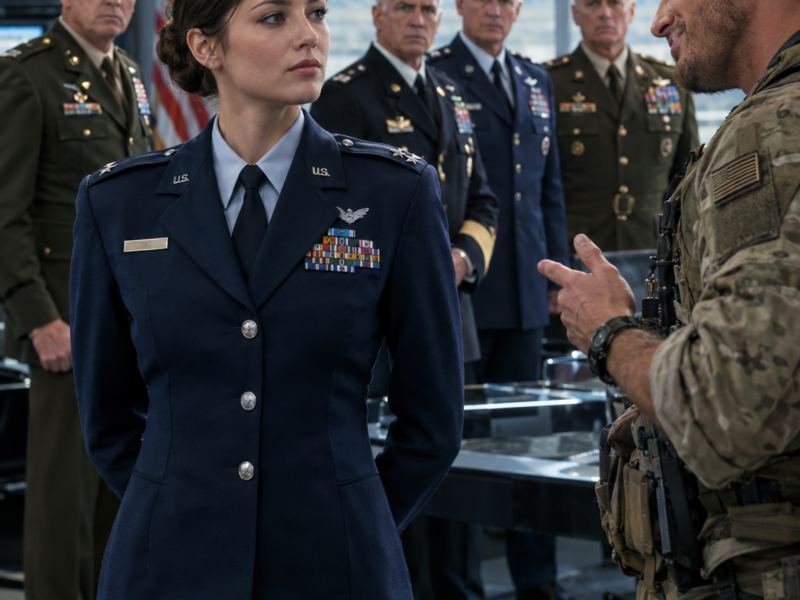
Cocky Navy SEAL Asked a Quiet Woman Her Rank as a Joke — Then Four Generals Snapped to Attention
The Navy SEAL laughed when he blocked my path outside the Pentagon and asked my rank as a joke, but his grin vanished when four generals suddenly snapped to attention behind him and one quietly said, “Ma’am, the briefing is waiting.” Nobody in the corridor understood why—until they saw the photograph inside my old leather folder.
Rain slid down the Pentagon windows in silver sheets, blurring the Virginia skyline beyond the security barriers. The morning rush had turned the entrance into a river of uniforms, identification badges, black government sedans, and hurried footsteps. Somewhere beyond the reinforced walls, phones rang, secure doors clicked open and shut, and the muted hum of ventilation systems blended with the distant rumble of aircraft approaching Reagan National.

I stood near the security checkpoint wearing a plain black coat, dark trousers, and weathered boots.
No ribbons.
No medals.
No insignia.
Just an old leather folder tucked beneath my arm.
Nobody looked twice.
That was exactly how I wanted it.
I had spent seventeen years making sure nobody did.
A group of Navy SEALs emerged from the security corridor, laughing among themselves. They were unmistakable even without their gear. The posture. The clipped movements. The habit of scanning every doorway without appearing to scan anything.
One of them noticed me.
He slowed.
Then he stepped directly into my path.
“Ma’am.”
I stopped.
He smiled.
“You lost?”
“No.”
His teammates laughed.
He looked at my coat.
Then the folder.
Then back at me.
“Government employee?”
“No.”
“Contractor?”
“No.”
“Journalist?”
“No.”
His grin widened.
“Then what’s your rank?”
I looked at my watch.
“You’re already late.”
The laughter stopped.
The SEAL blinked.
“For what?”
I didn’t answer.
He leaned slightly closer.
“Ma’am, I’m just asking a question.”
“I know.”
His teammate laughed.
“She’s got attitude.”
The SEAL folded his arms.
“Seriously. What rank are you?”
I looked past him toward the inner corridor.
“Move.”
He smiled again.
“You know, most people answer when a SEAL asks them something.”
“Most people aren’t me.”
That got a few raised eyebrows.
The SEAL’s grin disappeared.
Before he could respond, the enormous security doors behind us opened.
Four generals walked into the corridor.
The atmosphere changed instantly.
Personnel straightened.
Conversations died.
Security officers stepped aside.
The SEAL turned.
His posture snapped rigid.
He recognized them.
Everyone did.
Four senior officers.
Four men whose combined careers represented decades of command.
They walked directly toward us.
The SEAL stepped aside.
I didn’t.
The generals stopped.
For one heartbeat, nobody moved.
Then all four raised their right hands.
And saluted me.
The SEAL’s face went completely blank.
The hallway became silent.
I returned the salute.
“At ease.”
All four lowered their hands.
General Thomas Hart stepped forward.
“General Hart, the briefing room is ready.”
The SEAL stared at me.
“General?”
I looked at him.
“That’s what you asked.”
His mouth opened.
Nothing came out.
One of his teammates whispered:
“Oh, hell.”
The SEAL swallowed.
“I was joking.”
“I know.”
I walked past him.
His voice followed me.
“Why didn’t anyone tell us?”
I stopped.
Slowly, I turned.
“Because the people attending this briefing don’t know me as General Hart.”
His expression tightened.
“Then who are you?”
I opened the leather folder.
Inside was a photograph.
Old.
Faded.
The edges were burned.
It showed a desert convoy engulfed in flames.
Vehicles overturned.
Smoke rising into a black sky.
And beside the wreckage stood a much younger woman.
Me.
The SEAL stepped closer.
His face changed.
“My father.”
I said nothing.
He stared at the photograph.
“My father was in that convoy.”
“I know.”
His eyes lifted.
“You were there.”
“Yes.”
“He said an officer pulled him out.”
“I did.”
“My father said the officer died.”
“They were wrong.”
The SEAL stared at me.
His teammates weren’t laughing anymore.
One of them looked at General Hart.
Another looked toward the security checkpoint.
I closed the folder.
“The report was altered.”
The SEAL’s voice dropped.
“By who?”
I looked at the four generals.
None of them answered.
General Hart finally spoke.
“We found the missing file.”
My fingers tightened around the folder.
Seventeen years.
Seventeen years of silence.
Seventeen years of watching the official story become history.
Seventeen years of knowing that twelve soldiers had survived because I disobeyed an order.
Then watching the government declare the entire rescue mission a failure.
I had never corrected them.
Not because I was afraid.
Because correcting them would have exposed something far worse.
General Hart looked toward the inner corridor.
“The original operation record was recovered three days ago.”
“Where?”
“An encrypted archive.”
“Who opened it?”
He hesitated.
“Someone inside the Pentagon.”
The SEAL stepped closer.
“What operation?”
I looked at him.
His eyes were no longer arrogant.
They were searching.
“My father never talked about it.”
“He wasn’t supposed to.”
“Why?”
“Because everyone involved was told the mission never happened.”
The SEAL looked at the photograph again.
“What did you save him from?”
I opened the folder.
Another photograph.
Then another.
A convoy.
A burning communications truck.
A satellite image.
A handwritten grid coordinate.
And finally, a list of names.
Twelve names.
The SEAL scanned the page.
“My father is here.”
“Yes.”
He looked farther down.
“Who are the others?”
I closed the folder.
“Men your government said were dead.”
One of the generals stepped closer.
“General, we need to get inside.”
I nodded.
Then the alarms began.
A piercing tone screamed through the corridor.
Red emergency lights flashed.
Security personnel immediately moved into position.
The SEAL’s entire team changed.
Every weapon hand moved instinctively.
Every body turned toward the entrances.
The crowd scattered.
A security officer shouted:
“Lockdown!”
Heavy doors began closing at both ends of the corridor.
The four generals remained where they were.
I didn’t move.
The SEAL looked at me.
“What is happening?”
I checked my watch.
Then the leather folder.
Then the corridor.
“They know I’m here.”
His expression hardened.
“Who?”
I looked toward the sealed doors.
“That’s what we’re about to find out.”
A second alarm sounded.
Then the lights went out.
For two seconds, the Pentagon corridor disappeared into darkness.
Emergency lighting flickered on.
The SEAL grabbed my arm.
“Stay behind me.”
I looked at his hand.
Then at him.
“Let go.”
He did.
Not because he wanted to.
Because something in my voice told him he should.
A security officer ran toward us.
“General Hart!”
“Yes?”
“We’ve lost communications with the briefing room.”
General Hart looked at me.
“Impossible.”
The officer shook his head.
“It’s isolated.”
I stepped forward.
“Who has access?”
“Only cleared personnel.”
I looked at the SEAL.
His expression changed.
“You think one of us did it?”
“No.”
“Then who?”
I looked at the security cameras.
Every camera was frozen on the same frame.
The time stamp had stopped.
17:43:11.
My stomach tightened.
I knew that number.
Not the time.
The code.
I had seen it seventeen years earlier.
On the night of the convoy.
On the mission report that disappeared.
On the encrypted radio transmission that had ordered us to abandon twelve men in the desert.
I whispered:
“They’re using the same protocol.”
General Hart’s face went pale.
“What protocol?”
I opened the folder again.
At the bottom of the original photograph was a tiny marking.
Three numbers.
17-43-11.
The SEAL saw it.
“What does that mean?”
I looked toward the locked briefing room.
“It means whoever is inside knows exactly who I am.”
A loud metallic crash echoed from behind the doors.
Everyone raised their weapons.
The SEAL stepped in front of me again.
I moved around him.
“General—”
“Stay behind me.”
“No.”
He looked at me.
“I said stay behind me.”
I stared directly into his eyes.
“You’re protecting the wrong person.”
The doors suddenly opened.
Not slowly.
They exploded inward.
Security officers rushed forward.
Then stopped.
A man stood inside the briefing room.
Older.
Gray-haired.
Wearing a dark civilian suit.
He held no weapon.
He simply looked at me.
And smiled.
“Welcome back, General Hart.”
Nobody spoke.
The SEAL stared at him.
“Who is that?”
I knew.
My hand tightened around the folder.
Because seventeen years ago, that man had signed the order that condemned my convoy.
And according to every government record in existence—
he had died six months later.
He looked at the SEAL.
Then at the four generals.
Then back at me.
“You kept the photograph.”
I answered quietly.
“I kept everything.”
His smile disappeared.
Then the emergency lights went red.
A secure alarm began screaming from somewhere deep inside the Pentagon.
General Hart whispered:
“Ma’am…”
I turned.
“The briefing is no longer about the past.”
I looked at the man in the doorway.
“It’s about who is coming next.”
And somewhere beneath the building, a locked vault door began to open.
The vault door stopped halfway open.
For three seconds, nobody moved.
Then the lights inside the Pentagon corridor went black.
Not dim.
Black.
The emergency lights came on a heartbeat later, washing everything in pulsing red.
I heard the SEAL behind me draw a breath.
Then the metallic sound of a weapon being brought into a ready position.
I didn’t turn.
“Lower it.”
His voice came immediately.
“Ma’am, I don’t know what’s behind that door.”
“Neither do I.”
I finally looked at him.
“That’s why you don’t point your weapon at it.”
He hesitated.
Then lowered it.
The four generals had already moved.
Not backward.
Forward.
They formed a tight security diamond around me without being told.
That was when the SEAL finally understood what was happening.
They weren’t protecting themselves.
They were protecting me.
The senior general looked toward the open vault.
“General Hart, we need to move you to a secure location.”
“No.”
“Ma’am—”
“No.”
I stepped toward the vault.
The air coming through the opening was cold enough to raise goosebumps along my arms.
I knew that temperature.
Seventeen years earlier, the convoy had carried something similar.
Not weapons.
Not gold.
Not intelligence files.
People.
Three intelligence officers who had disappeared from every official record after the convoy was attacked.
And one of them had been the reason I was ordered to drive into the kill zone.
I stopped two feet from the vault.
The SEAL moved beside me.
“General.”
I glanced at him.
“You have a name?”
“Senior Chief Daniel Cross.”
I looked at his face.
Then at his eyes.
“Your father was Captain Michael Cross.”
His jaw tightened.
“Yes, ma’am.”
“He wasn’t supposed to be in that convoy.”
Cross stared at me.
“What?”
I reached into the leather folder.
The photograph was still there.
But beneath it was something I hadn’t shown him.
A folded piece of paper.
Yellowed.
Creased.
Burned along one edge.
I opened it carefully.
At the top was a handwritten name.
Michael Cross.
Cross stared at it as though I’d placed his father’s grave marker in front of him.
“What is that?”
“The original passenger manifest.”
He looked at me.
“Original?”
“The official report listed your father as convoy security.”
I tapped the paper.
“He wasn’t.”
Cross leaned closer.
“What was he?”
I looked toward the vault.
“An extraction asset.”
Silence.
One of the generals swore quietly.
Cross shook his head.
“My father was a helicopter pilot.”
“He was.”
I folded the paper.
“He was also the only man in that convoy who knew what we were actually carrying.”
“What?”
I didn’t answer.
Because the vault had just made another sound.
A heavy mechanical click.
Something inside had released.
I raised one hand.
Everyone froze.
A faint vibration traveled through the floor.
Then came a voice from the dark.
“General Hart.”
The SEAL’s weapon came up again.
This time I didn’t stop him.
The voice continued.
“You took your time.”
I knew that voice.
Seventeen years had changed it.
Age had made it deeper.
But I would have recognized it through gunfire.
The older man from the briefing room stepped out of the darkness.
His suit was immaculate.
His silver hair was combed straight back.
He carried no visible weapon.
He didn’t need one.
Men like him rarely carried their own weapons.
They carried authority.
And secrets.
Cross stared at him.
“Who the hell are you?”
The man looked at him.
Then smiled.
“Your father asked me the same question.”
Cross went rigid.
I stepped between them.
“Enough.”
The man’s eyes settled on me.
“You still do that.”
“Do what?”
“Stand between people and the truth.”
I felt something cold settle in my stomach.
“Where is the file?”
His smile disappeared.
“Which one?”
“The convoy file.”
“The original?”
“Yes.”
He looked at the four generals.
None of them spoke.
That was answer enough.
I turned toward them.
“You knew.”
The senior general lowered his eyes.
“We suspected.”
“That’s not the same thing.”
“No.”
His voice was quiet.
“But we didn’t know who had been protecting it.”
I looked back at the older man.
He wasn’t looking at me anymore.
He was looking at Cross.
“Your father survived.”
Cross stopped breathing.
The corridor seemed to contract around us.
“My father died seventeen years ago.”
“No.”
The man’s voice remained calm.
“That is what they wanted you to believe.”
Cross took one step forward.
“Where is he?”
The man said nothing.
Cross stepped again.
“Where is my father?”
I caught his arm.
“Don’t.”
He looked at me.
His face had changed.
The arrogant SEAL from fifteen minutes earlier was gone.
In his place stood a son who had just been told that the grave he’d spent half his life mourning might have been empty.
I released his arm.
The older man watched us.
Then he said something that made every general in the corridor go still.
“Your father was the first witness.”
I looked at him.
“Witness to what?”
He reached inside his jacket.
Every weapon in the hallway rose.
He slowly withdrew a small black drive.
No larger than a thumb.
He held it between two fingers.
“The reason your convoy was destroyed.”
I stared at it.
“That drive was destroyed.”
“So was I.”
He smiled without humor.
“Yet here we are.”
The emergency lights flickered.
Once.
Twice.
Then every screen in the corridor came alive simultaneously.
Security camera feeds.
Pentagon maps.
Access logs.
Personnel records.
And one image.
A satellite photograph of a desert road.
The convoy.
Burning.
Seventeen years ago.
Cross stepped closer to the screen.
“My father.”
I nodded.
The image zoomed in.
A military transport truck appeared.
Then another.
Then a third.
A red marker appeared over the lead vehicle.
Text appeared beneath it.
TARGET CONFIRMED.
Cross looked at me.
“You knew.”
“I knew we had been targeted.”
“No.”
His voice hardened.
“You knew someone inside our own command gave them our position.”
I didn’t answer.
Because the screen changed again.
A list of names appeared.
Fourteen names.
Fourteen people connected to the convoy.
Thirteen were marked DECEASED.
One was marked ACTIVE.
Cross stared.
Then the color drained from his face.
At the bottom of the list was one name.
MICHAEL CROSS.
Status: ACTIVE.
Location: WASHINGTON, D.C.
My heart stopped for half a second.
The four generals saw it too.
The senior general whispered,
“That’s impossible.”
I stepped toward the screen.
“No.”
Cross looked at me.
“General?”
I pointed to the timestamp.
“This isn’t a historical record.”
He followed my finger.
The timestamp was today’s date.
Today’s time.
Someone had updated the file minutes ago.
I felt the room change.
This was no longer about something that happened seventeen years ago.
Someone was actively moving pieces around us.
And then the building shook.
Not from an explosion.
From something much closer.
A door slammed somewhere below us.
Then another.
Then another.
Rapid.
Controlled.
Three levels.
Moving upward.
Security personnel began shouting over their radios.
“Unauthorized movement on sublevel three.”
A second voice answered.
“Seal the corridor.”
Then static.
The lights went out again.
This time they stayed out.
I heard Cross whisper,
“How many?”
I closed my eyes for one second.
Listened.
Footsteps.
Boots.
Fast.
Organized.
Not security.
I opened my eyes.
“At least eight.”
One of the generals looked at me.
“How can you tell?”
I looked toward the darkness.
“Because they’re not running.”
The footsteps stopped.
Every single one.
Silence.
Then a single knock came from the other side of the vault door.
Three slow taps.
My pulse changed.
I knew that pattern.
I had heard it seventeen years earlier.
Inside the burning convoy.
Before the first shot.
Before the ambush.
Before the official story was written.
Three taps.
A signal used by our own people.
I looked at Cross.
He was staring at me.
“What does it mean?”
I tightened my grip around the leather folder.
“It means whoever is on the other side knows exactly who I am.”
The vault door began opening again.
And this time, I wasn’t afraid of what was coming out.
I was afraid of what might already be inside.
The vault door opened six inches.
Then twelve.
A thin strip of darkness appeared between the steel and the frame.
No movement.
No voice.
No muzzle flash.
Just darkness.
I raised my hand.
Every man behind me stopped breathing.
“Nobody fires.”
Cross looked at me.
“Ma’am, if they come through that door—”
“They won’t.”
“How do you know?”
I looked at the three marks on the steel.
“Because they’re waiting for me to remember.”
I stepped forward.
The senior general grabbed my shoulder.
“General Hart, don’t.”
I turned slowly.
“If I wanted protection, I would have brought a battalion.”
His hand fell away.
I walked toward the opening.
The smell reached me first.
Old paper.
Dust.
Machine oil.
And something else.
Smoke.
Impossible smoke.
The vault had been sealed for years.
Yet I could smell the desert.
Burning rubber.
Diesel fuel.
Hot metal.
For one terrible second, I was back there.
Seventeen years earlier.
The convoy was burning around me.
Men were shouting through the radio.
Rounds were striking the armored vehicles.
And somewhere beneath all that noise, someone was knocking.
Three times.
I pushed the memory away.
Then I stepped through the door.
The room beyond was larger than I expected.
Rows of archival cabinets disappeared into darkness.
Server racks hummed along the far wall.
A single work lamp illuminated a table in the center.
And sitting behind that table was a man.
Older.
Thinner.
Gray hair.
Military posture.
His hands rested calmly on the table.
Cross stopped behind me.
I heard his breath catch.
“My God.”
The man looked up.
His eyes went directly to Cross.
“Daniel.”
Cross froze.
The man stood.
For a moment, nobody spoke.
Then Cross whispered,
“Dad?”
The man nodded.
“Hello, son.”
Cross took one step forward.
Then another.
His weapon lowered.
His shoulders began to shake.
I had watched soldiers face death without blinking.
But nothing prepares a man to see someone he buried seventeen years ago standing ten feet away.
Cross reached him.
His hand stopped inches from his father’s shoulder.
“You’re alive.”
His father gave a tired smile.
“Apparently.”
Cross struck him.
The sound echoed through the vault.
Everyone froze.
Michael Cross staggered sideways.
Daniel stood over him, breathing hard.
“That’s for dying.”
Michael touched his split lip.
“I deserved that.”
Daniel hit him again.
This time his father didn’t move.
“That’s for making Mom believe you abandoned us.”
Michael closed his eyes.
“I know.”
Daniel’s voice cracked.
“She died believing you were dead.”
“I know.”
The room went silent.
I looked away.
Some wounds weren’t mine to witness.
But the truth waiting on the table was.
I walked toward it.
There was a black case beside the lamp.
The same kind of case used for compartmented intelligence material.
I recognized the locking mechanism.
Four-position rotary system.
Manual override.
No electronic access.
That meant whoever had stored this evidence had expected the Pentagon’s network to become compromised.
I reached for it.
Michael Cross spoke behind me.
“Don’t.”
I stopped.
“Why?”
“Because opening that case starts something you can’t stop.”
I turned.
“Seventeen years ago, you said the same thing.”
His face tightened.
“You remember.”
“I remember everything.”
He looked toward the four generals.
“Then you know what happened.”
“No.”
I stepped closer.
“I know what I was told.”
Michael’s expression hardened.
“And you believed it?”
“I believed the people who gave me the order.”
“That’s why they won.”
The words hung in the air.
I opened the leather folder.
The photograph lay on top.
Beneath it was the original convoy manifest.
Then a second document.
Then a third.
I placed them on the table.
Michael stared at them.
“Where did you get those?”
“The missing archive.”
He looked at the senior general.
“You found it.”
The general nodded.
“Two nights ago.”
Michael’s face changed.
“Then we’re out of time.”
A low alarm began somewhere beneath the vault.
Not the Pentagon emergency system.
Something older.
Mechanical.
A bell.
One ring.
Then another.
Michael looked at me.
“They know.”
“Who?”
“The people who ordered the convoy hit.”
Cross stepped forward.
“My father has been hiding here for seventeen years. From who?”
Michael looked at him.
“From the people who still control your government.”
The generals exchanged glances.
I didn’t.
Because I had suspected that possibility for years.
But suspicion was not proof.
I looked down at the documents.
The first page contained a list of names.
Military.
Intelligence.
Defense contractors.
Foreign intermediaries.
At the bottom was a handwritten note.
One sentence.
I recognized the handwriting immediately.
Mine.
I read it twice.
Then a third time.
I had written it seventeen years ago.
But I had no memory of doing so.
Michael saw my expression.
“You don’t remember?”
“No.”
“You were injured.”
“I know.”
“You lost six hours.”
“I know that too.”
He shook his head.
“You lost more than six hours.”
I looked up.
“What are you saying?”
Michael reached for the page.
“You weren’t supposed to survive the convoy.”
“I know.”
“No.”
He pointed to the handwriting.
“You weren’t supposed to remember why you survived.”
The room became silent.
I felt something cold move through my chest.
“What did I do?”
Michael didn’t answer.
Cross stepped toward him.
“What did she do?”
Michael looked at me.
“You gave the order.”
I stared at him.
“What order?”
“The order that saved everyone.”
He paused.
“And exposed everyone.”
I felt the old memory returning.
Not as a picture.
As sound.
Radio static.
An engine screaming.
Someone crying.
My own voice.
Calm.
Controlled.
Giving coordinates.
Then another voice.
A man’s voice.
A voice I hadn’t heard in seventeen years.
“Confirm target.”
My younger self answered.
“Confirmed.”
I stepped backward.
“No.”
Michael looked at me.
“You didn’t know what you were targeting.”
“What was it?”
He pointed at the black case.
“The people inside that convoy weren’t carrying intelligence.”
I stared at him.
“Then what were they carrying?”
Michael opened the case.
Inside was a small metal container.
No larger than a paperback book.
It had no markings except one symbol.
A black circle crossed by a vertical line.
I had seen that symbol before.
On the photograph.
On the original convoy vehicles.
And on the wrist of the dead man I had pulled from the burning wreckage.
My stomach tightened.
Michael spoke quietly.
“That container held the names of every officer involved in the operation.”
I looked at the generals.
“Every officer?”
“Every officer who knew.”
The senior general’s face had gone pale.
Michael continued.
“Names, orders, payments, recordings.”
He looked at me.
“And proof that the convoy wasn’t attacked by the enemy.”
I already knew the answer.
“Who attacked it?”
Michael’s eyes moved toward the vault entrance.
“Your own people.”
A gunshot cracked through the corridor.
Then another.
Cross immediately moved in front of his father.
The four generals drew their weapons.
I didn’t.
I was staring at the black container.
Because a tiny red indicator had just appeared on its side.
Michael saw it.
His face changed.
“Get down!”
I dropped.
The container began counting down.
00:09.
00:08.
00:07.
And from somewhere deep inside the Pentagon came a woman’s voice over the emergency speakers.
Calm.
Clear.
Almost familiar.
“General Hart, if you can hear me, do not open the container.”
I stared at the timer.
00:06.
Then the voice continued.
“Because the moment you do…”
The countdown reached five.
“…they will know which one of you betrayed them.”
The timer continued.
00:04.
And I suddenly recognized the voice.
It was mine.
For one second, I couldn’t move.
That voice was mine.
Not similar.
Not distorted.
Mine.
The same cadence.
The same clipped pronunciation.
The same slight pause before the word “because.”
I had spent seventeen years trying to remember six missing hours.
Now my own voice was telling me I had forgotten something far more important.
The timer showed 00:03.
Michael Cross shouted,
“Don’t touch it!”
I was already moving.
I grabbed the metal container and threw it across the vault.
It struck the concrete wall.
00:02.
The lights went white.
Then every screen in the room went dead.
Silence.
I waited for the explosion.
Nothing happened.
Three seconds.
Five.
Ten.
Cross slowly lifted his head.
“Was that it?”
I looked at the container.
The red indicator had disappeared.
I walked toward it.
Michael grabbed my arm.
“Wait.”
I looked at him.
“What?”
“That wasn’t a bomb.”
“Then what was it?”
“A handshake.”
I stared at him.
He pointed toward the server racks.
Every machine had rebooted.
One after another, green lights appeared.
Then a single terminal displayed a message.
AUTHENTICATION ACCEPTED.
ACCESS GRANTED: HART, E.
My initials.
I felt the room tilt.
“I never authorized this.”
Michael’s expression was grim.
“You did seventeen years ago.”
“No.”
“You just did it again.”
I stepped toward the terminal.
The screen displayed a file directory.
There were hundreds of files.
Mission reports.
Audio recordings.
Satellite imagery.
Bank transfers.
Photographs.
And one folder marked:
OPERATION BLACK CIRCLE — EYES ONLY.
I clicked it.
A video began playing.
The image was grainy.
Desert night.
A convoy stopped beside a ruined checkpoint.
The camera angle was wrong for a normal military recording.
It had been hidden inside one of the vehicles.
A younger version of me appeared on screen.
Seventeen years younger.
Same face.
Same eyes.
But there was something different about her.
She looked exhausted.
Blood covered one sleeve.
She was speaking into a field radio.
“Command, this is Hart.”
Static.
Then a voice answered.
“Proceed with extraction.”
My younger self looked toward the burning convoy.
“There are civilians.”
“Proceed.”
“There are American personnel still alive.”
A pause.
Then the voice came back.
“Proceed, Captain.”
My hands tightened.
I remembered that voice.
Not clearly.
But enough.
The recording continued.
My younger self lowered the radio.
Then she looked directly toward the hidden camera.
And said something that made my blood run cold.
“If this recording survives, it means they lied about what happened here.”
Cross stared at the screen.
His father said nothing.
The younger me continued.
“The convoy was carrying witnesses.”
She looked down at a document.
“Not weapons.”
Then she whispered,
“They’re eliminating everyone who knows about the transfer.”
The screen suddenly went black.
A new line appeared.
TRANSFER COMPLETE.
Cross turned toward his father.
“You knew.”
Michael didn’t deny it.
“I knew enough.”
“You let her take the blame.”
Michael looked at me.
“Because she ordered me to.”
I felt my pulse hammering.
“I ordered you to?”
He nodded.
“You had twenty-six people trapped inside the convoy.”
“And?”
“You told me to get the survivors out.”
“How many?”
“Twenty-six.”
He paused.
“Twenty-six came out.”
Cross looked at him.
“But the report says everyone died.”
“Exactly.”
I stared at Michael.
“Then why did you disappear?”
“Because the survivors became liabilities.”
“To whom?”
Michael looked at the four generals.
“No.”
The senior general stepped forward.
“Don’t look at us.”
Michael’s eyes narrowed.
“You were all there.”
The general’s jaw tightened.
“We were junior officers.”
“You were officers who signed the amended report.”
Silence.
I looked at the four men.
One by one.
None could meet my eyes.
Then I understood.
The altered report wasn’t created to hide the attack.
It was created to hide the survivors.
My chest tightened.
“Where are they?”
Michael didn’t answer.
“Where are the twenty-six?”
He looked at the terminal.
“Some are dead.”
“And the others?”
“They disappeared.”
Cross stepped forward.
“My father disappeared.”
Michael nodded.
“I was one of them.”
Cross stared at him.
“Why did you never come home?”
“Because if I did, they would find you.”
Cross’s expression broke.
“You could have called.”
“They were monitoring your family.”
“You could have sent a message.”
“I did.”
Cross shook his head.
“We never got anything.”
Michael looked at me.
“She did.”
I frowned.
“What?”
“I sent every message through General Hart.”
I stared at him.
“I don’t remember.”
“You weren’t supposed to.”
The terminal beeped.
A new file appeared.
ACCESSING MEMORY SUPPRESSION RECORD.
My stomach dropped.
Cross looked at the screen.
“Memory suppression?”
I didn’t answer.
The file opened.
Medical records.
Psychological evaluations.
Neurological scans.
A classified rehabilitation program.
My name appeared at the top.
Then a sentence.
SUBJECT AGREED TO PARTIAL MEMORY BLOCKING TO PROTECT OPERATIONAL IDENTITIES.
I read it again.
And again.
Michael spoke quietly.
“You weren’t missing six hours.”
I looked at him.
“You were missing seventeen years.”
The vault seemed to shrink around me.
Memories began surfacing.
Not one at a time.
All at once.
A hospital room.
Bright lights.
A doctor telling me the mission had failed.
A senior officer placing a pen in my hand.
A document in front of me.
A warning.
If you remember the names, people die.
Then another memory.
Michael Cross standing beside my hospital bed.
Alive.
Bleeding.
He whispered something.
I couldn’t hear it.
I watched myself answer him.
“I’ll bury the truth.”
Michael’s face tightened.
“You remembered.”
“No.”
I touched my temple.
“I buried it again.”
The terminal suddenly flashed red.
INTRUSION DETECTED.
Michael spun toward the vault entrance.
“They’re inside.”
Cross raised his weapon.
“How many?”
Michael listened.
Then his face went pale.
“Too many.”
A voice came through the emergency speaker.
“General Hart.”
I knew it immediately.
The same voice from the earlier announcement.
My voice.
But this time it wasn’t a recording.
Someone was speaking live.
“Your memory is returning faster than expected.”
I stepped toward the speaker.
“Who are you?”
A pause.
Then:
“You.”
The four generals looked at each other.
I felt a strange calm settle over me.
“That’s impossible.”
“No.”
The voice answered.
“It’s exactly what they wanted you to believe.”
The vault doors slammed shut.
Cross ran toward them.
Too late.
The locking bolts engaged.
One.
Two.
Three.
Then the lights went out.
Michael shouted,
“Everybody down!”
Gunfire erupted outside the vault.
Rounds punched into the steel door.
The generals returned fire through the emergency ports.
Cross dragged me behind the concrete table.
I looked at the terminal.
A final message appeared.
NOT ALL OF YOUR MEMORIES WERE ERASED.
I stared.
Another line appeared.
SOME WERE REPLACED.
Then the screen displayed a photograph.
A photograph of me.
Standing beside the convoy.
But I wasn’t wearing a military uniform.
I was wearing civilian clothes.
And beside me stood the same gray-haired man who had welcomed me back.
Except the photograph was dated nineteen years ago.
Two years before the convoy attack.
Cross saw it.
“What the hell?”
I couldn’t answer.
Because beneath the photograph was a single sentence.
GENERAL HART WAS NEVER SUPPOSED TO BE IN THAT CONVOY.
The gunfire stopped.
Every person in the vault went silent.
Then the vault speaker clicked on.
The voice spoke one final sentence.
“Because she was the one who ordered it.”
I looked at the photograph.
For the first time in seventeen years, I remembered the truth.
I hadn’t been sent to protect the convoy.
I had been sent to destroy it.
And someone had spent seventeen years making sure I never remembered why.
For seventeen years, I had believed I was the survivor.
I wasn’t.
I was the weapon.
The realization should have broken me.
Instead, everything became clear.
The photograph.
The convoy.
The missing hours.
The altered report.
The men who disappeared.
And the voice that sounded exactly like mine.
It wasn’t another General Hart.
It was an older recording of me.
A version of me who had known the truth and deliberately buried it.
I looked at Michael Cross.
“Tell me everything.”
He shook his head.
“Not here.”
The vault door shook from another impact.
Cross raised his weapon.
“We don’t have a choice.”
I looked at the four generals.
“How many men do we have outside?”
The senior general checked his radio.
“Unknown.”
“How many security teams are still responding?”
“None.”
“Then we’re already surrounded.”
He looked at me.
“What do you suggest?”
I walked to the vault’s control panel.
“There’s another exit.”
Michael stared at me.
“You remember?”
“Not yet.”
I ran my fingers across the metal wall.
Nothing.
Then I noticed three tiny scratches.
Three lines.
Three taps.
I pressed the first.
Nothing.
The second.
Nothing.
The third.
A section of the wall clicked.
Cross stared.
“You knew about that?”
“I didn’t.”
I pushed.
A hidden panel opened.
Behind it was a narrow service tunnel.
Michael smiled faintly.
“Now you remember.”
I looked at him.
“No.”
I stepped into the tunnel.
“I know.”
We moved quickly.
The generals followed.
Cross stayed beside me.
For once, he didn’t ask questions.
He simply watched my back.
The tunnel ended beneath an abandoned maintenance room.
I pushed the hatch open.
Cold air hit my face.
We emerged into a dark corridor several levels below the main Pentagon complex.
No alarms.
No guards.
Just silence.
Michael came through last.
Then he stopped.
“You need to see something.”
He pointed toward the wall.
A series of names had been scratched into the concrete.
Twenty-six names.
The survivors.
My eyes moved down the list.
Michael Cross.
Then another.
Then another.
At the bottom was a final name.
Mine.
I touched it.
Underneath was a date.
The date of the convoy attack.
Then another date.
Six months later.
Then another.
Seven years later.
The same name appeared three times.
Different locations.
Different identities.
All alive.
I looked at Michael.
“These are the survivors.”
He nodded.
“And the missing file?”
He reached into his jacket.
The black drive was still there.
“No.”
I looked at him.
“The file was never missing.”
He handed me the drive.
“It was waiting.”
“For me?”
“For you.”
I inserted it into the terminal mounted on the wall.
The screen flickered.
A video appeared.
I saw myself sitting in a dark room.
Older than the woman in the convoy photograph.
Younger than the woman standing there now.
I stared at the screen.
My recorded self looked directly into the camera.
“If you’re watching this, then the suppression protocol failed.”
I swallowed.
The recording continued.
“General Hart, there are two things you need to remember.”
She paused.
“First, you were never responsible for the convoy attack.”
I closed my eyes.
Second.
“Second, you were responsible for stopping it.”
My eyes opened.
The recording showed another image.
A satellite photograph.
The convoy.
Then a second convoy.
Then a third.
All moving toward the same location.
A classified weapons facility.
My recorded self spoke again.
“The convoy was bait.”
Michael looked at me.
I understood.
“They wanted the attackers to strike.”
He nodded.
“We needed proof.”
“Proof of the network.”
“Yes.”
I stared at the screen.
“So the convoy wasn’t sacrificed.”
“No.”
Michael’s voice softened.
“It was protected.”
The old me continued.
“The official report had to say everyone died because the enemy believed the witnesses were dead.”
The screen displayed the twenty-six names.
“They were extracted.”
Cross stepped forward.
“And my father?”
Michael looked at his son.
“He was one of the men who made the extraction possible.”
Cross stared at the screen.
I watched his expression change.
The anger remained.
But beneath it was something else.
Relief.
His father had not abandoned him.
He had been protecting him.
For seventeen years.
Then the recording changed.
My younger face disappeared.
A document appeared.
One signature.
Mine.
Beneath it was a second signature.
I recognized it immediately.
The gray-haired man.
The man who had been waiting inside the vault.
My voice continued.
“He is not your enemy.”
I stared at the screen.
“The man you believe betrayed you is the man who kept the network alive long enough for us to dismantle it.”
Michael whispered,
“There’s more.”
The recording continued.
“Someone inside our command will eventually discover the archive.”
The screen showed a list.
Four names were highlighted.
The four generals standing behind me.
I turned.
Nobody moved.
The senior general looked at the screen.
Then at me.
“I didn’t know.”
“I believe you.”
Another general stepped forward.
“I was ordered to sign the amended report.”
“By whom?”
He hesitated.
Then said,
“Secretary Vance.”
Michael closed his eyes.
“He’s still alive.”
The name meant something.
Not because I remembered it.
Because I suddenly knew where I had heard it.
The Pentagon hallway.
The hospital.
The convoy.
The man who had signed my memory suppression order.
Secretary Vance.
The alarms suddenly stopped.
Every light in the corridor came back on.
And then a voice came over the building-wide speakers.
“General Hart.”
I looked up.
“Congratulations.”
The voice belonged to the gray-haired man.
But this time he wasn’t speaking from the vault.
He was speaking from somewhere inside the command center.
“You finally remembered.”
Cross looked at me.
“Where is he?”
I looked at the security monitor.
A live image appeared.
The Pentagon command floor.
The gray-haired man stood in the center.
Around him were armed security personnel.
And beside him stood Secretary Vance.
Seventeen years older.
Still alive.
Still smiling.
Vance looked directly into the camera.
“General Hart.”
I stepped closer to the monitor.
“Vance.”
His smile widened.
“You were always the difficult one.”
“You altered my memories.”
“I protected the operation.”
“You destroyed twenty-six lives.”
“No.”
He shook his head.
“I saved twenty-six lives.”
I looked at Michael.
He nodded.
Vance continued.
“The difference between us is that you still believe truth is supposed to be clean.”
I said nothing.
He leaned toward the camera.
“It isn’t.”
Then the screen changed.
A countdown appeared.
TEN MINUTES.
Cross stared.
“What is that?”
Michael answered.
“Evacuation protocol.”
I looked at him.
“How many?”
“Everyone in the building.”
My eyes narrowed.
“That’s not an evacuation.”
“No.”
Michael looked toward the command center.
“It’s a purge.”
The Pentagon was about to erase every remaining copy of the archive.
Every name.
Every recording.
Every piece of evidence.
Seventeen years of truth could disappear in ten minutes.
I looked at Cross.
Then at the four generals.
Then at the old leather folder in my hand.
For seventeen years, they had believed I was a dead officer.
A forgotten general.
A woman who had survived because someone made a mistake.
They were wrong.
I had survived because I had planned for this moment.
I opened the folder.
Inside was the final document.
The one I had never been able to remember.
I unfolded it.
At the bottom was my signature.
And beneath it, one sentence.
IF THEY EVER COME FOR THE ARCHIVE, RELEASE EVERYTHING.
Cross looked at me.
“You planned this?”
I nodded.
“Seventeen years ago.”
He smiled for the first time.
“So what happens now?”
I closed the folder.
“Now they learn why four generals saluted me.”
I picked up the radio.
Every surviving military channel opened simultaneously.
My voice went across the Pentagon.
Then across every secure command network connected to it.
“This is General Hart.”
The building went silent.
“Release protocol Black Circle.”
The senior general stared at me.
“Ma’am, that’s classified at the highest level.”
I looked at him.
“Not anymore.”
He understood.
His hand moved to the communications panel.
One switch.
Then another.
The archive began transmitting.
Files.
Names.
Orders.
Photographs.
Audio.
Seventeen years of buried evidence began moving beyond the Pentagon walls.
Vance’s voice exploded through the radio.
“STOP HER!”
The command floor erupted into chaos.
Security teams moved.
Phones rang.
Alarms screamed.
But it was already too late.
The truth was out.
Cross stood beside me.
He looked down at the photograph of his father.
Then back at me.
“General.”
I turned.
He straightened.
This time there was no joke in his voice.
No arrogance.
Only respect.
“Thank you.”
I nodded.
“You’re welcome.”
He hesitated.
Then smiled.
“And for the record…”
I raised an eyebrow.
“What?”
He glanced toward the four generals.
“I definitely should have asked your rank more politely.”
For the first time that night, I smiled.
“Probably.”
Behind us, the Pentagon filled with the sound of thousands of alarms.
Above us, helicopters began circling.
Inside the command center, men who had spent seventeen years hiding the truth were running out of places to hide.
And as I walked toward the doors, the senior general caught up beside me.
“General Hart.”
I stopped.
He looked toward the chaos.
“What’s next?”
I looked at the photograph in my hand.
Twenty-six names.
Twenty-six survivors.
One truth.
Then I looked toward the Pentagon command center.
“Now we find the other twenty-five.”
Because the convoy had never been the end of the story.
It had been the beginning.
And somewhere in Washington, twenty-five people who had been officially dead for seventeen years were still waiting for someone to come find them.
I had finally remembered who I was.
And they were about to remember me.
The end









