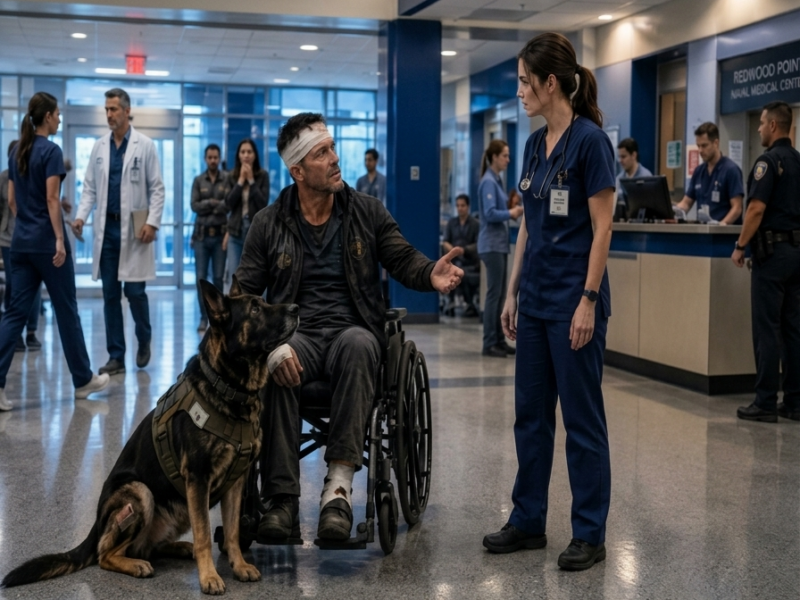
“Can you please help me?” the paralyzed Navy SEAL whispered from his wheelchair outside a crowded Boston hospital, but everyone kept walking past him until I stopped
The late October rain had turned the concrete apron outside Boston General Hospital into a cold, reflective mirror of ambulance strobes and amber sodium lights. It was twenty minutes past eleven, and the autumn wind off Massachusetts Bay carried a sharp, cutting chill that soaked through uniform cotton in seconds.
My name is Claire Vance. For six years, I have worked as a senior triage nurse on the night shift, guiding victims of highway multi-car pileups, gunshot wounds, and acute cardiovascular collapses through the swinging double doors of Trauma Room 4. You learn early in this profession to read the room: the frantic breathing of panic, the dull stupor of shock, the quiet resignation of someone who knows their clock has run out.
What I saw sitting near the emergency entrance, however, fit none of those categories.
He sat in a heavy, manual transport wheelchair parked right at the edge of the ambulance bay overhang, where the rain dripped continuously onto his shoulders. Passersby—medical residents rushing to sign out, security guards making their hourly rounds, visitors clutching paper coffee cups—filtered past him like water around a stone. Boston is a fast city, and a homeless man in a wheelchair near a hospital entrance is a sight most people train themselves to ignore.
“Can you please help me?” the paralyzed Navy SEAL whispered from his wheelchair outside the crowded hospital, his voice a gravelly rasp cut short by the biting cold.
Everyone kept walking past him until I stopped, swung my jacket over my shoulders, and knelt beside him on the wet pavement.
His face was drawn, pale, and covered in a week’s growth of dark beard, but his posture—even slouched in a wheelchair—retained a broad-shouldered, rigid discipline that did not belong to a permanent street dweller. His dark eyes were wide, bloodshot, and moving frantically between the glass entry doors and the dimly lit parking structure across the avenue.
“I’m Claire,” I said, putting a hand on his shoulder. “Sir, you’re shivering. Let’s get you inside where it’s warm.”
His hands trembled violently as he tried to reach the old flip phone hanging from a lanyard in his lap. His fingers, stiff from the cold and nerve damage, lacked the fine motor control to open the device.
“I just need someone to call my brother,” he stammered, his teeth chattering against each other.
I gently took the phone from his stiffened fingers. “I’ll dial it for you. What’s his number?”
The man stared at me. The frantic movement in his eyes stopped completely. He looked directly into my face, his dark irises reflecting the flickering blue neon of the hospital sign above us.
“I don’t remember,” he whispered softly.
Something about his voice bothered me. It wasn’t the confusion of dementia or the slurred disorientation of an overdose. There was no fear in his tone—only a sudden, intense recognition, as if he had just recognized a landmark after years in a desert.
“Alright,” I said, making a quick professional assessment. “First, we get you dry.”
I gripped the rubber handles of his wheelchair and pushed him inside through the sliding glass doors, bypassing the main waiting area where three dozen triage patients sat under the buzz of fluorescent lights. I maneuvered his chair down the quiet south wing toward Examination Room 7—an empty, sound-dampened room reserved for overflow psychiatric assessments and private consultations.
Inside, I pulled the privacy curtain closed and grabbed a stack of heated blankets from the warming oven in the corner. As I draped the heavy cloth over his chest and arms, I rolled up his rain-soaked navy canvas sleeve to place a blood pressure cuff around his bicep.
Beneath his left forearm, etched in faded blue ink, was a intricate tactical emblem: an eagle grasping a trident and an anchor, surrounded by the words SEAL Team 6 – Trident Operatives.
“You were a SEAL?” I asked, adjusting the velcro strap.
He nodded once, his eyes fixed on the linoleum floor. “Mason. Mason Reed.”
“Retired, Mason?”
His eyes dropped further. “Not exactly.”
Before I could ask what that meant, a sharp, single knock echoed off the laminate frame of the exam room door.
The curtain was yanked back without warning. A tall man wearing a dark tailored trench coat and a black leather driver’s cap stood in the doorway. He had a broad, square jaw, a pale scar cutting through his left eyebrow, and a thick, square radio earpiece coiled behind his ear.
He didn’t look at me. He looked straight at Mason. Then, his cold, gray eyes turned to meet mine.
“He’s not your patient, Nurse,” the man said. His voice was smooth, devoid of accent, and entirely devoid of emotion. “He wandered off from a long-term care facility down on Commercial Street. I’m his transport escort.”
I stood up straight, keeping my body positioned directly between the stranger and Mason’s wheelchair.
“This is a private examination space,” I replied, keeping my tone firm and even. “He came through my triage line. Until I run a full diagnostic panel and sign his release form, he remains under my care. If you’re his escort, where is your official identification and transport paperwork?”
The man’s expression hardened into a flat, dangerous line. He didn’t reach for a badge. Instead, his right hand slid four inches into the left breast fold of his dark coat.
“Walk away, Nurse,” he said softly. “You don’t want your name on this chart.”
Behind me, I felt a sudden, frantic tug at the hem of my scrub top. Mason had reached out with his left hand, his fingers hooking into the cotton cloth with a strength that belied his physical condition.
“Please,” Mason whispered. His voice cracked, trembling with raw, unadulterated terror. “Don’t let him take me. If I leave with him, I won’t make it to morning.”
I looked back at the man in the dark coat. “You heard him. Leave this room now, or I press the blue code button behind this desk and have hospital security and the Boston Police Department here in ninety seconds.”
The man stared at me for three long beats. He looked at the emergency call button on the wall, calculated the response time, and slowly withdrew his hand from his coat.
“You’re making a mistake,” he said quietly.
He turned on his heel and disappeared into the dimly lit hallway, his soft-soled boots making no sound against the tile floor.
I immediately reached for the door, pulled it shut, and threw the manual brass deadbolt into place. My heart was pounding against my ribs like a caged bird.
I turned back to Mason. “Who was that?”
Mason lowered his head into his trembling hands. The heated blanket sloughed off his shoulders, exposing his dark, salt-stained jacket.
“He’s a contractor,” Mason whispered, his voice barely audible over the hum of the ventilation system. “He works for the oversight committee.”
“What committee? Mason, what is going on? Why did you tell me you didn’t remember your brother’s phone number?”
“Because I don’t have a brother,” Mason said, looking up at me with eyes brimming with unshed tears. “Three years ago, my unit was deployed to a deep-water research facility thirty miles off the coast of Maine. The official Department of Defense press release said our primary transport vessel suffered a catastrophic hull breach during a storm. They told the families that seven operators—including me—were killed when the ship went down.”
I felt a cold chill slide down my spine, freezing the air in my lungs. “I remember that news story. It was on every network for a week.”
“That’s not what happened,” he whispered. “The ship didn’t sink because of a storm. We were ordered to board that platform to secure a classified bio-digital surveillance architecture. But when we got inside, we found out the architecture wasn’t foreign. It belonged to our own senior command.”
“A black site?” I asked, my voice barely a breath.
“A domestic intelligence monitoring network,” Mason corrected him softly. “We found records of illegal wiretaps, off-the-books dark accounts, and financial liquidations targeting American citizens. When my team leader realized what we were holding, he refused to hand the drives over. Ten minutes later, a tactical drone strike hit the platform.”
He grabbed his legs beneath the blanket, shaking his head bitterly. “My spine was severed by falling steel. Six of my brothers died in that room. I survived because the tide dragged me into a ballast tank. When they pulled me out of the water twelve hours later, they realized I was paralyzed from the waist down. They couldn’t put me on trial without revealing the project… so they erased me.”
“Erased you?”
“They assigned me a false identity, placed me in a private medical ward in Vermont, and kept me sedated for three years,” Mason said. “Two days ago, the nurse who was guarding my room made a mistake. She left the access key on the side table. I managed to get into a transport van, drove to the rail station, and came straight to Boston.”
Before I could digest the staggering impossibility of his story, the overhead fluorescent lights in Exam Room 7 flickered violently, dimmed to a dull amber wire, and went out completely, plunging the room into shadow.
A second later, the battery-powered emergency LED lights on the wall clicked on, casting a harsh, pale beam across the small room.
In the sudden silence, a sharp, digital chime echoed from Mason’s lap.
The old flip phone was lighting up. The small external LCD screen displayed a single, glowing line: UNKNOWN NUMBER.
“Don’t touch it,” Mason gasped, backing his wheelchair against the wall. “Don’t answer it!”
“We need to know who’s on the line,” I said. My hands were cold, but my mind was operating on pure adrenaline.
I picked up the small plastic phone, flipped it open, and pressed it to my ear.
“Hello? This is Nurse Vance at Boston General. Who is this?”
No one spoke. For five agonizing seconds, the only sound on the line was a low, rhythmic static, like the sound of wind sweeping across open water.
Then, a clear, digitized audio recording played through the speaker:
“If they find me, they already know about the nurse.”
The voice on the recording was crisp, resonant, and unmistakably Mason’s own voice—recorded weeks or months earlier.
My heart stopped beating. The blood drained from my face so quickly I had to lean against the examination table to keep my balance.
“Mason…” I whispered, turning the phone toward him. “What nurse?”
Mason looked up at me, tears spilling over his cheeks, his chin trembling in the pale LED light.
“You,” he whispered.
The metallic latch of the examination room door gave a sudden, sharp click.
Slowly, deliberately, the brass handle began to rotate downward from the outside.
“Move!” I hissed.
I didn’t pause to analyze the impossibility of the situation. I grabbed the hard plastic handles of Mason’s wheelchair, unlocked the side service door that led into the hospital’s old utility duct system, and shoved him through just as the primary lock on the exam room door sheared off with a violent metallic bang.
We burst into the service corridor—a narrow, brick-lined passageway built during the hospital’s original 1920s construction, lit only by low-wattage yellow maintenance bulbs spaced fifty feet apart.
“Where does this lead?” Mason panted, using his strong upper body to pull himself forward in the seat as I pushed with all my weight.
“To the old West Stairwell,” I said, my lungs burning as we sprinted down the narrow tile pathway. “It exits out near the old laundry docks on St. Margaret’s Way. Security never patrols it.”
Behind us, heavy footfalls began echoing down the brick tunnel—slow, measured, and coming closer with a terrifying, mechanical efficiency.
We slammed through the heavy reinforced fire door into the concrete stairwell. The air was frigid, smelling of damp lime and machine grease. I shoved the steel crossbar down to lock the door behind us, then grabbed Mason’s chair to navigate the steep concrete steps.
“Stop,” Mason said suddenly, reaching up to lock both rubber tires with his handbrakes.
“Mason, we can’t stop!” I cried out, listening to the heavy pounding against the fire door above us.
“Listen to me, Claire,” he urged, his face illuminated by the dim green emergency exit sign above the landing. He reached deep inside the inner lining of his salt-stained canvas coat, his fingers tearing through a hidden seam beneath his right armpit.
He pulled out a tiny, rectangular piece of brushed titanium—no larger than a postage stamp, sealed in clear, waterproof resin.
“I’ve carried this for three years,” he whispered, pressing the cold piece of metal into my palm.
“What is it?” I asked, looking down at the dark object. My hand was shaking so hard the drive almost slipped through my fingers.
“The complete digital manifesto of Operation Sentinel,” Mason said, his eyes burning with intense, desperate clarity. “The real operational logs from that offshore platform. The bank accounts, the shell corporations, and the names of every high-ranking military officer and politician who ordered my team erased.”
“Why give this to me?” I stammered, trying to press it back into his hands. “Mason, you need to take this to the Department of Justice! To the press!”
“They monitor every federal courthouse from Maine to Virginia,” he said bitterly. “If I walk into a federal building, I’m processed into a closed psychiatric ward before I can cross the lobby. I didn’t come to Boston to hide, Claire.”
Footsteps echoed from the floor above us—the heavy, rhythmic crunch of tactical boots descending the concrete steps, two flights up.
Mason closed his hand firmly over mine, squeezing my fingers around the titanium drive until the sharp edges bit into my skin.
“I didn’t come here for my brother,” he said, staring at me with a look that chilled me to the bone.
I stared at him, my mind racing through a hundred impossible questions. “Then why did you come? Why Boston General?”
“Because three weeks before my unit was deployed to that platform,” Mason whispered, “my team commander gathered us in the briefing room at Little Creek. He knew the mission was compromised. He knew we were walking into a trap. He told me that if everything fell apart… if the chain of command turned dark… there was one nurse at Boston General Hospital he trusted with his life.”
The footsteps on the concrete stairs above us stopped instantly.
The silence that followed was suffocating, heavy enough to crush the air straight out of my lungs.
“Who?” I gasped, my voice barely a thread of sound. “Mason… who was your commander?”
A voice spoke from the shadows of the upper landing—crisp, refined, and entirely familiar.
“He’s talking about me, Claire.”
The door at the top of the stairwell swung open fully, allowing the harsh white light of the second-floor hallway to flood down the concrete steps.
Standing on the landing ten feet above us was a man dressed in a sharp charcoal suit. He had short, iron-gray hair, a silver tie clip, and a gold signet ring on his right hand. His posture was impeccably straight, his expression calm, sad, and strangely nostalgic.
My jaw dropped. The floor beneath my feet felt as though it had dissolved into thin air.
It was Dr. Marcus Kane.
Dr. Kane was the former Chief of Surgery at Boston General—a world-renowned neurosurgeon, a decorated former Navy Captain, and a man whose hands I had assisted in over two hundred delicate spinal procedures over the past six years. Six months ago, he had been admitted to our own ICU following a severe motor vehicle collision on Route 128 that had left him with extensive thoracic trauma. I had personally monitored his arterial lines for three weeks until his discharge.
“Dr. Kane?” I whispered, my voice cracking. “You… you were his commander?”
“Commander of the 4th Special Operations Medical Detachment,” Dr. Kane corrected me softly, his voice echoing off the cold concrete walls. He slowly walked down three steps, keeping his hands visible, resting them lightly on the iron handrail. “I built that team, Claire. I handpicked Mason. I handpicked every man on that research platform.”
“You ordered the drone strike,” Mason snarled from his wheelchair, his upper body tensing as if he were preparing to throw himself down the stairs. “You sat in the command trailer on the support ship and watched the thermal feeds while the roof collapsed on us!”
“I did what was necessary to preserve the stability of the command structure, Mason,” Kane replied, his voice devoid of anger, carrying only a terrifying, clinical detachment. “If those files had been leaked three years ago, fifty senior officers would have been court-martialed. Our entire intelligence network in Eastern Europe would have collapsed overnight.”
Kane turned his dark eyes onto me. “Claire… you are one of the finest trauma nurses I have ever had the privilege of working alongside. You have saved hundreds of lives in these operating rooms. Please… do not destroy your life for a ghost.”
“He isn’t a ghost, Marcus!” I shouted, stepping in front of Mason’s chair, holding the titanium drive tight against my chest. “He’s a living, breathing man! A soldier you left to die in a ballasted tank!”
“He is a casualty of a war you do not understand,” Kane said calmly. He reached into his suit jacket and pulled out a small, high-frequency digital signal jammer, clicking the top switch. “Every cell tower within four hundred yards of this building is now dead. You cannot call the police. You cannot upload that file to the cloud. Give me the drive, Claire. Walk back to Trauma Room 4, sign your shift log, and go home to your family.”
“And what happens to Mason?” I demanded.
Kane looked down at the paralyzed man in the wheelchair with a look of genuine, haunting pity. “Mason will be transferred to a private care facility in New Mexico. He will be made comfortable. He will want for nothing. But his story ends tonight.”
“No,” Mason whispered.
With a sudden, violent movement, Mason unlocked his handbrakes, grabbed the iron handrail beside his chair, and used the full strength of his massive shoulders to heave his wheelchair sideways, blocking the narrow concrete landing completely.
“Run, Claire!” Mason roared. “GO!”
I didn’t hesitate.
I turned and bolted down the final flight of concrete stairs toward the sub-basement laundry docks, my rubber-soled nursing shoes squeaking against the wet steps. Behind me, I heard the metallic crash of Mason’s wheelchair slamming against the iron handrail, followed by the heavy, muffled thud of Dr. Kane’s operatives bursting through the fire doors above.
“Secure the nurse!” Kane’s voice commanded from the landing, stripped of all warmth. “Do not shoot her, but do not let her exit the building with that drive!”
I slammed through the double crash doors at the base of the stairwell, bursting into the sprawling, cavernous expanse of the hospital’s subterranean laundry facility.
The air was hot, suffocatingly humid, and filled with the thunderous, rhythmic roar of thirty industrial washing machines processing thousands of pounds of soiled linen. Giant canvas carts filled with sheets, towels, and surgical gowns lined the concrete aisles like a labyrinth of white cloth.
I ducked behind a row of towering commercial dryers, pressing my back against the hot steel plating, my heart hammering against my ribs like a sledgehammer.
I looked down at my hand. The small piece of titanium was slippery with my own sweat.
Think, Claire, think, I told myself, closing my eyes for three deep, ragged breaths.
Kane had jammed the local cellular network, meaning I couldn’t broadcast the file using my phone. The main hospital Wi-Fi was likely monitored by the internal IT department, which Kane had helped design three years ago. But there was one network in the hospital that operated on an isolated, hardened fiber-optic trunk—a network built specifically to withstand catastrophic cyberattacks and power grid failures.
The Organ Transplant Direct Relay in the Sub-Basement 2 Cryo-Lab.
It was an automated, high-speed federal data link connected directly to the United Nations Organ Sharing Network and the Massachusetts Department of Public Health. It didn’t pass through the hospital’s local routers; it ran on a direct underground cable straight to the state telecommunications hub in downtown Boston.
To get there, I had to cross three hundred yards of unlit utility tunnels beneath the laundry facility.
Footsteps entered the laundry room.
Through the gaps between the giant canvas carts, I saw three men dressed in tactical grey uniforms moving in a sweeping formation. They held suppressed handguns raised at shoulder height, their tactical flashlights slicing through the clouds of steam rising from the drainage floor.
“Claire,” Dr. Kane’s voice echoed through the industrial PA system, bouncing off the concrete ceiling. “You are acting out of emotional panic. You are an officer of the medical community. You know as well as I do that some operational secrets are required to maintain civil order.”
I stayed crouched low, sliding through the narrow gap between two linen carts, moving quietly toward the red double doors marked UTILITY ACCESS – AUTHORIZED PERSONNEL ONLY.
“If you attempt to access the lower levels,” Kane’s voice continued over the speakers, “my security team will be forced to initiate a bio-hazard lockdown of the south wing. Two hundred innocent patients in the recovery wards will be trapped without primary power or ventilator backup. Is that a trade you are willing to make, Nurse Vance?”
My breath hitched in my throat. He was threatening to kill power to the ICU.
He’s bluffing, I thought, panic cold and razor-sharp in my belly. He wouldn’t risk two hundred civil casualties… or would he?
He had ordered a drone strike on his own unit. He wouldn’t blink at a hospital ward.
I reached the red utility doors, pushed them open just six inches, and slipped through into the pitch-black utility tunnel beyond.
The air dropped twenty degrees instantly. The tunnel was cold, wet, and lined with massive high-voltage electrical conduits and steaming hot water pipes that hummed with immense energy.
I ran through the darkness, using my hand along the cold concrete wall to guide me, my eyes slowly adjusting to the dim red safety LEDs set into the floor every thirty feet.
After two minutes of breathless running, I reached the heavy stainless-steel door of the Cryo-Lab. I swiped my master nursing access badge through the electronic reader.
The lock chimed softly: ACCESS GRANTED.
I threw the door open, stepped inside, and slammed it shut, throwing the heavy manual vault wheel into place.
The Cryo-Lab was stark, blindingly bright, and clinical. Row after row of stainless-steel cryogenic storage tanks sat under bright white LED panels, surrounded by heavy computer terminals monitoring organ viability metrics.
In the center of the room sat the Primary Relay Console—a military-grade server rack fitted with a thick glass touch-screen interface displaying a glowing blue status indicator: STATE ORGAN RELAY NETWORK – ONLINE / DIRECT FIBER.
I rushed to the console, my cold fingers flying across the touch screen. I navigated past the organ donor registry menus, bringing up the manual administrative diagnostic sub-system.
On the side of the terminal chassis was a small, sealed access panel marked EMERGENCY DATA PORT.
I pulled the waterproof resin off the titanium drive, exposing the thin gold contact pins. I slid the drive into the emergency slot.
The screen flashed bright amber:
UNAUTHORIZED HARDWARE DETECTED.
FILE STRUCTURE: MILITARY ENCRYPTED – CLASS 4.
INPUT DECRYPTION ACCESS PASSPHRASE:
My blood ran ice-cold. “A passphrase…” I whispered. “Mason… what was the passphrase?”
I hadn’t asked him. He hadn’t told me.
Outside the heavy stainless-steel vault door, a sharp, metallic thump echoed through the thick metal.
BOOM.
They were using a hydraulic spreader to force the vault door from its hinges.
“Claire!” Dr. Kane’s voice came through the external intercom speaker on the wall. “You have thirty seconds before my men breach that frame. The passphrase for that drive is known only to three people—two of whom are dead, and one who is currently lying unconscious in the stairwell.”
My mind raced through everything Mason had said to me outside the emergency room entrance.
I just need someone to call my brother…
I don’t remember…
There was one nurse in Boston he trusted…
Why me? Why would Mason’s team leader—a man I had only treated six months ago in the ICU—tell his surviving operator to seek out a triage nurse at Boston General?
I closed my eyes, recalling the three weeks Dr. Kane had spent in my ICU ward after his car crash.
I remembered his charts. I remembered his arterial line monitors. But most of all, I remembered the delirium he had suffered during his third night of post-operative recovery—when his fever had spiked to 104 degrees, and he had gripped my forearm, weeping into the dark room, repeating a single phrase over and over again.
It hadn’t been delirium. It had been confession.
I opened my eyes, turned back to the terminal keyboard, and typed nine characters into the prompt:
T-R-I-D-E-N-T-6
The console screen instantly transformed from amber to a brilliant, dazzling green:
PASSPHRASE VERIFIED: TRIDENT 6 OPERATIONAL LOGS.
INITIATING COMPREHENSIVE BROADCAST TO MASSACHUSETTS STATE POLICE, FEDERAL BUREAU OF INVESTIGATION, AND DEFENSE CRIMINAL INVESTIGATIVE SERVICE…
PROGRESS: 15%… 32%… 54%…
BANG!
The stainless-steel vault door exploded inward with a deafening metallic screech, sending heavy iron bolts flying across the room like shrapnel.
Through the swirling cloud of gray smoke and hydraulic fluid, Dr. Kane stepped into the lab, his face pale, his charcoal suit covered in dust, holding a black 9mm pistol pointed directly at my head.
“Step away from the terminal, Claire,” Kane said, his voice flat and dead.
The progress bar on the bright green screen behind me hit 72%… 81%…
“It’s over, Marcus,” I said, standing my ground directly in front of the console screen, blocking his line of sight to the direct transfer port. “The file is broadcasting straight to the FBI field office in Chelsea. In forty seconds, every federal agent in New England will have the complete operational log of your offshore platform.”
Kane’s jaw clenched. The calm, refined facade he had maintained all night finally cracked, revealing the desperate, cornered monster beneath.
“Do you have any idea what you’ve done?” he whispered, his eyes wide with wild, chaotic energy. “That network was protecting thousands of active assets across three continents! You’ve destroyed forty years of national security architecture for six dead operators who signed up to die for their country!”
“They signed up to protect their country!” I screamed back, tears of anger burning my eyes. “Not to be murdered by their own commander to hide an illegal wiretap network!”
Kane raised the weapon higher, aligning the front sight directly between my eyes. His finger tightened slowly on the trigger.
“History is written by the survivors, Claire,” he said softly. “You won’t be one of them.”
CHIME.
The terminal behind me emitted a loud, resonant double-tone that echoed through the small concrete lab:
BROADCAST 100% COMPLETE.
DATA ACKNOWLEDGED BY FEDERAL BUREAU OF INVESTIGATION – BOSTON FIELD OFFICE.
AUTOMATED EMERGENCY TACTICAL BEACON ACTIVATED.
Before Kane could press the trigger, the sudden, deafening wail of federal emergency sirens erupted from the street level above the hospital, penetrating down through two layers of subterranean concrete.
Bright blue and red strobe lights flashed through the high frosted glass security windows near the ceiling of the Cryo-Lab.
“COMMANDER!” one of Kane’s tactical operators screamed from the ruined vault doorway, his voice filled with panic. “We have state police cruisers blocking the main ambulance bay! Federal Marshals are inside the lobby! We have to move NOW!”
Kane looked at the green screen behind me, then at the flashing red beacon on the wall. He knew the math. The transfer was complete, the signal was verified, and his air cover had vanished into thin air.
Slowly, his hand began to tremble. The pistol in his grip wavered, dropping three inches.
“You…” Kane rasped, staring at me as if he were seeing a ghost. “You actually did it.”
“Drop the weapon!” a booming voice thundered through the smoke of the outer corridor.
A squad of ten heavily armed FBI SWAT operators burst through the shattered vault door, their assault rifles raised, tactical laser sights painting Kane’s chest in a dozen bright red dots.
“DROP THE WEAPON NOW! ON THE FLOOR! HANDS BEHIND YOUR HEAD!”
Kane looked down at his gun, then up at the ceiling, letting out a long, shuddering breath. The pistol slipped from his fingers, clattering loudly against the stainless-steel floor. He slowly raised his hands and dropped to his knees as four federal agents tackled him to the floor, slapping heavy steel restraints onto his wrists.
I dropped against the side of the console, my legs completely giving out beneath me. I collapsed onto the cool tile floor, burying my face in my hands as the adrenaline that had sustained me for two straight hours drained out of my body, leaving me shuddering with uncontrollable sobs.
A senior FBI agent knelt beside me, laying a heavy black tactical coat over my shivering shoulders.
“Nurse Vance?” he asked gently. “I’m Special Agent Miller. You’re safe now. The building is secure.”
“Mason…” I gasped out, looking up through my tears. “The man in the wheelchair… in the stairwell…”
“Our medical team has him,” Agent Miller said, giving me a reassuring nod. “He’s alive, Nurse. He’s receiving emergency care right now.”
The storm had cleared by five o’clock in the morning, leaving behind a crisp, spotless sky that glowed with the first faint shades of gold and violet over Boston Harbor.
I stood on the fourth-floor balcony of Boston General’s West Wing, holding a paper cup of black tea, watching the sun lift above the Atlantic horizon. Below, the ambulance bay was filled with flashing blue lights from twenty federal law enforcement vehicles, state police cruisers, and news vans that had lined up along St. Margaret’s Way.
The news cycle was already exploding across national networks: Former Navy Captain and Renowned Surgeon Arrested in Deep-State Intelligence Conspiracy; Paralyzed Veteran Rescued from Secret Custody.
Dr. Marcus Kane and fourteen members of his private oversight network were currently locked in federal holding cells in downtown Boston, facing charges of treason, multi-count murder, and unlawful detention of military personnel.
A soft, rhythmic squeak of rubber wheels against the linoleum floor sounded behind me.
I turned around.
Mason was sitting in a clean, high-backed hospital wheelchair, wearing a dark blue fleece jacket and clean grey sweatpants. His beard had been trimmed, his dark hair was washed, and his eyes—once filled with the desperate, frantic terror of a hunted man—were clear, calm, and steady.
“They told me I’d find you up here,” he said softly, rolling his chair out onto the balcony beside me.
“How are you feeling?” I asked, setting my tea down on the railing and kneeling beside his chair, taking his hand in mine.
“Better than I’ve felt in three years,” Mason said, looking out at the golden sunlight reflecting off the ocean water. “The federal prosecutors spent three hours with me this morning. They verified every byte of data on that titanium drive. The families of my six brothers… they finally know the truth. Their names are being restored to the official memorial roll at Little Creek next month.”
Tears touched the corners of my eyes. “I’m so glad, Mason. I’m so, so glad.”
Mason looked down at our joined hands, his thumb gently rubbing the back of my fingers.
“When I was sitting outside in the rain last night,” he whispered softly, “watching everyone walk past me… I thought about giving up. I thought about dropping that flip phone in the storm drain and letting Kane’s men take me away.”
He looked up into my eyes, his face illuminated by the bright morning light.
“Why didn’t you?” I asked.
“Because my team leader was right,” Mason said, a soft, genuine smile touching his lips for the first time. “He told me that no matter how dark the world gets… no matter how corrupt the people at the top become… there are still people who choose to heal instead of destroy. People who listen when someone asks for help.”
He reached into his jacket pocket and pulled out a small, silver dog tag attached to a beaded chain—his own original tag, recovered from the federal evidence locker an hour earlier.
He gently placed the cold silver piece into my palm, wrapping my fingers tightly around it.
“I want you to keep this,” he said.
“Mason, I can’t take your dog tags…”
“You saved my life, Claire,” he said firmly, his eyes fixed on mine with unwavering gratitude. “And more than that… you saved my brothers’ honor. That tag belongs to you now.”
I looked down at the shiny silver tag resting against my palm, then back up at the ocean stretching out toward the horizon.
The rain had stopped. The shadows had vanished. And for the first time in three years, the paralyzed soldier beside me was finally free.
The end.









