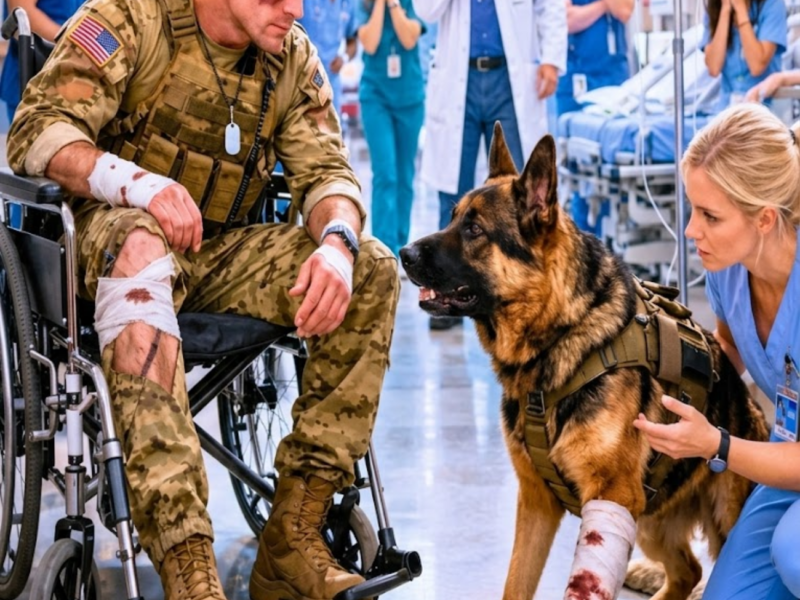
“Can you help me?” the wounded SEAL captain whispered from a wheelchair outside the emergency entrance at Naval Medical Center San Diego
The silence in my small, third-floor apartment was thicker than the heat coming off the pavement outside. I stared down at the glossy photograph in my hands, my thumb tracing the white border where the paper had begun to curl. It was an image from a lifetime ago—a dusty clearance road outside Fallujah, lit by the harsh midday sun of a country I had sworn never to see again. In the center of the frame stood four members of the 752nd Explosive Ordnance Disposal Company, covered in gray grit, smiling weary, triumphant smiles behind a half-buried, disarmed pressure plate.
And every single one of their faces had been aggressive, deliberate black ink drawn through them with a heavy permanent marker.
Except mine.
I flipped the photo over. The handwriting on the back was sharp, angular, and pressed so hard into the paper that the pen had almost torn through: You should have stayed dead, Sergeant Hayes.
My heart knocked against my ribs with the familiar rhythm of impending detonation. I stepped back from the threshold, securing the heavy deadbolt with a quiet click, then slid the chain into place. My pulse raced, but my body moved with the automatic, practiced precision of a combat soldier. I didn’t turn on the overhead lights. Instead, I retreated to the shadows near the kitchen counter, picking up my phone as it buzzed violently on the laminate surface.
The unknown number flashed across the screen. I pressed the phone to my ear, holding my breath, hearing only the low static of an encrypted line.
“Emma,” a man’s voice whispered, gravelly and distorted through a voice-scrambler. “Captain Reed lied to you about what happened that night.”
The line went dead with a sharp tone.
I pulled the device away from my ear, staring at the blank screen. Down in the courtyard below my window, a dog barked—a sharp, rhythmic alarm that sounded unnervingly like Ranger. I crept toward the window, pulling the edge of the blind back just enough to peer down into the streetlight-dappled alley.
Nothing moved except the swaying branches of an eucalyptus tree and the low, creeping fog rolling off San Diego Bay.
Ten minutes later, I was back in my car, navigating the slick streets toward the rear security gates of Naval Medical Center San Diego. I shouldn’t have been going back. My shift had ended three hours ago, and every instinct honed through two tours in Al Anbar province screamed at me to cut my ties, pack a bag, and vanish into the desert. But five years of living as Emma Carter—a quiet, unremarkable trauma nurse who spent her weekends tending to potted ferns and reading medical journals—hadn’t erased the core of Sergeant Emma Hayes. You don’t leave a man behind, especially not a man who holds the missing piece of a ghost you’ve been running from for half a decade.
The emergency department ambulance bay was quieter now, lit by the stark halogen floodlights that made every surface look clinical and bleached. I parked near the loading dock, slipped my hospital badge around my neck, and walked briskly through the automatic double doors.
Nurse Miller was at the central desk, sifting through patient charts. She looked up, her eyebrows knitting together in surprise. “Emma? What are you doing back? Did you drop your keys again?”
“I left my shift notes in the trauma bay,” I lied seamlessly, keeping my voice steady. “And I wanted to check on the transfer patient from earlier—Captain Reed.”
Miller’s face softened with a mix of sympathy and fatigue. “The SEAL? He’s up on Four East, room 412. But good luck getting in. The Navy police put a hold on his room an hour ago. Some suit from NCIS came in asking questions, and Reed isn’t talking to anyone.”
“NCIS?” I asked, keeping my posture relaxed. “Did something happen?”
“Just official business, I guess. Though if you ask me, the guy looks like he’s expecting an ambush.” Miller shook her head. “His dog is still down in the transport room, by the way. Security won’t let the animal upstairs, and the handler they called hasn’t arrived yet.”
My blood ran cold. “Ranger is alone?”
“In the holding office near the basement ramp. He won’t stop whining, Emma. Nobody can get near him.”
I didn’t wait for Miller to say anything else. I turned toward the service stairs and took them two at a time, descending into the cool, concrete realm of the hospital basement. The air down here smelled of ozone, industrial detergent, and cold damp stone.
As I reached the door marked Transport Operations, a low, guttural growl vibrated through the steel panel.
“Easy, Ranger,” I said softly, knocking twice on the door before pushing it open.
The Belgian Malinois-German Shepherd mix was crouched by the corner of an overturned desk, his body tense, his dark eyes locked onto the door frame. The moment he saw me, his posture shifted. His ears flattened slightly, not in aggression, but in immediate recognition. He let out a high-pitched, desperate whine and lunged forward, stopping just inches from my knees, his broad head thumping against my scrub pants.
“Good boy,” I murmured, dropping to one knee and letting him catch my scent. His hot breath brushed my wrist, right over the jagged scar where a piece of shrapnel had torn through my flesh in 2018. “Where is he, boy? What did he tell you?”
Ranger didn’t just sit; he nudged his nose hard into my pocket.
I reached in and pulled out what he was smelling—a small leather-bound notebook I always carried to jot down patient vitals. But there was something else tucked into the spine. A small, metallic USB drive, heavy and cold, etched with a serial number I recognized instantly.
It was an Army EOD tool tracking tag. Mine. The one that was supposed to have burned in the wreckage of my Humvee five years ago.
“How did he get this?” I whispered to the empty room.
Ranger let out a low bark and turned his head toward the far door—the one leading to the subterranean utility tunnels that connected the hospital to the military compound next door. The heavy iron door was unlatched, resting open by a fraction of an inch.
Before I could process the implication, footfalls echoed down the concrete corridor outside. They weren’t the hurried, soft-soled clicks of hospital staff. They were measured, heavy, and deliberate—the tactical walk of trained men.
I grabbed Ranger’s tactical harness. “Quiet,” I commanded in a breath.
The dog froze, his body rigid against mine. I slunk behind the shadow of a heavy linen cart just as the main office door swung open.
Two men stepped inside. They were dressed in dark, unbranded suits, their jacket cut wide enough to conceal shoulder holsters. One of them held a handheld frequency scanner that emitted a rhythmic, high-frequency chirp.
“The signal was coming from down here,” the taller man said, his voice devoid of any regional accent. “The handler said the dog was locked in this room.”
“Find the nurse,” the second man replied, his hand resting casually inside his jacket. “Reed gave her the drive before we could clear the bay. If she’s read the files, she knows about Project Archangel. Clear the floor, and don’t leave a trace.”
My throat went bone dry. Project Archangel.
That was the classified operation code for the Fallujah deployment—the one that was wiped from official military records after my unit was hit. We were told it was a rogue insurgent cell. We were told our coordinates had been leaked by local militia.
Everything I had believed about the worst day of my life was a lie.
I squeezed Ranger’s harness gently, signaling him to heel. We backed away millimeter by millimeter into the shadows of the utility tunnel. But as I pulled the heavy door shut behind us, the metal hinge gave a tiny, dry squeak.
“There!” one of the suits shouted.
“Run!” I hissed to Ranger.
We burst into the dark, echoing dampness of the underground tunnel just as the sound of a suppressed pistol shot shattered the subterranean quiet, sending concrete splinters flying off the wall behind my head.
The tunnel was a labyrinth of steam pipes, thick electrical conduits, and dripping drainage lines running beneath the hospital complex. It was pitch black save for the amber emergency lights placed every fifty yards. Ranger sprinted beside me, his nails clicking against the wet iron grates of the floor, his head turning every few seconds to ensure I was still behind him.
My lungs burned as I forced my legs to move faster than they had in years. The adrenaline surged through my system, washing away the calm facade of Nurse Emma Carter and bringing back the icy focus of Sergeant Hayes.
Behind us, the heavy footfalls of the two men echoed through the concrete tube, accompanied by the low rumble of a radio transmission. They weren’t just searching; they were flanking. They knew the layout of the underground network better than I did.
“Left, Ranger!” I whispered.
The dog veered hard into a narrow maintenance alcove tucked behind a massive water boiler. I pressed my back against the burning hot metal of the boiler, pulling Ranger in close against my legs. I held my hand firmly over his snout, but the dog didn’t need the instruction—he was a seasoned war dog, his breathing shallow and completely silent.
Through the gaps in the iron piping, I saw the flashlight beams sweeping across the concrete walls.
“She couldn’t have gone far,” a voice echoed through the tunnel. “Check the access hatches to the administrative building. The director wants the drive secured before the morning shift arrives. If the girl resists, handle it. She’s already listed as dead in the DoD database anyway. Nobody is going to investigate a ghost.”
Listed as dead.
The words struck me like a physical blow. When I woke up in a military hospital in Germany five years ago, I had been told my identity was scrubbed to protect me from retaliation by the insurgent cell that destroyed my unit. I had been given a new identity, a new social security number, and a small stipend to build a quiet life as a civilian nurse. I thought I was being protected.
I wasn’t being protected. I was being hidden.
The flashlights faded down the main corridor, the sound of the men’s footsteps growing distant as they turned toward the administrative wing.
I reached down and pulled the metallic USB drive from my pocket. It was a ruggedized, military-grade flash storage device equipped with a hardware encryption keypad. I stared at the tiny buttons. It required an eight-digit pin.
What pin would Mason Reed use?
I thought back to the photograph—the three men, the damaged convoy, the dusty road outside Fallujah. The date stamped on the corner of that photo was October 14th, 2018.
10-14-2018. Eight digits.
My fingers shook as I punched the numbers into the tiny keypad. A miniature LED light on the corner of the drive blinked twice, then shifted from amber to a solid, steady blue.
Unlocked.
“Good boy, Mason,” I breathed.
I plugged the drive into my phone using an OTG adapter I kept on my key ring for shift reports. The phone screen flickered, instantly overridden by a secure file directory containing dozens of scanned documents, audio logs, and satellite imagery.
I clicked on the top file: AFTER_ACTION_REPORT_FALLUJAH_ARCHANGEL.PDF.
The document bore the seal of the Defense Intelligence Agency, marked with red TOP SECRET // RESTRICTED ACCESS banners across every page. I scrolled down past the military jargon until my eyes caught a paragraph highlighted in yellow:
…Target vehicle carrying Sergeant E. Hayes and EOD Team 4 was not struck by an enemy IED. Detonation was achieved via remote command signal originating from tactical command element Alpha-6. Objective: Elimination of EOD personnel prior to cataloging recovered ordnance at Site 12. Command authority granted under Operation Archangel…
My breath hitched in my throat. Tears of pure, hot rage stung my eyes.
It wasn’t an insurgent bomb. It wasn’t a ambush.
Our own command had blown us up. They had sent my team to clear that ordnance site, and when we found whatever was hidden down in those vaults, they detonated the explosives from three miles away to make sure none of us ever talked about what was down there.
Mason Reed hadn’t been part of the cover-up. He had been the commander of the extraction unit sent to sweep the area afterward. He was the one who pulled my broken, bleeding body out of that crater when the command element had ordered him to let the site burn.
“He saved me,” I whispered into the dark. “He disobeyed orders and saved my life.”
Ranger let out a low growl, his body tensing against my hip.
I looked up from the screen. Standing at the end of the maintenance alcove, backlit by the distant emergency light, was a third man. He wasn’t wearing a suit. He wore tactical trousers, a dark fleece jacket, and an ear-piece. In his right hand, he held a silenced Sig Sauer P226 pointed directly at my chest.
“Hand over the drive, Sergeant Hayes,” the man said, his voice flat, completely devoid of emotion. “You’ve been a dead woman for five years. It’s time to make it official.”
Ranger didn’t wait for my command. With an explosive, guttural roar, the 90-pound combat dog launched himself forward, leaping off the concrete wall and diving straight for the shooter’s neck.
The gunshot was muffled—a soft, hollow thwip-thwip—followed immediately by the thrashing sound of a heavy body hitting the concrete floor. Ranger’s jaws locked onto the man’s tactical jacket near his left shoulder, tearing the fabric as the assassin cried out and dropped his weapon.
“Ranger, hold!” I screamed, lunging forward.
I kicked the dropped pistol across the wet floor, sending it sliding into the darkness beneath the steam pipes. The assassin fought back with terrifying efficiency, driving his heavy elbow into Ranger’s ribs. The dog let out a sharp yelp but refused to release his grip until I grabbed the man’s tactical collar, driving my thumb hard into the nerve cluster behind his ear.
The man collapsed, temporarily paralyzed by the shock of the strike.
I grabbed Ranger’s harness, pulling him back. “Come on!”
We sprinted back down the main utility corridor, but the gunfire had already alerted the other two men. Flashlight beams cut through the steam ahead of us, blocking our route back toward the hospital basement.
“This way!” I gritted my teeth, turning left toward a rusted iron ladder that climbed vertically up a ventilation shaft. “Up, Ranger!”
The dog hesitated for half a second before scrambling up the narrow, steep stairs leading to the upper maintenance deck. I followed right behind him, my hands slick with grease and cold sweat. As my head cleared the lip of the shaft, I reached down, grabbed a heavy iron pipe wrench hanging from a utility tool rack, and slammed it down onto the padlock securing the access hatch.
The lock shattered, and I threw the hatch closed just as a bullet slammed into the underside of the iron door with a deafening CLANG.
We were on the roof of the four-story administrative wing.
The cool San Diego sea breeze hit my face like a cold shock, smelling of salt and aviation fuel from the nearby naval air station. The sky was dark, heavy clouds blocking out the moon, leaving the city lights shining in the distance like a scattered blanket of gold.
At the far end of the roof, leaning against the concrete parapet with a crutch tucked under his arm, was Captain Mason Reed.
He was still in his hospital gown and trousers, a heavy navy blanket wrapped over his shoulders. His face was pale, drawn with immense pain, but his blue eyes were sharp and fixed on the access door behind me.
“You took your time, Hayes,” Mason said, his voice weak but laced with that dry, unbreakable military humor.
“You could have given me a heads-up about the execution squad, Captain,” I panted, running to his side. Ranger immediately shoved his head under Mason’s hand, his tail giving two hard, relieved wags.
Mason smoothed his hand over the dog’s ears. “If I told you in the ER, you would have run. You spent five years hiding behind a nurse’s badge, Emma. I needed you to see the truth before you ran again.”
I pulled out the blue-lit USB drive and held it up between us. “They blew us up, Mason. Alpha-6… Command gave the order.”
Mason’s jaw tightened, the muscle working under his stubbled skin. “I know. I was on the comms channel when the signal was sent. I heard the order come down from General Vance’s headquarters. They told my team the site was compromised and that all personnel inside were KIA. But when we arrived, I saw you crawling out of the rubble.”
“Why did you keep this drive?” I demanded, my voice cracking with five years of buried grief. “Why keep me in the dark for five years?”
“Because Vance wasn’t just a rogue officer,” Mason said, looking toward the dark horizon of the bay. “He was running an illegal arms-trafficking operation out of the uncataloged ordnance depots in Iraq. Your team didn’t just find bombs down there, Emma—you found the manifests bearing his signature. If I brought this forward five years ago, Vance would have killed you in your hospital bed in Germany. I had to wait until he was nominated for the Joint Chiefs. I had to wait until he brought all his key operatives into one place.”
“And where is he now?” I asked.
Mason looked down at his watch. “He’s at North Island Naval Air Station, less than three miles from here. He’s attending a private defense intelligence gala tonight. In two hours, he boards a flight to Washington to be confirmed by the Senate.”
The sound of metal groaning came from the access door behind us. The heavy iron hatch was bulging outward as the men downstairs used a thermal torch to cut through the hinges. Sparks shot into the night air through the seam.
“They’re coming through,” I said, drawing myself up. “We don’t have a way off this roof.”
Mason smiled—a cold, fierce, terrifying smile that reminded me exactly why this man commanded the most elite special operators in the world.
“Who said we were running?” Mason reached into his blanket and pulled out a heavy tactical radio. He clicked the channel switch three times. “Ghost-1, this is Reed. We are green on the roof. Bring the bird.”
From the blackness above the bay, a low, thrumming vibration shook the air.
It wasn’t a civilian medevac helicopter. It was an MH-60 Black Hawk, running completely dark—no navigation lights, no strobe—descending like a shadow out of the low-hanging cloud cover. The wash from its twin rotors hit the rooftop with violent force, sending loose gravel and dust spinning into the air.
The thermal torch shattered the lock on the access door, and the heavy metal hatch blew outward. The two suited men burst onto the roof, their weapons drawn.
“Drop your weapons!” the lead suit screamed over the deafening roar of the helicopter.
Mason didn’t move. He stood tall on his one good leg, supported by his crutch, staring down the barrels of their guns with total indifference.
From the open side door of the descending Black Hawk, two armed operators in unmarked tactical gear aimed high-powered rifles down at the roof. Twin red laser dots painted the chests of the two suits.
“I don’t think so,” Mason shouted over the rotor wash. “This isn’t your operation anymore.”
The suits froze, realizing instantly that they were hopelessly outgunned. The side door of the Black Hawk swung wider, and a hoist cable descended directly toward us.
“Hayes, get on!” Mason ordered, shoving a harness into my hands.
“What about you?” I yelled back.
“Ranger and I are going together!” Mason hooked his own harness to the central winch, then wrapped his arms around the dog, who braced himself against his master’s chest as if he had done this a hundred times before.
I strapped myself into the secondary line. The winch groaned, and in a single smooth motion, the three of us were lifted off the gravel roof, hanging in the open sky above San Diego Bay while the two suits stood helpless below, watching us vanish into the fog.
Ten minutes later, the Black Hawk touched down on a private helipad hidden in the industrial shipyards of Coronado.
The interior of the tactical hangar was lit by halogen work lights. Three men in civilian clothes, but holding military demeanor, stood waiting alongside a table loaded with encrypted laptops, satellite communications gear, and tactical equipment.
Mason detached his harness, wincing as his injured leg touched the concrete floor. One of the operators immediately brought him a folding chair, but Mason waved him off, leaning heavily against the tactical table.
“Hayes,” Mason said, gesturing to the man behind the laptops. “This is Miller. Former DIA. He’s been helping me track Vance’s off-book accounts for three years.”
Miller nodded to me, his hands flying across a mechanical keyboard. “The drive you brought off the hospital floor contains the final piece we needed—the original digital signature from the Fallujah command module. It links Vance directly to the detonation order that killed your unit.”
I stepped closer to the screens, watching lines of code and decoded military transmissions scroll past. “Is this enough to arrest him?”
“Arrest him?” Miller let out a bitter laugh. “Vance has two former Secretaries of Defense in his pocket. If we hand this over to the Department of Justice, it will spend six months in classified review before it’s quietly shredded, and you’ll both end up in a fatal car accident.”
“Then what are we doing?” I asked, looking from Miller to Mason.
Mason reached down to a wooden crate beside the table and pulled out a black tactical vest, tossing it onto the table in front of me. Alongside it lay an Army EOD patch—my old unit patch, clean and unfrayed.
“We aren’t giving it to the government,” Mason said, his voice dropping an octave, cold as ice. “We’re going to the gala. General Vance is giving his acceptance speech in front of two hundred flag officers, international diplomats, and news cameras. We are going to broadcast this drive onto every screen in the ballroom.”
I looked down at the vest, then at the patch. For five years, I had believed I was a survivor who needed to hide to stay safe. I had built a life out of quiet routines, hiding my skills, hiding my scars, pretending that Sergeant Emma Hayes was dead and buried under the sand of Iraq.
I picked up the patch and pressed the velcro backing against the chest of the tactical vest.
“How do we get into North Island?” I asked.
Mason’s eyes glinted in the harsh light of the hangar. “We don’t need to break in. I’m still an invited guest.”
The Grand Ballroom of the Officers’ Club at Naval Air Station North Island was a sea of dress whites, crystal chandeliers, and polished brass. High-ranking officers, politicians, and defense contractors moved through the room with champagne glasses in hand, their laughter drowned out by the gentle chamber music playing from the balcony.
At the center podium, beneath a massive American flag, stood General Thomas Vance.
He was a tall, silver-haired man in his late fifties, his chest covered in rows of ribbons and medals. He smiled warmly at the crowd, adjusting his glasses as he prepared to deliver his address.
“Ladies and gentlemen,” Vance’s voice echoed through the high-powered sound system. “As I prepare to take on the responsibility of serving on the Joint Chiefs of Staff, I am reminded that the safety of our nation relies not just on our strength, but on our absolute commitment to truth and duty…”
Outside the glass double doors of the ballroom, I stood in the darkened gallery, wearing my dark service uniform beneath a heavy trench coat. Ranger sat at my heel, his head held high, his nose twitching at the scent of food and expensive perfume coming from inside.
Beside me, Mason sat in a wheelchair, dressed in his crisp Navy Dress Whites, his medals gleaming under the soft lighting of the corridor.
“Is Miller in position?” Mason whispered into his wrist mic.
“In position,” Miller’s voice came back through our earpieces. “I’ve overridden the audiovisual control room. The feed is locked to my terminal. You have three minutes before their IT team realizes what’s happening.”
“Do it,” Mason said.
Inside the ballroom, General Vance raised his hand to speak again, but before he could utter another word, the clear, bright screens flanking the podium flickered.
The chamber music cut out instantly.
In its place, a sharp, metallic static echoed through the room’s speakers, followed by the deep, digitally unencrypted voice recording from October 14th, 2018:
…Command element Alpha-6, this is Vance. Confirm target location of EOD Team 4… Target confirmed inside vault… Execute protocol Archangel. I repeat, detonate charges now…
Gasps erupted across the room. Officers froze with their glasses halfway to their lips. General Vance’s face turned from flushed red to an absolute, chalky white in less than two seconds. He lunged toward the podium control panel, smashing his hand against the kill switch, but the screens remained locked.
The satellite maps, the casualty lists, and the bank transfer records showing tens of millions of dollars moving from foreign arms dealers into offshore accounts bearing Vance’s name began scrolling across the huge screens in crystal-clear high definition.
“Turn it off!” Vance screamed into his microphone, his voice echoing frantically through the hall. “Security! Turn that off now!”
The heavy oak doors at the back of the ballroom swung open.
Mason wheeled himself slowly through the entrance, with me walking steady and erect right beside him, and Ranger pacing proudly at my hip. The crowd parted like the Red Sea, shocked silence falling over the two hundred guests as they recognized the decorated SEAL commander and the woman walking beside him.
I pulled off my trench coat, revealing my Army uniform with the EOD badge and the name tag reading HAYES pinned over my heart.
Vance gripped the edges of the podium, his knuckles white, his eyes wide with a mix of terror and disbelief. “You… you were dead,” he stammered, forgetting that his microphone was still live. “Hayes… you died in Fallujah.”
“I survived, General,” I said, my voice echoing clearly off the high marble walls of the room. “And so did the truth.”
Two armed Naval Criminal Investigative Service agents stepped out from the side doors of the ballroom. They didn’t move toward us. They walked straight up the steps of the stage, stopping on either side of General Vance.
“General Thomas Vance,” the lead agent said, pulling a set of steel handcuffs from his belt. “By order of the Judge Advocate General, you are under arrest for treason, murder, and high crimes against the United States.”
Vance looked frantically around the room, searching for a single friendly face among the sea of high-ranking military commanders staring back at him with disgust and fury. Finding none, his head slumped, and he offered no resistance as the steel cuffs clicked around his wrists.
As the agents led Vance down the podium steps, he passed directly in front of us. He stopped for a brief second, looking into my eyes.
“You ruined everything,” he whispered bitterly.
“No,” I replied softly, looking him dead in the eye. “We just cleared the field.”
Three weeks later, the morning sun was rising over San Diego Bay, painting the water in brilliant shades of pink and orange.
I stood on the pier near the hospital, holding two paper cups of hot coffee. Ranger sat beside me, his long tail sweeping slowly across the damp wooden planks.
Footsteps sounded behind me—the slow, rhythmic thud of a man walking with a cane.
Mason stopped beside me, taking one of the coffee cups with a nod of thanks. He was out of his wheelchair now, wearing comfortable civilian clothes, though his left leg was still held in a heavy medical brace.
“The JAG tribunal wrapped up the preliminary hearings yesterday,” Mason said, taking a sip of the hot liquid. “Vance is going to spend the rest of his life in Leavenworth. Every officer involved in Archangel has been relieved of command.”
I looked out over the quiet water, watching a navy frigate head out to open sea. “And what about Sergeant Emma Hayes?”
Mason reached into his jacket pocket and pulled out a small leather case, handing it to me.
I opened it. Inside was a silver discharge medallion and a set of official papers bearing the seal of the Department of the Army.
“Fully reinstated, fully cleared, and honorably discharged with full benefits,” Mason said softly. “Emma Hayes is officially alive again. You don’t have to hide anymore, Emma. Not from the past, and not from anyone else.”
I felt a warm, long-absent weight lift off my chest. The scar on my wrist didn’t tingle with ghost pain anymore; it was just a mark of where I had been, not who I was forced to be.
Ranger let out a quiet bark and pressed his head against my hand. I smiled, reaching down to scratch him behind his ears.
“So,” I said, looking up at Mason as the morning light caught his eyes. “What does a retired SEAL captain and a former bomb technician do with the rest of their lives?”
Mason looked out at the ocean, a real, genuine smile breaking across his face for the first time since I met him.
“Whatever we want, Emma,” he said. “Whatever we want.”
The end









