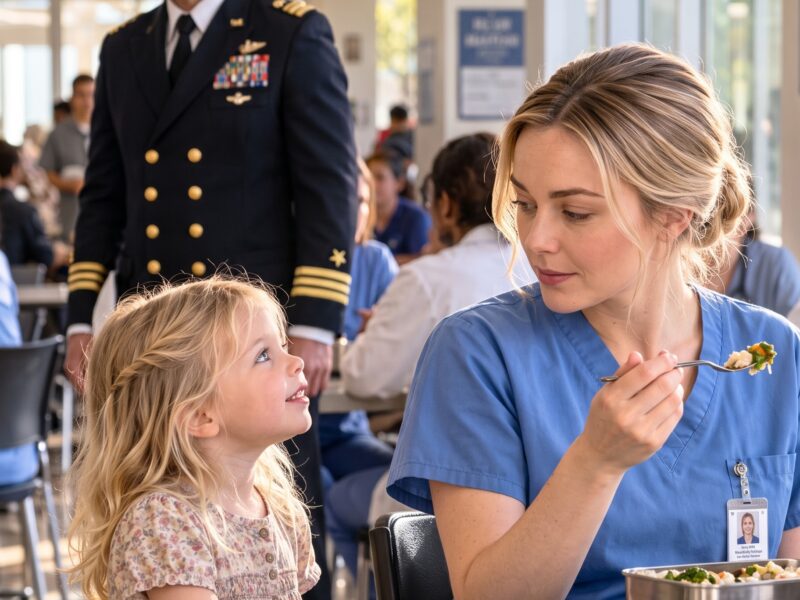
“Can you cook?” the Navy SEAL’s toddler asked me in the hospital cafeteria, while his exhausted father watched with cold suspicion
The linoleum floor of the Harborview Medical Center cafeteria smelled faintly of bleach, over-steeped chicory coffee, and the sterile chill that drifted down from the surgical suites on the third floor. It was 6:45 in the morning. My shift had technically ended forty-five minutes earlier, but the post-op charting on an unstable diabetic patient had kept me chained to the nurse’s station until the morning crew trickled in with their travel mugs and hurried greetings.
I had been a registered nurse at Harborview for exactly nine days. Nine days of learning the labyrinthine corridors, memorizing door codes, and trying not to look like the terrified twenty-four-year-old newcomer whose scrub tops were still stiff from the plastic packaging. My name badge read Maya Lin, RN – Pediatric Acute Care.
I was carrying a paper cup of black coffee toward an empty booth by the tall glass windows overlooking the gray expanse of Puget Sound when I saw them standing near the register.
The man was impossible to miss. He stood with the rigid, calculated stillness of someone who spent his life expecting the ground to detonate beneath his boots. His black hooded sweatshirt was drawn tight over shoulders that looked broad enough to carry a field pack across a mountain range. Even in the casual civilian clothes, his posture screamed active duty. His hair was cropped down to the scalp at the sides, his jaw shadowed by dark stubble, and his pale gray eyes swept the cafeteria with an exhausting, relentless vigilance.
Clinging to the fabric of his dark cargo pants was a little girl who could not have been older than three.
She was wearing a yellow knitted cardigan that was slightly too large for her, the sleeves rolled twice at the wrists. Her skin had that translucent, waxy pallor I had seen too many times over the past week—the look of a child whose bone marrow was working too hard or whose heart was beating against an invisible resistance. Dark purple crescents bruised the skin beneath her large hazel eyes.
As I took a step toward the tray-return station, the little girl let go of her father’s pant leg, took three unsteady steps across the polished floor, and looked up at me.
“Can you cook?” she asked.
Her voice was surprisingly clear, though it carried the thin, reedy rasp of shallow breathing.
I stopped in my tracks. A warm, spontaneous smile touched my lips, easing the tension behind my temples. “A little,” I replied, keeping my tone light, conversational, the way they taught us in clinical rotations to prevent pediatric patients from retreating into their shells. “I can make scrambled eggs that aren’t too burnt, and I make decent toast.”
Before the girl could respond, a shadow crossed the fluorescent light above us.
The man moved with terrifying, soundless speed. In a fraction of a heartbeat, his massive frame was positioned directly between me and the child, cutting off my line of sight as if I were an approaching sniper on an open street.
“Emma,” his voice was low, flat, and hard as granite. “Don’t bother the nurse.”
The air between us went brittle. He did not look at me with the weary embarrassment of an apologetic parent; he looked at me with cold, surgical suspicion. He scanned my badge, my lanyard, my face, and the coffee in my hand, cataloging every detail as a potential threat.
“I’m sorry, sir,” I murmured, stepping back reflexively. “She wasn’t bothering me at all. I was just—”
“She’s fine,” he cut in, not raising his voice, which only made the dismissal sharper. “Come on, Emma.”
He reached down to take her small hand, but Emma didn’t immediately turn. She peered around her father’s thigh, her small fingers clutching the seam of his pocket.
“Mommy used to make pancakes,” she whispered.
The words were so soft they barely carried over the hum of the nearby ice machine, but the effect on the man was instantaneous. His jaw muscles clenched until a tendon rippled against his cheek. His broad shoulders hitched upward by a millimeter, frozen in an ancient, unhealed agony.
Something sharp twisted in my chest. I had heard that specific tone of quiet longing before. I had lived inside it for three long years. Without thinking about protocol or the cold wall of hostility radiating from the father, I dropped down onto the balls of my feet so that I was level with the little girl’s eyes.
“What kind did she make?” I asked softly, keeping my hands resting gently on my own knees.
Emma’s face brightened, a tiny spark of life breaking through her exhaustion. “Heart-shaped ones. With the little strawberry noses.”
“Emma, enough.” Cole’s voice dropped an octave. It wasn’t cruel, but it had the unmistakable bite of military command.
The little girl flinched, pulling her chin into the oversized collar of her yellow cardigan. Her small right hand moved defensively across her chest, her fingers curling tightly around her left wrist.
That was when I saw it.
Tucked just beneath the blue plastic hospital identification band that marked her as an outpatient was a narrow band of braided purple paracord. It was worn, frayed at the edges from water and skin oil, but fastened by a distinctive, handmade silver clasp shaped like a folded crane.
My breath caught in my throat. The cafeteria around me seemed to recede into a muted hum.
A silver crane clasp.
“Is your mommy here at Harborview, sweetie?” I asked, my voice suddenly trembling, the professional distance I had practiced for months crumbling into dust.
Cole stepped forward, his boot coming within inches of my scrub pants. His gray eyes were dead and glacial. “That is none of your business, Nurse Lin. Step away from my daughter.”
I looked up into his face. There was a raw, ferocious protective instinct there, but beneath the armor, there was a man drowning in grief.
“You’re right, sir,” I managed to say, rising slowly to my feet, my heart pounding a strange, erratic cadence against my ribs. “I apologize. Have a good morning, Emma.”
The little girl offered a faint, hesitant wave as her father turned her around and guided her firmly toward the elevators. I stood by the waste bins, the lukewarm paper cup burning through my fingers, watching the heavy metal doors slide shut behind them.
I couldn’t shake the image of the purple cord.
Three years ago, on a rainy Tuesday in November, I had sat on the living room floor of a small apartment in Bremerton with a spool of military-grade paracord and a pair of pliers. My older sister, Sarah, had been preparing to leave on what she claimed was an extended civilian nursing contract with a humanitarian mission. She had always been the brave one, the brilliant trauma nurse who chased crises while I stayed behind, finishing my prerequisites and worrying about everything.
Before she walked out the door with her duffel bag, I had clipped that silver crane onto the purple braid and fastened it around her wrist. For protection, I had told her through tears. Cranes carry prayers across oceans.
Two months later, two men in dark suits arrived at my door to tell me that Sarah’s rental vehicle had skidded off a mountain pass during a flash freeze in rural Idaho. The car had burned on the rocks below. There were no remains to bury, only a closed metal case and a certified death certificate.
I spent the rest of the morning trying to convince myself that purple paracord bracelets were common. Military families bought them at surplus stores. The crane was a common charm. It was a coincidence. A cruel trick played by an exhausted mind on a rookie nurse who missed her sister.
Yet, when my twelve-hour night shift began again at seven that evening, my feet moved toward the pediatric wing with an urgency I could not explain.
The pediatric ward at Harborview was quiet after visiting hours ended. The long hallways were lit by low amber nightlights, and the gentle ping of infusion pumps echoed off the pastel walls. As I checked the assignment board near the central station, I saw the name written on Room 412: Emma Cole. Attending: Dr. Sterling. Status: Observation / Cardiac Workup.
My pulse jumped.
I walked down the corridor toward Room 412. The door was cracked open an inch, spilling a sliver of light across the blue linoleum. I paused outside, my hand resting against the doorframe, listening.
Down at the far end of the hall, near the emergency stairwell, a man’s voice echoed in low, harsh tones. Lieutenant Cole was pacing beneath an exit sign, his phone pressed hard against his ear.
“I don’t care what the committee decided, Colonel,” he was saying, his voice thick with suppressed fury. “Her platelet count is dropping again, and the cardiac ultrasound showed fluid accumulation. She needs the experimental protocol. Sarah’s notes specifically stated that the synthetic enzyme would counteract the cellular degradation… No, I will not stand down. She’s three years old. She’s all I have left.”
I stared at his silhouette. His free hand was rubbing the back of his neck, his tall frame bowed as if under an impossible load.
Sarah’s notes.
My hands began to shake violently. I turned away from the hallway and stepped quietly into Room 412.
Emma was not in the high hospital bed. She was sitting in the wide, vinyl armchair by the rain-streaked window, her small knees pulled up against her chest, staring out into the dark city lights reflecting off the bay. The room was cold, filled with the rhythmic click-hiss of an oxygen wall-port that had been left on low flow.
She turned her head as the hinges whispered. When she saw me in my navy-blue scrubs, her little mouth formed an ‘o’.
“Are you leaving too?” she asked.
The question was so small, so weighted with an unnatural familiarity with loss, that it felt like a cold blade slipping between my ribs.
I walked across the room, pulled the small rolling stool beside the armchair, and sat down so our eyes were level.
“Why would you think that, Emma?” I asked, keeping my voice as steady as my trembling lungs would allow.
“Everybody does,” she replied simply, resting her chin on her knees. “The other nurses with the pink shirts left. And Daddy says people only stay for a little while before their orders change.”
Her small left arm was resting on the armrest. The purple bracelet sat loosely against her wrist, the silver crane tarnished slightly near the wingtips.
“May I look at your bracelet?” I whispered.
Emma hesitated, then slowly extended her arm. “Mommy gave it to me before she went to the stars. She said it was magic. She said her sister made it with a wish inside.”
The breath left my body in a silent, jagged gasp.
I reached out with trembling fingertips, touching the cool silver of the crane. With a gentle twist of my thumb, I turned the clasp over.
There, etched into the flat underbelly of the silver metal with the clumsy, unpracticed stroke of an electric engraving pen I had bought at a hardware store when I was twenty-one, were seven tiny characters:
S & M – 11/14
Sarah and Maya. November 14th. The date our mother had died, and the date we had promised we would always find each other, no matter where the world scattered us.
“Emma,” my voice broke, a single hot tear spilling over my lash line and tracing down my cheek. “Did… did your mommy work here?”
Emma nodded solemnly. “She worked in the big room where the sirens come. She saved Daddy when the bad building fell down. Daddy said Mommy was an angel who carried him out.”
My mind spun into a terrifying, incomprehensible vertigo. An accident in Idaho? A burning rental car on a mountain pass?
Sarah had never worked in Idaho. Sarah was an emergency trauma nurse who had spent five years at Harborview before she supposedly left for private humanitarian relief. And if she had saved a Navy SEAL from a collapsing building…
“Where did you get that?”
The voice cracked through the doorway like a rifle shot.
Lieutenant Cole stood in the threshold. His phone was gone. His face had gone entirely white, the skin around his eyes pulled tight with a dangerous, volatile panic.
He crossed the room in two massive strides, his hand shooting out to grip Emma’s wrist, pulling her arm away from mine.
“I asked you to stay away from her,” he hissed, his eyes blazing down at me. “Who the hell are you? Who sent you in here?”
“Nobody sent me,” I stood up from the stool, my knees shaking so badly I had to brace my hand against the windowsill. “Cole, please… look at me.”
“Emma, go to the bathroom and wash your hands. Right now,” he commanded without taking his eyes off me.
Emma scurried off the chair, frightened by the raw electricity in the room, and vanished behind the small wooden door of the adjoining restroom. The latch clicked shut.
Cole took half a step closer, towering over me, his fists clenched at his sides. “That bracelet belonged to my wife,” he said, his voice dropping into a ragged, guttural whisper that shook with an agonizing intensity. “She died saving my life during an unsanctioned tactical evacuation in Helmand. She was attached to our unit as a critical-care flight nurse. Her name was Sarah.”
I stood there, tears streaming freely down my face now, unable to draw air into my chest.
“Sarah died three years ago,” Cole continued, the words tearing out of him as if each one were dragged over broken glass. “And she left me one request before she bled out in the belly of a Pave Hawk helicopter. She made me promise that if anything happened to her, I would make sure Emma never forgot how much her mother loved her. She told me to keep that damn bracelet on her wrist until she was old enough to understand.”
He reached into the inner pocket of his heavy jacket, his hand visibly shaking, and pulled out a worn, tri-folded piece of notebook paper. It was creased, yellowed at the folds, the edges reinforced with clear cellophane tape.
“She wrote this in the field hospital before we boarded the bird,” Cole whispered, his gray eyes shining with unshed tears. “For Emma. And for someone else she said I would never find.”
He thrust the paper toward me, as if daring me to challenge the reality of his grief.
I took the paper with numb fingers and unfolded it beneath the fluorescent lamp.
The upper half was covered in colorful, clumsy crayon drawings of three small birds sitting on a telephone wire. Beneath it, written in slanted, elegant blue ballpoint ink, were four lines of familiar, hurried script:
My sweet Emma, my brave little bird—if you are reading this, Daddy is carrying you home. Always remember the heart-shaped pancakes, always wear the crane, and if the dark gets too loud, find your Auntie Maya. She has my eyes, and she has my heart.
My vision blurred into a sea of salt.
My sister hadn’t died in a car crash on an icy road. She had died in the dust of a foreign war, wearing a flight suit, tending to wounded warriors whose names were classified. And the government had handed me an empty metal box and a forged death certificate to keep the mission buried.
Cole stared at me, his brow furrowing as he watched the utter destruction unfolding across my face. He saw the way my hand traced the loops of the cursive letters, the way my breathing hitched in identical cadence to the woman he had buried in an unmarked military cemetery.
“How do you know her handwriting?” he asked, the suspicion in his voice suddenly giving way to a terrifying, creeping realization. “Who are you?”
I looked up at him, my fingers pressing the folded letter against my scrub top, right over my pounding heart.
“My name is Maya,” I choked out. “Sarah didn’t skydive off an Idaho bridge, Lieutenant. She was my sister. And I’ve spent three years mourning a lie.”
The silence that followed inside Room 412 was heavier than any silence I had ever known in a hospital room. Outside, the rain lashed against the reinforced glass, drumming a relentless, frantic tattoo against the night.
Lieutenant Cole didn’t move. He didn’t blink. The blood seemed to drain from his facial features entirely, leaving his skin the color of wet ash. His eyes dropped from my face down to my hospital badge—Maya Lin—and then to the trembling hands that held Sarah’s letter.
“Maya…” he whispered. The name sounded foreign on his tongue, like a ghost he had read about in an ancient text but never expected to breathe the same air with. “Sarah said… she told me her sister was an art student in Seattle. She said you hated blood. She said you fainted when she cut her thumb on a melon knife when you were teenagers.”
A wet, ragged laugh slipped past my lips despite the tears choking my throat. “I did. I hated it. I spent two years studying graphic design because I couldn’t stand the thought of sterile rooms. But after they told me she was dead… after they handed me that flag and told me she burned on an Idaho mountain… I couldn’t sit in a studio anymore. I couldn’t draw pretty things while people were dying in the dark. I enrolled in nursing school three months after her funeral.”
Cole took a slow step backward, his boots squeaking against the wax. He reached behind him, blindly finding the edge of the rolling tray table, bracing his weight against it as if an invisible wave had struck him in the chest.
“They told me she had no living family,” Cole said, his voice raw, hollowed out by disbelief. “When JSOC handled her final effects, the casualty assistance officer reported that Sarah’s immediate kin—her parents—were deceased, and that her younger sister had relocated abroad and cut contact. They classified her entire service jacket under a Special Access Program. I tried… God help me, Maya, I tried to find you after we landed at Dover. I had this letter. But every database was a dead end. Her personnel file had been scrubbed clean. It was like she never existed outside the hospital where she was recruited.”
“Recruited?” The word felt vile, unnatural. “Sarah was a civilian trauma nurse. She worked here, in Harborview’s Level 1 ER, for five years.”
“She was recruited by a private defense medical contractor—Aegis Global Logistics—attached to a joint task force,” Cole said, his voice dropping into a conspiratorial whisper as he glanced toward the closed door. “They were looking for nurses with advanced flight certifications and zero military records to staff non-official cover field surgical units. Plausible deniability. If an operation went bad on foreign soil where we weren’t supposed to be, the Pentagon could claim civilian contractors were operating independently.”
He closed his eyes for a second, his chest rising and falling in heavy, ragged motions.
“She wasn’t just my medic, Maya,” Cole added, his voice cracking with a fierce, quiet ache. “She was my wife. We were married in a small chapel outside of Munich, two months before Emma was born. We kept it off the military records to keep her off the target packages. When our compound in the Kunar Valley was overrun by irregular militia, Sarah refused to board the primary evacuation bird because she was still pumping blood into my femoral artery. She held my leg closed with her bare hands while the tail rotor was on fire. A secondary mortar hit the hangar wall. The shrapnel…”
He stopped. He didn’t need to finish the sentence. I knew trauma. I knew what hot steel did to human flesh.
The bathroom door creaked open.
Emma stood in the gap, her small hands wet, looking between the two of us with wide, observant eyes. She sensed the tectonic shift in the room. Children who grow up around trauma possess an emotional radar sharper than any piece of diagnostic equipment.
“Daddy?” she whimpered, her bottom lip trembling. “Why is the nurse crying?”
Cole dropped down instantly, dropping his head into his hands for a fraction of a second before lifting a face that was completely transformed. The cold, impenetrable operator was gone; in his place was a father clinging to the edge of a cliff.
“Come here, Em,” he murmured, opening his arms.
Emma ran across the room and buried her face into his neck. Cole wrapped his massive arms around her, burying his nose into her soft, brown hair. Over her shoulder, his gray eyes met mine.
“Emma,” Cole said softly, his voice trembling with a reverence that made my knees weak. “Do you remember the stories Daddy told you about Auntie Maya? The one who drew the little birds on your wall in Virginia?”
The little girl pulled back, her hazel eyes locking onto mine with an intensity that took my breath away. She tilted her head, studying my face, my dark eyes, the shape of my jaw that mirrored the sister who had brought her into the world.
“Auntie Maya?” Emma whispered.
“Yes, baby,” Cole said, a tear finally escaping his lashes and disappearing into his stubble. “This is her. Mommy sent her.”
Emma didn’t hesitate. She squirmed out of her father’s grip, took two wobbly steps toward me, and wrapped her thin, frail arms around my knees.
When I knelt and pulled her against my chest, the scent of her hair—lavender baby shampoo and the sterile tang of the hospital—unlocked a dam inside me that had been sealed for three years. I held my sister’s daughter against my heart, weeping silently into her yellow cardigan, while Cole stood over us, his broad hand resting gently, protectively on the crown of her head.
For three minutes, the room was a sanctuary. The lies, the forged documents, the grief that had hollowed out my twenties—all of it seemed to dissolve beneath the simple warmth of a three-year-old child’s embrace.
Then, Emma’s body stiffened in my arms.
It wasn’t a sudden jolt; it was a slow, rigid spasm. Her breath caught in her throat with a wet, bubbling gasp.
“Emma?” I pulled back instantly, my clinical training overriding my emotion in a split second.
The little girl’s eyes were rolling upward, fluttering rapidly beneath pale lids. Her lips, which had been faintly pink moments ago, were turning a terrifying shade of dusky blue.
“Cole!” I yelled, lifting her effortlessly into my arms and lunging toward the hospital bed. “Hit the blue code button by the headwall! Now!”
Cole didn’t hesitate. His military training snapped back into place. His fist slammed into the emergency call lever, setting off the shrill, staccato klaxon that echoed down the pediatric corridor.
CODE BLUE PEDIATRIC – ROOM 412. CODE BLUE PEDIATRIC – ROOM 412.
I laid Emma flat on the thin mattress, ripping open the snaps of her yellow cardigan. Her small chest was heaving with paradoxical motion—the sternum pulling inward while her belly distended, a classic sign of severe airway compromise or catastrophic cardiac failure.
Her pulse was thready, running at an astronomical rate—easily over 200 beats per minute.
“She’s in supraventricular tachycardia,” I barked, grabbing the pediatric bag-valve mask from the wall bracket and hooking the green tubing to the oxygen regulator, twisting the dial until the ball floated at fifteen liters. “Get her legs elevated! Cole, keep her airway straight!”
The door to Room 412 burst open.
Three nurses, two respiratory therapists, and the on-call pediatric resident came charging through the opening with the red crash cart. Leading them was Dr. Victor Sterling, the senior pediatric cardiologist whose name was on Emma’s admission chart.
Sterling was a man in his late fifties, his silver hair immaculate despite the hour, his eyes sharp and calculating behind horn-rimmed glasses. He took in the scene in an instant—me bagging the child, Cole holding Emma’s lower extremities, the monitors flashing bright crimson alarm banners.
“What happened here?” Sterling demanded, shoving his stethoscope into his ears. “Nurse Lin, step back from the bed. This is an ICU-level response.”
“She experienced a sudden cardiac collapse following an SVT event,” I said without letting go of the silicone mask. “Heart rate is 210, O2 saturation is 78% on room air, skin is mottled. She needs six milligrams of adenosine rapid IV push, or she’s going to arrest!”
Sterling didn’t look at the monitor. He looked at Cole, his jaw tight. “Lieutenant Cole, I told you she needed to remain fully sedated in the PICU. What were you doing in here with an acute-care floor nurse?”
“Treat my daughter, Victor!” Cole’s voice was a terrifying roar that rattled the IV poles. “Push the damn drug!”
The pediatric resident scrambled to draw the clear liquid from the tiny glass vial. “Adenosine drawn, six milligrams! Flushing with ten CCs of normal saline!”
“Push it,” Sterling said coldly, though his eyes never left mine.
The resident injected the medication through the peripheral line in Emma’s right hand and slammed the saline flush behind it.
For five terrifying, agonizing seconds, the cardiac monitor went flat.
A straight, unbroken green line stretched across the black screen. The only sound in the room was the desperate, shallow hiss of the oxygen regulator and the sound of my own breath catching in my throat.
Come on, Emma. Come on, sweet girl.
Beep.
A single, wide QRS complex broke the horizontal line.
Beep.
Another followed. Then another, settling into a steady, rhythmic sinus rhythm at 110 beats per minute.
Emma’s chest relaxed. The dusky blue tint faded from her lips, replaced by a pale, exhausted peach. Her eyelids fluttered, and she slipped into a deep, drug-induced sleep.
The room exhaled a collective, ragged breath. The respiratory therapist quickly secured a high-flow nasal cannula beneath her nostrils, while the resident began taping down the lines.
Dr. Sterling pulled the stethoscope from his ears, his expression dark and unreadable. He stepped toward the foot of the bed, his gaze fixing on me with an intensity that had nothing to do with standard medical oversight.
“Nurse Lin,” Sterling said, his voice deceptively smooth, dripping with an authority that sounded more like a threat. “You are off your assigned floor. You have an unstable outpatient in an unmonitored room without physician orders. Step out into the corridor. Immediately.”
Cole stepped between us, his massive frame blocking Sterling from reaching me.
“She saved my daughter’s life, Doctor,” Cole said, his voice deadly low. “She doesn’t take orders from you regarding where she stands.”
Sterling met Cole’s gaze without flinching. There was something cold and bureaucratic in the doctor’s posture—a man who was entirely comfortable wielding power behind closed institutional doors.
“Lieutenant Cole,” Sterling said softly, adjusting his glasses. “You are here under a classified Department of Defense medical waiver. Your daughter’s treatment is governed by protocol SAP-44. If you interfere with the clinical administration of this hospital, I will have the military police escort you off the premises before the sun rises, and Emma will be transferred to a closed federal facility in Maryland.”
Cole’s hands curled into white-knuckled fists. The vein on his forehead throbbed with lethal intent.
I reached out, placing my hand gently on the back of Cole’s forearm. The touch was light, but the message was clear: Stand down. Not here. Not yet.
Cole looked down at my hand, saw the pale, steady determination in my eyes, and slowly lowered his shoulders.
“I’m leaving the room, Dr. Sterling,” I said, meeting the older physician’s gaze with every ounce of steel Sarah had ever passed down to me. “I am going to document this resuscitation in the EHR system. Every milligram. Every second.”
Sterling’s eyes narrowed by a fraction of a millimeter. A flicker of genuine apprehension crossed his features before he recovered his polished veneer.
“You will document nothing until I have reviewed the telemetry strips, Nurse Lin,” Sterling replied. “Go back to your floor.”
I turned and walked out into the corridor, my sneakers silent on the linoleum.
As I reached the nurse’s station, my mind was racing through the medical terminology Sterling had dropped like a casual bomb. Protocol SAP-44. It wasn’t a standard clinical trial code. It was a military Special Access Program designation.
Sarah hadn’t just died in the desert. She had brought something back with her. Something that was currently ticking inside Emma’s blood—and Dr. Victor Sterling was not here to heal the child. He was here to keep her locked inside a cage.
The staff breakroom on the fourth floor was dark save for the green glow of a vending machine and the pale neon light spilling from the emergency exit sign across the hall.
It was 3:15 a.m.
I sat at the laminate table with a cold cup of chamomile tea between my palms, staring at the screen of my personal smartphone. For the past two hours, using my institutional credentials, I had been digging through the archived clinical records of Harborview Medical Center from four years ago.
Everything related to Sarah Lin had been wiped.
Her employee ID number produced an error code: RECORD RESTRICTED – LEVEL 4 CLEARANCE REQUIRED. Her clinical notes from the emergency department had been reassigned to generic pseudonyms. It was a digital ghost town.
The heavy door of the breakroom swung open without a sound.
Cole slipped inside, his broad frame moving with the eerie silence that made my pulse jump. He wore a dark naval fleece now, zipped to the throat, his face cast in deep shadows. He turned the deadbolt on the interior door handle, checked the blinds that looked out onto the hallway, and then pulled out the metal folding chair across from me.
“She’s asleep,” Cole said, his voice rough with exhaustion. “The resident gave her a low-dose sedative. Sterling left the floor twenty minutes ago. He took an elevator down to the administrative wing in the basement.”
“Cole, what is happening to Emma?” I asked, leaning forward, unable to contain the terror that had been building behind my ribs. “That wasn’t just a pediatric SVT episode. I saw her lab panel on the crash cart. Her white cell count is abnormally elevated, but there are no bands. Her inflammatory markers are through the roof, and her liver enzymes are failing. It looks like… it looks like acute organ rejection, but she’s never had an organ transplant.”
Cole rubbed his face with his calloused hands. When he lowered them, his gray eyes looked twenty years older.
“She doesn’t have an organ rejection, Maya,” he whispered. “She has a cellular payload.”
I stared at him, my mind struggling to bridge the gap between medicine and the dark world he inhabited. “What does that mean?”
“Five years ago,” Cole began, his voice barely louder than the hum of the refrigerator, “Aegis Global Logistics was contracted by the Defense Advanced Research Projects Agency—DARPA—to develop a rapid-clotting, synthetic cellular stabilizer. It was designed for special operations forces operating behind enemy lines without access to fresh whole blood. A microscopic biological vector that could be injected into a catastrophic wound to immediately seal internal hemorrhaging and accelerate tissue regeneration.”
My nursing background kicked in, analyzing the theoretical physiology. “A synthetic bio-scaffold. If it worked, it would save thousands of lives on the battlefield.”
“It didn’t work,” Cole said grimly. “Not the way they intended. In animal trials, the synthetic vector mutated. Instead of staying localized to the wound site, it integrated into the host’s genetic code. It caused an autoimmune cascade—the body’s immune system began recognizing its own vascular endothelium as a foreign pathogen. It killed every primate they tested it on within eighteen months.”
“Then why would they—”
“They didn’t give it to Emma,” Cole cut me off, his voice trembling with a terrifying blend of rage and sorrow. “They gave it to Sarah.”
The cold tea in my cup suddenly felt like ice in my hands. “What?”
“During the attack on the surgical outpost in Kunar,” Cole explained, his knuckles turning white against the laminate table, “an experimental storage vessel containing the primary synthetic culture was breached by mortar fire. Sarah was in the clean room, operating on an operator whose chest was blown open. She absorbed an aerosolized dose of the vector while she was shielding the patient with her own body.”
Tears pricked behind my eyes, hot and furious. That was Sarah. Always throwing herself over the blast, always taking the fire so someone else could draw another breath.
“The military command wanted to quarantine her in a bio-containment facility in Germany,” Cole said. “They treated her like an asset, an infected lab specimen. But Sarah knew what that meant. She knew they would dissect her cellular degradation until she died on an isolation table. With the help of three guys from my team, I broke her out of the field hospital. We got her onto an unmarked commercial transport to Frankfurt, and then brought her back to the States under forged papers.”
“And Emma?” I asked, my voice barely a whisper.
“Sarah was four months pregnant when she was exposed,” Cole whispered, his voice cracking entirely. “She didn’t know it yet. The vector crossed the placental barrier. When Emma was born, she didn’t just inherit Sarah’s eyes, Maya. She inherited the mutated biological marker. For the first two years of her life, Emma’s immune system was protected by Sarah’s maternal antibodies. But as those antibodies degraded… Emma’s body began attacking itself.”
The horror of the situation crashed down upon me like a physical blow. The heart-shaped pancakes. The yellow cardigan. The tiny, exhausted girl clinging to her father’s hand in a cafeteria. She wasn’t just sick; she was a living, breathing casualty of a secret war she had never seen.
“Sarah didn’t run away to die, Maya,” Cole looked directly into my eyes, his gaze burning with an unbearable intensity. “She spent the last eighteen months of her life in an off-grid laboratory outside of Spokane, working eighteen hours a day to engineer a genetic counter-agent. A customized monoclonal antibody that could shut down the synthetic vector before it destroyed Emma’s vascular system.”
“Did she find it?” I demanded, my heart leaping into my throat. “Did she make it?”
“She finished the synthesis three days before she died,” Cole said. “She created two vials of the therapeutic serum. But she couldn’t test it on Emma without a matching biological delivery vector. A carrier cell that had an identical human leukocyte antigen—an HLA match.”
My breath hitched. The pieces of the puzzle began snapping together with terrifying, mathematical precision.
“An HLA match,” I murmured. “A bone marrow or peripheral stem cell donor.”
“Sarah was dying,” Cole said, tears spilling unchecked down his face. “Her own immune system had collapsed from the infection. She couldn’t act as the donor. She told me… on the night she died in that cabin in Washington… she told me there was only one person on the face of the earth whose bone marrow could carry the treatment into Emma’s bloodstream without triggering an immediate, fatal graft-versus-host reaction.”
He reached across the table, his rough, scarred fingers gently touching the back of my hand.
“She told me to find you, Maya.”
A shudder ran through my entire skeleton.
Find your Auntie Maya. She has my eyes, and she has my heart.
Sarah hadn’t just written a sentimental farewell to a little girl. She had left an encrypted medical directive. She had sent her husband and her dying child on an impossible search across the country to find the one woman whose blood held the key to Emma’s survival.
“Why didn’t you come to my apartment?” I asked, my voice shaking with grief. “Why didn’t you find me three years ago?”
“Because Aegis was hunting us,” Cole’s voice turned deadly cold. “The moment Sarah vanished with the synthetic data, Aegis classified the entire research team as rogue combatants. They staged the car accident in Idaho to close Sarah’s public profile and make sure no civilian authorities started asking questions. They put a surveillance tap on your apartment, Maya. For two years, there was a black sedan parked two blocks from your nursing school. If I had approached you then, they would have taken Emma into federal custody, and you would have disappeared into a black site.”
“And Dr. Sterling?” I asked, the chill returning to my blood. “Who is he?”
“Victor Sterling isn’t just a pediatric cardiologist,” Cole said, his eyes darkening with lethal fury. “He is the chief medical consultant for Aegis Global Logistics. He’s the man who designed the original DARPA delivery protocol. When Emma collapsed three days ago in Portland, I had no choice. She was in cardiogenic shock. I used my military credentials to force an emergency admission here at Harborview because I knew this hospital had the only pediatric ECMO unit in the Pacific Northwest that could handle a vascular collapse.”
“He knows,” I breathed, the realization sending a shockwave through my limbs. “Sterling knows who Emma is.”
“He suspects,” Cole corrected. “He knows Emma carries the biological marker. That’s why he wanted her isolated. He’s running blood panels right now to see if the synthetic vector is active. If he confirms that Emma has Sarah’s mutated cells, he won’t save her, Maya. He will transfer her to an Aegis research facility under a military custody order, and she will spend the rest of her short life as a laboratory subject to patent their multi-billion-dollar bio-weapon.”
The air in the breakroom felt suffocatingly thin.
The hospital around me—the place I had viewed as a sanctuary of healing, the place where I had come to fulfill my sister’s legacy—was suddenly an enemy stronghold. And the enemy was wearing a white lab coat and carrying a medical degree.
“Where is the serum, Cole?” I asked, my voice dropping into a steady, resolute stillness I didn’t know I possessed. “Where did Sarah put the counter-agent?”
Cole reached down to his boot, sliding his fingers behind the thick leather of his combat lace. He pulled out a small, flat titanium keycard engraved with an alphanumeric sequence and a tiny magnetic chip.
“It’s here,” Cole whispered. “In this building.”
I stared at the keycard. “Where?”
“Before she left Harborview four years ago,” Cole said, “Sarah kept a private cryogenic research locker in the hospital’s deep basement—the old pathology archive beneath the central boiler room. She paid for the lease in cash under our mother’s maiden name. The vials are down there, suspended in liquid nitrogen. But the access terminal is locked behind biometric security.”
“Whose biometrics?”
Cole looked up at me, his gray eyes reflecting the pale green light of the vending machine.
“Hers,” he said softly. “Or someone who shares at least fifty percent of her identical dermal ridges and retinal patterns.”
He looked at my right hand, resting on the laminate table.
My mother had always laughed that Sarah and I had the same hands—long, slender fingers, slightly crooked index joints, and identical whorl patterns on our thumbs that made our biometric passport scans fail twice when we were children.
“We have to do this tonight,” I said, rising from the table, my exhaustion vanishing beneath an icy, focused surge of adrenaline. “Before the morning shift arrives. Before Sterling gets the results of those blood panels.”
Cole stood up with me, his massive frame towering over the small table. For the first time since he had stepped between me and Emma in the cafeteria, the cold suspicion in his eyes was entirely replaced by an unyielding, brothers-in-arms resolve.
“If we get caught down there, Maya,” Cole warned, his voice low and solemn, “they won’t just fire you. They will charge us with biological espionage. They will bury us.”
I looked at the folded letter in my pocket, feeling the rough paper against my ribs.
“Sarah walked through fire for you, Cole,” I said, looking him dead in the eye. “It’s my turn to walk through it for her daughter.”
The service elevator descended past the sub-basement, past the morgue levels, down into the forgotten industrial gut of Harborview Medical Center.
The air grew heavy, thick with the smell of damp concrete, hydraulic oil, and the sulfurous heat of the steam pipes that snaked across the low ceiling. Every few floors, the iron cage of the elevator shuddered against the guide rails, rattling the heavy key ring clipped to my scrub waistband.
Cole stood with his back to the corner of the elevator, his hand resting inside his fleece jacket where the dull silhouette of a concealed firearm pressed against his ribs. He didn’t speak. His eyes remained locked on the floor indicator, counting the descending levels with mechanical precision.
Level B-4.
The doors parted with a groaning, ungreased screech.
A long, dimly lit corridor stretched out before us. The walls were unpainted cinderblock, covered in layers of dust and forgotten electrical conduit. Bare incandescent bulbs hung from yellowed cords every twenty paces, casting long, swaying shadows across the damp concrete floor.
At the far end of the hallway stood a reinforced steel security door painted dull industrial gray. Above it, a faded stenciled sign read: DEPARTMENT OF EXPERIMENTAL PATHOLOGY – ARCHIVE & CRYOGENIC STORAGE – AUTHORIZED PERSONNEL ONLY.
“The security feed for this level is hardwired into the old building automation system,” Cole whispered, stepping out of the elevator first, his eyes sweeping the dark pipes overhead. “It’s not connected to the main hospital network. That means Sterling’s corporate team can’t monitor it remotely, but it also means there’s an on-site security guard stationed at the substation near the boilers.”
“I know the night guard down here,” I whispered back, matching his silent stride. “His name is Frank. He’s seventy-two, an army veteran with bad knees. He usually sleeps through the four o’clock hour in the boiler annex.”
We moved swiftly down the corridor, our footfalls absorbed by the steady roar of the industrial ventilation shafts.
When we reached the steel door, Cole took the titanium keycard from his pocket and slid it into the magnetic reader. A tiny red light flickered on the housing, followed by an electronic chirp that sounded deafeningly loud in the confined space.
A digital screen illuminated beneath the reader, displaying a single, glowing line:
BIOMETRIC VERIFICATION REQUIRED: DERMAL PRINT OR RETINAL SCAN.
My heart hammered against my ribs like a trapped bird. I stepped forward, raising my right hand. The skin of my palm was cold, damp with nervous sweat. I wiped it quickly against the fabric of my scrubs, took a deep breath, and pressed my right thumb firmly against the glass scanning prism.
A blue laser line swept slowly across my skin. Once. Twice.
The terminal hummed. The seconds stretched into an eternity of silence.
MATCH CONFIRMED: LIN, S. (SECONDARY KIN OVERRIDE – 94.2% GENETIC CONGRUENCE).
ACCESS GRANTED.
A heavy pneumatic bolt clicked inside the doorframe. The heavy steel door swung inward with a faint hiss of breaking vacuum seals, revealing a small, chilled vault lined with stainless-steel storage units and tall, cylindrical Dewars of liquid nitrogen venting plumes of white vapor across the floor.
“We’re in,” Cole murmured, pulling the door closed behind us until the latch clicked softly, leaving us in the blue, frosty gloom of the cryogenic archive.
The room smelled of freezing metal and ozone. Along the left wall, three dozen small, secure lockers were numbered with digital keypads.
Cole walked straight to Unit 14-B.
He didn’t need a code. Sarah had set the combination to the date of Emma’s birth. He spun the dials with practiced ease, pulled the latch, and swung the heavy insulated door open.
Inside, resting in an aluminum rack surrounded by dry-ice foam, were two small, shatterproof glass ampoules filled with a clear, faintly iridescent golden liquid. The labels on the glass were handwritten in Sarah’s distinct, slanted script:
PEDIATRIC THERAPEUTIC VECTOR – LOT 01 – CARRIER: HUMAN HLA-A2/B44.
“This is it,” Cole breathed, his voice catching in his throat as his fingers hovered over the glass. “This is Emma’s life.”
“And the donor protocol?” I asked, looking into the back of the locker.
Behind the ampoules lay a thick, spiral-bound clinical notebook wrapped in waterproof plastic. On the cover, written in black marker, were the words: AUTOLOGOUS MONOCLONAL ENGRAFTMENT: PROCEDURE MANUAL FOR EMMA COLE.
I reached in and pulled the notebook out. My hands trembled as I flipped through the handwritten pages. Sarah had documented everything with the obsessive, brilliant detail of a master clinician fighting for her child’s survival.
Step 1: Harvest 200ml of peripheral blood stem cells from matching sibling/first-degree maternal relative using mobilization protocol.
Step 2: Incubate donor cells with Lot 01 therapeutic serum at 37 degrees Celsius for 45 minutes to facilitate vector bonding.
Step 3: Administer rapid intravenous infusion to patient under continuous cardiac monitoring.
“Cole,” I said, looking up from the notebook, my eyes wide with the realization of what we had to do. “This isn’t a simple injection. We don’t just give her the serum. We have to harvest my peripheral stem cells, incubate them with Sarah’s formula, and infuse the modified cells directly into Emma’s central line.”
“Can you do it?” Cole asked, his gray eyes searching mine with an intensity that demanded absolute truth. “Do you know how to operate the apheresis unit?”
“I trained on the blood separation machines during my pediatric rotation at Swedish Medical,” I replied, the determination hardening in my voice. “The pediatric oncology floor on seven has a standalone apheresis separator in the clean utility room. But we need at least two hours undisturbed. If anyone interrupts the harvest or the incubation, the cells will hemolyze, and the serum will be destroyed.”
“Nobody will interrupt us,” Cole said, his hand dropping back to his weapon. “I’ll make sure of it.”
He reached into the locker, carefully transferring the two glass ampoules into a portable, insulated transport case lined with cold gel packs. He zipped the case, secured it beneath his fleece, and picked up the spiral notebook.
We stepped back toward the vault door.
Cole reached for the interior release handle, but before his fingers touched the steel, the soft, rhythmic click of approaching leather shoes echoed from the concrete corridor outside.
Cole froze. His hand snapped to his holster, drawing the suppressed semi-automatic pistol in a single, fluid motion that made no more sound than a falling leaf. He pressed his back against the wall beside the hinge, his eyes signaling me to retreat into the shadows behind the nitrogen Dewars.
Outside, a keycard slid through the reader.
The electronic chirp sounded. The pneumatic bolt released.
The door swung open, and the fluorescent light from the hallway cut a sharp, yellow rectangle across the blue-tinted floor of the vault.
Dr. Victor Sterling stepped into the room.
He wasn’t wearing his white lab coat anymore. He was dressed in a tailored charcoal overcoat, his leather gloves pristine, his face composed in a mask of cold, bureaucratic detachment. Behind him stood two men in dark, unbranded tactical windbreakers, their hands resting near the open zippers of their jackets.
Sterling looked around the room, his eyes instantly fixing on the open door of Unit 14-B.
“I must admit, Lieutenant Cole,” Sterling said, his voice echoing smoothly off the stainless steel, “I underestimated your resourcefulness. And I certainly underestimated Nurse Lin’s genetic utility.”
Cole stepped out from behind the door, the black muzzle of his suppressed weapon leveled squarely between Sterling’s eyes.
“Tell your dogs to take their hands out of their jackets, Victor,” Cole said, his voice dropping into that chilling, guttural tone that belonged to an apex predator. “Or the last thing you see in this life will be the inside of this freezer.”
The two men behind Sterling shifted their weight, their postures stiffening, but Sterling merely held up a gloved hand, signaling them to stay still. A faint, condescending smile played at the corners of his mouth.
“Shoot me, Lieutenant, and you will never leave this basement alive,” Sterling said calmly. “There are four more contractors stationed at the elevator bank, and the local police have already been notified of a violent kidnapping in progress on the pediatric floor. As far as the world is concerned, you are an unstable, combat-fatigued veteran who has taken his sick child hostage, aided by an accomplice nurse.”
“You forged my sister’s death,” I stepped out from behind the nitrogen cylinders, clutching Sarah’s procedure manual to my chest, my eyes blazing with pure hatred. “You left her to die in the mountains, and you tried to erase her entire existence.”
Sterling’s eyes shifted to me, studying me with the dispassionate interest of an entomologist observing a rare beetle.
“Your sister was brilliant, Maya,” Sterling said softly. “A truly magnificent clinical mind. But she lacked vision. She stole proprietary defense research worth three hundred million dollars to save a single, genetically compromised child. That technology belongs to the United States Department of Defense and its designated contractors. It was designed to preserve the combat readiness of our armed forces, not to be hoarded in an unauthorized civilian freezer.”
“She didn’t steal it,” Cole hissed, his finger tightening on the trigger until the slack was gone. “She fixed it. Your bio-weapon was a failure, Sterling. It was eating its hosts from the inside out. Sarah spent her final breaths turning your poison into a cure.”
“And that cure belongs to Aegis,” Sterling replied, taking half a step forward, completely unfazed by the weapon pointed at his forehead. “Give me the case, Cole. Hand over the vials and the notebook. I will ensure the child is placed in our private research facility in Bethesda. She will receive the best palliative care money can buy. And Nurse Lin can return to her duties with a very generous consulting retainer deposited into an offshore account.”
“And if we refuse?” I asked, my voice shaking with cold fury.
Sterling’s smile vanished, replaced by an expression of chilling, absolute finality.
“If you refuse, Nurse Lin, you will suffer a tragic accidental overdose of potassium chloride in the basement pharmacy. The Lieutenant will be eliminated during an armed confrontation with facility security. And little Emma will become property of the state before the sun comes up.”
The air in the room stretched until it felt like it would shatter.
“Cole,” I whispered.
“I know,” Cole said.
In a fraction of a second, Cole didn’t shoot Sterling.
He swung his weapon four inches to the left and fired two rapid, suppressed rounds directly into the heavy brass pressure valve of the primary liquid nitrogen cylinder standing beside the doorway.
Psssshhhhhh-CLANG!
The valve shattered.
An explosive, deafening roar tore through the vault as three hundred liters of pressurized liquid nitrogen erupted into the warm air. A blinding, impenetrable wall of dense white sub-zero fog exploded across the room, dropping the temperature by sixty degrees in less than three seconds.
“Shoot them!” Sterling screamed, his calm shattered by the concussive blast of freezing gas. “Shoot them now!”
Muzzle flashes strobed through the white cloud, the deafening crack-crack-crack of unsuppressed handguns splintering the concrete walls and sending sparks flying off the stainless steel lockers.
Cole moved like a phantom in the fog.
I heard the dull, sickening thud of a combat boot connecting with a knee, the wet crunch of cartilage, followed by a choked scream as one of the armed men hit the floor. A second later, the metallic clang of a heavy fire extinguisher echoed through the mist, followed by the limp thud of a body collapsing into the frost.
A massive, warm hand gripped my scrub collar, hauling me backward through the blinding white vapor toward the narrow secondary ventilation hatch behind the storage units.
“Move!” Cole’s voice was in my ear, urgent and fierce. “Up the ladder! It leads to the laundry chutes on the ground floor!”
I shoved Sarah’s notebook into my waistband, grasped the ice-cold steel rungs of the vertical maintenance ladder, and began to climb as the alarms began to howl throughout Harborview Medical Center.
The clean utility room of Pediatric Oncology on the seventh floor was quiet, insulated from the chaotic search unfolding six stories below.
The door was barricaded with an industrial laundry cart and a heavy stainless-steel linen hamper. The lights were extinguished; the only illumination came from the green and amber status displays of the Spectra Optia apheresis system humming softly in the corner.
Emma lay on a padded examination gurney, bundled in three warm thermal blankets. Her hazel eyes were wide, watchful, but remarkably calm. She didn’t cry. She held the small purple paracord bracelet against her chest, watching her father with the complete, unshakeable trust of a child who knew she was guarded by giants.
“Is Auntie Maya going to fix me?” Emma whispered into the dim room.
I sat in the rolling phlebotomy chair beside the machine, two large-bore IV catheters anchored in the antecubital veins of my arms. Clear plastic tubing coiled away from my arms into the mechanical centrifuge of the apheresis unit, where my blood was being spun into its component layers.
The rhythmic thump-swish, thump-swish of the peristaltic pumps filled the small room.
My face was pale, my lips dry from the rapid fluid shift, but my hands were completely steady as I monitored the digital flow rates.
“Yes, my sweet bird,” Cole murmured, kneeling beside the gurney, his fingers gently brushing Emma’s hair from her forehead. “Auntie Maya is giving you the magic Mommy made.”
On the stainless-steel prep counter beside the machine, the two glass ampoules of Sarah’s golden therapeutic serum sat in a warm-water incubation bath at exactly 37 degrees Celsius. Connected to the bath was a sterile transfer bag containing the 150 milliliters of rich, concentrated peripheral stem cells that the separator had harvested from my blood over the past forty-five minutes.
“The vector bonding is at eighty percent,” I said, my voice thin from the physical strain of the procedure, checking the small digital timer on my watch. “Ten more minutes of incubation, and the carrier cells will be fully primed.”
Cole stood up, walking silently to the door. He peered through the narrow wired-glass window that looked out onto the darkened corridor of the oncology wing.
Down the hallway, the elevator bell chimed softly.
Cole’s back straightened. His hand dropped to his side, gripping the handle of the suppressed firearm he had tucked behind his belt.
“They’re on the floor,” Cole said quietly, without turning his head. “Two men. Corporate security. They’re moving room to room with keycards.”
“Cole, we need eight minutes,” I said, a wave of cold sweat breaking across my neck as the apheresis machine signaled the completion of the harvest cycle. “If I disconnect the line now to run, the cells will die in the tubing. We won’t get another chance. My bone marrow won’t recover enough to harvest again for three weeks.”
Cole turned around. He looked at me, his gray eyes clear, steady, and filled with a peace that can only come to a soldier who has already accepted his duty.
Then he looked down at Emma.
He leaned down, pressed his lips to her warm forehead, and whispered three words against her skin: “Always carry you.”
He straightened up, stepped toward me, and placed his heavy hand on my shoulder. His grip was warm, solid, anchoring me against the cold dread pooling in my stomach.
“Finish the infusion, Maya,” Cole said, his voice dropping into that quiet, unbreakable cadence of a Navy SEAL preparing to breach an enemy door. “Get my daughter home. No matter what you hear in that hall, do not open this door until you see flashing red and blue lights through that window.”
“Cole, wait—” I gasped, reaching out with my left arm, but the IV line pulled taut, warning me back. “You can’t take them alone! Sterling has federal contractors!”
Cole offered a faint, fleeting smile—the first real smile I had seen on his scarred face.
“Those contractors are paid by the hour, Maya,” Cole said softly, sliding the deadbolt back and easing the door open an inch. “I’m fighting for Sarah’s heart.”
He slipped through the narrow gap into the dark corridor, pulling the door closed behind him until the latch clicked.
The next six minutes were the longest of my life.
I worked with frantic, mechanical precision, ignoring the dizziness buzzing in my ears. I clamped my lines, removed the heavy needles from my arms, and taped gauze tightly over the puncture wounds.
I pulled the sterile transfer bag from the incubation bath. The golden serum had completely integrated with my harvested stem cells, transforming the liquid into a rich, amber suspension that glowed faintly beneath the equipment lights.
Outside in the corridor, the silence shattered.
There was no shouting. No Hollywood gunfire. There was only the sudden, violent crash of a body hitting a drywall partition, the sharp snap of breaking bone, followed by the dull, concussive thud of a heavy tactical flashlight striking the linoleum. A man let out a short, choked gasp that was abruptly cut off by the sound of boots dragging across the floor.
A second later, a voice hissed in the dark hallway: “Target is in the north wing! Move up! Non-lethal rules are off—take him down!”
A single gunshot cracked through the night, the bullet punching a jagged hole through the upper panel of the utility room door, showering the floor in fine plaster dust.
Emma whimpered, pulling the blankets up to her nose.
“I’m right here, Emma,” I whispered, my voice fierce and steady as I hung the amber bag on the IV pole beside her bed. “Look at me. Look at Auntie Maya. Don’t look at the door.”
I spiked the central line port beneath her yellow cardigan with the infusion tubing, dialed the roller clamp open, and watched the golden fluid begin its slow, life-giving descent into her veins.
Drip. Drip. Drip.
Another concussive crash shook the wall behind the linen hamper. A man screamed—a raw, agonized sound—followed by the heavy, shuddering impact of someone being driven through the glass of the nurse’s station counter.
Then, the distinctive, heavy report of Cole’s suppressed firearm: Phfft. Phfft.
Silence fell over the corridor once more.
A terrible, suffocating silence that made the blood roar in my ears.
“Daddy?” Emma whispered, her hazel eyes glistening with tears.
I held her hand, my fingers interlacing with hers, feeling the worn paracord of the purple bracelet pressed between our palms. “He’s right outside, baby. He’s keeping the dark away.”
Two minutes passed. The amber bag was nearly empty.
On the cardiac monitor, the erratic, jagged spikes of Emma’s telemetry began to smooth out. The elevated ST-segments—the markers of vascular inflammation—began to descend, settling into a clean, rhythmic, beautiful wave of normal cardiac conduction. The grayish pallor on her cheeks gave way to a flush of genuine, healthy pink.
The biological lock had turned. Sarah’s cure was working.
Suddenly, the heavy door handle of the utility room rattled violently.
I lunged forward, grabbing a heavy stainless-steel bone mallet from the surgical tray on the counter, raising it above my shoulder, ready to strike anything that came through the opening.
The door swung slowly inward.
Cole stood in the threshold.
His black fleece was torn at the shoulder, his face smeared with dark soot and blood, his knuckles split and bleeding. He was leaning heavily against the doorframe, his breath coming in ragged, shallow gasps, but his gray eyes were bright, clear, and alive.
Behind him, through the large windows of the oncology corridor, the dark sky over Puget Sound was illuminated by the flashing red and blue strobe lights of twenty law enforcement cruisers, flanked by the heavy green tactical vehicles of the Naval Criminal Investigative Service and the Federal Bureau of Investigation.
Cole looked at the empty IV bag hanging above Emma’s bed. He looked at the steady, rhythmic green line on the cardiac monitor.
He dropped his weapon onto the clean floor, slid down the doorframe until his knees touched the linoleum, and let out a long, shuddering sob of pure, unadulterated relief.
“It’s over,” Cole whispered, his voice cracking into pieces. “The federal marshals have Sterling in custody downstairs. The data… the records… everything Sarah saved is in the hands of the Inspector General.”
Emma sat up in the bed, the yellow cardigan falling open to reveal the smooth, untroubled skin of her chest. She looked at her father sitting in the doorway, then looked at me, a wide, radiant smile breaking across her face.
“Can we go home now, Auntie Maya?” she asked.
I knelt beside the gurney, pulling Emma into my arms, while Cole crawled forward to wrap his broad, battered arms around both of us, completing the circle that had been broken three years ago on a foreign battlefield.
“Yes, Emma,” I wept, kissing the crown of her head as the sirens below wailed their song of justice. “We’re going home.”
Six months later, the morning sun broke through the tall pine trees outside the kitchen window of a small cedar-shingle home on Bainbridge Island.
The kitchen was filled with the rich, sweet aroma of melting butter, vanilla batter, and fresh coffee.
On the kitchen counter sat an open skillet, sizzling gently on the stovetop. Beside it, a wooden plate was piled high with golden-brown pancakes—each one carefully, deliberately poured in the shape of a heart, decorated with two round blueberries for eyes and a small, bright red strawberry for a nose.
“More syrup, Auntie Maya!” Emma giggled from her booster seat at the farmhouse table.
She was wearing a brand-new yellow sundress, her cheeks round, rosy, and radiating the boundless, exhausting energy of a healthy four-year-old child. Around her left wrist, looking bright and clean against her sun-tanned skin, was the braided purple paracord bracelet, the silver crane gleaming brightly in the morning light.
Cole stood by the sink, dressed in a soft gray t-shirt and faded jeans, washing the mixing bowls with the slow, contented pace of a man who no longer had to look over his shoulder. His military honorable discharge hung framed on the wall of his study, right beside Sarah’s posthumous civilian service medal.
“Don’t give her too much sugar, Maya,” Cole laughed, drying his hands on a dishtowel and walking over to kiss the top of Emma’s head. “She’ll be running laps around the garden before the ferry arrives.”
“Pancakes require syrup, Lieutenant,” I said, setting the plate down in front of Emma with a flourishing bow. “It’s a non-negotiable pediatric prescription.”
Emma clapped her hands in delight, immediately digging her fork into the strawberry nose.
Cole walked over to the kitchen window, leaning against the counter, his eyes drifting out toward the water where the morning gulls were soaring over the gentle waves of the Sound. He looked at peace—the ghosts that had haunted his eyes for three years finally laid to rest beneath the soil of truth.
I walked over and stood beside him, resting my shoulder against his arm, watching the steam rise from my coffee mug.
“She would love this,” Cole murmured softly, his voice full of warmth, free of the old bitterness that had once choked it. “She would love everything about this.”
I reached into my pocket, pulling out my own wrist.
Around my left arm was a matching band of purple paracord, freshly braided, fastened by a small silver clasp shaped like a flying crane—a gift Cole and Emma had made for me on the day Emma’s final bone marrow biopsy came back completely clear of the synthetic vector.
“She’s here, Cole,” I whispered, watching Emma laugh as she chased a blueberry across her plate. “She never really left.”
The little girl looked up from her breakfast, her hazel eyes catching the morning light, her face smeared with maple syrup and pure, unburdened joy.
“Look, Daddy! Look, Auntie Maya!” Emma beamed, pointing her sticky fork toward the window. “The cranes are flying home.”
We looked out together into the bright, clear sky, where three white birds were soaring in tight formation across the blue, carrying the promise of tomorrow on the tips of their wings.
The end.









