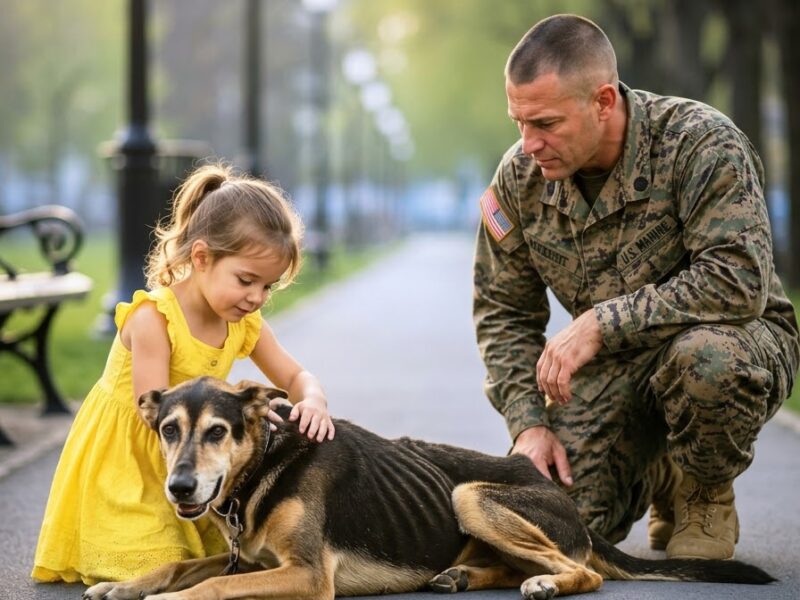
“Can we save him, Daddy?” my daughter whispered outside a deserted gas station in Ohio
The storm moving across the flat, open farmlands of north-central Ohio didn’t feel like a summer downpour; it had the cold, unrelenting weight of an autumn gale. Sheets of water pounded against the rusting iron overhang of the abandoned gas station off Route 30, creating a deafening rhythm that drowned out the faint hum of distant highway traffic.
I knelt on the wet, cracked concrete, the cold mud soaking through the knees of my worn jeans. Beside me, my eight-year-old daughter, Emma, clutched the fringes of her bright pink raincoat. Her small hand gripped my leather jacket with a force born of pure, desperate empathy.
“Can we save him, Daddy?” she whispered, her voice trembling against the roar of the rain. “Please… he’s all alone.”
I didn’t answer right away. As a former Staff Sergeant with twelve years in the Marine Corps Corps infantry, I was trained to assess situations through a lens of cold, immediate utility. What I saw before me was a canine in the final stages of physical collapse. The German Shepherd was lying on his side behind a rusted ice chest, his ribcage jutting sharply beneath a coat matted with road grime, motor oil, and dried blood. His hind leg twitched rhythmically—a neurological tremor brought on by severe hypothermia or trauma. His breathing was shallow, catching in his throat with a wet, rattling sound.
Yet, despite the failure of his body, the dog’s dark, golden-brown eyes were wide open, tracking Emma’s movement with an uncanny, intelligent focus. There was no aggression in him, only a profound, desperate exhaustion.
“Stay back a step, Em,” I said gently, extending the back of my hand slowly toward his snout to let him scent me. “Let me take a look at him.”
The dog didn’t growl. He lifted his chin by a fraction of an inch, pressing his wet nose against my knuckles. A faint, shuddering breath escaped his lungs.
I reached toward his neck, intending to check for a collar or a rabies tag. The leather was thick, worn smooth around the edges, and coated in dried mud. Tucked beneath the heavy fold of his fur was a flat piece of stamped metal. I rubbed the dirt away with my thumb, expecting a standard pet license with a local phone number.
My hand froze. The blood drained from my face so quickly that my vision swam.
It wasn’t a pet tag. It was a standard-issue military identification tag—a dog tag—stamped onto dull stainless steel.
BROOKS, DANIEL E.
204891142 A POS
USMC OEF/OIF
My heart hammered violently against my ribs, a sudden, suffocating surge of adrenaline spiking through my bloodstream. My fingers began to shake uncontrollably as I turned the metal tag over. Beneath the official military lettering, a name had been crudely hand-engraved with a tactical knife: SHADOW.
“Daddy?” Emma asked, her voice sounding distant, as if I were listening to her from underwater. “What’s wrong? Why are you looking like that?”
“It… it can’t be,” I muttered, my voice barely audible above the storm.
I leaned in closer, my hands pushing aside the damp fur along the left side of the dog’s skull. There, running just above his left eye, was a distinct, star-shaped jagged white scar where shrapnel had grazed him years ago.
I knew that scar. I had watched the field medic staple that exact wound shut in a dusty medical tent in the Helmand Province of Afghanistan.
This was Shadow. The multi-purpose military working dog attached to 3rd Battalion, 5th Marines.
And Daniel Brooks had been my squad leader, my mentor, and the man who had physically dragged my unconscious body out of a burning Humvee after an IED blast shattered my femur and ended my combat career.
Four years ago, I had returned home to Ohio on a medical discharge. Three years ago, I received the official notification from the Department of Defense: Sergeant Daniel Brooks had been killed in action during a classified night raid along the border. The official report stated that his unit had been ambushed, the outpost overrun, and that Sergeant Brooks, along with his working dog, Shadow, had perished when an secondary ordnance depot exploded. There were no recoverable remains. I had stood in uniform at an empty memorial service in Arlington, holding a folded flag, believing my brother was gone.
Yet here, at an abandoned gas station in the middle of nowhere, three thousand miles from the Hindu Kush, Daniel’s dog was breathing beneath my hands.
“Daddy, he’s closing his eyes!” Emma cried, grabbing my arm. “Daddy, help him!”
The dog’s head slouched heavily into the puddle. His breathing was growing fainter, the space between his shallow gasps stretching ominously.
The military instincts that had laid dormant inside me for four years snapped back into sharp, absolute focus. I didn’t care about the impossibility of the moment. I didn’t care how a war dog officially listed as KIA had ended up bleeding out in rural Ohio. Daniel Brooks had given everything to ensure I made it back home to hold my daughter. I was not going to let his dog die in the dirt.
“Emma, open the back door of the truck,” I commanded, my voice dropping into the firm, level tone of a tactical leader. “Pull the blankets off the back seat.”
“Okay!” she yelled, sprinting toward our old Ford F-150.
I slid my arms beneath Shadow’s heavy, emaciated frame. He weighed far less than a healthy working dog should—maybe fifty pounds of bone and lean muscle. As I lifted him, he let out a soft, painful whine, but his dark eyes remained locked onto mine.
“I’ve got you, marine,” I growled through clenched teeth, lifting him into my chest. “Hold on. Just hold on.”
I carried him to the truck, laying him carefully across the woolen blankets on the floorboards of the extended cab. Emma immediately climbed into the back beside him, tucking the edges of the blanket around his trembling shoulders and resting his heavy head in her lap.
I slammed the door, jumped into the driver’s seat, and threw the truck into gear, spraying gravel as I tore out onto the highway toward the nearest 24-hour veterinary emergency center in Mansfield.
The thirty-minute drive was a blur of flashing wiper blades and white-knuckle driving. In the rearview mirror, I watched Emma stroke the soft fur behind Shadow’s ears, whispering comforting words to him while the dog lay motionless, his labored breath fogging the lower corner of the glass.
My mind was spinning out of control. Military dogs do not simply vanish from overseas combat zones and reappear thousands of miles away in the Midwest. They are high-value government assets, tracked by microchips, serial numbers, and military handlers. If Shadow was alive, the official report I had been given three years ago was a lie. And if the report was a lie, then everything I believed about the death of Daniel Brooks was compromised.
“We’re almost there, boy,” I called back, pushing the truck to eighty miles an hour on the slick asphalt. “Hang on.”
We pulled into the lit driveway of the emergency clinic at twenty minutes past midnight. I didn’t wait for assistance. I scooped Shadow up in the blankets and kicked open the glass doors of the lobby, shouting for medical staff.
A young veterinarian and two technicians rushed out from behind the desk with a stainless-steel gurney.
“What happened?” the vet asked, taking one look at Shadow’s gray muzzle and shallow respiration. “Hit by a car?”
“Severe trauma, exposure, malnutrition,” I said rapidly, pushing the gurney alongside them as they wheeled him into the trauma bay. “He’s a working dog. He’s a fighter. You save him, doc. Do whatever it takes. I’ll pay whatever it costs.”
The doors of the surgical suite swung shut, leaving Emma and me standing in the sterile, fluorescent-lit hallway. My hands were covered in dark, dried blood and wet rain.
Emma walked over, wrapping her small arms around my waist and pressing her face into my hip. “Is he going to make it, Daddy?”
I looked down at the blood on my hands—the blood of a ghost—and pulled my daughter close.
“He has to, Em,” I whispered, staring through the small glass window of the door. “He’s the only link I have left to the man who saved my life.”
The veterinarian emerged from the surgical bay at four in the morning. He was pulling off his latex gloves, his eyes tired, but there was a subtle relief in his posture that made the tension in my shoulders loosen slightly.
“He’s stable, Mr. Miller,” the vet said, wiping his brow. “It was close. He had severe internal hypothermia, two fractured ribs from what looks like a blow from a blunt object—not a vehicle—and extreme exhaustion. He hasn’t eaten proper food in weeks. But his heart is remarkably strong. Frankly, I’ve never seen a dog fight through shock like this.”
“Can I see him?” I asked immediately.
“He’s coming out of anesthesia now. Just keep it quiet. Your daughter can come too, but don’t let her agitate him.”
We stepped into the recovery room. Shadow was lying on a padded heating mat, an IV line taped to his front leg, a monitor softly beeping beside him. His chest rose and fell in a slow, steady rhythm.
As the soles of my boots clicked against the linoleum floor, Shadow’s ears twitched. His eyelids fluttered open. He didn’t look at the medical equipment, nor did he look at the vet. His eyes swept the room until they locked directly onto mine.
A soft, low rumble sounded in his chest—not a growl, but the deep, vocal greeting unique to working dogs recognizing friendly personnel. He nudged his nose forward, pressing it weakly against the palm of my hand.
I dropped to my knees beside his bed, leaning my forehead against his neck. The scent of antiseptic couldn’t wash away the lingering smell of wet fur and leather—a smell that pulled me back to fighting positions in Helmand, to cold nights on guard duty, to Daniel Brooks sitting on a wooden crate sharing a ration pack with his dog.
“Good boy,” I choked out, my voice cracking as tears burned the back of my throat. “You made it back, Shadow. You made it back.”
It cost nearly four thousand dollars—the absolute remainder of my emergency savings account—to clear his medical bill over the next three days. I didn’t care if I had to eat canned beans for the next six months.
When we brought Shadow home to our small, two-story farmhouse on the outskirts of town, his recovery was nothing short of miraculous. Within ten days, the IV lines were gone, the rib fractures were bound, and he began to put on weight.
He developed an immediate, unbreakable bond with Emma. Wherever she went, Shadow followed with a slow, watchful cadence. When she sat on the living room rug doing her third-grade homework, Shadow lay beside her, resting his heavy chin on her pink slippers. At night, he refused to sleep in the kennel I had set up in the hallway; instead, he posted himself like a sentry at the foot of Emma’s bed, his dark eyes watching the doorway.
Yet, despite the peace that seemed to settle over the house, a suffocating tension was building inside me.
Every time I looked at the stainless-steel military tag sitting on my kitchen counter, the questions grew louder. Shadow was not a stray who had wandered off. The fractures on his ribs were from a physical beating. The severe malnutrition suggested he had been held in confinement for a long time before escaping.
Someone had been keeping him. Someone had tried to break him.
Two weeks after we brought him home, the fragile illusion of our normal life shattered.
It was a Tuesday afternoon. Emma was at school, and I was in the garage, working on an oil change for a neighbor’s tractor to earn extra cash. Shadow was lying near the open garage door, soaking up the autumn sunlight.
Suddenly, his body went rigid. A sharp, low growl vibrated from his throat—a sound I hadn’t heard him make since he arrived.
I set my wrench down and stepped out into the driveway.
A sleek silver sedan had pulled off the county road, coming to a stop near our mailbox. The engine idling was smooth, whisper-quiet. The windows were heavily tinted, blocking any view of the driver.
Shadow stood up, moving in front of me with deliberate, tactical footwork. His lips peeled back, exposing white, sharp teeth. His tail was held straight, his coat bristling along his spine.
The car door opened, and a woman stepped out.
She was in her mid-thirties, wearing a dark gray wool coat. Her dark hair was pulled back into a tight, neat bun, but her face was pale, drawn with exhaustion, and marked by dark circles beneath her eyes. She carried herself with a stiff, cautious posture, her hands tucked deep into her coat pockets.
She took three steps toward the driveway, then froze when her eyes landed on the German Shepherd.
A soft gasp escaped her lips. Her hand flew to her mouth, and her eyes welled with sudden, overwhelming tears.
“Shadow?” she whispered, her voice trembling violently. “Oh God… it really is you.”
I stepped in front of the dog, keeping my hand near my belt out of instinct. “Who are you?” I demanded, my tone hard and unyielding. “How do you know this dog?”
The woman pulled her eyes away from Shadow and looked at me. Her expression was a mix of terror and profound relief.
“You’re Marcus Miller,” she said softly. “Daniel talked about you in every letter he ever sent home. He said you were the bravest man he ever served with.”
I stared at her, my pulse spiking. “Who are you?”
“I’m Sarah,” she said, her voice cracking. “I’m Daniel’s sister.”
I brought Sarah into the kitchen, pulling out a wooden chair for her at the table while Shadow posted himself by the front window, his tail brushing against the radiator as he kept a watchful gaze on the quiet road outside.
I poured two mugs of black coffee, setting one down in front of her. Sarah’s hands were shaking so severely that the porcelain clicked against the tabletop when she reached for it.
“I don’t understand,” I said, leaning against the counter and crossing my arms. “Daniel told me his family lived in Oregon. How did you find me here in Ohio?”
“Because I’ve been following Shadow’s trail for six months,” Sarah whispered, staring into her mug. “And because you were the only person left from Daniel’s unit that I knew I could trust.”
She reached into her dark gray coat and pulled out a thick, legal-sized manila envelope. The paper was worn, creased at the corners, and sealed with heavy red tamper-evident tape.
“Three years ago, when the Marines came to my mother’s house to tell us Daniel was dead, they gave us a official briefing,” Sarah said, her voice turning cold and bitter. “They said it was an explosion. They said there was nothing left to recover. They gave us a wooden box with a flag and told us to grieve.”
“I was at the memorial, Sarah,” I said quietly. “I saw the paperwork.”
“The paperwork was a lie, Marcus,” she snapped, her eyes flashing with a sudden, fiercer light. “Daniel didn’t die in an explosion. Two days before that final mission, he used a secure civilian satellite link to send a digital message to a private server I maintained for his personal files. He knew something was wrong with his command structure. He knew he was being set up.”
My stomach tightened into a hard knot. “Set up by who?”
“A private defense contracting firm called Blackwood Logistics,” she said, pulling a folded piece of paper from the envelope. “They were handling security and supply transport along the border sector where Daniel’s team was deployed. Daniel discovered that Blackwood was using military supply runs to move unregistered weapons and narcotics across the border with the full knowledge of high-ranking personnel within his own battalion.”
She slid the paper across the table toward me. It was a printout of an encrypted email, stamped with a timestamp from four years prior.
The text was brief, written with the frantic brevity of a man who knew his time was running out:
Sarah—If you are reading this, something has gone terribly wrong. The official reports are compromised. They are moving assets under cover of tactical ops. Shadow and I found the cache in the northern sector. If I don’t check in by Friday, do not trust the casualty report. Look for the ledger. Shadow knows where it is.
I stared at the black ink on the page, my brain struggling to process the implications. “This… this is impossible. The military investigation—”
“The military investigation was handled by a tribunal that relied entirely on evidence provided by Blackwood Logistics!” Sarah interrupted, her voice rising. “They declared Daniel dead, sealed the records under national security classifications, and swept the entire incident under the rug!”
“What about Shadow?” I asked, looking toward the window where the Shepherd sat like a bronze statue. “How did he survive? Where has he been for three years?”
“He was captured,” Sarah whispered, a tear finally escaping her eye and trailing down her cheek. “Blackwood didn’t kill the dog because they knew Daniel had trained Shadow to locate specific physical assets using a custom scent marker—a chemical tracking compound Daniel used for search-and-rescue ops. They kept Shadow locked in a private holding facility in southern Indiana, trying to force him to work for their own recovery team to find where Daniel hid the physical evidence ledger before he died.”
“He escaped,” I said, realization dawning on me.
“Three weeks ago, there was a transport transfer near the Ohio border,” Sarah said. “Shadow broke out of a transport crate, mauled two handlers, and ran into the wilderness. He’s been running ever since, dodging their recovery teams, trying to find safety.”
She looked at me, her eyes desperate. “He wasn’t just running aimlessly, Marcus. He was coming to you. Daniel always told Shadow that if anything happened to him, you were the rally point. He memorized your scent from your old tactical jacket that Daniel kept in his locker.”
A chill ran down my spine. The image of the dying dog beneath the rusted gas station overhang returned to my mind—not a random stray waiting to die, but a soldier completing a three-thousand-mile tactical evasion to reach his secondary objective.
“Where is the ledger, Sarah?” I asked softly.
“I don’t know,” she admitted, shaking her head. “It’s a physical hard drive containing the private financial records and GPS coordinates of the illegal caches. Daniel hid it somewhere before he was captured or killed. Shadow is the only living thing that knows where it is.”
Before I could answer, Shadow suddenly stood up from the window.
A deep, ferocious bark echoed through the small kitchen, rattling the plates in the sink.
I whipped my head toward the window. Parked across the street, sitting quietly at the edge of the tree line near my property marker, was a heavy black Chevrolet Suburban with dark tinted glass and no state license plates.
Sarah stood up so fast her chair fell backward onto the linoleum floor. All the color drained from her face.
“Oh God,” she whispered, her hands flying to her mouth. “They followed me. They tracked my cell phone.”
“Who?” I growled, stepping toward the counter and opening the bottom drawer where I kept my service weapon—a heavy Colt .45 pistol.
“The head of security for Blackwood,” Sarah choked out, tears overflowing her eyes. “The man who commanded the unit that ambushed Daniel.”
At that exact moment, a tall, broad-shouldered man in a dark tactical jacket stepped out of the passenger side of the Suburban. He pulled a pair of leather gloves onto his hands, looking directly at my house with cold, calculated precision.
Then, he walked toward my front porch.
I didn’t hesitate. I racked the slide of the Colt .45, chambering a .230-grain hollow-point round, and shoved the pistol into the waistband of my jeans behind my back.
“Sarah, go into the back room,” I ordered, my tone dropping into the quiet, lethal register of a tactical operator. “Lock the door. Do not come out unless I tell you to.”
“Marcus, please—they’re dangerous,” she pleaded.
“Go!”
I moved to the front entrance. Shadow was standing directly in front of the heavy oak door, his shoulders bunched, his head lowered in a terrifying predator’s posture. His growl was no longer a warning; it was the acoustic signature of a war dog prepared to tear a human throat open.
“Easy, boy,” I whispered, placing a steadying hand on his shoulder. “Hold your position.”
A sharp, heavy knock echoed through the wood of the door. Three slow, rhythmic strikes.
I unlocked the deadbolt and pulled the door open six inches, keeping my body behind the heavy frame, my right hand resting behind my back on the grip of my firearm.
Standing on the porch was a man in his late forties. He had a crew-cut hair, a broad, weather-beaten face, and a thick scar running horizontally across his chin. He wore an unzipped tactical jacket over a black polo shirt. Beneath the jacket, I instantly spotted the outline of a shoulder holster housing a heavy Sig Sauer pistol.
Behind him, two other men in matching tactical attire stepped onto the porch steps, their hands resting casually near their belts.
“Marcus Miller?” the man asked. His voice was smooth, raspy, bearing the flat, unaccented tone of a career intelligence operative.
“Who’s asking?” I replied, my eyes fixed on his.
“My name is Vance,” he said, offering a faint, cold smile that didn’t reach his gray eyes. “I’m a senior security consultant representing Blackwood Global. We’re currently conducting an asset recovery operation regarding stolen government property.”
“You’re on private property, Vance,” I said flatly. “And you’re trespassing. Turn around and walk back to your truck before this becomes a law enforcement issue.”
Vance laughed—a dry, humorless sound. “Law enforcement? Marcus, let’s not play games. You were a Staff Sergeant in the 3rd Battalion. You know how the world works. You know that local sheriffs don’t get involved in matters that carry a Class-1 Department of Defense clearance.”
He leaned in slightly, his eyes dropping to the dog standing at my knee.
“That animal is registered asset #884-Bravo,” Vance said, his tone turning crisp and clinical. “He is the property of the United States Government, currently assigned to our custody. Furthermore, the woman currently sitting in your kitchen is in possession of classified digital records.”
Shadow let out a sudden, violent bark, slamming his front paws against the threshold. Vance didn’t even flinch. He just watched the dog with a look of mild disgust.
“You have ten seconds to step aside, Miller,” Vance said quietly. “Hand over the dog, hand over the woman, and you walk away from this with your retirement check intact. You refuse, and my team enters this house. Your daughter, Emma, is currently at Oakridge Elementary School, correct? It would be a terrible shame if a security situation spilled over into a school zone.”
A cold, white-hot rage flared in my chest—the kind of absolute, crystalline focus that overtakes a soldier when an enemy threatens his family.
I didn’t say a word. I pulled the Colt .45 from my waistband, pressing the cold steel barrel directly against the center of Vance’s forehead before his two men could even react.
The two contractors behind Vance instantly drew their sidearms, aiming them at my chest.
“You mention my daughter again,” I said, my voice dropping to a deadly whisper, “and I will paint this porch with your brain matter before your men can pull their triggers. Try me, Vance. See if I care about my pension.”
Vance stared down the barrel of my gun. For the first time, his calm composure cracked. He saw the cold, hollow look in my eyes—the look of a Marine who had survived IEDs, ambushes, and four years of pain, and had nothing left to lose.
“Stand down,” Vance muttered to his men, raising his gloved hands slightly.
“Now,” I said, stepping forward and forcing Vance back two steps onto the porch. “You and your lapdogs are going to turn around, get in that vehicle, and drive away from my house.”
“This isn’t over, Miller,” Vance hissed, his eyes burning with hatred. “You don’t know what you’re holding. That dog doesn’t just have a scent marker. He knows where the physical evidence is buried. If we don’t get that drive by midnight, my directors will orbital-strike this entire property with legal team and tactical teams you can’t fight off.”
“Get off my land,” I repeated, thumbing the hammer of the .45 back with a loud, mechanical click.
Vance held my gaze for three long seconds, then slowly backed down the steps. “Have it your way, Staff Sergeant. But you can’t protect everyone. Not here. Not in the dark.”
He turned and walked back to the Suburban. The two contractors followed him, keeping their weapons raised until they climbed into the vehicle. The heavy SUV reversed down the driveway, turned onto the county road, and sped away toward the highway.
I slammed the front door, locked the deadbolt, and leaned my back against the wood, my chest heaving as the adrenaline surged through my veins.
Shadow stood beside me, nudging his snout hard against my knee.
Sarah stepped out of the back hallway, her face white as a sheet. “What are we going to do, Marcus? They know he’s here. They know about Emma.”
I looked down at Shadow, then at Sarah, my decision already made.
“We don’t wait for them to attack us in the dark,” I said, my voice firm and absolute. “We hit them first. Sarah, call the school. We’re picking up Emma right now. Then, Shadow is going to lead us to Daniel’s cache before Vance can figure out where it is.”
By six o’clock that evening, the Ohio sky had turned a deep, bruised violet as another heavy rainstorm rolled across the state.
I had secured Emma at a trusted friend’s house two towns over—a former Marine sniper who turned his farm into an off-grid fortress. She was safe, guarded by two men I would trust with my life.
Now, it was just Sarah, Shadow, and me inside my F-150, driving deep into the dense, rugged terrain of the Mohican State Forest—a ninety-minute drive south of my property.
“Why are we coming here?” Sarah asked from the passenger seat, holding a tactical flashlight in her lap.
“Because Daniel didn’t hide that drive in Afghanistan,” I said, watching the narrow, winding dirt road through the rain-streaked windshield. “Before our last deployment, Daniel spent a two-week leave right here in Mohican. He bought a small, private five-acre plot of land along the river using a shell corporation. He called it his ‘contingency plan.’ He was the only one who ever knew the exact coordinates.”
“Except Shadow,” Sarah added, looking back at the rear seat.
Shadow sat upright in the back, his snout pressed against the crack of the rear window, catching the damp forest air. As the truck turned onto an unmarked logging trail deep within the park, his behavior changed instantly.
He let out a low, focused whine, standing up on the bench seat and pawing at the door handle.
“He recognizes it,” I said, pulling the truck into a thick thicket of pine trees and cutting the headlights. “We move on foot from here. Keep your light low.”
I pulled my tactical vest over my dark hoodie, checking my weapon and securing three spare magazines in my chest pouches. I handed Sarah a smaller 9mm pistol from my glove box, showing her how to release the safety.
“If anything happens to me,” I said, looking her dead in the eye, “you take Shadow and run for the main park ranger station. Understood?”
She nodded, her jaw set with newfound determination. “Understood.”
We stepped out into the dark, rain-soaked forest. The smell of pine, wet earth, and rotting leaves was overwhelming.
Shadow immediately took the point position. He didn’t wander. He moved with the precise, disciplined trajectory of a working dog executing an operational search-and-seizure command. His head was held low, his tail straight, his body moving silently through the dense brush.
We followed him for nearly twenty minutes, climbing a steep, slippery ridge that overlooked a rushing river far below.
At the crest of the ridge, surrounded by three massive, old-growth oak trees, stood the remains of an old stone foundation—the ruins of an 19th-century moonshiner’s cabin long since reclaimed by the wilderness.
Shadow stopped in the center of the stone foundation. He didn’t bark. He dropped to his knees, his front paws furiously digging into the thick layer of damp leaves and rich topsoil beneath a collapsed stone hearth.
“Here,” I whispered, rushing forward with a small tactical entrenching shovel from my pack.
I pushed Shadow aside gently and began digging into the soft earth. Eight inches down, the metal blade of the shovel struck something solid with a sharp clack.
I cleared the dirt away with my gloved hands.
Buried in the mud was a pelican case—a heavy-duty, waterproof military equipment box sealed with four heavy plastic latches.
My heart pounded as I lifted the heavy case out of the hole and set it on a flat stone. I popped the four latches and pulled the lid open.
Inside lay three items:
First, a high-capacity, military-grade encrypted external hard drive stamped with Daniel’s unit badge.
Second, a thick binder containing hundreds of printed financial ledgers, shipping manifests, and photographs documenting Blackwood Global’s illegal operations across three continents.
And third, tucked into the side pocket of the case, was a small, sealed waterproof envelope with my name written across the front in Daniel’s dark, sharp handwriting: MARCUS.
My hands shook as I opened the envelope and pulled out a single sheet of notebook paper.
Marcus—
If you’re reading this, then Shadow did his job, and I’m already gone. I couldn’t risk bringing this evidence to the brass; the corruption goes too deep. Vance realized I uncovered the transport routes three days ago. I know I’m not making it off this next ridge alive.
Don’t seek revenge, brother. Just protect my sister. Protect my dog. Take this drive directly to the Office of the Inspector General in Washington. The encryption key is the serial number on Shadow’s military tag.
Thank you for having my back in Helmand. Now, I need you to have it one last time.
Semper Fi, my friend.
—Daniel
Tears blurred my vision as I held the letter against my chest, the rain washing down my face. Daniel hadn’t just died in a random ambush; he had laid a trap from beyond the grave, sacrificing his life to ensure the truth survived.
“We have it,” Sarah whispered, staring at the hard drive in awe. “We actually have it.”
“Nobody moves!” a voice roared through the darkness.
Suddenly, four powerful, high-lumen tactical flashlights erupted from the tree line around the stone foundation, blinding us in a crossfire of white light.
“Drop the weapons! NOW!”
Out of the shadow stepped Vance, holding a suppressed assault rifle aimed straight at my chest. Beside him were three heavily armed contractors, their laser sights painting bright red dots across my tactical vest and Sarah’s coat.
“I have to hand it to you, Miller,” Vance sneered, stepping over the ruined stone wall. “We’ve been searching this forest for two years. All we needed was for the dog to lead us to the precise spot.”
Sarah gasped, shrinking back behind me.
Vance pointed his weapon at the Pelican case sitting on the stone. “Hand over the drive, Miller. And maybe—just maybe—I’ll let you and the girl walk out of these woods alive.”
I looked at the red laser dots dancing across my chest. I looked at Sarah, trembling behind me. And then, I looked down at Shadow.
The German Shepherd was standing perfectly still beside the stone hearth. His ears were pinned back, his body coiled like a steel spring. He wasn’t looking at the flashlights. He was looking directly at Vance’s throat.
A cold, calm clarity washed over me. The fear was gone. The doubt was gone.
“You know what you forgot, Vance?” I said, my voice quiet, cutting through the sound of the falling rain.
Vance frowned, his finger tightening on the trigger. “What’s that?”
“You forgot that Daniel didn’t just train Shadow to track,” I said softly. “He trained him to attack on command.”
I looked at Shadow and spoke the single, classified USMC working-dog engagement word that Daniel had taught me years ago in Afghanistan.
“STRIKE!”
Shadow erupted into motion like a dark, lethal lightning bolt.
He didn’t bark. He launched his entire fifty-pound body through the air, crossing the ten-foot gap between the hearth and Vance in a fraction of a second. His jaws locked around Vance’s right wrist with bone-crushing force, forcing the suppressed rifle to discharge harmlessly into the mud as Vance let out a blood-curdling scream of pain.
“FIRE!” one of the contractors yelled.
I didn’t give them the chance. I drew my Colt .45 and fired three rapid shots into the chest of the contractor on the left, sending him crashing backward into the brush.
Sarah ducked behind the stone wall, firing two frantic shots from her 9mm that forced the second contractor to dive for cover behind an oak tree.
The third contractor raised his rifle toward Shadow, but I closed the distance, slamming the heavy steel slide of my pistol into his jaw, knocking him unconscious into the dirt.
Vance was on his back in the mud, screaming in agony as Shadow thrashed his wrist violently, stripping the weapon from his grip.
I stepped over Vance, racking the slide of my pistol, and pressed the hot barrel directly against the point of his jaw.
“OFF! SHADOW, OFF!” I commanded.
Shadow released his grip instantly, stepping back two feet, his teeth coated in blood, his chest heaving as he stood guard over the fallen operative.
Vance lay sobbing in the mud, clutching his shattered, bleeding wrist. “Don’t… please… don’t kill me…” he gasped, his cold confidence completely shattered.
I looked down at him with pure, unadulterated contempt.
“I’m not going to kill you, Vance,” I said, pulling heavy zip-ties from my tactical vest and pulling his arms behind his back, binding them tight. “Killing you is too easy. You’re going to spend the rest of your life in a supermax federal prison.”
I reached down, picked up the Pelican case, and secured the waterproof latches.
Sarah stepped out from behind the stone wall, her weapon held low, her eyes wide with adrenaline and disbelief. “Is it… is it over?”
I looked at Sarah, then at the thick forest around us, and finally down at the German Shepherd standing proudly beside the ruined hearth, his head held high against the falling rain.
“Yeah, Sarah,” I said softly, hooking Shadow’s military tag back over his collar. “It’s finally over.”
Six months later, the sun was shining brightly over the rolling green hills of central Ohio.
The story had made international headlines. The evidence recovered from the Mohican forest had completely dismantled Blackwood Global. Over twenty high-ranking executives, military officers, and private security contractors were indicted on charges ranging from federal corruption and weapons trafficking to first-degree murder. The sacrifice of Sergeant Daniel Brooks was officially recognized by the Department of Defense, his name cleared, and his family awarded the Navy Cross in a solemn ceremony at the Pentagon.
My small farmhouse was quiet now.
The front porch had been freshly painted white. In the yard, Emma was running through the green grass, laughing hysterically as she threw a red tennis ball across the lawn.
Shadow bolted after the ball, his dark coat gleaming in the warm afternoon sun, his fractured ribs and physical scars completely healed. He caught the ball mid-air with effortless grace, turned, and trotted back toward Emma, dropping it gently at her feet before turning to trot up the porch steps toward me.
I sat on the wooden swing, holding a cold glass of lemonade. Beside me sat Sarah, who had officially moved to Ohio to help manage the newly established Daniel Brooks Veteran Foundation—a non-profit organization dedicated to rescuing and retraining retired military working dogs.
Shadow approached the swing, resting his heavy, graying snout on my knee.
I rubbed his ears, feeling the jagged, star-shaped scar above his left eye—a scar that no longer represented pain or loss, but the unbreakable bond of loyalty that had survived three thousand miles, four years of darkness, and the ultimate test of combat.
“You did good, boy,” I whispered, scratching him behind the ears. “You brought us all home.”
Shadow let out a deep, contented sigh, closed his golden-brown eyes, and lay down across my feet, resting his head in the warm sunlight.
The end.









