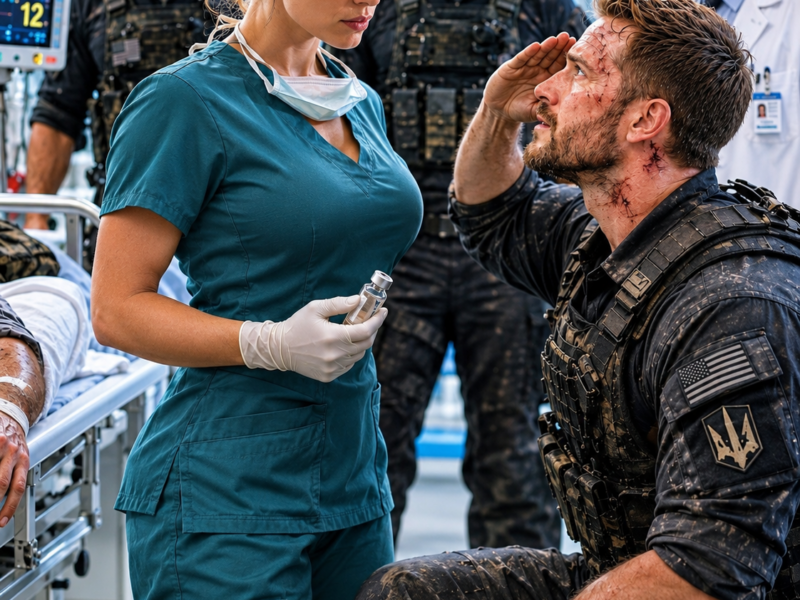
“By the time the sun came up, every man on that SEAL team would know my name—but at 2:17 a.m., my commanding physician looked me in the eye
The image on the ultrasound screen was unmistakable.
Black fluid surrounded Daniel’s liver and extended into the space beneath his right kidney. There was more collecting near the spleen.
Blood.
A lot of it.
“He’s bleeding internally,” I said. “His abdomen is full of blood.”
For half a second, nobody moved.
Then the surgical resident, Dr. Marcus Lee, stepped beside me and stared at the screen.
“She’s right.”
Dr. Hayes looked at the image.
His face changed, but only briefly.
“That doesn’t tell us where the bleeding is coming from.”
“No,” Marcus replied. “But it tells us we cannot send him to CT.”
Daniel’s monitor began to alarm again.
His blood pressure was now barely registering.
I looked at the resident.
“Can you get the trauma surgeon?”
Marcus grabbed the phone.
Dr. Hayes stepped between us.
“I am the attending physician. I decide what happens in this room.”
“And he’s dying,” Marcus said.
The words seemed to hit harder than anything I had said.
A nurse rushed in with another cooler of blood products. The charge nurse, Patricia, moved to Daniel’s other side and began checking the lines.
“Massive transfusion protocol is ready,” she announced.
Dr. Hayes stared at the ultrasound screen once more.
Then he looked at me.
“Emily, step away from the bed.”
I didn’t move.
“I’ve identified free fluid. His pressure is collapsing. He needs an operating room.”
“You’re not a physician.”
“I know what I’m looking at.”
His voice dropped.
“You have no idea what you’re doing.”
I could feel my hands trembling, but I kept them on the bed rail.
“Then have someone else confirm it.”
Marcus looked at Patricia.
“Call Dr. Cole. Now.”
That was when Dr. Hayes finally lost his temper.
“Nobody is calling anyone over my head!”
Patricia had already picked up the phone.
The next thirty seconds felt longer than the previous eleven weeks of my nursing career.
Daniel’s heart rate slowed.
The monitor flashed.
A second alarm sounded.
Then Marcus shouted, “He’s losing his pulse!”
The room erupted.
“Start compressions!”
“Get the airway equipment!”
“Where’s the next blood cooler?”
I stepped back just enough to let the team work.
My eyes stayed on Daniel’s face.
His team leader. The man who had told me not to leave his men.
I didn’t know him.
I didn’t know what mission had brought him here.
But I knew he had come through the doors alive, and I refused to accept that we were going to let him die without doing everything possible.
The trauma surgeon arrived less than two minutes later.
Dr. Samuel Cole was in his fifties, with silver hair, a tired face, and the kind of calm that made people instinctively lower their voices.
He took one look at the room.
“What happened?”
Marcus answered quickly.
“Penetrating chest trauma, profound shock, suspected abdominal hemorrhage. FAST scan positive.”
“Who performed the scan?”
“I did,” I said.
Dr. Cole looked at me.
“You’re the nurse?”
“Yes, sir.”
“Show me.”
I moved aside and pointed to the images.
He studied them for several seconds.
Then he looked at Daniel.
“How long has his pressure been this low?”
“Several minutes. He’s received blood, but he isn’t responding.”
Dr. Cole turned toward the operating room coordinator.
“Call the OR. Tell them we’re coming straight in. Activate the trauma team and prepare for emergency exploration.”
Dr. Hayes stepped forward.
“Sam, I don’t think we have enough information to take him upstairs. We haven’t completed imaging.”
Dr. Cole didn’t even turn around.
“We have a dying patient with a positive FAST examination and an abdomen full of blood. What additional information are you waiting for?”
“We need to understand the chest injury.”
“We can assess that while we control the hemorrhage.”
Dr. Hayes lowered his voice.
“You’re making a decision based on a nurse’s interpretation.”
Dr. Cole finally looked at him.
“I’m making a decision based on the patient in front of me.”
Then he pointed toward the doors.
“Move.”
Everyone moved.
Everyone except Dr. Hayes.
For a moment, he stood there with his hands clenched at his sides.
Then he stepped out of the way.
As we transferred Daniel onto the transport bed, I noticed something strange.
One of the other SEALs had appeared in the doorway.
He was tall, muscular, and had a bandage wrapped around his forehead. His face was pale from blood loss, but his eyes were fixed on Daniel.
“Where are you taking him?”
“Operating room,” I answered.
“Is he going to make it?”
I couldn’t promise him that.
“We’re doing everything we can.”
The man nodded once.
Then he looked directly at me.
“You’re the one who found it?”
I glanced at the ultrasound machine.
“Yes.”
He stepped closer.
“I’m Chief Petty Officer Michael Torres. That’s my team leader.”
I didn’t know what to say.
Torres looked down at Daniel.
“He told us to keep moving even after he got hit. Got all three of us out before he collapsed.”
His voice cracked slightly.
“Please don’t let him die.”
I looked him in the eye.
“I won’t stop fighting for him.”
The doors to the operating suite opened.
And Daniel disappeared behind them.
For the first time that night, I had nothing to do.
I stood in the corridor with blood on my gloves, a stiff neck, and the awful feeling that my entire career had just changed.
Patricia came over.
“Go wash up.”
“I should stay.”
“Emily.”
She rested a hand on my shoulder.
“You’ve done your part. Let the surgeons do theirs.”
I wanted to argue, but she was right.
I removed my gloves and washed my hands.
The water ran pink for several seconds before becoming clear.
I stared at my reflection in the stainless-steel sink.
I looked like the same person who had walked into the hospital eleven weeks earlier.
But I didn’t feel like her anymore.
The first update came forty minutes later.
Daniel had survived the initial operation.
He had a major injury to a blood vessel in his abdomen, along with damage to nearby tissue. The surgical team had controlled the bleeding and packed the abdomen temporarily while they worked to stabilize him.
He was still critical.
But he was alive.
I sat down hard in the staff lounge when Patricia told me.
“Thank God,” I whispered.
She gave me a tired smile.
“You’re the reason he made it to surgery in time.”
I shook my head.
“The surgeon saved him.”
“And who made sure the surgeon knew what was happening?”
I didn’t answer.
Patricia placed a cup of coffee in front of me.
“Drink something. You look like you’re about to fall over.”
I wrapped both hands around the cup.
Then the door opened.
Dr. Hayes stood there.
His expression was unreadable.
“Emily. My office.”
Patricia immediately straightened.
“She’s still on duty.”
“I know that.”
He looked at me.
“Now.”
I followed him down the corridor.
His office was small, with a desk covered in charts and a framed photograph of a sailing boat behind him.
He closed the door.
“Do you understand what you did tonight?”
“I performed a bedside assessment.”
“You disobeyed a direct order.”
“I identified a life-threatening condition.”
“You interfered with medical management.”
“I asked for confirmation. I asked for the trauma surgeon. I showed the ultrasound to Dr. Lee.”
Hayes leaned back.
“You’re very good at repeating yourself.”
I kept my voice calm.
“Dr. Cole agreed with the findings.”
“That doesn’t change the fact that you bypassed me.”
I stared at him.
“Would you rather I had ignored what I saw?”
His expression tightened.
“I would rather you had respected the chain of command.”
I thought about Daniel’s fading pulse.
About the blood filling his abdomen.
About his teammate standing in the doorway, begging us not to let him die.
“Respecting the chain of command shouldn’t mean ignoring an emergency.”
For a moment, he said nothing.
Then he opened a folder.
“You’re being removed from trauma assignments pending review.”
My stomach dropped.
“You’re suspending me?”
“Not yet. But your actions will be formally investigated.”
I nodded slowly.
“All right.”
He seemed surprised.
“That’s all you have to say?”
“I’ve documented what I saw and what I did. The ultrasound images are saved. The timestamps are in the record. I have nothing to hide.”
His jaw tightened.
“Be careful, Emily. You are very new here.”
I looked at him.
“That’s true.”
Then I walked out.
By 5:30 a.m., the other three SEALs had been stabilized.
Torres had a deep cut along his scalp and a fractured wrist. Another man, Petty Officer James Miller, had suffered a serious chest injury. The third, Alex Grant, had multiple fragments embedded in his leg.
None of them were out of danger.
But all three were alive.
They had been brought together in a private recovery area near the intensive care unit.
I was assigned to check on their vital signs while the day team prepared to take over.
Torres was sitting upright when I entered.
He looked exhausted.
“Hey, Rookie.”
I glanced at his chart.
“You’re supposed to be resting.”
“That’s what everyone keeps telling me.”
I checked his blood pressure cuff.
“Maybe everyone has a point.”
He gave a small smile.
Then his expression became serious.
“How’s Reeves?”
“Still critical, but stable after surgery.”
Torres closed his eyes briefly.
“Thank you.”
“You don’t have to thank me.”
“Yes, I do.”
He looked at me for a long moment.
“Do you know what happened out there?”
I shook my head.
“Only what the paramedics told us.”
He hesitated.
“We were on our way back from an operation when the vehicle was hit. The blast threw us into the road. Daniel got us behind cover and started treating the others.”
He glanced toward the hallway.
“He was hit while pulling Miller out. Still refused to leave until everyone was accounted for.”
I checked the dressing on his arm.
“That sounds like him.”
Torres studied me.
“You say that like you know him.”
“I don’t. I meant it sounds like the kind of person he is.”
He nodded.
“He always said the team came first.”
Then he looked down at his hands.
“Last thing he told us was to get home.”
The words stayed with me long after I left the room.
At 6:10 a.m., I was preparing the handoff notes when the emergency department phone rang.
Patricia answered.
Her face changed.
“What do you mean, you’re coming here?”
She listened for a moment.
Then she covered the receiver and looked at me.
“Emily, there’s someone asking for you.”
“Who?”
She handed me the phone.
A man’s voice came through.
“Is this Nurse Carter?”
“Yes.”
“This is Commander James Whitaker, Naval Special Warfare Medical Operations. I’m at the hospital entrance. I need to speak with the person who treated Staff Sergeant Reeves.”
I looked toward Patricia.
“He’s alive,” I said.
There was a pause.
“Then I owe you a conversation.”
Commander Whitaker arrived ten minutes later.
He wore a dark uniform and carried a slim folder under one arm. He looked older than I expected, perhaps in his early fifties, with a silver streak running through his hair.
He shook Patricia’s hand, then turned to me.
“You’re Emily Carter?”
“Yes, sir.”
“I understand you were the nurse who identified the abdominal hemorrhage.”
“That’s correct.”
He looked toward the intensive care unit.
“May I see the patient?”
“His doctors will need to approve that.”
“Of course.”
He nodded.
Then he glanced at my badge.
“How long have you been working here?”
“Eleven weeks.”
His eyebrows rose.
“Eleven weeks?”
I felt myself becoming defensive.
“Yes.”
He looked at Patricia.
“Who was the attending physician?”
“Dr. Hayes.”
Whitaker’s expression shifted.
“Richard Hayes?”
“Yes.”
He said nothing for several seconds.
Then he asked, “Was there a disagreement about taking Mr. Reeves to surgery?”
I hesitated.
I didn’t want to make accusations.
But I also knew the medical record would tell the story.
“Dr. Hayes initially wanted further imaging. I believed the patient was too unstable and requested an ultrasound. The scan showed significant internal bleeding.”
Whitaker opened his folder.
“And Dr. Hayes ordered you to stop?”
I stared at him.
“How did you know that?”
He looked down at the documents.
“Because this isn’t the first time we’ve heard his name.”
Before I could ask what he meant, Dr. Cole approached.
“Commander.”
Whitaker shook his hand.
“Doctor. How is Reeves?”
“Critical but stable. He’ll need another operation, but the immediate bleeding is controlled.”
“Can I see him?”
“Once he’s settled in intensive care.”
Whitaker nodded.
Then he turned to me.
“There’s something you should know. Daniel Reeves’s team was not supposed to be in that area when the incident occurred.”
I frowned.
“What do you mean?”
He opened the folder.
“The mission plan had been changed shortly before deployment. The team was redirected after receiving information about a possible threat.”
“Was that why they were attacked?”
“We don’t know yet.”
He paused.
“But there was a problem with the medical evacuation request.”
I remembered the paramedic saying they had been ordered to bring Daniel directly to us.
“What kind of problem?”
“The first request for evacuation was delayed.”
My stomach tightened.
“How long?”
Whitaker looked at the paperwork.
“Twenty-three minutes.”
I stared at him.
“Twenty-three minutes?”
He nodded.
“According to the initial report, the delay was caused by a communications failure.”
Dr. Cole crossed his arms.
“That report doesn’t match the injuries we’ve seen.”
Whitaker looked at him.
“What do you mean?”
“The team arrived with injuries that suggest they spent a significant amount of time without definitive medical support. Their condition was much worse than it should have been if the evacuation had proceeded as planned.”
Whitaker closed the folder.
“That’s why I’m here.”
I looked between them.
“What does this have to do with me?”
Whitaker held my gaze.
“Daniel Reeves asked that, if he survived, we make sure his team got home. He also asked that we find out why the evacuation was delayed.”
He took a breath.
“His medic recorded part of the incident on a field communication device. The recording has just been recovered.”
I felt a chill move through me.
“What does it say?”
Whitaker opened the folder again.
“It contains a transmission from Daniel himself.”
He looked toward the intensive care unit.
“And it may explain why someone wanted him to die before he could tell us what happened.”
By then, the hospital had begun to wake.
Day-shift nurses arrived carrying coffee. Doctors hurried through the corridors. Visitors gathered near the elevators.
But the small conference room where Commander Whitaker played the recording felt completely separate from the rest of the building.
Dr. Cole sat beside me.
Patricia stood near the door.
Whitaker placed a small device on the table.
“The recording is incomplete,” he explained. “The signal was damaged during the incident. We’ve recovered only a portion.”
He pressed play.
Static filled the room.
Then a man’s voice came through.
“Command, this is Reeves. We’re taking fire. Three wounded. Request immediate medical extraction.”
A second voice answered.
“Stand by. Extraction is not authorized.”
The room went silent.
The recording continued.
“Command, repeat. We have casualties. One critical. Requesting immediate evacuation.”
“Negative. Hold position.”
I felt my fingers curl against my palm.
A few seconds passed.
Then Daniel’s voice came through again.
“Command, we cannot hold. I have one man losing blood. We need medical support now.”
The reply was colder this time.
“Your location has been compromised. Remain in place until further instructions.”
Daniel sounded furious.
“Sir, we have wounded personnel. I am requesting authorization to move.”
“That request is denied.”
Then another voice entered the recording.
It was quieter.
But I recognized the tone immediately.
“Reeves, listen carefully. You will remain where you are.”
Whitaker stopped the recording.
He looked at us.
“That was the voice of Lieutenant Colonel Adrian Voss, the officer overseeing mission coordination.”
Dr. Cole leaned forward.
“Why would he deny medical extraction for wounded personnel?”
Whitaker didn’t answer immediately.
Instead, he turned to a page in his folder.
“Because the team’s position was connected to an operation that had not been officially approved.”
I looked at him.
“What does that mean?”
“It means someone authorized the mission without completing the required command process. If the team had been evacuated immediately, their location and the circumstances of the operation would have been exposed.”
Patricia covered her mouth.
I could barely breathe.
“You’re saying they were left there because someone wanted to hide what they were doing?”
“I’m saying that is one possibility. We are still investigating.”
He pressed play again.
The recording resumed with a burst of static.
Daniel’s voice sounded weaker.
“Command, this is Reeves. We have one man unconscious. Another cannot walk. I am injured. Request immediate evacuation.”
A pause.
Then Voss answered.
“Your situation is unfortunate. Maintain position.”
The recording ended.
Nobody spoke.
I stared at the device.
I had spent the night fighting to keep Daniel alive.
Now I was learning that someone had deliberately delayed the help he needed.
“Does Daniel know about this?” I asked.
Whitaker shook his head.
“He was unconscious when he arrived. We haven’t been able to speak with him.”
“Then you need to tell him.”
“We will. But first we need to establish what happened.”
I stood up.
“He’s in intensive care. He almost died. He has the right to know.”
Whitaker looked at me carefully.
“You’re right.”
He gathered the documents.
“There’s one more thing.”
He slid a photograph across the table.
It showed a group of officers standing beside a military vehicle. One of them was Lieutenant Colonel Voss.
Beside him stood Dr. Hayes.
I looked at the photograph again.
“Why is Dr. Hayes in this picture?”
Whitaker’s expression became grave.
“Because he served as a medical consultant during the operation.”
My mouth went dry.
“That can’t be right.”
“He was attached to the mission as an independent medical adviser. He reviewed the evacuation plan and provided recommendations.”
I remembered Dr. Hayes refusing to let me perform the ultrasound.
His insistence on sending Daniel to CT.
His anger when I challenged him.
I didn’t know whether those decisions were connected.
But I suddenly understood why Whitaker had reacted so strongly when he heard his name.
At 8:00 a.m., I was called into the hospital administrator’s office.
Dr. Hayes was already there.
So was Dr. Cole.
A woman named Helen Price, the hospital’s chief medical officer, sat behind the desk.
Commander Whitaker stood near the window.
I felt as if I had walked into a room where everyone knew something I didn’t.
“Emily,” Price said, “please sit.”
I did.
Dr. Hayes didn’t look at me.
Price folded her hands.
“We’ve reviewed the initial events surrounding Staff Sergeant Reeves’s treatment. There are concerns about the decisions made during the first twenty minutes of his care.”
I glanced at Dr. Hayes.
He remained still.
Price continued.
“We’ve also received information that may require an independent review of his medical treatment.”
“Because of the mission?” I asked.
“Partly.”
She looked at Whitaker.
He stepped forward.
“Lieutenant Colonel Voss has been placed under investigation. The initial communication records suggest that he deliberately withheld authorization for medical evacuation.”
Dr. Hayes finally spoke.
“That’s an allegation, not a finding.”
Whitaker nodded.
“Correct.”
“Then I don’t see why my clinical decisions are being questioned.”
Dr. Cole leaned forward.
“Because the patient arrived in profound shock, and you attempted to send him for imaging instead of controlling an obvious life-threatening hemorrhage.”
“I was assessing multiple injuries.”
“You were delaying surgery.”
“I was following the appropriate diagnostic process.”
Dr. Cole’s voice remained calm.
“Not for a patient who is actively dying.”
Dr. Hayes turned toward Price.
“Are we really going to let a junior nurse’s opinion determine whether an attending physician is competent?”
Price looked at him.
“No. We’re going to let the clinical record, the saved ultrasound images, and the independent review determine that.”
For the first time, Dr. Hayes looked uncertain.
I sat quietly.
I hadn’t expected anyone to defend me.
I had expected a disciplinary hearing, perhaps even the end of my job.
Instead, the discussion had moved far beyond me.
Price turned toward me.
“Emily, your actions are being reviewed separately. Based on the information available, you will not be suspended. However, you must cooperate with the investigation.”
“I will.”
Dr. Hayes pushed his chair back.
“This is absurd.”
He stood.
“You’re all making a mistake.”
Whitaker watched him leave.
Then he looked at me.
“There’s something else you should know.”
I waited.
“Lieutenant Colonel Voss has requested that all recovered mission recordings be classified. He is claiming national security concerns.”
“Can he do that?”
“Not unilaterally. The review board will decide what can be released.”
He paused.
“But there’s a second recording.”
My heart started beating faster.
“What does it contain?”
Whitaker looked at Dr. Cole.
“It contains a direct conversation between Voss and Daniel Reeves.”
At 10:45 a.m., Daniel was still unconscious.
The second operation had been completed. His surgeons had repaired the remaining injuries and were cautiously optimistic, though they warned us that the next twenty-four hours would be critical.
I stood outside the intensive care unit when Torres approached.
He had a fresh bandage on his forehead and his right arm in a sling.
“Any change?”
“He’s stable.”
Torres exhaled.
“That’s good.”
He looked through the glass at Daniel.
“Can I sit with him?”
The nurse inside checked the chart and nodded.
Torres went in.
I followed to help him settle into a chair.
For several minutes, he said nothing.
Then he leaned toward Daniel.
“Boss, we’re all here.”
He swallowed.
“You did your job. You got us out. Now you need to let us return the favor.”
His voice shook.
“Don’t you dare leave us.”
I looked away to give him privacy.
When I returned to the nurses’ station, Commander Whitaker was waiting.
“Emily, we recovered the second recording.”
“Did it explain the evacuation delay?”
“It may explain more than that.”
He handed me a transcript.
The recording began with Daniel reporting his team’s injuries.
Then Voss responded.
“Your position is compromised. You will not move until the operation is complete.”
Daniel replied, “The operation is already compromised. We have wounded men.”
Voss said, “You are not authorized to make that determination.”
Daniel’s answer was immediate.
“Then authorize medical extraction.”
A long silence followed.
Then Voss spoke again.
“If you leave that location, you will expose the source.”
Daniel sounded confused.
“What source?”
Voss didn’t answer.
Instead, another man spoke.
His voice was familiar.
Dr. Hayes.
“Colonel, we should get them out. Their condition is deteriorating.”
Voss replied, “You were brought in to advise on medical risk, Doctor. Stay within your role.”
Hayes hesitated.
Then he said something that made my blood run cold.
“Understood.”
Daniel’s voice came through again.
“Sir, my men are dying. I am not asking for permission to abandon the operation. I’m asking for permission to get them medical care.”
Voss answered.
“Your request is denied.”
The recording ended.
I read the transcript twice.
Dr. Hayes had known.
He had been there.
He had heard Daniel asking for help.
And he had stayed silent.
“Why didn’t he report this?” I whispered.
Whitaker’s expression was grim.
“That’s what the investigation needs to establish.”
I looked at the transcript.
“Was he afraid?”
“Possibly.”
“Or was he protecting Voss?”
Whitaker didn’t answer.
I handed the paper back.
“Then ask him.”
The confrontation happened that afternoon.
Dr. Hayes was in the administrator’s office when Whitaker and the hospital’s legal representative entered.
I wasn’t supposed to be there.
But Price asked me to remain because my statement was part of the medical review.
Hayes looked irritated when he saw me.
“Why is she here?”
Price answered.
“Because she was directly involved in the treatment of Staff Sergeant Reeves.”
Whitaker placed the transcript on the desk.
“Doctor, were you present during the mission briefing?”
Hayes looked at the document.
“Yes.”
“Did you hear the evacuation request?”
“I heard part of it.”
“Did you advise Lieutenant Colonel Voss to authorize immediate medical extraction?”
Hayes hesitated.
“I advised him that the team required medical support.”
“That is not what I asked.”
Hayes looked toward Price.
“I was not in command.”
Whitaker’s voice hardened.
“You were the medical consultant. You had a professional obligation to report a dangerous delay.”
“I did not have complete information.”
“You had enough information to know that wounded personnel were being denied evacuation.”
Hayes said nothing.
Whitaker continued.
“Then, several hours later, Staff Sergeant Reeves arrived at your hospital. You attempted to send him for imaging despite clear signs of profound hemorrhagic shock. When a nurse identified internal bleeding, you ordered her away from the patient.”
Hayes’s face reddened.
“I was managing a complex trauma case.”
“You were repeating the same mistake.”
The room fell silent.
Finally, Hayes spoke.
“I was told the mission was sensitive. I was told the team had to remain in place until the objective was secured.”
“And you accepted that?”
“I was following instructions.”
Whitaker shook his head.
“Medical responsibility does not disappear because someone gives you an order.”
Hayes looked down.
For the first time, he seemed to understand how serious the situation had become.
“I didn’t know they were going to be left there that long.”
“But you knew they were injured.”
“Yes.”
“And you knew they needed help.”
Hayes closed his eyes.
“Yes.”
Price leaned forward.
“Dr. Hayes, your clinical decisions tonight are now part of a formal review. Your role in the mission will also be referred to the appropriate authorities. You are being placed on administrative leave pending the outcome.”
Hayes stood abruptly.
“You can’t do this.”
Price’s voice was steady.
“We can, and we are.”
He looked at me.
There was anger in his eyes, but beneath it I saw something else.
Fear.
Then he walked out.
I didn’t feel victorious.
I felt sick.
Because I had spent eleven weeks believing that experience meant wisdom.
Now I knew that sometimes experience only meant someone had learned how to hide behind authority.
At 6:20 p.m., Daniel opened his eyes.
I was checking his medication when I noticed his fingers moving.
I leaned toward him.
“Daniel?”
His eyelids fluttered.
Then slowly opened.
His gaze moved across the room, unfocused at first.
“Where…”
“You’re in Harbor Point Medical Center. You’re safe.”
He tried to speak, but his throat was too dry.
I raised the head of the bed slightly and offered him a damp swab.
“Don’t try to talk too much yet.”
His eyes moved toward the window.
Then he looked at me.
“My team?”
“All three are alive. They’re recovering.”
He closed his eyes.
A tear slipped down his cheek.
I felt my own eyes sting.
“They made it,” I whispered.
He tried to nod.
Then his hand moved weakly toward mine.
I took it.
“You’re going to be okay,” I said.
He looked at my badge.
“Emily…”
“Yes.”
“Thank you.”
I shook my head.
“You don’t have to thank me.”
His lips moved again.
“Didn’t… give up.”
I smiled through my tears.
“No. I didn’t.”
A few minutes later, Torres came in.
When he saw Daniel awake, he stopped in the doorway.
For a moment, the tough, disciplined SEAL seemed unable to move.
Then he crossed the room.
“Boss?”
Daniel looked at him.
Torres laughed once, but it sounded dangerously close to crying.
“You’re a stubborn old man.”
Daniel’s mouth moved.
“You’re… ugly.”
Torres lowered his head.
“Yeah. Missed you too.”
The two men held each other’s gaze.
Neither needed to say anything more.
I stepped away to give them privacy.
But before I reached the door, Daniel spoke again.
“Emily.”
I turned.
He looked at me with effort.
“Don’t let them…”
His voice faded.
“Don’t let them bury it.”
I knew exactly what he meant.
“I won’t.”
The investigation lasted six weeks.
During that time, I returned to work, though I was temporarily assigned away from the emergency department.
I hated it.
I missed the noise, the urgency, and even the difficult patients who insisted they weren’t sick while clutching their chests.
But I understood why the hospital had made the decision.
The review was too important to risk any suggestion that I was influencing the medical record.
I submitted my statement.
I provided the exact times I had recorded the vital signs, the ultrasound images, and the notes documenting my concerns.
Patricia backed me up.
Dr. Lee did too.
Dr. Cole provided a detailed account of the patient’s condition when he arrived.
The records showed that Daniel’s blood pressure had continued to fall while Dr. Hayes delayed definitive treatment.
They also confirmed that the ultrasound had been performed before the surgical team took him to the operating room.
The independent review concluded that the decision to delay surgery for CT imaging would have placed Daniel at an unacceptable risk.
The review did not accuse Dr. Hayes of intentionally trying to harm him.
But it found that his decisions had fallen below the expected standard of emergency trauma care.
The military investigation reached a separate conclusion.
Lieutenant Colonel Voss had deliberately withheld evacuation authorization to protect an operation that had not been properly approved.
He had also failed to disclose the full extent of the team’s injuries in the initial report.
The evidence was enough for his command to remove him from operational duties while further proceedings continued.
Dr. Hayes’s military role was referred for additional review.
He was not allowed to return to clinical practice at Harbor Point while the hospital completed its own process.
I learned all of this during a meeting with Helen Price.
She placed a document in front of me.
“Your actions have been formally reviewed,” she said.
I looked down.
At the top of the page were the words:
NO DISCIPLINARY ACTION RECOMMENDED.
I read them twice.
Then I looked up.
“So I’m cleared?”
“Yes. More than that.”
Price smiled.
“The review specifically recognizes your early identification of internal hemorrhage and your insistence on obtaining an immediate surgical assessment.”
I felt a knot in my chest loosen.
“What happens now?”
“That depends on what you want.”
I frowned.
“What do you mean?”
Price leaned back.
“We’re creating a new emergency-response training program for nurses. Dr. Cole recommended you as one of the people who should help develop it.”
I stared at her.
“Me?”
“Yes. Your experience that night showed why nurses need to feel safe raising concerns when a patient is deteriorating.”
I didn’t know what to say.
Eleven weeks earlier, I had been terrified of making a mistake.
Now the hospital was asking me to help teach other nurses how to speak up.
I nodded.
“I’d like to help.”
Daniel was discharged three weeks later.
His recovery would take months, and he would need additional physical therapy, but the doctors were optimistic.
His team came to collect him.
Torres arrived first, followed by Miller and Grant.
All three were moving more comfortably.
Miller still had a brace around his chest. Grant walked with a cane. Torres had a scar running along his hairline.
They looked healthier.
They looked alive.
Daniel was sitting in a wheelchair when they entered.
Torres stopped in front of him.
“Ready to go home, boss?”
Daniel smiled.
“Depends. You driving?”
“Absolutely not.”
“Good. I don’t trust you.”
They laughed.
Then Daniel looked at me.
“Emily.”
I stepped closer.
“How are you feeling?”
“Like I’ve been run over by a truck.”
“That’s understandable.”
He held out his hand.
I took it.
“I wanted to say something before we leave.”
“All right.”
He glanced at his teammates.
“They told me what happened in the emergency room.”
I looked down.
“They were exaggerating.”
“No, they weren’t.”
He studied me.
“They said you kept asking for help when everyone else wanted you to wait.”
I didn’t answer.
He continued.
“I also heard about the investigation.”
His expression grew serious.
“You could have lost your job.”
“I knew that.”
“Why did you do it?”
I thought about the question.
The honest answer wasn’t dramatic.
It wasn’t about being brave.
It wasn’t about proving I was better than a doctor.
It was much simpler.
“Because you were getting worse, and I could see it.”
Daniel nodded slowly.
“That’s what I hoped you’d say.”
He squeezed my hand.
“Thank you for bringing me home.”
I smiled.
“Your team did that too.”
He looked at Torres.
“These idiots?”
“Hey,” Torres protested.
Daniel laughed, then winced.
“Yeah. These idiots.”
They wheeled him toward the exit.
Before he passed through the doors, Torres turned back.
“Rookie.”
I looked up.
He saluted me.
Miller followed.
Then Grant.
I felt my cheeks grow warm.
“Please don’t do that,” I said.
Torres grinned.
“Too late.”
Daniel raised his hand from the wheelchair.
“See you around, Nurse Carter.”
And then they were gone.
Two months later, I stood in the hospital’s new trauma training room.
A group of twelve nurses sat in front of me.
Some were experienced. Others had only recently started working in emergency care.
I recognized the nervous expressions on several faces.
I had worn those expressions myself.
A monitor displayed a simulated patient’s vital signs.
The blood pressure was falling.
The heart rate was climbing.
I walked toward the screen.
“Let’s say you’re the nurse assigned to this patient. You’ve noticed a change. You tell the attending physician, but they dismiss your concern.”
A young nurse raised her hand.
“What if the physician tells you to stop questioning them?”
I looked at her.
“Then you stay professional, document what you’ve observed, and escalate through the appropriate emergency channels.”
She nodded.
“But what if they get angry?”
I paused.
“People may get angry. You may be uncomfortable. You may even face consequences that need to be addressed later.”
I pointed toward the monitor.
“But the patient cannot wait for everyone in the room to feel comfortable.”
The room was silent.
I continued.
“Your responsibility is not to win an argument. It’s to recognize danger, communicate clearly, and make sure the patient gets the care they need.”
I looked around at the nurses.
“And never assume that being new means you have nothing valuable to contribute.”
A few people smiled.
I thought about that night.
About the ultrasound screen.
About the order to step away.
About the man whose life had been hanging by a thread.
Then I looked at the simulation monitor.
The blood pressure had dropped again.
“All right,” I said. “What do you do next?”
Hands began to rise.
And for the first time, I knew that the lesson from that night would reach far beyond Daniel Reeves.
It would reach every patient whose nurse noticed something others had missed.
I saw Daniel and his team again six months later.
They came to the hospital for a small ceremony honoring the medical staff who had treated them.
I almost didn’t recognize Daniel when he walked through the lobby.
He was standing straight again, with only a slight stiffness in his movement.
Torres was beside him, arguing about something.
Miller and Grant followed behind.
The four of them looked like a team again.
Daniel spotted me.
“There’s our Rookie.”
I smiled.
“You’re looking much better.”
“That’s because I finally stopped listening to Torres.”
“Hey!” Torres protested.
The hospital administrator gave a short speech.
Dr. Cole spoke about teamwork, rapid decision-making, and the importance of listening to every member of a medical team.
Then Daniel stepped forward.
He held a small wooden box.
“I don’t have a long speech,” he said.
He looked toward the doctors, nurses, paramedics, and hospital staff gathered in the room.
“My team and I were given another chance to go home. A lot of people helped make that happen.”
He opened the box.
Inside were four small unit challenge coins.
He picked one up and turned toward me.
“Emily Carter.”
I stepped forward.
He placed the coin in my palm.
“This belongs to you.”
I stared at it.
“Daniel, I can’t accept this.”
“Yes, you can.”
He closed my fingers around it.
“That night, you were told to stand back. You didn’t. You saw something everyone else had missed, and you refused to let us become another statistic.”
His voice softened.
“Three of us owe you our lives. And I owe you the chance to go home to my family.”
I looked down at the coin.
My eyes filled.
“I was just doing my job.”
Daniel smiled.
“That’s what makes it matter.”
The room began to applaud.
I didn’t feel like a hero.
I felt like a nurse who had been given a responsibility and had done her best not to abandon it.
And that was enough.
A year after the night Daniel arrived, I was working another night shift in the emergency department.
Rain tapped against the windows again.
The halls were busy.
A new nurse stood beside me, looking worried as she checked a patient’s monitor.
“Emily?”
I turned.
“What’s wrong?”
“His blood pressure has dropped. The doctor thinks it’s probably dehydration, but I’m not sure.”
I moved toward the bed.
“Show me what you’ve seen.”
She pointed to the readings.
I checked the patient, reviewed the chart, and looked at the monitor.
Then I nodded.
“Good catch. Let’s get the doctor back in here and reassess him.”
The nurse looked relieved.
“Are you sure?”
“Absolutely.”
I glanced at her badge.
Her name was Sophie.
She had been working for only three weeks.
I smiled.
“You’re new. That doesn’t mean you’re wrong.”
She straightened.
Together, we called the physician and made sure the patient received another assessment.
Nothing dramatic happened.
No one shouted.
No one had to disobey an order.
The patient improved with treatment.
But as I walked back toward the nurses’ station, I noticed the small wooden coin resting beside my monitor.
I picked it up and turned it over in my fingers.
On one side was the team insignia.
On the other were four simple words:
NEVER LEAVE YOUR PEOPLE.
I thought about Daniel.
I thought about Torres, Miller, and Grant.
And I thought about the young nurse who had just trusted her instincts enough to speak.
That night, I had been ordered to let one SEAL die.
I couldn’t change the order that had been given.
But I could choose what kind of nurse I would become.
And every time I helped someone speak up for a patient who couldn’t speak for themselves, I knew I was keeping the promise I had made in that trauma bay.
I would not look away.
I would not stay silent.
And I would never mistake a person’s rank, title, or years of experience for proof that they were right.
THE END.









