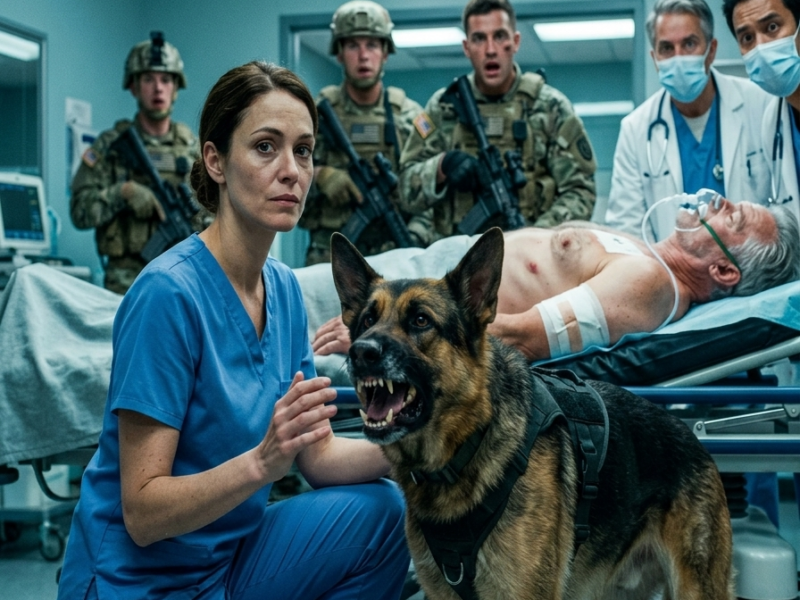
At Walter Reed, a massive K9 snarled at every doctor who approached the bloodied Marine general, and when security raised their weapons at the animal
The pneumatic double doors of the Walter Reed National Military Medical Center trauma bay slammed open with a violent, reverberating shudder that cut straight through the drone of telemetry monitors and the low murmurs of the graveyard shift. Outside, a late-autumn deluge hammered against the ballistic glass of the ambulance bay, washing greasy grit across the tarmac in long, gray ribbons. Inside, the air went completely still, instantly colonized by the familiar, copper-rich stench of arterial blood, cordite, and scorched Nomex fabric.
My shift had started at 1900 hours. By 2315, I was still the invisible stranger on Trauma Floor 3—Nurse Evelyn Harbor, transfer from Fort Bragg, thirty-one years old, wearing crisp hospital-issued ceil blue scrubs that hadn’t yet acquired the permanent wrinkles of twelve hours on concrete. The charge nurse had assigned me to inventorying trauma bays four through six, a polite way of keeping the transfer out of the way of the established clinical teams until my credentials cleared the military intranet.
Then the radio call had crackled through the comms desk: Priority Red. Three-star officer down. Blunt force, penetrating trauma, thermal burns. En route via unmarked secure transport.
They didn’t wheel him in on an ordinary civilian gurney. Four combat medics in civilian windbreakers rolled an olive-drab tactical litter directly through the primary threshold, their knuckles white, their faces pale beneath streaks of rain. On the litter lay General Daniel Hayes. He was a legend within the Marine Corps—commanding general of the Marine Expeditionary Force, an architect of modern counter-insurgency doctrine, and a man who was supposed to be testifying before the Senate Armed Services Committee at 0900 the following morning.
Now, his service blouse was shredded down the breast, soaked through with dark, sticky maroon that pooled in the hollow of his collarbone. His left hand, still encased in a blackened tactical glove, was twisted at an unnatural angle, the skin beneath the charred weave blistered from flash burns. His chest rose and fell in shallow, ragged hitched spasms, his oxygen saturation alarm screaming an angry ninety-two percent from the field monitor strapped to the litter frame.
And standing directly over his torso, front paws planted on the blood-slicked nylon webbing of the gurney, was a massive Dutch Shepherd whose frame looked more like a timber wolf than a domestic canine.
His name was Atlas. His black-and-tan brindle coat was spiked with dried mud and flecks of glass. Around his broad chest, a heavy-duty nylon assault harness with reinforced load-bearing buckles rattled with every breath he took. Atlas did not bark. He did not pant. His ears were pinned flat against a skull carved like an iron wedge, his upper lips curled back to reveal three inches of glistening ivory teeth, and from the deep cavern of his lungs came a vibration so low, so percussive, that it rattled the steel shelves of the surgical instrument trays five feet away.
“Get that animal out of my bay!” Dr. Victor Cole roared, stepping back so fast his clog struck the wheel of a mobile suction cart. Cole was the attending trauma surgeon, a tall man with thinning gray hair, rigid posture, and a reputation for treating every delay as an act of personal insubordination. “I can’t intubate with ninety pounds of feral jaw snapping at my sterile field! MP! Clear that dog!”
Two hospital security personnel—uniformed guards bearing sidearms and armed with collapsible batons—moved past the crash carts. Their boots squeaked loudly on the waxed floor.
Atlas’s posture shifted. His hindquarters dropped two inches, his spine arched into a taut bowstring, and the rumble in his chest shifted to an ear-splitting, razor-sharp snarl that echoed through the trauma bay. He wasn’t just agitated. He was preparing to engage, calculating the distance between his jaws and the nearest guard’s carotid artery.
“Control your distance,” the taller guard, Officer Mercer, muttered, unsnapping the thumb-break on his holster. “Back off, dog. Back down.”
“Don’t unholster,” I said.
The words came out before I could weigh them. They were flat, precise, and devoid of the deference a new civilian-contract nurse was expected to show an attending surgeon and armed security.
Dr. Cole’s head whipped toward me, his brow furrowing beneath his surgical cap. “Excuse me?”
“You’re escalating him,” I said, stepping past the crash cart, keeping my hands open and at waist level. “Look at his eyes. He isn’t looking at your hands. He isn’t reacting to the noise of the suction or the monitors. He’s scanning the margins.”
“I don’t give a damn what his psychological profile is,” Cole snapped, reaching for a pre-loaded syringe of succinylcholine from the medication tray. “This patient has a pneumothorax and massive abdominal hemorrhage. If I don’t crack that chest within three minutes, Hayes bleeds out on my deck. Security, remove that dog or shoot it.”
Mercer drew his duty weapon, leveling the muzzle toward the Shepherd’s broad chest.
“Don’t touch the bed,” I commanded, my voice dropping an octave, ringing with the instinctive cadence I hadn’t used since my deployment in Helmand five years ago.
The bay went dead silent. Even the rhythmic hiss of the ventilator in Bay 2 seemed to fade into the background.
Cole’s eyes narrowed into hard slits. “You’re new here. You’ve been on this deck for four hours.”
“I know,” I answered, never taking my gaze off Atlas.
I studied the dog with clinical detachment. Atlas’s amber eyes flicked from Mercer’s drawn weapon to the general’s ripped left lapel, then shot out toward the glass observation window overlooking the trauma concourse, then back to my face. His nostrils flared, pulling in air, sorting through the smells of iodine, blood, adrenaline, and fear.
He wasn’t acting like an animal in the grip of panic. A panicked K9 attacks the nearest movement, lashes out at random shadows, bites the hands trying to offer aid. Atlas was holding a defensive perimeter with terrifying precision. He was guarding the general not from the medical staff trying to touch his body, but from something specific attached to him—or someone who knew what he was carrying.
During my time at the surgical forward base in Kandahar, the multi-purpose canine handlers had a protocol for extreme extractions. When a handler was downed in a hot zone with classified reconnaissance data, the animal was programmed with an absolute custody directive. Nobody could approach the handler’s torso—not even allied field surgeons—until a specific verbal fail-safe released the dog from custody mode. The handler’s life was secondary only to the integrity of the mission data.
I took one slow, deliberate step forward. My boots made no sound on the tile.
“Atlas,” I said softly.
His triangular ears twitched forward, the black tips angling toward me. The snarl didn’t stop, but the vibration altered in frequency, shifting from offensive aggression to sharp evaluation.
I drew a slow breath, remembering the cadence whispered in the dark corners of the staging tents, the single release syllable meant to override a dog’s most primal protective instinct.
“Harbor,” I whispered.
The growl vanished. Not gradually, not with a hesitant whine, but instantly, as if an electrical breaker had been tripped inside the animal’s nervous system. Atlas’s mouth closed with a dull click of teeth. His rigid spine softened. He took one slow step backward, then another, dropping his massive chest down across the general’s knees, head lowered between his paws, amber eyes fixed on me with an intensity that made the small hairs on my arms stand up.
“What in God’s name was that?” Mercer whispered, his pistol still dangling at the low-ready.
Dr. Cole didn’t wait for an answer. He lunged forward with trauma shears, slicing through the remnants of the general’s undershirt. “Get the chest tube ready! Four units of O-neg on the rapid infuser! Nurse Harbor, hold that dog by the harness or get out of my way.”
I didn’t grab the harness. I moved to the right flank of the litter, where the torn canvas of the general’s blouse hung over the bed rail. Beneath the torn fabric, taped flat against his seventh and eighth ribs with olive-drab duct tape, was a rectangular metal case no larger than a cigarette pack, cold to the touch and smelling faintly of saltwater and gun oil.
I slipped two fingers beneath the edge of the tape and pulled. The adhesive tore away from the matted hair on Hayes’s chest with a soft scratch. Inside the thin brushed-aluminum shell lay a single, dark gray military-grade flash drive, encased in tamper-evident resin with an encrypted cryptographic stamp across its spine.
Dr. Cole stopped his hands mid-air, the trauma shears hovering over the general’s sternum. His eyes locked onto the drive. “What is that?”
Before I could answer, a hand like a vice gripped my wrist.
General Hayes had opened his eyes. They were bloodshot, the pupils unevenly dilated from concussion, but behind the glaze of shock was an absolute, cold terror. His fingers dug into my skin until my pulse throbbed against his thumb.
“Don’t give it to anyone,” he rasped, his voice bubbling with fluid from his punctured lung.
“General, you’re at Walter Reed,” I said, leaning close so only he could hear. “You’re in the trauma bay. You’re safe.”
His head moved a fraction of an inch, his gaze tracking past my shoulder, past Dr. Cole, fixing directly on the two security officers standing at the doorway.
“No,” Hayes whispered, the blood bubbling over his lower lip as his eyes found mine again. “Not safe. Someone inside this hospital… was waiting for me.”
The overhead fluorescent banks exploded in a sudden shower of sparks, and the room was instantly plunged into total, pitch-black darkness.
The blackout was not the sluggish, brown-out failure of a municipal power grid; it was instantaneous, total, and accompanied by the dull, hydraulic thud of primary circuit breakers tripping simultaneously across the trauma wing. The emergency generators, engineered to engage within three seconds of a primary failure, remained completely dead.
For half a second, the bay hung in absolute silence—the breathless pause of twenty medical professionals realizing that the machines keeping four human beings alive had just gone silent.
Then the darkness erupted.
Atlas didn’t hesitate. In the pitch-black void, seventy pounds of muscle launched off the foot of the litter, his body colliding with mine, knocking me flat onto the tile between the gurney and the crash cart. His front legs straddled my chest, his hot breath washing over my face as his body formed a living shield over my torso.
Crack.
The sound was unmistakable to anyone who had ever stood in an enclosed kill zone: the sharp, un-suppressed snap of a nine-millimeter discharge. The muzzle flash blossomed three feet from where I had been standing a second earlier, illuminating the room for a microsecond in stark, high-contrast monochrome. In that blinding strobe of light, I saw the silhouette of a man in uniform leaning across the general’s litter, an arm extended toward the cart where I had set down the aluminum case.
Dr. Cole screamed—a short, high-pitched gasp cut off by the sound of glass shattering as someone overturned an IV pole.
“Down! Everybody down!” Mercer’s voice bellowed from the doorway, followed by the heavy, chaotic thumping of boots scrambling across the slick floor.
A second shot blew through the ceramic tile four inches from my hip, sending sharp fragments biting through the fabric of my scrubs. Atlas erupted into a lunging roar, springing off my chest into the dark toward the flash of the muzzle. I heard the sickening impact of bone hitting muscle, a muffled curse in the voice of a man accustomed to command, and the metallic clatter of the small aluminum case skittering across the floor toward the central hallway.
Then the red auxiliary emergency beacons flickered to life.
They didn’t restore daylight; they bathed the trauma bay in a murky, blood-red luminescence that cast long, grotesque shadows against the walls. The air was thick with the acrid stench of burned powder and ozone.
General Hayes lay completely motionless on the litter, his head turned to the side, his pulse monitor dead, his eyes half-open and staring into nothingness.
Dr. Cole was huddled beneath the counter of the medication bay, his hands clamped over his surgical cap, his eyes wide with unadulterated terror. The second security officer was missing from the doorway.
And on the floor beside the overturned crash cart, the aluminum case was gone.
“Where is it?” Cole shrieked, his voice climbing an octave as he pointed a shaking finger at the empty floor. “Who fired that weapon? Who was that?”
Atlas was already at the bay doors. The Shepherd stood poised at the threshold of the main concourse, his head low, his tail straight, his muzzle dripping with saliva mixed with dark red drops that weren’t his own. He looked back over his shoulder once, caught my eye through the dim red glow, let out a sharp, impatient command-bark, and broke into a dead sprint down the north corridor toward the emergency stairwells.
“Nurse Harbor! Stay where you are!” Mercer yelled, stumbling through the doorway with his duty weapon drawn, his thumb frantically toggling the tactical light beneath the barrel. “The facility is in active lockdown! No personnel leave this floor!”
“He took the drive, Mercer!” I shouted back, already on my feet.
The lethargy that usually follows a near-miss didn’t hit me; the old conditioning took over, the ice-cold focus of field triage where hesitation is just another word for dying. I didn’t wait for permission. I didn’t check to see if Mercer was following. I sprinted after the dog, my nursing clogs slapping the red-lit linoleum with rapid, rhythmic cracks.
The north corridor of Walter Reed at midnight during a total grid failure was an alien landscape. Automatic fire doors had dropped three-quarters of the way to the floor, sealing off the clinical wings. Red exit signs cast faint, bloody squares onto the walls. From somewhere down the HVAC shafts, the low, mechanical whine of an auxiliary coolant pump rose and fell like a dying breath.
Fifty yards ahead, the heavy steel door to Stairwell 4 was swinging slowly shut, its hydraulic arm groaning under the strain. Atlas had already slipped through the gap.
I hit the crash bar with my shoulder, bursting into the concrete well. The air here was ten degrees colder, smelling of subterranean dampness, motor grease, and old paint. Four flights below, the rapid, frantic clatter of rubber soles on steel steps echoed upward, chased by the furious, rhythmic clicking of Atlas’s claws.
“Atlas! Hold!” I called down the shaft, my voice bounding off the concrete walls.
He didn’t hold. A working dog on a blood scent doesn’t abandon pursuit for anything less than a physical tackle or his primary handler’s direct override.
I took the stairs three at a time, sliding my palm along the cold steel handrail to keep from pitching forward into the vertical drop. Third floor. Second floor. First floor. The air grew thicker, heavy with the vibration of the hospital’s subterranean utility systems.
At the basement landing—Sub-level 1, where the morgue, the medical records archives, and the central maintenance conduits intersected—the fire door stood wide open, wedged against the wall by an overturned plastic laundry hamper.
Lying on the floor five feet beyond the threshold was the second security officer—the one who had been standing beside Mercer when Hayes was wheeled into the bay.
His name tag read K. Brooks. He was lying on his back, his uniform shirt torn open from the collar to the sternum, his jaw bruised where Atlas’s shoulder or head had struck him at full velocity. His eyes were rolled back, his breathing stertorous and irregular, a thin trickle of blood leaking from the corner of his nose where he had struck the concrete floor.
Beside his limp right hand lay his duty belt. His holster was empty.
Beside his left hand lay an electronic hospital badge, snapped clean in half along the magnetic strip, its lanyard twisted into a knot around his fingers.
Atlas was sitting five feet away, his chest heaving, his ears pinned flat against his skull. He wasn’t tracking the dark corridor anymore. He wasn’t sniffing the air for the man who had shot at us.
He was staring directly at the floor between Brooks’s hand and my boots.
I knelt beside Brooks, checking his carotid. His pulse was thumping, slow and heavy, the sign of a severe grade-three concussion. He had been blindsided, hit from behind before he could clear his weapon, then dragged down the stairs and dumped like a sack of laundry.
I reached for the badge lying beside his hand.
It wasn’t Brooks’s badge. His own identification was still clipped to the epaulet of his shirt.
This one was a laminated visitor-access pass with a high-security internal clearance overlay, the kind issued only by the Provost Marshal’s office for clinical liaisons and external military investigators. At the top was the Walter Reed insignia. Below it was a timestamp from that afternoon: 14:32 HRS.
And printed across the center in crisp, black, machine-punched typography was my name:
HARBOR, EVELYN M.
SPECIAL ATTACHÉ – MEDEVAC INVESTIGATIVE UNIT
Beneath the badge, pinned to the floor by the edge of Brooks’s boot, was the paper visitor log ripped from the intake desk in the sub-basement lobby. My name was signed on the fourth line down, written in a sharp, forward-slanting cursive that mirrored my own hand with terrifying, absolute precision.
I stared at the paper, the breath catching in my throat until my lungs burned.
I hadn’t arrived in Washington until 1700 hours. My civilian train from North Carolina hadn’t pulled into Union Station until three hours after that badge had been issued. I had never worked for an investigative unit. I was a surgical trauma nurse who had spent the last two years working orthopedic rehab at Bragg, trying to forget the sound of shrapnel hitting Kevlar.
“What is this?” I whispered to the empty, red-lit hall.
Atlas didn’t whine. He didn’t step forward to lick my hand or seek reassurance.
The dog slowly rose to his feet. His front legs stiffened, his ears locked forward, and the low, guttering growl returned to his throat—deeper this time, darker, carrying a lethal resonance that vibrated through the concrete under my knees.
He wasn’t looking at the dark tunnel leading to the morgue. He wasn’t looking at the stairwell above us.
His amber eyes were locked onto my throat.
And in that freezing, subterranean silence, the final piece of the puzzle slammed into place with the force of a high-caliber round.
When I had leaned over General Hayes in the trauma bay, I had thought Harbor was a tactical release code—a classified military command I had overheard in the tents of Helmand, a generic operational fail-safe known to dog handlers in special operations.
It wasn’t a military codeword.
It was my name.
General Hayes hadn’t trained Atlas to release on a random word. He had trained Atlas to stand down only for the person he had been told was coming to extract him. The person who was supposed to meet him at Walter Reed.
The person who had signed into the facility three hours before I ever set foot in the District of Columbia.
The Dutch Shepherd’s eyes were cold, calculating lenses that saw straight through my blue scrubs down to the pulse jumping frantically against my jugular vein. He was five feet away. At that distance, an attack-trained K9 can close the gap, latch onto a tendon, and crush the windpipe before a human nervous system can even signal the hands to rise in defense.
“Atlas,” I said. My voice was barely a whisper, pitched low, devoid of the panic that an animal reads as an invitation to strike. “Stand fast. Blijf.”
The Dutch command for stay flickered through my memory—a relic from the joint coalition exercises with the Dutch marine commandos in Uruzgan. The dog’s left ear twitched backward, but his lips remained drawn, exposing the yellowed roots of his incisors. He was trapped in an impossible conflict between his training and his senses. His nose told him I smelled like the blood of his handler, the floor of the hospital, and the sharp, sour tang of adrenaline. But his eyes and his programming told him that the entity named Harbor was the target who had compromised the mission.
“I didn’t take it,” I told him, keeping my palms flat, facing downward toward the floor, not making direct eye contact, which his breed interprets as an immediate challenge of dominance. “Whoever has that drive… they aren’t me, boy. Look at me.”
Slowly, without sudden movement, I reached down to the hem of my scrub top and pulled it upward two inches. Pinned to the inside waistband of my pants, where I had kept it since my honorable discharge from the Army Nurse Corps three years ago, was my old brass dog tag. It was tarnished, scratched by sand, stamped with my blood type, my social security number, and the letters USA.
Atlas’s nostrils flared again. He took a half-inch step forward, his neck extending, his wet nose brushing the cold brass. He inhaled deeply—pulling in the old scent of military footlockers, gun oil, and the faint, permanent residue of sulfur that never entirely washes out of skin that has lived in a forward operating base.
The growl died in his throat. It didn’t turn into warmth, but the lethal tension drained from his shoulders. He stepped back, his head dropping an inch, his eyes shifting from executioner to wary sentry.
Behind me, Officer Brooks groaned, his fingers twitching against the concrete floor as consciousness fought its way back through his concussed brain.
I leaned over him, pressing two fingers to his temple. “Brooks. Can you hear me? Look at the light.”
His eyelids fluttered, tracking my silhouette against the red emergency beacon. His lips were cracked, dry, and flecked with white saliva. “She… she had your pass,” he wheezed, his voice sounding like two dry shingles rubbing together. “She came through… thirty minutes before the general’s transport arrived. Said she was Hayes’s personal liaison from CID. Said she needed access… to the utility sub-levels.”
“Who was she, Brooks?” I demanded, leaning close enough to catch the faint scent of pepper spray on his collar.
“Looked… looked like you,” he muttered, his eyes unfocusing as nausea overtook him. “Same height. Dark hair. Same ID number. She… she hit me with the butt of my own piece before I could check the database. Took the master keys… to the central HVAC conduits.”
The cold certainty hit my stomach like lead. This wasn’t an opportunistic assault on an isolated general. It was an orchestrated, double-blind liquidation. Someone with access to high-level personnel records had pulled my file from the military medical registry at Fort Bragg, timed my transfer to Walter Reed to the exact hour, forged an investigative credential under my name, and used my identity as a disposable ghost to infiltrate the hospital’s subterranean spine.
If Hayes died on the table upstairs, and the encrypted drive vanished into the night, the paper trail wouldn’t lead to a shadow contractor or a corrupt flag officer. It would lead to Evelyn Harbor—the disgraced, unstable former field nurse who had conveniently signed into the sub-basement three hours early, stole the classified evidence, and vanished.
I stood up, stepping over the broken badge. “Where do the central conduits lead, Brooks?”
“North… north pump station,” he gasped, his head rolling back onto the concrete. “Direct access… to the medical waste loading dock… on Palmer Road.”
I turned to Atlas. The dog was already facing the dark, unlit corridor that stretched toward the sub-basement utility core. “Find her,” I commanded.
We moved through the darkness like two ghosts moving through an abandoned bunker. Walter Reed’s subterranean infrastructure was a labyrinth of cast-iron pipes, high-voltage conduits, and massive steam trunks that hissed with pressurized vapor even during an electrical blackout. The air grew progressively warmer, thick with the stench of engine oil and stagnant sump water.
Atlas moved three paces ahead of me, his paws padding silently over the concrete, his nose held four inches off the deck, tracking a scent trail that was invisible to human eyes. Every twenty yards, he paused, his ears swiveling to track the faint, rhythmic vibrations humming through the walls.
We passed the entrance to the morgue. The heavy stainless-steel doors were locked, their electronic access pads dead and unlit. We passed the central pharmaceutical storage vault, its reinforced grill bolted shut from the inside.
At the entrance to Conduit B-4, the heavy steel security gate had been sheared off its hinges with a hydraulic spreading tool. Fresh metal shavings glinted in the faint red reflection of my penlight.
Atlas froze. His ears went back, his body flattening against the damp brick wall of the conduit.
Through the narrow corridor ahead, fifty feet into the dark where the steam pipes converged into the main exhaust shaft, a flashlight beam sliced through the darkness.
“I have the package,” a woman’s voice said. It was flat, clipped, and devoid of inflection—the voice of an operative reading coordinates from a grid map. “The general will not survive the intervention. Dr. Cole is currently managing the scene under the assumption of an external assault.”
I pressed my back against the brick, my heart hammering against my ribs like a trapped bird.
The voice was terrifying not because it was cruel, but because its cadence, its pitch, and its regional drawl mirrored my own voice with uncanny, sickening precision.
“Confirm transport at the Palmer Road dock,” the voice continued into a handheld radio. “The decoy identity is in place. If local security recovers the visitor log, the Bragg transfer will absorb the initial warrant before the federal registry updates at dawn. Moving to extraction point now.”
The flashlight clicked off.
Atlas looked at me in the dark. In the faint, ambient glow of a distant emergency exit sign, his eyes burned with a terrible, patient hunger. He knew the voice. He had heard that voice giving orders near the general’s transport before the shooting started.
“Atlas,” I breathed, leaning down until my lips brushed the coarse fur of his ear. “Silent entry. No sound until the breach.”
The dog gave a single, tight nod of his head—a movement so subtle it was felt rather than seen—and slipped into the dark shaft of Conduit B-4.
The tunnel was narrow, barely six feet wide, flanked on both sides by high-pressure steam pipes wrapped in decaying asbestos insulation. Water dripped from the ceiling with a monotonous, hollow ping that echoed against the curved metal walls. The air was suffocatingly hot, smelling of scorched mineral oil and the metallic sweetness of industrial coolant.
I followed Atlas through the dark, my fingers trailing along the cold steel conduit lines to maintain my orientation. My scrubs were soaked with sweat, the blue fabric clinging to my ribs. Every instinct honed in the forward surgical units of the Arghandab screamed that I was walking into an ambush without armor, without a sidearm, and without a casualty collection point at my back. But the alternative was worse: waiting in the light until Mercer and the military police found Brooks’s body, found my name on the log, and threw me into a black cell at Quantico while Hayes died in a pool of his own blood.
Ten yards ahead, the tunnel opened into the sub-basement mechanical chamber—a cavernous room housing two massive, multi-story industrial boilers that provided heat to the north wings of the hospital complex. The boilers were silent now, their fireboxes cold from the grid failure, looming in the red-lit shadows like iron beasts.
Standing in the center of the concrete platform beneath the southern exhaust stack was the woman.
She was wearing identical ceil blue scrubs, identical black utility clogs, and a navy windbreaker bearing the embroidered seal of the Walter Reed medical staff. Her hair was pulled back into the same tight, regulation bun I had worn for eight years. In her right hand, she held Officer Brooks’s stolen nine-millimeter service weapon, held at the low-ready with the relaxed, practiced familiarity of an instructor at an urban combat range. In her left hand, she held the small brushed-aluminum case containing the general’s flash drive.
She didn’t turn around. She didn’t raise the weapon.
“You’re late, Evelyn,” she said into the empty room.
The sound of my own voice coming from a stranger’s mouth sent a chill down my spine that cut clean through the suffocating heat of the boiler room.
I stepped out from behind the steel casing of the primary boiler, keeping Atlas pinned to my left thigh with a firm hand on his nylon harness. The red auxiliary light from the emergency exit forty feet above us painted her features in sharp, stark relief.
She didn’t look like my twin. Up close, her cheekbones were wider, her jaw more angular, her skin bearing the faint, pale trace of a surgical scar running from the corner of her right ear down to the base of her throat. But at twenty paces in a poorly lit trauma bay, or on a low-resolution security camera at an intake desk, the resemblance was absolute. She was a composite—a calculated double engineered from my service records, my physical measurements, and my medical clearances.
“Who are you?” I asked, my voice steady, cutting through the hiss of the steam lines.
“A contingency,” she replied, her eyes flicking once to Atlas, then back to my chest. “General Hayes was supposed to deliver that drive to the Chairman of the Joint Chiefs at the Pentagon yesterday afternoon. When he redirected his convoy toward Walter Reed under the pretense of an acute medical emergency, we knew he was attempting to hand it off to an unvetted third party. We simply ensured that the handoff occurred within a controlled perimeter.”
“You shot him,” I said. “You had your people alter the grid, kill the power, and execute a three-star general in the middle of a hospital.”
She let out a dry, humorless chuckle that sounded like stones rattling in a tin cup. “The general was dead the moment he opened that safe at Camp Lejeune. The drive contains eighteen months of encrypted manifests from the defense logistics depot at Rota. Two billion dollars in unaccounted munitions, drone avionics, and high-yield explosives routed through shell corporations in Dubai. Hayes thought he was being a patriot by bringing it to the Senate. He didn’t understand that the people funding those transfers are the same people who sign his command appointments.”
“And me?” I asked, stepping forward half an inch, feeling Atlas’s muscles bunch beneath my fingers. “Why drag a trauma nurse from Bragg into an arms trafficking conspiracy?”
“Because you have a pattern, Evelyn,” she said softly, tilting her head with clinical detachment. “Three years ago in Sangin, you filed six formal incident reports regarding missing morphine supplies and unregistered surgical equipment from your unit’s inventory. You were labeled difficult. You were labeled paranoid. When your command buried the reports, you didn’t fight them; you resigned your commission, took an administrative post, and kept your head down. You are the perfect rogue element. A disgruntled former officer with a history of insubordination and access to trauma facilities. When they find you dead at the Palmer Road loading dock with this drive and Brooks’s weapon in your hand, nobody will ask who authorized the transfer. They’ll just close the file.”
She raised the nine-millimeter.
The motion was smooth, effortless, and lethal. The barrel leveled directly at my forehead.
“The dog was an anomaly,” she added, her finger taking up the slack on the trigger. “He should have torn your throat out the moment you said his name. He was supposed to die in the bay with Hayes.”
“Atlas doesn’t take orders from actors,” I whispered.
I didn’t yell. I didn’t shout a command that would telegraph the strike to a woman whose finger was half an ounce away from dropping a firing pin.
I simply opened my fingers and tapped the brass buckle on the dog’s left shoulder twice—the tactical signal for an immediate, non-verbal assault breach.
Atlas didn’t bark. He didn’t growl.
He exploded off the concrete deck like a black-and-tan missile, his body staying six inches off the floor, crossing the twenty-foot gap between us in less than half a second.
The woman fired.
The gunshot in the enclosed boiler room was deafening, a sledgehammer of compressed air and flame that blew out the remaining glass dials on the control consoles. The round screamed through the air, tearing through the meat of my left shoulder, spinning me backward against the iron plating of the boiler with an impact that drove every drop of breath from my lungs.
A hot, searing spike of agony flared down my arm, but I didn’t fall.
Before she could acquire the target for a second shot, Atlas hit her.
Seventy-five pounds of Dutch Shepherd slammed directly into her chest at twenty-five miles per hour. The impact drove her off her feet, sending her crashing backward across the steel diamond-plate platform. The pistol flew from her grip, clattering over the edge of the catwalk and plunging sixty feet down into the drainage sump below.
The woman screamed—not in terror, but in cold, furious shock—as Atlas’s jaws clamped around the heavy nylon sleeve of her windbreaker, his weight pinning her shoulders to the deck, his hind legs scrambling for leverage as he executed his takedown training with mechanical, unforgiving brutality.
“Off!” she shrieked, her free hand clawing at her tactical belt for a backup blade. “Off me, you filthy beast!”
She cleared a four-inch serrated combat knife from her waistband, raising the blade toward the soft tissue of Atlas’s throat.
I lunged forward, ignoring the white-hot fire burning in my left shoulder. I caught her wrist with both hands, throwing my entire body weight onto her arm, driving the steel blade down into the oak planks of a maintenance pallet beside her head.
The wood splintered. Her fingers went numb. The knife slipped from her grip and fell through the metal grating of the catwalk.
“It’s over,” I gasped, my knee planted squarely across her sternum, my right hand pinning her throat against the iron deck.
Atlas stood over her, his bared teeth an inch from her left eye, his breath hot and ragged against her skin, waiting for the single word that would end her life.
The woman lay completely still beneath my weight. Her chest heaved beneath her torn scrubs, but the panic had already faded from her eyes, replaced once again by that cold, terrifying void.
“You think you won something, Evelyn?” she whispered, blood leaking from a split lip where the dog’s harness had struck her face. “Listen to the alarms. The emergency generators didn’t fail. They were isolated. The local network is dead, but the federal feeds are live. The MP alert has already gone out to every military installation on the eastern seaboard. You’re holding a weapon in an unauthorized zone, you’ve assaulted three federal officers, and the general is currently dying on Bay 3.”
She looked past my shoulder toward the north exit.
“They aren’t coming to rescue you,” she said, a thin, bloody smile touching the corners of her mouth. “They’re coming to sweep the room.”
From the top of the boiler room stairwell, fifty feet above our heads, the heavy steel security doors crashed open.
The glare of six high-intensity tactical weapon lights flooded the chamber, cutting through the steam and painting the catwalk in blinding, merciless white.
“Federal agents! Drop the weapon! Hands where we can see them! Ground the animal!”
The voices boomed through the hollow cavern of the boiler room, amplified by bullhorns, their echoes crashing off the iron tanks like artillery. The red laser designators from four M4 carbines danced across the concrete deck, two of them settling squarely over my sternum, one over the center of my forehead, and one tracking the broad chest of the Dutch Shepherd standing over the fallen woman.
Atlas’s hackles rose until his spine looked like a saw blade. He didn’t retreat. He shifted his weight, placing his massive body directly between the laser dots on my chest and the men holding the rifles at the top of the catwalk.
“Don’t move, Evelyn,” the woman beneath me whispered, her voice devoid of fear, filled only with the smug, patient triumph of a spider watching a fly touch the center of the web. “If that dog twitches, they put forty rounds of five-five-six through your rib cage. You’re the rogue nurse. I’m the victim you dragged down here.”
The fire in my left shoulder was intense now, blood soaking through the torn fabric of my scrubs, running down my forearm in warm, thick rivulets that dripped off my fingertips onto the diamond plate. The room was spinning slightly at the edges—the familiar gray tunnel of hypovolemic shock beginning to encroach on my vision.
“Step back from the subject!” the lead agent barked, descending the iron stairs with rapid, disciplined strides. He was wearing the black tactical vest of the Naval Criminal Investigative Service, his shield pinned to his center chest rig. Behind him came three men in full tactical gear—helmets, night-vision mounts, and carbines held at the high-ready.
“Atlas,” I whispered, my voice cracked, dry as ash. “Af.”
The dog didn’t back down completely, but he dropped his front paws from the woman’s shoulders, sinking into a low, coiled crouch at my hip, his teeth hidden, but his eyes never leaving the advancing agents.
I raised my right hand into the glare of the tactical lights, keeping my palm wide, fingers spread. With my left hand, I reached into the ripped canvas of the woman’s windbreaker, ignoring her sudden, violent flinch, and pulled out the brushed-aluminum case containing the flash drive.
“Agent!” I called out, my voice ringing clear and hard through the hiss of the steam pipes. “Check the serial number on this case! Check the custody seal on this drive before you clear your weapons!”
The lead agent reached the bottom of the stairs, his weapon remaining leveled at my face. His name tag read Vance. His jaw was set like granite, his eyes scanning the scene—the blood on the deck, the dog, the woman lying beneath me in identical clothing, the empty holster on her belt.
“Secure her,” Vance ordered the men behind him.
Two operatives moved forward, their boots ringing on the steel grating. One of them kicked the woman’s discarded knife away, while the other hauled her roughly to her feet, wrenching her arms behind her back with heavy zip-cuffs before she could utter a single word of protest.
“She’s an imposter,” the woman shouted, her voice suddenly transforming into a high, panicked shriek that mimicked terror with absolute, flawless realism. “She attacked me in the corridor! She stole Brooks’s weapon and took the evidence from Hayes’s litter! She has a service record from Bragg—she’s been selling unit inventory for three years!”
Agent Vance didn’t look at her.
He stepped directly into my space, his carbine lowering to the low-ready, his eyes dropping to the brass dog tag hanging from my waistband, then to the blood pooling on my shoulder, then to the aluminum case clutched in my right hand.
He reached out, his gloved fingers taking the metal case from my grip.
With a flick of his thumbnail, he popped the brass latch. He pulled the flash drive into the beam of his tactical light, examining the micro-engraved serial number stamped along the cryptographic seal.
He pulled a handheld satellite transceiver from his vest pocket, punched in a six-digit verification string, and held the receiver to his ear.
Ten seconds passed in agonizing, absolute silence. The only sound in the room was the heavy, rhythmic panting of the dog and the dull, hollow dripping of water from the ceiling.
“Command,” Vance said into the radio. “This is Vance on Sub-level 1. I have the package. Serial number matches the manifest from Camp Lejeune: Delta-Seven-Niner-Niner-Zero. The seal is intact.”
He paused, listening to the voice on the other end of the encrypted channel.
“Understood,” Vance said.
He lowered the radio. His eyes moved from the drive to the woman in the zip-cuffs, whose face had suddenly lost every trace of color, the calculated confidence draining away into the gray, hollow mask of someone who realizes their extraction team was never coming.
“Take her to the secure transport on Palmer Road,” Vance said to his operatives. “Full sensory deprivation. High-security protocol. Nobody speaks to her until the Provost Marshal arrives from the Navy Yard.”
“Wait!” the woman screamed, struggling against the nylon restraints as the two agents dragged her toward the loading dock doors. “You don’t understand! The transfer was authorized by the undersecretary! You can’t hold me here!”
Her screams vanished behind the heavy pneumatic seal of the exterior blast doors, leaving the boiler room once again in silence.
Vance turned back to me. He unclipped a field dressing from his vest, stepped forward, and pressed it firmly against the bullet wound on my left shoulder, his hand steady and practiced.
“Apply pressure here, Nurse Harbor,” he said, his tone shifting from tactical command to the quiet, exhausted gravity of a field officer who has seen too many operations turn to ash.
“You knew,” I whispered, the dizziness washing over me in a cold, gray wave as I leaned against the rusted iron of the boiler. “You knew who she was.”
“General Hayes managed to transmit a thirty-second burst transmission from his vehicle three minutes before the ambuscade outside the gate,” Vance said, adjusting the dressing to staunch the bleeding. “He didn’t just report the attack. He told us he was diverting to Walter Reed because he had an asset on the inside he trusted with the chain of custody.”
“I never met General Hayes in my life,” I said, my teeth chattering as the shock set in. “I transferred from Bragg twelve hours ago. I was assigned to inventory supply closets.”
Vance looked down at Atlas, who was now sitting quietly on his haunches, his nose resting against the knee of my scrubs, his amber eyes watching the agent with calm, unblinking vigilance.
“You didn’t know him,” Vance said quietly. “But your brother did.”
The words struck me like an electric current, freezing the blood in my veins.
“Marcus?” I breathed.
Marcus had been a team leader in the 2nd Marine Raider Battalion. Four years ago, his team had vanished during a classified interdiction mission in the Gulf of Aden—a mission the Pentagon had officially classified as a maritime training accident during heavy seas. Marcus was the reason I had enlisted. He was the reason I had spent three years patching together broken young men in the dirt of Helmand, looking for answers that never came.
“Your brother wasn’t killed in an accident, Evelyn,” Vance said, his voice dropping so low it was swallowed by the hum of the steam lines. “He discovered that the logistics network operating out of Rota was supplying the very militia units his team was hunting in Yemen. When he tried to bring the documentation to his task force commander, his transport was sabotaged. But before he boarded that helicopter, he handed a backup drive to his commanding general.”
Vance reached down, resting his hand gently on Atlas’s broad head. The dog didn’t growl. He gave a single, slow thump of his tail against the concrete deck.
“General Daniel Hayes was Marcus’s battalion commander,” Vance continued. “For four years, Hayes has been gathering the financial records, the shipping manifests, and the corporate shell structures to prove that your brother’s team was murdered to protect a three-billion-dollar weapons syndicate. When Hayes realized they were closing in on him this morning, he looked at the national registry to see where he could deliver the evidence. He found your transfer orders to Walter Reed.”
The pieces fell together with the weight of an avalanche, crushing the three years of confusion, grief, and unresolved anger that had hollowed out my life since Marcus’s flag-draped casket had been lowered into the clay of Arlington.
Hayes hadn’t come to Walter Reed for medical treatment. He had come because he knew his own life was over, and he refused to die before putting the weapon to avenge my brother into the only hands on earth that would never let it go.
“The release code,” I whispered, tears finally burning the corners of my eyes, hot against the cold sweat on my cheeks. “He named the dog after me.”
“He named the dog after your family,” Vance corrected softly. “Atlas was Marcus’s personal K9 during his second tour in Sangin. When your brother died, the general adopted the animal out of the working dog program to keep him from being retired to a kennel. Hayes spent three years teaching that dog that if the world ever fell apart, the only person left to trust was the woman who carried Marcus’s blood.”
From the top of the stairwell, the heavy hum of the main electrical transformers surged back to life. The overhead lights flickered, hummed, and then flooded the boiler room with warm, brilliant white light as the city grid restored full power to the medical center.
Down the shaft came the hurried, chaotic sounds of the hospital recovering its rhythm: the wail of emergency sirens outside, the chatter of radios, the distant hum of ventilators returning to their primary circuits.
“How is the general?” I asked, my vision clearing as Vance helped me to my feet.
“He’s in the intensive care unit,” Vance replied, supporting my right arm as we turned toward the stairs. “Dr. Cole managed to place the chest tube before the secondary arrest. Hayes is in critical condition, but his vitals are stabilizing. He’s a tough old bastard, Evelyn. Marines don’t die easily when they still have a war to finish.”
We climbed the concrete steps together, one slow, deliberate rise at a time.
Atlas walked at my side, his shoulder pressed firmly against my thigh, his stride steady, his head held high. He didn’t look at the dark tunnels anymore. He didn’t search the shadows for threats that had already been broken.
We reached the first-floor trauma corridor just as the morning sun began to cut through the heavy gray clouds over Bethesda, casting long, golden bars of light through the high glass windows of the hospital concourse. The storm had passed, leaving the autumn air clean, sharp, and smelling of wet pine.
Dr. Cole stood at the central nursing station, his scrubs splattered with dried blood, holding a chart with trembling hands. When he saw me emerge from the stairwell—bloodied, bandaged, flanked by a federal agent and the massive Dutch Shepherd that had terrified his entire ward—his mouth opened, but no words came out. He simply lowered the clipboard, stepped aside, and allowed us to pass.
I stopped outside the heavy glass doors of Intensive Care Unit 4.
Inside, beneath the soft, rhythmic hum of a digital cardiac monitor and the slow, steady hiss of an oxygen line, General Daniel Hayes lay with his eyes closed. His face was gray with exhaustion, his chest bandaged in thick layers of white gauze, but his pulse was steady—a strong, stubborn rhythm tracing across the green screen like a battle line that refused to yield.
Atlas pressed his wet nose against the glass, letting out a single, soft whine that carried through the silence of the corridor.
General Hayes’s left hand, wrapped in clean surgical dressings, twitched on the white sheet. His fingers uncurled slowly, reaching out toward the glass, toward the dog, toward the sister of the boy he had carried home from the desert.
I laid my palm flat against the cool glass, directly over the general’s hand, feeling the steady, unbroken beat of my own heart against my ribs.
“We have the drive, General,” I whispered into the quiet morning light. “Marcus is coming home.”
Beside me, Atlas sat down on the polished floor, leaned his full, heavy weight against my knees, and for the first time in five years, closed his eyes and rested.
The end.









