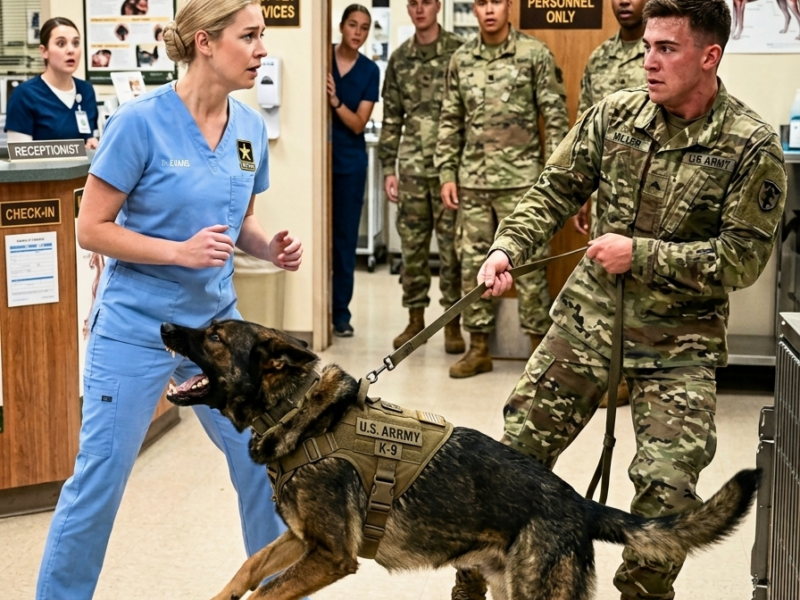
At the VA hospital in Fort Bragg, I was publicly accused of tampering with a wounded Green Beret’s medication while he stared at me like I was a liar
The night shift at the Veterans Affairs hospital adjacent to Fort Bragg had a rhythm of its own. It was a cadence measured by the rhythmic hiss of ventilators, the fluorescent hum of overhead lights, and the soft, squeaking rubber of non-slip shoes against freshly waxed linoleum. As a staff nurse on the specialized recovery wing, I was used to high-stakes environments, but tonight the air felt thick, charged with an invisible static.
I was halfway through my rounds, double-checking the IV lines on a sleeping officer, when I turned to find Sergeant Cole Mercer standing in the doorway of the nurses’ station. He was still wearing his combat boots, dirty from the training grounds, and his eyes held the hard, unyielding expression of a man who viewed the entire world as a tactical threat.
“You were alone with my room,” he said. His voice was quiet, pitched low enough that it barely carried past the desk, which somehow made it sound infinitely worse.
I set down my clipboard, keeping my breathing even. “I was dispensing scheduled pain relief for your unit member, Sergeant.”
“Tell me what you touched,” Cole demanded, stepping into the dim light of the station. His posture was rigid, every muscle coiled like a spring ready to snap.
I looked at the stainless-steel medication tray resting on my cart, then met his hardened gaze directly. “Only what I was assigned to give him. Nothing more, nothing less.”
He laughed, a bitter, humorless sound that rattled in his chest. “Funny, because something disappeared. A restricted compound was logged in the vault at nineteen hundred hours. It’s gone now, and the access log points straight to this station.”
The accusation burned, hot and sharp, but I had spent too many years in high-stress environments to lose my temper. “Then check the cameras, Sergeant. I have nothing to hide.”
He stared at me for a long, agonizing second, searching my face for a flinch, a glance away, or a twitch of guilt. Finding none, he turned on his heel and walked away without another word.
What Cole didn’t know—what nobody in this hospital knew—was that before I ever put on a set of medical scrubs, I had spent six years in the military as a working dog handler. I had spent half a decade training Belgian Malinois and German Shepherds for elite special operations teams. I had learned to read the absolute smallest changes in posture, breathing, scent, and spatial attention. More importantly, I had learned one golden rule that had kept me alive in hostile territory: never ignore an animal when it suddenly becomes afraid or alert.
Ten minutes later, Cole returned down the long corridor, but he wasn’t alone. Walking beside him on a tight lead was his Belgian Malinois, Ranger. Ranger was a broad-chested, scarred military working dog who usually ignored everyone except his handler, keeping his eyes locked onto Cole’s left hip.
The moment Ranger stepped across the threshold into the nurses’ station, his dark ears lifted, rotating like radar dishes. His nostrils flared wildly as he caught the draft blowing from the air vents. Then, breaking his heel command, he walked straight toward my stainless-steel medical cart.
Cole frowned, his hand instinctively dropping toward his side. “What is he doing? Ranger, heel.”
Ranger ignored the command. He dropped his nose to the bottom shelf of the metal frame, inhaled deeply, and froze solid. Every hair along his spine stood up. He didn’t bark; he gave a silent, rigid indication—the exact alert signal for explosives or hazardous biochemical material.
The old instincts, dormant for years, woke up inside me with terrifying clarity. “Don’t move the cart, Cole!” I snapped, my tone shifting instantly from civilian nurse to former tactical operator.
Cole looked at me suspiciously, his eyes narrowing. “Why?”
“Because your dog just found something. And if he’s indicating like that, it’s not a standard prescription.”
Cole crouched down, his jaw set. Keeping his body clear of the dog’s line of sight, he reached beneath the lowest metal lip of the frame. His fingers brushed against something metal, and with a soft click, he pulled away a tiny magnetic case hidden against the frame.
He opened it on the desk. Inside lay a crushed blue capsule and a sealed strip of medication bearing a altered, dangerously high dosage label.
The room went dead silent. The faint hum of the fluorescent lights suddenly sounded deafening.
Cole stared at the contents of the case, then looked up at Ranger, who remained sitting rigid beside the cart. “That wasn’t there this morning,” Cole muttered, his voice losing its aggressive edge, replaced by a sudden, creeping chill. “This frame was wiped down during shift change.”
I shook my head, my mind racing through the logistics. “No. It wasn’t.”
Hospital security arrived five minutes later, closing off the hallway and searching the rest of the station, but nothing else turned up. Yet as I stood near the desk, a strange, pungent smell drifted up from the crushed capsule in the magnetic box. It was subtle, almost completely masked by industrial antiseptic, but it hit a specific memory in my brain. It was a faint chemical odor—a synthetic solvent used in specialized military kennels to mask contraband scents during transport exercises.
My stomach plummeted. The realization hit me like physical trauma.
Someone hadn’t planted this evidence to frame me for stealing drugs. They had planted a specific chemical compound to see how I would react. They were testing whether I still possessed the training to recognize it.
Cole was watching me closely. He saw the sudden shift in my eyes, the way my breathing hitched. “You know what that smell is,” he stated. It wasn’t a question.
I took a deep breath, realizing that keeping my past hidden was no longer an option. “I spent six years in the 3rd Special Forces Group as a canine handler,” I admitted softly. “I left the service three years ago after a classified deployment in Eastern Europe went dark. My unit was compromised, and my lead handler vanished.”
Cole went pale, the color draining from his face until he looked like a ghost under the stark lights. “Eastern Europe… Task Force Blackwood?” he whispered.
My heart stopped. “How do you know that name?”
“Because that handler’s name was Daniel Voss,” Cole whispered, his hand shaking slightly as he reached into his inner jacket pocket.
Daniel. The name sent a shockwave through my system. Daniel Voss had been my mentor, my partner, and the last person I had seen before I was medically discharged following the ambush that destroyed our team.
Cole pulled out an old, creased photograph and laid it flat on the desk between us. In the photo, a younger, smiling Daniel stood beside a younger, unscarred Ranger. But it was the back of the photograph that made the blood run cold in my veins. Written in thick, black permanent marker were four words:
She knows where it is.
I looked up at Cole, a cold sweat breaking out across my skin, suddenly realizing the false accusation had never been about missing medication at all. It was a beacon. And somewhere inside this vast, darkened hospital, someone was watching us—someone who knew I was the only survivor left who held the key to what Daniel had hidden before he died.
The weight of those four words seemed to physically press down on the small room. She knows where it is. I stared at Daniel’s handwriting—the distinct, forward-slanting script I had seen on dozens of mission logs and training manifests during our years together in the unit.
“Where did you get this photograph?” I asked, my voice barely above a whisper as I looked at Cole.
Cole’s hand remained flat over the edge of the paper, his knuckles white. “It was tucked inside Daniel’s personal effects. When his status was changed from Missing in Action to Presumed Deceased six months ago, his gear was finally released from storage at Fort Bragg. I was assigned to inventory his locker. I found this taped beneath his locker liner.” He paused, looking at Ranger, who had finally broken his rigid posture and was now resting his head heavily on Cole’s boot. “Ranger was Daniel’s dog first. When Daniel didn’t come back from that deployment, the unit tried to retire Ranger due to trauma. I took him on so they wouldn’t put him down.”
The pieces of the nightmare were beginning to fit together, creating a picture I didn’t want to see. “Daniel didn’t die in that ambush,” I muttered, processing the reality. “He survived long enough to cache something. Something so dangerous that whoever wiped out our unit is still hunting for it.”
“And they think you have it,” Cole said grimly.
Before I could reply, the heavy double doors at the end of the recovery wing corridor hissed open. The heavy tread of polished leather boots echoed against the linoleum. Two men in dark suits, accompanied by the hospital’s head of security, walked briskly toward the station. The man in the lead was tall, with silvering hair pulled tight against his scalp and a stern, bureaucratic face that held no warmth.
“Nurse Miller,” the man said, pulling a metal badge from his belt. “I’m Special Agent Vance, Defense Criminal Investigative Service. We received a report of a narcotics breach and an unauthorized security alert on this floor.”
I stepped forward, trying to maintain my composure. “Agent Vance, someone tampered with my cart. They attached a magnetic case containing a masked chemical agent—”
“We are aware of the case, Nurse Miller,” Vance interrupted smoothly, his voice devoid of emotion. He held up a clear evidence bag containing the magnetic box Cole had retrieved just minutes earlier. “In fact, our department was alerted to potential irregularities in your employment file hours before this incident occurred. It seems you failed to disclose certain classified details regarding your military discharge.”
“My discharge was standard medical,” I argued, feeling a trap springing shut around me. “The operational details were classified under Title 10 regulations. I couldn’t disclose them to a civilian hospital board.”
“Be that as it may,” Vance replied, stepping closer, his presence suffocating. “Given the nature of the contraband found on your cart and the sensitive status of several patients on this floor, you are being placed on administrative suspension, effective immediately. You will surrender your keycard and accompany us to the administration office for questioning.”
I looked at Cole. His eyes were cold, scanning Vance and the agent standing behind him. Cole didn’t trust Vance; I could see it in the tension of his jaw. Ranger picked up on the sudden shift in energy, letting out a low, guttural growl from deep in his throat.
“Easy, boy,” Cole muttered, touching the dog’s collar. He turned to Vance. “Agent, this cart was accessed by multiple staff members during the shift change. You can’t pin this on her based on a planted case.”
“Sergeant Mercer,” Vance said, his tone dropping an octave, filled with quiet authority. “Your duty here is to guard your wounded teammate in Room 412. I suggest you return to your post and leave federal investigations to federal agents.”
Vance gestured toward the hallway exit. “Nurse Miller. With me.”
I knew that if I walked out of this hospital under federal custody, I might never get the chance to figure out what Daniel had left behind—or who was hunting me. But refusing an order from federal law enforcement in a VA facility would mean immediate arrest.
“Let me get my coat from the breakroom,” I said calmly, pointing down the secondary hallway.
Vance hesitated, then nodded to his partner. “Make it quick. Agent Miller will accompany you.”
I walked down the narrow side corridor, the second agent trailing two paces behind me. My mind was spinning. The chemical scent on the crushed capsule wasn’t just a test—it was a message. Daniel had used that exact masking agent during our final operation in the mountains of Eastern Europe to hide a hard drive containing the names of corrupt military contractors who were selling black-market weapons to rogue factions.
If that hard drive was still out there, and if Daniel had linked it to me, where would he have put it?
We reached the breakroom. I pushed the door open, stepped inside, and reached for my jacket hanging on the wall locker. As I did, my hand brushed against the bottom of the locker—and I felt a raised, metallic seam taped behind the bench.
My pulse spiked. It was the same magnetic tape used on the cart.
“Hurry up,” the agent ordered from the doorway, leaning against the frame with his arms crossed.
I bent down pretending to tie my shoe, my fingers slipping behind the bench. My nails caught the lip of a small, flat metal object. I pulled it loose, slipping it instantly up the sleeve of my cardigan. It was a heavy, old-fashioned brass key with a four-digit number stamped onto its stem: 1142.
Suddenly, the breakroom lights flickered and went out entirely.
A loud, piercing alarm shrieked through the hospital corridors—not a fire alarm, but the harsh, pulsating tone of a Code Black: facility-wide power grid failure. The backup generators sputtered, plunging the hallway into ambient red emergency light.
“What the hell?” the agent muttered, reaching for his radio.
Before he could key the mic, a shadow moved swiftly through the doorway behind him. A heavy hand struck the agent’s neck with surgical precision. The agent collapsed to the floor without making a sound.
Cole stepped into the breakroom, holding a tactical flashlight in one hand and Ranger’s leash in the other.
“Vance isn’t DCIS,” Cole said rapidly, his flashlight beam cutting through the red-lit darkness. “I just ran his badge number through my unit’s secure comms. The badge is fake. He’s here for you, Miller. We need to move now.”
I gripped the brass key in my sleeve, looking at Cole through the shadows. “I found something in here. A key. Stamped with 1142.”
Cole’s eyes widened in the dark. “1142 isn’t a room in this hospital. It’s a locker number at the old military transit hub near the airfield.”
A sudden burst of suppressed gunfire echoed down the main corridor, shattering the glass of the nurses’ station desk. The hunt was no longer in the shadows—they were coming for us directly.
The muffled sound of suppressed gunfire was unmistakable to anyone who had served in combat. It wasn’t the loud, echoing roar of standard civilian weaponry; it was the sharp, metallic thud-thud-thud of professional killers moving through a space with military discipline.
“Down!” Cole shouted, grabbing my shoulder and shoving me flat against the breakroom floor just as a volley of rounds shredded the drywall above our heads. Plaster dust rained down on us like gray snow.
Ranger didn’t bark—he knew better. He stayed low, pressed flush against Cole’s leg, his teeth bared in a silent snarl.
“They’ve cut the main power grid and killed the local comms,” Cole hissed, pulling a sidearm from a concealed holster beneath his civilian jacket. He slid the frame back, chambering a round with a sharp, mechanical click. “They aren’t here to arrest you, Miller. They’re here to clean the slate.”
“The service stairs at the end of the hall,” I whispered, my voice tight as I squeezed the brass key in my palm. “They lead straight down to the basement loading dock. If we can reach the maintenance tunnels, we can exit near the south perimeter fence.”
“Lead the way,” Cole said, bringing his flashlight up in a low-ready position. “I’ll cover the rear.”
We crawled out of the breakroom, staying beneath the thick layer of drywall dust floating in the red emergency lights. The hospital was descending into chaos—somewhere down the main ward, nurses were screaming, and automated voice systems were droning over the PA, repeating a meaningless emergency loop.
We reached the heavy fire door leading to the stairwell. Cole kicked the crash bar down, and we descended into the concrete stairwell, our boots clicking rapidly against the metal steps. Two flights down, the air grew noticeably colder, smelling of damp concrete, diesel fumes, and old machinery.
We burst through the basement access door and into the labyrinthine maintenance tunnels that ran beneath the Fort Bragg medical complex. These tunnels had been built during the Cold War, a massive network of concrete passages connecting the medical facilities to the older logistics depots near the airfield.
“Which way to Locker 1142?” Cole asked, his flashlight beam scanning the damp pipes running along the ceiling.
“The old transit hub is half a mile east through these conduits,” I said, pointing toward a dark, unlit tunnel marked with faded yellow paint. “It was decommissioned ten years ago, but the storage lockers were left in place for overflow base logistics.”
We moved quickly, Ranger pacing ahead of us, his nose low to the floor, sniffing out the dark corners before we stepped into them. The silence of the underground tunnel was suffocating, broken only by the steady drip of condensation from the overhead steam pipes.
As we walked, I looked down at the brass key in my hand. “Daniel knew he was being tracked three years ago,” I said softly, the realization settling heavily in my chest. “He planted this key in the breakroom locker because he knew that if anyone ever compromised his team, they would eventually track me down to this hospital. He left a trail that only another handler could follow.”
“He trusted you,” Cole said simply, keeping his eyes on the darkness ahead. “When Daniel was wounded in Eastern Europe, he didn’t call his command. He didn’t trust his own chain of command. He spoke about you constantly during our training rotations. He said you were the only handler who could see the entire board, not just the target in front of you.”
Before I could answer, Ranger suddenly stopped dead in his tracks. He dropped into a deep crouch, his tail stiff, his ears pinned back flat against his skull.
Cole immediately raised his arm, signaling for me to freeze. He clicked off the flashlight, plunging us into absolute, crushing pitch-black darkness.
For several seconds, the only sound was the slow, steady rhythm of our breathing. Then, from thirty yards ahead in the dark tunnel, came the faint, rhythmic sound of heavy boots stepping through puddles of standing water.
Clack. Clack. Clack.
Someone was already down here. They hadn’t just pursued us from the hospital—they had anticipated our egress route.
“They have night vision,” Cole whispered into my ear, his breath warm against the cold air. “If I fire, the muzzle flash will blind us and give away our exact position. We need to flush them into the open.”
“Ranger,” I whispered, leaning down toward the dog’s ear. I remembered the specific verbal cues Daniel used during silent infiltration drills. I pressed my hand against Ranger’s ribs, feeling his heart pounding like a hammer. “Seek silent,” I murmured in a dialect of Czech that Daniel always used for covert utility commands.
Ranger didn’t make a sound. He slipped away from Cole’s side, his pawfalls completely silent as he melted into the blackness of the tunnel.
Five seconds passed. Ten seconds.
Then, a sudden, brutal struggle exploded in the dark ahead. A man shrieked in shock as over eighty pounds of trained Malinois hit him in the chest, followed by the sickening crunch of Kevlar and bone as Ranger clamped down on his arm. A flashlight dropped to the concrete floor, rolling across the puddles and illuminating two armed operatives clad in tactical gear, wearing night-vision goggles.
“Go!” Cole yelled, stepping into the light of the fallen flashlight and opening fire.
The sharp cracks of Cole’s pistol echoed deafeningly within the tight concrete tunnel. One operative collapsed immediately, while the second struggled furiously to shake Ranger off his left arm. I didn’t hesitate. I sprinted forward, grabbed the fallen flashlight from the water, and swung it with all my strength into the remaining operative’s helmet. The heavy metal casing struck him square in the temple, and he crumpled to the ground, motionless.
“Ranger, off!” Cole commanded, rushing up beside me.
The dog immediately released his grip, stepping back and panting heavily, his eyes wild but disciplined.
I looked at the fallen operatives. They wore no military insignia, no unit patches, and no name tags. Their weapons were unmarked, scrubbed of serial numbers. These weren’t federal agents, and they weren’t rogue soldiers. They were private military contractors—a clean-up crew hired to eliminate every last trace of Task Force Blackwood.
“We don’t have much time,” Cole grunted, reloading his pistol with a fresh magazine. “The gunfire will bring the rest of them down here.”
We pushed past the fallen men, running down the final stretch of the tunnel until we reached a heavy iron door marked LOGISTICS STORAGE HUB 4. Cole used the butt of his pistol to smash the rusting padlock, and we threw the door open.
Inside was a massive, dust-covered room filled with rows of old green metal lockers from the Vietnam era. The air was stale, smelling of dry rot and rusted steel.
I swept the flashlight beam along the rusted metal faces until the numbers caught the light.
1140… 1141… 1142.
My hands trembled as I stepped up to Locker 1142. The brass key slid into the keyhole with a gritty, popping sound. I turned it to the right. The internal latch clicked, and the rusted locker door swung open with a long, agonizing creak.
Inside, resting on the top shelf, was not a hard drive, nor a weapons file, nor a pouch of cash.
It was a small, military-issue digital recorder wrapped in thick electrical tape, resting beside a worn, leather-bound field notebook. And sitting right beside it was a single, silver dog tag.
I reached out and picked up the dog tag, holding it up to the beam of the flashlight.
The name stamped into the metal wasn’t Daniel Voss.
It was Cole Mercer.
I froze, the blood running instantly cold in my veins as I turned slowly to face the man standing behind me in the dark.
The beam of my flashlight trembled, casting long, erratic shadows across the rusted metal lockers. The single silver dog tag dangled from my index finger, heavy and cold. I looked from the name stamped into the metal—MERCER, COLE A.—up to the face of the man standing five feet away from me in the damp, subterranean air.
Cole didn’t move. He stood perfectly still, his pistol lowered at his side, his face half-illuminated by the stark light. Beside him, Ranger sat, his dark eyes shifting between the two of us, sensing the sudden, suffocating tension that filled the room.
“Why is your dog tag in Daniel’s private locker, Cole?” I asked, my voice deadly quiet, every muscle in my body pulling tight. “You told me tonight was the first time you ever learned about my connection to Task Force Blackwood. You told me you were just inventorying Daniel’s gear six months ago.”
Cole sighed, a long, exhausted sound that seemed to age him ten years in a single second. He lowered his gun completely, sliding it back into the holster beneath his jacket—a deliberate gesture of non-aggression.
“Because I wasn’t just inventorying his gear, Miller,” Cole said softly, looking down at the dog tag in my hand. “I was his junior partner on Task Force Blackwood.”
I stepped back, my spine hitting the cold steel of the locker row. “You lied to me.”
“I had to,” Cole replied, his voice thick with emotion. “If I had walked into that hospital tonight and told you who I really was, you would have run. Or worse, you would have thought I was part of the group that betrayed our unit in Eastern Europe. I needed to see if you were still clean. I needed to know if you were working with Vance.”
“Vance works for the contractor,” I said, processing the information rapidly, my handler’s mind cross-referencing everything he had said since he walked into the nurses’ station. “The chemical on the cart…”
“Wasn’t planted by Vance,” Cole interrupted gently. “I planted it.”
I stared at him in disbelief. “You?”
“I had to trigger Ranger’s alert,” Cole explained, pointing to the Malinois. “Ranger was trained exclusively by Daniel and you. He only responds to specific chemical markers that you used during your team’s deployment. I needed a reason to pull you out of that station without alerting the surveillance team that Vance had placed in the hospital lobby. If I hadn’t staged that breach, Vance’s men would have picked you up at the end of your shift, taken you to a dark site, and you never would have walked out.”
“And the photo?” I asked, my mind racing. “The back of the photo—She knows where it is?”
“Daniel wrote that the night our base was hit in Europe,” Cole said, stepping closer, though keeping his hands visible. “When the ambush started, Daniel knew we had been sold out by high-ranking officials within our own command architecture—men who were using private defense contractors to divert weapons shipments. Before he was shot, Daniel handed me that notebook and his key, and told me that if anything happened to him, I had to find you. You were the only one who knew how to decipher his field codes.”
Cole reached into his pocket and pulled out a small, worn leather journal that matched the one sitting inside Locker 1142.
“Daniel didn’t die in that ambush, Miller,” Cole whispered, his eyes gleaming with a fierce, burning light in the flashlight beam. “He survived. But they’ve been keeping him hidden in a private medical facility three miles from here—a dark site disguised as a corporate research lab, run by Vance’s contractors. They’ve been keeping him alive because he encrypted the main dossier, and the decryption key is locked inside a neurological sequence only a handler who trained with him can execute.”
My breath caught in my throat. “He’s alive?”
“He’s alive,” Cole confirmed. “And that recorder in your hand? That’s his voice. He left it for you three years ago, before he was captured.”
My fingers trembled as I raised the digital recorder. I stripped away the heavy electrical tape and pressed the small play button on the side.
The speaker crackled with static, followed by the faint, muffled sound of heavy rain and wind. Then, a voice came through—rough, breathless, but unmistakable. Daniel.
“If you’re listening to this, Miller… it means Cole found you, and Ranger is still walking,” Daniel’s voice rasped through the tiny speaker. “I don’t have much time. Vance’s team compromised the entire chain of command. They think I hid the primary drive in the vault, but they don’t understand how we train. The drive isn’t a physical object. It’s stored on a closed-network server inside the research facility, locked behind a bio-metric and behavioral protocol. They’ve been trying to break me for three years, but they can’t bypass the handler safety phrase.”
The recording paused, filled with a heavy, ragged breath.
“Miller… you have to finish the run. Don’t come for me unless you’re ready to burn the whole house down. The code is the final command we taught Ranger on the night we passed out of the academy. Godspeed, kid.”
The recording clicked off, leaving an absolute, silence in the cold storage room.
I stood there in the dim light, the tears burning at the back of my eyes, but my mind was clearer than it had been in years. The fog of uncertainty, the self-doubt that had followed me since my medical discharge—it all vanished, replaced by a cold, hard resolve.
“He’s waiting for us,” I said, looking up at Cole.
Cole drew a long breath, a slow, dark smile touching the corner of his mouth. “Vance thinks he locked down the hospital. He has no idea we know about the research facility.”
Suddenly, a loud metallic thud echoed from the heavy iron door at the end of the locker row. The hinges groaned as someone began cutting through the lock with an industrial torch, blue sparks flying into the dark room.
Vance’s clean-up crew had finally found us.
Cole drew his sidearm, checking the sight line. “We’ve got about thirty seconds before that door comes down.”
I picked up the leather-bound notebook from the locker, slipped it into my pocket, and looked down at Ranger. The dog stood tall, his ears forward, his body poised for action.
“We aren’t running anymore,” I told Cole, my voice hardening like tempered steel. “We’re going to get Daniel.”
The blue sparks from the plasma torch ceased, replaced by the heavy, echoing thud of a tactical boot kicking the iron door off its frame. The metal door crashed onto the concrete floor with a deafening bang, sending a cloud of rust and dust billowing into the storage room.
Three contractors in heavy tactical armor surged through the breach, their weapon-mounted flashlights cutting sharp beams through the haze.
They expected two terrified targets cornered in a dead-end room. They didn’t expect a coordinated assault.
“Now!” I screamed.
Cole stepped out from behind a row of steel lockers, firing three rapid, precise shots. The lead contractor took two rounds to the center chest plate, his momentum halted as he stumbled backward into his teammate.
Simultaneously, I hurled a heavy brass fire extinguisher straight through the dust cloud. It struck the second contractor’s weapon, knocking the barrel off-target just as he opened fire. The burst of bullets tore harmlessly into the ceiling concrete.
“Ranger! Drž!” I yelled—the high-drive attack command in Czech that Daniel and I had spent two years perfecting.
Ranger launched off the concrete floor like a missile. He cleared the fallen iron door in a single bound, flying through the dust cloud and hit the third contractor full in the throat before the man could raise his rifle. The force of the strike brought the heavy contractor crashing down onto his back, his weapon clattering across the floor.
Cole closed the distance in two strides, using the frame of his weapon to neutralize the second operative before he could recover his stance.
Within eight seconds, the doorway was clear. The three contractors lay disarmed and motionless on the floor.
I picked up one of the fallen tactical rifles, checking the magazine and sliding the selector switch to semi-automatic with practiced familiarity. The weight of the weapon felt natural in my hands—an old, deadly muscle memory returning instantly.
“The research facility,” I said, looking at Cole as he pulled a set of vehicle keys from one of the downed men. “Where is it?”
“Two miles west, hidden behind an old industrial paper mill near the river,” Cole said, wiping a streak of dark grease from his forehead. “It’s gated, private security, full perimeter sensors. Vance uses it as his operational headquarters.”
“Then we use their own truck to drive right through the front gate,” I replied, my eyes locked on his. “They aren’t expecting a counter-attack. They think we’re still trying to escape the hospital perimeter.”
Ten minutes later, we were tearing down the dark, rain-slicked back roads of Fort Bragg in a blacked-out tactical SUV taken from the contractor parking area. The rain fell in heavy, blinding sheets, pounding against the windshield, but Cole kept his foot hard on the accelerator, navigating the dark curves by memory.
In the back seat, Ranger sat alert, his eyes fixed on the road ahead, sensing the culmination of a hunt three years in the making.
We crested a low hill, and the paper mill came into view—a sprawling, dark industrial complex surrounded by a twelve-foot chain-link fence topped with razor wire. Spotlights scanned the muddy gravel yard, and a single security booth sat at the main sliding gate.
“No subtle entry,” I said, sliding a fresh magazine into my rifle. “We hit the gate, clear the security team, and locate the lower basement level. That’s where dark sites always keep medical holding.”
“Right behind you, handler,” Cole grimaked, pressing the accelerator to the floorboards.
The heavy SUV roared down the hill, its engine screaming as it hit seventy miles per hour. The guard in the security booth barely had time to raise his hands before the metal bumper obliterated the chain-link gate, tearing through the barrier in a shower of sparks and twisted metal.
The SUV slammed to a halt in the center of the concrete courtyard. Steam billowed from the crumpled hood.
We threw the doors open, moving in a tight two-man element with Ranger moving point. Security alarms began to blare across the complex, red strobe lights painting the rain-soaked pavement in flashes of crimson.
We hit the facility’s main reinforced entrance before the outdoor guards could organize a defense. Cole blew the magnetic lock with his sidearm, and we burst into the sterile, white-walled corridor of the underground research lab.
It was starkly different from the industrial exterior—clean, high-tech, lined with glass doors and heavy server racks.
At the end of the primary hallway, behind a double-paned reinforced glass wall, sat a small medical bay. Inside, hooked up to monitoring equipment and restrained by heavy leather straps, sat a man. He was thin, his hair long and graying, his face lined with deep scars—but his eyes were wide, bright, and staring straight at us through the glass.
Daniel.
“Daniel!” I shouted, rushing toward the glass partition.
Before I could reach the control panel, a door at the side of the hallway opened, and Agent Vance stepped out, holding a heavy black pistol pointed directly at Daniel’s chest through an interior viewing window. Behind Vance stood two heavily armed guards.
“That’s far enough, Nurse Miller!” Vance shouted, his voice amplified by the hallway intercom system. “You’ve made a remarkably foolish decision coming here. You thought you were playing a rescue mission, but all you’ve done is save me the trouble of hunting you down.”
I stopped, bringing my rifle up, but Vance held all the cards—his finger was rested lightly against the trigger of his pistol, positioned inches from Daniel’s heart.
“You want the dossier, Vance,” I said, keeping my voice steady, projecting calm authority. “You’ve spent three years trying to get it from him, but his mind is locked. You know you can’t access those servers without the handler sequence.”
Vance smiled, a cold, vicious expression. “Which is precisely why I brought you here. You’re going to execute the command, Miller. Or I put a bullet through his heart right now, and I burn this entire facility to the ground.”
Inside the glass room, Daniel looked at me. He couldn’t hear us through the soundproof glass, but he saw my face. He shook his head slowly, telling me not to do it—telling me to sacrifice him to stop Vance.
I looked down at Ranger, who was standing beside my knee, trembling with restrained energy, his eyes locked onto Daniel behind the glass.
I looked back at Vance. “You want the sequence? Fine. But you need to open the main server access panel first.”
Vance gestured to one of his guards, who keyed a code into the central console. A thick steel panel slid back, revealing a terminal flashing with a secure, bio-metric prompt.
“Speak the phrase,” Vance ordered, stepping closer to the terminal while keeping his gun trained on Daniel.
I took a deep breath, stepping forward until I was standing right at the edge of the glass partition. I didn’t look at the terminal. I looked straight into Vance’s eyes.
“The command isn’t a password, Vance,” I whispered softly. “It was never a password.”
I looked down at Ranger and gave the signal Daniel and I had created—a simple, sharp hand gesture pointing straight at Vance’s throat, followed by two words spoken in a language Vance didn’t understand.
“Konec hry,” I commanded—Czech for Game over.
Ranger didn’t attack the glass. He lunged sideways, driving his entire body weight into the central power conduit running along the lower wall—the exact vulnerability Daniel had mapped out years ago when designing the security layout.
The main glass doors shattered violently as the emergency pressure seals failed instantly under the electrical short.
Cole opened fire in the same split second, taking down both guards before they could raise their weapons.
Vance spun, his face twisted in horror as he tried to bring his pistol around toward me. But I was already moving. I closed the distance in a heartbeat, grabbing his wrist, twisting his arm upward, and driving an elbow straight into his jaw. The pistol flew from his hand, shattering against the concrete floor.
Vance fell to his knees, gasping for air, looking up as Cole stepped over him, placing the barrel of his sidearm directly against Vance’s forehead.
“It’s over, Vance,” Cole said, his voice flat and absolute. “Defense Criminal Investigative Services is already on their way here—the real DCIS. And they’re coming with a full military escort.”
I ignored Vance, sprinting into the medical room. I dropped my rifle and fell to my knees beside the bed, my hands working frantically to unbuckle the heavy leather straps restraining Daniel.
“Miller…” Daniel rasped, his voice weak, broken from years of isolation, but filled with immense warmth. He looked up at me, his eyes wet with tears. “You… you actually came.”
“Of course I came, handler,” I whispered, pulling the final strap loose and pulling him up into an embrace.
Ranger trotted into the room, his long tail sweeping back and forth in a wild, frantic rhythm. He pushed his large head straight under Daniel’s hand, letting out a soft, whimpering whine of pure joy. Daniel buried his face in the dog’s thick fur, his hands trembling as he held his partner for the first time in three long years.
Cole stepped into the doorway, holstering his weapon, looking at the three of us with a quiet, satisfied smile.
Outside, the distant, rhythmic thumping of heavy military helicopters began to shake the building, their searchlights cutting through the rain outside as the real Special Forces units arrived to secure the facility and take down the syndicate once and for all.
The long night was finally over. The shadows that had haunted us for three years had been dragged into the light, and for the first time since Task Force Blackwood fell, we were finally going home.
The end.









