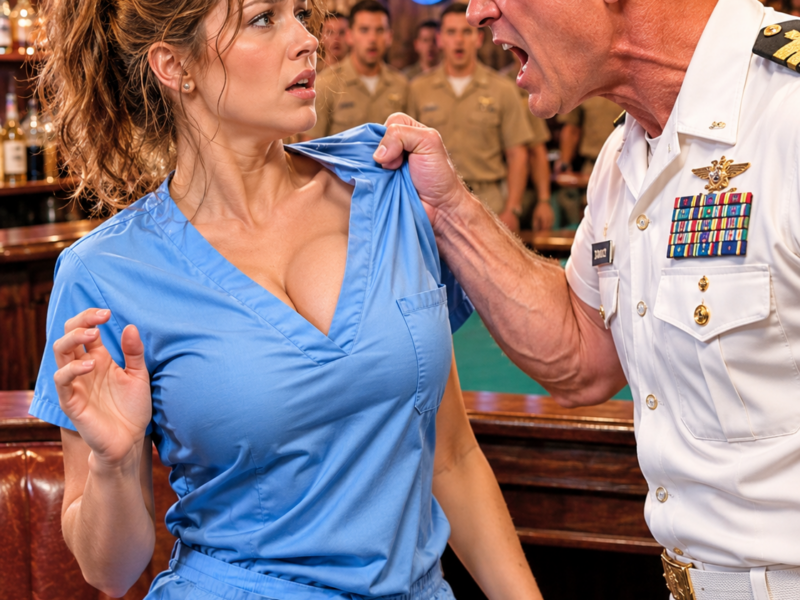
“At the Navy officers’ bar in Norfolk, a Navy SEAL laughed when I told him I was just a nurse, then asked whether I belonged behind the counter instead of at the table
The admiral unfolded the document slowly.
Ryan was still sitting beside me, but his posture had changed. His shoulders were stiff, and his eyes kept moving between the admiral and the small silver ribbon visible beneath my collar.
“Sir,” I said quietly, “whatever this is, can we discuss it somewhere else?”
Admiral Whitaker looked at me for a moment.
Then he glanced around the bar.
“I would normally agree, Lieutenant. But I believe the people in this room need to understand something before they decide what they think they know about you.”
He placed the folded document on the counter.
It was an official military report, its edges worn from being handled.
Ryan leaned forward.
“Admiral, I didn’t know—”
“That’s precisely the problem, Chief.”
The admiral didn’t raise his voice.
He didn’t need to.
“You’re comfortable making judgments about people whose service you haven’t bothered to understand.”
Ryan looked down.
I wished the floor would open beneath me.
Not because I felt sorry for him.
Because I knew what was coming, and I wasn’t sure I wanted to hear it again.
Three years earlier, I had been assigned to a joint medical support unit operating near a remote coalition outpost in Afghanistan.
I had been in the Navy for nine years.
Most of my career had been spent in emergency departments and military medical facilities. I had treated traumatic injuries, assisted in surgeries, and worked with service members whose physical wounds were easier to recognize than the ones they carried home.
But that assignment was different.
Our medical team supported several units operating across a difficult stretch of terrain. We weren’t supposed to be involved in direct combat operations.
We were there to keep people alive.
That distinction mattered to me.
I had a younger brother, Daniel, who had joined the Army at nineteen. He used to tell our mother that the military was full of people who knew how to fight but sometimes forgot how to take care of one another.
He had died in a training accident two years before I deployed.
After his funeral, I almost resigned.
Instead, I stayed.
I told myself that every person I helped get home was one more family spared the phone call my mother had received.
I never said that out loud.
Some reasons are too personal to turn into conversation.
The operation that changed my life began on a hot afternoon in late August.
Our team received word that a convoy had been hit outside a small forward position. Several American service members were injured, and the route back to the main medical facility had become unsafe.
We were asked to prepare for incoming casualties.
I remember the sound of the medical tent’s generator.
The smell of antiseptic mixed with dust.
The way a young corpsman kept checking the same medical bag, even though he had already checked it three times.
His name was Lucas Bennett.
He was twenty-two and had been assigned to our team for only a few months.
“Lieutenant, do you think they’ll make it?” he asked.
I was checking a tray of supplies.
“That’s why we’re here, Lucas.”
He nodded, but his eyes didn’t leave the entrance.
The first casualty arrived before sunset.
Then another.
By the time the third stretcher came through, we were running out of space.
One of the men had a serious abdominal wound. Another had suffered a traumatic injury to his leg.
We worked quickly.
I remember holding pressure against a wound while a doctor called for additional blood products.
I remember Lucas cutting through a uniform sleeve with shaking hands.
And I remember the radio.
The first warning came in broken pieces.
The convoy route was compromised.
Additional personnel were needed at the forward position.
The evacuation window was narrowing.
Then the lights flickered.
A loud impact shook the medical facility.
Someone shouted for everyone to get down.
The next few minutes became a series of sounds and movements that I can still recall with uncomfortable clarity.
Dust fell from the ceiling.
A metal cabinet tipped over.
A patient began screaming for his mother.
I crawled toward him, checked his airway, and tried to keep him calm.
“Look at me,” I told him. “Stay with me. You’re not alone.”
He grabbed my sleeve.
“Please don’t leave.”
“I won’t.”
I meant it.
Even when the second impact came.
The medical facility had taken damage, and the command team was trying to determine whether we could safely move the wounded.
Our communications equipment was partially down.
The nearest evacuation vehicle was still several minutes away.
And then Lucas came running toward me.
“Lieutenant! We’ve got another group outside!”
“How many?”
“Four. One’s unconscious. I think there’s another casualty near the vehicle.”
I looked toward the entrance.
The security team was trying to keep the area clear, but the situation was deteriorating.
The senior physician wanted the patients moved in stages.
I understood his reasoning.
But one of the men outside was trapped beneath part of a damaged vehicle.
If we waited, he might not survive.
I remember looking at Lucas.
He was pale beneath the dust.
“Get the trauma bags,” I told him.
“Ma’am, the security team said—”
“I heard them.”
I took a radio and requested an escort.
The response was that nobody could guarantee the route was secure.
I could still hear the trapped man’s voice.
It was weak.
Then it stopped.
I made a decision.
Not because I believed I was invincible.
Not because I thought I was more important than the people giving orders.
I made it because I knew what happened when people waited too long.
Lucas followed me.
We reached the vehicle with two members of the security team.
The man was alive.
His leg was pinned, and he was bleeding heavily.
I dropped beside him and began assessing his injuries.
“What’s your name?” I asked.
He barely opened his eyes.
“Michael.”
“All right, Michael. I’m Emily. We’re going to get you out.”
He tried to move.
“Don’t…”
“Don’t move. Just breathe.”
The security team worked to free him while I controlled the bleeding.
Then the radio crackled.
“Incoming! Move back!”
One of the security personnel grabbed my shoulder.
“Lieutenant, we have to go!”
I looked at Michael.
He was still trapped.
I looked at the man trying to pull me away.
“Give me thirty seconds.”
“Ma’am, we don’t have thirty seconds!”
I remember the argument.
I remember Lucas shouting that the pressure dressing wasn’t holding.
I remember the sound of another explosion somewhere beyond the perimeter.
And I remember making the choice to stay.
We managed to free Michael.
But as we moved him toward cover, a blast threw us against the ground.
I felt something strike my left side.
For a few seconds, I couldn’t breathe.
Lucas was shouting my name.
I tried to answer, but my mouth tasted of dirt and blood.
When I finally opened my eyes, Michael was still beside me.
And Lucas was kneeling over both of us.
“Lieutenant, you’re bleeding.”
“Michael?”
“He’s alive.”
“Then take him.”
Lucas shook his head.
“I’m not leaving you.”
I gripped his sleeve.
“That’s an order, Bennett.”
He looked at me as though he hated me for saying it.
Then he helped move Michael toward the evacuation point.
The last thing I remember before losing consciousness was the sound of a helicopter.
I woke up two days later in a larger medical facility.
My ribs were fractured.
My left shoulder had been badly injured.
I had a concussion and a deep wound along my side.
The doctors told me I was lucky.
I didn’t feel lucky.
I asked about Michael.
He had survived.
I asked about Lucas.
He was alive, too.
Then I asked about the other casualties.
Three had been evacuated successfully.
One had died before reaching the medical facility.
I spent the next several weeks recovering.
When the official review began, I answered every question honestly.
I didn’t consider myself a hero.
I had been doing my job.
The Silver Star came months later.
The citation mentioned extraordinary courage under fire, but it didn’t mention the things that stayed with me most.
It didn’t mention Lucas crying in the hallway after he learned I had survived.
It didn’t mention Michael asking for my name when he woke up.
And it didn’t mention the young corpsman who had blamed himself for not getting to me sooner.
I never wanted the medal to become the most interesting thing about my life.
That’s why I rarely wore it.
Back at The Anchor, Admiral Whitaker finished reading the report.
Nobody spoke.
Ryan had moved away from his stool.
He was standing now, his hands resting at his sides.
“Lieutenant,” he said.
I didn’t answer immediately.
He swallowed.
“I owe you an apology.”
I looked at him.
“Yes, you do.”
He nodded.
“I shouldn’t have said what I said.”
“No. You shouldn’t have.”
He glanced toward his teammates.
One of them stared into his drink.
Another quietly put his glass down.
Ryan rubbed his jaw.
“I’ve been in places where things went bad. I’ve seen people get hurt. I guess I thought I knew what courage looked like.”
I studied him for a moment.
“That’s the trouble with thinking you already know what it looks like.”
He didn’t argue.
The admiral folded the document again.
“There’s something else, Emily.”
I turned toward him.
His expression had become more serious.
“The report I just showed you isn’t the reason I came here.”
My stomach tightened.
“What do you mean?”
He reached into his jacket and removed another envelope.
This one was smaller.
My name was written across the front.
I recognized the handwriting immediately.
My fingers went cold.
“Where did you get that?”
“It was delivered to my office this morning.”
I stared at the envelope.
The handwriting belonged to Lucas Bennett.
I hadn’t spoken to him in nearly two years.
After the operation, Lucas had struggled with what happened. He blamed himself for not reaching me sooner, despite the fact that he had helped save several lives.
We spoke a few times during my recovery.
Then his messages became shorter.
Eventually, they stopped.
I had heard he left active duty.
I had also heard he was working as a civilian emergency medical technician somewhere in North Carolina.
But I hadn’t known how to reach him.
I had tried.
Several times.
“Is he all right?” I asked.
The admiral hesitated.
“I believe so. But there’s something in this letter you should read.”
I took the envelope.
Inside was a single sheet of paper and a photograph.
The photograph showed our medical team standing outside the damaged facility shortly before the attack.
I was near the center.
Lucas stood beside me, wearing a dusty helmet and an oversized medical vest.
At the bottom, someone had written a date.
Three days before the operation.
I turned the photograph over.
There was another message.
Emily,
There is something I should have told you before I left.
The report wasn’t the whole story.
I read the sentence twice.
Then I looked at the admiral.
“What does he mean?”
Whitaker exhaled slowly.
“That’s what I’ve been trying to determine.”
He explained that a supplemental incident report had recently surfaced during a review of several old operational records.
The report contained discrepancies in the original timeline.
One communication log appeared to have been altered.
A request for evacuation support had been recorded as received much later than the time it was actually transmitted.
That delay had affected the decisions made on the ground.
And according to the supplemental report, Lucas had been the person who first noticed the discrepancy.
I looked down at the letter again.
“Why didn’t he tell me?”
“Because he believed the discrepancy was his fault.”
I frowned.
“How could it be his fault?”
The admiral didn’t answer immediately.
Instead, he opened the second page of the document.
“Someone entered the wrong time into the official record. Lucas challenged it during the initial review. His statement was dismissed as confusion caused by the attack.”
I felt my throat tighten.
“Who entered it?”
Whitaker looked toward the far end of the bar.
“That’s the part we haven’t established.”
I looked at the photograph again.
The faces were younger.
The expressions were ordinary.
None of us knew what was coming.
Then I noticed something I hadn’t seen before.
A man stood behind the group, partially obscured by a vehicle.
He wasn’t wearing medical gear.
He was an operations officer attached to the command team.
I knew his face.
Captain Robert Hayes.
He had been responsible for coordinating the evacuation.
And he had personally signed the original report.
“Admiral,” I said, turning the photograph toward him. “Why is Captain Hayes in this picture?”
Whitaker’s jaw tightened.
“Because he was the officer responsible for the operation.”
I remembered Hayes.
He had visited me during my recovery.
He had told me the medical team had performed exceptionally.
He had shaken my hand and said my actions would be remembered.
At the time, I had believed him.
Now I couldn’t stop thinking about the delayed evacuation request.
“Is he still serving?”
“Yes.”
“Does he know about the supplemental report?”
“Not yet.”
I looked at the letter again.
There was a second paragraph I hadn’t noticed.
I turned the page toward the light.
Emily,
If you ever get the chance, please ask what happened to the original radio recording.
I felt a chill run through me.
“Original radio recording?” I whispered.
Admiral Whitaker nodded.
“That’s what Lucas mentioned in his preliminary statement.”
“Where is it?”
“That’s what we need to find out.”
I looked at the admiral.
Then at the photograph.
Then at the men who had been laughing only minutes earlier.
The bar seemed impossibly quiet.
Ryan stepped closer, his voice lower than before.
“Lieutenant, if there’s anything we can do…”
I glanced at him.
For the first time that evening, he looked less like a man trying to prove himself and more like someone who had realized how little he knew.
“I appreciate that, Chief.”
The admiral placed a hand lightly on the counter.
“Emily, I need you to understand something. This isn’t about changing your medal citation. Your actions that day are already documented. But if the evacuation delay was deliberate, then people may have been placed in danger unnecessarily.”
I nodded.
I understood.
I also knew that reopening an old incident would bring back memories I had worked hard to live with.
But Lucas had carried the weight of that day for two years.
If there was evidence that could clear his name, I couldn’t ignore it.
“I want to see him,” I said.
Whitaker nodded.
“I thought you might.”
He gave me an address.
A small town outside Wilmington, North Carolina.
Lucas was working at a county emergency services station.
I booked a flight the following morning.
I didn’t tell many people why I was going.
I told my supervisor I needed a few days away for a personal matter.
She looked at me over her desk.
“Is everything all right?”
I hesitated.
“I don’t know yet.”
She didn’t press.
That was one of the things I appreciated about her.
The drive from Wilmington to the station took about forty minutes.
It was raining lightly when I arrived.
The building was small, with two ambulance bays and a faded sign near the entrance.
A man in a navy-blue uniform was standing beside an ambulance, checking a supply cabinet.
He looked up when I stepped out of my car.
For a moment, neither of us moved.
Then his face changed.
“Emily?”
I smiled, although my eyes were already burning.
“Hi, Lucas.”
He walked toward me slowly.
He looked older.
His hair was shorter, and there were faint lines around his eyes that hadn’t been there before.
But it was still him.
The young corpsman who had once refused to leave my side.
The man who had carried a memory for two years without knowing how to put it down.
“I didn’t think you’d come,” he said.
“I almost didn’t.”
He looked at the rain falling beyond the ambulance bay.
“Coffee?”
“Please.”
We sat in a small break room.
For several minutes, we talked about ordinary things.
His work.
My hospital.
The people we’d lost touch with.
It was awkward in the way conversations become when two people have unfinished history between them.
Finally, I placed the photograph on the table.
Lucas stared at it.
Then he covered his face with one hand.
“I should have sent that sooner.”
“Why didn’t you?”
He looked at me.
“Because I was afraid.”
“Of what?”
“That I’d find out I was wrong.”
I leaned forward.
“Lucas, what happened?”
He took a long breath.
Then he told me.
During the operation, he had been monitoring the medical team’s radio traffic.
When the evacuation request was transmitted, he recorded the time in his field notebook.
He remembered it clearly because the request came just after he had administered medication to one of the wounded men.
The official report showed the request arriving nearly twenty minutes later.
At first, he thought he had misremembered.
Then he reviewed his notes.
The times didn’t match.
He reported the discrepancy to Captain Hayes.
Hayes told him the radio system had been unreliable and that the official log would stand.
Lucas tried to challenge it again.
This time, he was warned that he was confusing an already difficult incident.
“I thought maybe I was losing it,” Lucas said.
“Then I found something.”
He opened a small drawer beside the table.
Inside was a notebook wrapped in a plastic bag.
He placed it in front of me.
It was his original field notebook.
The pages were worn.
Some were stained.
But the handwriting was unmistakable.
I turned to the date of the operation.
There were several entries.
At 16:42, he had written that the evacuation request was transmitted.
At 16:47, he had recorded the acknowledgment.
At 17:01, he had noted that no evacuation vehicle had arrived.
I stared at the page.
The official report showed the request being received at 17:03.
Twenty-one minutes later.
“Why didn’t you keep this with the formal complaint?” I asked.
“I did. It disappeared during the review.”
I looked up sharply.
“What?”
“I gave them a copy. They told me it wasn’t relevant because the radio system had been malfunctioning.”
“And the original?”
“I kept it.”
I turned another page.
There was a handwritten note near the bottom.
A call sign.
A time.
And a short sentence.
Hayes requested hold.
I read it again.
“Lucas, what does this mean?”
His eyes moved to the notebook.
“I heard the instruction over the radio. I didn’t understand it at the time.”
“What instruction?”
He swallowed.
“The evacuation vehicle was ready to move. But someone told the driver to hold position until further authorization.”
I felt my stomach tighten.
“Who?”
Lucas pointed to the call sign.
It belonged to Captain Hayes.
For a long moment, I couldn’t speak.
“Are you sure?”
“I’ve replayed that moment in my head thousands of times.”
He leaned back.
“I don’t know why he did it. Maybe there was information we didn’t have. Maybe he thought the route was too dangerous. But the official record says the vehicle wasn’t ready.”
I looked down at the notebook.
“Which isn’t what happened.”
“No.”
The rain tapped against the window.
I thought about the men on those stretchers.
The patient who had grabbed my sleeve.
The young corpsman who had spent two years blaming himself.
And I thought about Captain Hayes shaking my hand in the recovery ward.
“Did you tell anyone else?”
“One person.”
“Who?”
Lucas hesitated.
“Chief Warrant Officer Daniel Brooks. He was the communications specialist assigned to the command post.”
I looked up.
“Where is he now?”
“Retired. Lives in Virginia.”
I felt a strange pull in my chest.
The trail wasn’t over.
Before I could say anything, Lucas reached into the drawer again.
He removed a small digital recorder.
“I kept this, too.”
My mouth went dry.
“What’s on it?”
“The original radio traffic. At least part of it.”
He placed it on the table.
“I didn’t know if it was enough to prove anything. I was scared they’d say I had altered it.”
I picked up the recorder.
It felt heavier than it should have.
“Why didn’t you send it to the admiral?”
“Because I wanted you to hear it first.”
I looked at him.
“Why me?”
His eyes were wet.
“Because you were the one who stayed. And I couldn’t keep pretending that the official report was the whole truth.”
I reached across the table and rested my hand over his.
“You didn’t fail me, Lucas.”
He looked away.
“I should’ve gotten you out.”
“You helped get Michael out. You helped get the others out. You did your job.”
“But you were lying there bleeding.”
“And you were twenty-two years old, trying to keep people alive during an attack.”
His shoulders shook once.
I let the silence sit between us.
Some apologies take years to become possible.
And some wounds don’t need another explanation.
They need someone to stop carrying them alone.
I took the recorder back to Norfolk.
Admiral Whitaker arranged for the material to be reviewed by the appropriate military investigative office.
The notebook was examined.
The recording was authenticated.
Chief Warrant Officer Brooks was located and interviewed.
At first, Brooks said he remembered very little about the operation.
But when investigators played the recording, his response changed.
He recognized the voice.
He recognized the call sign.
And he confirmed that the evacuation vehicle had been held after the initial request was received.
He also remembered why.
There had been a disagreement between Captain Hayes and the ground security commander about the route.
Hayes wanted additional confirmation before authorizing movement.
The security commander believed the delay was unnecessary.
The disagreement had lasted several minutes.
Then the attack escalated.
The evacuation vehicle finally moved when the situation became critical.
Brooks couldn’t explain why the official report had changed the timeline.
But he confirmed that the original communications record had contained the earlier request.
That was enough for investigators to reopen the case.
Captain Hayes was notified.
He requested legal representation and declined to make a detailed statement initially.
I didn’t celebrate.
I didn’t feel victorious.
I mostly felt tired.
For weeks, I attended interviews and reviewed documents.
I answered questions about my injuries, the medical team’s decisions, and the evacuation.
Some memories returned in fragments.
The generator.
The dust.
Lucas shouting my name.
The sound of the helicopter.
I had thought I had put those things behind me.
But the investigation forced me to look at them again.
One afternoon, Admiral Whitaker called me into his office.
He had a copy of the preliminary findings on his desk.
“Emily, we’ve confirmed that the evacuation request was received earlier than the official report stated.”
I sat down.
“And Captain Hayes?”
“Investigators have determined that he ordered the vehicle to hold pending additional authorization. The delay was not accurately reflected in the original report.”
I looked at the papers.
“Did he know people were trapped?”
“He knew there were casualties awaiting evacuation.”
I pressed my hands together.
“Why?”
The admiral took a breath.
“His explanation is that he believed the route was unsafe and wanted to avoid losing the evacuation crew as well.”
I stared at him.
“Was he wrong?”
“That is still under review.”
I nodded slowly.
I could understand caution.
I could understand fear.
I could even understand a difficult decision made with incomplete information.
What I couldn’t accept was changing the record afterward.
“Did he explain why the timeline was altered?”
The admiral looked at me.
“He says he didn’t personally alter it. He claims the reporting error occurred during the consolidation of multiple logs.”
“Do you believe him?”
Whitaker folded his hands.
“My job isn’t to believe him. It’s to establish what happened.”
That answer stayed with me.
A few weeks later, I was asked to attend a formal meeting with the investigative panel.
Captain Hayes was there.
He looked older than I remembered.
His hair had turned almost completely gray, and his face carried the exhausted expression of a man who had spent too long defending himself.
He glanced at me when I entered.
“Lieutenant Carter.”
“Captain.”
We sat across from one another.
The panel reviewed the communications records and Lucas’s notebook.
Then they played the recording.
A man’s voice came through the speakers.
“Evacuation vehicle, hold position. Await further authorization.”
A second voice responded.
“Command, we have wounded personnel waiting.”
The first voice answered.
“Stand by. Do not move until I confirm.”
The room was silent.
I recognized the voice.
Captain Hayes.
He stared at the table.
The panel chair asked him to explain the instruction.
Hayes rubbed his forehead.
“I believed the route was compromised.”
“Was that information recorded?”
“Not in the initial log.”
“Why not?”
He didn’t answer immediately.
Finally, he looked toward me.
“I was trying to prevent more casualties.”
I held his gaze.
“Then why did the report say the evacuation request came twenty minutes later?”
His jaw tightened.
“I didn’t write that report.”
“But you signed it.”
He looked down.
For a moment, I thought he might offer another explanation.
Instead, he said something I hadn’t expected.
“I was afraid.”
The room remained quiet.
He continued.
“I had already lost two men under my command that month. I was told the route might be compromised. I didn’t want to send another vehicle into danger.”
I listened.
Part of me wanted to hate him.
It would have been easier.
But I remembered what it felt like to make a decision while people were bleeding and every available option carried risk.
Fear didn’t make someone a monster.
But fear also didn’t excuse dishonesty.
“I understand being afraid, Captain,” I said. “I was afraid that day, too.”
He looked up.
“But Lucas spent two years believing he had failed me because the report made it seem like the evacuation request hadn’t been sent in time. And I spent three years thinking everyone had done everything they could with the information they had.”
Hayes closed his eyes.
“I know.”
“No,” I said quietly. “I don’t think you do.”
The panel ended the meeting shortly afterward.
The investigation continued for several more weeks.
Eventually, the findings confirmed that the official timeline had been materially inaccurate and that the original communications record had been improperly excluded from the final report.
Captain Hayes was removed from operational leadership pending administrative proceedings.
The Navy also issued a formal correction to the incident record.
There was no dramatic courtroom scene.
No public confession.
No satisfying moment when everyone applauded.
There was paperwork.
Interviews.
Long meetings.
And a written finding that arrived in an ordinary envelope.
But when Admiral Whitaker called me into his office and placed the corrected report on the desk, I felt something loosen inside my chest.
“Lucas’s statement has been formally acknowledged,” he said.
I looked at the document.
“And the original timeline?”
“Corrected.”
I nodded.
“Thank you, sir.”
He leaned back.
“Don’t thank me. You and Bennett brought forward the evidence.”
I looked at the Silver Star ribbon on my uniform.
For years, I had thought the medal represented the worst day of my life.
Now I understood that it also represented the people who had refused to let the truth disappear.
A month later, I visited Lucas again.
We met at a small diner outside Wilmington.
He was already sitting in a booth when I arrived, holding two cups of coffee.
He looked nervous.
“Did you hear?”
I smiled.
“I did.”
He lowered his eyes.
“They corrected the report.”
“They did.”
He stared at his coffee.
“I still wish I had gotten you out sooner.”
I slid into the seat across from him.
“Lucas, listen to me.”
He looked up.
“You were a young corpsman. You stayed with the wounded. You preserved the evidence when people told you it didn’t matter. You didn’t abandon anyone.”
His eyes filled.
“I thought you’d blame me.”
I shook my head.
“I never did.”
For a moment, he couldn’t speak.
Then he nodded.
We sat quietly until our coffee went cold.
Before I left, he gave me a small folded photograph.
It was another picture from Afghanistan.
This one showed our medical team standing outside the facility after the evacuation.
I was sitting on a stretcher, my left shoulder wrapped in bandages.
Lucas was beside me.
Both of us were smiling.
I hadn’t seen it before.
On the back, he had written:
We got them home.
I slipped it into my purse.
That evening, I returned to Norfolk.
I stopped at The Anchor.
The same bartender was working.
He recognized me immediately.
“Lieutenant Carter. Good to see you again.”
I ordered iced tea and took the same seat at the end of the bar.
A few minutes later, Ryan Mitchell walked in.
He noticed me.
For a moment, he seemed unsure whether to approach.
Then he walked over.
“Lieutenant.”
“Chief.”
He stood beside the stool rather than sitting down.
“I wanted to apologize again.”
I nodded.
“I heard you.”
He looked uncomfortable.
“I’ve thought about what you said. About pain not being less real because someone isn’t carrying a weapon.”
I waited.
He continued.
“I’ve spent a lot of time believing that the hardest jobs were the ones that looked dangerous from the outside. I never thought much about the people who had to put us back together afterward.”
I took a sip of tea.
“There’s room for all kinds of courage in the Navy, Chief.”
He nodded.
“Yes, ma’am.”
Then he did something I hadn’t expected.
He pulled out the stool and asked, “Would it be all right if I sat down?”
I considered him for a moment.
“Sure.”
He sat.
There was no grand speech.
No sudden friendship.
We talked about the hospital, his team, and the long process of recovering from injuries that didn’t always show.
Before he left, he shook my hand.
This time, he didn’t try to prove anything.
A few weeks later, I received an invitation to speak at a Navy medical support ceremony.
I almost declined.
I didn’t like standing in front of a room full of people while strangers discussed my courage.
But my supervisor reminded me that young medical personnel would be attending.
“They need to hear from someone who understands their work,” she said.
So I went.
I wore my service uniform.
The Silver Star rested over my left chest.
After the ceremony, a young Navy nurse approached me.
She looked barely twenty-five.
“Ma’am, can I ask you something?”
“Of course.”
“Sometimes people make me feel like what we do isn’t as important as what the combat units do. How do you deal with that?”
I looked at her for a moment.
Then I thought about the wounded men in Afghanistan.
About Lucas.
About Michael.
About the patient who had grabbed my sleeve and begged me not to leave.
I smiled.
“You don’t have to convince everyone that your work matters.”
She frowned slightly.
“Then what do I do?”
I adjusted the ribbon on my uniform.
“You remember the person in front of you. You do the job well. And when someone needs you, you show up.”
She nodded.
I could see her thinking about it.
Then she thanked me and walked back toward her colleagues.
I stayed for a few minutes after everyone else had left.
The auditorium was quiet.
Sunlight came through the high windows and fell across the rows of empty chairs.
I touched the edge of the Silver Star.
For a long time, I had treated it like something I needed to keep hidden.
Not because I was ashamed.
Because I didn’t want the worst day of my life to become the first thing people knew about me.
But I had finally learned that I didn’t have to choose between being a nurse and being a soldier.
I was both.
And neither title made the other smaller.
When I walked outside, my phone buzzed.
It was a message from Lucas.
Found another photo. This one is from the day we arrived. You look absolutely miserable.
I laughed.
Then another message appeared.
Glad we made it home, Emily.
I stood on the steps for a moment, watching sailors cross the parking lot in the afternoon sun.
Some carried heavy equipment.
Some carried coffee.
Some walked with the quiet exhaustion of people who had spent the day taking care of others.
I put my phone away and headed toward my car.
The Silver Star caught the sunlight once as I moved.
I didn’t hide it beneath my collar this time.
THE END.









