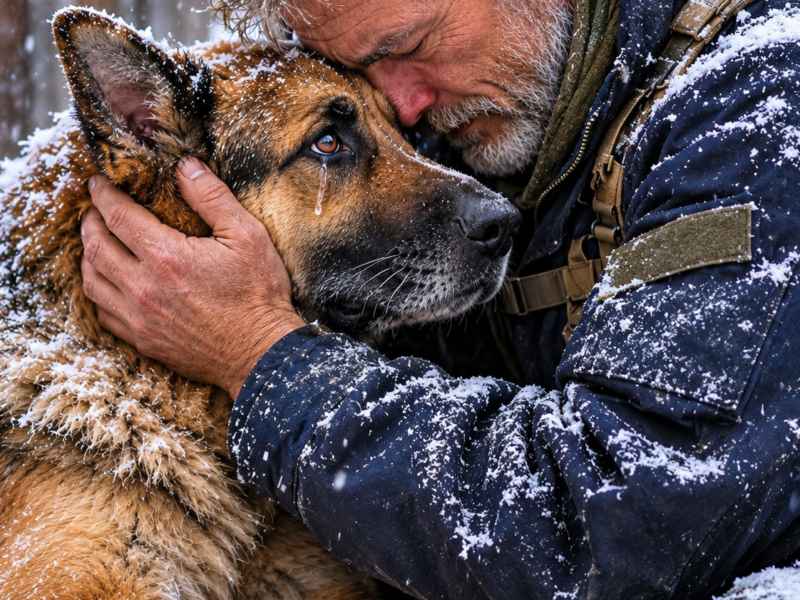
“At the county shelter in northern Colorado, I watched five families walk past a freezing German Shepherd K9 without giving him a second glance1
I didn’t open the kennel door immediately.
I kept my hand against Ranger’s muzzle, feeling the warmth of his breath against my fingers.
The scar beneath his shoulder was unmistakable.
Three short parallel marks, followed by a longer diagonal line.
I’d seen it on a photograph taken during Operation Iron Harbor, a mission in Afghanistan that had officially ended with the loss of two American service members and a military working dog.
The dog in that photograph had been listed as missing.
His name was Duke.
I pulled my hand away and looked at the photograph of Daniel Reeves again.
“Melissa, I need you to make a phone call.”
“To whom?”
“Someone at the military working dog program. I need the original service records for this animal.”
She looked from me to Ranger.
“Is he really that important?”
I stared at the faded green blanket.
“I think he’s been trying to tell us that for a long time.”
Melissa hesitated, then nodded.
While she made the call, I asked her to bring me a chair and a pair of gloves.
I wasn’t going to pull anything out of the kennel without understanding why Ranger was guarding it.
He watched every movement.
When Melissa returned, she had a different expression.
“They said they can’t release military records without authorization.”
“Did you tell them the dog’s name?”
“Yes.”
“What did they say?”
She swallowed.
“They asked if you were still there.”
I looked at her.
“Who did?”
“A man named Colonel Harris. He said he would call back.”
That name brought another memory to the surface.
Colonel Thomas Harris had been the officer who signed our debriefing paperwork after Operation Iron Harbor.
He had also been the man who told me the missing dog had never been recovered.
I hadn’t heard his voice in almost six years.
“Don’t tell him anything else,” I said.
Melissa frowned.
“Why?”
“Because I want to know what he’s going to say before he knows what I know.”
I turned back toward Ranger.
The dog had lowered himself beside the blanket.
His left paw rested over the green fabric.
I crouched again.
“All right, buddy. We’ll do this your way.”
I placed the food bowl a few feet away and waited.
He didn’t touch it.
Instead, he tapped three times.
Then he looked at the blanket.
I carefully moved closer.
“Can I see?”
His ears shifted backward.
I stopped.
For several seconds, neither of us moved.
Then Ranger lifted his paw.
I gently folded back the edge of the fabric.
A small black object appeared beneath it.
It was a military-grade GPS tracking unit, the kind used during field operations.
Its casing was scratched, and one corner had been crushed.
I didn’t touch it.
“Melissa, take a picture of this.”
She leaned over my shoulder.
“What is that?”
“Something that shouldn’t be here.”
I examined the surrounding blanket.
There was a narrow tear along the seam.
Inside it, I could see a second object wrapped in clear plastic.
A small metal identification tag.
My fingers went cold.
I knew the number stamped into it.
Not because it belonged to Ranger.
Because it belonged to Duke.
I had personally checked that tag before every deployment.
I remembered the tiny dent beside the final digit, caused when Duke had knocked it against a metal crate during training.
There was no mistaking it.
I looked at Ranger.
“Duke?”
The dog’s ears rose.
He made a soft sound in his throat and pressed his head against my knee.
I sat back on my heels.
For six years, I’d believed Duke had died somewhere in the mountains of Afghanistan.
Now the dog was standing in front of me.
But if Ranger was Duke, why was his paperwork under another name?
And why had someone gone to such trouble to keep the evidence hidden?
My phone vibrated.
An unknown number appeared on the screen.
I answered.
“Reed.”
A man’s voice came through.
“Lieutenant Commander Reed, this is Colonel Harris.”
“Colonel.”
“I understand you’ve been visiting a shelter in Larimer County.”
I glanced at Melissa.
She had stopped moving.
“That’s correct.”
“I’ve been informed that you’re asking questions about a former military working dog.”
“I’m asking questions about a dog whose identity appears to have been changed.”
There was a pause.
Then Harris spoke in a controlled voice.
“You’re mistaken. The animal was transferred through the appropriate channels.”
“His identification tag says Duke.”
Another pause.
“That dog died in Afghanistan.”
I looked at the animal beside me.
“Then explain why I’m looking at him.”
Harris exhaled.
“Listen carefully, Reed. You have no idea what you’re getting involved in.”
“Then help me understand.”
“This isn’t a matter for a civilian shelter.”
“Funny. It became one when somebody abandoned him there.”
His voice hardened.
“Stay away from that dog.”
I looked down.
Duke had begun tapping his paw again.
Three times.
I lowered the phone.
“Why?”
Harris didn’t answer immediately.
When he finally spoke, his voice was quieter.
“Because some things are better left where they were buried.”
The call ended.
I stood in the hallway, staring at the phone.
Melissa whispered, “What does that mean?”
I looked toward the kennel.
“It means someone is afraid of what this dog remembers.”
That evening, I took a long drive through the snow before returning home.
I couldn’t stop thinking about Operation Iron Harbor.
The mission had taken place near a remote mountain compound outside Gardez.
Our objective was to locate a missing intelligence courier and recover a storage device believed to contain information about an upcoming attack.
Duke had been assigned to our team.
His handler was Staff Sergeant Daniel Reeves.
Daniel had been twenty-nine then, lean, quiet, and almost painfully protective of his dog.
He used to say that Duke understood the world better than most people understood themselves.
During the operation, we entered a compound just before midnight.
Duke alerted near a storage building.
Daniel signaled that he had detected something.
Then an explosion hit the outer wall.
Dust swallowed the courtyard.
I remembered shouting into the radio.
I remembered Daniel falling behind a concrete barrier.
I remembered Duke disappearing into the smoke.
When we regrouped, Daniel was badly injured, and Duke was gone.
We searched for hours.
Nothing.
Two days later, we received an official update stating that Duke had been presumed killed.
Daniel was evacuated.
He never returned to the field.
Months afterward, I heard he had left the military.
I never spoke to him again.
And now the shelter records said Daniel had died in a car accident.
I parked outside my house and sat in the dark.
Something didn’t fit.
If Daniel had died recently, why had Duke been transferred so quickly?
Why had the green blanket been kept?
And why had Harris reacted as though the dog’s presence was a threat?
I went inside and opened the old metal box I kept in the closet.
It contained deployment photographs, a few medals, and a notebook from my final years in service.
At the bottom was a folded photograph.
Daniel stood beside Duke in front of a helicopter.
I turned it over.
On the back, in Daniel’s handwriting, were five words.
If he comes back, listen.
I read the sentence again.
Then I called the only person I knew who might still have an answer.
Marcus Bell had been our team medic.
He lived in Virginia now and worked as a civilian emergency management consultant.
He answered on the fourth ring.
“Reed? You know it’s late, right?”
“I need to ask you about Iron Harbor.”
The humor disappeared from his voice.
“What happened?”
I told him about Ranger, the identification tag, and Colonel Harris.
For a while, Marcus said nothing.
Then he asked a question that made my stomach tighten.
“Did you find the blanket?”
“Yes.”
“Did you open it?”
“Not all the way.”
“Don’t.”
“Why?”
“Because Daniel told me something before he disappeared.”
I stood up.
“What did he tell you?”
Marcus lowered his voice.
“He said Duke wasn’t carrying a warning device. He was carrying evidence.”
“What evidence?”
“I don’t know. Daniel never explained. He said there were people inside the operation who couldn’t be trusted.”
“Did he name anyone?”
Marcus hesitated.
Then he said, “Harris.”
I closed my eyes.
“Are you sure?”
“I heard them arguing the night before the mission. Daniel thought the coordinates had been changed. He believed our team had been sent to the wrong building.”
I remembered the mission briefing.
The compound coordinates.
The radio instructions.
The explosion.
All of it.
“Why didn’t you tell anyone?”
“Because I did. I reported it to the investigator assigned to the incident.”
“And?”
“Three days later, I was told my statement had been misplaced. A week later, I received orders transferring me to another unit.”
Marcus let out a tired breath.
“Reed, I thought you knew.”
I gripped the edge of my kitchen counter.
“I knew what they told us.”
“That’s not the same thing.”
We agreed to meet the next morning.
Before hanging up, Marcus said one more thing.
“There’s something else. Daniel contacted me about two months before he supposedly died.”
“What did he say?”
“He asked whether I’d kept my copy of the original mission roster.”
“Did you?”
“Yes.”
“Bring it.”
“I will. But Reed, don’t trust anyone who calls you about that dog.”
I slept less than three hours.
At eight the next morning, I was back at the shelter.
Melissa met me at the entrance.
She looked as though she’d been awake all night.
“Someone came here after closing.”
My shoulders tightened.
“Who?”
“I don’t know. The night attendant said a man in a gray SUV asked to see Ranger. He showed some paperwork, but she refused to release him.”
“Did he leave?”
“Eventually.”
“Did he say anything?”
Melissa looked toward the isolation hallway.
“He said the dog wasn’t supposed to survive.”
I felt the temperature in the room change.
“Did he leave a name?”
“No. But he left this.”
She handed me a small envelope.
My name was written across the front.
Inside was a photograph.
It showed Daniel Reeves standing outside a gas station, wearing a baseball cap and a dark jacket.
The photograph looked recent.
On the back, someone had written:
Ask his sister why she buried him.
I stared at the words.
“Where did this come from?”
“It was slipped under the front door.”
I folded the photograph and put it in my pocket.
Then I went to Ranger’s kennel.
He was standing beside the blanket.
When I approached, he tapped three times.
I knelt.
“I know, buddy. I’m trying.”
This time, he moved aside without hesitation.
I pulled on the gloves and carefully examined the seam.
The plastic-wrapped object was smaller than my palm.
Inside was a thin memory card and a folded piece of paper.
The paper was damp around the edges, but the writing remained legible.
It contained one sentence.
Daniel did not die in the accident. Find the original dispatch recording.
I read it twice.
Then I looked at Melissa.
“Do you have a secure place where we can keep this?”
She nodded.
I placed the card and paper in a sealed evidence bag she brought from the office.
I wasn’t a detective, and I wasn’t going to pretend I had the authority to conduct an investigation.
But I knew enough to understand that the shelter was no longer a safe place for the evidence.
I called a retired military investigator I trusted, a man named Frank Delaney.
He agreed to meet us at the shelter.
While we waited, I contacted the local police department and explained that someone had attempted to remove a dog from the facility using questionable paperwork.
I also asked them to document the envelope and the photograph.
The officer who arrived took everything seriously.
He made copies, photographed the kennel, and recorded Melissa’s account.
For the first time since I’d arrived, I felt that we were doing something more useful than simply guessing.
At noon, Marcus walked through the shelter doors carrying an old leather folder.
He looked older than I remembered.
His hair had turned almost completely gray, and he walked with a slight limp.
But his eyes were the same.
He saw Ranger and stopped.
“Well, I’ll be damned.”
Ranger approached the kennel gate.
He sniffed Marcus’s hand.
Then he tapped his paw three times.
Marcus’s face changed.
“That’s Duke.”
I nodded.
“I know.”
Marcus crouched.
“Hey, old man.”
Duke pressed his nose against his palm.
For several seconds, Marcus said nothing.
Then he looked at me.
“Daniel was right. He came back.”
We moved into the shelter’s small conference room.
Marcus opened the leather folder and removed a photocopy of the original mission roster.
The paper was yellowed along the edges.
He pointed to a section near the bottom.
“Look at the dispatch authorization.”
I leaned closer.
The coordinates listed in the original document were different from the ones in the final report.
Not slightly different.
They pointed to a building almost a mile away.
“Who changed them?” I asked.
Marcus turned the page.
The approval signature belonged to Colonel Harris.
My jaw tightened.
“Why would he redirect the team?”
Marcus shook his head.
“That’s what we never figured out.”
Frank Delaney arrived twenty minutes later.
He examined the roster, the memory card, and the note.
Then he made a few calls.
He didn’t promise anything.
He simply told us he would have the evidence preserved and the appropriate authorities notified.
That was enough for me.
We needed the original dispatch recording.
If it still existed, it could establish who had changed the coordinates and when.
Frank made a request through the official records process.
We were told the recording had been archived under the incident number.
But access would require a formal review.
I was beginning to think we would spend weeks waiting when Marcus opened his folder again.
“There’s another thing,” he said.
He removed a folded newspaper clipping.
It was from a Colorado Springs newspaper dated six weeks earlier.
The headline read: LOCAL VETERAN KILLED IN SINGLE-VEHICLE CRASH.
Below it was a photograph of Daniel Reeves.
The article said his car had left the road on a rural stretch of highway during a snowstorm.
No other vehicle was involved.
The family had declined to comment.
I looked at the date.
Six weeks earlier.
Not six weeks before Duke entered the shelter.
Nine days before.
I checked the article again.
There was a small detail I hadn’t noticed before.
The accident was reported at 11:42 p.m.
But the photograph Melissa had received showed Daniel standing outside a gas station at 12:16 a.m.
The same night.
I looked at Marcus.
“That’s impossible.”
He leaned closer.
“Where was that picture taken?”
I turned it over.
There was a faded logo on the gas station sign.
A location name was barely visible.
It was outside Pueblo.
Daniel had supposedly died near Colorado Springs.
The gas station was nearly fifty miles south of the reported accident.
We needed to know when the photograph had actually been taken.
Frank contacted a forensic specialist who agreed to examine it.
Then my phone rang.
Unknown number.
I answered.
“Reed.”
A woman’s voice sounded on the other end.
“Are you the man who found my brother’s dog?”
I stood.
“Who is this?”
“Emily Reeves.”
Daniel’s sister.
I stepped away from the conference table.
“Yes. I’m with Duke now.”
She began crying.
“Please don’t let them take him.”
I looked at Marcus.
“Who are you afraid of?”
Emily took a shaky breath.
“I don’t know who to trust anymore.”
“Then start with what you know.”
There was a long silence.
Finally, she said, “Daniel called me the night before the accident. He told me he was going to disappear for a while.”
“Why?”
“He said he had proof that someone had deliberately sent his team into a trap. He said the dog was the only one who could lead people to it.”
I gripped the phone.
“Why did you surrender him?”
“I didn’t.”
My eyes moved toward the kennel.
“What?”
“I never signed those papers. I never authorized anyone to take Duke.”
The room became very quiet.
“Emily, the shelter has a document with your name on it.”
“I know. I saw a copy last week. The signature isn’t mine.”
“Why didn’t you report it?”
“I tried. But someone called me and told me that if I kept asking questions, they’d make sure my children grew up without their mother.”
I looked at the photograph in my hand.
“Where are you now?”
“At home.”
“Are you alone?”
“No. My husband is here.”
“Listen carefully. Don’t leave the house. Don’t open the door to anyone you don’t recognize. I’m contacting the authorities.”
She began crying harder.
“Can you tell me something?”
“Of course.”
“Does Duke still remember Daniel?”
I looked through the conference room window.
The dog was lying beside his green blanket.
“Yes,” I said. “I think he remembers everything.”
She whispered, “Then he must know what happened.”
The call ended.
For the first time, I understood why Duke had refused to leave the blanket.
He wasn’t guarding an object.
He was protecting the last thing Daniel had trusted him to carry.
The next forty-eight hours moved slowly.
Frank worked with law enforcement to preserve the evidence and request the original dispatch recording.
The photograph was examined.
Its date could not be conclusively established from the image alone, but the location was verified.
Emily’s statement was formally recorded.
The shelter’s transfer documents were also examined.
The signature on the surrender form did not match the samples Emily provided.
A local investigator opened a case into the attempted removal of the dog and the falsified transfer paperwork.
But there was still one question nobody could answer.
Where was Daniel?
On the third day, Frank called.
“The archive request came through.”
I sat at my kitchen table.
“What did they find?”
“The dispatch recording.”
“Can you send it?”
“I’ve arranged for you and Marcus to listen at the investigator’s office. Don’t circulate it.”
We arrived at ten the next morning.
The recording was grainy, filled with radio interference and distant explosions.
At first, I heard nothing unusual.
Then Daniel’s voice came through.
“Control, this is Reeves. Confirm coordinates.”
A second voice responded.
“Proceed to the eastern structure.”
Daniel answered.
“Negative. Our original brief identifies the western structure.”
There was a pause.
Then Harris’s voice.
“Reeves, follow the updated coordinates.”
Daniel sounded confused.
“Sir, the eastern structure is outside the marked perimeter.”
“That’s an order.”
The recording continued.
A few minutes later, Daniel spoke again.
“Control, we’re taking fire. The eastern building is occupied.”
I closed my eyes.
I remembered the explosion.
I remembered the confusion.
I remembered trying to reach Daniel through the radio.
Then another voice interrupted.
“Reeves, withdraw immediately. Leave the dog.”
Marcus turned toward me.
I leaned forward.
The recording played on.
Daniel’s voice came back, louder now.
“Negative. Duke is with me.”
Harris replied.
“That animal is not worth losing personnel.”
Daniel said something I couldn’t make out.
Then there was a sharp burst of static.
The final transmission came several seconds later.
“Control, I have the device. Repeat, I have the device. If anything happens to me, the dog has the secondary copy.”
The recording ended.
Nobody spoke.
Frank removed his glasses.
“That changes the entire case.”
I stared at the speaker.
The original mission report had stated that the objective was never recovered.
But Daniel had recovered it.
And Duke had carried the secondary copy.
The green blanket wasn’t simply a hiding place.
It was a way to keep the evidence close without drawing attention.
The investigator looked at us.
“We’ll need to identify the device and determine what was on the memory card.”
I thought about the black GPS unit.
“There’s something else in that blanket.”
“What?”
“A tracking unit.”
The investigator nodded.
“We’ll have the forensic team examine it.”
I looked toward Marcus.
“Daniel knew they might come looking.”
Marcus said nothing.
That afternoon, Emily agreed to meet us at the shelter with a police escort.
When she entered the room, she looked smaller than she did in the newspaper photograph.
Her eyes were red, and she kept twisting a wedding ring around her finger.
I stood.
“Emily?”
She nodded.
“Thank you for finding him.”
I gestured toward the window.
Duke was lying on his blanket.
When Emily stepped inside, he raised his head.
She stopped.
“Oh, sweetheart.”
Her voice broke.
Duke stood slowly.
He walked to the kennel gate and pressed his nose against her hand.
Emily began to cry.
She knelt beside him.
“I’m sorry. I’m so sorry.”
Duke leaned against her shoulder.
For a moment, the shelter seemed to disappear.
There was no investigation, no missing evidence, no colonel, no official report.
Just a woman and the dog who had once belonged to her brother.
After several minutes, Emily looked at me.
“Can I tell you something?”
“Of course.”
“Daniel called me two nights before the accident.”
I waited.
“He said he was going to meet someone who could help him expose what happened. He didn’t tell me the name. He said that if anything went wrong, I should remember something.”
“What?”
She wiped her face.
“He said Duke would never stop tapping until the right person understood.”
I glanced at the dog’s paw.
Three taps.
Emily gave a sad smile.
“Daniel used to say the dog had a better memory than most people.”
I sat beside her.
“Do you think Daniel is alive?”
She looked at me for a long time.
“I don’t know.”
That was the honest answer.
And it was the one I trusted most.
Two weeks later, the forensic examination revealed that the memory card contained encrypted files.
The military investigators worked with federal authorities to recover the data.
The files included mission logs, communications records, and a collection of documents showing that the original target location had been deliberately changed.
There were also records suggesting that sensitive equipment had been removed from the eastern building before our team arrived.
The investigation did not immediately prove who had arranged the diversion or why.
But it established that the final report had omitted critical information.
Colonel Harris was placed on administrative leave while the investigation continued.
His office denied wrongdoing.
The attempted removal of Duke became a separate criminal investigation after the shelter’s records showed that the transfer authorization had been forged.
The authorities also reopened the circumstances surrounding Daniel’s death.
A second examination of the accident records revealed inconsistencies in the timeline.
The photograph outside the gas station became important, but it wasn’t enough to establish that Daniel was alive after the reported crash.
There were still unanswered questions.
I wanted certainty.
I wanted to know where Daniel had gone, who had helped him, and whether he had survived.
But the investigation moved at the speed of paperwork, interviews, and evidence.
It wasn’t the kind of answer that arrived in a dramatic phone call.
And for once, I understood that rushing could destroy the truth we were trying to recover.
Duke was transferred into a temporary foster arrangement while the authorities completed their examination.
Emily offered to take him.
But after spending time with him, she admitted that her home might not be the right place.
She had two young children, and Duke had spent too many months living in fear.
She didn’t want to force him into another unfamiliar environment.
I told her I could take him.
The shelter director, Melissa, smiled when she heard.
“Are you sure?”
I looked down at the German Shepherd sitting beside my boots.
He was still thin.
His coat needed attention.
He startled whenever a metal door slammed.
But when I moved, he moved with me.
“Yeah,” I said. “I’m sure.”
The paperwork took another week.
On the morning I brought him home, snow covered the driveway.
I opened the passenger door of my truck.
Duke looked at the house.
Then at me.
“Come on, old man.”
He climbed down carefully.
I showed him the backyard, the water bowl, and the dog bed beside the fireplace.
He inspected everything without much interest.
Then he walked toward the hallway.
He stopped outside the spare bedroom.
Sarah’s old reading chair was still there.
So was the blue blanket she used to keep over the back of it.
Duke sniffed the chair.
Then he looked at me.
For a moment, I wondered whether the dog could smell the absence of someone who had once been part of a home.
I sat on the floor beside him.
“I know,” I whispered.
He lowered himself beside my leg.
That night, I slept on the couch.
Not because I was afraid of leaving him alone.
Because I didn’t want him to wake up in an unfamiliar house and find nobody nearby.
At around two in the morning, I felt something touch my hand.
Duke had placed his paw over it.
Once.
Twice.
Three times.
I sat up.
He wasn’t looking at the door.
He was looking at me.
I put my hand over his paw.
“You’re home, buddy.”
He rested his head against my knee.
For the first time in years, the house didn’t feel quite so empty.
Months passed.
The investigation continued.
The evidence from Iron Harbor led to a broader review of the mission, and several official conclusions were withdrawn pending further examination.
Harris eventually faced formal disciplinary proceedings related to the falsified records and his handling of the investigation.
Other allegations remained under review.
The authorities never confirmed whether he had ordered the attempt to remove Duke.
But the forged shelter paperwork and the calls made to Emily became part of the case.
As for Daniel, no verified trace of him was found.
The accident investigation remained open.
Emily continued to hope.
I didn’t tell her to stop.
Some mornings, she came over with coffee and sat in the backyard while Duke rested between us.
She brought photographs of her brother.
In one, Daniel was holding a baseball glove.
In another, he was standing beside Duke in the snow.
She told me about their childhood, how Daniel had once rescued an injured bird and kept it in a shoebox until it recovered.
“He always thought everything deserved another chance,” she said.
I looked at Duke.
“Seems he passed that along.”
One afternoon, almost four months after I brought him home, I received a call from Frank.
He sounded different.
Careful.
“Reed, there’s an update.”
I put down my coffee.
“What is it?”
“An investigator found a witness who remembers seeing a man matching Daniel’s description at a bus station in New Mexico several days after the reported accident.”
I stood.
“Are they certain?”
“No. The witness identified him from an old photograph, but the identification isn’t conclusive.”
“Does that mean he’s alive?”
“It means we have a lead.”
I closed my eyes.
Frank continued.
“Emily has been informed. The authorities are checking the records now.”
I looked toward the backyard.
Duke was lying in the grass with his head on his paws.
He seemed peaceful.
For years, I had believed that the past was something you survived and then left behind.
But that wasn’t true.
Sometimes the past waited quietly until someone finally listened.
I walked outside and sat beside Duke.
He lifted his head.
I rested my hand on his neck.
“Your handler might still be out there, old man.”
His ears moved.
Then he tapped his paw three times against the grass.
I smiled.
I didn’t know whether he understood my words.
I didn’t know whether Daniel would ever come home.
But I knew one thing.
The dog everyone had rejected wasn’t broken.
He had been carrying a warning, a memory, and a promise that nobody else had been willing to hear.
And when the world finally stopped calling him dangerous long enough to listen, he led us back to the truth.
That evening, I placed Daniel’s photograph on the mantel beside Sarah’s blue ceramic mug.
Two people I had lost.
Two lives that had changed mine in ways I was still learning to understand.
Duke settled at my feet.
Outside, the snow began to fall again.
I reached down and rested my hand between his ears.
For the first time in a long while, I wasn’t waiting for the silence to end.
I was grateful for the company.
THE END.









