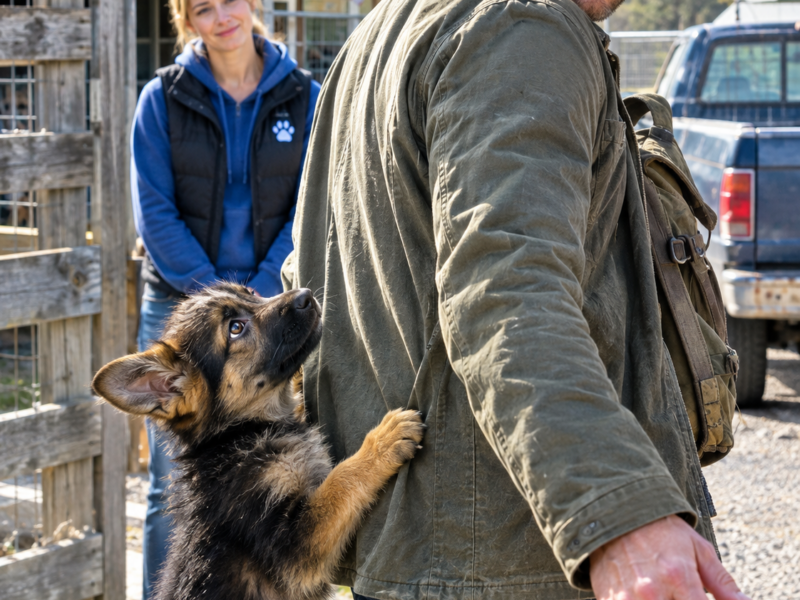
“At the animal shelter outside Denver, I watched a tiny German Shepherd puppy claw desperately at my jacket as I tried to walk away
I couldn’t leave that little dog behind now—not until I understood why he’d brought me back to a past I thought was buried.
I was still kneeling on the shelter floor when Karen reached for the brass tag in my hand.
“Let me see that,” she said quietly.
I pulled it back before I even realized what I was doing.
Her eyes flicked to mine.
“Sorry,” I muttered. “I didn’t mean to—”
“It’s all right.” She lowered herself onto the bench beside the kennel. “You look like you’ve seen a ghost.”
“I might have.”
Scout pressed against my leg, his tiny body shivering beneath his dusty coat. I slipped the tag into my palm and read the worn engraving again, hoping I’d somehow mistaken the numbers.
I hadn’t.
Daniel Mercer had been my closest friend for almost six years. We’d served together overseas, shared more miserable nights than I could count, and once spent an entire week eating nothing but crackers and instant coffee after our supply truck got delayed.
He’d been the kind of man who remembered birthdays, wrote letters to his mother, and carried a photograph of his little sister in the breast pocket of his uniform.
He’d also been the man who pulled me out of a burning vehicle during a mission that nearly killed us both.
Eleven years ago, during a night operation in a remote mountain region, Daniel disappeared after an explosion separated our unit.
We searched until sunrise.
We searched the next day.
Then we searched again.
All we found was a section of his damaged equipment and a bloodstained strip of fabric caught beneath a collapsed wall.
No body was ever recovered.
The Army eventually declared him presumed dead.
I had signed the final statement confirming the circumstances surrounding his disappearance.
For years, I told myself there had been nothing else I could have done.
Now a puppy was sitting at my feet with Daniel’s identification tag hidden beneath his collar.
“Karen,” I said, forcing my voice to steady, “I need you to tell me everything about the person who brought him here.”
She nodded immediately.
“Animal control delivered him on Saturday afternoon. A man had called about a puppy wandering near an abandoned property outside Golden. The officer found him close to an old service road.”
“Did you see the man?”
“No. The officer said the caller had already left.”
“Was there a report? A name? A phone number?”
“The caller gave a first name, I think. Mark. But I don’t know whether that was his real name.”
I looked down at Scout.
“Was the collar examined when he arrived?”
“Yes. The blue collar was intact, but there wasn’t a tag attached to it. We checked for a microchip twice.”
“Who had access to him after that?”
“Me, our veterinary technician, and the overnight kennel staff. Why?”
I didn’t answer immediately.
Because someone had put that tag on Scout after he arrived, or because Karen had missed it the first time.
Either possibility frightened me more than I wanted to admit.
I had spent most of my adult life learning not to turn suspicion into certainty without evidence.
But the numbers in my hand were evidence of something.
I just didn’t know what.
Scout nudged my boot and gave a small, exhausted whine.
I looked at his ribs beneath his fur and the raw patch on one paw.
“What’s the adoption process?” I asked.
Karen blinked.
“I thought you said you weren’t ready.”
“I’m not.”
I glanced at Scout.
“But I’m not leaving him here.”
Within forty minutes, I had signed the paperwork, bought a bag of puppy food, and driven away from the shelter with Scout curled inside a borrowed plastic carrier on the passenger seat.
I hadn’t owned a dog since childhood.
I had no idea what I was doing.
Every few minutes, Scout lifted his head to check that I was still there.
Each time, I found myself reaching over to rest two fingers against the carrier.
“I’m here, buddy,” I told him.
The words sounded strange coming from my mouth.
I’d spent years convincing myself that being there for people meant carrying out my responsibilities, answering calls, and showing up when I was ordered to show up.
I’d never considered how much of being there involved simply letting someone know you weren’t going to disappear.
At home, Scout refused to enter the kitchen until I sat on the floor beside his food bowl.
He ate cautiously at first, pausing between bites to look at me. When I moved toward the sink, he abandoned the food and followed, his paws slipping on the hardwood.
I had to laugh.
“You’re going to have to learn that I can’t spend every minute watching you eat.”
He wagged his tail once, as if he disagreed.
That evening, I set up a bed beside the living room sofa and placed a folded blanket inside it.
Scout sniffed the blanket, turned in a circle, and then climbed onto my boots instead.
I left him there.
For the first time in eighteen months, the house didn’t feel entirely empty.
But the brass tag sat on the coffee table, and every time I looked at it, I felt the past pressing against the present.
At nine o’clock, I called Emily.
She answered on the third ring.
“Hey, Dad. How was the shelter?”
“I brought someone home.”
There was a pause.
Then she practically shouted, “You got a dog?”
“A puppy.”
“Oh my God. Dad!”
I could hear her smiling.
“What kind?”
“German Shepherd. Little guy. His name’s Scout, apparently.”
“Apparently?”
“It’s what the shelter called him.”
“Can I come meet him this weekend?”
“Of course.”
Then she heard something in my voice.
“Dad, what’s wrong?”
I looked at the tag.
“I found something on him. Something that belongs to a friend of mine who died overseas.”
The excitement disappeared from her voice.
“What do you mean, belongs to a friend?”
I told her about Daniel. I explained the identification number, the circumstances of his disappearance, and the strange story Karen had given me about the collar.
Emily listened without interrupting.
When I finished, she asked, “Are you sure it’s his?”
“I’d recognize those numbers anywhere.”
“Then you should tell someone.”
“Tell them what? That a puppy showed up with an old military tag?”
“That the tag might be connected to a missing soldier.”
“Presumed dead,” I corrected.
I regretted the words as soon as I said them.
Emily was quiet for a moment.
“Dad, you don’t have to solve everything by yourself.”
I rubbed my thumb over the edge of the tag.
“I know.”
“No, you say you know. That’s different.”
I couldn’t argue with that.
Before we hung up, she asked me to send her a picture of Scout.
I took one while he slept on my boots and sent it.
A minute later, my phone buzzed.
Her reply contained only four words.
“Dad, look at his collar.”
I stared at the message, then looked down at Scout.
The faded blue collar was lying beside him where I’d removed it earlier to check for irritation.
I picked it up.
At first, I saw nothing unusual. The fabric was worn, the buckle scratched, and the stitching frayed near the loop where the brass tag had been attached.
Then I noticed a small bulge beneath the inner lining.
I pressed it between my fingers.
Something stiff shifted inside.
My pulse quickened.
I took a pair of sewing scissors from the kitchen drawer and carefully opened the loose seam.
A narrow strip of waterproof plastic slid onto the table.
It was folded into a tiny rectangle, stained at the edges but still legible.
On it, someone had written a set of coordinates and a date.
The date was eleven years old.
It was the date Daniel disappeared.
Beneath the coordinates were five words written in block capitals.
IF HE’S WITH YOU, TRUST HIM.
I read the message three times.
Then I called Emily back.
“Do you still have that picture I sent you?”
“Yes.”
“Look at Scout’s left ear.”
I turned toward the sleeping puppy.
A small notch cut into the edge of his left ear, barely noticeable beneath the fur.
It was a mark I’d seen before.
Not on a dog.
On a photograph.
Years ago, Daniel had shown me a picture of his childhood German Shepherd, Rex, who had been born with a small notch in one ear after an accident with a wire fence.
Daniel had joked that Rex looked like a veteran before he’d even learned to bark.
I remembered the story because it had been one of the few times Daniel had spoken about home without immediately changing the subject.
“Scout might be related to Rex,” I said.
Emily didn’t answer.
“Or maybe I’m reaching,” I added.
“Dad, the date is the day he disappeared. Someone hid coordinates inside the collar. And you found the dog carrying the tag. That’s a lot of coincidences.”
“I know.”
“Are you going to those coordinates?”
I looked at the clock.
It was nearly ten.
The coordinates pointed to a remote stretch of land west of Golden, beyond the old service road where Scout had reportedly been found.
I had no intention of driving into the mountains in the dark.
For once, I made a sensible decision.
“Tomorrow morning,” I said.
Emily exhaled.
“Promise you’ll call me when you get there.”
“I promise.”
I hung up and placed the strip of plastic inside a clear envelope.
Then I sat on the floor beside Scout’s bed until he woke and crawled into my lap.
I wanted to believe the message meant Daniel was alive.
But I had spent eleven years building my life around the opposite assumption.
Hope can be cruel when it arrives without explanation.
At six the next morning, I packed water, a flashlight, a first-aid kit, and enough puppy supplies for the day.
Scout watched from the doorway while I put on my boots.
When I lifted his carrier, he barked sharply.
“You’re coming,” I told him.
His tail began to wag.
The coordinates led us to a narrow road bordered by pine trees and weather-beaten fences. Snow still clung to the shaded ground, and the morning air carried the sharp smell of frozen earth.
The farther we drove, the fewer signs of human life we saw.
No houses.
No traffic.
Only the occasional wooden post leaning at an angle beside the road.
I stopped near a rusted gate and checked the coordinates on my phone.
We were close.
A weather-beaten sign hung from the gate.
PRIVATE PROPERTY.
Beyond it stood an abandoned maintenance building with a collapsed roof and a narrow gravel path leading down toward a wooded ravine.
I stayed in the truck for a moment, watching the tree line.
Something about the place stirred an old memory.
During the operation eleven years earlier, Daniel and I had been sent to investigate a suspected weapons cache near a mountain village. Our team had received coordinates from a local informant whose identity had been withheld from most of us.
The operation went wrong before midnight.
An explosion tore through the structure where we had taken cover. The radio network failed, visibility dropped to almost nothing, and our unit scattered while trying to reach the extraction point.
I remembered Daniel shouting my name.
I remembered turning toward him.
Then the wall between us collapsed.
When I regained consciousness, I was several yards from the building, bleeding from my forehead. Our team found me before dawn.
Daniel was nowhere.
For eleven years, I’d believed that was the last moment we’d ever shared.
Now I was standing near a place that looked disturbingly like the terrain in my memories.
I opened the passenger door and lifted Scout from his carrier.
He sniffed the air, then pulled toward the gate.
“Easy,” I whispered.
His ears stood straight.
He wasn’t frightened.
He was searching.
I checked the area for fresh tracks before stepping through the opening.
The maintenance building was empty except for broken shelves, old cables, and a rusted metal cabinet. I examined the cabinet, the walls, and the floor.
Nothing.
Then Scout began scratching at a narrow wooden panel near the back of the building.
I crouched beside him.
“What’s there?”
He pawed at the panel again, whining.
I pulled it loose.
Behind it was a shallow cavity containing a small metal box wrapped in plastic.
My hands shook as I removed it.
The box wasn’t locked.
Inside lay a photograph, a folded letter, and a second military identification tag.
The photograph showed Daniel standing beside a German Shepherd, one hand resting on the dog’s neck.
He looked older than I remembered, with a rough beard and deep lines around his eyes.
But it was Daniel.
Alive.
I lowered myself onto the dusty floor.
The photograph had been taken recently enough that the color hadn’t faded. On the back was a handwritten date from just three months earlier.
Below it, someone had written my name.
I stared at the image until my eyes burned.
The letter was folded into thirds.
I recognized Daniel’s handwriting immediately.
For a long time, I couldn’t open it.
I was afraid that the words inside would either confirm the impossible or take it away from me again.
Finally, I unfolded the paper.
If this reaches you, then I ran out of time to come back myself.
I know what you were told about the night I disappeared. I know what you signed afterward. You did what you believed was right, and I have never blamed you for that.
But the report you signed was built on a lie.
I stopped reading.
Outside, a branch snapped beneath the weight of snow.
I looked toward the doorway.
Nothing moved.
I returned to the letter.
The explosion was real. My injuries were real. But I was taken from that site before your team reached me.
The people who took me weren’t our enemies.
They were Americans.
My fingers tightened around the paper.
The letter continued.
I found evidence that the operation had been compromised before we arrived. The location had been changed at the last minute, and someone had passed our movements to the people waiting for us.
I saw a name on a document I wasn’t supposed to find. A name connected to the chain of command.
I tried to report it. Before I could, the explosion happened.
I lowered the letter.
For years, I had blamed myself for losing sight of Daniel in the chaos. I had replayed that night, wondering whether I should have taken another route, whether I’d missed a signal, whether I’d been too slow getting back to him.
The idea that someone had deliberately sent us into a trap made my stomach turn.
But I couldn’t accept the letter without evidence.
Daniel had taught me that much.
I continued reading.
I was held for months. When I escaped, I learned that my name had been listed among the dead. I also learned that the people responsible had enough influence to make the official account stick.
I tried to contact you once. The message never reached you. After that, I watched from a distance because I believed anyone close to me could be used against you.
I know how that sounds. I know you may hate me for staying away.
I don’t expect you to forgive me for eleven years of silence.
At the bottom of the page, Daniel had written one final line.
If you want the truth, come to the old ranger station at the coordinates below. Come alone, and bring the dog.
The coordinates were different from the ones on the plastic strip.
I checked my phone.
No signal.
Scout had settled beside my boot, his nose resting against the second tag.
I looked again at the photograph.
Daniel was alive three months ago.
But the letter didn’t say where he was now, or whether he was safe.
I folded it carefully and placed it inside my jacket.
Then I heard an engine outside.
A vehicle had stopped beyond the gate.
I moved to the doorway and peered through a gap in the boards.
A dark SUV sat on the gravel road.
A man stepped out wearing a gray coat and black gloves.
He looked toward the maintenance building.
Then he raised a phone to his ear.
I couldn’t hear every word, but the wind carried enough of his voice through the broken window.
“He’s here,” he said. “He found the box.”
He paused, listening.
“No, I haven’t approached him yet.”
Another pause.
“Understood.”
He lowered the phone and began walking toward the building.
Scout stood beside me, his body rigid.
I had been in enough dangerous places to recognize the feeling that came before trouble.
I slipped the letter and photograph into my inside pocket and checked the emergency phone in my pack.
No signal.
The back wall had a narrow opening leading into the trees, barely wide enough for me to pass through.
I lifted Scout and moved toward it.
Before I could reach the opening, the man called out from the front entrance.
“Sergeant Hayes?”
I stopped.
I hadn’t heard anyone call me by my old rank in years.
“My name is Michael Cole,” he continued. “I’m not here to hurt you.”
“Then stay where you are.”
He did.
For a moment, neither of us moved.
“I know you found Daniel’s letter,” Cole said.
“How?”
“Because I’ve been trying to find it for three months.”
“Who are you?”
“Someone who helped him disappear.”
I stepped into the doorway, keeping Scout behind my legs.
Cole looked exhausted. His face was pale, and a faint scar ran from his right temple to his jaw.
“If you helped him disappear, why are you following me?”
“Because the people who covered up what happened eleven years ago know Daniel has made contact with you.”
“Who are they?”
Cole glanced toward the road.
“I can’t explain everything here.”
“That’s convenient.”
“I know how this looks.” He raised his hands slightly. “But if I wanted you dead, I wouldn’t be standing in the open asking you to trust me.”
“That’s not much of a recommendation.”
“No,” he admitted. “It isn’t.”
He reached slowly into his coat and pulled out a photograph.
He held it toward me without coming closer.
It showed Daniel sitting at a wooden table, a bandage wrapped around his left forearm. Beside him was the same German Shepherd from the earlier photograph.
On the back was a handwritten message.
Tell Hayes I remember the promise.
I stared at the words.
Daniel and I had made that promise during our first deployment. If one of us ever found ourselves unable to get home, the other would make sure our families knew the truth.
We’d been young enough to believe promises could protect us from anything.
“What happened to him?” I asked.
Cole’s expression changed.
“He was injured two weeks ago. He managed to get away, but he hasn’t contacted me since.”
“Then why send the puppy?”
“I didn’t.”
The answer came too quickly to be rehearsed.
Cole shook his head.
“I found the dog near Daniel’s last safe house. The collar was already on him. I assumed Daniel had sent him to someone he trusted.”
“Why me?”
“Because Daniel told me about you.”
I looked down at Scout.
The puppy had stopped trembling, but his eyes remained fixed on Cole.
“You’re going to have to do better than that.”
Cole nodded toward the letter inside my jacket.
“Read the last page.”
I pulled it out.
I’d missed a second sheet folded behind the first.
The handwriting was Daniel’s, but the ink looked fresher.
Hayes, if you are reading this, the man who brought you here may not be the person you think he is. Trust the evidence, not the uniform, the title, or the story.
I looked up at Cole.
He read the message over my shoulder and went still.
“I didn’t know that was there,” he said.
“How am I supposed to believe anything you tell me now?”
“You’re not,” he replied. “Not until you verify it.”
He reached into his coat again, slowly enough that I could see every movement.
This time, he removed a small flash drive.
“Everything I managed to recover is on here. Original dispatch records, altered reports, and a recording made the night Daniel disappeared.”
I didn’t take it.
“Why bring it to me?”
“Because I couldn’t get anyone else to listen.”
“And why should I?”
Cole looked at the puppy.
“Because Daniel trusted you enough to send Scout.”
I glanced at the second tag, then at the coordinates on the plastic strip.
The pieces didn’t fit yet.
But they were beginning to form a picture.
I took the flash drive.
Cole let out a breath.
“There’s one more thing,” he said. “The person who signed off on the revised operation report is still serving in the military.”
He gave me a name.
Colonel Richard Voss.
I knew him.
He’d been a lieutenant colonel when Daniel disappeared, the officer who briefed our team before the operation. He had personally visited me in the hospital afterward and told me that we’d done everything possible to bring Daniel home.
He’d even attended the memorial service.
I remembered him standing beside Daniel’s mother, his hand resting on her shoulder as he spoke about sacrifice and duty.
I remembered believing him.
“What does Voss have to do with this?” I asked.
Cole’s face tightened.
“He approved the original route change. Then he signed the report saying the route had never changed.”
I looked at the flash drive.
If Cole was telling the truth, then the man who had comforted Daniel’s family might have helped conceal what happened to him.
But if Cole was lying, he was leading me toward a dangerous accusation based on a letter, an old tag, and a puppy.
I needed proof.
“Where can I find Daniel?”
Cole gave me an address in the foothills outside Boulder.
“There’s a cabin near the old ranger station. If he’s still there, he’ll be waiting.”
“And if he’s not?”
Cole looked toward the trees.
“Then we need to find out who got to him first.”
I wanted to leave immediately, but the SUV’s engine suddenly started.
Cole turned toward the road.
A second vehicle had appeared behind his.
A black pickup, moving slowly, its headlights off despite the dim morning light.
Cole’s face drained of color.
“Get down,” he whispered.
The first gunshot shattered the window beside us.
I dropped to the floor, pulling Scout against my chest as glass scattered across the boards.
Cole grabbed my jacket and dragged me toward the rear opening.
“Move!”
We scrambled through the gap and into the trees.
Another shot struck the metal cabinet inside the building.
I ran bent low, one hand gripping Scout, the other clutching the flash drive in my pocket.
Branches tore at my coat as we descended the slope.
Behind us, someone shouted.
Cole led us through a narrow drainage ditch and toward a stand of pine trees near the road.
He moved like a man who had practiced escaping places like this.
We reached his SUV, parked beyond the bend.
He opened the rear door.
“Get in.”
I hesitated.
The message in Daniel’s letter echoed in my mind.
Trust the evidence, not the uniform, the title, or the story.
Cole looked directly at me.
“I know you don’t trust me. You shouldn’t. But if we stay here, we’ll never find Daniel.”
A bullet struck the tree above us.
I got in.
Cole drove hard down the mountain road, taking a sharp turn that sent loose equipment sliding across the floor.
Scout curled against my chest, trembling.
I kept one hand over his back.
“You’re okay,” I whispered.
I wasn’t sure whether I was talking to him or myself.
We didn’t stop until we’d reached a crowded gas station near the highway.
Cole parked beside a row of trucks and killed the engine.
For several seconds, neither of us spoke.
Then I pulled out my phone.
I had a signal.
I called Emily first.
She answered immediately.
“Dad? You said you’d call.”
“I’m all right.”
“That doesn’t sound like you’re all right.”
“I need you to listen carefully. I’m sending you a location. I want you to save every message and photograph I send you, and if you don’t hear from me in two hours, call the police.”
“What happened?”
“Someone fired at us.”
Her breath caught.
“Dad!”
“I’m safe for now.”
“Come home. Right now.”
“I can’t.”
“Why not?”
I looked at Scout, who had finally settled against my arm.
“Because I think I know what happened to Daniel.”
The silence on the line was long enough that I checked whether we’d been disconnected.
Then Emily said, “Then find out. But don’t make me lose you trying.”
I closed my eyes.
“I won’t.”
It was the first promise I’d made in years that I understood might cost me something.
I sent her the location and asked her to contact a lawyer she trusted before sharing anything with anyone else.
Then I called a former military investigator I’d known since my final years of service. His name was Frank Delaney, and he was one of the few people I’d trust to examine the records without immediately accepting the official account.
I gave him the basics.
He listened without interruption.
When I finished, he said, “Do not confront Voss. Do not upload that drive to a random computer. Bring it somewhere secure, and let me verify the chain of evidence.”
“Can you help me?”
“I can help you find out what’s real. That’s all I’m promising.”
It was enough.
Cole and I drove to a small law office Frank had arranged to use outside Boulder. The attorney there made encrypted copies of the flash drive and photographed every item I’d recovered.
For the first time since finding Scout’s collar, I felt as though I was doing something other than chasing a ghost.
The records were worse than I’d expected.
The original mission route had been changed six hours before deployment. The revised coordinates had been transmitted through an account connected to Voss’s office.
A communication log showed that a warning had been received shortly before the explosion.
The warning had never reached our team.
And the after-action report had been edited twice before it was finalized.
One version included a reference to an unidentified American male being removed from the site by personnel in unmarked vehicles.
The final version omitted that sentence.
Frank stared at the screen for a long time.
“That’s enough to reopen questions,” he said. “It’s not enough to prove who ordered what, but it’s enough to keep digging.”
“What about the recording?”
He opened the audio file.
Static crackled through the speakers.
Then a voice I recognized spoke over the radio.
Mine.
I was calling for Daniel.
A second voice answered.
Daniel’s.
He was alive after the explosion.
He was asking for extraction.
Then a third voice came through, calm and unmistakable.
Colonel Voss.
“Negative. Leave the area. The operation is compromised.”
A pause followed.
Then Daniel’s voice again.
“Sir, I’m wounded. I have at least two civilians here.”
Voss replied, “Your orders are to withdraw.”
Daniel refused.
The recording ended in a burst of static.
I sat staring at the screen.
The official report had claimed that Daniel was killed during the initial blast.
But he’d survived long enough to speak over the radio, and he’d been trying to help civilians when someone ordered the team to leave him behind.
“Why would Voss do that?” I asked.
Frank folded his hands.
“That’s the question we need to answer.”
Cole stood by the window, watching the street.
“He wasn’t the only one involved,” he said.
Frank turned toward him.
“Who else?”
Cole hesitated.
“I don’t know the full chain. I was a communications specialist attached to the support team. I saw the route change come through, and I knew the warning had been suppressed. When Daniel disappeared, I started asking questions.”
“And?”
“My supervisor told me to stop. Two weeks later, I was reassigned. When I tried to access the records again, my credentials had been revoked.”
He looked at me.
“I didn’t help Daniel because I was brave. I helped him because I was afraid of what would happen if I stayed quiet.”
I understood that kind of fear better than I wanted to.
For eleven years, I’d been haunted by the thought that I hadn’t done enough.
Cole had spent eleven years wondering whether he had.
Neither of us could change what happened that night.
But we could decide what to do with what we knew now.
Frank called an attorney with experience in military investigations and asked him to contact the appropriate oversight office.
He also arranged for the original files to be preserved with verified timestamps and duplicate copies held by independent parties.
No one was going to be able to make the evidence disappear with a single phone call.
Then we drove toward the old ranger station.
The cabin sat at the end of a narrow track bordered by bare aspens and tall pines. Smoke rose from a short chimney, and a thin trail of footprints crossed the snow toward the front porch.
I left the SUV several yards away.
Scout was awake now, watching the cabin through the window.
When I opened the door, he scrambled into my arms.
I carried him up the steps.
My hand hovered over the wooden door.
I had imagined this moment a thousand different ways since finding the tag.
In some versions, Daniel would be waiting inside, unchanged by time, ready to explain everything.
In others, I would find only another letter and another reason to hate myself for hoping.
I knocked.
Nothing happened.
I knocked again.
A floorboard creaked inside.
Then a man’s voice called, “Who’s there?”
I swallowed.
“It’s Hayes.”
Silence.
I could hear the wind moving through the trees behind me.
Then the lock turned.
The door opened a few inches.
Daniel stood on the other side.
His beard was streaked with gray. A scar crossed his cheek, and he leaned slightly on a wooden cane. He was thinner than the man in my memories, and his left hand trembled against the doorframe.
But his eyes were the same.
For a moment, neither of us spoke.
Then he looked at the puppy in my arms.
“Scout,” he whispered.
The dog wriggled free and landed on the porch.
Daniel dropped his cane.
Scout ran straight to him, whining and pressing his front paws against Daniel’s knees.
Daniel sank down slowly, wincing as he wrapped both arms around the puppy.
“I thought I’d lost you, too,” he murmured.
The sound of his voice broke something open inside me.
I stood there, unable to move, while my best friend held the dog and buried his face in its fur.
Then Daniel looked up.
His expression changed when he saw me.
“Tom.”
I had forgotten what it felt like to hear my name spoken by someone who knew me before the worst night of my life.
I stepped forward.
He struggled to stand, but I caught his arm.
For a second, we held each other awkwardly, neither knowing whether to laugh or cry.
Then he gripped the back of my jacket with surprising strength.
“I’m sorry,” he said.
I pulled away just enough to look at him.
“Eleven years.”
“I know.”
“Eleven years, Daniel.”
“I know.”
“Do you have any idea what that did to me?”
His eyes filled, but he didn’t look away.
“Yes,” he whispered. “I’ve spent every day imagining it.”
I wanted to strike him.
I wanted to ask a hundred questions.
I wanted to sit down beside him and never let go.
Instead, I said the only thing I could manage.
“You’re alive.”
Daniel nodded.
“I’m alive.”
We went inside.
The cabin was simple, with a wood stove, a narrow bed, and shelves crowded with books and medical supplies. A pair of crutches leaned against the wall.
Daniel lowered himself into a chair, breathing through the pain.
Scout settled at his feet.
I remained standing.
“Start at the beginning.”
Daniel looked at the fire.
“The explosion damaged my leg and left me unconscious. When I woke up, I was in a vehicle with two men wearing civilian clothes. They said they were taking me to a medical facility.”
“Were they Americans?”
“Yes.”
“Did you know them?”
“One of them was a contractor I’d seen during the briefing. The other was someone I had never met.”
He rubbed his left hand.
“They took me to a private clinic. I was held there for weeks while they treated my injuries. They told me the mission had been compromised and that my unit was under investigation. They said I couldn’t contact anyone until the inquiry was finished.”
“Did you believe them?”
“At first.”
He looked at me.
“I was drugged, injured, and confused. By the time I realized I was being held against my will, they’d already moved me.”
He explained that he escaped with help from a nurse who had become suspicious of the men guarding him. He tried to contact his commanding officer, only to discover that he had officially been declared dead.
When he returned to the United States, he found his bank accounts frozen and his military records sealed pending an investigation that appeared never to have existed.
He had no clear way to prove who he was without alerting the people who had arranged his disappearance.
“So you vanished,” I said.
“I hid.”
“You could have found me.”
“I tried.”
“When?”
“About a year after the operation. I sent a message through an old contact. Two days later, that contact called me and told me to stay away from you.”
“Who was it?”
“Someone I trusted. I later learned he had been questioned by Voss’s office.”
Daniel lowered his eyes.
“I thought if I contacted you again, they’d come after you. And I knew they’d already used the report to close the case. I didn’t have the records to challenge it.”
“So you let me believe you were dead.”
“Yes.”
The answer hurt more than an excuse would have.
I sat down opposite him.
“You don’t get to decide what risks I can take for myself.”
“I know that now.”
“No. You know it because you’re sitting here and I’m angry. That’s not the same as understanding what it means.”
Daniel nodded slowly.
“You’re right.”
His willingness to accept the blame left me with nowhere to put the anger.
For years, I had imagined a reunion in which I would demand answers and he would give me a reason to forgive him.
The real thing was harder.
Because Daniel wasn’t the only person who had made a choice that changed my life.
I had signed the report.
I’d accepted the official account because it gave me something solid to hold on to. I hadn’t questioned the missing records or the strange route change. I’d told myself the Army had investigated everything and found nothing more.
I had wanted the uncertainty to end.
And someone had used that desire to bury the truth.
“What happened to the people you were helping?” I asked.
Daniel looked down at his hands.
“Two civilians survived. A woman and her son. They’d been caught near the building when the explosion happened. I got them out before I was taken.”
“Are they safe?”
“The woman died several years later. Her son is alive. He was the reason I kept looking for evidence.”
Daniel explained that the boy had been a witness to the operation’s aftermath. He had seen the men who removed Daniel and remembered the number on their vehicle.
That number matched a contractor fleet connected to the support operation.
The boy’s statement had never made it into the official file.
Daniel had spent years trying to locate him and recover the original records.
When he finally found a way to prove the route had been altered, he contacted Cole.
Then he learned that Voss had been promoted and was preparing to retire.
“He knew I was getting close,” Daniel said. “Two weeks ago, someone broke into the place where I was staying. I got away, but I couldn’t take much with me.”
“What about Scout?”
Daniel smiled faintly.
“He belonged to a woman who helped me after I escaped. She had a German Shepherd named Rex. When Rex died, she kept one of his puppies. Scout was the last of that line.”
He stroked the dog’s ears.
“She passed away this summer. Before she died, she told me to stop living like a ghost. She said I’d spent enough years punishing myself for surviving.”
I glanced at the notch in Scout’s ear.
“That’s why he looks familiar.”
“Rex had the same notch.”
Daniel reached into a drawer and pulled out a small envelope.
“I put the tag on Scout because I knew he might reach someone who could help me. I hid the coordinates inside the collar in case the tag was removed.”
“You sent him to me?”
“I hoped he’d find his way to you. I didn’t know whether you’d recognize the tag, or whether you’d want anything to do with me.”
I stared at him.
“You sent a puppy into the world carrying a message about a conspiracy.”
Daniel winced.
“When you say it like that, it sounds terrible.”
“It was terrible.”
“I know.”
He looked at Scout, who was now asleep against his boot.
“I thought it was the only way to get the evidence out without putting another person directly in danger.”
“And you didn’t think about what could happen to him?”
Daniel’s face tightened.
“I thought about it every day.”
For the first time, I saw the full weight of his decision.
He hadn’t sent Scout because he believed a dog could solve an eleven-year-old mystery. He had sent him because every other route had been closed, and he was running out of people he could trust.
That didn’t make the choice right.
It made it understandable.
And sometimes, understanding is the beginning of forgiveness, not the end of anger.
I told Daniel about the attack at the maintenance building.
His expression darkened when I described the black pickup.
“They know you have the records,” he said.
“Yes.”
“Then we can’t wait.”
“We’re not going to.”
I told him what Frank had found and how the evidence had been secured.
For the first time since I arrived, Daniel looked almost hopeful.
“Can the investigation reopen?”
“It can be requested. Whether it will is another question.”
He nodded.
“Voss won’t go quietly.”
“Neither will I.”
Daniel looked at me for a long moment.
Then he asked, “Do you remember what I told you before the operation?”
I did.
We had been sitting outside the barracks, arguing over whether to take a different route through the village. Daniel had been uneasy about the intelligence we’d received, but he couldn’t explain why.
He’d said, “If something doesn’t fit, don’t let rank make it fit.”
I had laughed at the time.
Now the words felt like an accusation I had carried for eleven years without knowing it.
“I remember,” I said.
“I should have pushed harder. I should have found another way to contact you.”
“And I should have asked more questions before signing that report.”
Daniel shook his head.
“We were both trying to survive.”
“That doesn’t mean we get to pretend the choices didn’t matter.”
“No,” he said. “It doesn’t.”
For the next two days, we worked with Frank and the attorney to prepare a formal statement.
Daniel agreed to testify under his real name. Cole provided a detailed account of the records he had seen and the steps he had taken to preserve them.
The original audio, the altered reports, the route-change log, and Daniel’s medical records formed a chain of evidence that could no longer be dismissed as a story told by a man presumed dead.
An independent military oversight office opened a formal inquiry.
Voss was ordered to surrender relevant records and was placed on administrative leave while investigators examined the operation.
He denied wrongdoing through his attorney.
For several weeks, nothing seemed to happen.
The waiting was worse than the chase.
Daniel moved into a secure rehabilitation facility near Boulder, where doctors treated the injuries that had never healed properly. I visited him most afternoons, often bringing Scout along.
The puppy grew bolder by the day.
He learned to climb the short steps to Daniel’s room, steal socks from the laundry basket, and fall asleep beneath the chair whenever the two of us began talking about the past.
Emily came up one weekend and met Daniel for the first time.
She had been too young to remember him clearly, but she recognized his face from the old photographs I kept in a drawer.
She hugged him before either of us could say anything.
“I’m glad you’re here,” she whispered.
Daniel closed his eyes.
“Me too.”
Then she turned to me.
“And I’m glad you brought Scout home.”
I scratched the puppy behind the ears.
“So am I.”
The investigation took months.
It uncovered evidence that the mission route had been changed after intelligence indicated a high risk of civilian presence. The warning had been withheld, and the final report had been altered to conceal the sequence of events.
Investigators also found records showing that Daniel had been transferred between private medical facilities under an assumed identity after the operation.
The evidence did not answer every question about who had authorized each decision, but it was enough to establish that the official account had been materially false.
Voss eventually agreed to an interview after his attorney learned that investigators had obtained a second copy of the original dispatch log from a retired communications officer.
He denied ordering anyone to conceal Daniel’s survival.
But the recorded transmission contradicted his statement.
So did the vehicle records.
So did the testimony of two former contractors who had been granted protection in exchange for cooperating.
The case moved beyond the original operation. A criminal investigation examined whether evidence had been deliberately suppressed and whether Daniel had been unlawfully detained.
I attended the hearings with Daniel beside me.
He walked slowly with a cane, but he insisted on standing when asked to identify himself.
“My name is Daniel Mercer,” he said. “I served in the United States Army. I was reported dead eleven years ago. I am here because that report was false.”
He did not raise his voice.
He didn’t need to.
For the first time in eleven years, the room had to acknowledge that he existed.
The legal process was slow, complicated, and far from perfect. Some questions remained unanswered. Some people who had made decisions during the operation were never charged because the available evidence could not establish their individual roles.
But the official record was corrected.
Daniel’s death declaration was formally rescinded, and his military file was amended to reflect that he had survived the operation and been unlawfully held afterward.
Voss retired under investigation and later faced administrative and criminal proceedings related to the suppression of records. The case did not end with a dramatic courtroom confession, and no single ruling could give Daniel back the eleven years he’d lost.
Still, the truth was no longer buried in a sealed file.
When the first official correction arrived, Daniel sat beside me on a bench outside the rehabilitation center.
He read the document twice, then folded it carefully.
“That’s it?” he asked.
“For this part.”
He stared at the mountains.
“I thought I’d feel different.”
“Do you?”
He considered the question.
“Not as different as I expected.”
I understood.
Truth could restore a name, expose a lie, and hold people accountable. It couldn’t rewind time or make the people we’d lost return.
It couldn’t give Daniel back his twenties or remove the years of fear from his face.
But it could stop the lie from becoming the only story anyone remembered.
A few weeks later, Daniel came to my house for dinner.
Emily was there, too.
We ate at the kitchen table, where Sarah had once insisted everyone sit together even when we were tired or angry. I had finally taken her coffee mug out of the cabinet and placed it in a box for safekeeping, not because I wanted to forget her, but because I was learning that remembering someone didn’t require keeping every moment exactly where it had been.
Scout lay beneath the table, chewing on a rubber toy.
At one point, Daniel looked around the kitchen and asked, “How long have you been living here like this?”
I knew what he meant.
“Too long.”
He nodded.
“I did the same thing. I kept moving from place to place, never unpacking more than I needed. I told myself it was temporary.”
“Was it?”
“No.”
He turned his glass between his hands.
“I think I was afraid that if I settled somewhere, I’d have to admit I wasn’t coming back to the life I had before.”
I looked at the photograph of Sarah on the shelf.
“I know that feeling.”
For a while, we ate in silence.
Then Daniel said, “I can’t ask you to forgive me for what I did.”
“You don’t have to ask.”
He looked up.
“I haven’t decided how much of it I can forgive yet,” I told him. “Some days I’ll be angry. Some days I’ll be glad you’re here. I imagine both things will be true for a long time.”
He nodded.
“I can live with that.”
It was the first answer he’d given me that didn’t try to make the pain smaller.
After dinner, Emily took Scout into the backyard.
Daniel stood beside me at the kitchen window, watching the puppy tumble through the grass.
“He chose you,” Daniel said.
“He tried to drag me across a shelter floor.”
“That sounds about right.”
I laughed, and for a moment I could almost hear the younger version of Daniel laughing beside me.
Then he grew quiet.
“I didn’t know if you’d want me back.”
I looked at him.
“I don’t know how to go back to what we were.”
“Neither do I.”
“But maybe we don’t have to.”
Outside, Scout chased a dry leaf across the yard while Emily called after him.
Daniel watched them for a long time.
Then he reached into his pocket and placed his old military identification tag on the windowsill.
“I carried that through everything,” he said. “I thought it was the only thing I had left that proved who I was.”
I picked it up.
The brass was worn smooth around the edges, the engraving faded from years of handling.
“You don’t need this to prove you’re alive anymore.”
He smiled faintly.
“No. I guess I don’t.”
I set the tag beside the photograph of Sarah.
For the first time, it felt like an object from the past rather than a weight I had to carry into the future.
That night, after Daniel left and Emily drove back to Colorado Springs, I sat on the porch with Scout asleep against my boots.
The air smelled of damp grass and wood smoke.
For years, I’d believed that survival meant learning to live with what you couldn’t change. I had mistaken silence for strength and distance for protection. I had told myself that if I kept my world small enough, nothing else could be taken from me.
But Scout had dragged me out of that quiet house and into a story I never expected to face again.
He hadn’t brought the past back because it needed to be relived.
He’d brought it back because some part of it was still waiting to be acknowledged.
Daniel was alive. The truth had been recorded. The people responsible were being held to account as far as the evidence allowed.
None of that erased the years we’d lost.
But it gave us somewhere honest to begin.
Scout stirred, lifted his head, and rested his chin on my knee.
I rubbed the soft fur between his ears.
“You’re a stubborn little guy,” I whispered.
His tail thumped once against the porch boards.
I thought about the morning I’d tried to walk away from him at the shelter, convinced I had nothing left to offer another living thing.
I had been wrong.
I couldn’t save every broken thing. I couldn’t undo every mistake or bring back every person I’d lost.
But I could stay.
And when Scout finally settled down again, his warm weight resting against my boots, I understood that sometimes the first step toward finding your way home is simply refusing to leave someone else behind.
The end.









