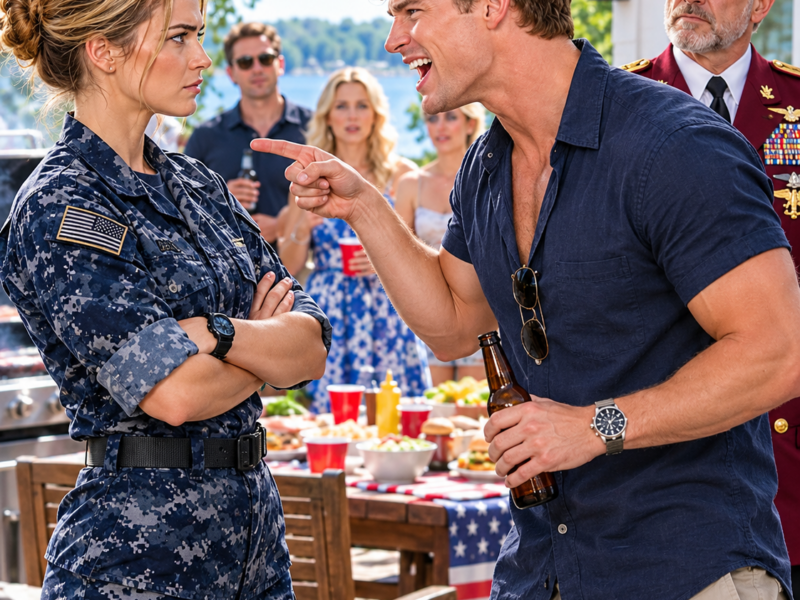
“At my uncle’s Fourth of July barbecue in Virginia Beach, my cousin laughed in front of thirty relatives and called me a washed-up Navy nobody
For a few seconds, nobody moved.
The July sun was still beating down on Uncle Frank’s backyard. The grill hissed. Somewhere near the patio, a little kid laughed as a sprinkler swept across the grass. But around that table, the entire afternoon seemed to stop.
I stared at the photograph in Frank’s hand.
There I was, younger by eight years, thinner, with a beard I barely recognized. My left sleeve was torn. There was dried blood along my jaw. Behind me stood three men.
One was Frank.
The second was a medic named Daniel Reeves.
And the third was a man I had spent eight years trying not to think about.
Captain Aaron Whitaker.
I looked at Frank.
“Where did you get that?”
He didn’t answer immediately. His eyes stayed on the photograph.
“Your uncle kept it,” he said. “He wasn’t supposed to have it.”
I glanced toward Uncle Frank.
He had stopped smiling. His face had changed in a way I had never seen before. At family gatherings, Frank was usually the loudest person in the yard. He told the same stories, laughed at his own jokes, and made sure everyone knew he had once served in the teams.
Now he looked like a man who had just heard a name he thought was buried.
“Dad,” Tyler said, trying to recover his usual confidence. “What is this? Some kind of military inside joke?”
Frank turned toward him.
“Go inside.”
Tyler blinked.
“What?”
“I said go inside.”
For once, Tyler didn’t have a comeback.
He looked at me, then at his father, and finally walked toward the house. His girlfriend followed him, carrying two untouched plates.
Frank waited until they were gone.
Then he pointed at the photograph.
“Matthew, I need you to tell me exactly what happened on that ridge.”
I leaned back in my chair.
“I thought you knew.”
“I know what the report says.”
“Then you know what happened.”
“No,” Frank said quietly. “I know what somebody wanted the report to say.”
Those words landed harder than I expected.
For eight years, I had convinced myself that the official account was the only version I was ever going to get. I had learned to live with it. I had learned not to mention Kunar at family dinners. I had learned to answer questions about my service with vague descriptions and a polite smile.
But I had never stopped remembering that night.
The dust.
The radio.
The sound of men calling for help.
And the coordinates that sent our extraction aircraft to the wrong side of the valley.
I looked at Frank.
“Why are you asking me now?”
He reached into the pocket of his shorts and pulled out a folded piece of paper. It looked old, creased, and worn around the edges.
“Because I found this three weeks ago.”
He placed it on the table.
It was a photocopy of a message log.
I recognized the format immediately. Military communications records were not something you forgot once you had spent enough time staring at them in the dark.
The timestamp was August 19, 2017.
The operation was listed by its abbreviated designation.
And halfway down the page was a line I had memorized years ago.
EXTRACTION COORDINATES UPDATED. USE GRID 41.
I felt my jaw tighten.
“That’s the change.”
Frank nodded.
“Look at the next line.”
I lowered my eyes.
The next entry was marked as an acknowledgment from the operations channel.
Then came the sender identification.
A.W.
I stared at it.
Aaron Whitaker.
For a moment, the backyard disappeared.
I could hear the old radio in my head, the static breaking up every few seconds. I could see the ridge, the rocks, the blood on Daniel’s sleeve. I could feel the weight of the radio against my chest as I tried to get someone to answer.
Whitaker had been the operations officer coordinating the extraction.
He was also the man who had told us the aircraft was coming.
He was the man whose instructions had sent the aircraft to the wrong location.
And according to the report, he had died in the confusion that followed.
I looked up.
“This doesn’t prove anything.”
“No,” Frank said. “Not by itself.”
“Where did you get it?”
“From a man who was there.”
“Who?”
Frank hesitated.
“Daniel Reeves.”
I felt my stomach tighten.
“Daniel is alive?”
Frank nodded.
I had not heard that name in years.
After the operation, I was told Daniel had been transferred to another unit. I sent messages through old contacts. I tried to find him. Eventually, someone told me he had left the service and moved overseas.
I assumed he wanted nothing to do with what happened.
I couldn’t blame him.
Daniel had been the medic on our team. He had spent the night trying to keep a wounded operator alive while the rest of us fought to get off that ridge.
The last time I saw him, his hands were covered in blood, and he was screaming into the radio that the coordinates were wrong.
I swallowed.
“Why would he contact you?”
“He didn’t,” Frank said. “I contacted him.”
“How?”
“Through an old friend. It took months.”
I stared at the paper.
“What did he tell you?”
Frank pulled out the chair opposite me and sat down.
“He told me the extraction coordinates were changed after your team had already confirmed its position. He said the change came through an authorized channel. He said your radio operator challenged it.”
I looked at him.
“That was me.”
“I know.”
“I asked for confirmation twice. I was told the updated grid was verified.”
Frank nodded.
“And then?”
I closed my eyes.
“Then the aircraft went to the wrong ridge.”
The words came out flat.
Not because they didn’t hurt.
Because I had repeated them to myself so many times that they had lost their shape.
“We were supposed to have extraction at 0210,” I continued. “We had two men injured. One couldn’t walk. We had already moved into position. Then the coordinates changed. I questioned them. Whitaker confirmed the update.”
“And you followed the order.”
“I followed an authenticated order.”
Frank didn’t interrupt.
“That distinction matters,” I said. “It mattered then, and it matters now. I wasn’t going to make a unilateral decision that could put the entire team at risk.”
“I understand.”
“Do you?”
His expression softened.
“I’ve spent most of my life around men who had to make decisions with incomplete information. I understand more than you think.”
I looked back at the photograph.
“What happened to Whitaker?”
Frank rubbed his thumb along the edge of the table.
“That’s the part Daniel couldn’t explain.”
“He died.”
“That’s what the report says.”
“His remains were identified.”
“Not according to the records Daniel saw.”
I went still.
Frank leaned forward.
“Matthew, the official casualty report listed Whitaker as killed during the withdrawal. But Daniel says he saw him alive after the extraction aircraft left.”
I felt cold despite the heat.
“That’s impossible.”
“That’s what I said.”
“Daniel was injured. He was exhausted. He could have been mistaken.”
“He said Whitaker was standing near the vehicles at the lower staging point. He said he recognized him because Whitaker was wearing a red scarf around his neck.”
I remembered the scarf.
It was a ridiculous detail to remember after everything else. Bright red, tucked under the collar of his uniform. Whitaker wore it even when everyone else complained about the cold.
I stared at Frank.
“What exactly did Daniel say?”
Frank took a breath.
“He said Whitaker looked directly at him. Then he got into a vehicle and left.”
The sound of a plate breaking came from the patio.
Neither of us turned.
I looked at the message log again.
“Why didn’t Daniel report this?”
“He did.”
“To whom?”
“His chain of command. The investigators. Anyone who would listen.”
“And?”
Frank’s face hardened.
“He was told he had suffered a concussion and that his recollection was unreliable. His statement was classified. Then he was reassigned.”
I felt something hot rise in my chest.
“They told me Whitaker was dead.”
“I know.”
“They told me the coordinates were changed because of a communications failure.”
“I know.”
“They told me the team had lost contact with command.”
Frank didn’t answer.
I pushed the paper away.
“So what are you saying? That Whitaker deliberately sent us to the wrong location?”
“I’m saying Daniel believes somebody changed those coordinates on purpose.”
“That isn’t the same thing.”
“No,” Frank said. “It isn’t.”
He reached for the photograph again and turned it over.
There was handwriting on the back.
Three names.
Three dates.
And a short sentence.
THE RIDGE WAS NEVER THE TARGET.
I read it twice.
“What does that mean?”
Frank shook his head.
“Daniel wouldn’t explain over the phone. He said he would only talk in person.”
“Where is he?”
“Norfolk.”
I looked at him sharply.
“He’s here?”
“He arrived yesterday.”
For the first time that afternoon, I forgot about the people watching us from the house.
“Why didn’t you tell me?”
“Because I wanted to know whether you were ready to hear it.”
I almost laughed.
“Ready? Frank, I’ve spent eight years wondering why six men died on that ridge.”
Frank’s eyes dropped.
“I know.”
“No. You don’t know.”
I stood up so quickly my chair scraped backward.
“You weren’t there. You didn’t hear the radio. You didn’t watch a man bleed out because the aircraft that was supposed to reach us was circling an empty mountain. You didn’t have to tell a wounded teammate that help was coming when you had no idea whether it was.”
Frank stood too.
“You’re right.”
His voice was low.
“I wasn’t there.”
That stopped me.
He didn’t defend himself. He didn’t tell me to calm down. He simply stood there, holding the old photograph.
“I won’t pretend I know what you carried home,” he said. “But I know what it looks like when a man is blamed for something he didn’t do.”
I looked away.
Frank placed the photograph on the table.
“Daniel wants to meet you tonight. There’s something he kept from the investigation.”
“What?”
“A recording.”
I turned back.
“Of what?”
“The original radio traffic.”
My heart started beating harder.
“Where did he get that?”
“He made a copy before the records were sealed. He says the recording contains a transmission that never appeared in the official transcript.”
I looked at the paper again.
A.W.
Aaron Whitaker.
The man I thought had died.
The man who had given us the coordinates.
“Where are we meeting?”
Frank told me.
Then he added something I wasn’t expecting.
“Tyler is coming too.”
I frowned.
“Why?”
Frank glanced toward the house.
“Because he heard enough to know this isn’t a joke.”
I didn’t answer.
I had spent most of my life treating Tyler’s arrogance as harmless. He was the cousin who turned every family story into a competition, who made fun of my quiet job, who called my years in uniform a vacation with better equipment.
But he was also Frank’s son.
And apparently, he had been listening.
That evening, I drove to a small seafood restaurant near the waterfront. Frank was already there when I arrived. Tyler sat across from him, unusually quiet.
At the far end of the table was a man with gray hair, a slight limp, and a familiar scar along his right cheek.
Daniel Reeves.
He looked older.
We all did.
For several seconds, neither of us spoke.
Then Daniel stood.
“Stonewall.”
I stared at him.
Nobody had called me that in years.
“Danny.”
He reached out, and we shook hands. His grip was weak, but his eyes were clear.
“I thought you were overseas.”
“I was.”
“What happened?”
“Long story.”
He looked at Frank.
“You told him?”
“Enough.”
Daniel nodded and reached into a canvas bag beside his chair.
Before he could take anything out, Tyler spoke.
“Can I ask something?”
We all turned toward him.
He looked uncomfortable.
“Earlier, when I called him Stonewall, Dad reacted like he’d seen a ghost. I thought it was just some nickname from his unit.”
Daniel looked at me.
“Was it?”
I sat down.
“It started during that extraction.”
Daniel pulled out a small recorder.
“Then maybe it’s time he knows why.”
He placed it on the table.
“I called you Stonewall because you refused to leave that ridge,” he said. “Not because you were the strongest man there. Not because you were some kind of action hero.”
He paused.
“You stayed because you knew the men behind you couldn’t move.”
I looked down.
Daniel continued.
“After the first extraction attempt failed, the team was ordered to withdraw south. You were told to abandon the eastern ridge and move to the new grid.”
“I remember.”
“But you refused.”
“I asked for clarification.”
“You asked three times. Then you told command the new position was exposed and that moving the wounded across that open ground would get them killed.”
I remembered that conversation.
I remembered the response.
The order stands.
I remembered looking at Daniel, who was trying to hold pressure against a wound that wouldn’t stop bleeding.
I remembered deciding that if I moved the team, I might lose all of them.
“So you stayed,” Daniel said. “You held the eastern ridge until the second aircraft came.”
“I didn’t hold it alone.”
“No. You didn’t.”
He looked at Frank.
“That’s why I called him Stonewall.”
Frank nodded slowly.
Tyler stared at me.
I wished he wouldn’t.
I didn’t want admiration. I didn’t want an apology. I wanted the past to remain where I had buried it.
Daniel pressed the recorder.
Static filled the small space between us.
Then a voice came through.
“Control, this is Stonewall. Confirm grid forty-one.”
My own voice.
Younger. Sharper. Tired.
A second voice answered.
“Grid forty-one confirmed. Proceed immediately.”
Daniel stopped the recording.
“That’s the official version,” he said.
He pressed another button.
The static returned.
Then came my voice again.
“Control, we have wounded. Grid forty-one is exposed. Request confirmation.”
A pause.
Then another voice.
Not Whitaker’s.
A different man.
“Stonewall, disregard the previous transmission. Maintain your current position. Do not move to grid forty-one.”
My fingers tightened around the edge of the table.
I remembered hearing something like that.
But not clearly.
The signal had been breaking up. Another transmission had come over it almost immediately. At the time, I thought it was interference.
Daniel continued the recording.
Then came Whitaker’s voice.
“Negative. Grid forty-one is the only authorized extraction point. Any personnel remaining at the eastern ridge will be considered outside the operation.”
I looked at Daniel.
“That was him.”
“Yes.”
The recording continued.
A third voice interrupted.
“Whitaker, this is command. Confirm you received the revised instructions.”
Whitaker answered.
“Confirmed.”
Then the other voice said something that made my blood run cold.
“Your revised instructions are to recover the package. The personnel are secondary.”
Daniel stopped the recording.
Nobody spoke.
Tyler looked between us.
“What package?”
Daniel stared at the recorder.
“That was the question I asked for eight years.”
Frank leaned forward.
“What did you find?”
Daniel took a folded document from his bag.
“The operation wasn’t only an extraction. Our team had been sent to recover a source who had information about a weapons shipment moving through the valley.”
I felt my throat tighten.
“We were told there was a local informant.”
“There was,” Daniel said. “But the informant wasn’t the package.”
He unfolded the document.
“He was carrying a storage device. It contained financial records, names, and communications connected to a network operating inside the region.”
Frank studied the paper.
“Who was on the list?”
Daniel looked at me.
“People who weren’t supposed to be there.”
He tapped the page.
“Contractors. Brokers. A few officials. And one American officer.”
I stared at the name.
Aaron Whitaker.
But beneath it were two more.
One was a senior logistics officer.
The other was a civilian contractor whose company had been responsible for coordinating the transportation and communications equipment used by several units.
The contractor’s name was familiar.
I had seen it in the original mission briefing.
“Why would Whitaker send us to the wrong ridge?” I asked.
Daniel’s voice dropped.
“Because the source was supposed to be transferred before your team could reach him.”
“Transferred where?”
“Out of the valley.”
“And the coordinates?”
“They were changed to pull your team away from the actual pickup point.”
I felt sick.
“You’re saying we were a distraction.”
Daniel nodded.
“The plan was to make it look like the operation had failed because of bad communications. Your team would take the blame. The source would disappear. The storage device would never be recovered.”
“But the source—”
“Died before we reached him.”
I closed my eyes.
I remembered a young man standing near a stone wall during the briefing. He had been wearing a dark jacket and carrying a small canvas bag.
I remembered him asking whether we would bring his family out too.
I remembered telling him we would do everything we could.
I had never seen him again.
“Did he know?” I asked.
Daniel shook his head.
“I don’t think so.”
For a moment, all I could hear was the hum of the restaurant’s refrigerator.
Then I asked the question that had been sitting in my chest since 2017.
“Why did the report blame me?”
Daniel looked down.
“Because you were the only person who openly challenged the coordinates. They used your objections to make it look like you had been confused and had failed to follow the final instructions.”
I stared at him.
“I followed the authenticated order.”
“I know.”
“They said I ignored command.”
“I know.”
“They said I made the wrong call.”
Daniel’s eyes filled with something that wasn’t quite anger and wasn’t quite grief.
“They needed someone to carry the failure.”
He turned the document toward me.
“And you were alive.”
That was the part I had never considered.
The men who died couldn’t defend themselves.
The people who had issued the orders could control the records.
And I had been left with a version of events that made me look like a reckless junior officer who had failed under pressure.
I had spent eight years trying to accept that.
But now I understood.
The report hadn’t simply been wrong.
It had been constructed.
Tyler sat perfectly still.
For once, he wasn’t looking for a joke.
“Why didn’t you release this?” he asked Daniel.
Daniel gave a tired smile.
“I tried. The original file was classified. The recording was dismissed as incomplete. The document was called unverified. And when I kept asking questions, people started asking about my medical history.”
He looked at me.
“They said I had a concussion. They said trauma could distort memory. They said I was making accusations because I couldn’t accept the loss.”
I felt my hands trembling.
“Did you ever find out what happened to Whitaker?”
Daniel nodded.
“Three years ago, I got a message from someone who worked at a private logistics company. He said Whitaker was alive and using a different name.”
Frank’s expression hardened.
“Where is he now?”
“Dead.”
The word landed without drama.
Daniel explained that Whitaker had died in a traffic accident overseas two years earlier. His death had been confirmed through records Daniel had obtained from a former colleague.
He had never faced an investigation.
He had never been questioned publicly.
And he had never answered for what happened on that ridge.
I looked down at the table.
“So that’s it?”
Daniel shook his head.
“No.”
He reached into his bag again and pulled out a small envelope.
“This is why I came back.”
Inside was a handwritten letter.
The handwriting was uneven, as if the person had written it in a hurry.
Daniel slid it toward me.
“I received it last month. It came from someone who worked in the operations center that night.”
I unfolded the page.
The first line made my chest tighten.
Matthew Hayes,
I should have spoken years ago.
I read the letter silently.
The writer said he had been the communications technician assigned to monitor the operation. He had received two conflicting instructions. One ordered the team to remain at the eastern ridge. The other redirected the extraction to grid forty-one.
He had flagged the contradiction.
He had been told to stand down.
He had watched the transmission logs change.
And when the investigation began, he had been instructed to sign a statement confirming that the revised coordinates had been received and acknowledged by the entire team.
At the bottom was a name.
Specialist Evan Brooks.
I remembered him.
He had been young, quiet, and almost invisible during the briefing. He was the person who had first warned us that the communications channel was behaving strangely.
I looked at Daniel.
“Where is he?”
“Virginia.”
“Does he know we’re here?”
“He’s waiting for my call.”
I put the letter down.
For eight years, I had thought I was chasing a ghost.
Now there were three living witnesses.
Daniel.
Evan.
And me.
Frank leaned back.
“Then we take it to the people who can reopen the investigation.”
I shook my head.
“It won’t be that simple.”
“No,” Frank said. “It won’t.”
“They’ll ask why we’re bringing it up now. They’ll question the recording. They’ll question Daniel’s memory. They’ll question the letter.”
“Then we answer every question.”
I looked at him.
“You’re willing to put your name on this?”
Frank’s expression didn’t change.
“I’ve spent enough years telling people about honor. I don’t intend to stay quiet when it becomes inconvenient.”
Tyler finally spoke.
“Dad.”
Frank turned.
“I owe Matthew an apology.”
Nobody moved.
Tyler looked directly at me.
“Not just for today. For years.”
I didn’t answer.
He continued.
“I made jokes about your service because I thought it was something you used to make yourself seem important. I didn’t know what happened. I didn’t even try to understand.”
He swallowed.
“When I called you Stonewall, I thought I was embarrassing you.”
He looked down at his hands.
“I didn’t know I was making fun of the one thing you did right when everybody else was giving you the wrong orders.”
I stared at him.
Part of me wanted to tell him that he had no idea what he was talking about.
Another part of me wanted to accept the apology and move on.
But I couldn’t do either.
“Tyler,” I said, “you don’t owe me respect because of a nickname.”
He looked up.
“You owe people respect before you know what they’ve survived.”
His eyes dropped again.
“I know.”
I let the silence sit.
Then I added, “And don’t ever use someone else’s worst day as entertainment.”
He nodded.
“I won’t.”
The following morning, I met Evan Brooks at a small office near the naval station.
He looked nothing like the young communications technician I remembered. He was older, heavier, and wore glasses. But the moment he saw me, he stood up.
“Chief.”
I hadn’t been called that in a long time.
“Evan.”
He shook my hand with both of his.
“I should have found you sooner.”
I told him he was here now.
We spent nearly four hours going through the documents. He had kept copies of the original transmission logs, along with emails and a signed statement he had refused to submit.
He had been afraid.
Not cowardly.
Afraid.
He had a wife and two young children at the time. His career depended on the people who were telling him to keep quiet. He had convinced himself that if he stayed out of it, the truth would eventually come out on its own.
It hadn’t.
He looked at me across the table.
“I’ve thought about that night every week for eight years.”
“So have I.”
“I heard you challenge the coordinates. I knew you were right.”
“Why didn’t you say so?”
His eyes filled.
“Because they told me the operation was classified and that speaking up would put people at risk. Then they told me the investigation had already reached its conclusion.”
I nodded.
“I understand.”
He looked surprised.
“You do?”
“I know what it feels like to be told that the safest thing is to stop asking questions.”
I placed my copy of the letter on the table.
“But we’re done doing that.”
Over the next several weeks, the evidence went through official channels. There were interviews, requests for records, and more than one meeting where people in expensive suits asked the same questions in different ways.
The recording was authenticated.
The original transmission logs were recovered.
Evan’s statement was corroborated by two additional records.
Daniel’s medical assessment was reviewed by an independent specialist, who found no basis for dismissing his account.
And the investigation was reopened.
It took months.
There were no dramatic press conferences. No public apologies delivered beneath flashing cameras. No one came to my house with a medal and a speech.
The truth arrived the way it often does.
Slowly.
In documents.
In corrections.
In quiet conversations behind closed doors.
The final report confirmed that the extraction coordinates had been deliberately altered by an authorized officer without the required operational justification. It also found that the original communications record had been improperly modified and that the earlier investigation had relied on incomplete and misleading information.
Whitaker’s role was confirmed.
The civilian contractor’s involvement was documented.
The findings cleared me of the accusations that had followed me for eight years.
They also acknowledged that my decision to hold the eastern ridge had prevented additional casualties.
I read that sentence three times.
Not because I needed someone to tell me I had done the right thing.
But because, for the first time, the official record no longer said I had done the wrong thing.
Six men had died during that operation.
No report could bring them back.
No correction could give their families the years they had lost.
And no explanation could make the night itself disappear.
But at least the truth was no longer buried beneath a lie.
A month after the report was released, Uncle Frank invited me over for dinner.
No barbecue this time.
Just a small table, a quiet evening, and a pot of coffee that had been sitting too long.
Tyler opened the door.
He didn’t make a joke.
He simply stepped aside and said, “Come in.”
Frank was waiting in the backyard.
The photograph was on the table.
He had placed it in a simple frame.
I picked it up.
There I was, standing on that ridge with Daniel and two other men. My face was exhausted. My uniform was dirty. I looked like someone who had been awake for three days.
Frank stood beside me.
“I thought you might want it.”
I studied the picture.
“Why did you keep this?”
“Because I knew what happened out there wasn’t what they wrote down.”
I looked at him.
“You knew?”
“Not the details. But I knew the men I served with. I knew the kind of person you were. When I heard the official story, something didn’t fit.”
He paused.
“I should have asked more questions.”
I put the photograph down.
“You did now.”
Frank nodded.
Then he looked toward the house.
“Tyler wants to say something.”
I turned.
Tyler was standing in the doorway, holding two glasses of iced tea.
He walked over and placed one in front of me.
“I’ve been thinking about what you said.”
I waited.
“About respecting people before knowing what they’ve survived.”
He pulled out a chair.
“I always thought being tough meant having the loudest voice. Having the best story. Making sure everybody knew you were the smartest guy in the room.”
He looked at the photograph.
“I guess I had it backward.”
I didn’t say anything.
He continued.
“You didn’t spend eight years telling everyone you were a hero. You barely talked about what happened. I mistook that for having nothing to say.”
He shook his head.
“I was wrong.”
I took a sip of the tea.
“People don’t owe you their stories, Tyler.”
“I know.”
“And you don’t need to turn every conversation into a contest.”
He gave a small, embarrassed smile.
“I’m working on that.”
Frank laughed softly.
It was the first normal sound I’d heard from him in weeks.
Then he reached for the photograph and turned it around.
The old sentence was still written on the back.
THE RIDGE WAS NEVER THE TARGET.
Frank looked at it for a long time.
“I used to think that sentence meant the operation was about something bigger than the men on the ground.”
He turned the photograph back toward me.
“Now I think it means something else.”
“What?”
“The people who changed those coordinates believed the mission mattered more than the men carrying it out. They treated lives like numbers on a map.”
He tapped the photograph.
“But you didn’t.”
I looked at the faces in the picture.
Daniel.
The others.
Men who had trusted one another when the orders stopped making sense.
I thought about the young informant who had asked whether his family would be brought out.
I thought about the men who never came home.
And I thought about the years I had spent wondering whether one different decision could have changed everything.
“I wasn’t trying to be a hero,” I said.
Frank nodded.
“I know.”
“I just didn’t want to leave them.”
He placed a hand on my shoulder.
“That’s what made you Stonewall.”
For the first time, I didn’t feel the need to correct him.
We sat there until the sun disappeared behind the houses.
The neighborhood lights came on one by one. Somewhere down the street, fireworks began popping early, a few bright flashes against the darkening sky.
Tyler stood beside the grill, quietly helping his father put things away.
And I realized something I hadn’t understood when I first walked into that backyard.
The truth hadn’t changed what happened on the ridge.
It hadn’t made the loss smaller.
It hadn’t erased the guilt I had carried or returned the years I had spent believing the wrong story.
But it had given the dead their names back.
It had given the living a chance to speak.
And it had finally separated the man I was from the lie that had been told about me.
Before I left, Frank handed me the framed photograph.
“Take it,” he said.
I hesitated.
“Are you sure?”
“It’s yours.”
I held it carefully.
For years, I had avoided photographs from that time. I thought looking at them would pull me back into a place I had worked so hard to leave.
But this one felt different.
It wasn’t a reminder of failure.
It was a reminder of the men who stayed.
The men who carried each other.
The men who refused to let the truth disappear.
As I reached my car, Tyler called after me.
“Matthew.”
I turned.
He stood beneath the porch light.
“I’m sorry I laughed.”
I looked at him for a moment.
Then I nodded.
“Don’t let the next person have to earn your respect by surviving something terrible.”
Tyler nodded slowly.
“I won’t.”
I drove home with the photograph on the passenger seat.
At a red light, I glanced over at it.
The younger man in the picture looked exhausted. His eyes were fixed on something beyond the camera. He didn’t look like a hero.
He looked like someone who had been given an impossible choice and had made the best decision he could with what he knew.
For eight years, I had wanted the world to understand that.
Now it finally did.
And for the first time since that night in Kunar, I could look at the man in the photograph without wondering whether I had failed him.
The end.









