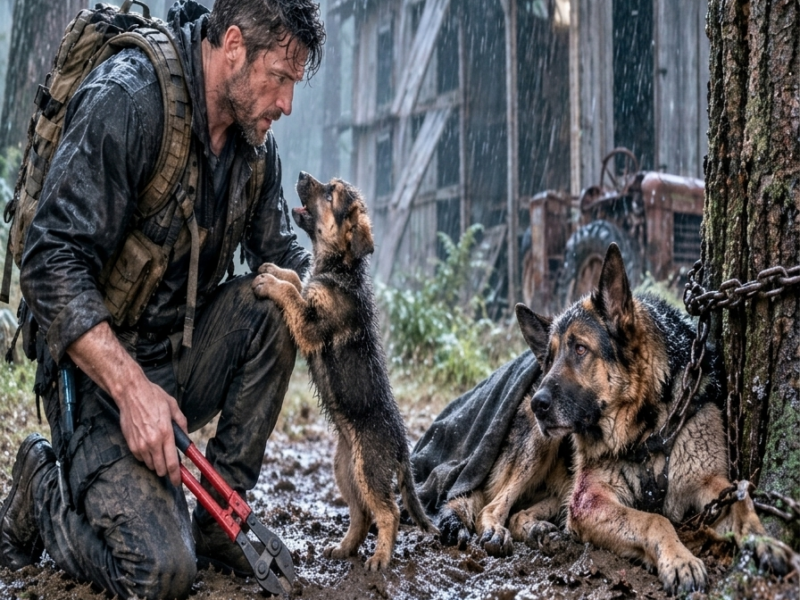
At dawn outside a rural animal shelter in Virginia, a bloodied puppy clawed at my Navy jacket and dragged me toward a locked shed
The damp morning mist of rural Virginia hung heavy over the rusted wire fences of the county animal shelter. It was barely dawn, the sky a bruised shade of purple and slate gray. A bitter frost coated the overgrown grass, biting through the thin fabric of my dark trousers. I stood beside my truck, pulling the collar of my worn Navy jacket tight around my neck. Twelve years in the SEAL teams had taught me how to read an environment in seconds, to process threats, to remain cool when adrenaline threatened to turn blood to ice. But standing in that quiet, forgotten dirt lot, an unnerving stillness settled deep into my chest.
I had driven down from Norfolk on a rare week of leave, driven purely by an restless urge I couldn’t quite name. Since leaving active duty, quiet mornings didn’t bring peace; they brought ghosts.
A sharp, scratchy whimper broke the silence.
I turned. A tiny creature was scrambling out from beneath the rotted floorboards of a dilapidated wooden shed near the tree line. It was a golden-mix puppy, barely eight weeks old, covered in dried mud and dark patches of matted fur. He was trembling violently, his tiny frame so emaciated that every rib showed beneath his skin like the curved spokes of an old umbrella. One of his small ears was torn, dripping fresh blood onto the cold dirt.
The puppy limped toward me, his front left paw pulled high against his chest. He didn’t cringe away as most abused strays would. Instead, he locked his dark, intelligent eyes onto mine with a terrifying intensity.
He reached my boots, reared up on his hind legs, and dug his tiny, blood-stained claws directly into the canvas of my Navy jacket. He pulled back, whining—a high-pitched, desperate sound—and then dragged his weight backward toward the shed.
“Hey… hey, take it easy, little guy,” I whispered, kneeling in the freezing mud. The cold seeped instantly through my jeans, but I barely felt it. I reached out a gloved hand, expecting him to snap or cower.
He didn’t. The puppy pressed his cold, wet nose firmly into the palm of my hand, let out a shuddering sigh, and then let go of my jacket. He took three limping steps toward the locked shed, turned his head, and gave me a look that was uncannily articulate. He pulled again, his eyes darting between me and the padlock hanging from the shed door.
He’s not asking for help for himself, I realized with a sudden knot in my gut. He wants me to follow him.
The heavy wooden door of the shed was wrapped in an iron chain, fastened with a thick, rusted padlock. The structure looked ready to collapse, its wooden planks swollen from decades of Virginia rain.
“Hey! Back away from there!”
The harsh, metallic voice echoed across the lot. I glanced over my shoulder. A middle-aged man in a grease-stained jacket was standing on the gravel path outside the main shelter office. He wore a faded baseball cap pulled low, and a lit cigarette dangled lazily from the corner of his mouth. A brass key ring jingled at his hip. This was Carl, the shelter manager I’d spoken to briefly over the phone the day before.
Carl didn’t walk toward me; he stayed near the office doorway, his hands jammed deep into his pockets, his posture stiff and defensive.
“She’s dangerous, buddy,” Carl called out, his voice sharp with an unnatural edge. “Bit a worker yesterday. She’s sick, wild, and locked up for a reason. Leave her alone and get back to your vehicle.”
I looked from Carl back down to the puppy. The little dog had dropped to his stomach, growling silently at the shelter manager, his body shivering against my boot.
In the Navy, you learn to trust your instincts over human speech. People lie with their words, their cadence, their eyes. Carl’s eyes were darting toward the treeline, avoiding direct contact with mine. His stance wasn’t that of a concerned animal caretaker; it was the tense, coiled posture of a guard defending an unwanted discovery.
“He wants me to open it,” I said quietly, my voice carrying across the quiet lot.
“I said move away!” Carl yelled, finally taking three aggressive steps forward. “That’s county property! You break that latch, I’m calling the Sheriff!”
I ignored him. I reached down, took a deep breath, and hooked my fingers under the bottom link of the rusted chain wrapping the door. My SEAL training was a muscle memory that never truly faded—leverage, force, purpose. I braced my foot against the rotted frame, bent my knees, and pulled with everything I had.
With a loud, metallic SNAP, the rusted staple pulled free from the soft, water-logged wood. The chain clattered to the dirt.
“Hey!” Carl shouted, his footsteps speeding up across the gravel.
I grabbed the heavy iron handle and yanked the shed door open.
The stench hit me first, thick and suffocating. It wasn’t just the smell of damp earth or animal waste; it was the sharp, metallic tang of fresh blood, coupled with the putrid scent of infected wounds and old cotton soaked through with stagnant rainwater.
Dim morning light filtered into the dark interior. In the far corner, lying on a heap of filthy burlap sacks, was a large golden retriever mix.
She was motionless. Her body was a map of profound violence—matted fur, deep lacerations across her flanks, and dark purple bruising visible beneath her thin coat. She was barely breathing, her chest rising and falling in shallow, agonizing hitches.
When the light struck her eyes, her head twitched weakly. She didn’t growl. She didn’t show her teeth. She simply lifted her heavy head, her dark eyes clouded with pain, and looked directly at me.
Then, she looked down at the tiny puppy who had just rushed past my legs.
The puppy crawled into the curve of her belly, whining softly, licking the dark, dried blood near her jaw. The mother dog let out a faint sigh, resting her chin over her pup’s tiny back. She was using the last ounce of her strength just to hold her child close.
“It’s okay,” I murmured, dropping to my knees beside her. I unzipped my Navy jacket, pulled it off, and gently draped the warm fleece lining over her shivering body. “You’re safe now. I’ve got you.”
I gently placed my hand beneath her chin to check her pulse. As I moved my fingers through the matted fur around her neck, I noticed something strange.
Her injuries weren’t the result of a fight with another animal. There were precise, thick circular bruises around her neck—trachea burns caused by a heavy wire choke-leash. The cuts on her paws were clean, straight lines, as if she had been scrambling through broken glass or barbed wire while tied down.
And then my fingers hit metal.
Hidden deep within her thick, muddy collar was a small, faded blue aluminum tag. It was bent and severely scratched, but a small portion of the surface remained clean.
I pulled out my pocket flashlight, clicking it on. I wiped away a layer of dried mud with my thumb.
The engraved letters came into sharp focus:
HOPE
My heart stopped. The breath tore out of my lungs in a sharp, ragged gasp. The dark shed seemed to spin around me, the air suddenly thin and freezing.
Hope.
It was a name I hadn’t spoken aloud in twelve agonizing years.
Hope was the name of my younger sister Clara’s golden retriever. Clara had brought Hope home as an eight-week-old puppy during her senior year of high school. The two had been inseparable. Wherever Clara went, Hope was a foot behind her.
Twelve years ago, Clara was found dead at the bottom of a ravine behind our family’s old summer property in the Blue Ridge Mountains. The local police had ruled it a tragic accident—a late-night slip over a dark cliff edge during a summer storm. But that same night, Hope had vanished without a trace. The authorities told us the terrified dog had likely run off into the wilderness and died of exposure or predators.
My sister was gone. Her dog was gone. My family collapsed under the weight of the grief, and six months later, I enlisted in the military to run away from the quiet horror of an empty home.
I looked down at the dying animal beneath my jacket. I looked into her milky, pain-filled eyes.
“Hope?” I whispered, my voice breaking.
The golden retriever’s tail gave a single, weak thump against the dirt floor. She knew the name. She recognized the voice.
Footsteps slammed into the doorway of the shed, blocking out the morning light.
Carl stood in the frame, breathing heavily. But his face wasn’t red with anger anymore. It was pale, slick with cold sweat. His hands were tucked inside his heavy work jacket, his shoulders braced.
“You shouldn’t have opened that door, Navy,” Carl said, his voice dropping into a flat, deadly register that carried no trace of his previous bluffing tone.
I stood up slowly. All the grief, all the shock that had seized my chest seconds ago instantly condensed into a cold, lethal rage. I stepped between Carl and the dogs.
“Where did you get her, Carl?” I asked, my voice dangerously calm.
Carl didn’t answer. He took a half-step back toward the open lot, his right hand moving subtly inside his jacket pocket.
“I asked you a question,” I stepped out of the shed, forcing him to retreat into the open daylight. “Where did this dog come from?”
Carl swallowed hard, his eyes flicking toward my boots, then back to my chest. “She was dropped off three nights ago. Tied to the front gate in the middle of a thunderstorm. She was bleeding out then.”
“You didn’t log her in,” I stated, gesturing toward the empty intake board near the main office. “You locked her in a hidden shed behind the facility. You left her to die of starvation and infection.”
“She was broken goods!” Carl spat, a flash of defensive fury crossing his face. “She wasn’t supposed to live through the night! And that damn pup… he wasn’t supposed to survive either.”
“Who brought her here?” I demanded, closing the distance between us until I was standing less than two feet from him. My shadow fell completely over his slumping frame.
Carl shook his head, his jaw clenching. “You don’t know what you’re stepping into, son. That dog… she didn’t belong to no regular family. After your sister went over that cliff, folks took her. She was sold. Private breeding, illegal fighting rings, security operations—she was passed around for twelve damn years because she was valuable.”
“Valuable?” I repeated, my fists clenching so hard my knuckles popped. “She’s a family dog!”
“She was a witness,” Carl whispered, his eyes widening with genuine fear. “And three days ago, she escaped from the old Miller property down near the river. She ran ten miles through a storm to get back to this town. But you can’t save her, soldier. The people looking for her… they own this county.”
A faint whimper echoed from inside the shed.
I turned back. The puppy was crawling out toward me once again. He wasn’t looking at his mother now. He was carrying something small in his jaws.
He dropped a tiny object right at my boots.
I knelt and picked it up. It was a heavy, cylindrical steel capsule, no larger than a key fob, attached to a thick leather strap that had clearly been cut from the mother dog’s inner harness. The capsule was sealed with a rubber gasket to make it waterproof.
My hands shook as I unscrewed the rusted steel cap.
Inside was a tightly rolled piece of laminated paper. I pulled it out and unrolled it with numb fingers.
It was a photograph.
In the picture, a sixteen-year-old girl with bright green eyes and wild red hair was laughing, hugging a plump golden retriever puppy in a sunlit backyard. It was Clara. And the puppy was Hope.
My eyes welled with tears, but as I turned the photograph over, the breath caught entirely in my throat.
On the back of the photo, written in faded black ink in my sister’s distinct, slanted handwriting, were six words:
If anything happens, trust Hope.
Beneath those six words was a second line, written in darker, bolder strokes, dated exactly two weeks before the night Clara died:
314 Blackwood Lane. Under the floorboards.
314 Blackwood Lane was our childhood home. The home where Clara died. The home my parents had sold a decade ago.
“She knew,” I whispered to the cold wind, the truth striking me like a physical blow. Clara hadn’t slipped. She hadn’t fallen. She knew someone was coming for her.
“Hand over the capsule,” Carl’s voice rang out, sharp and cold.
I turned around slowly.
Carl had pulled his hand from his coat pocket. He was pointing a snub-nosed .38 revolver directly at my chest.
“I don’t want to kill an ex-military guy,” Carl said, his voice trembling slightly as he held the revolver with both hands. “It creates too much noise. But you need to leave that picture, leave the dogs, and drive back to Norfolk. Forget you ever stopped here.”
I looked down the barrel of the .38. I had faced loaded weapons in dark alleys in Mosul and compound raids in Helmand. Carl was terrified. His finger was twitching on the trigger, his weight balanced entirely on his back foot. He was an amateur driven by fear of someone much worse than him.
“You’re shaking, Carl,” I said, taking a slow, deliberate breath. I kept my hands open at chest level, letting the photograph drop safely into my shirt pocket. “If you fire that gun, the sound will carry to the highway. In two minutes, three truckers will call 911. You won’t cover this up.”
“You don’t understand!” Carl shouted, his eyes wide. “They told me if anyone came looking for that dog, I was supposed to bury her and whatever was on her! They paid me five grand just to keep my mouth shut!”
“Who paid you?”
“Get out!” he yelled, taking a step forward.
I didn’t wait for him to settle his aim.
I sidestepped to the left, closing the distance between us in a fraction of a second. My right hand slammed upward against the cylinder of the revolver, knocking his aim toward the sky. BANG. The shot exploded into the morning air, shattering a tree branch high above us.
Before Carl could process the shock, I drove my left palm upward into his jaw. His head snapped back, his knees buckled, and he dropped the gun into the slush. I swept his legs, sending him crashing face-first into the freezing mud.
In less than three seconds, Carl was pinned under my knee, his arm twisted securely behind his back.
“Who paid you, Carl?” I growled, pressing his face into the dirt.
“Miller!” Carl gasped, sobbing out of pain and terror. “Thomas Miller! He bought the dog years ago! He said… he said the dog had something hidden in her collar that could ruin him! He brought her to me three days ago after he caught her trying to dig near the old Blackwood house!”
Thomas Miller.
The name hit me like an electric shock. Miller was one of the wealthiest land developers in the county. Twelve years ago, he had been a close business associate of my father’s. He was also the man who bought our childhood home at a fraction of its market value right after Clara’s death, claiming he wanted to “help our grieving family move on.”
“What was Miller looking for?” I pressed harder on Carl’s wrist.
“I don’t know! I swear on my life, I don’t know!” Carl wept. “He just said the dog kept returning to the old Blackwood house. He tied her up at his estate, but she broke her chain, dug under his fence, and ran back to Blackwood Lane! He beat her nearly to death when he caught her, then dragged her here to starve!”
I pulled Carl up by his collar, dragging him toward the metal fence of the dog run. I used his own heavy-duty handcuffs—which he carried on his belt for handling aggressive strays—to secure him tightly to the high iron mesh.
“If you move, you’ll tear your wrists,” I said coldly. “The police will be here soon. I’m calling them from the road.”
I sprinted back into the dark shed. The golden retriever was fading fast. Her eyes were milky, her breathing ragged and shallow.
“Hang on, Hope,” I whispered. “Just hang on.”
I gently scooped her up into my arms, wrapping her tightly in my fleece jacket. She felt impossibly light, her frame reduced to bone and fragile skin. I carried her out into the cold daylight, the puppy scrambling behind my boots, whining frantically.
I laid Hope across the back seat of my truck, covering her with a heavy wool emergency blanket from the trunk. The puppy scrambled up beside her, curling himself into a tiny ball against her chest, licking her muzzle to keep her awake.
I jumped into the driver’s seat, started the engine, and tore out of the gravel parking lot, spraying rocks into the air as I headed straight toward the county emergency veterinary clinic.
The next two hours passed in a surreal blur of sterile white tiles, the harsh smell of antiseptic, and the hum of fluorescent lights.
Dr. Sarah Vance, a veteran veterinarian with sharp blue eyes and a calm demeanor, had taken Hope straight into the trauma bay. I stood in the waiting room, pacing the length of the linoleum floor, my hands stained with dried mud and my sister’s dog’s blood. The tiny puppy sat quietly on an vinyl chair beside my leather duffel bag, his eyes never leaving the double doors where his mother had disappeared.
Finally, the doors opened. Dr. Vance stepped out, pulling off her surgical mask.
“Is she…?” I couldn’t finish the sentence.
“She’s alive,” Dr. Vance said, letting out a heavy breath. “She was severely dehydrated, suffering from internal bleeding, and hypothermic. But she’s an incredibly tough dog, Mr. Mercer. We’ve stabilized her, started IV fluids and blood transfusions, and repaired her lacerations. She’s resting now.”
I let out a breath I felt like I’d been holding for twelve years. “Can I see her?”
“Briefly,” Vance nodded, looking closely at my stained hands. “She has old scars, Ethan. Scars that are years old. Whichever monster had her before… they kept her confined in darkness for a very long time.”
I followed her into the quiet recovery ward. Hope lay on a padded heating blanket, an IV drip taped to her front leg. When I approached, her ears twitched, and her tail gave a soft, slow thump against the floor.
I knelt beside her, resting my forehead against hers. “I’m sorry,” I whispered. “I’m so sorry I took so long to find you.”
The puppy scampered into the room, hopped up onto the edge of the dog bed, and wedged himself between his mother’s paws.
I pulled out the laminated photograph from my shirt pocket and showed it to Dr. Vance. “My sister died twelve years ago. This dog vanished the same night. This picture was inside a capsule on the pup’s collar.”
Dr. Vance scanned the photo, her expression shifting from professional concern to shock. “314 Blackwood Lane…” she read aloud. “Ethan… Thomas Miller bought that property years ago. He torn down the old orchard last month, but the main house… it’s been abandoned and boarded up for almost a year. There are rumors he’s planning to demolish it completely next week.”
“He’s tearing it down to destroy whatever is hidden there,” I said, the pieces of the terrifying puzzle finally locking into place. “Hope didn’t just escape. She went back to the only place she knew my sister had hidden the truth.”
I stood up, adjusting the strategic knife hidden beneath my jacket.
“Keep them safe, Doctor,” I said, staring at Hope and her pup. “I have to go finish what my sister started.”
The iron gates of 314 Blackwood Lane were wrapped in thick yellow chain and marked with NO TRESPASSING signs bearing the logo of Miller Development Corporation.
The estate was swallowed by forgotten wilderness. Overgrown pine trees and thick vines strangled the long, winding dirt driveway. At the top of the hill stood the house—a two-story Victorian structure with wrap-around porches, peeled white paint, and dark, boarded-up windows that looked like hollow eye sockets staring out over the foggy valley.
This was the house where I had grown up. The house where Clara’s laughter used to ring through the hallways during hot Virginia summers. Now, it looked like a tomb.
I parked my truck half a mile down the ridge in a dense thicket of oak trees, approaching the property on foot through the treeline. My combat boots made no sound against the wet pine needles.
As I approached the perimeter of the overgrown lawn, I noticed fresh tire tracks in the mud—heavy tread marks from a commercial excavator and two pickup trucks. Miller’s demolition crew was already preparing the site. A large yellow bulldozer sat parked near the old barn, its steel blade caked in fresh earth.
I waited in the treeline, watching the house for ten minutes. No movement. The crew had likely left for lunch or was waiting for the final permits to tear the foundation apart.
I darted across the open lawn, vaulting over the rotting porch railing, and slipped through a broken basement window on the side of the house.
The interior of the home smelled of damp plaster, rot, and forgotten time. Shadows stretched long across the bare wooden floors. Furniture covered in yellowing sheets sat like ghosts in the living room.
I navigated the dark hallway by memory, reaching the center of the house—the old library.
314 Blackwood Lane. Under the floorboards.
I pulled out my flashlight, casting a beam across the dust-covered oak floorboards. The library had been partially ransacked. Books were scattered across the floor, and several walls had been smashed open with crowbars. Miller had been searching this house, but he didn’t know the exact location. He was guessing.
I knelt near the built-in bookshelves in the corner of the room. I remembered playing hide-and-seek with Clara in this room when we were children. She always hid in the tiny hollow beneath the floor behind the heavy oak desk—a space our grandfather had constructed decades ago as a hidden floor safe.
I shoved the heavy desk aside. The floorboards beneath it looked untouched, covered in a thick layer of undisturbed dust.
I pulled out my combat knife, jammed the heavy steel blade between two wide oak planks, and levered upward with all my strength.
The wood groaned, splintered, and popped free.
I shone my flashlight into the dark floor cavity.
Inside sat a small, faded metal fire-box, secured with an old combination lock.
Beside the box was something that made my breath catch in my throat: a small, dark red dog collar with a bell attached. It was Hope’s original puppy collar. Clara had placed it here as a marker.
I picked up the metal box. I turned the dial of the lock to the three numbers I would never forget—Clara’s birthday: 0 – 4 – 1 – 2.
The lock clicked open.
I lifted the lid. Inside was a small black leather journal, a micro-cassette recorder, and an official county land deed bearing the seal of the Virginia State Government.
I opened the journal. The pages were filled with Clara’s hurried, nervous handwriting from the final weeks of her life.
July 14th:
I saw Mr. Miller in Dad’s office tonight. They were arguing about the river basin expansion. Dad told him no. He said he would never sign off on dumping industrial waste into the county watershed. Miller threatened him. He said everyone has a price, and if Dad wouldn’t take the money, he’d take everything else.
July 22nd:
I followed Miller to the old quarry behind the house. He was meeting with two men in unmarked suits. They were talking about Dad. Miller said, “The accident is arranged for next month.” Oh God. I recorded them. I have their voices on tape. I’m so scared. I hid the tape here. Hope saw me hide it. If I can’t get to the Sheriff in town, I’ll send Hope to the old church…
My hands shook violently as I closed the journal.
Clara hadn’t died in an accident. She had uncovered a plot by Thomas Miller to murder our father to seize our land for an illegal chemical dumping operation. When Miller caught Clara spying on him, he killed her—and staged her death as a fall down the ravine. Then he spent twelve years searching for the tape that could send him to death row, passing her loyal dog from hand to hand, trying to break the animal that held the secret to his survival.
“You always were too smart for your own good, Clara,” a cold, smooth voice echoed from the doorway.
I spun around, bringing my flashlight up.
Thomas Miller stood in the entrance of the library. He was in his late fifties now, dressed in a sharp wool overcoat, his silver hair neatly combed back. In his right hand, he held a sleek, silencer-equipped pistol pointed directly at my head.
Behind him stood two large men in dark tactical gear, carrying shotguns.
“Put the box down, Ethan,” Miller said smoothly, stepping into the room. “You’re just like your sister. Always poking your nose into things that don’t belong to you.”
“You murdered her,” I said, my voice echoing off the cold, empty walls of the library. My body went completely still, every combat instinct locking into high gear. “She was sixteen years old, Miller. She was just a child.”
“She was an obstacle,” Miller replied coldly, taking a slow step forward. “Your father was stubborn, but Clara was dangerous. She was clever enough to record a private conversation and hide the evidence where my men couldn’t find it for over a decade.”
He gestured toward the metal box in my hand.
“I bought this worthless house, tore up half the grounds, and bought every stray animal that came out of this ridge trying to find that tape,” Miller continued, a cold smile touching his lips. “And that damn dog… that miserable hound kept returning here, digging at the foundations like a ghost haunting me. I should have put a bullet in her head twelve years ago.”
“She survived you,” I said, tightening my grip on the steel handle of my combat knife hidden behind my back. “And now her pup brought me here.”
“A charming story,” Miller sneered. “Unfortunately, no one is left to tell it. You broke into a private demolition site, Ethan. An unfortunate accident is about to happen to you—just like your sister.”
He raised his pistol, aligning the sights with my chest. “Drop the box.”
I didn’t drop it. I threw it.
With all the explosive power of a combat veteran, I hurled the heavy steel box straight into the face of the guard standing on Miller’s right. The edge of the metal box slammed into the man’s nose with a sickening crunch, dropping him instantly to the floor.
Before Miller could react to the sudden distraction, I ducked low, lunging forward under his line of sight.
THWACK.
I drove my shoulder straight into Miller’s midsection, slamming him backward into the wall. His pistol flew from his grip, clattering across the hardwood floor.
The second guard raised his shotgun, but I rolled across the floor, grabbing Miller’s dropped pistol from the dust.
BANG! BANG!
Two rapid shots shattered the silence of the abandoned home. The second guard gasped, dropping his shotgun as he collapsed against the doorframe, hit in the shoulder and thigh.
Miller scrambled backward on his hands and knees, his polished coat covered in dust and plaster, screaming in panic. “Don’t shoot! Ethan, wait! We can make a deal! I’ll pay you! Millions! Whatever you want!”
I stood over him, the silenced pistol held steady in a two-handed tactical grip, pointed directly between his eyes.
My finger tightened on the trigger. Twelve years of anger, grief, and betrayal screamed in my head. The image of Clara’s cold grave, of Hope’s broken, bloody body in that dark shed, boiled in my mind. It would be so easy. One millimeter of pressure, and justice would be served right here on the floorboards where my sister had hidden her final secret.
Miller whimpered, pressing his back against the baseboard, tears of terror streaming down his face. “Please… Ethan… please…”
I looked at the black leather journal lying in the dust a few feet away. I remembered Clara’s handwriting: If anything happens, trust Hope.
Clara hadn’t wanted revenge. She had wanted the truth to come out. She had risked her life to protect our family and our land through the law, not through cold-blooded murder. If I executed Miller here, I would become the monster he was.
“Get up,” I said, my voice a blade of ice.
I reached down, grabbed Miller by his collar, and yanked him to his feet. I dragged him out through the broken front door into the bright, blinding light of the Virginia afternoon.
Distant sirens were wailing down in the valley.
Before coming up the ridge, I had used my satellite phone to place a direct call to the State Police and the FBI field office in Richmond, providing them with Carl’s confession and the coordinates of Miller’s illegal operations.
Three state trooper cruisers tore up the winding dirt driveway, their red and blue lights flashing against the misty pine trees, gravel spraying from their tires as they surrounded the house.
Armed officers spilled out, weapons raised.
“Drop your weapon!” an officer yelled through a loudspeaker.
I smoothly removed the magazine from the pistol, racked the slide to clear the chamber, and placed the empty firearm on the hood of an abandoned truck. I stepped back, holding Miller by his arms, forcing him down onto his knees in the dirt.
“Thomas Miller,” I called out to the lead trooper, handing over the small micro-cassette tape I had secured in my pocket. “You’ll find evidence of murder, conspiracy, and illegal toxic dumping right here.”
Miller slumped forward into the mud, sobbing as the federal agents moved in to place the handcuffs on his wrists.
Three weeks later.
The crisp autumn sun beamed warmly down on the sprawling green hills of the Blue Ridge countryside. The leaves had turned brilliant shades of crimson, gold, and deep amber.
I sat on the wooden bench on the back porch of my family’s old home. The legal battle had been swift and devastating for Miller Development. With the micro-cassette recording, Clara’s journal, and Carl’s full testimony, federal prosecutors had dismantled Miller’s entire empire. He was facing life in prison without the possibility of parole.
The state had officially returned the Blackwood property to my family, clearing Clara’s name and honoring her sacrifice.
A soft, warm nose pressed against my hand.
I looked down. Hope was sitting beside my knee. Her coat was clean and golden again, brushing out thick and bright in the sunlight. Her surgical wounds had healed into faint, hidden lines beneath her fur. Though she walked with a slight limp, her eyes were clear, bright, and filled with a profound, peaceful calm.
Beside her, tumbling through the green grass, was her puppy. He was thriving—fat, energetic, and endlessly curious, pouncing on fallen leaves and barking at his own shadow.
“He looks just like you did when Clara brought you home,” I murmured, stroking Hope’s soft ears.
She leaned her heavy head into my lap, letting out a long, contented sigh.
I reached into my pocket and pulled out a brand-new brass dog tag. It was shiny, polished, and engraved with a single word on the front, and a new name on the back.
On the front: HOPE.
On the back, for the puppy: JUSTICE.
I clipped the new tag onto Hope’s collar, the bright metallic sound ringing softly across the quiet porch.
The tiny puppy ambled over, his oversized paws awkward on the wooden steps. He climbed up my leg, scrambled into my lap, and pressed his forehead against my chest—the exact same spot he had touched outside that dark, locked shed three weeks ago.
I wrapped my arms around both of them, looking out over the mountains where the morning sun was breaking through the blue mist. For twelve long years, I had carried a cold, empty darkness inside my chest, running across the world to escape the memory of a tragedy I couldn’t understand.
Now, sitting on the porch my sister had loved, listening to the soft breathing of the animals she had saved, the heavy silence finally felt like peace.
“We’re home,” I whispered into the cool morning air. “We’re finally home.”
The end.









