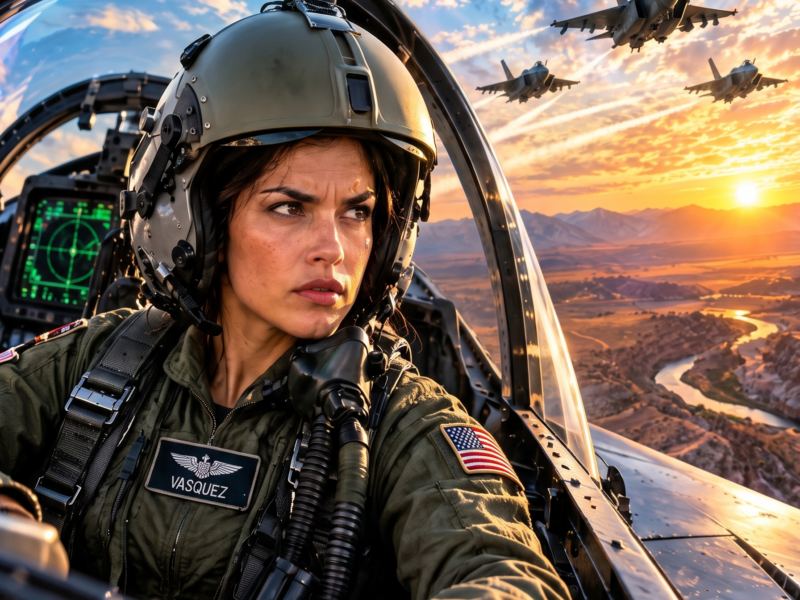
At dawn, I watched enemy jets tear across our border while our command center froze in disbelief
The first warning came at exactly 5:17 a.m. The sun had not yet crested the jagged peaks of the eastern mountain range, leaving the air base bathed in the cold, artificial glow of sodium floodlights. I was standing in the corner of the command control room, holding a paper cup of black coffee that had gone lukewarm twenty minutes ago. It was supposed to be a quiet morning. I had been relegated to an advisory role, a desk job meant to keep a retired fighter pilot busy enough not to lose her mind, but grounded enough to ensure she never flew a combat sortie again.
Then, every alarm in the room erupted at once.
The sound was a piercing, rhythmic klaxon that vibrated right through the concrete floor and into the soles of my boots. For one agonizing second, nobody moved. The technicians stared at their monitors, paralyzed by the sheer impossibility of the data flooding their screens.
“Multiple contacts crossing the border,” the lead radar operator finally shouted, his voice cracking. “Vector zero-niner-five, altitude twenty thousand, speed Mach one-point-two. They are not squawking friendly.”
The room exploded into motion. Telephones rang, keyboards clattered, and the sterile white lights switched to emergency crimson. I stepped forward, tossing my coffee into a trash can, my eyes locked on the massive central tactical display. The screen flashed bright red as six distinct triangular icons swept aggressively toward our airspace. They were moving in a tight, disciplined wedge formation. This wasn’t a navigational error. It was an invasion.
My commander, Colonel Vance, stormed into the center of the room, his uniform jacket still unzipped. He stared at the radar, his jaw tight. “Scramble the interceptors. Get the alert fighters in the air right now.”
A young officer at the communications console swallowed hard, his face pale in the red light. “Sir… the alert fighters are down. We had a fuel contamination issue in the main reservoir an hour ago. The interceptors are currently being drained and refueled from the backup tanks. They can’t launch for at least another fifteen minutes.”
Vance cursed violently under his breath. Fifteen minutes. At the speed the enemy formation was flying, they would be over our base, dropping ordnance on our runways, in less than seven. We were completely exposed. A sitting duck in the middle of the desert.
I looked through the reinforced glass window of the control room, out toward the flight line. The heavy blast doors of Hangar Four were wide open. Sitting alone on the tarmac beneath a single, harsh floodlight was an F-16 Fighting Falcon. My old F-16. It had been pulled out for a routine avionics diagnostic and was fully fueled, armed with a standard loadout of AIM-9 Sidewinders and AIM-120 AMRAAMs from a training exercise the day prior.
I hadn’t flown combat in six years. Not since the incident over the northern gulf that had cost me my wingman and my flight status.
Vance noticed where I was looking. His eyes snapped toward me, reading my face instantly.
“No,” Vance said, his voice hard, leaving absolutely no room for debate.
I turned toward him, my heart already beginning to hammer a familiar, heavy rhythm against my ribs. “You didn’t even let me speak, Colonel.”
“I know exactly what you’re thinking, Elena.” He stepped closer, towering over me, his voice dropping to a low, commanding growl meant only for us. “You are not certified. You are not cleared. And that aircraft is scheduled for teardown.”
“That aircraft is fully fueled and armed,” I shot back, pointing at the window. “By the time your interceptors are ready, this base will be a smoking crater. I can buy them time.”
“You’re finished, Elena,” Vance said, his words deliberately cruel, designed to shut me down. “You lost your nerve six years ago. If you go up there against six bandits, you’ll die. Stand down. That’s an order.”
Those words hurt more than they should have. Because he was right. Or at least, that’s what everyone in the squadron believed. They believed the trauma had broken me.
I stared at him for three seconds. Then, without a word, I turned and walked toward the exit.
“Elena! I gave you a direct order!” Vance shouted over the alarms.
I pushed through the heavy steel doors and broke into a sprint. The cold morning air hit my face like a physical blow as I hit the tarmac. The maintenance crew was running around frantically, securing loose equipment before the inevitable attack. They stopped and stared as I approached my old aircraft in my standard flight suit.
Chief Miller, a grizzled mechanic who had known me since I was a rookie, stood near the landing gear. He looked at me, then at the sky, then back at me. He whispered, “She’s actually doing it.”
“Pull the chocks, Chief,” I yelled, grabbing my old helmet from the equipment rack near the ladder. “Spin her up.”
Miller didn’t argue. He signaled his crew, and they moved with practiced, desperate speed.
I climbed into the cockpit. The seat still carried the faint, indelible smell of old leather, aviation fuel, and hydraulic fluid. It was a scent that instantly bypassed my brain and went straight to my blood. My hands remembered everything before my mind did. Flipping switches, arming the auxiliary power unit, initiating the engine crank. The massive turbofan engine whined, then roared to life, shaking the airframe.
The digital displays flickered and burned bright green. I pulled the canopy down, sealing myself inside the pressurized bubble.
Then, the radio came alive. “Unidentified American aircraft, you are ordered to remain on the ground. Power down your engines immediately.”
I recognized Vance’s voice. He was on the tower frequency.
I looked toward the control tower, imagining him staring at me through the glass. I keyed my mic. “I’m afraid that’s not going to happen, control.”
Silence on the other end. Then he shouted my name, a mixture of rage and panic.
I ignored it, kicking the rudder pedals and pushing the throttle forward. The F-16 surged out of the hangar area, tearing down the taxiway. I didn’t bother waiting for clearance. I lined up on the main runway, slammed the throttle to the afterburner detent, and let the brakes go. The acceleration threw me back into the seat. The runway disappeared beneath me in a blur of gray concrete and flashing lights.
I pulled back on the stick. The nose lifted, and I tore into the dawn sky, punching through a low layer of gray clouds.
Above the clouds, the morning sun was blinding. My radar immediately picked up the six enemy fighters. They were thirty miles out, closing fast. They expected a squadron to rise up and meet them. They expected a wall of American airpower.
Instead, they saw one lone F-16 rising from the deck.
The lead enemy pilot, broadcasting on the open guard frequency, laughed. It was a cold, arrogant sound. “One jet? The Americans send one jet?”
I didn’t answer. I reached forward, my fingers moving over the weapons console with a muscle memory that defied the last six years of exile. I selected my medium-range missiles.
He laughed again. “Turn back, little bird, or die.”
I locked my targeting radar directly onto his aircraft. A high-pitched, steady tone filled my helmet.
The laughter stopped instantly.
“Fox Three,” I whispered to the empty cockpit, though I didn’t pull the trigger. I didn’t need to. I just needed his threat warning receiver to scream. I banked hard to the left, diving toward the treacherous, jagged canyons of the northern mountain range, and pulled the entire enemy formation right behind me.
The G-force hit me like a concrete wall as I dropped the F-16 into a vertical dive, aiming straight for the razor-sharp ridges of the northern mountains. My anti-G suit inflated violently around my legs and abdomen, forcing the blood to stay in my upper body, keeping my vision from tunneling into darkness. I grunted, forcing short, explosive breaths from my lungs. Six years away from the stick, and my body was screaming in protest, but my mind was crystal clear. It was a terrifying, beautiful clarity that I hadn’t felt since the day I was grounded.
“Bandits are altering course,” Vance’s voice cracked over the encrypted channel. He was still furious, but tactical necessity had taken over. “They are tracking you, Elena. All six. You’re pulling them off the base vector, but they have you locked. Evade, evade!”
I glanced at the threat display panel. Six red vectors were closing the distance, their speeds exceeding Mach 1.5. They were flying sleek, twin-engine interceptors—likely fifth-generation, built for air superiority. My F-16 was a nimble, lightweight brawler, but it was outgunned, outnumbered, and vastly out-accelerated in a straight line.
I wasn’t trying to defeat six aircraft. I was trying to buy time. Below us, our scrambled fighters were finally getting fueled. Every single second I kept these bandits chasing ghosts in the mountains was a second closer to our interceptors lifting off.
“Control, I am engaging defensive maneuvers. Keep those interceptors moving,” I replied, my voice strained under the physical pressure of a five-G pullout.
I leveled out just a few hundred feet above the jagged treetops that lined the mountain slopes. The terrain here was a nightmare of blind canyons, sheer granite walls, and unpredictable wind shears. It was suicide to dogfight in this airspace. Which made it the perfect place to level the playing field.
The first enemy fighter, eager for a kill, broke from their formation and dove after me. His radar lock tone screamed in my helmet.
“Missile in the air!” Vance warned.
I didn’t panic. I watched the terrain rushing toward my canopy. A massive, towering peak loomed dead ahead. I held my course until the very last fraction of a second, waiting until the enemy pilot thought I was going to fly straight into the rock. Then, I slammed the stick hard right and rolled the aircraft ninety degrees, pulling back violently.
The F-16 snapped around the peak, slipping through a narrow gap in the granite. I popped a barrage of flares and chaff, filling the airspace behind me with burning magnesium and aluminum clouds. The heat-seeking missile tracking my exhaust lost its lock, flying blindly into the chaff cloud and detonating against the mountain wall with a brilliant orange flash.
“One miss,” I breathed, righting the aircraft.
But the enemy wasn’t stupid. The lead pilot barked an order in a language I didn’t understand over the open frequency. The remaining five fighters didn’t follow me into the canyon. They spread out, climbing high to establish a vertical trap, effectively placing a ceiling over the mountains. If I tried to climb out, they would rain missiles down on me.
“They’re boxing you in, Wraith,” Vance said, using my old callsign for the first time. “You have nowhere to go.”
“I don’t need to go anywhere,” I replied. “How long on those interceptors?”
“Three minutes to launch.”
Three minutes in a dogfight was an eternity. It was a lifetime.
The pilot who had missed me swung wide, coming back for a gun run. He was too fast. I chopped my throttle, deploying the speed brakes. The F-16 decelerated so violently I was thrown forward against my harness. The enemy fighter, expecting me to run, overshot my position completely, flashing directly over my canopy.
As he passed, I slammed the throttle back to full military power, pulled the nose up, and dropped my targeting reticle right over his tail exhaust. I squeezed the trigger. The M61 Vulcan cannon in my left wing root roared, vibrating the entire airframe as it spat out a stream of 20mm depleted uranium rounds.
The rounds shredded the enemy fighter’s right wing. The jet violently pitched out of control, trailing thick black smoke before the pilot ejected, his parachute blooming like a white flower against the gray rock.
“Splash one,” I said, my breathing heavy.
The enemy formation went berserk. Their arrogant discipline shattered into raw fury. Two more fighters dove into the canyon, abandoning their high-altitude trap to hunt me down. They were coming from opposite directions, a classic pincer movement.
My fuel warning light suddenly flared bright amber on the master caution panel. The prolonged use of the afterburner and the low-altitude maneuvers were draining my tanks faster than I had calculated. I had maybe four minutes of flight time left before I became a two-ton glider.
“Wraith, you are bingo fuel,” Vance yelled. “Break away! Egress south, we have a search and rescue bird ready to pick you up when you punch out!”
I looked at the fuel gauge. Then I looked at the two fighters closing in on my tactical display. If I bailed out now, they would simply reform and strike the base.
I looked at the narrow, winding river gorge ahead of me. “Not yet.”
I dropped the F-16 even lower, my landing gear doors practically scraping the tops of the pine trees. I threw the jet into a violent series of high-G turns, banking left, right, left, threading the needle through the gorge. The two pursuing fighters struggled to maintain their lock, their heavier aircraft fighting the brutal aerodynamics of the canyon.
Suddenly, a loud, concussive THUD shook my aircraft. The master caution panel lit up like a Christmas tree. Hydraulic pressure in my left wing began dropping instantly. One of them had managed a snapshot with their cannon, and a round had punched right through my flap actuator.
The stick grew incredibly heavy in my hands. The F-16 wanted to roll over and die. I fought the controls, my muscles screaming, forcing the wings level.
“I’m hit. Taking hydraulic loss,” I called out, tasting blood where I had bitten my lip.
“Eject, Elena! Now!” Vance screamed.
The two enemy fighters locked onto me simultaneously. A solid, unbroken tone shrieked in my helmet. I was out of airspeed, out of altitude, and out of ideas. I closed my eyes, bracing for the inevitable impact.
Then, the radio exploded with a new voice.
“Viper flight, Fox Three!”
Four contrails ripped across the dawn sky above the canyon. A volley of AIM-120 missiles streaked downward like spears of white lightning. The enemy fighters’ lock-on tone abruptly vanished as their own threat receivers went crazy. They violently broke off their attack, scattering like frightened birds.
I looked up through the canopy. Four American F-22 Raptors soared overhead in perfect formation. Our interceptors had arrived.
“We got the watch, Wraith,” the lead Raptor pilot said. “Get that bird on the ground.”
The enemy formation, realizing they were now vastly outmatched by stealth fighters, turned tail and burned hard for the border. The invasion was over.
But my fight wasn’t. My engine began to sputter, starved of fuel, and the hydraulic pressure was practically zero. I was ten miles from the runway, losing altitude fast.
“Control,” I gasped, fighting the dead weight of the stick. “Clear the deck. I’m coming in hot, heavy, and completely blind.”
The runway rushed up to meet me, a blurred slab of gray concrete that looked terrifyingly narrow. Without hydraulic pressure, my landing gear had to be manually deployed via emergency blow-down, and I had no way to confirm if the wheels had locked into place. The engine was completely silent now, having flamed out three miles from the base when the last drop of fuel was consumed. I was flying a multi-million-dollar brick.
“You’re coming in too fast, Wraith. Flare the nose!” the tower controller shouted over the radio.
“I can’t!” I grunted, pulling back on the stick with both hands. It felt like it was set in wet concrete. “Controls are completely stiff!”
The main gear hit the tarmac with a bone-jarring slam. The impact blew out the right tire instantly. The F-16 violently skewed to the right, metal screaming as the bare wheel rim dug into the concrete, sending a massive shower of sparks into the morning air. I slammed on the emergency brakes and deployed the drag chute. The chute caught the wind, jerking the aircraft backward and snapping my helmet against the headrest, but it kept me from veering off into the grass.
The jet shuddered, groaned, and finally ground to a halt, resting precariously on a tilted angle just fifty yards short of the runway’s end.
Silence rushed back into the cockpit, save for the ticking of the overheated metal and my own ragged, exhausted breathing. I sat there for a moment, my hands shaking so badly I could barely undo my harness. Through the canopy, I saw the flashing red and yellow lights of the crash tenders and fire trucks racing toward my position.
I popped the canopy manually. The smell of burning rubber and scorched metal filled my lungs. I climbed down the ladder slowly, my legs feeling like lead.
As my boots hit the concrete, the fire crews began spraying the hot brakes with foam. I ignored them, looking past the trucks. An olive-drab staff car tore across the tarmac and slammed on its brakes near my jet. Colonel Vance stepped out.
He didn’t look relieved. He looked furious, his face tight with a complicated mixture of anger, shock, and something else I couldn’t quite place. Dread, maybe.
He marched right up to me, ignoring the chaos around us. He looked at the smoking ruin of the F-16, then back at me.
“You disobeyed a direct order,” Vance said, his voice terrifyingly quiet. “You stole a military aircraft, engaged foreign combatants without clearance, and nearly got yourself killed.”
I stood my ground, though my knees threatened to buckle. “I saved the base, Colonel. If I hadn’t gone up, there wouldn’t be a runway left for the interceptors to launch from.”
“I know,” he said.
The anger in his eyes suddenly fractured, giving way to a profound, weary sadness. He stared at me for several seconds, the desert wind whipping his collar. Then, he quietly said, “Your father did the exact same thing thirty years ago.”
I froze. The adrenaline that was still coursing through my veins instantly turned to ice. “What?”
My father, Captain James Mitchell, had died when I was twelve years old. The military had come to our house in dress blues. They told my mother his F-4 Phantom had suffered a catastrophic mechanical failure during a routine training flight over the ocean. No remains were recovered. No wreckage was found. It was a closed casket, a folded flag, and a lifetime of unanswered questions.
“My father died in a training accident,” I said, my voice barely a whisper.
Vance shook his head slowly. “Not here. Not on the tarmac.”
He turned and walked back to his car. He didn’t order me to the infirmary or the brig. He just opened the passenger door and waited. I followed him, my mind spinning into a chaotic spiral.
We drove in silence to his private office in the command bunker. He locked the door behind us, engaged the electronic scrambling field that prevented listening devices, and walked over to a heavy steel safe behind his desk. He dialed the combination, opened the heavy door, and pulled out a faded, manila envelope. The wax seal on the back was broken, but the paper was yellowed with age.
He handed it to me. “Your father left this for you. He made me swear I would only give it to you if… if you ever proved you were exactly like him.”
My hands trembled as I took the envelope. It felt heavy, like it contained something infinitely denser than paper. I opened the flap and tipped it over.
Inside was a single photograph. It was a Polaroid, its edges fraying. It showed two men standing in front of an unmarked, matte-black stealth aircraft that I couldn’t identify. One of the men was a much younger Vance. The other man, smiling with a rugged, reckless confidence, was my father.
But it wasn’t the picture that made my breath catch in my throat. It was the writing on the back. I flipped the photograph over. In my father’s distinct, hurried handwriting, written in faded black ink, were five words.
Don’t believe they buried me.
I looked up at Vance. The room suddenly felt suffocatingly small. “What does this mean? Who was in the casket?”
“Nobody,” Vance said grimly. “Your father didn’t die in a crash, Elena. He discovered something he wasn’t supposed to know. A black-ops weapons program operating deep within our own intelligence apparatus, funneling technology to the very people who attacked us this morning. When he threatened to expose them, they ordered him killed.”
“But he survived,” I said, looking down at the note.
“He stole that prototype stealth fighter and vanished. He became a ghost, fighting a shadow war against them for three decades. I helped him fake the crash.” Vance ran a hand over his face, suddenly looking every bit of his sixty years. “I thought he was finally dead. I haven’t heard from him in ten years. But those enemy fighters today… they didn’t cross the border to test our defenses, Elena. They crossed the border to destroy this base before you could find what your father hid here.”
I stared at him, my pulse thundering in my ears. “What did he hide?”
Vance pointed to the window, looking out toward Hangar Four. “He hid it in that F-16 you just flew. And now that you’ve activated its systems, they know exactly where it is. And they are coming back.”
The silence in Vance’s office was absolute, broken only by the low hum of the electronic scrambler. I looked down at the photograph in my trembling hands, then back to the Colonel. My mind was struggling to bridge the gap between the father I mourned—a hero who died a tragic, ordinary death—and the phantom operative Vance was describing.
“Why my jet?” I asked, my voice tight. “That F-16 has been in the squadron for twenty years. It’s been through dozens of overhauls. If he hid something in it, the maintenance crews would have found it.”
“Your father was a master of avionics, Elena,” Vance said, pacing the room. “He didn’t hide a physical object. He hid data. Ghost code buried deep inside the aircraft’s primary flight computer. Code that only activates under a specific set of parameters. High G-force maneuvers, a specific sequence of radar locks, and a complete depletion of the primary fuel tanks.”
My blood ran cold. I had just triggered every single one of those parameters during my dogfight in the canyon.
“When you flew that jet today, you didn’t just save the base,” Vance continued, stopping to look me in the eye. “You woke up his ghost. The system initiated an encrypted burst transmission. I saw the anomaly on the command logs right before you landed. Whatever he hid, it’s decrypted now. Sitting in the jet’s onboard memory bank.”
“We need to get to the jet and download it,” I said, already turning toward the door.
“It’s not that simple,” Vance cautioned, grabbing my arm. “The people your father was fighting—they aren’t just foreign enemies. They have operatives inside our own chain of command. The ‘fuel contamination’ that grounded our interceptors this morning wasn’t an accident. It was sabotage. Someone on this base coordinated with the enemy to leave us defenseless so they could destroy the F-16 and bury the data forever.”
A heavy knock at the office door made us both jump.
“Colonel Vance,” a voice boomed from the hallway. It was Major General Thorne, the base commander, a man known for his ruthless bureaucratic efficiency. “Open this door. I have Military Police with me.”
Vance locked eyes with me. “They’re here to arrest you for court-martial. They’ll lock you away, dismantle the F-16 under the guise of an investigation, and wipe the data.” He moved quickly to his desk, grabbing a hard-encrypted data drive and a sidearm. He shoved them into my hands.
“Colonel, open the door now, or I’m having it breached!” Thorne shouted.
“You have to get to the jet, download the avionics log, and get off this base,” Vance whispered urgently. “There’s a utility maintenance tunnel behind that bookshelf. It leads directly to the hangar sublevels. Go.”
“What about you?” I asked, gripping the drive.
“I’m the commanding officer. I’ll stall them. I’ll take the fall for letting you fly.” He offered a sad, brief smile. “It’s the least I can do for James’s daughter. Now go! Don’t let them bury the truth again.”
I didn’t hesitate. I threw my weight against the heavy oak bookshelf. It swung outward on a concealed hinge, revealing a dark, narrow concrete corridor. I slipped inside and pulled the shelf closed just as the office door behind Vance shattered inward under the force of a battering ram.
I ran. The maintenance tunnels beneath the base were a labyrinth of steam pipes and electrical conduits, dimly lit by flickering yellow bulbs. My ribs ached, my flight suit was soaked with sweat, and the physical toll of the dogfight was catching up to me, but adrenaline fueled my sprint.
I navigated the tunnels using memory from my days as a junior lieutenant when we used to sneak around the base after hours. After ten minutes of winding through the subterranean dark, I found the access hatch leading up to the tarmac just outside Hangar Four.
I pushed the heavy grate up slightly and peered out. The night had fallen rapidly. The smoking ruin of my F-16 was sitting on the concrete where the fire crews had left it, illuminated by portable halogen floodlights. But it wasn’t alone.
Four heavily armed men in black tactical gear—not standard base security, but private contractors—were securing the perimeter around the aircraft. They were setting up portable data-extraction terminals. They were here to wipe the jet’s memory.
I drew the sidearm Vance had given me, my hands finally steady. I couldn’t take all four of them in a firefight. I needed a distraction.
I slipped out of the grate and crept toward a fuel truck parked fifty yards away. I opened the main valve on the truck’s auxiliary hose, letting the highly flammable jet fuel pool quietly onto the concrete. I picked up a heavy metal wrench from a nearby toolkit, took aim at the far side of the hangar, and hurled it against a corrugated steel wall.
The loud CLANG echoed across the silent tarmac.
The four operatives instantly raised their rifles, turning toward the noise. Two of them broke formation to investigate.
It was all the opening I needed. I sprinted out of the shadows, raised my sidearm, and fired a single shot into the pool of jet fuel beneath the truck. The spark ignited the fuel instantly, sending a massive wall of orange flame into the night sky. The concussive heat knocked the operatives off their feet.
In the chaos, I bolted for the F-16. I scrambled up the side of the battered fuselage, sliding into the dark, smoke-scented cockpit. The power was dead. I reached under the main console, feeling blindly for the emergency battery backup switch. I found it and flipped it.
The displays flickered weakly to life.
I plugged Vance’s encrypted drive into the avionics port and rapidly typed the manual override codes. A progress bar appeared on the shattered green screen. Decrypting Ghost File… 20%… 40%…
Outside, the operatives recovered. “She’s in the jet! Fire!” one of them shouted.
Bullets began striking the armored canopy of the F-16, spider-webbing the reinforced glass. I ducked down, shielding the data drive with my body.
80%… 90%… 100%. Transfer Complete.
I yanked the drive free and shoved it deep into the pocket of my flight suit. But I was trapped. The canopy was taking heavy fire, and they were advancing on the aircraft. I had nowhere to run.
Suddenly, a deafening roar tore the night apart. A shadow blotted out the stars overhead. It wasn’t an F-16. It wasn’t a Raptor. It was an aircraft with no radar signature, moving with terrifying, silent speed until its engines flared.
The matte-black stealth fighter from the photograph hovered directly over the tarmac, its vertical thrust engines kicking up a hurricane of concrete dust and fire.
The operatives panicked, diving for cover as the aircraft’s internal weapons bay doors snapped open.
The radio in my helmet, still drawing emergency power, cracked to life.
“Get your head down, kid,” a voice said. It was older, gravelly, but unmistakably familiar. “I’m clearing a path.”
I didn’t have time to process the impossible reality of the voice in my helmet. I threw my arms over my head as the matte-black stealth fighter unleashed a synchronized burst of non-lethal concussive ordnance across the tarmac. A series of deafening shockwaves hammered the concrete, shattering the portable floodlights and throwing the black-ops mercenaries to the ground, completely disorienting them.
Through the spider-webbed canopy of my ruined F-16, I watched the ghost plane pivot smoothly in mid-air. Its lower fuselage opened, dropping a thick, high-tensile steel cable with a specialized extraction harness attached to the end. The cable landed with a heavy clatter right on the nose of my jet.
“Hook in, Elena! We don’t have all night!” the voice barked over the emergency frequency.
My father.
Thirty years of grief, confusion, and anger threatened to paralyze me, but the survival instincts he had drilled into me as a child took over. I popped the damaged canopy manually, shoving the heavy glass out of the way. The chaotic wind from the stealth fighter’s engines tore at my flight suit. I climbed out onto the nose of the F-16, grabbed the heavy steel carabiner, and locked it into the D-ring of my flight harness.
“I’m secure!” I yelled into my helmet mic.
“Brace yourself,” he replied.
The stealth fighter immediately pitched its nose up and accelerated into the night sky. The cable went taut. I was violently ripped from the surface of the F-16, swinging through the air like a pendulum over the burning tarmac. The G-force of the rapid ascent stole the breath from my lungs. Below me, the base alarms were shrieking anew, and I could see the scrambled security forces swarming the runway, arriving far too late.
The winch mechanism above me whined as it rapidly retracted the cable. I was pulled upward, fighting the buffeting wind, until I breached the open weapons bay of the stealth aircraft. I grabbed the internal handholds and hauled myself inside the pressurized compartment just as the bay doors snapped shut beneath my boots.
The sudden silence inside the fuselage was deafening. The compartment was dimly lit by red tactical lights. I unhooked my harness, my hands shaking uncontrollably, and leaned against the cold metal bulkhead to catch my breath.
A heavy, hydraulic door hissed open at the front of the bay, leading into the cockpit.
He stood there, silhouetted in the glow of the instrument panels. He was much older than the man in the photograph. His hair was completely gray, and his face was lined with deep, weather-beaten scars. But his eyes—sharp, calculating, and fierce—were exactly as I remembered them from when I was twelve years old.
He didn’t wear a military uniform, just a faded black flight suit with no insignia.
For a long moment, neither of us spoke. The hum of the advanced engines was the only sound between us.
“You’re late,” he finally said, a faint, ghost of a smile pulling at the corner of his mouth.
“You’re supposed to be dead,” I managed to choke out, the anger finally breaking through the shock. “Thirty years, Dad. Thirty years of a folded flag on a mantle. You let me believe you burned up in the ocean.”
He stepped forward, his expression softening into a painful, heavy regret. He reached out and placed a hand on my shoulder. His grip was solid, real. “If I had told you I was alive, they would have killed you, your mother, and everyone you loved. The people I was hunting… they own the system, Elena. I had to become a ghost to fight them. I had to make sure you were safe.”
“Safe?” I laughed, a bitter, breathless sound. “They grounded me six years ago. They tried to kill me today. And they almost wiped the data drive you hid.”
I reached into my pocket and pulled out the encrypted drive Vance had given me, holding it up in the red light.
My father’s eyes widened slightly. “You got it.”
“I flew the F-16. I unlocked the ghost code,” I said, my voice hardening, the pilot returning to the surface. “Vance gave me this to download it. What is on this drive, Dad? What is worth faking your death and living in the shadows for thirty years?”
He turned and walked back into the cockpit, motioning for me to follow. He sat down in the pilot’s seat and plugged the drive into his central console. The screens illuminated with strings of complex data, geographical coordinates, and offshore banking ledgers.
“Proof,” he said quietly. “Complete, undeniable proof of a shadow syndicate operating within our government. Evidence of generals, politicians, and defense contractors funding endless, fabricated wars to maintain their power and profit. They were the ones who orchestrated the attack on your base today. They needed a war to start, and they needed my data destroyed before it could be decrypted.”
He looked up at me, the tactical lights casting long shadows across his face.
“I couldn’t fight them in the light, Elena. So I fought them in the dark. I intercepted their shipments, I disrupted their proxies, and I waited for the day I could finally expose them.” He tapped the data drive. “This is the final piece. The master ledger. But I couldn’t access it until someone flew that F-16 to its absolute limits to trigger the decryption sequence. I needed a pilot who was reckless enough, skilled enough, and brave enough to disobey orders and do what was right.”
He looked at me with a profound, overwhelming pride. “I knew it would be you. I always knew.”
A tear slipped down my cheek, but I wiped it away quickly. The anger was fading, replaced by a cold, sharp resolve. The world I thought I knew was a lie, but the man sitting in front of me was the truth.
“So, what do we do now?” I asked, stepping up to the co-pilot’s seat and strapping myself in.
He smiled, a true, dangerous smile, and pushed the throttle forward. The stealth fighter accelerated into the endless dark sky, leaving the world we knew far behind.
“Now,” my father said, “we show them that ghosts bite back.”
The end,









