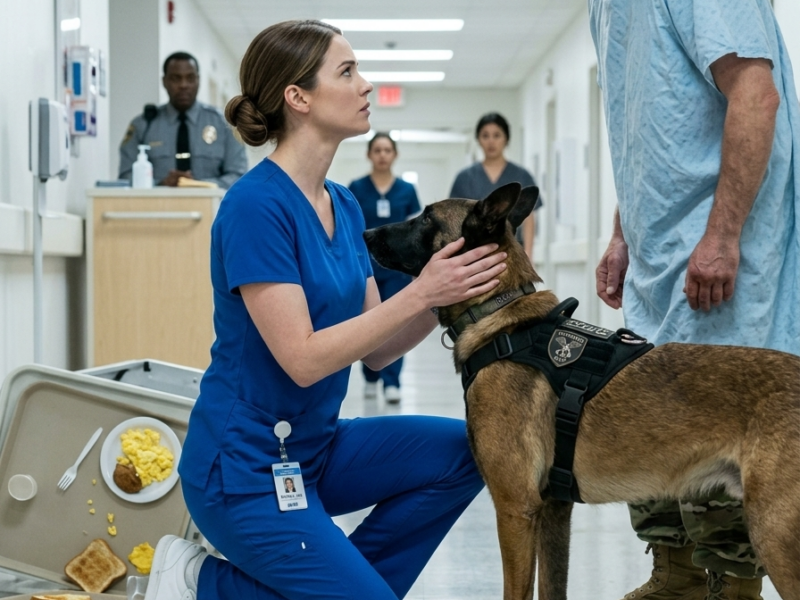
At a crowded veterans’ hospital in Denver, I collapsed beside my old service dog while a nurse accused me of faking my condition, and my daughter stared at the floor as if she already knew I was guilty
The linoleum floor of the Denver Veterans Affairs hospital was freezing against my cheek, smelling of industrial bleach, dried salt from winter boots, and the cold, metallic dread that had shadowed my life for the better part of three decades. My name is Thomas Miller. In another lifetime, I wore the tan beret of the 75th Ranger Regiment, led patrols through dry Afghan riverbeds, and carried wounded brothers through machine-gun fire without allowing my pulse to break its rhythm. But on this damp Tuesday morning in November, I was just another battered, graying silhouette crumpled onto the floor of a crowded corridor, gasping for oxygen that refused to reach my lungs.
Beside me, the frantic clicking of claws against wax signaled that Ranger was already on guard. He was a ten-year-old Belgian Malinois whose muzzle had turned the color of ash, yet his body remained an engine of solid muscle, scarred tendon, and unwavering devotion. Ranger had slept beside my cot through night sweats that soaked my sheets. He had pressed his heavy head against my knees when phantom mortar blasts rattled my skull in the quiet aisles of grocery stores. He had never lied to me. He had never once hesitated when an instinct warned him that the world was about to break.
Two minutes earlier, my daughter Emily had been guiding me by the crook of my elbow toward Examination Room 4B for what she termed a routine cognitive and neurological assessment. Emily was thirty-two, tall, sharp-featured, and carried herself with an exhausting efficiency that had only intensified since my wife, Sarah, had passed away three years prior. Over the past six months, Emily had slowly, methodically dismantled my independence. First, it was the keys to my pickup truck, confiscated after she claimed she found a fresh scrape on the passenger fender that I could not account for. Then it was my checkbook, tucked away into a leather organizer because she insisted the utility bills were slipping through the cracks. Most recently, it was my morning and evening medication regimen. She had bought a plastic weekly dispenser with blue and white lids, filling the compartments behind the closed door of the guest bedroom every Sunday afternoon, handing me my small paper cup of water with a tight, patient smile.
“Come on, Dad, lift your feet,” Emily had murmured as we reached the doorway of 4B. “Dr. Vance is running behind, but he promised to fit us in before the lunch recess. You know how important this evaluation is for your pension paperwork.”
Ranger had abruptly planted his four paws. His ears pinned back flat against his skull. The coarse ridge of fur along his spine flared like dry brush caught in an updraft, and from deep inside his barrel chest came a low, vibrating growl that vibrated directly through the leather lead in my grip.
“Control your animal, sir,” a voice had barked from down the hall. A supervising charge nurse with a clipboard, arms crossed over lime-green scrubs, stopped in her tracks, her face tightening with acute disgust. “This is a sterile clinical wing, not a dog kennel. If he cannot behave, he needs to be hitched outside in the rain.”
“I am trying,” I managed to raspy croak, hauling back on the lead with both hands. “He doesn’t… he doesn’t growl without reason.”
“Sir, get up off the wall,” the woman snapped again, taking a single aggressive stride toward us. “You are causing a scene. Don’t play the dizzy card to avoid a standard screening.”
That was when the floor tilted on its axis. A sudden, vicious wave of vertigo struck the back of my skull like a lead pipe. The fluorescents overhead smeared into long streaks of white glare. My legs turned from bone to water, my fingers uncurled from the leather leash, and gravity hauled my two-hundred-pound frame down onto the hard floor. The collision drove the breath from my chest.
Through the fog of my collapsing vision, I looked up. People in blue coats and khaki jackets stopped, turning their heads. An orderly half-jogged forward with a blood pressure cuff draped around his neck. But my daughter did not move. Emily stood completely motionless against the doorframe of 4B. Her arms were pinned to her sides, her purse clutched in white-knuckled fists, her face drained of every drop of color. She was not reaching down to catch me. She was not crying out for help. She was staring down at my prostrate body with wide, hollow eyes, wearing the awful, paralyzed expression of someone watching a long-hidden secret finally crack through the ice.
Ranger stood astride my ribs, baring teeth that could snap bone, daring the green-scrubbed nurse to take another step.
“Clear back! Give him room,” another voice cut through the commotion. It was soft, firm, and entirely devoid of panic.
A young woman in navy scrubs knelt directly into the grime beside my shoulder. Her hospital badge read Elena Ruiz, RN – Internal Medicine. She did not reach immediately for my throat or attempt to haul me upright. Instead, she laid her bare hand gently on Ranger’s broad neck, murmuring a single, low cadence in German—a handler’s command that made the dog’s tail give a single, nervous twitch before his growl subsided into a desperate whine.
Elena looked up at the charge nurse, then back down into my glazed eyes. “Wait,” she said, her voice dropping to a near-whisper that somehow silenced the entire hall. “Don’t move him yet.”
“He’s hyperventilating because he doesn’t want the cognitive battery,” the charge nurse muttered, though she stepped back toward the nurses’ station.
Elena ignored her. Her fingers pressed firmly against the inside of my wrist, tracking a pulse that felt like a fluttering moth trapped in a mason jar. Her hazel eyes were wide with a fierce, calculating intensity as she leaned over me. “Mr. Miller, can you hear me? Look at my penlight. Good. What did you take this morning before you came through those front doors?”
My tongue felt thick, like a piece of salted meat wedged between my teeth. “Nothing unusual. My… my blood pressure pill. A low-dose aspirin. The blue tablet for my stomach.”
Elena’s gaze drifted slowly up from my face, bypassing the gawking orderly, and settled on my daughter. “Are you sure about that, Mr. Miller?”
The sheer gravity in her tone sent a spike of cold adrenaline through the chemical haze in my brain. Suddenly, fragments of the last ninety days began to snap together in my mind with terrible clarity. The chronic morning nausea that felt nothing like my old gastritis. The trembling in my dominant hand that made it impossible to sign my name without spilling ink. The way Emily had stood over the kitchen sink every single morning, watching me swallow each capsule down to the last drop of tap water, never turning her back until the glass hit the counter.
Elena reached down to the pocket of my canvas field jacket, slipping out the translucent amber pill bottle that Emily had shoved there before we left the car. Elena spun the bottle in her palm, reading the white adhesive label. Her brow furrowed into deep lines.
“This prescription isn’t yours,” Elena said flatly.
Emily took a half-step forward, her voice cracking like dry kindling. “Mom’s… Mom’s old medication must have gotten mixed in. The cabinets are right next to each other in the master bathroom. I grabbed the wrong bottle in the dark when I filled the weekly organizer on Sunday. It was an accident.”
The corridor went deathly quiet. A custodian stopped his floor buffer twenty feet away, the motor winding down to an eerie, echoing hum.
I stared up at my only child, feeling as though the floor beneath me had fallen away into an abyss. “Emily,” I breathed, my ribs aching under the weight of my own lungs. “Your mother died three years ago. We cleaned out her medicine cabinet the week after her funeral. We packed every single bottle into a cardboard box and gave it to the sheriff’s take-back program. You were the one who drove the box into town.”
Emily’s lips parted, but no sound came out. She dropped her gaze to the toes of her leather boots, tears beginning to spill silently down her cheeks. They were not the wild, theatrical tears of an accused daughter defending her innocence. They were the slow, sickening tears of a person whose ledger of small, daily lies had just reached its final page.
Ranger gave another low, gut-wrenching whine, his wet nose pressing hard against my collarbone.
Elena Ruiz set the bottle down on the floor and leaned in until her lips were inches from my ear. “Your dog has been trying to tell you something for months, Mr. Miller. Animals know the smell of systemic toxicity before the human liver starts to break down. We pulled your preliminary lab work from the outpatient draw you did three weeks ago.”
“What does it say?” I wheezed, the salt from my own forehead stinging my eyes.
“It shows progressive, trace accumulations of a heavy neuro-sedative. A proprietary compound used in clinical trials for late-stage neurological restraint. It causes profound dizziness, false symptoms of rapid-onset dementia, and unsteadiness. In three more months of this dose, you would have been completely incapacitated. You would have failed any competency hearing in the state of Colorado.”
I looked back at Emily. Her chest hitched with a dry sob. “I was trying to keep you safe, Dad,” she whispered, her hands trembling so violently she dropped her car keys onto the floor with a metallic clatter. “I was trying to protect you.”
“From what?” I demanded, finding my voice through a surge of raw, terrifying rage. “From what, Emily?”
She clamped her mouth shut and buried her face in her hands.
Elena didn’t look at Emily. She reached inside the breast pocket of her navy scrub top and produced a stiff, yellowed envelope, folded twice across the center. It bore the embossed seal of the old St. Jude Memorial Clinic—the facility where my wife had spent the final forty-eight hours of her life before her heart inexplicably stopped in the middle of a thunderstorm.
“I used to work the palliative ward at St. Jude before I transferred to the VA last year,” Elena said, her voice shaking with an emotion she fought hard to conceal. “I found this slipped behind the intake registry in Sarah Miller’s archived chart during our paper-to-digital migration last week. It was addressed to you, Thomas. But the admitting physician never let it leave the building.”
With trembling, clumsy fingers, I took the envelope. Inside was a scrap of prescription pad paper, written in the frantic, jagged cursive that I had loved for forty years. It was Sarah’s hand, undeniable and desperate:
If anything happens to me, do not let Emily manage his medication. She isn’t doing this alone. Check the lake cabin deed before—
The sentence was cut off, trailing down the paper in a sharp, ink-smeared line.
Before my brain could process the words, Ranger’s head snapped up toward the far bank of elevators forty yards down the hall. Every hair on the dog’s neck stood rigid. He let out a deafening, chest-splitting bark that made three doctors jump back against the wall.
Standing beside the open elevator doors was a tall man in a charcoal cashmere overcoat, holding a leather briefcase, his silver-streaked hair neatly parted. His eyes were fixed on the yellow paper in my trembling hands.
Elena looked up, caught sight of the man, and all the blood left her lips. “Dr. Vance,” she whispered, her voice laced with sheer panic. “He wasn’t supposed to be on this floor today.”
The man in the charcoal coat did not utter a single syllable. Seeing our eyes locked on him, he dropped the briefcase, spun on his heel, and sprinted down the emergency stairwell corridor.
Ranger tore the leather lead from my weakened fingers and lunged after him like a missile, his barks echoing through the institutional halls as the heavy fire doors swung shut behind the runner.
The heavy fire door shuddered on its pneumatic hinges as Ranger’s body slammed through the threshold, his baying echoes vanishing into the concrete echo chamber of the stairwell.
“Ranger! No!” I roared, trying to force myself onto my feet.
The room spun wildly. The sedative or whatever poison was coursing through my vascular system turned my balance into a broken compass. My right elbow caught the edge of a stainless-steel trash bin, sending it crashing against the wall with a deafening rattle. The orderly lunged forward to grab my torso, but I shoved him back with an instinctive burst of military muscle memory that caught us both off guard.
“Let me go,” I snarled, wiping cold sweat from my eyes. “Elena, who was that?”
Elena Ruiz was already on her feet, her hands gripping my arms with surprising strength. Her breathing was fast, shallow, and ragged. She wasn’t acting like a hospital employee following code; she was acting like a soldier whose perimeter had just been breached.
“That was Dr. Arthur Vance,” Elena said, keeping her voice low as hospital security began converging from the far junction of the hallway. “He was Sarah’s primary attending physician at St. Jude three years ago. Six months after she died, he resigned his clinical privileges there and took a consulting post here at the VA, overseeing neurological impairment evaluations. Thomas, listen to me carefully. He is the doctor who authored the preliminary medical report recommending you be placed under full legal conservatorship.”
I swung around to look at my daughter. Emily had picked up her keys from the floor, but she hadn’t run. She was pressed against the concrete pillar beside Examination Room 4B, shaking so hard her knees knocked together.
“You knew him,” I said. It wasn’t a question. It was a condemnation carved in stone. “You told me Vance was a specialist you found through the veterans’ network. You said he was a family friend of a colleague at the university.”
“Dad, please,” Emily pleaded, her voice cracking as tears cut clean paths through her makeup. “You don’t understand what was happening. We were in debt. After Mom got sick, the out-of-network bills… they didn’t stop. They kept coming. St. Jude was going to put a lien on the house. They were going to take everything you worked thirty years to build!”
“So you poisoned me?” I took a step toward her, the fury in my chest burning through the chemical fog in my veins. “You sat at my kitchen table, poured my coffee, smiled at me while I couldn’t remember where I put my car keys, and you fed me the same drugs that killed your mother?”
“I didn’t kill her!” Emily shrieked, the sound drawing gasps from the cluster of nurses gathering near the station. “I didn’t! Mom figured it out on her own! She found the loan agreements Vance drew up using her signature! She was going to go to the district attorney, Dad! She was going to ruin all of us!”
Before I could bridge the distance between us, the heavy metal door at the end of the hall flew open with a resounding boom.
Ranger didn’t come back. Instead, a hospital security officer backed out of the stairwell, his hands raised, his face slick with sweat. Behind him, Ranger stood at the landing, barking with a frantic, rhythmic intensity that signaled a downed casualty or a cornered target.
“Officer, step aside!” I shouted, stumbling down the hallway, refusing Elena’s attempt to steady me.
“Sir, stay back! There’s an altercation on the landing!” the guard warned, reaching for his stun gun.
I didn’t slow down. I hit the crash bar of the stairwell door with my good shoulder and burst onto the concrete landing between the third and fourth floors.
Dr. Arthur Vance wasn’t running anymore. He was trapped against the steel banister two flights down, his expensive cashmere coat torn open, his silk tie askew. Ranger stood three steps below him, low to the ground, lips peeled back over white fangs, blocking the descent to the exterior exit. Every time Vance shifted his weight, Ranger snapped the air with an explosive bark that echoed like gunshot cracks against the cinderblock walls.
Vance was breathing heavily, his manicured hands clutching a thick manila folder that had spilled several pages across the concrete steps.
“Call your beast off, Miller!” Vance shouted, his cultured, bedside manner completely dissolved into a sharp, cornered whine. “He’s vicious! If he bites me, I’ll have the county destroy him by nightfall!”
“He won’t bite unless I tell him to,” I said, descending the concrete stairs one slow, deliberate step at a time. My boots felt heavy, but the vertigo was receding, burned away by the cold clarity of a man who suddenly realizes he has been living in a crosshair for three years. “And right now, Doctor, you ought to be praying he stays interested in your shins instead of your throat.”
Elena Ruiz slipped through the door behind me, pausing at the top of the stairs, looking down at Vance with an expression of cold, burning contempt. “The transfer records, Arthur. Hand them over.”
Vance glared up at her, his jaw clenching. “You always were an insubordinate meddler, Ruiz. You stole that note from the archive. You violated federal patient privacy protocols to pull Miller’s intake files.”
“His wife died of acute respiratory failure under your direct supervision forty minutes before she was scheduled to be discharged,” Elena retorted, descending three steps behind me. “I was the junior nurse on that unit. I saw you alter the digital dosing chart for her intravenous potassium. And when I brought the irregularity to the chief of staff, you had me transferred to the outpatient clinic across town within forty-eight hours.”
The pieces fell together with sickening finality. My heart hammered against my ribs like an iron bell. Sarah hadn’t succumbed to a sudden stroke. She hadn’t slipped away quietly in her sleep as the hospital administrators had told me in that sterile family consultation room three years ago. She had been silenced because she discovered that the man managing her care was systematically liquidating our family’s assets through forged medical liens and predatory conservatorships.
“Why Emily?” I asked, stopping on the landing five feet above Vance. “She’s my daughter. What did you hold over her head?”
Vance let out a bitter, breathless laugh, clutching the manila folder to his chest. “Your daughter is weak, Thomas. She inherited none of your military discipline. She got involved with private real estate investments in Boulder five years ago. High-yield, fraudulent syndications that collapsed overnight. She owed three hundred thousand dollars to private lenders who don’t negotiate through small-claims courts. When your wife got sick, Emily came to St. Jude looking for a way to leverage your military pension and the clear title on your four-hundred-acre property in Clear Creek County.”
“You made a deal with her,” I whispered.
“I offered her an exit,” Vance spat, his eyes darting toward the lower fire exit, measuring the distance between his loafers and Ranger’s bared teeth. “All she had to do was facilitate a gradual, documented cognitive decline. A diagnosis of early-onset vascular dementia. It’s remarkably easy to simulate when the subject is ingesting ninety milligrams of synthetic benzodiazepine analogues masked inside their daily antacid. The VA would have rubber-stamped the conservatorship within six months. Emily would have gained control of the land trust, sold the acreage to my development partners, cleared her debts, and you… you would have lived out your golden years in a very comfortable, very secure memory care facility in Grand Junction.”
“And Sarah?” My voice was barely a growl now, lower and far more dangerous than the dog’s. “What did you do to my wife?”
“Sarah found the preliminary conservatorship draft in Emily’s bag while she was sitting in the hospital chair,” Vance said, his voice flat, devoid of remorse. “She wasn’t stupid. She knew immediately what it meant. She was going to call the state attorney general before breakfast. I couldn’t allow forty million dollars in commercial land entitlements to collapse because of an old woman’s moral panic.”
The air left my chest in a cold hiss. Forty million dollars. The Clear Creek property had been in my family for four generations. A rugged expanse of pine, granite, and rushing water that Sarah and I had placed into an agricultural preservation trust decades ago, refusing every predatory developer who had knocked on our door with checkbooks open.
“She wrote that note while you were out of the room,” Elena said, pointing a finger at the yellow paper still clenched in my fist. “She knew you were coming back with the syringe.”
“She was an obstacle,” Vance said coldly. “Just like you are, Miller. But you’re too late. Look around you. You are an unstable, heavily medicated combat veteran with a history of post-traumatic stress. You just assaulted a hospital security officer, cornered a respected physician in a private stairwell, and set an aggressive attack dog on me. Who do you think the Denver police will believe when they walk through that door?”
As if on cue, the heavy steel security alarms on the ground floor began to shriek, their strobe lights painting the concrete stairs in alternating flashes of blood-red and blinding white.
The piercing wail of the fire alarm cut through the stairwell, rattling my teeth and sending shockwaves of pain through my skull. Below us, the heavy metal doors leading to the ambulance bay clattered as heavy boots approached.
“Thomas, we have to move,” Elena urged, grabbing my jacket sleeve. “The VA security protocols will seal this stairwell from the ground level in less than two minutes. Once they lock those mag-doors, you are trapped, and Vance has friends in hospital administration who will ensure you are sedated and held under an involuntary psychiatric hold before you can speak to a detective.”
Vance’s mouth twisted into a triumphant, calculating grin. He adjusted his glasses with trembling fingers, leaning his back against the painted cinderblock. “Listen to the nurse, Thomas. Back off. Let the dog sit down. If you run, you’re a fugitive. If you stay, you’re a patient under my clinical authority. Either way, the conservatorship paperwork filed with the probate court this morning becomes permanent the moment you are booked into an observation ward.”
“Filed this morning?” The realization struck me like cold water. “You didn’t wait for this evaluation.”
“The evaluation was a formality,” Vance sneered, his confidence swelling as the heavy footsteps below grew louder. “Emily signed the petition as your next of kin at eight o’clock this morning. Your signature on the asset release was already notarized by my staff. You have no legal standing, Miller. You don’t even own the boots on your feet.”
Ranger let out an explosive snarl, dropping lower onto his haunches, his muscles tensing for a spring.
“Ranger, heel!” I commanded.
The dog didn’t back down entirely, but he shifted his stance, maintaining his body between Vance and me, his eyes locked on the doctor’s throat with lethal focus. I reached down, grabbed the collar of Vance’s cashmere coat with my left hand, and slammed him back against the steel handrail. The doctor gasped, the manila folder slipping completely from his fingers, scattering dozens of white and blue legal sheets down the concrete steps.
“I spent twenty-four years taking orders from men I respected, and hunting men who thought they were untouchable,” I growled into his face, my thumb digging into the nerve cluster behind his jaw. “You are neither. You’re a thief who hides behind a prescription pad.”
I didn’t strike him. Striking him would give him the assault charge he needed to bury me. Instead, I leaned down, scooped up three pages of the scattered legal documents bearing my forged signature and the St. Jude corporate seal, and shoved them deep into the inner pocket of my field jacket alongside Sarah’s note.
“Elena, where does the third-floor maintenance conduit lead?” I asked without taking my eyes off Vance.
“It cuts through the mechanical room into the east parking structure,” Elena replied instantly. “It bypasses the main security checkpoint.”
“Move,” I ordered.
I whistled a sharp, two-tone command. Ranger broke off his guard stance instantly, wheeling around to take the point position at my hip. We charged back up the stairs, leaving Vance gasping against the handrail, clutching his bruised neck as the heavy emergency doors below finally swung open, admitting three armed VA security guards with batons drawn.
“Stop! Drop to the ground!” a guard yelled from below.
We hit the third-floor landing before they could level their sights through the switchback stairs. Elena shoved open an unmarked gray service door with a keycard she pulled from her lanyard, pulling me and Ranger into a cavernous, dimly lit corridor humming with the roar of massive ventilation shafts and heating pipes.
The air in the mechanical conduit was hot, dry, and thick with the smell of motor oil and circulating dust. My knees buckled again as another wave of the sedative surged through my blood. I caught myself against an insulated steam pipe, hissing as the heat burned through my canvas sleeve.
“Hold on, Thomas,” Elena said, wrapping her arm around my waist, shouldering a portion of my weight with remarkable strength. “Just fifty yards. My car is parked on the second level of the staff garage.”
“Why are you doing this?” I panted, my breath coming in ragged, painful wheezes. “You could lose your license. You could go to prison for helping me.”
Elena didn’t slow down. “Your wife didn’t just die under Vance’s watch, Thomas. My mother was admitted to St. Jude four years ago with an operable brain aneurysm. Vance was her attending physician. He convinced my family she was non-responsive, persuaded my father to sign over her life insurance policy to a medical management trust he controlled, and let her slip into a coma. I spent three years going through nursing school just to get close enough to his paper trail to prove what he did. When I saw your name on his morning schedule today, I knew he was doing it again. I couldn’t save my mother. But I am not going to let him put you in the ground.”
The weight of her words settled into my chest, a dark, shared brotherhood of grief and stolen lives. We weren’t just surviving; we were carrying the ghosts of the women who had loved us.
We reached a heavy metal fire exit at the end of the maintenance shaft. Elena shoved the push-bar, and the cold, damp Denver morning air hit my face like an electric shock. The gray concrete expanse of the staff parking garage stretched out before us. Rain was falling steadily now, pattering against the windshields of hundreds of parked sedans.
Ranger suddenly spun around, facing the doorway we had just exited. His ears went flat again.
From the shadow of a concrete pillar ten yards away stepped Emily.
She was soaking wet. Her coat was buttoned crookedly, her hair plastered across her cheeks by the rain. She was holding my truck keys in one hand and her phone in the other.
“Dad,” she said, her voice shaking violently. “Don’t go with her. Please.”
I stopped. Ranger stood between us, his head lowered, letting out a soft, mournful whine that tore through my heart far worse than any snarl. He loved Emily. She had fed him treats under the dining room table since he was a pup. He knew her scent as well as he knew mine, and his canine mind was fracturing under the impossible weight of her betrayal.
“You took my truck,” I said, my voice hollow, stripped of anger, leaving only an ocean of cold, desolate agony.
“Vance has people everywhere, Dad,” Emily sobbed, taking a tentative step forward. “He told me if I didn’t get you to the evaluation this morning, they would foreclose on the house within forty-eight hours. He said they had documents showing Mom mismanaged the trust funds before she got sick. He said they would prosecute her posthumously, that they would drag her name through every paper in the state and leave you destitute on the street!”
“And you believed him?” I asked, looking at my daughter as if seeing a total stranger. “You believed a man who drove an eighty-thousand-dollar car and wore four-thousand-dollar suits while your mother lay dying in a charity ward?”
“I was terrified!” she screamed, the sound echoing through the concrete garage. “I made mistakes, Dad! I lost money in Boulder! I was drowning! Vance paid off my first two loan notes! He told me he was helping us! He said the medication would just make you calm, that it would keep you from fighting the court when the trust transfer went through! He told me it was harmless!”
“Harmless?” Elena stepped forward, her eyes blazing. “It’s a synthetic neurotoxin, Emily! Three more months of that dose and your father’s kidneys would have failed! He would have suffered massive multi-system organ failure, exactly like your mother did!”
Emily froze. Her eyes darted from Elena to me, her breath hitching in her throat. “What… what did you say?”
“Your mother didn’t die of natural respiratory arrest,” I said, my voice dropping to a whisper that cut through the sound of the rain. “Vance killed her. He killed your mother to stop her from exposing the forgeries you helped him set up. And you’ve been finishing his work for him every morning at seven o’clock with a glass of water.”
Emily’s face crumpled into a mask of pure, unadulterated horror. She looked at her open hands, at the keys sitting in her palm, as if they were coated in fresh blood. “No… no, he told me Mom had an embolism. He showed me the pathology report…”
“The pathology report he signed himself,” Elena said cold.
From behind the metal maintenance door, the sound of heavy boots and radio chatter erupted. The security team had reached the conduit.
“We have to go. Now!” Elena hissed, pulling my jacket.
Emily looked at the door, then down at the keys in her hand. Her chest heaved with sudden, violent realization. The lie she had built her life around for three years had just shattered into dust.
“Take the truck,” Emily whispered, lunging forward and shoving the heavy key ring into my coat pocket. “The registration is in the visor. The Clear Creek deed… Vance doesn’t have the original. He only has the forged copy.”
“Where is the original, Emily?” I demanded, holding her shoulders with hands that still trembled from the poison in my veins.
“Mom hid it,” Emily cried, tears streaming down her chin. “Before she went to St. Jude the last time, she drove up to the cabin alone. She buried something under the hearthstone behind the woodstove. She told me if the world ever turned upside down, that was the only place that mattered. Dad… I am so sorry. God, I am so sorry…”
“Get in the car with Ruiz,” I told her, my voice hard. “You answer for what you did, Emily. But you answer to the law, not to Arthur Vance.”
“I can’t,” Emily whispered, backing away toward the pedestrian staircase. “Vance’s partners… they aren’t just doctors, Dad. If they see me with you, none of us will make it out of Denver.”
Before I could grab her wrist, the maintenance door burst open. Three armed men in dark tactical jackets—not VA hospital security, but private contractors with earpieces and sidearms—spilled into the parking garage, their weapons drawn.
The sharp, concussive crack of a suppressed firearm splintered the concrete pillar four inches above my right ear, spraying fine gray dust across my cheek.
“Down!” I roared, throwing my body weight over Elena, driving both of us behind the rear axle of an armored municipal maintenance van parked beside the conduit entrance.
Ranger didn’t need an order. He dropped flat against the oily concrete, belly to the ground, his teeth bared, every muscle coiled like a high-tension spring. These weren’t hospital guards executing an administrative restraint; these were private extraction operators carrying black polymer pistols equipped with threaded suppressors. Vance wasn’t trying to commit me to an observation ward anymore. The discovery of the forged documents on the stairwell had changed the operational math. He was burning the evidence.
Across the lane, Emily let out a piercing scream as one of the contractors grabbed her by the hood of her winter coat, hauling her backward toward a black Yukon idling near the exit ramp.
“Emily!” I yelled, trying to leverage myself up against the van’s bumper.
“Thomas, you can’t engage them!” Elena shouted over the pounding rain, dragging my arm back down. “You have no weapon! Your nervous system is half-compromised! If you run into that line of fire, they put two rounds in your chest and throw Emily into that truck anyway!”
She was right. The tactical reality was cold, brutal, and unyielding. An infantryman who charges an armed position without suppression or cover isn’t a hero; he’s a casualty. My hands were shaking, my depth perception was warped by the synthetic sedative, and Ranger was a dog, not a bulletproof shield.
“My truck,” I muttered through clenched teeth, my jaw aching from the tension. “Third row, space 214. The old blue Silverado with the steel brush guard.”
Elena reached into my pocket, snatched the keys Emily had given me, and hit the unlock button. Fifty yards away, through the driving sheet of rain, the amber marker lights of my 2004 Chevrolet flashed twice.
“On my count,” I said, looking down at Ranger. “Ranger, flank left. Distraction only. Bark and evade. Do not engage. Aus!”
Ranger looked into my eyes, understood the grim necessity of the maneuver, and gave a single, tight nod of his head.
“Go!”
Ranger broke from behind the rear tire like a black-and-tan blur, sprinting low beneath the bumpers of parked sedans, erupting into a furious, echoing series of war-barks thirty yards to the right of the shooters.
The contractor holding Emily swung his weapon toward the noise, his eyes searching the dark undercarriages of the vehicles. That half-second of broken discipline was all we needed.
Elena and I broke from cover, keeping our heads down below the glass line of the parked cars, sprinting through the icy puddles toward the Silverado. Every step sent a jolt of fire through my calves, the chemical weakness fighting my willpower with every stride. We reached the driver’s side door just as a round blew out the back window of an adjacent station wagon, raining tempered glass onto our shoulders.
I shoved Elena into the passenger seat, threw myself behind the heavy steering wheel, and jammed the steel key into the ignition cylinder. The 6.6-liter Duramax diesel engine roared to life with a deep, industrial growl that cut through the rain.
I slapped the center console. “Ranger! Up!”
The passenger door was still ajar. A wet, muscular mass launched through the opening, landing squarely across Elena’s lap before scrambling into the rear crew-cab bench, panting heavily, his coat smelling of ozone and wet wool.
“Hang on!” I barked.
I dropped the heavy column shifter into reverse, slammed the accelerator to the floorboards, and dumped the clutch. The three-quarter-ton truck leaped backward, its heavy steel bumper smashing into the front quarter-panel of an advancing contractor sedan with a violent shriek of twisting metal. The impact threw the shooter off his feet, sending his weapon skittering across the slick concrete floor.
I slammed the brakes, hauled the wheel hard to the left, dropped the transmission into first gear, and floored the pedal. The Silverado lunged forward, tires screaming for purchase against the slick concrete, smashing through the fiberglass parking arm at the garage exit and bursting out into the blinding gray downpour of Speer Boulevard.
Behind us, in the rearview mirror, I saw the black Yukon peel away from the pillar, its tires smoking as it turned in pursuit, carrying Emily into the gray labyrinth of the city.
“They have Emily,” Elena said, her voice shaking as she clutched the dashboard with bloodless knuckles. “Thomas, they have her.”
“They won’t hurt her yet,” I said, fighting the shuddering steering wheel as the heavy truck hydroplaned across four lanes of traffic toward the entrance ramp for Interstate 70 West. “Emily is the only person who can legally execute the trust transfer until the court declares me dead or incompetent. Vance needs her alive to sign the final property release. But once they reach the probate registry or realize they don’t have the original deed, she becomes a liability.”
“Where are we going?” Elena asked, glancing nervously in the side mirror as two sets of high-intensity LED headlights appeared three hundred yards behind us, weaving aggressively through the mid-morning commuter traffic.
“Clear Creek County,” I said, setting my jaw until my molars ground together. “Up past Idaho Springs. Elevation eight thousand feet. There’s a four-hundred-acre parcel of timber and granite that my great-grandfather homesteaded before Colorado was paved in concrete. Sarah knew that land better than anyone. If she hid the true deed under the hearthstone, that’s where Vance’s developers are headed next.”
“And if they beat us there?”
“They won’t,” I said, glancing at the fuel gauge, which read three-quarters full. “They drive luxury SUVs built for suburbia. I built that logging road forty years ago with a Caterpillar dozer and a box of dynamite. Once we get above the tree line in this rain, technology stops working for men who don’t know how to read the mud.”
For forty-five minutes, the Silverado climbed into the Front Range, the gray urban concrete of Denver giving way to towering walls of wet red sandstone and dense forests of lodgepole pine shrouded in heavy, low-hanging clouds. The rain turned to sleet as the elevation climbed past seven thousand feet, slush accumulating in heavy ridges along the windshield wipers.
My hands were freezing, but my mind was sharpening. The physical shock of the escape, coupled with the adrenaline surging through my system, was slowly metabolizing the synthetic sedative Vance had fed me. The double vision was fading into a grim, crystalline focus.
In the back seat, Ranger sat upright, his muzzle resting between my bucket seats, his dark eyes locked on the road ahead. He knew where we were going. This was the road that led to the only home that had ever truly belonged to us—the cabin where Sarah had planted wild columbines along the timber porch, where we had sat together through summer thunderstorms watching elk move through the clearing.
“Elena,” I said quietly, keeping my eyes on the slick mountain asphalt. “Why did your mother trust Vance in the first place?”
Elena looked out the passenger window, watching the dark pines flash past in the gray mist. “Because he was charming. He had credentials from Johns Hopkins. He spoke with the quiet, absolute authority of a man who makes families feel that if they just surrender their judgment to him, nobody will have to suffer. He preys on the exhausted, Thomas. He finds families at the exact moment their strength breaks—when the medical bills are insurmountable, when the caregiving becomes an unbearable physical burden—and he offers them a clean, professional exit. He makes murder look like a natural progression of administrative care.”
“He made a mistake with Sarah,” I said, turning the heavy truck off the paved state highway onto an unmarked gravel spur road that climbed steeply into the dark timber. “Sarah never surrendered her judgment to anyone. Especially not a thief in a doctor’s coat.”
The gravel road gave way to rutted red clay, slick with freezing mud and melting sleet. The Silverado’s four-wheel-drive transfer case engaged with a heavy, mechanical clunk, the tires biting deep into the earth as we climbed higher into the mountain mist.
Behind us, a mile down the valley, the high beams of the black Yukon broke through the pine canopy, ascending the switchbacks with relentless, predatory speed.
The heavy truck bounced violently over a washout of granite gravel and dead pine limbs, its four-wheel-drive hubs grinding in low gear as we crested the final ridge of Miller’s Ridge. Through the swirling gray curtains of sleet, the cabin emerged like a dark, stubborn monument of cedar logs and fieldstone, its steep tin roof covered in a fresh crust of freezing slush.
It was silent. The deep, heavy silence of the high Rockies that I had missed every single day I spent trapped in the sterile, air-conditioned suburbs of Denver. But this silence was not peaceful; it was held like a breath before an artillery barrage.
“Out,” I told Elena, cutting the Silverado’s engine and letting the heavy truck roll silently behind the cover of an ancient, split-rail woodshed fifty feet from the porch.
Ranger slipped out of the cab without a sound, his paws finding purchase in the wet pine needles, his body lowered in full patrol posture. The cold mountain wind hit us with clean, bitter force, smelling of spruce sap, wet granite, and the impending freeze.
“They’re three switchbacks behind us,” Elena whispered, her teeth chattering as she pulled her navy scrub jacket tight against her chest. “We have five minutes at most before they clear the upper gate.”
“That’s four minutes more than I need,” I said.
We moved quickly across the clearing, our boots leaving shallow depressions in the freezing mud, and slipped through the cabin’s heavy oak front door. The interior smelled of cold ash, dried lavender that Sarah had hung from the cedar rafters four autumns ago, and the dry, sweet scent of seasoned pine. Everything was exactly as we had left it on the morning Sarah took her last ambulance ride down the mountain: the braided wool rug on the wide-plank floor, her reading glasses sitting on the side table beside an unfinished paperback, her woolen cardigan draped over the back of the rocking chair.
A sharp, violent pain wrenched my chest, but I shoved it down into the dark basement of my mind where soldiers store their grief during an active breach.
I crossed the room to the massive stone fireplace built from river rock we had hauled from Clear Creek forty summers ago. At the base of the hearth, set deep into the granite mantle, was a broad, flat flagstone that sat flush with the pine flooring.
I dropped to my knees, drew my old hunting knife from its sheath behind the woodbox, and wedged the carbon-steel blade into the lime-mortar seam along the stone’s western edge. The mortar was cracked, dried out by decades of roaring pine fires. With a single, sharp heave, the flagstone shifted upward, scraping against the stone surround.
Beneath it lay a shallow, hand-chiseled recess lined with oiled canvas.
Inside was a weathered tin lockbox.
My hands, still stiff from the cold and the chemical residue in my veins, flipped the brass latches. Inside lay the true, original deed to the four-hundred-acre Miller homestead, embossed with the gold seal of the General Land Office from 1888. Beneath it lay a micro-cassette recorder, a thick stack of bank transfer receipts bearing Dr. Arthur Vance’s personal signature, and a spiral-bound notebook filled with Sarah’s meticulous, elegant handwriting.
Elena knelt beside me, her eyes widening as she picked up the notebook. “These are the transaction ledgers from St. Jude’s offshore foundation accounts,” she breathed, flipping through pages of dates, routing numbers, and patient identification codes. “She didn’t just find the forged deed. She traced Vance’s entire money-laundering network. He was using terminal patient trusts to wash illicit development capital through commercial shell companies in Delaware.”
“Sarah was the head accountant for the county school district for twenty-five years,” I said, a grim, proud smile touching the corner of my mouth. “She could find a stolen dollar in a burning haystack. Vance thought she was just an old soldier’s sick wife. He had no idea who he was dealing with.”
Outside, the heavy roar of a high-displacement V8 engine shattered the mountain silence.
Ranger gave a single, muffled whuff from the front window, his body rigid, his snout pointed toward the logging trail.
Through the rain-streaked glass, the black Yukon tore into the clearing, its front bumper smashing through the split-rail fence before sliding to an aggressive halt thirty feet from the porch. The driver’s door flew open, and two men in tactical gear stepped out, their carbines held at the low-ready position.
From the rear passenger door stepped Dr. Arthur Vance, holding an umbrella over his head, his face pale, drawn, and furious. Behind him, the second contractor hauled Emily from the back seat, her hands zip-tied in front of her, her face bruised, a piece of heavy duct tape plastered across her mouth.
“Miller!” Vance’s amplified voice cut through the sleet, projected through a portable emergency megaphone. “Come out onto the porch! Bring the documents! You have thirty seconds before my associates put a round through your daughter’s knee!”
Elena looked at me, terror flooding her hazel eyes. “Thomas… what do we do?”
“We stop running,” I said quietly.
I stood up, reached above the stone mantle, and lifted down my old Remington 870 twelve-gauge pump-action shotgun from its iron wall pegs. It had hung there untouched for three years, but I had cleaned and oiled it every Veterans Day out of pure habit. I racked the slide with a heavy, metallic clack-clack that sounded like thunder in the quiet cabin, chambering a three-inch shell of double-aught buckshot.
“Take the lockbox and Sarah’s ledger,” I told Elena, pointing toward the root cellar door beneath the kitchen counter. “There’s an old exterior storm hatch that leads out into the spruce grove behind the cabin. Take the papers, crawl through the brush, and head down the creek bed toward the county road. If you hear shooting, do not look back.”
“I am not leaving you,” Elena whispered fiercely.
“You aren’t leaving me,” I replied, looking her directly in the eyes. “You’re delivering the evidence. If that ledger stays in this house, Sarah died for nothing. Get it to the state police in Idaho Springs. Now.”
She hesitated for half a heartbeat, saw the cold, unyielding iron in my face, picked up the tin box, and slipped silently into the shadows of the kitchen.
I turned to Ranger. The old dog was looking at me, his eyes bright, his tail giving a single, steady thump against the pine floor. He knew what was coming. We had walked into ambushes together in the Shah-i-Kot Valley when the world was fire and screaming metal, and we had walked out together because we never blinked first.
“Ranger,” I whispered, kneeling down to press my forehead against his wet, scarred snout. “Stay at my six.”
I stepped out onto the heavy cedar porch.
The sleet stung my bare face like needles. The two armed contractors instantly raised their carbine barrels, leveling them directly at the center of my canvas coat.
“Lower the shotgun, Miller,” Vance shouted, lowering the megaphone, his voice trembling with a mixture of manic rage and desperation. “Drop it off the deck, or she loses the leg. I swear to God I will end her right here.”
Emily was shaking violently, her eyes wide with terror, shaking her head from side to side behind the gray tape, screaming muffled, desperate words that were lost to the wind.
“You won’t shoot her, Arthur,” I said, my voice steady, carrying over the wind without the need for a megaphone. “Because you don’t have the deed. And without the deed, that four-hundred-acre parcel stays in Sarah’s name until the probate court sorts out her estate in three years. Your development syndicate will be bankrupt by Christmas.”
Vance’s face twisted into an ugly, sneering mask. “Where is it?”
“It’s right here,” I said, reaching into my left coat pocket and holding up the yellowed, original 1888 patent parchment, its gold seal catching the dull gray daylight.
Vance’s eyes widened with naked greed. “Bring it down here. Now.”
“Come get it,” I said.
Vance nodded to the contractor on his left—a burly man with a scar running across his shaved scalp. The man lowered his carbine to his hip, reached into his tactical vest for a set of plastic restraints, and started up the four timber steps toward the porch.
He never reached the top step.
“Ranger, attack!” I roared.
The Malinois didn’t bark. He launched from behind the porch swing like a gray streak of lightning, clearing the wooden rail in a single, magnificent leap, hitting the contractor directly in the chest with all seventy-five pounds of his weight and momentum. The man crashed backward onto the frozen mud, his carbine firing a wild, deafening burst of fully automatic fire that chewed harmlessly into the cedar rafters of the porch.
In that same split second, I leveled the Remington 870 from my hip and fired.
The heavy blast of double-aught buckshot struck the engine block of the black Yukon, shattering the radiator and severing the main electrical harness in an explosion of steam, sparks, and boiling antifreeze.
The second contractor swung his weapon toward the porch, but Emily, seeing her chance, threw her entire body weight backward into his shins, knocking him off balance into the freezing slush.
I racked the slide, stepped off the porch into the mud, and fired a second round into the dirt two feet in front of Vance’s polished leather shoes. The spray of frozen gravel and mud pelted his face, knocking him flat on his back into the slush, his cashmere coat instantly soaked and filthy.
“Stay down!” I bellowed, racking the shotgun for a third time, the heavy barrel pointed squarely between Vance’s wide, terrified eyes.
The scarred contractor was screaming on the ground, his forearm pinned in Ranger’s crushing, lock-jaw grip. The dog was not tearing; he was holding, executing his military training with flawless, lethal control, growling with a ferocity that shook the falling sleet.
The second contractor scrambled backward across the mud, saw the smoking barrel of the twelve-gauge leveled at his employer, looked at the ruined engine of the Yukon, and slowly raised his empty hands into the air, dropping his carbine into the freezing slush.
“Call him off! Call him off!” Vance shrieked, scuttling backward like a crab, clutching his muddy hands to his chest. “I’ll give you whatever you want! The money… there’s six million in the Delaware holding account! I can transfer it to an offshore trust in your name right now! Nobody has to know!”
I walked forward until the steel muzzle of the Remington was three inches from Vance’s nose. The smell of his expensive cologne was swallowed by the scent of gunsmoke, wet dog, and freezing rain.
“My wife died in an empty room because of you,” I said, every word cold, deliberate, and final. “You took her breath, you poisoned my mind, and you turned my only child into an accomplice to her own mother’s murder.”
“Dad…” Emily wept from the mud, having wriggled the tape down from her mouth, her voice small, broken, and desperate.
I didn’t take my eyes off Vance. “I spent twenty-four years defending this country from monsters who wore uniforms, Doctor. But you’re the worst kind of enemy. You wear a white coat and prey on the helpless.”
For a long, terrible second, the clearing hung in total silence, broken only by the panting of the dog and the hiss of the dying engine.
I wanted to pull the trigger. Every instinct forged in thirty years of combat, every drop of grief for Sarah that had hollowed out my chest, screamed at me to end him right there in the Colorado mud.
Then, down the logging road, through the gray spruce trees, the low, wailing sirens of four Clear Creek County Sheriff cruisers echoed up the mountain, accompanied by the flashing red-and-blue beacons reflecting off the wet granite cliffs. Elena had made it to the highway.
I slowly lowered the shotgun, resting the butt against my hip.
“Ranger, out,” I commanded softly.
Ranger instantly released the contractor’s arm, backed away three paces, and sat down squarely at my heel, his chest heaving, his eyes never leaving the men in the mud.
“You’re going to live, Arthur,” I said, looking down at the shivering, broken man on the ground. “You’re going to live for a very long time in a very small, very cold cell in Canon City. And every single day, you are going to remember that an old soldier and his dog took everything back.”
Twenty minutes later, the clearing was filled with state troopers, county deputies, and paramedics. Vance and his two hired guns were handcuffed and loaded into the backs of separate cruisers, their luxury SUV impounded as a crime scene vehicle.
Emily sat on the bottom step of the cabin porch, wrapped in a heavy wool emergency blanket, a female deputy standing quietly beside her. She looked up at me as I walked over, her face pale, bruised, and streaked with tears of profound, irreversible shame.
“Dad,” she whispered, her voice barely audible over the wind. “I know… I know you can never forgive me. I know I belong in prison too.”
I stood before her, looking down at the daughter Sarah and I had raised, feeling the deep, agonizing ache of a father whose heart has been broken in a way that time can never fully mend.
“You’re right, Emily,” I said gently, but with absolute truth. “You have to answer for every signature, every lie, and every pill you put in my hand. You have to face the law, and you have to face your mother’s memory. But I will not let them bury you in the dark like Vance wanted to bury us. When your trial comes, I will be in the courtroom. Not to save you from your punishment, but to make sure you tell the whole truth.”
She buried her face in the coarse wool blanket, weeping with the deep, cleansing agony of someone whose soul had finally begun the long, brutal climb back toward the light.
Elena Ruiz walked up the porch steps, carrying the tin lockbox safely under her arm. She stopped beside me, looking out over the four hundred acres of pine, granite, and rushing water that stretched down the valley toward the plains.
“It’s over, Thomas,” Elena said softly.
“No,” I replied, reaching down to scratch Ranger behind his scarred, graying ears as the old dog leaned his full weight against my knee. “The fight is over. Now, we finally get to lay Sarah to rest.”
The clouds above the Continental Divide parted for the first time in three days, letting a single, piercing shaft of late-afternoon sunlight cut through the sleet, illuminating the granite hearth of the cabin, warm and unbroken, against the cold mountain sky.
The end.









