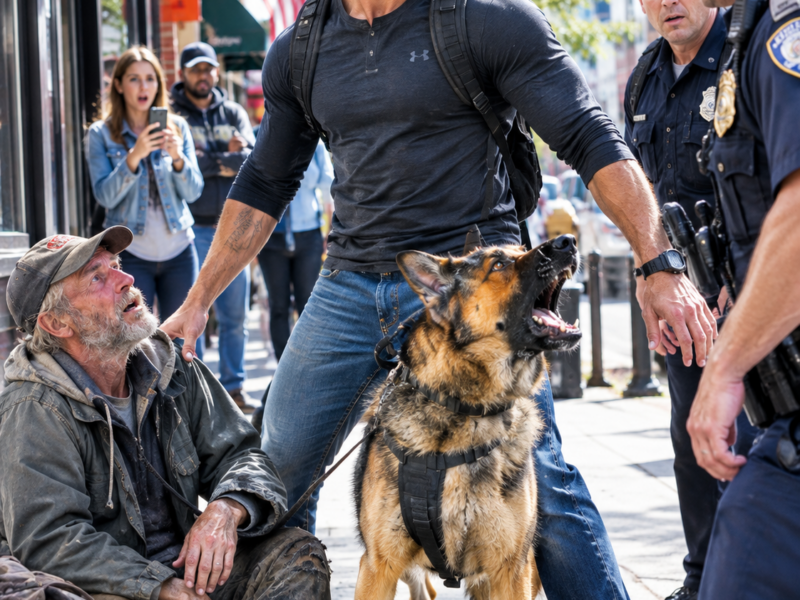
“At a crowded street corner in San Diego, I watched two police officers shove a homeless man to the pavement and reach for their handcuffs
Daniel turned the phone facedown, but I could tell from his expression that the warning had confirmed something he already suspected. And Ranger, who had been quiet since we entered the diner, suddenly began barking at the back door.
I had spent thirty-one months learning how to recognize danger before it reached me. Life on the street teaches you things no classroom ever could. You learn which footsteps mean someone is looking for trouble, which parked cars have been sitting too long, and when a stranger’s smile is only a mask. But nothing had prepared me for the feeling that settled over me as Daniel rose from his seat and motioned for me to stay behind him.
Ranger stood between us and the back entrance, his ears pointed forward, his body rigid. The German Shepherd wasn’t barking wildly. Each bark was deliberate, as if he wanted whoever stood outside to understand that they had been noticed.
Daniel reached down and rested a hand against the dog’s shoulder. “Easy, buddy.”
Then he looked at me. “Marcus, when I open that door, stay where you are.”
I almost laughed. I had spent years being told where I could and couldn’t go. By landlords, employers, police officers, and people who looked through me as if I were a stain on the sidewalk. But there was something different about Daniel’s voice. He wasn’t ordering me around to make himself feel powerful. He was trying to keep me safe.
He moved toward the door, keeping Ranger close. Before he reached it, three sharp knocks sounded from the other side.
“San Diego Police Department,” a man called. “Open up.”
My stomach tightened.
Daniel didn’t touch the handle. “Which officers?”
“Open the door, sir.”
“That’s not an answer.”
There was a pause. Then another voice, older and colder, came through the wood. “Petty Officer Hayes, we know you’re in there. This is a police matter. Don’t make it worse.”
Daniel’s face changed at the sound of his name. Not fear. Recognition.
He turned to me and lowered his voice. “Do you recognize either voice?”
“The older one,” I whispered. “I heard him at the parking garage.”
Daniel nodded once, as though a piece of a puzzle had just clicked into place.
He pulled out his phone and began recording. “You’re standing outside a private business. State your names and explain why you’re here.”
“Officer Frank Dwyer,” the older voice answered. “Officer Nolan Price is with me. We’re investigating interference in an active missing-person case.”
“Then you can explain that to your supervisor,” Daniel replied. “You’re not entering this diner without a warrant.”
The handle rattled.
Ranger lunged forward with a sharp growl, stopping just short of the door. The sound that came from him was deep enough to make the glasses on the nearby shelf tremble. Whoever stood outside stopped moving.
“Control your dog!” Dwyer snapped.
“He’s under control,” Daniel said. “Are you?”
For a few seconds, nobody spoke. Then footsteps retreated down the narrow passage.
I rushed to the window beside the kitchen. Through the rain-streaked glass, I saw two uniformed men walking toward the street. One was broad-shouldered, with gray at his temples. The other was younger, thin, and kept glancing over his shoulder.
A black SUV waited at the curb with its headlights off.
My breath caught.
Even from the side, I recognized the vehicle. It was the same model I had seen near the parking garage. The same dark windows. The same dent above the rear wheel.
The younger officer climbed into the passenger seat of a patrol car. Dwyer didn’t follow him. Instead, he walked to the SUV and spoke through the driver’s window.
Then the SUV pulled away.
I watched until its taillights disappeared around the corner.
“That’s them,” I said. “That’s the car.”
Daniel came to stand beside me. Ranger remained at his heel, alert but silent.
“You’re sure?”
“I’m sure enough to bet the only thing I have left.”
Daniel studied my face. “Then we’re going to do this properly.”
I turned toward him. “What does that mean?”
“It means we don’t chase that vehicle into an alley. We don’t confront two officers alone. And we don’t let them turn this into a story about a homeless man making accusations.”
The words stung because they were true. I had seen people dismiss the truth simply because it came from someone wearing worn-out shoes and carrying everything he owned in a plastic bag.
Daniel picked up his phone. “I know someone who can help us.”
He stepped into the kitchen to make the call. I sat down again, my hands trembling so badly that the water in my glass rippled. Ranger came over and rested his heavy head on my knee.
I scratched behind his ears.
“You always this good at figuring people out?” I whispered.
His tail thumped once against the floor.
For the first time that night, I felt like I wasn’t completely alone.
Twenty minutes later, a woman arrived in a rain-darkened jacket. She introduced herself as Elena Ruiz, an investigator with the county’s independent oversight office. She had short black hair, tired eyes, and the kind of expression that suggested she had heard every excuse people could invent and was still willing to listen for the truth.
Daniel explained what had happened without exaggeration. He showed her the threatening message and the photo taken inside the diner. Then he described the officers at the back door.
Elena didn’t interrupt. When he finished, she turned to me.
“Mr. Reed, I need you to tell me exactly what you saw that night. Not what you think it means. Just what you saw.”
I swallowed and began.
I told her about the parking garage, the black SUV, and the little girl standing beneath a flickering light. I described the man who had grabbed her arm, the way she pulled away, and the moment she pressed a white card against the tinted window.
I told her about the two officers arriving a few minutes later. I remembered Dwyer’s face when the SUV driver handed him a thick envelope. I remembered the way he slipped it inside his jacket before turning toward the girl’s backpack, which lay abandoned beside a concrete pillar.
And I remembered the girl looking directly at me.
She hadn’t screamed. She hadn’t waved for help. She had simply looked at me with wide green eyes and moved her lips around three silent words.
Please help me.
“I should’ve done more,” I finished.
Elena leaned forward. “What could you have done?”
“I could’ve followed them. Called somebody. Grabbed the license plate number sooner.”
“You were alone, and you believed the people who were supposed to protect her might be involved. You made a note of what you saw. That matters.”
“Does it?” I asked. “Because the next time I saw those officers, they were trying to scare me into silence.”
“It matters,” she repeated. “But from here on, you let us handle the dangerous part.”
Daniel stood near the window, watching the street. “We need to find Lily before whoever has her realizes Marcus talked.”
At the girl’s name, Elena opened a folder on her tablet.
“Lily Carter, twelve years old. Reported missing six days ago by her aunt, who has temporary custody. The original report says she may have run away after an argument at home.”
“That’s a lie,” I said before I could stop myself.
Elena looked up. “Why?”
“Because she looked terrified. That wasn’t a kid sneaking out to avoid getting grounded. That was a kid who knew something terrible was happening.”
Elena studied me for a moment, then turned her screen around.
The photograph showed a girl with dark hair, green eyes, and a small crescent-shaped birthmark beneath her left ear. She wore a green backpack and a hesitant smile.
“That’s her,” I whispered. “The same girl.”
Daniel leaned closer to the screen. “You said she was wearing mismatched sneakers?”
“Red on one foot. White on the other.”
Elena typed something into her notes. “That detail wasn’t in the report.”
“She probably lost one shoe when the man grabbed her.”
“Or she was running,” Daniel said quietly.
Ranger lifted his head.
Daniel crouched beside him and checked the dog’s harness. “You remember the smell from the garage, buddy?”
I watched him work. There was something astonishing about the relationship between them. Daniel didn’t treat Ranger like a tool or a possession. He spoke to him as if the dog were a partner whose opinion mattered.
“Ranger’s trained to track a scent from an item belonging to the missing person,” Daniel explained. “If we can find something Lily carried recently, he may be able to help. But we need to do this through the proper channels.”
Elena nodded. “I can request access to the evidence locker. Her backpack was reportedly recovered from the garage, but the report says it contained nothing significant.”
“Who recovered it?” I asked.
She checked the file.
“Officer Dwyer.”
The room fell silent.
Daniel’s jaw tightened. “Then we need to see that backpack.”
Elena made another call. Within an hour, she had arranged for a supervisor from the missing-persons unit to meet us at a secure county facility. She also contacted an attorney who specialized in police misconduct and requested preservation of the diner’s security footage.
Before we left, the diner owner approached our table. His name was Mr. Patel, and he had been pretending not to listen while wiping the same clean counter for nearly twenty minutes.
“I have something you should see,” he said.
He led us to a small office behind the kitchen and opened a security recording on his computer. The footage showed the front entrance, the counter, and a portion of the street outside. The image was grainy, but the time stamp was clear.
At 8:17 p.m., a man in a dark jacket entered the diner, sat at the counter, and ordered coffee. He never drank it. Instead, he watched our table in the reflection of the window.
At 8:24, he stood, left cash beside the cup, and walked out.
At 8:26, my phone received the threatening message.
The man’s face was partly hidden by a baseball cap, but when he turned toward the camera, I saw a pale scar cutting through his right eyebrow.
“I’ve seen him,” I said.
“Where?” Elena asked.
“Near the garage. He was standing beside the SUV before Lily got in.”
Daniel took a photograph of the screen, making sure the time stamp was visible.
“That gives us a second witness point and a timeline,” Elena said. “It doesn’t identify him yet, but it’s something we can verify.”
Mr. Patel copied the footage to a drive and handed it to her.
“You should know,” he told me, “I’ve seen that man around here before. He asks questions about people who sleep near the transit station. He likes to know who has family and who doesn’t.”
I felt a cold knot form beneath my ribs.
People like me were easy to target. No fixed address. No one expecting us home. No one who would notice if we disappeared for a day or two.
Except this time, someone had noticed.
By midnight, we were inside the county facility. A supervisor named Sergeant Brooks met us in a conference room and listened while Elena laid out the evidence. At first, Brooks looked skeptical. But when Daniel showed him the message and the footage, his expression grew serious.
He authorized an inventory check of Lily’s belongings under an independent chain of custody.
The backpack arrived in a sealed evidence bag. It was green, scuffed at the bottom, and missing one strap buckle. When the supervisor opened it, we found a notebook, a broken pencil, a small packet of tissues, and a child’s sweatshirt.
No phone. No wallet. No white card.
Ranger sniffed the outside of the bag, then paused, his ears lifting. Daniel gave him a quiet command and allowed him to examine a piece of cloth from the sweatshirt. The dog worked carefully, nose moving from the fabric to the floor, then toward the hallway.
He stopped at a door marked RECORDS STORAGE.
Daniel held him back. “That’s enough, Ranger.”
The dog looked up at him, then sat.
Sergeant Brooks frowned. “That room holds archived paperwork. No one from the missing-persons unit should have taken her belongings there.”
“Then let’s find out why the scent leads that way,” Elena said.
Brooks called the facility manager and requested access logs. It took nearly forty minutes for someone to locate the digital records. The logs showed that two nights earlier, Dwyer had entered the building using a temporary access card. He had signed out no evidence and had no recorded reason to visit the storage area.
The card had been issued under a supervisor’s authorization that the supervisor now denied giving.
For the first time, the room seemed to tilt toward something bigger than a pair of crooked cops.
Elena photographed the access log. Sergeant Brooks ordered the records secured and called a higher-ranking investigator who was not connected to Dwyer’s precinct.
But we still didn’t know where Lily was.
As the hours dragged on, I kept thinking about her eyes. The fear in them. The way she had looked at me as though I might be the last person in the world who could help her.
I knew that feeling.
After Laura and Sophie died, I had spent months believing I could have prevented the accident if I had taken a different road or left work five minutes earlier. Grief had turned every memory into a courtroom, and I had been both the prosecutor and the accused. Eventually, I lost my job, then my apartment, then the small pieces of myself that used to make me believe tomorrow might be better.
I had survived by convincing myself that caring about people was a risk I could no longer afford.
Then a frightened child had asked for help without making a sound.
And I had seen her.
At 2:13 a.m., Elena’s phone rang. She listened, asked three questions, then stood so abruptly her chair scraped the floor.
“They found the SUV,” she said.
My heart hammered. “Where?”
“An industrial property east of the city. It’s registered to a private security company with contracts involving several public agencies.”
“Is Lily there?”
“We don’t know yet.”
Daniel was already on his feet. “Who’s going in?”
“An authorized search team. You’re not part of the entry.”
He looked as though he wanted to argue, but after a moment, he nodded. “Understood.”
Elena glanced at me. “Marcus, you’ll stay here.”
“I’m not leaving.”
“You’re a witness, not an officer.”
“I know what I am.” My voice shook, but I kept going. “I’m not asking to kick down a door. I’m asking not to be sent away while everyone else decides whether the girl I saw is worth finding.”
For a moment, Elena said nothing. Then she pulled out a chair.
“You can remain in the secure room with Sergeant Brooks. You will not follow the team, and you will not contact anyone connected to the case. Do you understand?”
“Yes.”
Daniel rested a hand on my shoulder before leaving with Ranger and the authorized team’s canine handler. “We’ll find her if she’s there.”
I wanted to believe him.
The next forty minutes were the longest of my life.
Sergeant Brooks stayed in the room, listening to updates through a secure radio. Elena paced near the window. I sat with my hands locked together, imagining every possible ending and hating myself for each one.
Then the radio crackled.
“Search team has located a minor. Female, approximately twelve. Alive. Medical assessment requested.”
My knees nearly gave out.
Elena closed her eyes for one brief second, then began issuing instructions. Sergeant Brooks spoke into his radio. I pressed my palms against my face and tried to breathe.
A few minutes later, Daniel returned.
His clothes were damp, and his expression was drawn, but Ranger walked beside him calmly. Daniel crouched in front of me.
“She’s alive, Marcus.”
I couldn’t speak.
“She was in a locked office behind the main warehouse. Frightened, dehydrated, but conscious. The medical team is with her now.”
I grabbed Daniel’s forearm. “Did she say anything?”
“She asked whether the man who helped her was safe.”
A sound escaped me that was half laugh and half sob.
Daniel squeezed my shoulder. “She remembered you.”
Lily was taken to a children’s hospital under protective supervision. The first interviews were conducted by a trained child forensic interviewer, not a room full of strangers demanding answers. I was told only what I needed to know: she was physically stable, and investigators had secured evidence at the property.
The story that emerged over the next two days was worse than I had imagined, but it was not the story of a vast, all-powerful conspiracy. It was something more ordinary, and in its own way more frightening: a few people using their positions to make money and betting that everyone else would look away.
Lily had witnessed a private security contractor handing sealed envelopes to Officer Dwyer. Her father had worked as an accountant for the company and had recently died in what the official report described as an accidental fall. Before his death, he had told Lily that he was gathering records of fraudulent invoices and payments routed through shell companies.
Lily had copied several pages from his files. She believed someone was following her. When she tried to tell a school counselor, the counselor contacted the police liaison assigned to the school. That liaison was connected to Dwyer.
Lily ran before the people watching her could take the documents from her. The man with the scar, identified as a contractor named Wade Harlan, found her near the garage and forced her into the SUV. Dwyer and Price later helped conceal the vehicle’s movements and falsify parts of the missing-person report.
The envelope I had seen was payment. The white card Lily pressed against the window was a message she hoped someone would read.
The police are lying.
She had been right.
But she hadn’t been alone in seeing the truth. A traffic camera had recorded the SUV near the industrial property. The diner footage placed Harlan at the scene. The access logs showed Dwyer’s unauthorized visit. And a search of the warehouse recovered Lily’s missing phone, the documents she had copied, and records linking Harlan’s company to suspicious payments.
Officer Price eventually agreed to cooperate. His statement confirmed that Dwyer had ordered him to classify Lily as a runaway and ignore evidence that she had been taken against her will. Price said he had followed orders because he feared losing his job. It did not excuse what he had done, but it gave investigators another path to the truth.
Dwyer was suspended and later charged alongside Harlan. The contractor’s company was placed under investigation. Other officers and officials were questioned, and the records were turned over to prosecutors and an independent audit team.
There were no instant confessions, no dramatic press conference in which every wrong was corrected at once. There were interviews, evidence reviews, legal motions, and days when it seemed as if the machinery of the system might grind the truth into dust.
But this time, the evidence had been preserved before it could disappear.
And Lily was safe.
Three days after she was found, Elena arranged a brief visit at the hospital. A child advocate was present, and Lily could end the visit whenever she wanted. I almost didn’t go. I had spent so long feeling ashamed of the person I had become that the thought of standing in front of a little girl who had been through so much made me feel like an impostor.
Daniel found me outside the room.
“You don’t have to say anything perfect,” he told me. “Just be honest.”
So I went in.
Lily sat propped against pillows, wearing a clean sweatshirt and holding a stuffed rabbit someone had brought her. Her dark hair was brushed away from her face. The crescent-shaped birthmark beneath her left ear was unmistakable.
When she saw me, she gripped the rabbit tighter.
“Hi, Marcus,” she whispered.
“Hi, Lily.”
“I thought you might not come.”
“I almost didn’t.”
“Why?”
I looked down at my hands. “Because I didn’t think someone like me could help someone like you.”
She frowned. “What does that mean?”
“It means I’ve made a lot of mistakes. I thought nobody would believe me because I don’t have a home right now.”
Lily considered that. Then she said, “I believed you would see me.”
I felt the words settle inside me more heavily than any accusation ever could.
“I’m sorry I couldn’t get to you sooner,” I said.
“You saw me,” she replied. “That was the first thing.”
For a while, we talked about ordinary things. Her favorite subject was science. She liked drawing animals and wanted to learn how to train dogs. She told me her father had once taken her to a shelter to meet puppies, but they had never been able to adopt one because he traveled too often for work.
Before I left, she asked whether Ranger could visit.
Daniel arranged it with the hospital staff and Lily’s advocate. The next afternoon, Ranger entered the room wearing his working harness, guided by Daniel. He approached Lily slowly and sat beside the bed when Daniel gave the command.
Lily reached out, paused to make sure it was okay, and stroked the fur between Ranger’s ears.
“You’re a good boy,” she whispered.
Ranger leaned gently against her hand.
Daniel watched them with a small, tired smile. “He thinks so too.”
Lily laughed. It was a quiet laugh, fragile at first, but real.
I hadn’t heard a sound like that in years without feeling pain immediately afterward. This time, the pain was still there, but it had room beside something else.
Hope.
The weeks that followed were not easy. Lily went to live with a relative who had been cleared by child-protection workers, and her father’s death was reopened for review. She began counseling and returned to school gradually. The investigation continued, and the legal case moved at its own slow pace.
Daniel kept checking on me. He never offered pity or promised that one good deed would fix my life. Instead, he helped me replace my damaged identification, connected me with a veterans’ outreach worker who knew how to navigate housing applications, and made sure I had somewhere safe to sleep while the paperwork moved forward.
I learned that Daniel had served multiple deployments and had returned carrying grief of his own. He never talked about it as if his experiences made him more important than anyone else. He simply understood what it meant to come home and find that the world you had known was gone.
One morning, he took me to a small veterans’ support center where a caseworker helped me apply for transitional housing and steady work. I had expected a lecture about responsibility. Instead, she asked what kind of work I had done before I lost everything.
“Construction,” I told her. “Framing, repairs, basic electrical work. Whatever needed doing.”
She slid a form across the table. “There’s a maintenance position with a housing nonprofit. It’s not glamorous, but it’s steady. Would you like an interview?”
I stared at the form as though it might vanish if I touched it.
“Yes,” I said. “I would.”
It took time. There were background checks, appointments, and setbacks. I missed a bus once and arrived late to another meeting. I nearly gave up when a housing application was returned for a missing document. But I kept going because, for the first time in a long time, I had people expecting me to show up.
Daniel never treated me as a project. He treated me like a man who had been knocked down and still had a choice about whether to stand.
Three months later, I was working full-time for the nonprofit, repairing doors, patching walls, and making small apartments safe for people moving out of shelters. I had a room of my own with a lock that worked and a window that opened. My first paycheck went toward groceries, work boots, and a framed photograph of Laura and Sophie that I had carried through every move, every winter, and every night I had believed I had nothing left to live for.
I placed it on the dresser.
For the first time in years, I had somewhere to put it down without fearing I would lose it.
The case against Dwyer and Harlan was still moving through the courts. Price’s cooperation became part of the evidence, and the audit uncovered additional fraudulent payments. No one pretended that a few arrests could repair every failure that had allowed Lily to be taken. But the department changed how missing-child reports were reviewed, and an outside team examined cases in which officers had dismissed evidence too quickly.
I was asked to give a formal statement. This time, I sat across from investigators with my name printed correctly on the paperwork. They listened. They asked careful questions. When I said I wasn’t sure about a detail, they wrote that down instead of trying to force certainty out of me.
That mattered more than I could explain.
On the day Lily returned to school, she sent me a short message through her aunt. It was a photograph of a drawing: a German Shepherd beside a man wearing a dark jacket, with a little girl standing between them. Above the three figures, she had written, “Someone saw me.”
I kept the picture beside Laura and Sophie’s photograph.
A week later, Daniel and Ranger met me outside the nonprofit’s workshop. Daniel had been called away for duty soon, and he wanted to say goodbye before leaving. Ranger recognized me immediately, trotting over and pressing his head against my hand.
“Still checking on everyone?” I asked him.
Daniel smiled. “That’s his job.”
“No,” I said, rubbing Ranger’s ears. “I think it’s more than that.”
We stood together for a while, watching the sun break through the clouds above the street. Cars moved through the intersection. People hurried past with coffee cups and briefcases, each carrying a life I knew nothing about.
For years, I had believed the worst thing that could happen to a person was losing everything. My home. My family. My place in the world.
Now I understood that losing those things was terrible, but it did not have to be the end of the story.
The worst thing was beginning to believe that your life no longer mattered, that nobody would notice if you vanished, and that the right thing to do was to stop looking at anyone else who might be hurting.
I had almost walked past Lily’s fear because I was too busy surviving my own.
I couldn’t change the nights I had spent alone or the choices I regretted. I couldn’t bring Laura and Sophie back. I couldn’t erase what Lily had endured.
But I could remember what happened when one person refused to look away.
Daniel had risked his comfort to listen to a homeless man. Ranger had trusted his training and followed a scent that others had ignored. Elena had insisted on evidence when it would have been easier to dismiss an inconvenient witness. Mr. Patel had preserved a recording instead of pretending he had seen nothing.
And Lily had found the courage to ask for help, even when the people around her had failed her.
None of us had solved the case alone.
That was the truth I carried with me when Daniel finally turned to leave.
“Take care of yourself, Marcus,” he said.
“I will.”
He hesitated, then added, “And if you ever need help, call.”
I nodded. “Same goes for you.”
He walked toward his truck, Ranger beside him. Before climbing in, the dog turned and looked back at me. I raised a hand. His tail moved once, and then he was gone.
I returned to the workshop, where a list of repairs waited on my desk and a new tenant was due to collect her keys that afternoon. I had work to do. I had a place to sleep. I had people who knew my name.
Most importantly, I had finally stopped confusing my worst chapter with the whole story.
And somewhere across the city, a little girl who had once pressed a desperate message against the window of a black SUV was beginning to believe that the world could still hold people worth trusting.
I hoped she would never forget that she had been brave.
I hoped I wouldn’t either.
The end.









