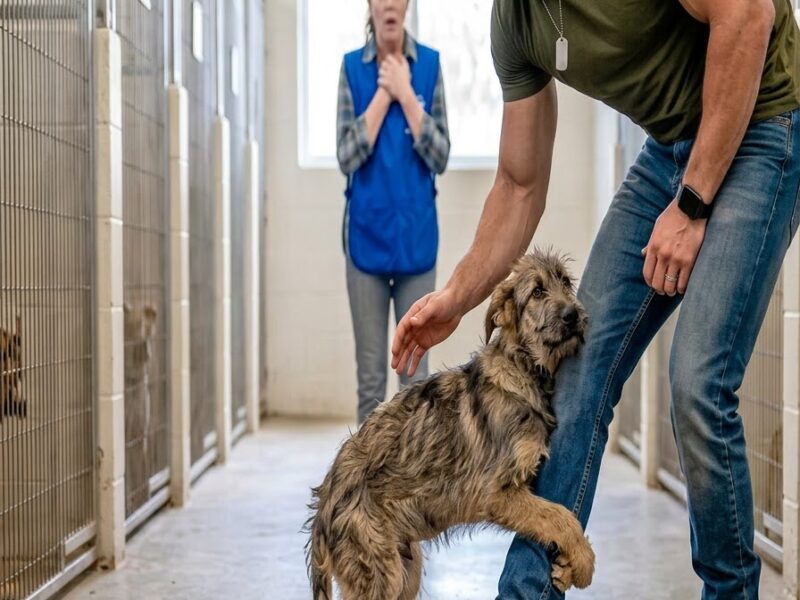
At a crowded animal shelter in Virginia, a $300 puppy suddenly wrapped his paws around my leg as I walked toward the exit
The Virginia shelter smelled of cheap floor cleaner, damp concrete, and the heavy, stagnant air of waiting. It was a humid Tuesday afternoon in late autumn, and I had only stopped by to drop off three bags of high-protein food left over from my neighbor’s farm. I wasn’t looking for another dog. I had spent twelve years in the Navy—eight of those as a specialized K9 handler attached to maritime interdiction units—and when I retired to a quiet piece of land outside Fredericksburg, I made a promise to myself that I was done taking care of things that could break my heart.
I was walking toward the exit, my boots squeaking against the newly mopped linoleum, when I heard it. A quiet, desperate scraping sound behind a low kennel door near the back of the adoption room.
I stopped. The puppy was tiny, thin enough that his ribcage showed beneath a patchwork coat of black and pale copper fur, and covered in gray dirt. One of his ears was folded strangely over his head, pinned down as if it had been broken and healed wrong. He was marked down on a yellow white-board as a mixed breed, priced at a modest three-hundred-dollar adoption fee.
A young shelter volunteer carrying a stack of towels paused beside me and sighed. “Nobody wants him.”
“Why?” I asked, keeping my hands jammed into the pockets of my canvas jacket. “He looks healthy enough.”
“He panics whenever someone leaves,” she replied, her voice tinged with the weary empathy of someone who saw too many abandoned animals. “People sit with him, he acts sweet, but the moment they stand up to walk away, he goes ballistic. Three different families brought him back this month alone.”
I crouched beside the galvanized wire kennel. The moment my knees hit the floor, the puppy pressed his small body tightly against the iron bars. His dark, golden-brown eyes locked onto mine, completely unblinking, filled with a deep, terrifying focus.
I pulled my hand from my pocket, reaching two fingers through the mesh to lightly touch his front paw. The moment my skin brushed his fur, his violent trembling stopped dead. For the first time all afternoon, the puppy was completely still, breathing in short, measured hitches.
“I have to go, buddy,” I whispered, feeling an uncomfortable tightness forming in my chest.
I stood up.
Instantly, the puppy burst into a frenzy of sharp, ringing barks. I took one firm step toward the double glass exit doors.
He didn’t bark anymore. He screamed. It wasn’t a dog’s vocalization; it was a high-pitched, human-like shriek of absolute agony, a sound of unadulterated horror.
Before the volunteer or I could react, the small puppy squeezed his tiny, emaciated torso through a bent gap at the bottom of the half-open kennel latch. He hit the concrete floor running, his claws clicking furiously against the floor as he sprinted straight across the crowded lobby.
He didn’t run for the front door. He didn’t run for food. He ran directly at me.
Before I could brace myself, his tiny front paws wrapped tightly around the leather collar of my heavy work boot. He buried his small snout against my ankle, locking his limbs in a iron grip, shivering so violently I could feel the vibrations through my thick socks. I gently shook my foot, trying to pull away, but he tightened his grip, letting out a low, muffled cry.
The busy lobby went completely silent. Adopters, shelter workers, and children stopped in their tracks, staring at the grown man frozen near the door with a tiny puppy clinging to his leg like a drowning swimmer grabbing a lifeline.
“Sir,” the volunteer whispered, her eyes wide as she dropped her towels. “He’s… he’s never done that before. He usually hides in the corner when he panics.”
I looked down at the small bundle of fur wrapped around my boot. Something about his raw desperation felt painfully, hauntingly familiar. After twelve years in military service, spent surrounding myself with men and animals exposed to high-stress trauma, I knew what fear looked like. This wasn’t ordinary animal separation anxiety. This was acute, deliberate recognition.
I slowly sank down onto the hard linoleum floor. The instant my lap met the ground, the puppy released his grip on my boot, crawled rapidly up my chest, and buried his head underneath the lapel of my heavy jacket, pressing his small heart directly over mine.
“Let me see him for a second,” I said softly, lifting his small head.
As I turned his head to check his ear, I noticed a clean, hairless scar just behind his left ear cartilage. Tucked neatly into the pale skin was a small, branded sequence of numbers burned directly into the tissue: NV-884.
My blood ran cold. That wasn’t a standard shelter tattoo, nor was it a commercial AKC microchip mark. It was a tactical tracking brand used exclusively by private defense contractors operating out of specialized working-dog breeding facilities in North Carolina.
“Where did you get this dog?” I asked, my voice dropping an octave as I showed the brand to the volunteer.
Her expression shifted from mild curiosity to deep confusion. She hurried back to the front reception desk and pulled up a thick manila folder labeled with the puppy’s intake number.
“There’s no registered owner listed,” she said, running her finger down the printed intake page. “No breeder name. No surrender forms. He was found tied to a post near the highway three weeks ago. Just one handwritten note attached to his file from the intake officer.”
“What does the note say?”
“It says: ‘Returned three times. Adopters report extreme fixation. Won’t leave my side.'”
I stared at the handwritten words, rubbing the soft fur behind the puppy’s scarred ear. He had fallen fast asleep against my ribs, his chest rising and falling in rhythmic, peaceful waves now that he was anchored to me.
“Look at his paws,” I murmured, turning over one of his small front feet. The tiny pads were covered in fresh, scabbed-over lacerations. “He hasn’t been scratching at his cage doors to escape. He’s been trying to dig through metal to get back to a specific person.”
“Wait,” the volunteer said, leaning over her computer monitor. “There’s an attached image file from his original stray intake report. The deputy who found him took a photo of the porch where he was picked up.”
She flipped the monitor toward me. My heart slammed against my ribs so hard it felt like a physical blow.
The digital photo showed the puppy sitting loyally beside an empty, weathered wheelchair on the front porch of a dilapidated farmhouse outside Quantico. Hanging on the wood-paneled wall directly behind the wheelchair was a framed, dust-covered military portrait.
The portrait showed a young man in a Navy dress uniform, smiling broadly beside an ocean vessel.
It was Marcus Vance. My former squad mate, my spotter, and my best friend—the man who had been reported killed during a night operation in the Gulf of Aden seventeen years ago, before I ever made it back to American soil.
Below the framed photograph was a polished brass plaque bearing a name and a service number I knew better than my own.
Before I could utter a single word, the puppy in my lap suddenly snapped his head up. His ears pinned forward, his nostrils flared, and his golden eyes locked onto a dark, secure hallway at the far end of the shelter floor.
He didn’t bark. He scrambled to his feet, lunging out of my lap, and began forcefully tugging the hem of my jacket with his teeth, pulling me directly toward a heavy, locked oak door marked STAFF ONLY — PRIVATE OFFICAL RECORDS.
From the other side of that sealed wooden door, coming through the silence of the empty corridor, came the low, wheezing sound of a human cough.
And then, a faint, metallic whisper called out into the dark:
“Mark… is that you?”
The sound of my own name coming through that locked oak door froze the air in my lungs. I reached down, scooping the small, branded puppy into the crook of my left arm, and stepped aggressively past the bewildered shelter volunteer toward the private corridor.
“Sir, you can’t go back there!” she called out, reaching for her desk phone. “That area is restricted to county animal control officers and federal liaisons!”
“Who is in that room?” I demanded, standing inches from the heavy wooden door frame. “Who has access to this wing?”
“It’s… it’s just administrative storage,” she stammered, stepping around the counter with a set of brass keys dangling from her hand. “The county leases those back rooms to the Department of Veterans Affairs and local transport units for cold storage and file archives. Nobody lives in there!”
“Unlock it,” I said. My voice was low, flat, and carried the unyielding command of an operator who was done asking questions.
The volunteer swallowed hard, intimidated by the sudden change in my posture, and rapidly slid a long iron key into the deadbolt. The lock clicked open with a heavy metallic thud.
I pushed the door open with my shoulder.
The hallway beyond was dark, illuminated only by the pale amber glow of a single streetlamp shining through a high transom window. The air smelled of damp paper, old motor oil, and sterile medical antiseptics. Arranged along the walls were rows of gray filing cabinets and surplus military equipment lockers.
At the far end of the hall, sitting on an overturned plastic crate beside an unlit radiator, was a figure swathed in a faded military field jacket. His legs were covered by a heavy wool blanket, but I could instantly recognize the sharp, angular line of his shoulder blades and the distinct scar across his left temple.
It was Marcus.
He looked decades older than thirty-five. His hair was streaked with gray, his skin was drawn tight over his cheekbones, and his left leg was gone below the knee, replaced by a worn, early-generation prosthetic. But his pale blue eyes, illuminated by the transom light, were unmistakable.
“Marcus?” My voice cracked, echoing hollowly off the cinderblock walls. “You… you were listed KIA on the USS Cole deployment roster in ’09. We held a memorial service for you in Norfolk.”
Marcus offered a weak, agonizing smile, leaning his head back against the concrete wall. “Official records are very convenient things when the Navy wants a shadow team to vanish, Mark.”
The puppy in my arms let out a soft, joyful whine, wiggling frantically until I lowered him to the floor. The moment his tiny paws touched the concrete, he darted down the dark hallway, launching himself directly onto Marcus’s lap and burying his face against the veteran’s neck. Marcus wrapped his thin, trembling arms around the dog, resting his forehead against the animal’s copper-colored fur.
“You found him,” Marcus whispered, his voice cracking with emotion. “I thought… I thought they took him for good this time.”
I walked down the corridor slowly, my boots heavy against the floor, and dropped to one knee beside my old teammate. I reached out, placing a hand on his trembling shoulder. He was real. Bone, muscle, and breath.
“What is going on here, Marcus?” I asked softly. “Why were you declared dead? And why is this puppy branded with a private contractor’s tactical serial code?”
Marcus took a ragged breath, adjusting the blanket over his lap as the puppy settled into his chest. “When our unit got pulled into that black-budget operation off the Horn of Africa, three of us didn’t die in the explosion. We were transferred to a classified recovery program run by Apex Maritime—a private defense contractor working out of a naval annex near Quantico.”
“Apex?” I muttered, my mind racing. Apex Maritime was a massive defense conglomerate that specialized in high-risk tactical logistics and specialized K9 units for private security forces operating overseas.
“They used us to train advanced tactical working dogs,” Marcus explained, his eyes fixed on the small brand behind the puppy’s ear. “Not just standard bomb-sniffing dogs, Mark. They were breeding high-drive Malinois and Dutch Shepherd hybrids, conditioning them using bio-metric implants and intense attachment training. The dogs were conditioned to bond exclusively with single handlers to execute high-stress reconnaissance work.”
He stroked the puppy’s folded ear. “This little guy was part of Project K-90, the newest generation. He was bred from my old service dog’s bloodline. But when he was born with a deformed ear cartilage and a congenital heart murmur, Apex ordered the batch culled. They didn’t want flawed genetics leaking into their commercial supply.”
A cold, dark fury flared in my chest. “Culled?”
“I couldn’t let them do it,” Marcus said, looking up at me with eyes filled with old guilt. “I stole him from the facility three weeks ago. I snorted him out in an equipment crate and brought him to my cabin outside Quantico. But Apex tracked my location. They raided my place, grabbed me, and brought me to this county holding facility to keep me quiet while they processed my discharge papers. They threw the puppy out on the highway like garbage, assuming he’d die in the cold.”
“He didn’t die,” I said, watching the puppy rest his chin on Marcus’s hand. “He dragged himself to a porch, got picked up by animal control, and refused to let anyone adopt him because he was searching for you.”
“They’re coming for him, Mark,” Marcus warned, his hand tightening on my sleeve. “Apex isn’t just a contractor. The director of the local facility is Commander Vance—my own uncle. He runs the county animal control board as a front to dispose of spent assets and failed breeding projects. He knows you’re here.”
Right on cue, the heavy double glass doors at the front of the shelter slammed open with a violent crash.
The heavy, rhythmic tread of tactical boots echoed from the lobby, accompanied by the harsh, metallic click of high-caliber sidearms being chambered.
Through the darkness of the administrative hallway, a stern, booming voice echoed over the shelter’s intercom system:
“Sergeant Miller! This is Commander Vance of Apex Logistics. You are currently interfering with stolen federal property and an unauthorized trespasser. Secure the canine and step into the lobby with your hands visible, or we will breach the facility.”
The dark hallway echoed with the cold, mechanical hum of the shelter’s air conditioning unit. Beside me, Marcus tried to push himself up against the cinderblock wall, his face pale with exertion, his prosthetic leg clicking lock-jawed into place. The puppy immediately pressed himself against Marcus’s good ankle, standing erect, a tiny, low growl vibrating in his small chest.
“Mark, you need to take the dog and go through the rear loading bay,” Marcus whispered, grabbing my forearm with surprising strength. “They aren’t here for me. They can’t legally harm a former service member without triggering an investigation. But that puppy carries the genetic markers of their proprietary tracking program. If he gets tested by a state vet, Apex loses millions in federal defense grants.”
“I’m not leaving you behind a second time, Vance,” I said, leaning back against the filing cabinets to survey our options.
I pulled my cell phone from my pocket—no service. The contractors had brought a localized signal jammer, standard protocol for covert recovery sweeps.
I looked down the hall toward the main lobby door. Through the frosted glass panel, I could see the silhouettes of three men standing in tactical formation. They weren’t wearing police uniforms. They wore unmarked navy-blue field jackets, combat boots, and sidearm holsters fitted with silenced sidearms.
“How many men does your uncle have on his local security detail?” I asked Marcus.
“Four or five,” Marcus replied, his jaw tight. “All ex-military contractors. They run the transport trucks between the breeding facility in Quantico and the regional animal shelters. They use the shelters to wash their budget paperwork.”
“Then we make them play by our rules,” I said.
I turned to the shelter volunteer, who was cowering behind a stack of paper boxes near the door, clutching her ring of keys. “Where does the rear service door lead?”
“To… to the animal intake yard,” she stammered, tears welling in her eyes. “It’s surrounded by an eight-foot chain-link fence, but the gate is locked from the outside.”
“Does the county fire alarm trigger an automatic landline dispatch to the local police department?”
“Yes! The moment the thermal sensors pick up smoke or high heat, it bypasses local signal jammers and calls the Fredericksburg Fire and Sheriff’s department directly.”
“Good,” I muttered.
I reached into my canvas jacket, pulled out my heavy brass Zippo lighter, and walked over to the corner of the hallway where a large plastic recycling bin was filled with dry shredded paper and intake files. I flicked the lighter to life, held the flame to the paper edge until a bright, snapping orange fire caught, and tipped the burning bin directly beneath the ceiling’s primary thermal sensor.
Within five seconds, a piercing, ear-splitting siren began blaring throughout the facility:
BEEP! BEEP! BEEP! ATTENTION: FIRE DETECTED. EMERGENCY SERVICES DISPATCHED.
High-pressure water sprinklers instantly burst to life along the ceiling corridor, showering us in cold, heavy rain.
“Move!” I bellowed.
I pulled Marcus to his feet, letting him lean his weight across my shoulders, while I scooped the small puppy back into my jacket pocket. We shuffled as fast as his prosthetic would allow down the wet rear hallway toward the emergency exit door.
Behind us, the frosted glass of the lobby door shattered into a thousand pieces as the three contractors kicked their way through the frame.
“Clear the hall!” a voice shouted over the roaring fire alarm. “Find Vance and the specimen!”
I slammed my palm against the emergency push-bar of the rear service exit. The door swung open into the biting autumn rain outside.
We burst out into the fenced intake yard. The mud was deep, churning beneath our boots as rain pelted down from the gray sky. Across the yard stood an eight-foot chain-link fence topped with barbed wire, securing three commercial K9 transport vans belonging to Apex Maritime.
Standing beside the main gate, holding an unlit cigar in his hand and wrapped in a heavy waterproof trench coat, was Commander Vance.
He was a tall, silver-haired man in his late fifties, his face weathered by decades of naval service, his posture immaculate despite the pouring rain. Beside him stood a massive, fully grown Belgian Malinois on a short tactical lead—a dog that looked identical to the small puppy tucked inside my coat, but three times the size, its dark eyes cold and ruthless.
“You always were remarkably predictable, Miller,” Commander Vance said, his voice easily cutting through the sound of the rain and sirens. “Using fire alarms to break signal jammers is a classic SEALS tactic. But you’re out of your depth here.”
“Commanding an illegal contractor ring using public shelters as a cover isn’t depth, Vance,” I shouted back, holding Marcus steady beside me. “It’s treason. And it ends today.”
Commander Vance chuckled, a low, dry sound, as he unclipped the tactical lead from his Malinois’s collar.
“It ends when I say it ends,” Vance said softly. “Track, attack.”
The massive attack dog bared its teeth, letting out a terrifying, guttural roar, and launched itself across the muddy yard straight toward us.
The eighty-pound Belgian Malinois tore through the mud like a thrown spear, its massive paws throwing up chunks of wet earth as it closed the forty-foot gap between us in seconds.
Marcus instinctively tried to step in front of me, but his prosthetic slipped in the deep slush, sending him falling hard onto his knees in the mud.
I moved on pure combat instinct honed by a decade of handling working dogs in high-threat zones. I didn’t turn to run. I didn’t reach for a weapon. I ripped off my heavy canvas work jacket, wrapping it four times tightly around my left forearm to create a thick, makeshift bite sleeve, and stepped directly into the attack line.
“Lunge!” I yelled, dropping my center of gravity.
The heavy war dog leaped into the air, its jaws gaping open, aiming directly for my throat.
I threw my padded left arm up, driving the thick canvas deep into the dog’s mouth as it struck me. The sheer force of the eighty-pound animal at full sprint slammed into my chest, knocking me back against the wet chain-link fence. The dog’s teeth sank deep into the heavy canvas, missing my flesh by millimeters, its jaws locking on with crushing force.
“Ranger, hold!” Commander Vance commanded from across the yard, stepping forward with a smirk. “Bring him down!”
The attack dog thrashed its head violently, trying to tear the canvas sleeve off my arm.
Suddenly, from inside the pocket of my fallen jacket resting in the mud beside Marcus, a tiny, furious sound erupted.
The three-hundred-dollar, ear-deformed puppy scrambled out of the jacket pocket. Covered in mud and soaked with freezing rain, the tiny creature didn’t run away. He didn’t hide behind the vans.
He charged.
The tiny puppy launched his five-pound body directly at the massive attack dog’s rear leg, sinking his small, needle-sharp puppy teeth straight into the working dog’s hock tendon.
The large Malinois let out a sudden, surprised yelp, releasing its grip on my canvas-wrapped sleeve to glance down at the tiny creature biting its ankle.
It was a fraction of a second of distraction, but in high-stakes combat, a fraction of a second is an eternity.
I drove my right hand down, catching the massive dog by its tactical harness handle, twisted my hips, and pinned the animal firmly against the muddy ground using my body weight, securing its muzzle with my padded left arm.
“Hold!” I roared into the big dog’s ear, using the specific high-frequency tactical command code used only by naval K9 handlers.
The large Malinois instantly stopped struggling. Its ears flattened, its tail tucked, and it went completely still beneath my hands, recognizing the authority in my voice.
Commander Vance’s smirk vanished instantly, replaced by a dark, dangerous glare. He reached beneath his heavy trench coat, pulling a black, suppressed 9mm pistol from his shoulder holster.
“Impressive, Sergeant,” Vance said coldly, leveling the weapon directly at my forehead. “You still have the touch. But commands don’t stop bullets. Step away from the canine.”
“Put the gun down, Uncle!” Marcus screamed from the mud, trying to raise himself up. “It’s over! The fire dispatch already pinged the county sheriff! Listen to the sirens!”
In the distance, over the sound of the pouring rain, the rising wail of multiple police sirens and fire engines echoed from the main highway, rapidly approaching the shelter entrance.
Commander Vance didn’t flinch. “The sheriff works for my board, Marcus. By the time they sort out the paperwork, you and Miller will be listed as casualties of an unfortunate electrical fire, and the specimens will be back in our research facility.”
Vance squeezed the trigger.
CLICK.
The gun didn’t fire.
Vance frowned, staring at the weapon’s receiver. The firing pin had jammed, fouled by the thick, wet mud that had splashed over his coat during the commotion.
Before he could rack the slide to clear the jam, the tiny copper-colored puppy bolted across the muddy yard, leaping onto Vance’s polished boot and biting down on his leather laces with all the strength in his small body.
Vance instinctively stumbled backward, his foot catching on a rusty drainage grate submerged in the mud. He lost his balance, his arms flailing, and crashed heavily onto his back into the water-logged ditch beside the fence line.
The heavy pistol flew from his grip, skittering across the slick concrete pad where I was waiting.
I scooped up the fallen weapon, racked the slide to clear the fouled chamber, and pointed it straight at Commander Vance’s chest as he struggled to sit up in the mud.
“Don’t move,” I said, my hand as steady as stone.
The tiny puppy sat down right on top of Vance’s chest, his strange, folded ear flopping in the wind, letting out a sharp, victorious bark that echoed across the wet yard.
Ten minutes later, the intake yard was flooded with the bright, flashing red and blue lights of eight state police cruisers and three Fredericksburg fire engines.
Federal agents from the Department of Defense Inspector General’s office—who had been quietly investigating Apex Maritime’s offshore funding for months—arrived shortly after, taking Commander Vance and his three armed contractors into federal custody. The illegal signal jammers were seized, and the transport vans were impounded as primary evidence in a massive contractor corruption case.
Paramedics wrapped Marcus in dry, heavy thermal blankets, seating him in the back of an ambulance to treat his hypothermia and check his prosthetic fitting.
I sat on the lowered tailgate of my pickup truck, wrapped in a dry wool blanket provided by a young firefighter. Beside me sat the tiny copper-and-black puppy, his belly now full of wet dog food provided by the weeping shelter volunteer.
The rain had finally stopped, replaced by a golden autumn sunset that broke through the gray clouds, reflecting off the wet pavement of the shelter parking lot.
The lead federal investigator, a sharp-eyed woman in a dark suit, walked over to my truck holding a clipboard filled with seizure documentation.
“Sergeant Miller,” she said, offering a respectful nod. “We’ve audited the intake logs for this facility. Commander Vance had been using this shelter to hide over forty unregistered working dog litters over the last three years. Thanks to you and Vance’s nephew, we’re shutting down the entire Apex breeding operation in Quantico today.”
“What happens to the dogs?” I asked, stroking the puppy’s folded ear.
“They’ll be evaluated by certified military veterinarians,” she replied. “The healthy ones will be reassigned to legitimate state search-and-rescue teams. As for this little guy…”
She looked down at the tiny puppy resting against my leg. “Officially, he doesn’t exist on any federal inventory paper. The shelter director marked him down as fully processed and adopted.”
She handed me an official Virginia pet registration certificate.
I looked down at the paper. In the field labeled Owner Name, someone had typed: Mark Miller & Marcus Vance.
And in the field labeled Pet Name, it read: Radar.
“Radar,” I whispered softly.
The puppy immediately perked up his folded ear, looking up at me with his bright, golden-brown eyes, and let out a soft, happy huff.
Marcus walked over from the ambulance, relying on a set of medical crutches, a weary but genuine smile resting on his face for the first time in seventeen years.
“He suits the name,” Marcus said, leaning against the side of my truck. “Always listening for things nobody else can hear.”
“Where are you going to go, Marcus?” I asked, looking at my old teammate. “You’re officially off the shadow roster now. You can reclaim your life.”
“The VA is setting me up with a housing grant near Richmond,” Marcus said, looking out over the quiet Virginia countryside. “They’re offering me a position as a peer counselor for injured veterans returning from overseas service.”
“You’re not going alone,” I said, picking up the small puppy and placing him gently into Marcus’s arms. “Radar is coming with us. We’ve got twenty acres of fenced land outside Fredericksburg. Plenty of room for two old sailors and a dog that doesn’t know how to quit.”
Radar buried his face into Marcus’s neck, his small tail wagging so fast it blurred in the afternoon sun. He wasn’t trembling anymore. There were no more cage bars, no more contractor tracking numbers, and no more abandoned roadside porches.
I started up my truck engine, the deep rumble of the V8 filling the cold autumn air. Marcus climbed into the passenger seat, cradling Radar safely in his lap as the puppy drifted into a deep, peaceful sleep.
I pulled out of the shelter parking lot, leaving the flashing police lights and dark secrets behind us in the rearview mirror, and drove toward home.
The end.









