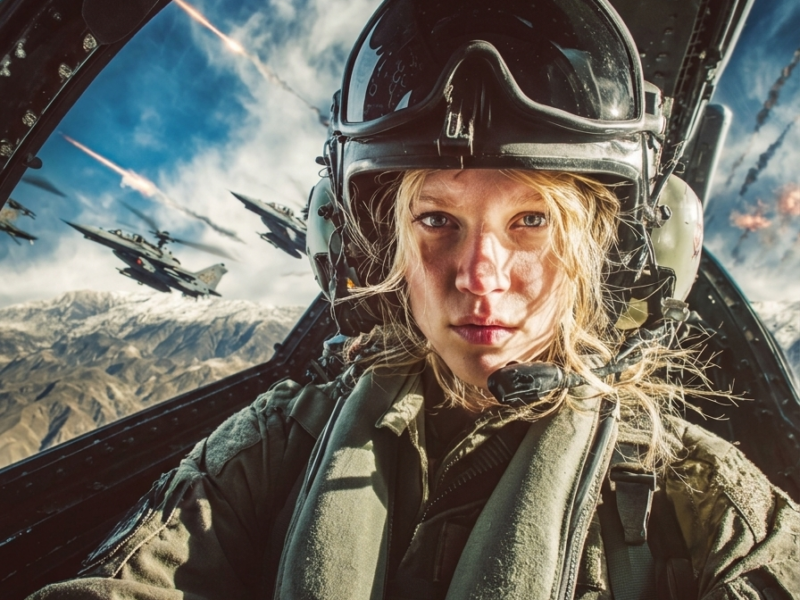
At 4:41 a.m. above the Afghan mountains, three enemy fighter jets suddenly surrounded my Apache and opened fire while my commander ordered me to retreat
At 4:41 a.m. above the Afghan mountains, three enemy fighter jets suddenly surrounded my AH-64 Apache and opened fire while my commander ordered me to retreat, but I smiled at the radar because the attack was built around one lie they didn’t know I had already discovered.
The first air-to-air missile screamed past my cockpit so close that the entire airframe shuddered violently, the hydraulic alarms howling a high-pitched metallic warning.
“Three targets! Fast movers, closing at Mach 1.2!” my gunner, Lieutenant David Miller, shouted over the intercom, his voice tight with adrenaline.
I pulled hard left on the cyclic, collective slammed down, dropping the seven-ton attack helicopter like a rock into the deep shadows between two jagged, snow-capped peaks. A millisecond later, another heat-seeking missile exploded against the sheer cliff wall behind us, showering our Kevlar-reinforced canopy with burning debris and gravel.
“They’re hunting us, Captain! They came out of nowhere!” Dave yelled, his hands flying across the weapon control panels to arm the 30mm chain gun and Hellfire racks.
“I know,” I said calmly, feeling the icy focus that always settled over me when the world went to hell.
What Dave didn’t know was that I had seen something strange on our long-range sensor suite five minutes before the first radar lock pinged our instruments.
Their combat formation was perfect. Too perfect. They hadn’t been patrolling the Hindu Kush range on an intercept vector. They had been waiting in a blind radar pocket at altitude, completely dark, engines throttled back, waiting for us to cross a precise GPS waypoint that wasn’t listed on any public flight plan.
Someone inside our own tactical operations center had given them our exact flight path, altitude, and radio frequencies.
“Command, this is Raven One, we are under heavy anti-air engagement at Grid November-Seven,” I spoke into my helmet mic, adjusting our flight trajectory to hug the rocky terrain. “Request immediate air support or vector clearance.”
Static answered. Cold, empty white noise hissed through my headset for ten agonising seconds.
Then my commander’s voice, Colonel Marcus Vance, finally came through the line. The transmission was crystal clear—meaning the previous static hadn’t been atmospheric interference; it had been an deliberate manual override delay.
“Raven One, this is Vanguard Leader,” Vance said, his voice entirely devoid of the urgency a commander should feel when his lone helicopter is being swarmed by supersonic jets. “Disengage immediately. Break contact and return to base. Do not engage those aircraft.”
I stared at the heads-up display as the three tactical icons swept back around to execute a textbook pincer maneuver.
“Sir, they won’t let us disengage,” I replied, pulling the Apache into a tight banking turn that pressed me hard against my harness. “They have continuous radar lock. If I turn our tail to them now without defensive counter-measures, we are target practice.”
“That is an order, Captain Hayes. Stand down and turn back. Now.”
I almost obeyed. Muscle memory and ten years of military discipline screamed at me to follow the chain of command. But as I brought the helicopter’s nose up to clear a granite ridge, the third enemy fighter descended through a gap in the gray morning clouds, cutting across the pale twilight.
For one second, the rising sun flashed off its dark-painted canopy and delta wings.
I caught the tail number and the distinct white-and-red tactical insignia painted on the vertical stabilizer. My blood instantly ran cold.
Those jets weren’t Russian surplus, nor were they insurgent hardware. They belonged to a high-tier private defense contractor—a black-budget military corporation operating directly out of our forward operating base at Bagram. They weren’t supposed to be anywhere near this sector.
Someone with high-level security clearance had brought them here to execute a clean, untraceable mid-air execution.
“Turn us toward the eastern valley,” I told Dave, adjusting our collective.
Dave blinked, staring at the digital topographical map on his lower display. “Captain… that’s a dead end. The canyon narrows to less than fifty feet at the gorge entrance. We’ll be trapped.”
“I know,” I muttered. “Follow my lead.”
We banked hard right, diving straight into the narrow throat of the mountain valley. Behind us, the three high-speed radar signatures turned in tight formation, diving aggressively into the shadow of the peaks to finish the job.
The gorge swallowed the Apache whole. Walls of dark, ancient granite rose hundreds of feet on either side of us, blocking out the morning sunlight and reducing our visual environment to shades of slate gray and pitch black.
“Altimeter dropping! Fifty feet… forty feet above ground level!” Dave shouted, his eyes darting between the FLIR (Forward Looking Infrared) screen and the narrow stone walls passing by our rotor blades at over one hundred and forty knots. “Daniel, if we clip a ledge at this speed, we won’t even leave enough wreckage to fill a body bag!”
“Keep your eyes on the weapons system, Dave. They’re coming in single file.”
The spatial physics were simple, but lethal. Fighter jets were built for high-speed, high-altitude air superiority. In a wide-open sky, an Apache helicopter is a sitting duck against supersonic jet fighters armed with long-range air-to-air missiles. But inside a winding, narrow mountain canyon, speed becomes a death sentence. Their jet engines needed wider turning radiuses, and their advanced radar locking systems would struggle to differentiate between our radar reflection and the massive granite cliffs surrounding us.
I slowed our forward airspeed dramatically, pulling the helicopter into a hovering flare behind a massive outcropping of rock, hiding our thermal signature against the freezing mountain stone.
The first enemy jet appeared between the gorge walls, its twin jet engines roaring like thunder, screaming down the valley at over four hundred miles an hour, searching for us in the gloom.
“Now!” I snapped.
Dave didn’t hesitate. He pulled the trigger on his flight controls. The 30mm automatic chain gun mounted beneath the Apache’s belly erupted with a deafening, rhythmic thump-thump-thump-thump, spitting heavy armor-piercing high-explosive rounds directly into the jet’s air intake.
The jet didn’t even have time to fire. The armor-piercing shells tore through its cockpit and engine casing in a fraction of a second. The jet detonated in a blinding fireball, its shattered wings slamming into the left canyon wall, sending a shockwave through the air that rocked our helicopter like a toy.
“Direct hit! Target one destroyed!” Dave yelled, a brief surge of triumph in his voice.
“Don’t celebrate yet,” I warned, watching the radar display. “Target two and three just flipped their vector.”
The second jet, realizing the death trap, pulled up hard to gain altitude, but its wingman—the second fighter—launched two heat-seeking missiles blindly down into the canyon before attempting to pull out of the dive.
“Chaff! Flare! Drop, drop, drop!” I shouted.
I slammed the collective down, dropping the Apache straight toward the icy riverbed at the bottom of the gorge. Bright magnesium flares spewed from our tail dispenser, lighting up the dark rocks in brilliant white smoke. The two incoming missiles tracked the burning flares, bypassing our engines and slamming directly into the rock wall twenty feet above our cockpit.
A shower of burning thermite and pulverized boulders rained down on us. I rolled the helicopter sideways, threading the needle between a falling slab of granite and the canyon wall, the main rotor blades missing the rock by less than three feet.
“He’s climbing out of the valley!” Dave shouted, pointing up at the second jet as it banked hard to re-enter the upper airspace. “We lost him on the visual!”
“He’s going to loop back for a high-altitude bombing run,” I said, pulling the cyclic back to climb rapidly out of the shadowy abyss. “We take the fight to him now before he can set up his run.”
“With an Apache against a jet in open air?” Dave looked back at me, his eyes wide with disbelief. “That’s suicide!”
“He expects us to stay down here and hide,” I said, setting the turbine engine throttles to maximum continuous power. “He thinks we’re prey. Let’s correct his mistake.”
The helicopter shot up out of the dark gorge like a rocket, breaking through the morning mist into the glaring golden light of the mountain sunrise.
The second jet was hovering high above the ridge line, sweeping its radar down to spot us. The moment our rotor popped over the cliff crest, its targeting system locked onto us with a solid, high-frequency tone.
The fighter turned directly toward us, accelerating fast for a head-on gun run.
“He’s got solid lock!” Dave yelled. “Fire Hellfires?”
“No! Hellfires are laser-guided anti-tank missiles; he’ll break lock if he maneuvers!” I shouted over the engine roar. “Hold your fire until I give the word!”
For three terrifying seconds, the world compressed into a high-speed game of chicken. The jet was screaming toward us at eight hundred feet per second, its nose cannon flashing with bright red bursts of tracer fire. Cannon rounds zipped past our canopy, punching holes through our left stub wing and ripping away a portion of our rocket pod.
I held my course, flying straight at his nose cone, refusing to break.
Fifty yards. Forty yards. Thirty yards.
“Daniel!” Dave screamed.
At the very last microsecond, when I could see the pilot’s helmet reflection inside the enemy cockpit, I yanked the cyclic violently to the right and kicked the rudder pedal full left, putting the helicopter into a flat, horizontal slide directly beneath the jet’s belly.
As the jet roared over our rotor blades, sweeping us with its jet wash, I flipped the weapon selector to manual override and pulled the fire trigger on my own control stick.
A volley of unguided 70mm Hydra rockets launched from our right wing pod, slamming point-blank into the belly of the passing fighter jet.
The sky flashed orange. The jet was torn in half by the force of six simultaneous high-explosive detonations, its tail section spinning out of control and crashing into the icy slopes below in a trailing plume of black oil and flame.
Two down.
Silence filled the cockpit, save for the heavy breathing of two men who had just cheated death twice in five minutes.
Dave let out a long, ragged breath, resting his head against his targeting harness. “Tell me that was the last one…”
I adjusted my helmet display and looked up toward the apex of the sky. “Only one left.”
The third jet—the command aircraft that had descended first—was circling thousands of feet above us, staying well out of range of our short-range weaponry. It wasn’t diving to attack. It was watching. Observing.
“Why isn’t he engaging?” Dave asked, scanning the high-altitude fighter with his optical sights. “He’s got the altitude advantage. He could drop a heavy ordnance on us right now.”
“Because he’s not trying to kill us anymore,” I said, my teeth clenched as a horrible realization took root in my mind. “He was just the backup plan.”
Right on cue, our long-range tactical radio crackled to life again. The static cleared completely, replaced by the calm, authoritative voice of Colonel Marcus Vance.
“Raven One, this is Vanguard Leader,” Vance said. “I am observing your location via satellite feed. Stand down immediately. Power down your systems and set down on the nearest flat ridge. That is a direct order from Sector Command.”
I stared at the radio panel, my hand gripping the control stick so hard my knuckles turned stark white.
“Colonel,” I said slowly into the mic. “We were just attacked by two unflagged tactical aircraft inside our own operational corridor. I have destroyed both hostile threats. Why are you ordering me to ground my aircraft?”
“Captain Hayes, you have engaged unauthorized assets involved in a classified joint-agency operation,” Vance replied, his voice chillingly devoid of emotion. “You have compromised high-level national security protocols. If you do not land your aircraft immediately, you will be designated as rogue combatants and treated as hostile insurgents.”
I froze.
In that single, terrible moment, the entire tapestry of deceit unravelled before me. The strange flight path. The deliberate radio delay. The unflagged contractor jets waiting in the mountain shadows. Vance hadn’t sent us out here on a routine reconnaissance mission. He had sent us out here to be quietly eliminated in an area with zero radar coverage, where our deaths could be blamed on local insurgent ground fire.
He wasn’t afraid that the enemy fighters would destroy us.
He was terrified of what would happen if I survived and made it back to base with the flight data recorder.
“Raven One, respond,” Vance’s voice barked through the headset, colder now. “Acknowledge order to land, or I will authorize immediate terminal intercept.”
I looked up at the third jet high above us. It was finally rolling into a steep diving attack profile, dipping its nose toward our position, its wings sweeping back as it accelerated toward terminal speed. Vance had just given the pilot the green light to execute us.
“Dave,” I said, my voice dropping to a low whisper. “Override the automated flight recorder. Copy all radar logs, gun camera footage, and Vance’s voice transmissions to an encrypted external flash drive in my vest.”
Dave looked at me with wide, terrified eyes. “Daniel… if we disobey a direct order from the Sector Commander, we’re committing treason. They’ll put us in a military prison for the rest of our lives.”
“They aren’t going to put us in prison, Dave,” I said, pointing up at the diving jet. “They aren’t planning on taking us alive. Now transfer the files!”
Dave hesitated for a fraction of a second, then slapped his fingers against his side display, overriding the military encryption codes and backing up every scrap of telemetry data to my personal encrypted drive.
“Files transferred!” Dave called out. “Target three is closing fast! Range two miles! He’s firing!”
The third jet released a single, heavy guided air-to-ground missile from its centerline wing pylons. A white column of smoke trailed behind the missile as it tracked toward us at Mach 3.
“He didn’t fire a heat-seeker,” I observed, keeping my eyes locked on the approaching white trail. “It’s an optoelectronic, radar-guided armor penetrator. Flares won’t work.”
“Then how do we dodge it?!” Dave panicked.
“We don’t dodge the missile,” I said. “We dodge the mountain.”
I waited until the missile was less than five hundred yards away, moving so fast it appeared as a blur of white flame against the blue sky.
At the ultimate point of no return, I pulled the Apache into a violent vertical climb, flipping the helicopter backward into a dangerous acrobatic hammerhead turn—a maneuver that pushed the aircraft’s mechanical limits far beyond its design parameters. The main rotor blades shrieked in protest, the airframe vibrating so intensely that warning lights flashed red across the entire dashboard.
The missile, moving too fast to adjust to our sudden vertical vector, passed inches under our flight deck and slammed directly into the peak behind us.
The resulting explosion blew a massive wall of snow, ice, and shattered rock into the air, creating an artificial cloud of thick white debris.
The third jet pilot, expecting us to be obliterated by his missile, tore through the snow cloud at supersonic speed, intending to confirm the kill.
He didn’t expect us to be sitting inside the cloud, hovering in the vortex of blinding white snow.
As the shadow of the jet swept past our canopy, I pulled the nose up and fired our last remaining weapon: a single, laser-guided Hellfire missile aimed straight up at the jet’s tailpipe from less than fifty yards away.
The Hellfire didn’t need time to track. It hit the jet’s engine exhaust instantly.
A blinding flash lit up the skies above the Afghan peaks as the third jet disintegrated into thousands of fragments of twisted aluminum and burning titanium.
The thunderous roar of the explosion echoed off the mountains and then slowly faded away, leaving only the steady, rhythmic beat of our Apache’s main rotor blades cutting through the morning air.
Silence returned to the skies.
I slowly lowered the nose of the helicopter, bringing us back to a level hover above the mountain valley. My hands were shaking slightly on the flight controls, but my mind was completely clear.
Dave slumped forward in his seat, breathless, staring out at the falling snow and debris. “We… we survived. Jesus Christ, Daniel… we actually survived.”
“Not yet,” I whispered, glancing at the radio panel.
Then Dave tapped my shoulder, pointing a trembling finger at the main multi-function radar display in the center of the panel.
“Captain…” Dave’s voice was barely a whisper, filled with a sudden, overwhelming dread. “There’s another signal.”
I snapped my eyes to the radar screen.
A single, steady transponder signal was blinking at the bottom of the display. It wasn’t an airborne contact. It wasn’t an enemy fighter, nor was it a ground-based SAM site.
The signal was originating directly from the primary communications tower inside our own home installation—Bagram Airfield.
A high-priority military data burst bypassed our standard flight communications and forced its way onto my tactical primary screen. A single, short text message painted itself across the clear glass display in bright green terminal font:
DO NOT RETURN. BASE COMPROMISED. VANCE IS EXECUTING PROTOCOL ZERO.
My blood turned to ice. My breath hitched in my throat as I stared at the bottom of the screen.
Beneath those cold, terrifying words was an official military operator identification number and a security clearance name that sent a sharp pain through my chest. It was an identification tag I hadn’t seen on an active military network in over three long years.
It was my own name.
Captain Daniel Hayes. ID: 8841-Alpha.
“Daniel…” Dave whispered, his voice trembling as he read the message over my shoulder. “How is your name on that transmission? You’re sitting right here… who sent that from base?”
My brain raced, trying to connect the impossible dots. Three years ago, during my first deployment in this theater, my original flight team had been wiped out in a classified operation that was officially erased from military records. I was told I was the sole survivor. I had spent three years believing that my former co-pilot and best friend, Captain Marcus Reed, had died in that burning wreckage in the Helmand province.
But the encryption key attached to the bottom of the message wasn’t mine. It was the dual-authentication key that only two people in the entire armed forces possessed: myself, and Marcus Reed.
Someone inside our own headquarters had been using my old, ghosted military profile to track Colonel Vance’s illegal operations from within the base’s internal server network.
Before I could process the shock, the radio speaker crackled again. But it wasn’t Vance this time. It was a distorted, heavily scrambled voice broadcast over an emergency military frequency.
“Daniel, if you’re reading this, do not turn back to base,” the voice said through the static, rushed and breathing heavily. “Vance knows you survived the interceptors. He just locked down the airfield and dispatched a heavy tactical security squad to eliminate anyone linked to your flight record. He’s scrubbing the entire unit.”
“Marcus?” I spoke into the microphone, my voice choked with disbelief. “Is that you? You’re alive?”
“There’s no time, Brother,” Marcus’s voice crackled through the speaker, accompanied by the faint background sound of alarm sirens ringing across an airfield. “Vance isn’t just a corrupt officer selling intelligence to military contractors. He’s part of a private syndicate that has been intercepting and redirecting classified weapons shipments out of the sector for the past five years. Your flight today accidentally stumbled onto their main transport route.”
“I have the flight data logs,” I said, hitting the button to lock our encrypted drive. “I have Vance ordering us to stand down while contractor jets fired on us. I have his voice recorded.”
“That data is your death warrant if you bring it here,” Marcus replied urgently. “Vance has already notified Defense Headquarters that your Apache went rogue and executed three friendly assets. He’s claiming you’ve gone insurgent. Ground attack fighters are prepping on the runway right now to hunt you down across the entire sector!”
Dave looked at me in sheer terror. “Daniel… we have nowhere to go. We’re running low on fuel, we’re out of heavy ordnance, and our own military is about to hunt us down like animals!”
I looked at the fuel gauge. We had forty-five minutes of flight time remaining before our turbines ran dry over the desolate Afghan wilderness.
“Marcus,” I said into the mic, my voice turning to steel. “Where’s Vance right now?”
“He’s in the primary Tactical Operations Center on the third floor of the command hangar,” Marcus answered. “He’s preparing to wipe the central server banks and evacuate via his private transport in twenty minutes.”
“Can you override the perimeter air-defense grid for thirty seconds?” I asked, pulling the collective up and turning the Apache’s nose away from the safety of the mountains, aiming it directly back toward the distant horizon where our base lay.
Silence hung on the line for two agonizing seconds.
“I can disable the automated C-RAM air defense turrets on the north runway,” Marcus said, a dark chuckle echoing through the static. “But Daniel… the entire base is on full lockdown. You’ll be flying an Apache straight into a hive of two thousand armed soldiers.”
“They think we’re running away,” I said, setting the turbine engine controls to maximum combat power. The dual engines roared, sending us screaming across the morning skies at full throttle. “They think we’re terrified.”
I turned to Dave, whose face had hardened from terror into quiet, furious determination. He gripped his gunnery flight stick and locked his helmet display onto the forward crosshairs.
“Dave,” I said softly. “Are you with me?”
Dave racked the charging handle on the 30mm chain gun control unit, a sharp, deadly grin breaking across his face. “Captain, I’d rather die taking down a traitor than live as a ghost. Let’s go give the Colonel his performance review.”
I pushed the flight stick forward. The Apache dropped low to the desert terrain, flying at tree-top level, screaming across the badlands toward our own base at maximum speed.
We weren’t running. We weren’t hiding.
We were going home to deliver the truth—at three hundred rounds per minute.
The end.









