“At 36,000 feet, when the right engine of Delta Flight 1163 exploded and 178 passengers began screaming
The first officer was still looking at me when Captain Alders finally spoke.
“Yes, Mark. I know exactly who she is.”
I turned toward him.
“Captain, we don’t have time for introductions.”
He nodded and returned his attention to the instruments.
“My name is Mark Sullivan,” the first officer said. “I’ve read some of your flight-test reports.”
“Then you know why I’m here.”
He looked at the damaged engine indications.
“I know what you did at Edwards. I just never expected to meet you like this.”
Neither had I.
I moved closer to the center console and studied the aircraft’s behavior.
The right engine had suffered a catastrophic failure. The hydraulic indications showed a serious loss of pressure, and the control response was becoming increasingly unreliable.
The captain was still trying to compensate for the aircraft’s tendency to roll right.
“James, how much control authority do you have?”
“Not enough. The yoke is responding, but I have to put considerable force into it.”
“Does it change when you adjust power?”
He glanced at me.
“We haven’t been experimenting with power settings. We’ve been trying to stabilize the aircraft.”
“That’s understandable. But I need you to pay attention to the relationship between thrust and the aircraft’s movement.”
Mark looked at the instruments again.
“You’re thinking about differential thrust?”
“Among other things. We need to understand what authority remains before we make another major correction.”
I asked Mark to relay our condition to air traffic control and request immediate assistance locating a suitable airport.
The nearest option was a regional airport with a long runway and relatively uncomplicated approach geometry.
“Tell them we’re declaring an emergency and need priority handling,” I said.
Mark transmitted the request.
The controller responded immediately, offering vectors and asking about the aircraft’s condition.
Captain Alders took a breath.
“Tell them we have a right engine failure and degraded flight controls. We need the longest available runway.”
Mark repeated the information.
Then the captain looked at me.
“What exactly do you want me to do?”
I pointed toward the remaining engine instruments.
“Let’s make small, deliberate adjustments and observe the response. Don’t make a large correction based on a single indication.”
He hesitated.
I understood why.
He had spent 26 years learning to fly commercial aircraft according to procedures designed to keep passengers safe.
Now a retired military test pilot who had boarded in seat 14C was asking him to consider a situation outside the normal checklist.
I leaned closer.
“James, I’m not asking you to abandon your training. I’m asking you to use everything you’ve learned about this airplane and consider what the aircraft is telling us.”
He looked at Mark.
The first officer nodded.
“Let’s evaluate it carefully.”
The captain made a small adjustment.
The aircraft’s movement changed.
Not dramatically, but enough to tell us that the remaining engine’s thrust was influencing the aircraft’s directional behavior.
I watched the instruments.
“There’s our first useful piece of information.”
James glanced at me.
“That helped.”
“Then we’ll keep working methodically. You remain the flying pilot. Mark handles communications and checklists. I’ll help you interpret the behavior and evaluate the options.”
For the first time since entering the cockpit, I saw some of the tension leave his shoulders.
Outside, the aircraft was still carrying a damaged engine and compromised systems.
Inside, we finally had a plan.
But getting the aircraft onto the ground was going to be much harder than keeping it in the air.
***
In the passenger cabin, Carol Jennings was doing everything she could to keep people calm.
She had worked as a flight attendant for eleven years.
She had experienced severe turbulence, medical emergencies, unruly passengers, and one frightening evacuation.
But she had never watched an aircraft lose an engine while the oxygen masks dropped.
People were crying.
A man near the rear of the cabin was trying to call his wife.
A young mother was holding her little boy against her chest, repeating the same sentence.
“Mommy’s right here. Mommy’s right here.”
The businessman who had been sitting beside me was gripping both armrests.
He kept looking toward my empty seat.
When Carol passed, he caught her sleeve.
“That woman who went up front. Is she really a pilot?”
Carol paused.
“She’s a retired Air Force colonel.”
“That’s not what I asked.”
Carol looked toward the cockpit.
“I think the captain believes she can help.”
He swallowed.
“God, I hope so.”
***
In the cockpit, Mark received new information from air traffic control.
“Captain, the regional airport is preparing for us. Emergency services are already being dispatched.”
James nodded.
“What’s our distance?”
“Approximately 80 miles.”
I looked at the navigation display.
The airport offered the best available combination of runway length, terrain clearance, and approach options.
We would not have the luxury of treating this like an ordinary landing.
“How is the aircraft responding now?” I asked.
“More predictable than before,” James answered.
“Good. But don’t mistake improved control for a safe aircraft. We still have to get it down.”
Mark adjusted the radio.
“Approach is asking whether we can maintain our current heading.”
James looked at me.
I studied the instruments and the aircraft’s movement.
“Tell them we can maintain the heading for now, but we need room to make corrections. No unnecessary turns.”
Mark transmitted the request.
The controller acknowledged.
Then a new voice came over the radio.
“Delta 1163, this is Atlanta Center. We have coordinated with the receiving airport. You are cleared direct. Emergency vehicles will be positioned along the runway.”
James responded.
“Understood. We appreciate it.”
I heard the controller add something unusual.
“Delta 1163, can you confirm the identity of the retired Air Force officer assisting your crew?”
James glanced at me.
“That’s correct. Colonel Diane Whitfield is in the cockpit.”
There was a pause.
Then the controller said, “Understood, Colonel. We will do everything possible to support your arrival.”
I looked away from the radio.
I had spent enough years in military aviation to recognize that tone.
Someone had recognized my name.
***
The next fifteen minutes were a careful exercise in managing a damaged aircraft.
I did not touch the controls.
That was important.
James was the captain, and he remained responsible for flying the airplane.
Instead, I watched the instruments, listened to the aircraft, and helped the crew evaluate the effects of each adjustment.
Mark worked through the relevant procedures and communicated with air traffic control.
We discussed the remaining control authority, the condition of the aircraft, and what we might reasonably expect during the descent.
Every configuration change had to be considered carefully.
The airplane could not be treated like a healthy aircraft.
At one point, James looked over at me.
“What happens if we lose the remaining hydraulic pressure?”
I didn’t answer immediately.
I wanted to be certain he understood that there was no magic maneuver waiting to rescue us.
“We’ll have fewer options. That’s why we need to keep the aircraft stable and avoid unnecessary demands on the systems.”
“And the landing?”
“We prepare for the possibility that the touchdown will be firm. We’ll follow the aircraft’s approved emergency procedures and use every available braking capability.”
He nodded.
Mark looked up from the checklist.
“Passengers are asking whether we’re going to crash.”
I stared at the navigation display for a moment.
“Tell Carol to be honest without frightening them unnecessarily. Tell them we’re diverting to an airport and that the crew is preparing for an emergency landing.”
Mark made the call.
I thought about the people behind us.
The businessman in 14B.
The student across the aisle.
The little boy who had been asking about the mountains.
They had boarded expecting to arrive in Seattle.
Some were probably thinking about meetings, hotel rooms, or the people waiting to meet them.
None of them had any idea that the woman who had sat quietly beside them with a paperback was now helping their pilots make decisions that could determine their future.
I looked at James.
“Let’s bring them home.”
He nodded.
“That’s the plan.”
***
As we descended, the regional airport came into view.
The runway looked unusually long from the cockpit, but I knew how quickly perspective could change during an emergency approach.
Emergency vehicles were positioned along the pavement.
Fire engines.
Ambulances.
Airport rescue trucks.
Their lights flashed against the gray afternoon sky.
Mark received the latest weather report and landing information.
“Visibility is good. Winds are manageable.”
James acknowledged.
I watched the approach indicators.
We had spent enough time discussing the possibilities.
Now we had to execute the plan using the aircraft’s actual condition, not the aircraft we wished we had.
“James, keep your attention on the flight path. Mark, confirm the landing configuration and available braking procedures.”
“Confirmed,” Mark replied.
The cockpit was filled with the familiar sounds of alarms, radio transmissions, and the occasional click of a switch.
I noticed James rubbing his thumb against the side of the control column.
It was a small movement.
But I knew what it meant.
He was trying to keep his hands steady.
“James.”
He looked at me briefly.
“You’ve got this.”
He gave a short nod.
“Let’s hope you’re right.”
“I’ve seen you fly. I know you can do it.”
He didn’t answer.
But his grip became steadier.
***
In the cabin, Carol stood near the forward galley.
“Everyone, we’re approaching the airport now. Please remain seated, keep your seat belts fastened, and follow all crew instructions.”
A woman began crying.
Someone else whispered a prayer.
The college student across the aisle from my seat finally removed his headphones.
He looked toward the front of the aircraft.
“Are we going to die?”
Carol knelt beside him.
“We’re doing everything we can to get everyone safely on the ground.”
He nodded, though his eyes were wet.
Then the aircraft changed pitch.
Several passengers gasped.
The little boy began crying again.
His mother pulled him closer.
Carol gripped a seatback and kept her voice steady.
“Stay with us. Keep your masks on and listen carefully.”
***
“Approach stable,” Mark announced.
James made a small adjustment.
The runway was growing larger in the windscreen.
I watched the airspeed, descent rate, and control response.
The aircraft was not behaving like a normal airplane, but we had managed to bring it into a condition where a landing was possible.
“Keep your corrections smooth,” I said.
James nodded.
At 500 feet, Mark called out the remaining checks.
At 300 feet, the runway occupied nearly the entire windscreen.
The fire trucks were visible along both sides.
At 200 feet, James exhaled slowly.
I could hear the effort in his breathing.
“Stay with it,” I said.
He made the final adjustments.
For a moment, the aircraft seemed to drift.
Then the nose settled.
The runway rushed toward us.
“Now,” Mark called.
The main landing gear struck the pavement with a tremendous impact.
The aircraft bounced slightly, then settled.
Passengers screamed as the cabin jolted.
James immediately followed the emergency landing procedures.
The remaining engine roared.
The aircraft began decelerating.
The noise inside the cockpit was overwhelming.
Mark called out the remaining runway.
James kept the aircraft on the centerline.
I watched the instruments.
The speed was falling.
The runway was passing beneath us in a blur.
Then, slowly, the aircraft began to feel less like something we were fighting and more like something that was finally coming to rest.
The aircraft stopped.
For several seconds, nobody spoke.
I looked through the windscreen at the emergency vehicles surrounding us.
Then James released a long breath.
Mark leaned back in his seat.
“We’re on the ground.”
James looked at me.
His eyes were wet.
“Colonel, I don’t know what to say.”
I gave him a tired smile.
“Start by telling the passengers they’re safe.”
***
The cabin erupted when the captain announced that the aircraft had stopped.
Some people cried.
Others laughed.
A man hugged the stranger beside him.
A woman began calling her husband, unable to get the words out properly.
Carol moved through the cabin, checking passengers and preparing everyone for the evacuation.
The emergency crews arrived almost immediately.
After assessing the situation, the cabin crew directed passengers off the aircraft using the available evacuation procedures.
People left their belongings behind.
Shoes slipped on the pavement.
Some passengers stumbled as they reached the ground.
But they were alive.
All 178 passengers and six crew members had survived.
I remained near the cockpit door until the evacuation was complete.
When I finally stepped outside, the afternoon air felt strangely cold.
The smell of aviation fuel and overheated brakes hung around the aircraft.
A firefighter approached me.
“Colonel Whitfield?”
“Yes.”
He looked toward the damaged right engine.
“Ma’am, I heard what happened up there.”
I shook my head.
“The pilots brought it down.”
He smiled.
“Maybe. But I’m told you helped them figure out how.”
I didn’t respond.
My eyes were fixed on the aircraft.
A few feet away, Carol was helping an elderly passenger who had difficulty walking.
I walked over.
“Carol.”
She turned.
For the first time since the emergency began, she smiled.
“Colonel, I think I owe you an apology.”
“For what?”
“For almost sending you back to your seat.”
I laughed quietly.
“You were doing your job.”
She looked at me for a moment.
“Still, I’m glad I listened.”
I touched her shoulder.
“So am I.”
***
The airport terminal was filled with exhausted passengers waiting for instructions.
Airline representatives distributed water, blankets, and temporary travel information.
Some people were speaking to their families.
Others sat quietly, staring at the floor.
I found a chair near a vending machine and placed my tote bag beside me.
For the first time in nearly an hour, I had nothing to do.
I took out my paperback.
The cover had been bent during the emergency.
I turned it over in my hands but couldn’t bring myself to read.
Then someone stopped in front of me.
It was the businessman who had sat beside me.
His name, I later learned, was Daniel.
He looked embarrassed.
“I sat next to you for the entire flight.”
I nodded.
“Yes.”
“You offered me the armrest when I was working on my laptop.”
I remembered.
He rubbed his forehead.
“When the plane started shaking, I told you to sit down. I actually grabbed your arm.”
“You were frightened.”
“That’s not an excuse.”
He looked down at my paperback.
“I didn’t even know who you were.”
I studied his face.
“Daniel, you don’t have to know someone’s history to treat them with respect.”
He swallowed.
“You’re right.”
For a moment, neither of us spoke.
Then he asked, “Can I thank you?”
“You can thank Carol and the two pilots. They did the hardest part.”
He nodded, but I could tell he wanted to say more.
Finally, he extended his hand.
I shook it.
He walked away slowly.
I watched him return to his family.
It occurred to me that I had spent years being recognized by people who knew my rank, my flight hours, and my service record.
Yet the most meaningful acknowledgment that day came from a man who had known nothing about me.
***
The first airline safety officials arrived less than an hour later.
They asked me to participate in an initial debrief.
Captain Alders and Mark were already there.
Both looked tired.
James stood when I entered.
“Colonel, there’s something I want you to know.”
I sat down.
“What is it?”
He looked at Mark.
Then back at me.
“When I first heard your name, I remembered a training report from years ago. It was about a degraded-control test scenario at Edwards.”
I nodded.
“That program involved several teams.”
“One particular report changed how we approached emergency training.”
I waited.
James continued.
“It was a case where pilots had to stop thinking about what the aircraft should be doing and start understanding what it actually could do.”
I smiled faintly.
“That was the whole point of the program.”
Mark leaned forward.
“I read that report in flight school. I never imagined the person who wrote it would be sitting in row 14 on one of my flights.”
I looked at him.
“Life has a strange sense of humor.”
James shook his head.
“Colonel, you should know something else. When you came through that door, I was seriously considering whether we were going to make it.”
He paused.
“I had followed every procedure I knew. Nothing was giving me the response I needed.”
He looked down at his hands.
“Then you walked in and gave us a way to think about the problem.”
I let the silence sit for a moment.
“Captain, you listened. That’s what mattered.”
***
The incident attracted attention quickly.
News crews began arriving at the airport.
Airline officials were reluctant to release details before the initial investigation, but word had already spread among passengers.
Someone had recorded the emergency vehicles surrounding the aircraft.
Another passenger had filmed the evacuation.
A local television station began reporting that a retired Air Force colonel had assisted the flight crew during the emergency.
By early evening, my name was circulating among aviation professionals.
Then something happened that I hadn’t expected.
My phone rang.
I looked at the screen.
The number was familiar.
It belonged to an old colleague from Edwards.
I answered.
“Diane?”
“Hello, Robert.”
“Is it true?”
“Which part?”
“Don’t do that. I heard about Flight 1163.”
I looked toward the terminal windows.
“Yes. I’m safe.”
There was a long pause.
Then he said, “You know what they’re saying at the base?”
I smiled.
“I can imagine.”
“No, you can’t. They’re talking about the old days. About the test program. About the pilots you trained.”
I closed my eyes briefly.
“Robert, I was just trying to help.”
“I know. That’s why I’m calling.”
His voice softened.
“You were always the one who stayed calm when everyone else started looking for answers.”
I didn’t know what to say.
Then he added, “There’s something else. The squadron has heard.”
“What squadron?”
“The F-22 unit.”
I frowned.
“Why would they care?”
“Because some of those pilots trained using procedures developed from your work. And because they know exactly what your name means.”
I looked through the window at the aircraft sitting on the runway.
“Robert, don’t let them turn this into a ceremony.”
He laughed.
“I wouldn’t dream of it.”
***
At a nearby Air National Guard base, two F-22 pilots were completing a routine training sortie when their operations desk received a new instruction.
The flight lead was informed about the emergency landing.
He was also given my name.
There was a pause.
“Confirm the name?”
“Colonel Diane Whitfield. Retired. Former Edwards test pilot.”
The younger pilot looked toward his flight lead.
“Sir, that’s the colonel whose work appears in our degraded-control training material.”
The flight lead nodded.
“I know.”
They received authorization to conduct a formation flyover near the airport.
It wasn’t an official military ceremony.
It wasn’t a public relations event.
It was something more personal.
Two pilots recognizing someone whose work had helped shape their profession.
***
I was still sitting near the terminal windows when the sound reached us.
At first, it was a distant rumble.
Several passengers looked toward the ceiling.
Then someone near the glass pointed outside.
“Look!”
Two gray F-22 Raptors appeared above the airfield.
They approached in formation, their engines producing a deep, powerful roar that seemed to fill the entire terminal.
The jets passed over the runway.
Then they climbed away into the afternoon sky.
For a few seconds, nobody spoke.
Several passengers raised their phones.
A young airport employee stood near the entrance with his hand over his chest.
Outside, a handful of military personnel who had gathered near the airfield stood at attention.
One raised a salute.
Then another.
I watched the aircraft disappear beyond the clouds.
My eyes began to sting.
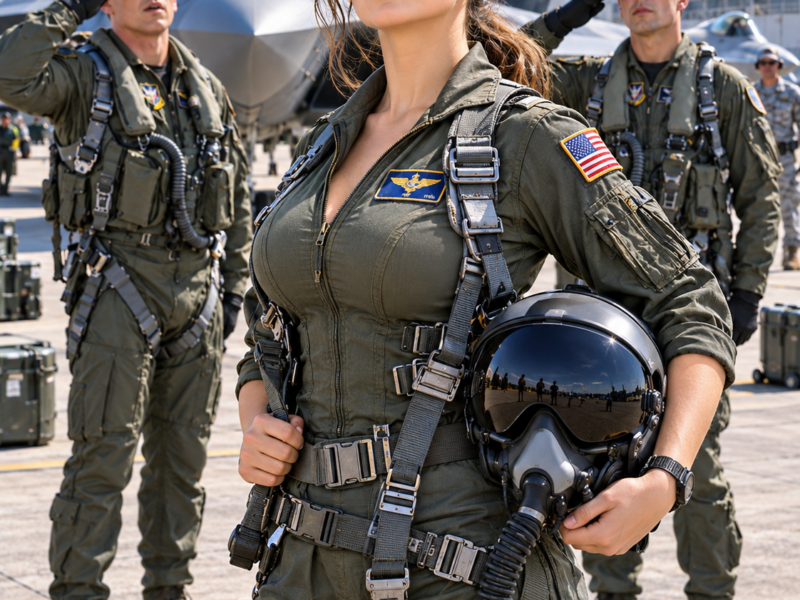
I hadn’t worn a flight suit in three years.
I hadn’t stood on a military runway in almost as long.
And I hadn’t expected anyone to remember.
Carol came and stood beside me.
“Was that for you?”
I nodded.
She looked at the sky.
“That’s quite a thank-you.”
I smiled.
“They didn’t have to do that.”
“Maybe they wanted to.”
I didn’t answer.
For the first time that day, I thought about my husband.
He would have loved seeing those jets.
He had spent years listening to me talk about the people I flew with, the aircraft I tested, and the strange family that existed among military pilots.
He used to tease me that I could recognize an aircraft by its engine sound before I could recognize a neighbor’s car.
I reached into my tote bag and found my phone.
There was a photograph of him saved as my lock screen.
I looked at his face.
“We got them down,” I whispered.
***
Later that evening, the airline arranged transportation and replacement flights for the passengers.
Before I left the terminal, Captain Alders found me near the exit.
He was carrying a small envelope.
“Colonel, I wanted to give you something.”
I opened it.
Inside was a handwritten note.
It read:
*Colonel Whitfield,*
*I have spent 26 years believing that experience means knowing what to do. Today reminded me that sometimes it means recognizing when someone else knows something you don’t.*
*Thank you for helping us bring everyone home.*
*James Alders.*
I folded the note carefully.
“James, you’re a good captain.”
He looked uncomfortable.
“I nearly lost that airplane.”
“But you didn’t.”
He nodded.
Then he said something that stayed with me.
“When I first saw you, I thought you were just another passenger who had decided to get involved in something she didn’t understand.”
I raised an eyebrow.
“That’s understandable.”
“Then I heard your name, and I remembered the reports.”
He paused.
“But what I remember most is that you never once acted like you were better than us.”
I looked at him.
“Because I wasn’t.”
He shook his head.
“Today, you could have made that cockpit about your career. Your record. Your rank.”
He held my gaze.
“You didn’t.”
I put the note inside my paperback.
“Neither did you.”
We shook hands.
Then he walked back toward the airline representatives.
***
The following morning, I finally reached Seattle.
My daughter, Emily, was waiting outside the arrivals area with my grandson in her arms.
The moment she saw me, she hurried forward.
“Mom!”
She hugged me so tightly that I nearly dropped my bag.
Then she pulled back and looked at my face.
“I saw the news.”
I looked at her.
“You did?”
“Mom, the entire country has apparently seen the news.”
I laughed.
She shook her head.
“Why didn’t you tell me you were on an airplane that had an emergency?”
“I was a little busy.”
She tried to smile, but her eyes filled with tears.
“I thought I was going to lose you.”
I touched her cheek.
“I’m here.”
She looked down at the baby.
“This is your grandson, Oliver. You almost missed meeting him.”
I took him carefully into my arms.
He was tiny.
His fingers curled around one of mine.
I looked at his face and felt something inside me settle.
For years, I had measured my life in flight hours, missions, test results, and aircraft recovered from situations that should never have happened.
I had spent so much time learning how to bring machines home that I had sometimes forgotten what home actually meant.
Now I was standing in an airport holding the smallest person I had ever loved.
And I understood why I had been so determined to get back on the ground the day before.
***
A few weeks later, the official investigation began establishing exactly what had happened to Flight 1163.
The engine failure and resulting damage had created a complicated emergency involving multiple aircraft systems.
Investigators examined the damaged engine, the affected hydraulic components, maintenance records, flight data, and cockpit recordings.
The airline also conducted a detailed review of the crew’s response.
I participated in the process and answered every question I could.
I was careful not to claim that one person had saved the aircraft.
That wasn’t how aviation worked.
There had been a flight crew.
There had been a cabin crew.
There had been air traffic controllers.
There had been emergency personnel waiting on the ground.
And there had been 178 passengers who followed instructions during a frightening situation.
The aircraft had made it to the runway because several people had done their jobs under extraordinary pressure.
I was simply one of them.
A few months later, I received a letter from Carol.
She had included a photograph taken after the evacuation.
I was standing beside her near the emergency vehicles, wearing the same navy cardigan I had boarded in.
My hair was untidy.
My jeans were stained with coffee.
I looked exhausted.
On the back, she had written:
*To the quiet woman in 14C, who reminded me that courage doesn’t always announce itself.*
I kept that photograph.
Not because it showed me doing something extraordinary.
But because it reminded me of everyone else who had been there.
***
About six months after the emergency, I received an invitation to speak at an aviation safety conference.
The organizers wanted me to discuss the incident, my years at Edwards, and the importance of recognizing unexpected expertise during emergencies.
I almost declined.
I wasn’t interested in becoming a celebrity because I had happened to be sitting on the right airplane at the wrong moment.
But then I received an email from Mark Sullivan.
He wrote that he had been invited to attend and hoped I would come.
At the bottom, he had added one sentence.
*I still think about the moment you walked into the cockpit. I hope someday I can offer someone else the same calm you offered us.*
I accepted.
At the conference, I stood before a room filled with pilots, engineers, safety officers, and flight instructors.
I spoke about preparation.
I spoke about humility.
I spoke about how quickly an emergency can strip away the assumptions people carry into a cockpit.
But I spent the most time talking about the cabin crew.
I told them about Carol.
I told them about the mother holding her little boy.
I told them about the businessman who had grabbed my wrist because he was frightened and didn’t know what else to do.
And I told them that when people are afraid, they don’t always behave the way they normally would.
Sometimes the person who appears least important in a room carries the knowledge everyone needs.
Sometimes the person who seems confident is terrified.
And sometimes the person who has spent years preparing for a crisis is simply grateful to have another chance to go home.
After the conference, a young woman approached me.
She was probably in her late twenties, wearing a pilot’s uniform and carrying a notebook.
“Colonel Whitfield?”
“Yes?”
“I read about Flight 1163 during my training.”
I smiled.
“That’s a little strange.”
She laughed.
“Can I ask you something?”
“Of course.”
“How did you know you could walk into that cockpit and help?”
I considered her question.
Then I answered honestly.
“I didn’t know I could save the aircraft. I knew I had experience that might be useful, and I knew I would regret staying in my seat if I didn’t offer it.”
She wrote that down.
Then she looked up.
“Do you ever miss flying?”
I glanced toward the conference room windows.
“Every day.”
“Would you go back?”
I smiled.
“Not to the way things were. But I still find ways to be useful.”
She thanked me and walked away.
I watched her disappear into the crowd.
For a moment, I felt that familiar ache that came whenever I thought about the years I had spent in the air.
Then I remembered my daughter, my grandson, and the life waiting for me at home.
I didn’t feel the need to choose between them anymore.
***
A year after the emergency, I received one final surprise.
An envelope arrived at my house with a photograph inside.
It showed the two F-22 Raptors during their flyover.
Beneath the image were signatures from both pilots.
One had written:
*Colonel Whitfield, we learned from your work long before we knew your name. Thank you for reminding us why we chose this profession.*
I placed the photograph beside the old picture of my husband.
Then I looked at the paperback I had carried aboard Flight 1163.
Its cover was still bent.
There was a small coffee stain across the first few pages.
I opened it and found the place where I had stopped reading that morning.
I had been on page 117.
I read the same paragraph twice before smiling.
For 90 minutes, I had been invisible to almost everyone on that aircraft.
Nobody knew my history.
Nobody knew what I had done.
Nobody knew how many years I had spent preparing for situations most people would never encounter.
And that was fine.
Because I had never needed strangers to recognize my uniform, my rank, or my accomplishments.
I had only needed the chance to use what I knew when it mattered.
Sometimes I still think about the passengers who sat near me that morning.
The businessman who apologized.
The college student who later sent a handwritten thank-you note through the airline.
The mother and her little boy.
And Carol, who had taken a chance on a stranger when every instinct told her to keep the cockpit door closed.
I think about Captain Alders and Mark, too.
They were experienced pilots who had the humility to listen when their training alone wasn’t giving them the answers they needed.
But most often, I think about the moment the two F-22s passed overhead.
I had spent years watching aircraft disappear into the sky.
That afternoon, for once, I was standing on the ground, looking up.
And I realized that the greatest thing I had ever brought home wasn’t an aircraft, a medal, or a career.
It was 184 people who had boarded a plane expecting an ordinary Tuesday and were given the chance to see another morning.
I closed the paperback, placed it beside the photograph, and went into the next room.
My grandson was asleep in his crib.
I stood beside him for a while, listening to his quiet breathing.
For the first time in a very long time, I didn’t miss being in the cockpit.
I was exactly where I wanted to be.
The end.









