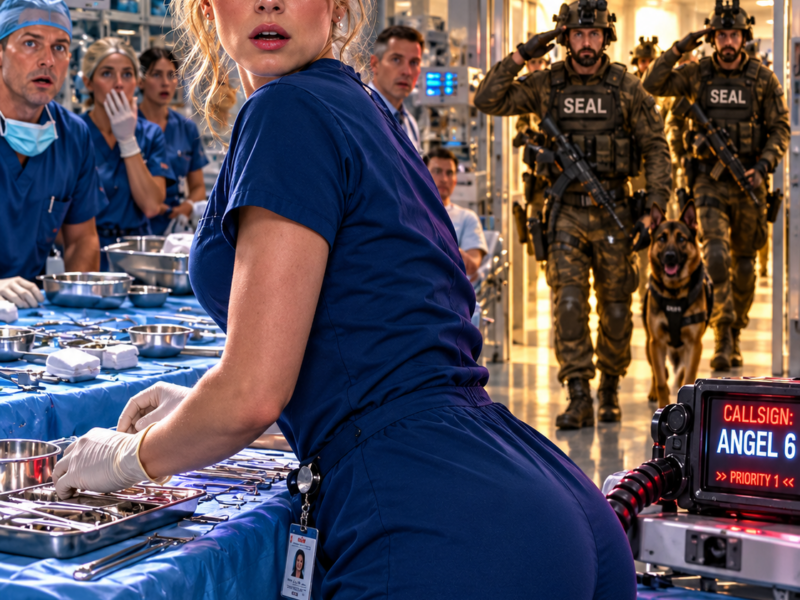
“At 3:07 a.m., the rural ER physician who had spent two years calling me the hospital’s quiet little joke suddenly stopped laughing when the radio crackled
Daniel’s voice came through the radio again.
“Emily, did you hear me?”
I pressed the transmit button, keeping my eyes on the trauma bay doors.
“I heard you. Tell me who is in the vehicle.”
There was a long pause.
Then Daniel said a name I hadn’t heard spoken aloud in almost four years.
“Captain Michael Hayes.”
My fingers tightened around the radio.
Across the nurses’ station, Mason was watching me with an expression I’d never seen on his face before.
“Who is Captain Hayes?” he asked.
I ignored him.
“Daniel, confirm that identification.”
“Confirmed. He’s in the passenger seat of the black SUV. Unconscious when we reached him. He’s breathing, but his condition is deteriorating.”
I swallowed.
“Is he alone?”
“No.”
“Who else?”
Daniel’s voice dropped.
“That’s the problem. We found a second person in the back seat. Male, approximately forty. He has a gunshot wound, and he’s wearing an old unit insignia.”
For a moment, the ER seemed to move farther away.
I knew that insignia.
I’d helped design the medical identification system used by our team during deployments overseas.
And there was only one person who still wore the original version.
“Daniel,” I said carefully, “tell me the second man’s name.”
He didn’t answer immediately.
Then the radio crackled.
“Staff Sergeant Ryan Mitchell.”
Hannah looked at me.
“Emily, are you okay?”
I handed her the radio.
“Prepare Trauma One. Get the blood cooler ready. Tell the lab we’re expecting a massive transfusion.”
Mason stepped forward.
“Hold on. You’re giving orders now?”
I turned toward him.
“We have two critical patients coming in. One needs immediate surgery. The other may be bleeding internally. We don’t have time for this conversation.”
His jaw tightened.
But he moved.
For the first time since I’d started working at Cedar Ridge, he didn’t make a joke.
I walked into Trauma One and began checking the equipment.
My hands knew what to do.
The monitors.
The suction.
The airway cart.
The emergency blood protocol.
I had performed these tasks hundreds of times.
But tonight, every familiar object seemed connected to a different memory.
A different hospital.
A different country.
A different version of myself.
Four years earlier, I’d been Lieutenant Emily Carter, senior combat medic attached to a special operations medical support unit.
We called ourselves the Ravens.
We weren’t famous.
We didn’t appear in newspapers.
Most people would never recognize the name of our unit.
Our job was simple to describe and difficult to survive: get wounded people out, keep them alive, and make sure nobody was left behind.
Captain Michael Hayes had been our commanding officer.
Ryan Mitchell had been our communications specialist.
Daniel Foster had been our field operations coordinator.
And I had been the medic everyone called when the situation became too complicated for ordinary procedures.
Until one night in Afghanistan.
One night that ended with three casualties, a missing radio log, and an official investigation that concluded I had abandoned my assigned position during an evacuation.
I had denied it.
Nobody believed me.
My medical credentials were reviewed.
My military career ended.
And the people I had trusted most stopped returning my calls.
I moved to Montana because nobody in Cedar Ridge cared about my old rank.
They needed a nurse who could work nights.
I needed somewhere quiet enough to sleep.
For three years, I had almost managed to forget.
Then the ambulance sirens began echoing through the parking lot.
At 3:24 a.m., the first stretcher came through the doors.
Michael Hayes was barely recognizable.
His once-dark hair had turned almost completely gray, and there was blood along his forehead.
A paramedic was holding pressure against his abdomen.
“Male, fifty-two. Found unconscious. Suspected internal bleeding. Blood pressure dropping.”
I stepped beside the stretcher.
“Michael?”
His eyelids moved.
For a second, I thought he might recognize me.
Then his eyes opened.
“Emily?”
“I’m here.”
He tried to lift his hand.
“Don’t let them…”
His voice disappeared beneath a cough.
I leaned closer.
“Don’t let who?”
His eyes moved toward Mason.
Then back to me.
“Don’t let them take the black box.”
Before I could ask what he meant, his eyes closed again.
Mason immediately took over the examination.
“Let’s get him on the monitor. Two large-bore IVs. Type and cross. Call surgery.”
I assisted with the transfer.
His abdomen was rigid, and his blood pressure was dangerously low.
We needed to move quickly.
While Mason worked, the second stretcher arrived.
Ryan Mitchell was conscious, but barely.
His left shoulder was soaked with blood.
He looked toward the ceiling as the paramedics pushed him into Trauma Two.
Then his eyes found me.
“Well,” he whispered, “look who finally came out of hiding.”
I stood beside him.
“Save your strength.”
He gave a weak smile.
“Still giving orders.”
“Somebody has to.”
For the briefest moment, I saw the young man I remembered.
The one who used to make terrible coffee during long nights overseas.
The one who once stayed awake for thirty-six hours because I had been injured and refused to leave my bedside.
Then his expression changed.
“Emily, you shouldn’t have answered that radio.”
I glanced toward the hallway.
“Why?”
He turned his head slightly.
“Because they know you’re here now.”
Before I could ask who he meant, he lost consciousness.
The next forty minutes were a blur of medical decisions.
Michael needed emergency surgery.
Ryan needed blood, imaging, and a specialist to evaluate the damage to his shoulder.
Our on-call surgeon, Dr. Patel, arrived in sweatpants beneath his white coat.
He took one look at Michael’s scans and ordered the operating room prepared.
Mason stood beside him, studying the images.
“There’s significant abdominal bleeding. We need to move now.”
I checked the blood pressure again.
“Seventy over forty.”
Dr. Patel looked at me.
“Let’s go.”
As they prepared Michael for surgery, his hand suddenly caught my wrist.
His eyes were open.
“Emily.”
I leaned closer.
“Don’t talk.”
He ignored me.
“Locker…”
“What locker?”
“Old station. Number seventeen.”
His fingers tightened.
“Find the original recording.”
Then he released me.
I watched the surgical team take him away.
Mason stood beside the doorway.
“Would you like to explain why our patient is giving you instructions about a locker?”
I looked at him.
“Not right now.”
“Emily, this isn’t a military hospital.”
“No,” I replied. “It’s a hospital with two critically injured patients. That’s what matters.”
He stared at me for a moment.
Then he looked down at the chart.
I returned to Ryan’s room.
He was awake again.
Hannah was checking his IV when I entered.
“He’s been asking for you,” she said quietly.
I thanked her and waited until she stepped outside.
Ryan looked at me.
“How long have you been here?”
“Almost three years.”
“Three years?”
“Yes.”
He gave a painful laugh.
“Michael was right. You really did disappear.”
I pulled a chair beside his bed.
“I didn’t disappear. I was discharged.”
His expression softened.
“Emily…”
“Don’t.”
He looked toward the window.
“We were told you left us.”
I stared at him.
“Who told you that?”
“Command.”
I felt my throat tighten.
“They told you I abandoned the evacuation?”
Ryan didn’t answer.
He didn’t need to.
I leaned forward.
“I carried Daniel’s replacement radio through a burning medical station. I stayed with the wounded until the last transport arrived. I was the one who went back for you.”
Ryan closed his eyes.
“I know.”
The words landed harder than I expected.
“You know?”
He nodded.
“I saw the footage.”
“What footage?”
He looked at the door.
“Not here.”
I lowered my voice.
“Ryan, what happened tonight?”
He swallowed.
“Michael found the original mission recording.”
I stared at him.
“What recording?”
“The one they said never existed.”
I remembered the investigation.
The missing radio log.
The contradictory timestamps.
The testimony from men who had never been at the scene.
“What does it prove?”
Ryan looked directly at me.
“That you never abandoned your post.”
For several seconds, neither of us spoke.
I could hear the monitor beside his bed.
A steady electronic rhythm.
Three years of humiliation, three years of wondering whether I had somehow failed the people I loved, seemed to gather inside that small room.
“Who erased it?” I asked.
Ryan shook his head.
“Michael knows. But he wanted to bring it to you first.”
“Why?”
“Because your name isn’t the only one in that recording.”
He paused.
“There’s someone else.”
Before I could press him, a nurse entered to check his blood pressure.
I stepped outside.
Mason was waiting in the corridor.
“I spoke to the county sheriff,” he said.
I nodded.
“Good.”
“He wants to know why a military radio network was using our emergency frequency.”
“I’ll speak with him when the patients are stable.”
Mason folded his arms.
“Emily, I have worked in emergency medicine for seventeen years. I’ve never seen anyone take control of a trauma room the way you did tonight.”
I said nothing.
He continued.
“And I have apparently spent three years making assumptions about you.”
I looked at him.
“That’s one way to describe it.”
He glanced toward Ryan’s room.
“Who are these people?”
I considered lying.
It would have been easier.
But there was no point pretending the past hadn’t found me.
“Former colleagues.”
“Military?”
“Yes.”
He nodded slowly.
“Special operations?”
I didn’t answer.
His expression changed.
“That explains the callsign.”
“No,” I said. “It explains why you shouldn’t confuse a quiet person with an inexperienced one.”
He looked down.
For once, he didn’t have a clever response.
At 4:51 a.m., Hannah found me in the supply room.
She was holding a folded piece of paper.
“Emily, someone left this at the front desk.”
I opened it.
There was no name.
No return address.
Just six handwritten words.
YOU WERE NEVER SUPPOSED TO FIND IT.
Beneath them was a number.
17.
I read it twice.
Then I looked at Hannah.
“Who gave you this?”
“A man in a dark jacket. He said he was a family member.”
“Did you see his face?”
She shook her head.
“He left before I could ask.”
I folded the paper and placed it in my pocket.
“Don’t tell anyone about this.”
Her eyes widened.
“Emily, should we call security?”
“Yes. Quietly. And save the front desk camera footage.”
She nodded.
I walked to the nurses’ station and called Daniel using the private number I had kept for years.
He answered immediately.
“Emily?”
“Someone left a message at the hospital.”
I read it to him.
There was silence.
Then Daniel said something that made me grip the phone.
“Don’t go to locker seventeen alone.”
“Why?”
“Because Michael wasn’t the only one looking for that recording.”
“Who else?”
Daniel exhaled.
“Someone from the old command structure. Someone who signed the report that ended your career.”
I closed my eyes.
I knew the name before he said it.
“Colonel Richard Vance.”
“Yes.”
I looked through the glass doors toward the empty parking lot.
Vance had been the senior officer overseeing our unit during the investigation.
He had testified that my actions had endangered the evacuation.
He had personally recommended my removal.
I hadn’t heard his voice since the day I left the military medical review board.
“Why would he come here?”
“Because Michael has evidence that could destroy him.”
I lowered my voice.
“What evidence?”
Daniel hesitated.
“Emily, listen carefully. The original recording doesn’t just prove what happened during the evacuation. It contains a transmission that was never included in the official report.”
“Whose transmission?”
Daniel answered quietly.
“Yours.”
I felt the room tilt around me.
“That’s impossible. My radio was destroyed.”
“Your radio was damaged. The backup channel kept transmitting.”
I remembered the night.
The smoke.
The shouting.
The wounded men.
My hands covered in blood as I tried to keep pressure on a soldier’s chest.
And a voice through the static telling me to leave the injured behind.
I had refused.
The recording could prove it.
But if Daniel was right, it could also prove something worse.
“What’s on that transmission?”
He took a breath.
“Your final message before the evacuation. The one command claimed was never sent.”
I looked at the clock.
5:06 a.m.
“Daniel, where is locker seventeen?”
“An abandoned communications station outside town. About twenty miles north of Cedar Ridge.”
“Who has access?”
“Michael. Me. And the person who arranged the original cover-up.”
I felt cold despite the warmth of the hospital.
“How did Michael end up on that bridge?”
“That’s what we’re trying to figure out.”
Then Daniel added, “Emily, there’s something else. The accident wasn’t random.”
I stopped moving.
“What do you mean?”
“Someone forced their vehicle off the road. We found tire marks leading toward the bridge, and the black SUV had been followed for several miles.”
I looked toward the operating room.
“Was Michael carrying the recording?”
“No.”
“Then where is it?”
Daniel’s answer came slowly.
“He gave it to someone before he left.”
I thought about Michael’s first words when he regained consciousness.
Don’t let them take the black box.
“Who?”
“We don’t know yet.”
At 5:19 a.m., Dr. Patel came out of surgery.
He removed his mask and looked at me.
“He’s alive. We controlled the bleeding, but he’s not out of danger. The next twenty-four hours will be important.”
I nodded.
“Thank you, Doctor.”
He placed a hand briefly on my shoulder.
“You did good work tonight.”
I watched him walk away.
Then I returned to Michael’s room.
He was unconscious, pale beneath the hospital lights, with a ventilator assisting his breathing.
I stood beside his bed.
“Michael, you always said I was the worst person in the unit at following orders.”
His fingers didn’t move.
I looked at the monitor.
“Looks like you were right.”
I reached into my pocket and touched the folded note.
Number seventeen.
At 5:43 a.m., Ryan woke up again.
I was sitting beside him when he spoke.
“Did Michael make it?”
“He’s alive.”
Ryan closed his eyes.
“Good.”
I waited.
He looked at me again.
“You have to understand something.”
“What?”
“Michael didn’t find the recording by accident.”
I leaned forward.
“Explain.”
He swallowed.
“Three weeks ago, someone contacted him. They said they had proof that the investigation had been manipulated.”
“Who contacted him?”
“A woman.”
“Name?”
“Sarah.”
I frowned.
“Sarah who?”
Ryan shook his head.
“I never got her last name.”
“Was she military?”
“No. She worked in records administration at the regional command office.”
I stared at him.
I remembered Sarah.
Not her last name, but her face.
She had been the young civilian clerk who processed our medical reports after the evacuation.
Quiet.
Careful.
Always carrying a blue folder.
“Why would she have the recording?”
Ryan looked toward the door.
“Because she was the one who copied it before the original files disappeared.”
My mouth went dry.
“Where is she now?”
Ryan hesitated.
“That’s what Michael was trying to tell you.”
I waited.
“She was the person in the back seat with him.”
The room seemed suddenly smaller.
The second casualty.
The man with the gunshot wound.
Ryan’s eyes filled with tears.
“No, Emily. Sarah was the second casualty.”
I stared at him.
“Then who was in the back seat?”
Ryan didn’t answer.
He reached for my hand and squeezed it.
“That’s the part we haven’t figured out.”
At 6:02 a.m., the hospital’s security officer called me to the front entrance.
The man who had delivered the note was visible on the camera footage.
He wore a dark jacket and a baseball cap.
His face was turned away from the lens.
But when he reached into his pocket to pay for a coffee at the vending machine, the camera captured his left hand.
There was a distinctive silver ring.
A black raven engraved into the surface.
I knew that ring.
I’d seen it on the hand of the man who had stood beside Colonel Vance during my discharge hearing.
Major Thomas Bell.
The officer who had signed the report stating that I had abandoned my patients.
I stared at the screen.
“Emily?” the security officer asked.
I didn’t respond.
My phone vibrated.
A message from an unknown number appeared.
STOP LOOKING FOR THE RECORDING.
I read it once.
Then another message arrived.
WE KNOW WHERE DANIEL IS.
I immediately called him.
No answer.
I called again.
Still nothing.
Then a third message appeared.
YOU HAVE UNTIL SUNRISE.
I looked at the clock.
6:14 a.m.
Outside, the first pale light was beginning to spread across the Montana mountains.
For three years, I had believed that my career ended because people had misunderstood what happened that night.
Now I understood something far more disturbing.
Someone had known exactly what happened.
Someone had deliberately changed the record.
And someone was still willing to hurt people to keep the truth buried.
I walked to Trauma Two.
Ryan was awake, watching me.
“What’s happening?” he asked.
I showed him the messages.
He read them slowly.
Then he looked at me.
“Emily, you can’t go.”
I placed the phone in my pocket.
“I’m not going anywhere without calling the sheriff.”
“That’s not what I mean.”
He reached for my wrist.
“You’re not understanding. The person who sent those messages isn’t trying to scare you away from locker seventeen.”
I looked at him.
“What are they trying to do?”
Ryan’s voice dropped to a whisper.
“They’re trying to make sure you open it.”
I stared at him.
He continued.
“Michael told me something before the crash. He said the original recording wasn’t the only thing inside that locker.”
“What else?”
Ryan looked directly into my eyes.
“Your medical report from that night.”
I frowned.
“My report was submitted years ago.”
“Not the official version.”
He took a shaky breath.
“The original one. The one you wrote before command changed it.”
I felt my stomach tighten.
I remembered writing it.
Six pages.
Names.
Times.
Patient conditions.
Every order transmitted over the radio.
And one final paragraph describing an instruction I had received from a senior officer.
An instruction to leave a wounded soldier behind.
I had refused.
I had documented everything.
Then the report vanished.
The investigation claimed I had never submitted it.
I looked at Ryan.
“Why didn’t you tell me this earlier?”
“Because I didn’t know if I could trust anyone.”
He paused.
“Not even you.”
I pulled my hand away.
That hurt more than I expected.
But before I could respond, the hospital’s emergency phone rang.
Hannah answered.
Then she looked toward me.
“Emily, it’s the sheriff.”
I took the receiver.
“This is Carter.”
The sheriff’s voice was tense.
“Your former colleague Daniel Foster has been located.”
I closed my eyes in relief.
“Where is he?”
There was a pause.
“At the abandoned communications station north of town.”
I looked toward the window.
“Is he safe?”
The sheriff didn’t answer immediately.
“That’s why I’m calling. His vehicle is there, but we haven’t found him.”
I tightened my grip on the phone.
“How long has he been missing?”
“According to the last signal from his phone, approximately forty minutes.”
I looked at the clock.
6:21 a.m.
Then the sheriff said something else.
“We also found a second vehicle parked behind the station.”
“What kind?”
“A black government-issued SUV.”
I slowly lowered the receiver.
Because I knew exactly who still had access to those vehicles.
And I knew why Daniel had gone to locker seventeen.
I turned toward Ryan.
“I need you to tell me one thing.”
He looked at me.
“Did Michael know who was following him?”
Ryan nodded.
“Yes.”
“Who?”
His eyes moved toward the hospital entrance.
Then he whispered a name.
“Colonel Vance.”
I stood still.
Three years ago, Vance had ended my career with a few paragraphs in an official report.
Now he had followed my friends to Montana.
He had sent someone to my hospital.
And Daniel was missing.
I looked down at my hands.
They were steady.
That surprised me.
For three years, I had trained myself to be the quiet nurse who didn’t argue, didn’t complain, and didn’t ask anyone to believe her.
But I was no longer interested in convincing people who had already decided I was guilty.
I picked up the phone and called the sheriff again.
“Deputy, I need you to listen carefully. Don’t let anyone enter that communications station until your people secure the perimeter. I know what you’re looking for, and I know who may be inside.”
He asked me whether I was certain.
I looked through the glass toward Michael’s room.
“No,” I said. “But I’m going anyway.”
The sheriff arrived at the hospital twenty minutes later.
His name was Frank Dawson, a broad-shouldered man in his late fifties with a weathered face and the patient manner of someone who had spent decades listening to people tell him things they weren’t sure they wanted to admit.
He had already watched the security footage.
He had already seen the messages.
And he wasn’t particularly pleased that a potential federal matter had landed in his county.
“Emily, I need you to understand that I can’t authorize you to conduct an investigation.”
“I’m not asking you to.”
“Then what are you asking?”
“Protection for the patients, a secure perimeter at the station, and an explanation of why a man who hasn’t lived in Montana for three years is sending threats to my phone.”
Dawson rubbed his jaw.
“That’s fair.”
He looked toward the operating room.
“Are those men really your former military colleagues?”
“Yes.”
“And the people threatening them?”
I took a breath.
“Former command officers.”
He nodded slowly.
“Then we’ll do this carefully.”
He arranged for two deputies to remain at the hospital and sent another unit toward the communications station.
I stayed.
I hated staying.
But Michael was still recovering from surgery, Ryan was unstable, and neither of them could be left without someone who understood their medical history.
At 7:10 a.m., Mason found me outside the ICU.
He had changed into a fresh set of scrubs.
“Emily.”
I turned.
He looked exhausted.
“I owe you an apology.”
I waited.
He continued, choosing his words carefully.
“I’ve spent a long time making jokes about you because I didn’t understand you. That’s not an excuse.”
“No, it isn’t.”
He nodded.
“I know.”
For a moment, neither of us spoke.
Then he said, “I reviewed your work tonight. Every decision you made was right. I should have trusted your judgment earlier.”
I looked through the glass at Michael.
“Trust isn’t something you can demand after ignoring someone for years.”
“I understand.”
I believed he was sincere.
That didn’t mean the damage disappeared.
Mason glanced at my phone.
“Are you expecting more threats?”
“Possibly.”
“Then don’t handle this alone.”
I looked at him.
He shifted uncomfortably.
“I know I’m probably the last person you’d want to hear that from.”
I almost smiled.
“Probably.”
He accepted that.
Then he walked away.
At 8:03 a.m., Deputy Dawson called.
They had found Daniel.
He was alive.
He was inside the old communications station, locked in a storage room with a head injury and his hands tied.
The deputies had arrested a man at the rear entrance.
But Colonel Richard Vance wasn’t among them.
Neither was Major Bell.
Daniel was transported to Cedar Ridge.
When he arrived, I was waiting outside the treatment room.
He looked older than I remembered.
His beard was streaked with gray, and there was a deep cut above his eyebrow.
But when he saw me, he managed a tired smile.
“Still wearing the same expression.”
I shook my head.
“Still talking too much.”
He laughed, then winced.
I helped him onto the bed.
After the doctor examined him, I pulled a chair beside him.
“Tell me everything.”
Daniel looked toward the closed door.
Then he reached inside his jacket and removed a small memory card.
“I got this from locker seventeen.”
I stared at it.
“Where’s the black box?”
“Destroyed.”
My stomach tightened.
“Then what is that?”
“The original backup.”
He placed it in my hand.
“Michael was right. It contains the radio transmission, your medical report, and a second recording.”
I looked at him.
“Whose?”
Daniel’s eyes filled with something between anger and grief.
“Colonel Vance.”
I sat very still.
“What does he say?”
Daniel swallowed.
“Everything.”
The memory card was eventually transferred to federal investigators.
They took possession of it under a formal evidence protocol, photographed the packaging, recorded the chain of custody, and made a forensic copy.
I watched the process from a small conference room at the sheriff’s office.
For the first time in years, I wasn’t being asked to defend myself.
I was being asked to identify my own voice.
The recording began with static.
Then came the sound of boots, distant gunfire, and men shouting over one another.
I heard my younger voice calling out patient conditions.
I heard Ryan asking for an evacuation route.
I heard Michael ordering the team to move toward the eastern access point.
Then a different voice entered the recording.
Colonel Vance.
“Leave the remaining casualties. The extraction window is closing.”
My younger voice answered immediately.
“Negative. We have two wounded personnel still alive.”
“That’s an order, Lieutenant.”
“They’re still breathing, sir.”
“Move your team.”
I closed my eyes.
There it was.
The moment that had followed me into every sleepless night.
Then came my final transmission.
“Raven Actual, this is Carter. I am remaining with the wounded until evacuation is complete. If command wants to remove me, they can do it after these men are alive.”
No one spoke in the conference room.
The recording continued.
A few minutes later, Vance transmitted again.
“Record that Lieutenant Carter abandoned her assigned position.”
I heard another voice.
Major Bell.
“Sir, she didn’t abandon anything. She’s still treating the casualties.”
Vance’s response was quiet.
“Then make sure the report says otherwise.”
I opened my eyes.
Daniel sat beside me.
He looked as though he had been waiting years for me to hear those words.
But the recording wasn’t finished.
A second transmission began.
Vance was speaking to someone over a private channel.
“Once the medical report is altered, the remaining issue is the missing patient.”
A man answered.
“She documented him.”
Vance replied, “Then find the original report.”
I leaned closer to the speaker.
The other man spoke again.
“What if the medic kept a copy?”
Vance paused.
“She won’t. She trusts the system.”
I felt something cold settle in my chest.
That wasn’t an argument about a missed order.
It wasn’t a misunderstanding.
They had known exactly what I had witnessed.
And they had deliberately removed it.
I turned toward Daniel.
“Who was the missing patient?”
Daniel looked down.
“Private First Class Noah Bennett.”
The name meant nothing to me at first.
Then I remembered the young soldier on the stretcher.
Nineteen years old.
Severe abdominal injuries.
A medical evacuation request that had been denied.
I’d stayed with him.
I’d treated him.
And when the final transport arrived, he had been alive.
I remembered writing his name in my report.
I remembered asking where he was being transferred.
I remembered being told he had died before evacuation.
But now the recording made something clear.
Vance had referred to him as the missing patient.
Not the deceased patient.
The missing patient.
I looked at Daniel.
“Did Noah die?”
He shook his head.
“We don’t know.”
“Then where is he?”
Daniel took a breath.
“That’s what Michael was trying to find out.”
I felt my hands begin to tremble.
The investigation had started as an effort to clear my name.
Now it had become something else entirely.
A search for a young soldier whose disappearance had been hidden beneath an official report.
The next few days passed slowly.
Michael survived surgery, although he developed an infection that required another procedure.
Ryan underwent treatment for his shoulder and began physical therapy.
Daniel stayed under observation.
The federal investigators interviewed all three men.
And for the first time in years, I gave a full account of the evacuation without being interrupted.
I told them about the wounded soldiers.
The orders.
The missing report.
The radio transmissions.
And Noah Bennett.
Major Bell was arrested two days later.
He was found in a motel outside Billings with documents connected to the original investigation.
Colonel Vance surrendered after federal agents presented him with the recordings and the altered reports.
He was charged with evidence tampering, obstruction, and conspiracy-related offenses.
The investigation continued for months.
Some details were classified.
Others were never fully explained.
But the most important discovery came from a set of financial records recovered from an office connected to the old command structure.
Noah Bennett had not died in the evacuation.
He had been transferred under a different identity to a military medical facility.
His injuries had been severe, and he had suffered memory problems after multiple surgeries.
He had eventually been medically discharged.
The report listing him as deceased had been used to conceal the fact that he had witnessed an unauthorized operation that Vance was trying to hide.
Noah had survived.
He had simply been erased from the official story.
When investigators located him, he was living in Oregon with his wife and young daughter.
He remembered very little about the evacuation.
But he remembered one thing.
A female medic who refused to leave him.
He remembered her voice.
He remembered her telling him to keep his eyes open.
And he remembered hearing someone say she had abandoned him.
When the investigators showed him my photograph, he began to cry.
I received his call on a Tuesday afternoon in early spring.
I was sitting at my kitchen table with a cup of coffee when an unfamiliar number appeared on my phone.
“Hello?”
A man’s voice answered.
“Is this Lieutenant Carter?”
I paused.
“It used to be.”
“My name is Noah Bennett.”
For several seconds, I couldn’t speak.
Then I stood up.
“You’re alive.”
He laughed softly, but there was pain in it.
“Apparently, I’ve been making a habit of that.”
I covered my mouth.
“I’m sorry.”
“For what?”
“For not finding you.”
He was quiet.
Then he said, “You did find me. You just didn’t know where they put me.”
I sat down again.
We spoke for nearly an hour.
He told me about his surgeries, the years of confusion, and the family he had built after leaving the service.
He had a daughter named Lily.
She was six.
He said she loved horses and hated vegetables.
I found myself smiling through tears.
Before we ended the call, he asked one question.
“Did they ever tell you why you stayed?”
I looked at the photograph on my refrigerator.
It was an old picture of the Ravens, taken before everything fell apart.
“Because you were still breathing,” I said.
Noah was silent for a moment.
Then he replied, “That’s what I thought.”
The following summer, I drove to Oregon to meet him.
His daughter ran across the yard when I arrived, carrying a small stuffed horse.
Noah stood behind her.
He looked healthier than he had in the photograph.
Older, yes.
But alive.
He introduced me to his wife, and we spent the afternoon sitting on the porch while Lily asked me questions about the mountains in Montana.
At one point, Noah disappeared inside and returned with a small wooden box.
“I wanted you to have this.”
Inside was a folded American flag and a photograph from the evacuation.
I recognized the picture immediately.
It showed me kneeling beside his stretcher, one hand holding a bandage against his abdomen.
I looked at Noah.
“Where did you get this?”
“Someone from the medical team kept it. They sent it to me years later.”
He pointed to the back.
There was a handwritten note.
SHE DID NOT LEAVE.
I held the photograph carefully.
For years, I had imagined that if the truth ever came out, I would feel victorious.
I didn’t.
I felt tired.
And grateful.
Grateful that Noah had survived.
Grateful that Michael, Ryan, and Daniel had refused to let the truth disappear.
And grateful that somewhere along the way, I had found the strength to keep working even when nobody knew what I had done.
A few months later, I returned to Cedar Ridge.
The hospital was exactly as I had left it.
The coffee was still terrible.
The ambulance bay door still jammed when the temperature dropped.
And the night shift still had too few nurses.
Mason was at the nurses’ station when I walked in.
He looked up.
“Welcome back, Nurse Ghost.”
I stopped.
He immediately looked uncomfortable.
“Sorry. Habit.”
I considered him for a moment.
Then I smiled.
“At least this time, you know I’m listening.”
He laughed.
It wasn’t a perfect apology.
But it was a beginning.
Hannah was still there, too.
She had become one of the strongest nurses on the overnight team.
When she saw me, she rushed over and hugged me.
“I knew there was something about you.”
I raised an eyebrow.
“That’s a dangerous thing to say.”
She laughed.
Then she asked whether I would ever tell the rest of the staff about my military service.
I thought about it.
“I might.”
“Why not now?”
I looked toward the ambulance entrance.
A new patient was being wheeled inside.
A frightened teenager with a broken arm.
His mother was walking beside him, trying not to cry.
I reached for a pair of gloves.
“Because right now, someone needs a nurse.”
Hannah nodded and followed me.
That night, at 3:07 a.m., the ambulance radio crackled.
A familiar voice came through.
“Raven Actual to Cedar Ridge. Just checking that you’re still awake.”
I stopped beside the nurses’ station.
It was Daniel.
I picked up the microphone.
“Raven Actual, this is Carter. Go ahead.”
His laughter filled the radio.
“Just wanted to say good morning.”
I looked around the ER.
Mason was smiling.
Hannah was shaking her head.
And for the first time, nobody laughed at the callsign.
I pressed the button again.
“Good morning, Daniel.”
Then I placed the radio back on its hook and returned to my patient.
My name was Emily Carter.
I was a nurse in a small Montana emergency room.
I wasn’t a ghost.
I wasn’t a joke.
And I no longer needed the world to know what I had once been to understand what I was worth.
THE END.









