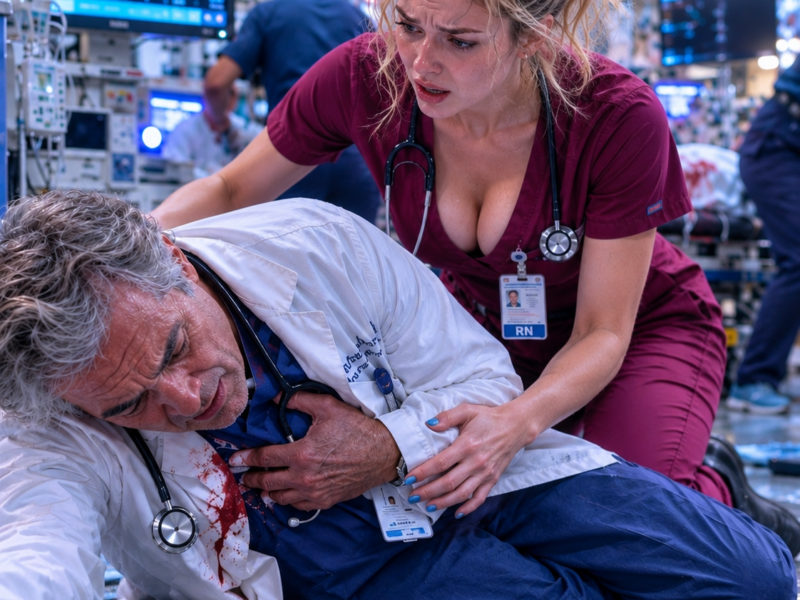
“At 2:17 a.m., the chief surgeon grabbed my wrist in front of seven patients and demanded to know why a rookie nurse had overridden his orders
I stared at the photograph in Margaret Collins’s hand.
The corridor seemed to grow quieter around me.
It was an old picture, slightly yellowed at the edges, with a crease running through the middle.
A younger version of my mother stood beside a hospital bed, wearing a white nurse’s uniform.
Her dark hair was tied back, and she looked exhausted.
But she was smiling.
In her arms was a newborn wrapped in a pale blue blanket.
The baby had a tiny blue star pinned to the corner of the blanket.
The same star I wore beneath my name badge.
I looked up at Margaret.
“That’s my mother.”
Margaret nodded slowly.
“Her name was Susan Carter.”
“Yes.”
“And the baby?”
Margaret didn’t answer immediately.
Instead, she looked toward Dr. Lawson.
“Michael, I think you should sit down.”
He gave a short, uncomfortable laugh.
“Margaret, I don’t understand why we’re discussing a photograph in the middle of a staffing dispute.”
“Because this photograph concerns a decision made at this hospital twenty years ago.”
His expression changed.
“That’s impossible.”
I stepped closer.
“What decision?”
Margaret looked at me with an expression I couldn’t quite read.
“Your mother worked at Westbridge Hospital before it merged with St. Mary’s. She was a neonatal intensive care nurse. Twenty years ago, she was involved in a case that changed several lives.”
I felt my throat tighten.
“My mother never told me she worked in a neonatal unit.”
“She didn’t want to.”
“Why?”
Margaret lowered the photograph.
“Because she believed she had failed someone.”
Those words landed harder than I expected.
My mother had always been careful about how she talked about her past.
She rarely discussed her nursing career.
When I was little, I knew only that she’d worked long hours at a hospital before eventually leaving the profession.
She raised me alone after my father died.
Whenever I asked why she never returned to nursing, she’d say, “Some things are harder to leave behind than people realize.”
I had assumed she was talking about grief.
Now I wasn’t so sure.
“Where is the baby?” I asked.
Margaret looked down at the photograph.
“That’s what we need to establish.”
Dr. Lawson shifted his weight.
“This is becoming ridiculous. We have patients to care for.”
Margaret finally turned toward him.
“Then perhaps you should return to them instead of trying to intimidate a nurse who just helped save seven lives.”
His jaw tightened.
“She disobeyed direct instructions.”
“She escalated legitimate clinical concerns. If you have evidence of misconduct, submit it through the proper review process.”
For once, Dr. Lawson had nothing to say.
Margaret motioned toward a small conference room.
“Emily, please come with me.”
I followed her, still looking at the photograph.
Before the door closed, I glanced back at the corridor.
Dr. Lawson was watching us.
He wasn’t angry anymore.
He looked worried.
And that frightened me more than his shouting.
Inside the conference room, Margaret placed the photograph on the table.
She sat opposite me and folded her hands.
“I need to explain something, but I also need you to understand that some of the records from that period are incomplete.”
“Why?”
“Westbridge was dealing with a serious staffing and financial crisis. Several departments were being reorganized. During that period, there was a neonatal emergency involving two newborn girls.”
I stared at her.
“Two girls?”
“Both were born prematurely within minutes of each other. One mother had suffered severe complications during delivery. The other family had traveled from out of state.”
She paused.
“Your mother was assigned to the neonatal unit that night.”
I looked again at the photograph.
“Which baby is this?”
Margaret took a breath.
“According to the original nursing notes, the baby in your mother’s arms was identified as Baby Carter.”
My hands went cold.
“Then that’s me.”
“That’s what the records suggest.”
“Why would there be another baby?”
Margaret opened her briefcase and removed a thin folder.
“The other infant was registered as Baby Bennett. The Bennett family was wealthy and had strong connections to the hospital board.”
I waited.
“Both babies were receiving treatment in the same unit. There was an emergency evacuation during a power failure. The unit’s backup systems were activated, but several records had to be reconstructed afterward.”
“An evacuation?”
“One of the electrical panels overheated. Smoke entered part of the neonatal wing. Staff moved the infants to another section while firefighters secured the area.”
I tried to picture my mother carrying a newborn through a smoke-filled hospital.
“Did something happen to the babies?”
Margaret looked at me.
“One infant was later reported deceased.”
My stomach tightened.
“Which one?”
“The official record says Baby Carter.”
I stared at her.
For a few seconds, I couldn’t make sense of the sentence.
“That’s impossible. I’m Emily Carter.”
Margaret nodded.
“Exactly.”
I stood so quickly that the chair scraped against the floor.
“Are you telling me my mother was given a dead baby’s identity?”
“I’m telling you that the records don’t match.”
“That’s not an answer.”
“I know.”
I pressed both palms against the table.
“Why didn’t anyone investigate?”
“An internal review was conducted. But the hospital’s original neonatal director resigned shortly afterward. Several documents were never recovered, and the matter was eventually closed.”
I looked at the photograph again.
The baby was alive.
My mother was smiling.
And somewhere in the hospital’s records, that child had been declared dead.
“Who was the other family?”
Margaret hesitated.
“The Bennetts.”
I almost laughed.
The name sounded familiar, but I couldn’t place it.
Then Margaret said something that made my stomach drop.
“The current chairman of our hospital board is Richard Bennett.”
I knew that name.
Everyone at St. Mary’s knew it.
Richard Bennett was a wealthy businessman whose donations had funded the new surgical wing, the emergency department renovation, and the children’s rehabilitation center.
His portrait hung near the hospital entrance.
He was also Dr. Lawson’s father-in-law.
I looked toward the conference room door.
“Is that why Dr. Lawson was so upset?”
Margaret didn’t answer.
Instead, she opened the folder and showed me a photocopy of an old nursing report.
My mother’s handwriting was unmistakable.
The final line read:
“Infant transferred alive. Identification discrepancy reported to supervisor. Awaiting verification.”
I read it twice.
“She knew.”
Margaret nodded.
“Your mother reported a discrepancy that night.”
“Then why was the baby declared dead?”
“I don’t know.”
“Who signed the report?”
Margaret turned the page.
There were two signatures.
One belonged to the hospital’s former neonatal director.
The other was difficult to read.
But the initials were clear.
M.L.
I stared at them.
“Who is M.L.?”
Margaret slowly closed the folder.
“Michael Lawson’s father.”
For a moment, I couldn’t hear anything except the ventilation humming above us.
Dr. Lawson’s father had been involved in the original case.
And now his son was trying to silence me.
“Does Michael know about this?”
Margaret looked away.
“I believe he knows more than he has admitted.”
I sat down.
The seven patients I’d helped that night suddenly felt connected to something much larger than a disagreement over hospital procedures.
I thought of Robert Hayes.
Jessica Miller.
The other five people whose lives had nearly slipped away.
I thought about how easily someone could dismiss a warning simply because it came from a person they considered unimportant.
Then I looked at the photograph.
“Where is my mother now?”
“At home, I believe.”
“I need to talk to her.”
Margaret nodded.
“Before you do, there’s something else.”
She reached into her briefcase and removed a small envelope.
It was sealed and marked with a date from twenty years earlier.
The handwriting on the front belonged to my mother.
Emily.
I couldn’t breathe for a second.
“Where did you get that?”
“It was found in a storage box during the hospital’s recent records audit. It was addressed to the hospital’s former director but never entered into the official correspondence system.”
I took the envelope.
My name was written in blue ink.
I turned it over.
The flap had already been opened and resealed.
Inside was a single folded sheet.
The first sentence made my eyes sting.
“If Emily ever comes looking for the truth, please don’t let her believe I abandoned the child I was supposed to protect.”
I read the sentence again.
Margaret sat quietly while I continued.
The letter described the night of the evacuation.
My mother had been assigned to care for both premature infants.
She wrote that the babies had similar identification bands and that one of the labels had become detached during the transfer.
She had immediately reported the problem.
But the supervisor instructed her to wait until the attending physician completed the emergency assessment.
By the time she returned, the babies had been transferred to separate rooms.
The records listed one child as deceased.
The other as discharged.
My mother had insisted that the identification was wrong.
She had asked for a formal investigation.
Instead, she was accused of mishandling the records.
The final paragraph was shorter.
“I know what I saw. Both children were alive when they left my care. If the hospital insists otherwise, then someone has decided that the truth is less important than the people who would be hurt by it.”
I lowered the paper.
“Why didn’t she tell me?”
Margaret looked genuinely sad.
“Perhaps she thought she was protecting you.”
“From what?”
“From being pulled into something she couldn’t prove.”
I folded the letter carefully.
“She shouldn’t have had to protect me from the truth.”
Margaret didn’t disagree.
I left the hospital just after sunrise.
The rain had stopped, but the streets were wet and gray.
I drove straight to my mother’s house in a quiet neighborhood outside Chicago.
She was in the kitchen when I arrived, wearing her old cardigan and preparing coffee.
She looked up when I entered.
“You’re early.”
I placed the photograph on the table.
Her hand stopped above the coffee pot.
For several seconds, neither of us spoke.
Then she slowly pulled out a chair.
“Where did you find that?”
“At St. Mary’s.”
She sat down.
I put the letter beside it.
Her eyes filled immediately.
“Oh, Emily.”
I had rehearsed dozens of questions during the drive.
But when I saw her face, all I could manage was one.
“Who was the baby in this photograph?”
My mother closed her eyes.
“You.”
“Then why did the hospital record say I died?”
She reached across the table.
I didn’t take her hand.
“Because I made a mistake,” she whispered.
“What mistake?”
She swallowed.
“Not the one they accused me of making.”
She told me the story slowly.
Twenty years earlier, she had been caring for two premature newborn girls.
One was the daughter of a young woman named Laura Bennett.
The other was my mother.
At the time, Susan was pregnant and had gone into premature labor.
She had no partner, no family support, and very little money.
The delivery had been complicated.
I had been born weighing just over three pounds.
My mother remembered holding my tiny hand through the incubator opening.
She remembered promising me that she would never let me grow up feeling unwanted.
Then came the electrical fire.
During the evacuation, one of the babies was moved with an identification label that had been damaged by water.
My mother noticed the discrepancy and reported it.
But the neonatal director told her to continue caring for the infants while he verified the paperwork.
By morning, one family had been told their child had died.
The other family had taken home a baby under the wrong identity.
I stared at her.
“Which family?”
My mother looked at me.
“The Bennett family.”
I couldn’t speak.
She nodded.
“Emily, the baby they believed was their daughter was actually you.”
I felt the chair beneath me shift.
“What?”
“You were the baby who went home with Richard Bennett and his wife.”
I shook my head.
“No. You raised me.”
“I raised you because I was your mother. I never gave you away.”
“Then who did they take home?”
My mother began crying.
“Laura Bennett’s daughter.”
I pushed back from the table.
“You’re saying Richard Bennett raised another woman’s child while believing she was his?”
My mother nodded.
“And that baby was declared dead in the records.”
I looked at the photograph.
The woman holding me was my mother.
The woman who had raised me was my mother.
But somewhere, another family had spent twenty years believing their daughter had died.
“Why didn’t you tell me?” I asked.
“Because when I tried to correct the records, the hospital threatened to charge me with negligence. They said I had mishandled the identification bands. I was a single mother with no money and a newborn who needed constant medical care.”
She wiped her cheeks.
“I was terrified they would take you from me.”
I sat back down.
“Did you know where the other baby went?”
“Not at first. I only knew that the Bennett family had taken home a child whose identification did not match the original transfer record.”
“Did you ever see her again?”
My mother shook her head.
“Once. About three years later, I saw Richard Bennett at a hospital fundraiser. He was carrying a little girl. I recognized her from the neonatal photographs.”
My fingers tightened around the edge of the table.
“Did you tell him?”
“I tried to approach him, but the hospital director stopped me. He said I would destroy two families if I continued.”
“That wasn’t his decision.”
“No,” my mother whispered. “But I was too afraid to fight him.”
I stared at her for a long time.
I wanted to be angry.
Part of me was.
But I could also see the twenty-six-year-old woman in front of me, holding a premature baby while powerful people told her that speaking the truth would cost her everything.
“What happened to the girl?”
My mother shook her head.
“I don’t know.”
I looked at the letter.
There was one sentence I hadn’t fully understood.
“If Emily ever comes looking for the truth, please don’t let her believe I abandoned the child I was supposed to protect.”
I turned the page over.
At the bottom was a name.
Laura Bennett.
And beneath it, an address.
My mother watched me.
“I kept that address because I never stopped hoping someone would look into it.”
I took a picture of the page with my phone.
Then I stood.
“Emily, please don’t go there alone.”
I turned back.
“Mom, that girl deserves to know.”
My mother nodded, tears slipping down her cheeks.
“I know.”
That afternoon, I drove to the Bennett residence.
It was a large house in a quiet suburb, with a stone walkway and a perfectly trimmed lawn.
I stood at the front door for almost five minutes before ringing the bell.
A woman in her early fifties opened it.
She had light brown hair, tired eyes, and a small scar near her chin.
“Can I help you?”
I held up the photograph.
“My name is Emily Carter. I think we need to talk about something that happened at Westbridge Hospital twenty years ago.”
Her expression changed.
She looked at the photograph.
Then at me.
Her hand tightened around the doorframe.
“Where did you get that?”
“From the hospital.”
She looked over her shoulder.
“Richard?”
A man’s voice answered from inside.
“What is it?”
Laura stepped aside.
“Come in.”
Richard Bennett appeared at the end of the hallway.
He was older than the photographs in the hospital lobby, but unmistakably the same man.
When he saw the picture, he stopped.
Then he looked at me.
“Who are you?”
I took a breath.
“My name is Emily Carter.”
He glanced at Laura.
For the first time, I saw fear cross his face.
“Not here,” he said.
Laura turned toward him.
“Richard, what does that mean?”
He lowered his voice.
“Emily, you need to leave.”
I looked at him.
“I think your daughter deserves to know why her birth records don’t match the hospital’s original nursing report.”
Laura’s face went pale.
“What birth records?”
Richard stepped forward.
“Don’t do this.”
I looked directly at him.
“Why was a baby declared dead when my mother documented that she was alive?”
He said nothing.
Laura turned toward her husband.
“Richard?”
His silence lasted too long.
Then she whispered, “You knew?”
He closed his eyes.
That was the moment I understood that this was not simply a hospital’s paperwork mistake.
Someone had known the truth.
Someone had kept it buried.
And someone had built an entire family around that decision.
Richard finally spoke.
“Laura, I can explain.”
She backed away from him.
“Then explain.”
He looked at me, then at her.
“Twenty years ago, we were told our daughter had died. Your mother was the nurse who brought us the baby.”
Laura stared at him.
“That’s not what you told me.”
“I know.”
“Then what happened?”
Richard rubbed his forehead.
“After the evacuation, the hospital director told us there had been a problem with the identification bands. He said the baby we had taken home might not be ours.”
Laura’s eyes filled.
“And you said nothing?”
“I was told the hospital would investigate.”
“That was twenty years ago.”
He looked down.
“Yes.”
I felt sick.
“Why didn’t you demand a DNA test?”
Richard finally looked at me.
“Because I already knew.”
Laura gripped the back of a chair.
“How?”
He hesitated.
Then he said something I hadn’t expected.
“Because the hospital director showed me the original transfer sheet. He told me the baby we had taken home was actually Susan Carter’s daughter.”
Laura covered her mouth.
“And you let me raise her believing she was ours?”
Richard’s voice cracked.
“I didn’t know what else to do.”
“You could have told me.”
“I was afraid.”
“Of what?”
He looked at me.
“Of losing the only child we’d ever brought home.”
The room went quiet.
I had expected anger.
I had expected excuses.
I hadn’t expected a man who looked like he had spent twenty years trying not to remember the same night.
“Where is she?” I asked.
Richard frowned.
“Who?”
“Your biological daughter.”
He lowered his head.
“Her name was listed as Baby Carter in the records. The hospital later told us she had died.”
I shook my head.
“No. My mother said both babies left the unit alive.”
Laura slowly sat down.
“Then where is our daughter?”
Richard didn’t answer.
I reached into my bag and removed the original nursing report.
I placed it on the table.
“Your daughter was transferred alive. The report says so.”
Laura picked it up.
Her eyes moved across the page.
Then she began to cry.
Richard took a step toward her.
She raised her hand.
“Don’t.”
For the next hour, we sat at the dining table and compared every document we had.
The birth dates matched.
The transfer times matched.
The identification numbers were nearly identical, except for one digit.
A digit that had been written over.
At the bottom of the transfer sheet was the signature of the former neonatal director.
And beside it was the initials of Michael Lawson’s father.
I finally understood why Margaret had looked so frightened.
The old hospital had not merely made a mistake.
It had allowed the mistake to become permanent.
Richard had been told the truth.
He had chosen silence.
And my mother had been threatened into silence.
But there was still one question.
Where was Laura’s daughter?
Richard finally opened a drawer and removed a small box.
Inside were hospital documents, photographs, and a folded letter.
“I kept these,” he said.
“Why?” Laura asked.
“Because I couldn’t throw away the only evidence that she had existed.”
He handed me the letter.
It was from the former neonatal director.
The date was three months after the evacuation.
The letter contained a brief statement:
“The infant identified as Baby Bennett was transferred to an outside pediatric facility under temporary care arrangements. All further records should be requested through the designated guardian.”
I read it twice.
“Who was the guardian?”
Richard pointed to a name near the bottom.
It was a woman named Patricia Miller.
I recognized the surname.
Jessica Miller.
The young mother from my shift.
My hands began to tremble.
I pulled out my phone and searched the hospital’s patient records system through the authorized clinical channel.
I couldn’t access historical family records, but I could see the information Jessica had voluntarily provided during her admission.
Her emergency contact was listed as Patricia Miller.
Her mother’s name.
I looked up.
“Jessica.”
Laura frowned.
“Who is Jessica?”
I explained that Jessica had been the patient who suffered a postpartum emergency during my shift.
Her mother had been listed as Patricia.
Richard stared at the name.
Then he sat down heavily.
“Patricia was the nurse who cared for our daughter after the evacuation.”
Laura gripped my arm.
“Are you saying Jessica might be our daughter?”
“I don’t know,” I said.
“But the name on this letter gives us a reason to ask.”
The room seemed to shrink around us.
Richard looked at Laura.
For twenty years, they had believed their daughter was dead.
Now they had a possible lead.
And I had a patient in my hospital who might be connected to the same night that had shaped my entire life.
We drove back to St. Mary’s together.
Jessica was recovering in the postpartum unit.
Her baby was sleeping beside her.
When we entered, she looked surprised to see me.
“Emily? Is everything okay?”
I approached carefully.
“You’re doing well. The doctors say you’re recovering.”
She smiled faintly.
“Good. My son has already made enough trouble for one lifetime.”
I smiled, but my eyes moved to the woman sitting beside her.
Patricia Miller.
She was in her late sixties, with silver hair and a soft expression.
When she saw Richard and Laura, the color left her face.
“Richard?”
He stepped forward.
“Patricia, we need to talk.”
She looked at Jessica.
“Not here.”
Jessica’s smile faded.
“Mom?”
Patricia took a breath.
“There’s something I should have told you a long time ago.”
Jessica looked between us.
“What’s happening?”
I pulled a chair closer to her bed.
“Jessica, we’re trying to understand something that happened at Westbridge Hospital twenty years ago. It involves two babies and some missing records.”
Her eyebrows drew together.
“Westbridge?”
Patricia sat down.
“I worked there. I was assigned to the neonatal unit after the electrical fire.”
Richard spoke quietly.
“Do you remember a baby girl transferred into your care?”
Patricia’s eyes filled.
“Yes.”
“Do you remember her name?”
She looked at Jessica.
Then she nodded.
“Laura Bennett’s daughter.”
Laura made a small sound.
“Was she alive?”
Patricia covered her mouth.
“Yes.”
Richard leaned forward.
“Where did she go?”
Patricia looked at Jessica again.
For a long moment, she seemed unable to speak.
Then she reached for her daughter’s hand.
“I adopted her.”
Jessica stared at her.
“What?”
Patricia’s tears began falling.
“I was told her parents had signed away their rights after the baby was declared abandoned. I was told there was no family willing to take her.”
Richard stood.
“That is a lie.”
Patricia shook her head.
“I didn’t know. I swear I didn’t know.”
Jessica pulled her hand away.
“Mom, what are you saying?”
Patricia looked at her daughter.
“Jessica, I raised you because I loved you. But you weren’t born to me.”
Jessica’s face went completely still.
I watched her eyes move from Patricia to Laura.
Then to Richard.
“No.”
Laura stepped forward.
“Sweetheart…”
“Don’t call me that.”
Her voice was barely audible.
She looked at me.
“Why are you here?”
I couldn’t find an answer that wouldn’t hurt her.
So I told her the truth.
“Because I think the hospital made a terrible mistake, and you deserve to know where you came from.”
Jessica looked down at her newborn son.
Her fingers tightened around his blanket.
“Does that mean my whole life was a lie?”
Patricia began crying harder.
“No. Nothing about loving you was a lie.”
Jessica turned away.
“Please leave.”
Richard tried to speak.
“Jessica, we only want—”
“Leave!”
The room fell silent.
Laura stepped back.
I touched Richard’s arm.
“Not today.”
He looked at me, then at the young woman in the hospital bed.
For the first time since I had met him, he seemed to understand that he had no right to demand anything.
We left.
Outside the room, Laura leaned against the wall and cried.
Richard stood beside her without touching her.
I returned to my unit.
There were still patients who needed me.
And there was a young mother inside room 214 who needed time more than she needed answers.
The following weeks were difficult.
Jessica refused to speak to Patricia.
She also refused to meet Richard or Laura.
The hospital opened an independent investigation into the Westbridge records.
Margaret provided every document she could find.
My mother gave a formal statement.
And the hospital board ordered an external review of the original neonatal case.
Dr. Lawson was placed on administrative leave after the investigation uncovered evidence that he had accessed historical records without authorization and had attempted to influence the internal review.
The most painful discovery came from an archived file stored off-site.
It contained the original identification labels from the evacuation.
The labels had been switched during the emergency transfer.
The neonatal director had discovered the error within days.
Instead of correcting it, he had ordered the records amended.
He feared lawsuits, professional consequences, and the collapse of the hospital’s reputation.
Richard had been informed.
He had agreed to remain silent because he feared losing the baby he had already brought home.
Patricia had been told that Jessica was an abandoned infant.
My mother had been threatened with professional discipline if she continued challenging the records.
No single person had created the entire tragedy.
But several people had made choices that allowed it to continue.
And the people who suffered most were the two children who grew up without knowing the truth.
Three months later, the hospital completed its investigation.
The records were corrected.
My legal birth certificate remained valid, but the hospital formally acknowledged that my biological mother was Susan Carter and that I had been mistakenly transferred to the Bennett family.
The investigation also confirmed that Jessica was Laura and Richard’s biological daughter.
For the first time in twenty years, the truth was officially recognized.
But truth didn’t immediately repair the damage.
Jessica still struggled.
She loved Patricia, but she was angry that the woman who had raised her had kept such an enormous secret.
She wanted to know why no one had questioned the adoption paperwork.
Patricia admitted that she had accepted the documents because she believed the hospital had handled everything legally.
She had never imagined that the people who gave her the baby might have been lying.
One afternoon, Jessica called me.
“Emily, can we talk?”
I met her at a small coffee shop near the hospital.
She looked tired.
Her son was asleep in his stroller.
“I’ve been thinking about something,” she said.
I waited.
“Do you hate Richard and Laura?”
I considered the question.
“I don’t know them well enough to hate them.”
“Do you think they deserve another chance?”
I looked at her.
“That’s not my decision.”
She stirred her coffee.
“Everyone keeps telling me they want to know me. But nobody asks whether I want to know them.”
I nodded.
“Then maybe that’s where they need to start.”
She looked down at her son.
“I spent my whole life thinking I was abandoned.”
Her voice cracked.
“And now I find out my biological parents were alive the entire time.”
I reached across the table.
“They didn’t know where you were.”
“But they knew I existed.”
“Yes.”
“That’s the part I can’t forgive yet.”
I didn’t tell her she should.
Some wounds don’t heal because someone else is ready to move on.
Sometimes the most loving thing a person can do is stop asking for forgiveness.
A few weeks later, Jessica agreed to meet Laura.
Not Richard.
Just Laura.
They chose a quiet park.
I wasn’t there, but Jessica told me afterward that they sat on a bench for nearly an hour without saying much.
Laura brought a photograph of herself holding Jessica’s newborn hospital picture.
Jessica brought a picture of her own son.
They didn’t hug.
They didn’t suddenly become a family.
But Laura asked whether she could call again.
And Jessica said yes.
That was enough for one afternoon.
Richard eventually sent Jessica a letter.
He didn’t ask her to forgive him.
He didn’t tell her how much he had suffered.
He simply admitted that he had known about the identification error and had chosen silence.
He wrote that he had been afraid of losing her, but that his fear had cost her the truth.
Jessica kept the letter in a drawer.
She didn’t answer it.
Not then.
As for my mother, something changed between us.
One evening, I visited her after work.
She was sitting on the porch, wrapped in a blanket, watching the last light disappear behind the trees.
I sat beside her.
“I used to think you never talked about nursing because you didn’t want to remember the hospital,” I said.
She smiled sadly.
“I didn’t want you to know how frightened I had been.”
I rested my head against her shoulder.
“You should have told me.”
“I know.”
She took my hand.
“I thought being brave meant carrying it alone.”
I looked at her.
“You didn’t have to.”
She squeezed my fingers.
For the first time, she allowed herself to talk about the years she had spent caring for newborns.
She told me about the babies who went home, the parents who cried with relief, and the ones whose names she still remembered.
She had never stopped loving nursing.
She had only stopped believing that the profession would protect her when she needed it.
I asked if she would ever consider returning to a hospital.
She looked toward the darkening street.
“Maybe someday.”
Six months after the night that started everything, St. Mary’s held a small ceremony to recognize the seven patients whose emergencies had brought attention to the failures in its clinical culture.
Robert Hayes attended.
So did Jessica, with her little boy sleeping against her shoulder.
Margaret spoke briefly about the importance of listening to nurses, regardless of their seniority.
Then she invited me forward.
I didn’t want a medal.
I didn’t want a speech about being a hero.
I had simply done what I believed a nurse should do.
But when Robert approached me afterward, he took both my hands.
“My daughter told me you stayed until the cardiologist arrived,” he said.
“I was just doing my job.”
He shook his head.
“Sometimes doing your job is exactly what saves someone.”
Jessica approached a few minutes later.
She was holding her son.
“I wanted to thank you,” she said.
I smiled.
“You don’t owe me anything.”
“I know.”
She looked down at her baby.
“But if you hadn’t listened to me that night, I might never have gotten to bring him home.”
I felt my eyes sting.
She hesitated.
Then she added, “I met Laura again last weekend.”
“How did it go?”
“We’re taking it slowly.”
She looked toward the entrance, where Patricia was waiting.
“Patricia is still my mom. Laura is someone I’m learning about. I don’t think I have to choose one to make room for the other.”
I smiled.
“That sounds like a good place to start.”
She nodded.
Then she walked over to Patricia.
They stood together for a moment before Patricia gently adjusted the blanket around the baby.
Jessica didn’t pull away.
It wasn’t a complete reconciliation.
It was something smaller and perhaps more honest.
A beginning.
Later that evening, I found my mother standing near the hospital entrance.
She was looking at the old photograph Margaret had returned to us.
The one showing her holding me as a premature newborn.
“Do you ever wonder what would have happened if the records had been corrected that morning?” I asked.
She looked at the photograph.
“All the time.”
“Would my life have been different?”
“Of course.”
She turned toward me.
“But I would still have loved you.”
I leaned against her shoulder.
Inside the hospital, the night shift was beginning.
Monitors were beeping.
Elevators were opening and closing.
Somewhere, a nurse was explaining medication instructions to a frightened patient.
The work continued.
Before I went upstairs, I looked once more at the tiny silver-blue star beneath my name badge.
For years, I had worn it because my mother gave it to me.
I had thought it was simply a reminder of where I came from.
Now I understood that it represented something else.
It reminded me that a person’s identity could be written incorrectly on a form, hidden in a file, or denied by someone with enough power.
But the truth didn’t disappear just because someone decided it was inconvenient.
And sometimes, the people who needed someone to listen weren’t the ones with the loudest voices.
They were the ones lying in hospital beds, waiting for someone to notice that something wasn’t right.
That night, I walked into the same corridor where Dr. Lawson had once grabbed my wrist.
My badge was still there.
My name was still Emily Carter.
And for the first time, I no longer felt that I had to prove I belonged.
THe end.









