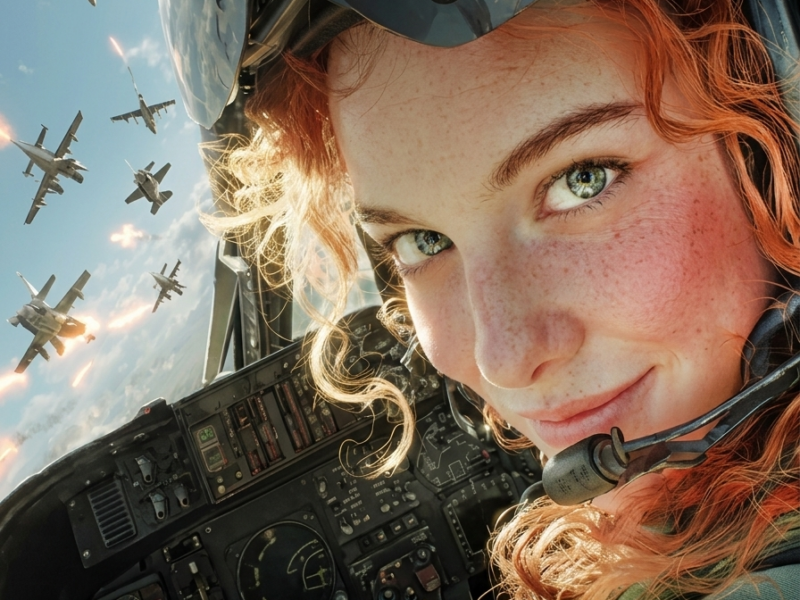
At 2:17 a.m. over the Nevada desert, I watched two fighter jets lock their missiles onto my Apache while my commander calmly called me a traitor
The air at four thousand feet above the Nevada desert smelled of scorched oil and old dust inside the cramped cockpit of the AH-64 Apache. It was 2:17 a.m., and the night sky was an endless sheet of void, save for the pale, ghostly glow of the horizon and the blinding glare of red warnings illuminating my visor.
My copilot, First Lieutenant David Vance, was breathing in shallow, jagged gasps behind me. His boots scraped nervously against the floorboards as the synthetic voice of the aircraft’s threat-warning system hammered against our eardrums.
“Missile lock,” Vance whispered. His voice was cracked, stripped of all military decorum. “Captain… they’re painted on us. Solid state lock. Ku-band radar. They aren’t scanning us. They’re preparing to launch.”
I leaned forward against my harness, the collective stick firm in my left hand, feeling the mechanical vibration of the main rotor blades cutting through the chill desert air. On the tactical display, two high-velocity radar contacts were descending from fifteen thousand feet, closing at Mach 1.2. Their silhouettes, sleek and razor-sharp, cut through the silver moonlight like ghosts hunting a grounded hound. Two F-16 Fighting Falcons from the 422nd Test and Evaluation Squadron out of Nellis.
My own unit. My own base. My own people.
Then, the secure channel chimed, overriding the localized telemetry alarms. The static cleared, replaced by a voice so flat, so deeply familiar, it felt like a draft of ice water poured directly down my spine.
“Raven One, power down your engines and land immediately on Grid Bravo-Nine,” Colonel Marcus Vance—David’s uncle and my commanding officer—said over the encrypted frequency.
My hands tightened around the cyclic. My gloves were slick with sweat despite the cabin’s freezing air. “Sir, you know I can’t do that. I’m executing the directive authorized under operational order Black-Seven.”
There was a pause on the line. Cold, deliberate, and heavy with unspoken malice.
“Operational order Black-Seven does not exist, Captain,” Colonel Vance replied softly. “You are in unauthorized possession of classified hardware. You have breached restricted airspace. We have orders to bring you down by any means necessary.”
My stomach dropped into a bottomless pit. Three hours earlier, this had been presented to me in a dimly lit briefing room as a low-altitude endurance trial—a routine training exercise designed to test low-observable radar deflection over the desert basin. But the moment my skids cleared the pad, the grid coordinates had shifted, the telemetry channels had been severed, and the secondary mission protocols had engaged automatically.
I glanced down at the space beneath my armored seat. Strapped securely to the airframe by reinforced titanium cables was a heavy matte-black transit case, no larger than a briefcase, fitted with a dual-biometric lock. I had been given strict, absolute orders by a plain-clothes intelligence officer before takeoff: Do not breach the seal. Do not read the telemetry. Deliver it to the drop point at Tonopah.
“They think you stole something, Sarah,” Vance said from the rear seat, his voice trembling as he looked over my shoulder at the black box.
“I didn’t steal anything,” I said, my teeth clenched so hard my jaw ached. “I was handed this box by your uncle’s chief of staff.”
“Another warning!” Vance screamed as the cockpit chimed violently. “Launch warning! Solid lock! They’re closing to three miles!”
“Hang on!” I barked.
I slammed the collective down, dropping the heavy attack helicopter into a sheer dive toward the yawning darkness of the desert floor. Below us lay the jagged teeth of the Black Ridge Canyon, a narrow, unforgiving trench carved into the dry earth. The Apache plummeted, the airspeed needle bouncing past one hundred and forty knots. Sand and dry brush whipped upward in the dark as I pulled up mere feet above the canyon floor, the belly of the aircraft scraping dangerously close to the razor-sharp rock formations.
A blinding flash lit up the canopy from above. The first AIM-9X Sidewinder missile streaked overhead, its solid rocket motor roaring like a dying god as it slammed directly into the canyon wall two hundred yards ahead. The shockwave slammed into the helicopter, throwing us sideways. I fought the cyclic, wrestling the fourteen-ton machine back into alignment through sheer muscle memory and adrenaline.
“They’re trying to kill us!” Vance yelled, bracing himself against the side frame. “They aren’t aiming to disable! That was a live heat-seeker!”
“I know,” I muttered.
The radio crackled again. Colonel Vance’s voice broke through the white noise. “Last warning, Captain. Surrender the payload, or you will not survive the next pass.”
Despite the terror gripping my chest, a cold, bitter sound escaped my throat. I almost laughed. Because through the static, through the icy professionalism of his command tone, I caught the faint, unmistakable tremor in his breath. Colonel Marcus Vance—a man who had sent dozens of pilots to their deaths without blinking—sounded terrified.
“You should ask yourself why you’re so desperate to stop me, Marcus,” I said directly into the microphone, dropping the military honorific entirely.
Silence filled the radio. No reprimand. No counter-command. Just the empty, hollow hiss of dead air over the Nevada desert.
That was the exact moment the fog in my mind fractured. He wasn’t trying to recover the black case. He didn’t care about the integrity of the hardware or the protocol. He was trying to ensure that neither the box nor the pilot carrying it ever touched the ground again.
I reached down with my left hand, keeping my right firmly locked on the cyclic stick. I pulled the manual release pin on the titanium straps, hauling the heavy black transit case onto my lap.
“What are you doing?” Vance shouted from the back. “If you break the seal, it triggers an automatic zeroize protocol! It’ll fry the drives!”
“He’s not trying to save this box, David! He’s trying to bury it!”
I slammed my thumb onto the biometric scanner. The light flashed red, then amber, and finally emitted a sharp, mechanical click. The heavy latch sprang open.
Inside, cushioned by high-density military foam, was a small, high-capacity encrypted hard drive pulsing with a dim blue LED light. Resting beside it was a physical photograph, worn at the edges and yellowed by exposure to light.
I grabbed the photo with a trembling hand and held it under the dim red glow of the instrument panel.
It was a picture of six military aviators standing in full flight gear, smiling in front of the burned, twisted wreckage of an MH-60 Black Hawk buried in a mountain treeline. Five of the faces had been crossed out with thick, black permanent marker. Below each crossed-out face was a handwritten date and a single word: DECEASED.
The sixth face in the photograph was not crossed out. It was me.
My blood turned to liquid ice. My vision swam as I read the stamped classification label at the bottom of the photo: OPERATION SPECTRUM – TASK FORCE 121 – ALL PERSONNEL TERMINATED.
“Captain…” Vance’s voice was barely a breath, filled with a horror that matched my own. He was looking at his own monitor, which had pulled the flight manifest metadata automatically from the opened case. “Your name… your original service record… it says you died three years ago. In the Kunar Province.”
I stared at my own face in the photograph. Three years ago. I remembered the crash. I remembered the blinding flash of an RPG, the sickening crunch of metal, the smell of burning jet fuel, and the sound of my crew screaming as the world span out of control. I remembered waking up weeks later in a sterile room at Walter Reed, surrounded by doctors who told me I was the sole survivor, that my memory loss was the result of severe traumatic brain injury, and that my record had been scrubbed for special operations reassignment.
They had built me a new identity. A new history. A clean slate.
But the photograph in my hand had been taken two days after the official crash date. And the wreckage behind us wasn’t an MH-60 in Afghanistan. The tail boom clearly showed the markings of an experimental stealth variant tested only in the United States.
“Then they know I survived,” I whispered, the realization hitting me like a physical blow. “They didn’t save me. They hid me.”
The radar system shrieked again. The two F-16s had regrouped. They were executing a classic high-low pincer maneuver, climbing rapidly to gain altitude before diving down into the canyon for a definitive, unavoidable strike.
“They’re coming back around!” Vance screamed, his hands wildly typing commands into the weapons system display. “Sarah, we have no air-to-air missiles! We only have thirty-millimeter rounds and hydra rockets! We can’t fight F-16s in an Apache!”
I looked at the flight instruments, then at the bright crimson threat icons sweeping toward us on the digital map. The fear that had been strangling my chest for the last fifteen minutes suddenly vanished, replaced by an eerie, tranquil clarity. The trap wasn’t set tonight. The trap had been set three years ago. Tonight was just the cleanup.
“We aren’t going to fight them,” I said quietly.
I pulled the collective back hard and kicked the right rudder pedal. The Apache’s nose whipped around three hundred and sixty degrees, swinging out of the canyon trench and ascending directly into the open night sky, pointing straight at the two fast-approaching fighter jets.
“What are you doing?!” Vance screamed, clutching the sides of his seat as the g-force pulled at his frame. “You’re flying straight into their kill zone!”
I opened the open-band radio channel, letting my voice flood the frequency shared by the two F-16 pilots and Colonel Marcus Vance. A cold, dark laugh tore through my throat—not a laugh of courage, but the terrifying laugh of someone who has just watched the dark walls of a maze collapse to reveal the exit.
“I’m giving them exactly what they came for!” I shouted into the mic.
“Fox Two! Fox Two!” the lead jet pilot barked over the tactical network.
Two bright orange stars ignited in the sky above us as both F-16s launched their heat-seeking missiles simultaneously. They tracked straight down our throat, lock-on tones screaming in an unbroken, deafening line inside my helmet.
Five hundred feet. Four hundred feet. Three hundred feet.
At the absolute last fraction of a second, when the heat of the incoming missile exhaust was almost visible through the canopy, I slammed the collective to the floor and kicked the left pedal while dumping our entire load of magnesium flares.
The Apache dropped like a stone, tumbling sideways in an autorotation maneuver that pushed the rotor blades to their structural limit. The two sidewinder missiles pulled violently toward the massive cluster of burning flares hanging in the air where we had been a microsecond prior.
The F-16s, traveling at over six hundred miles per hour, could not adjust their trajectories. They roared through the brilliant, blinding cloud of flares at the exact moment the missiles detonating within the cluster.
A colossal shockwave of fire and shattered steel ripped through the night sky. The lead F-16 caught the blast directly, its right wing tearing completely free from the fuselage before spinning into a fireball. The second jet, blinded by the explosion and unable to pull up in time, clipped the tail frame of its wingman. Both aircraft smashed together in a catastrophic chain reaction, crossing paths in a massive, blinding flash of orange and white light that illuminated the desert for miles.
The concussive wave slammed into my Apache, throwing the helicopter into a violent, uncontrolled tailspin. The main rotor blades screamed in agony, alarm panels flashing red across every console as oil pressure plummeted.
“Hold on!” I roared, wrestling the cyclic, fighting the centrifugal force that threatened to snap my wrists.
With a bone-jarring thud, I caught the spin twenty feet above the desert sand, bringing the battered helicopter into a ragged, shivering hover. Behind us, two massive plumes of black smoke and burning wreckage marked the graves of the jets.
Silence returned to the cockpit, save for the rhythmic, dying whine of our transmission and the heavy breathing of two survivors.
Then, a soft beep hummed from the black box on my lap.
The small encrypted drive had engaged its internal transmitter, bypassing the helicopter’s damaged comms array entirely. The small display screen on the side of the drive flickered to life, printing out line after line of green raw text, decoding a hidden satellite protocol.
A single line of text appeared, glowing brightly against the dark cabin:
YOU WERE NEVER THE PILOT THEY WERE HUNTING.
I stared at those words, my heart freezing in my chest.
Before I could process the sentence, a heavy static hiss hummed through my helmet’s earphones. It wasn’t Colonel Vance. It wasn’t the air controller. It was a low, smooth, agonizingly familiar female voice—a voice I had not heard since the night my helicopter went down in flames three years ago. A voice I thought belonged to a ghost.
“Welcome back, Sarah,” the voice whispered softly into my ear. “You took long enough to wake up.”
The voice lingered in my headset like a drop of poison, thick and heavy with a familiarity that made my skin crawl.
“Captain… who is that?” Vance asked from the back seat. His voice was faint, accompanied by the distinct smell of electrical fire bleeding through the air conditioning vents. “The radio’s dead. The primary comms panel is completely scorched. How is anyone talking to us?”
“She isn’t using the radio,” I said, my gaze locked onto the small, pulsing blue light of the hard drive in the black box. “She’s broadcasting directly through the aircraft’s inner tactical bus. She’s inside our systems.”
“Sarah? Can you hear me?” the voice came again. It was cool, unhurried, lacking the frantic cadence of military aviation protocols. “I know you’re confused. I know your head hurts. It always does when the suppression protocols begin to degrade. But you need to put the Apache on the ground before Marcus’s secondary retrieval team reaches your sector.”
“Major Vance…” I breathed, the name slipping off my tongue before my conscious mind could even process it.
Major Rachel Vance. Marcus Vance’s younger sister. My flight lead in Afghanistan. The woman whose charred dog tags I had been shown in the hospital room at Walter Reed. The woman I was told died trying to drag my unconscious body from the burning wreckage of our stealth transport.
“She’s dead,” I said out loud, as if saying it would make it true. “Rachel died in the Kunar Valley. I saw the casualty report.”
A soft, dark chuckle echoed in my ears. “You saw what Marcus wanted you to see, Sarah. You saw what they printed for you on heavy paper with official stamps so you wouldn’t ask why your memories were full of gaps. Look at the photograph again. Really look at it.”
My trembling fingers reached down to the yellowed photograph resting on my knee. Under the harsh emergency red lights of the instrument cluster, I examined the six faces standing in front of the crashed experimental stealth helicopter.
I had looked at my own face first. But now, I looked at the woman standing to my right.
She was wearing a helmet with a tinted visor pulled down, but her flight suit bore no unit patches, no rank insignia, and no name tape. Her left hand was resting on the frame of the aircraft, and on her wrist was a distinct, tribal scar—a long, jagged line running from her thumb to her forearm.
I turned my wrist over.
Under my flight glove, beneath the Nomex fabric, my skin was smooth. Clear. Unmarked.
My breath caught in my throat. I tore off my glove with my teeth. Nothing. No scar.
“That isn’t me,” I whispered, the cabin spinning around me. “The woman in the photo… the one marked as surviving… that’s you.”
“Bingo,” Rachel’s voice whispered back. “They didn’t rebuild your identity, Sarah. They gave you mine. You’ve been living inside my ghost for three years.”
“Captain!” Vance yelled, startling me back to reality. “Engine two just seized! We’re losing hydraulic pressure in the main rotor assembly! We have to put this bird down now or we’re going to autorotate straight into the rock!”
The Apache shivered violently. A loud, metallic screech echoed from the rotor head above us, followed by a spray of black hydraulic fluid over the front canopy. The warning lights were no longer just flashing; they were glowing steady, a bright chorus of catastrophic mechanical failure.
I shoved the photograph into my flight suit pocket, grabbed the encrypted hard drive, and fought the dying helicopter down toward an abandoned mining strip five miles south of the canyon exit. The landing was rough—the skids slammed into the cracked asphalt, sending a bone-shattering shock through the airframe before the rotor blades ground to a agonizing halt, throwing sparks into the desert air.
Silence fell over the basin. The engine whined as it died, leaving only the sound of wind whipping through the desert scrub and the ticking of hot metal cooling in the night air.
“Out! Get out!” I shouted, popping the canopy latch and throwing open the heavy acrylic door.
Vance scrambled out of the rear cockpit, unholstering his M9 sidearm as his boots hit the dirt. He was hyperventilating, his eyes wide as he looked back at the burning wreckage of the two F-16s miles away in the distance.
“My uncle… he sent those jets,” Vance stammered, pointing a shaking finger toward the horizon. “He tried to vaporize us. His own nephew. Why? What is on that drive, Sarah?!”
“Stay sharp, Lieutenant,” I snapped, slinging the strap of the black box over my shoulder and drawing my own sidearm. “Your uncle isn’t acting alone. If he sent jets, he has ground teams moving in with night optics right now.”
We moved quickly into the shadow of a rusted, collapsed corrugated iron barn at the edge of the abandoned strip. The air was frigid, cutting through our flight suits, but my face was burning with adrenaline.
I set the black box on an overturned wooden crate inside the structure. The hard drive was still illuminated, its small LED screen continuing to scroll through encrypted files.
“Rachel,” I said into my headset, knowing the drive’s internal relay was still holding the connection. “Talk to me. What is Operation Spectrum?”
Static hissed, then smoothed out. “Operation Spectrum wasn’t a mission, Sarah. It was an extraction protocol. Three years ago, our team was brought in to retrieve a prototype neural-interface processor from a black site near the Iranian border. The technology wasn’t designed for aircraft guidance. It was designed for human cognitive rewriting—a method of completely scrubbing an operative’s memory and replacing it with a localized, obedient behavioral loop.”
Vance stepped forward, his gun lowered, his face pale in the darkness. “Cognitive rewriting? That’s science fiction. That’s impossible.”
“It was impossible,” Rachel corrected coldness dripping from her tone. “Until they tested it on us. The crash in Afghanistan wasn’t an accident. It was the field trial. They loaded six of us into that stealth transport, activated the pulse, and watched us destroy ourselves from the inside out. I was the only one who didn’t lose my memory because my receiver unit failed during insertion. But you… Sarah… you were the primary subject.”
I reached up, my hand trembling as I touched the base of my skull, right at the top of my spine. Beneath the skin, right below the hairline, was a small, hard ridge—a tiny piece of scar tissue I had spent three years assuming was a fragment of shrapnel left over from the crash.
“They didn’t give you my identity to protect you,” Rachel continued softly. “They gave you my identity because I escaped. I went dark. I became a phantom. Marcus couldn’t admit to the Joint Chiefs that he had lost the lead operative of Project Spectrum. So he took the one survivor whose brain was completely blanked, implanted her with my service records, my name, my background, and set her back into the system as a sleeper.”
“No…” Vance murmured, shaking his head. “No, my uncle is a hard man, but he’s a patriot. He wouldn’t… he couldn’t sanction something like this on American soldiers!”
“Ask him yourself, Lieutenant,” I said, pointing toward the desert road outside the barn.
Far in the distance, headlights were cutting through the dust. Three black, unmarked SUVs were driving at high speed toward the air strip, their engines humming low and predatory in the quiet desert night.
“They found us,” Vance whispered, backing deeper into the shadow of the rusted barn, his knuckles white around the grip of his pistol. “How did they track us so fast? The Apache’s transponder was killed when the rotor seized!”
“The drive,” I said, looking down at the glowing blue device on the crate. “It’s a beacon. It was designed to bring them straight to whoever opened the case.”
“Then throw it away! Leave it here and we run!” Vance urged, grabbing my arm.
I looked at him, seeing the genuine terror in his eyes. He was a good officer, a brilliant navigator, but he had lived his entire career inside the protective shadow of his uncle’s rank. He still believed the world was governed by rules, by chains of command, by courts-martial and legal defenses. He didn’t understand yet that we were no longer soldiers. We were loose threads waiting to be burned.
“If I drop this drive, David, we die in this desert and nobody ever knows why,” I said calmly. “Your uncle won’t leave us alive to testify. You saw those F-16s burn. He cleared two multi-million-dollar fighters and their pilots off the board just to hide this. What do you think he’ll do to two lieutenants with handguns?”
I picked up the drive. Connected to its side was a small USB interface and an auxiliary fiber-optic port.
“Rachel,” I spoke into the headset. “Is the data on this drive accessible without a military terminal?”
“It has an auto-run diagnostic,” Rachel’s voice answered promptly. “If you plug it into any interface with a display array, it will project the raw archive. But Sarah… you need to understand what’s on that drive before you open it. It isn’t just mission logs. It’s the memory backups. Your memory backups.”
My heart pounded against my ribs. “What do you mean?”
“The neural interface doesn’t just erase memory,” Rachel explained, her voice dropping to a low, grim pitch. “It extracts it. It digitizes it. Everything you were before the crash—your childhood, your family, your real name, your actual military record—it’s all stored in that encrypted container. Marcus kept it as an insurance policy. If your behavioral loop ever failed, he could use the drive to re-overwrite your mind or destroy you completely.”
Outside, the crunch of gravel signaled the arrival of the SUVs. High-intensity spotlights snapped on, blinding beams of white light cutting through the cracks in the barn’s wooden walls, illuminating the dust motes hanging in the air.
“Captain Sarah Vance!” a loud voice boomed through a megawatt bullhorn outside. It wasn’t Colonel Marcus. It was Major Thomas Cross, the chief of security for the special black-site installation at Tonopah. “You are surrounded by tactical security personnel! Step out of the structure with your hands clear of your weapons and the transit unit in your possession!”
Vance looked at me, his chest heaving. “What do we do?”
“We get the truth out,” I said.
I looked around the dilapidated barn. Hanging from the ceiling was an old, industrial maintenance console used for servicing tractor engines, equipped with a high-resolution CRT monitor and an active satellite bridge used by local telecom companies for remote diagnostics. It was ancient, but it had power—a faint red standby light glowed near the base.
I ran to the console, wiped a thick layer of grease off the screen, and jammed the fiber-optic cable from the black drive directly into the unit’s input port.
The ancient screen flickered violent purple, then green. Lines of code began to waterfall down the display at breakneck speed.
“Cross!” I shouted toward the wall, my hand on my pistol. “Where is Marcus?”
“The Colonel is currently coordinating the containment perimeter, Captain!” Cross’s voice echoed back. “He gave clear instructions! You have two minutes to surrender the hardware, or we will breach with lethal force!”
“He’s stalling!” Rachel warned through my ear. “He’s not going to breach, Sarah! He knows what happens if those security guards see what’s on that monitor! He’s calling in an artillery strike from the automated test grid five miles out! He’s going to level that barn!”
My eyes snapped back to the monitor. The green code had stopped scrolling. In its place, a video file began to play.
The timestamp at the bottom read: OCTOBER 14, 2023 – LOCATION: SITE 7, KUNAR PROVINCE.
On the screen was a sterile, stainless-steel medical room. Strapped to an operating table was a woman in a flight suit. Her hair was matted with blood, her face pale.
It was me.
Standing over me was Colonel Marcus Vance, dressed in immaculate dress greens, and a team of doctors wearing white biohazard suits.
“Subject demonstrates high resistance to initial suppression protocol,” a doctor’s voice said from the recording. “Her memory of the strike on the civilian transport is still intact.”
The civilian transport.
The words echoed in my head like a grenade blast.
On the screen, the recorded version of Marcus Vance leaned over my strapped-down body. “Captain Miller,” he said smoothly, using a name I had never heard in my life. “You saw something you weren’t supposed to see. The payload on that transport wasn’t weapons. It was biological data. And you tried to stop the recovery team.”
“You murdered them…” the recorded version of me rasped, her lips dry and cracked, blood weeping from a head wound. “There were children in those trucks, Marcus… you dropped thermite on them…”
“We secured the data,” Marcus said without a shred of emotion. “And now, we secure you.”
He motioned to the doctors. A massive, needle-tipped helmet was lowered over my head. The machine hummed—a sickening, high-pitched whine that vibrated through the speakers of the barn monitor.
On screen, my body contorted in agonized convulsions as the monitor next to the bed displayed a digital representation of a brain, its neural pathways being systematically erased, reformatted, and rewired in real-time.
Beside me, Lieutenant David Vance was staring at the screen, his mouth open in total horror. Tears welled in his eyes as he watched his uncle—the man he had idolized his entire life—coolly document the methodical destruction of a human mind.
“No…” David whimpered, stepping back from the screen, his gun slipping lower in his grip. “No… he wouldn’t… he told me she was a war hero… he told me he saved her…”
“David!” I grabbed his tactical vest, pulling his eyes to mine. “Look at me! You see what he is now! You see what they did to me! My name isn’t Rachel Vance! It’s Captain Sarah Miller! I wasn’t his niece! I was his prisoner!”
A sudden, sharp whistling noise cut through the night air from high above—a sound every soldier recognizes with terrifying clarity.
Incoming artillery.
“Out!” I screamed, grabbing the drive and tackling David to the floor just as the roof of the barn detonated in a fountain of fire, iron, and splinters.
The shockwave lifted us off the dirt floor and slammed us into the far stone foundation of the barn as the roof caved in. Dust, heat, and blinding smoke consumed the space. The air was ripped from my lungs, leaving me coughing hysterically as hot embers rained down on my flight suit.
“David!” I choked out through the thick smoke, my hand searching through the debris.
I grabbed his shoulder and hauled him up. His face was covered in gray dust and blood was trickling from a small cut on his forehead, but his eyes were open, filled with a cold, terrifying fury I had never seen in him before.
He picked up his pistol from the dirt, racked the slide with a harsh clack, and looked at me. “He tried to kill me,” David said, his voice flat, devoid of the panic that had consumed him twenty minutes ago. “He knew I was in this barn with you. He knew I was his blood. And he fired a high-explosive round right on top of my head.”
“Welcome to the other side, Lieutenant,” I said, grabbing the black drive from the dirt. The unit was scuffed, its casing dented, but the blue LED was still flashing with stubborn persistence.
Outside, the explosion had thrown the tactical security team into chaos. The SUVs had been rocked by the blast, their alarms blaring into the night. SUV doors slammed as guards scrambled for cover, believing they had taken mortar fire from an unknown enemy.
“Rachel!” I yelled into the headset. “Are you still there?”
“I’m here,” her voice came back, crystal clear despite the radio static around us. “The artillery round came from the automated battery at Tonopah Test Range, Sector Four. Marcus is commanding the grid personally from the underground tactical operations center at the base.”
“How far are we from Tonopah?” I asked, ducking low as a tactical guard fired a burst of automatic weapon fire blindly through the burning ruins of the barn.
“Eight miles north,” Rachel replied. “If you can breach their perimeter, I can override the security doors from here. But Sarah… the moment you step foot inside that facility, Marcus will lock the entire base down and initiate a thermal scrub. He’ll burn the whole complex to the ground with everyone inside it to stop this data from reaching the Pentagon network.”
“He’s already burning things,” I said, looking out at the tactical guards advancing through the smoke. “David, cover me!”
David didn’t hesitate. He leaned out from behind a fallen stone pillar and fired three precise shots toward the oncoming security team. The bullets struck the dirt near the lead guard’s feet, forcing them back behind the armored doors of their SUV.
We sprinted through the rear breach of the barn, sliding down an embankment into a dry drainage culvert that ran parallel to the main road.
“We need transport!” David yelled over the sound of gunfire echoing behind us.
“We have transport,” I pointed down the culvert.
Parked in the shadows of an old water tower was a security scout vehicle—a modified, heavily armored civilian truck left running by the perimeter scouts who had gone to join Cross’s team at the barn.
We scrambled up the embankment. I threw myself into the driver’s seat while David jumped into the passenger side, pointing his weapon out the window to clear our egress. I slammed the truck into gear, floored the accelerator, and spun the wheel, sending the heavy vehicle roaring down the dirt access road, leaving a cloud of dust and burning ruins behind us.
The eight-mile drive to Tonopah felt like a descent into the maw of hell. The desert sky was pitch black, save for the flashing red warning beacons of the distant military installation sitting like a dark fortress on the flat horizon.
“Rachel,” I said as I kept my foot pressed to the floor, pushing the truck past eighty miles an hour. “You said you escaped three years ago. Where have you been?”
A long silence hung on the line before Rachel answered. “I’ve been inside the grid, Sarah. I couldn’t leave Nevada. The interface they installed in my head before I broke free… it requires a localized synchronization signal from the Tonopah main server every seventy-two hours, or the neural pathway collapses. I’m not hiding in some safehouse across the world. I’ve been living in a maintenance bunker two miles from Marcus’s office, surviving on stolen rations and hacking their internal network.”
My heart heavy with a grim realization. “You’re dying.”
“We’re both dying, Sarah,” Rachel said softly. “The interface isn’t meant to be permanent. It’s a burn-wire. It was designed to degrade the host within four years to ensure absolute security containment. Marcus knows this. He wasn’t just waiting for you to recover. He was waiting for your brain to burn out naturally. But when you opened that case tonight, you accelerated the timeline.”
David looked at me from the passenger seat, his face shadowed in the dim glow of the dashboard. “If we get into that control room… if we broadcast that archive to the Defense Information Systems Agency… can they undo what they did to your head?”
“I don’t care about my head, David,” I said, staring straight ahead at the perimeter gates of Tonopah appearing through the darkness. “I just want my name back.”
The main entrance to the Tonopah black site was guarded by heavy steel drag-teeth, reinforced concrete barriers, and an automated gun turret mounted on a tower. As our stolen security truck screamed toward the gate, the automated turret swung its twin barrels toward us, its infrared targeting laser painting the windshield in bright crimson.
“Rachel!” I roared into the mic. “The gate tower is active!”
“Working on it!” Rachel yelled over the headset.
Fifty yards from the barrier, the automated turret suddenly shuddered, its green status light turning amber, then dark blue. The heavy steel drag-teeth retracted into the asphalt, and the massive hydraulic gates swung wide open.
“Go! Go! Go!” David shouted.
I slammed through the gate, the truck’s suspension groaning as we cleared the perimeter and tore into the main compound of Tonopah Test Range.
The underground tactical operations center beneath Tonopah was a relic of the Cold War—floors of reinforced concrete, lead-lined walls, and a thick air of damp steel and ozone.
David and I moved fast through the dimly lit service corridors, weapons drawn, following the red emergency strip lights that guided us down into the lower sublevels. The base was eerie, completely silent save for the wail of containment sirens bouncing off the concrete walls. Marcus had evacuated the non-essential military staff, locking down the facility under a false bio-containment protocol.
We reached the blast door of Sublevel Three. The heavy steel wheel was sealed shut, a digital lock pulsing with a red access denied light.
The door suddenly groaned, hydraulics hissing as the locking bolts retracted one by one. The door swung open a crack, revealing a small, dark server room filled with rows of humming mainframes and dangling black cables.
Standing beside the central terminal was a woman.
She wore ragged tactical trousers, a torn black jacket, and her face was thin, hollowed by years of isolation and harsh radiation exposure. But her eyes—sharp, steel-gray, and unyielding—were identical to the eyes I had stared at in the mirror every morning for three years.
Rachel Vance.
She looked at me, a faint, sad smile touching her pale lips. “Hello, Sarah. Or should I say… Captain Miller?”
I stepped into the room, lowering my weapon slowly. Looking at her was like looking at a fractured mirror—a picture of what I was supposed to be, or what I was destined to become.
“You look terrible,” I said, my voice choking with emotion.
“Living off emergency rations in a lead-lined bunker will do that to a girl,” Rachel gritted out, though her eyes softened as she turned to David. “Hello, nephew. You grew up.”
David stood frozen, looking back and forth between his dead aunt and the woman he had believed was his aunt for three years. “Aunt Rachel…”
“No time for family reunions,” Rachel interrupted smoothly, turning back to the main terminal console. She grabbed the encrypted drive from my hand and jammed it into the master server bus. “Marcus is in the main command bunker on Sublevel Four. He’s initiated the thermal scrub sequence. In six minutes, superheated thermite charges installed throughout the facility foundations will detonate. It will incinerate every server, every document, and every living tissue in this complex, leaving nothing but slag.”
“Can we stop the sequence?” David asked, stepping toward the console.
“No,” Rachel said firmly. “The sequence is hard-wired into the emergency destruction protocols. But we don’t need to stop it. We just need to hold the satellite uplink open long enough for the drive to dump its contents directly into the public Joint Chiefs server array.”
“How long?” I asked.
“Four minutes,” Rachel replied. “And Marcus knows it. He’s coming down here himself to cut the primary power trunk.”
As if on cue, the heavy steel door at the end of the server hall blew inward with a deafening boom.
Smoke poured through the breach, followed by three heavily armed private security operatives. Behind them, stepping through the smoke with a heavy tactical shotgun in his hands, was Colonel Marcus Vance.
His dress uniform was gone, replaced by a dark tactical rig. His hair was pristine, his expression unreadable, cold, and calculated—the expression of a surgeon preparing to slice away a cancerous tumor.
“David,” Marcus spoke, his voice echoing through the metallic room over the sound of screaming sirens. “Step away from them. You’re my blood. I can still save you. I can tell the board you were taken hostage.”
David raised his pistol with both hands, locking his sights directly onto his uncle’s chest. “You tried to vaporize me in a barn, Marcus. You took a war hero’s mind and turned her into your personal ghost. You aren’t my family. You’re a traitor.”
Marcus’s eyes darkened. “I did what was necessary to protect national security! Do you have any idea what happens if the public finds out what Project Spectrum did?! The entire command structure of the military intelligence apparatus collapses! We are at war with invisible enemies, and we need weapons that don’t break, don’t talk, and don’t regret!”
“They aren’t weapons, Marcus!” I screamed, stepping out from behind the server rack, my weapon trained on him. “They were human beings! Captain Sarah Miller had a family! She had a life! You stole it!”
“And I gave you a better one!” Marcus roared, raising his shotgun.
A chaotic gunfight erupted in the cramped server hall.
David dove behind a steel server rack, firing rapidly as the security guards advanced. Muzzle flashes illuminated the dark room like strobe lights, metal ricocheting wildly off steel casings and concrete walls.
I rolled to the left, taking cover behind the primary power unit, returning fire. My rounds struck the lead guard in the vest, knocking him down before I shifted my sights to Marcus.
Marcus fired his shotgun—the blast tore through a cluster of fiber-optic cables above my head, raining sparks and blue electrical arcs down onto the floor.
“The uplink is at sixty percent!” Rachel screamed over the noise of gunfire, her fingers flying across the terminal keyboard despite blood seeping from a shrapnel wound in her side. “Sarah! I need two more minutes!”
“You don’t have two minutes!” Marcus yelled, advancing through the smoke, pulling the pump handle back on his shotgun with a heavy clack-clack.
He aimed straight at Rachel’s head.
“Marcus!” David screamed.
David stepped out into the open aisle, completely exposing himself, and fired three rounds into Marcus’s tactical vest. The impact staggered the Colonel, forcing him back two steps, but his heavy body armor absorbed the force.
Marcus turned his shotgun toward his nephew without hesitation and pulled the trigger.
“NO!” I lunged forward, throwing my body into David.
The shotgun blast caught me squarely in the right shoulder and side. The force felt like a hit from a speeding train, throwing me and David into the central terminal desk. A blinding white heat exploded through my body, dark blood soaking my flight suit instantly.
“Sarah!” David cried, clutching me as I collapsed against the base of the console.
Marcus stepped over the fallen guards, his eyes fixed on me as I lay bleeding on the floor. He raised the shotgun, pointing the barrel directly between my eyes.
“You were always the most resilient subject, Miller,” Marcus said softly, his finger tightening around the trigger. “A true shame.”
CLICK.
A dry, empty mechanical sound echoed in the room.
Marcus’s eyes widened slightly. He looked down at his weapon.
Standing behind him, her hands covered in grease and wet blood, was Rachel. She was holding the shotgun’s magazine tube in her left hand, having stripped the feeder mechanism clean off the weapon from behind while he was distracted.
Before Marcus could react, Rachel pulled a small, silver pin from a high-explosive demolition charge strapped directly to the central server core.
“You forgot the first rule of Project Spectrum, Marcus,” Rachel whispered, her voice steady, completely free of fear. “Never leave a ghost in your house.”
“Rachel, wait—” Marcus gasped, terror finally breaking through his arrogant mask.
Rachel slammed the detonator button.
A localized, blinding flash of white light filled the room as the primary charge blew outward. The force threw Marcus backward off his feet, driving him hard into the far concrete wall as the main power bus shattered into a million pieces.
The central server terminal screen flickered wildly. The progress bar reached ONE HUNDRED PERCENT.
TRANSMISSION COMPLETE.
DESTINATION: DISA / JOINT CHIEFS OF STAFF / ALL MEDIA OUTLETS.
STATUS: UNENCRYPTED – PUBLIC DOMAIN.
A low, subterranean rumble shook the foundation of the base. The five-minute mark had expired. The thermal charges throughout the underground complex began to detonate in a synchronized chain reaction.
“Sarah… David… get to the elevator shaft… NOW!” Rachel coughed, falling to her knees beside the shattered terminal, her face pale, her life fading fast.
“I’m not leaving you!” I rasped, trying to push myself up from the floor, but my right arm was useless, slick with my own blood.
Rachel grabbed my left hand, her grip surprisingly strong, her gray eyes staring deeply into mine. “My story ended three years ago in Afghanistan, Sarah. Yours is just starting. Take your name back.”
She shoved me toward David.
David grabbed me under my arms, hauling me up. Tears were streaming down his face as he looked at his dying aunt, then at the burning, caving-in corridor behind us. He dragged me into the heavy service elevator shaft just as the blast doors collapsed in a wall of thermite fire, sealing Sublevel Three forever.
EPILOGUE: THE SURVIVOR
Three weeks later.
The morning sun was rising over the Potomac River, casting a soft, golden light over the granite monuments of Washington, D.C.
I sat in a wheelchair on the balcony of a secure military medical facility, wrapped in a thick blanket. My right shoulder was locked in a heavy medical brace, and the bandage at the base of my skull was finally gone, replaced by a thin, neat surgical line where the neural interface unit had been safely removed.
The door behind me opened softly. Lieutenant David Vance stepped out onto the balcony, dressed in a sharp service dress uniform—devoid of his old unit patches, but clean and crisp.
He set a hot cup of coffee on the small table beside me and looked out at the city horizon.
“It’s over, Sarah,” David said quietly. “The Department of Justice filed the formal indictments an hour ago. Marcus’s entire network… seventeen officers, three contractors, and two former directors… all taken into custody.”
I took a slow sip of the coffee, feeling the warm steam against my face. “And the story?”
“It’s everywhere,” David replied, pulling a folded newspaper from under his arm and laying it on my lap. “The press is calling it the largest intelligence scandal since Watergate. They released the full files. The names of all six pilots from Operation Spectrum have been restored to the active honor rolls with full honors.”
I looked down at the front page. Beneath the massive, bold headline was a photograph of the six aviators standing beside the crashed helicopter in Afghanistan.
The crossed-out lines were gone. The word DECEASED had been removed.
Below the photograph, printed in clean, bold type, were our real names:
MAJOR RACHEL VANCE – CONGRESSIONAL MEDAL OF HONOR (POSTHUMOUS)
CAPTAIN SARAH MILLER – UNITED STATES ARMY AVIATION CORPS
I ran my fingers over the printed letters of my real name. Sarah Miller. It didn’t feel like a foreign concept anymore. It felt heavy, real, and undeniable—a name bought with blood, fire, and two thousand miles of desert darkness.
“What are you going to do now, Captain?” David asked softly, looking down at me with a faint smile.
I looked up at the blue morning sky, watching a lone commercial airliner cut a clean, white vapor trail through the high clouds—free, unburdened, and heading home.
“I think,” I said, a genuine, warm smile breaking across my face for the first time in three years, “I’m going to learn how to fly again.”
The end









