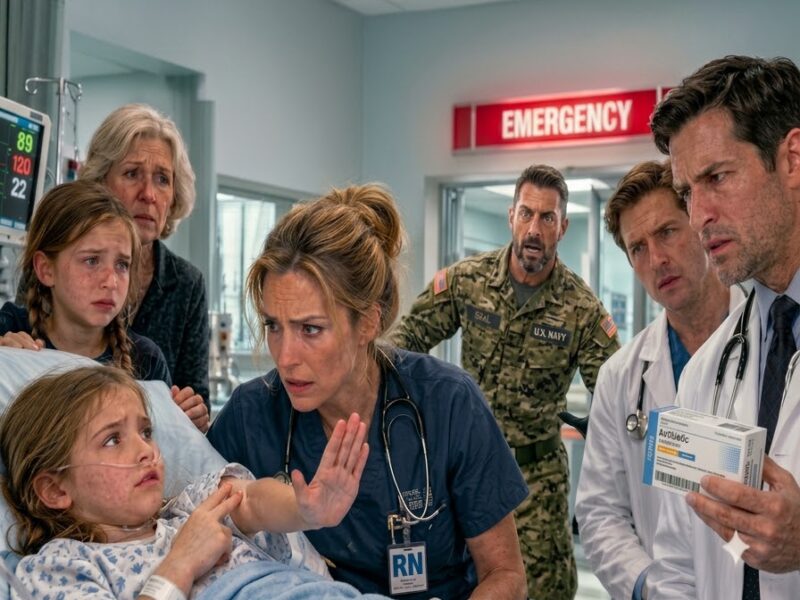
At 2:17 a.m. in a Seattle ER, my daughter suddenly slapped the metal bedrail and whispered, “Three, one, three,”
The harsh fluorescent lights of the Seattle emergency room buzzed with a low, agonizing hum that vibrated straight through my teeth. The clock on the wall read 2:17 a.m. The smell of antiseptic, copper, and damp cold air heavy with rain hung thick in the narrow room. My daughter, Emily, lay motionless on the narrow stainless-steel bed. She was sixteen years old, but in that pale, flickering light, surrounded by towering monitors and tangled IV lines, she looked impossibly small.
She had collapsed six hours earlier in the hallway of her high school. The school nurse had called me in a panic, stating Emily’s temperature had spiked without warning, causing her to lose consciousness. By the time I rushed to the hospital from my workshop, she was burning up, her skin flushed, her breathing terrifyingly shallow. Every few seconds, her fingers would twitch against the scratchy hospital sheet, as if she were desperately reaching for something in the dark.
I had spent twenty years in the Navy, serving as a Chief Petty Officer in high-stress, tactical environments. I had seen combat, I had seen men break under pressure, and I knew what panic looked like. But sitting beside my daughter, watching her struggle to breathe, I felt a terrifying, unfamiliar helplessness. I reached out, gently pressing my rough, calloused palm over her cold, trembling fingers.
“Emily, sweetheart, I’m right here,” I whispered, leaning close so my breath brushed against her temple. “Dad’s right here. You’re safe.”
Her eyelids fluttered open for a fraction of a second. Her pupils were dilated, unfocused, glassy with fever. Her lips parted, cracked and dry.
“Three… one… three,” she rasped. The words were barely audible over the hiss of the oxygen line, but they were precise.
Behind me, Dr. Vance, a tall, weary-looking attending physician with dark circles under his eyes, didn’t even look up from his digital chart. “She’s confused from the fever, Mr. Miller,” he said, his voice flat and clinical. “Hyperpyrexia can cause vivid hallucinations and disorganized speech. It’s completely normal under these conditions.”
The second doctor, a younger resident named Aris, stepped closer to the IV pole, adjusting the drip rate with a swift, impatient flick of his wrist. “Sir, you need to step back and let us work,” Aris added, not unkindly, but with the condescending authority of someone who believed he held total control over the room. “We’re trying to stabilize her temperature.”
I stepped back, swallowing the sharp, metallic tang of anger burning in my throat. I knew how doctors operated, but I also knew my daughter. Emily was quiet, brilliant, and methodical. She didn’t babble nonsense, even when sick.
Then, suddenly, Emily’s right hand flew sideways.
Clang. Clang. Clang.
Her knuckles struck the hollow metal bedrail with deliberate force. She paused for a distinct breath, her chest rising and falling.
Clang.
Another pause.
Clang. Clang. Clang.
My entire body went rigid. The blood drained from my face, leaving my skin icy cold. That wasn’t the spastic, random flailing of a delirious teenager. That was a rhythm. A cadence. Three taps, one tap, three taps.
It was a 3-1-3 sequence—a specialized distress signal used by covert naval logistics units to communicate an active breach under absolute radio silence. It was a code I had learned twenty years ago in a classified operational unit. It was a signal I had never taught her. A signal I had spent the last decade trying to forget.
“Stop moving her, please!” Dr. Vance barked, finally looking up with annoyance. “Resident, draw another blood gas panel.”
Before Aris could move, the heavy curtain separating our bay from the main hallway was ripped back with a harsh, metallic rattle. A trauma nurse stepped into the room. Her name tag read Rachel. She looked to be in her late thirties, with sharp, perceptive eyes and a calm demeanor that instantly shifted into intense focus as her eyes landed on Emily’s hand.
“Everyone stop,” Rachel said, her voice dropping into a register that was low, authoritative, and utterly devoid of hospital protocol.
Dr. Vance frowned, holding a needle suspended in the air. “Rachel, what are you doing? We’re setting an IV line—”
“I said stop,” Rachel repeated, stepping past the doctors without looking at them. Her eyes were locked entirely on Emily’s trembling fingers, which were preparing to strike the metal rail a third time.
Rachel looked up, her gaze cutting directly into mine. “Where did she learn that?”
“I don’t know,” I said, my voice thick with a sudden, suffocating dread. “I never taught her.”
Rachel’s face had gone ghostly pale under the fluorescent tubes. “That’s not delirium,” she whispered.
“Nurse, this is completely inappropriate—” Dr. Vance began, stepping forward with his hands raised in frustration.
Rachel ignored him entirely. She grabbed the edge of the privacy curtain and pulled it completely shut, locking out the noise of the bustling ER hallway. She leaned down over the bed rail, bringing her face inches from Emily’s.
“Emily,” Rachel said softly, her voice carrying a terrifying edge of urgency. “Can you do it again? Show me.”
Emily didn’t open her eyes, but her hand rose once more.
Tap. Tap. Tap.
Pause.
Tap.
Pause.
Tap. Tap. Tap.
Rachel didn’t hesitate for another second. She straightened up, walked over to the wall-mounted internal phone, picked up the receiver, and pressed a hardcoded sequence on the keypad. “Security, this is Trauma Bay 4. Lock down the east wing corridor immediately. We have a Code Sierra breach.”
“Code Sierra?” Dr. Vance snapped, his voice rising in genuine anger. “Are you out of your mind? That’s a federal protocol for chemical or high-risk security threats! This girl has a viral fever!”
Rachel slammed the receiver back onto the hook and spun around. “Look at her wrist, Doctor!”
We all turned. Beneath the clear plastic band of her hospital identification bracelet, tucked tightly against the inside of her pulse point, was a tiny, meticulously folded strip of white paper. It had been wedged so deeply under the plastic that the skin around it was red and indented.
My hands trembled violently as I reached out. My fingers, accustomed to turning wrenches and heavy machinery, struggled with the delicate plastic. I unclipped the band and slid the paper out. It was no larger than a stick of gum, torn from the margin of a notebook, stiffened by sweat.
I unfolded it carefully. Written in Emily’s sharp, neat cursive handwriting were seven words:
Dad, don’t trust the man in blue.
A cold sweat broke out across the back of my neck. I instinctively turned toward the small glass window set into the heavy wooden doors of Trauma Bay 4.
Standing in the main hallway, framed by the bright lights of the lobby, were two city police officers. Both were dressed in the dark blue uniforms of the Seattle Police Department. They stood side by side, their hands resting naturally near their utility belts. Neither officer had stepped inside the room. Neither officer was looking at the nurses or the doctors. Both were staring directly at the door of Bay 4, their faces blank, unreadable, and completely motionless.
Then, a sudden, crushing grip locked onto my forearm.
I gasped and looked down. Emily’s eyes were wide open. The feverish glaze was gone, replaced by an absolute, primal terror that chilled me to the bone. She wasn’t looking at me. She wasn’t looking at the doctors. She was pointing her free hand past my shoulder, toward the dark corner of the room where the wall-mounted security monitor hung.
I turned slowly, every muscle in my body tightening into a combat-ready posture I hadn’t used in ten years.
The security monitor showed the live closed-circuit feed from the exterior hallway directly behind Trauma Bay 4—a restricted service corridor used for transporting hazardous waste and stretchers.
Standing in the dim light of that service corridor was a man.
The camera showed only his back. He was wearing a dark rain jacket, his hood pulled low. But as he tilted his head slightly toward the camera, the harsh overhead light caught the right side of his neck.
Stretching from the base of his skull down beneath his collar was a thick, jagged, white keloid scar. It looked like a lightning bolt carved into his skin.
My heart plummeted into a dark, bottomless void. My lungs locked up.
I had seen that scar before. I had stood in a burning compound in Fallujah twenty years ago and watched the man who possessed that scar take three round bursts to the chest before the structure collapsed into a mountain of flaming rubble. I had watched that man die with my own eyes. I had signed the incident report myself.
On the screen, the shadowed figure slowly raised his right hand. He didn’t look at the camera. He raised his hand toward the junction box on the wall and severed the main power line.
The security monitor flickered twice, filled with static, and went completely black.
The darkness that swallowed the room was immediate and absolute, broken only by the sharp, piercing screech of the emergency battery back-ups booting up seconds later. Red emergency lamps flickered to life along the baseboards, casting long, blood-colored shadows across the white tile floor. The continuous, rhythmic beep of Emily’s heart monitor glitched, slowed, and settled into a low, strained tone.
“What the hell is going on with the power?” Dr. Vance yelled, stepping toward the bay curtain. “Aris, check the hallway outlet!”
“Nobody opens that curtain!” I roared, my voice cutting through the panic like a foghorn. The pure tactical authority in my tone caught both doctors off guard. Vance froze with his hand inches from the fabric, turning to look at me in shock.
I moved with a fluid speed I thought I had lost years ago. I pulled the heavy metal bedframe two feet to the left, placing my body directly between Emily and the doorway. My mind was racing, discarding the present and retrofitting the past.
The man with the scar was named Arthur Vance—no relation to the doctor standing in front of me—or at least, that was the alias he had used when he served as an intelligence contractor attached to my Navy logistics unit in Iraq, 2004. We called him ‘Grave-Digger.’ Officially, he was there to manage high-value asset transfers. Unofficially, he was running black-market military hardware out of the supply depots we were assigned to guard.
When I discovered the discrepancy in our shipping manifests twenty years ago, I reported it up the chain of command. Three days later, our compound was ambushed. It wasn’t an insurgent attack. It was a clean-up operation. I barely made it out alive, dragging two of my men through the flames. I saw Vance get caught in the primary blast radius. I saw the wall crush him. I had lived two decades believing the secret died in that fire.
I looked down at Emily. She was trembling violently under the sheets, her breath coming in ragged gasps.
“Emily,” I said, dropping to one knee beside her bed, taking her small hand in both of mine. “Listen to me carefully. Look at me.”
Her eyes locked onto mine. The fever was still raging, but the adrenaline had pushed her into a state of hyper-awareness. “Dad…” she whimpered, her voice barely a thread. “The man… at the library…”
“What library, sweetie? Tell me.”
“Three days ago,” she gasped, tears cutting clean lines through the fever-flush on her cheeks. “A man… gave me a book. He said… he said it was a gift from you. An old Navy manual. He told me… if I ever felt sick, I had to look at page 313.”
My stomach dropped into a abyss. Page 313. In the standard-issue Naval Logistics and Communications Handbook from my era, page 313 contained the emergency tactical breach protocols and distress signals. Someone hadn’t just target Emily; they had been grooming her, preparing her to deliver a message to me when the time was right.
“Did he touch you? Did he give you anything else?” I demanded, my hands tightening around hers.
“A… a drink,” she whispered, her head rolling back onto the pillow. “He bought me a smoothie at the cafe near school today. He said… he said you were coming home soon, Dad. He said you were finally going to pay your debt.”
Poison. They hadn’t just brought her down with a random virus. They had administered a slow-acting, synthetic toxin designed to spike her body temperature, force an emergency room admission, and bring me to a predictable, contained location where I couldn’t run.
I turned sharply toward Nurse Rachel. She hadn’t panicked when the lights went out. Instead, she was standing by the crash cart, rapidly pulling syringes and glass vials from the locked drawers using a manual key from her pocket.
“You know what Code Sierra is,” I said, stepping toward her. “You recognized the 3-1-3 sequence. Who are you, Rachel?”
Rachel didn’t stop her work. She snapped the plastic cap off a pre-filled syringe of atropine and drew a second vial of clear liquid. “My name isn’t Rachel, CPO Miller,” she said, her voice completely stripped of its hospital warmth. “I’m former Defense Intelligence Agency, attached to the regional threat matrix. We’ve been tracking a black-budget remnant group operating out of Puget Sound for six months. They’ve been liquidating everyone tied to the 2004 Fallujah inventory logs.”
“Vance is alive,” I said, the words tasting like ash in my mouth.
“Arthur Vance didn’t die in Iraq,” Rachel said, turning to face me. “He faked his death using the body of a civilian contractor. He’s been living off the grid for twenty years, using the stolen military assets from your depot to build a private security network. And three weeks ago, a federal audit unsealed the old supply manifests from your unit. Vance knew you were the only living witness who could verify his signature on those transfers.”
“So he poisoned my daughter to draw me out,” I said, a dark, terrifying rage blooming deep in my chest.
“He didn’t just come to kill you, Marcus,” Rachel said, her eyes dead serious under the red emergency lights. “He came to retrieve the key.”
“What key?” I demanded. “I don’t have any key! I left the Navy twenty years ago! I fix boat engines in a garage!”
“The digital ledger,” Rachel said, stepping over to Emily’s bed and swiftly injecting the syringe into her IV line. Emily gasped as the neutralizing agent hit her bloodstream, her heart rate monitor spiking before beginning a steady, controlled descent. “When you reported the discrepancy in 2004, you didn’t just file a paper report. You backed up the encrypted master manifest onto an external flash drive. Vance thinks you still have it.”
I froze. Memories long buried under twenty years of civilian life rushed back to the surface. The night before the compound was attacked, I had taken a physical backup disk from the communications trailer and tucked it inside my personal locker. When I was medically evacuated after the fire, my personal effects were shipped back to my home in Seattle. I had thrown that box of old uniforms, medals, and gear into the dark corner of my attic and never opened it again.
“He doesn’t care about the money anymore,” Rachel continued rapidly. “That ledger contains the names of six current sitting government officials who funded Vance’s operation back then. If that ledger goes public, those men go to prison for life. If Vance kills you and takes it first, he gets paid fifty million dollars to make it disappear forever.”
Suddenly, the red emergency lights in the room flickered violently and died completely.
The room plunged into pitch-black darkness.
From the hallway outside Trauma Bay 4, the silence was broken by a soft, rhythmic sound.
Thump. Thump. Thump.
It was the sound of heavy, tactical boots stepping slowly over broken glass.
“They’re inside the wing,” Rachel whispered, drawing a small, compact 9mm pistol from beneath her scrub top with a metallic click.
“The police officers outside…” I whispered.
“Were never cops,” Rachel replied cold. “Vance owns the local precinct’s night shift.”
Dr. Vance and the young resident, Aris, were cowering against the far wall, paralyzed by fear. “Please,” Dr. Vance whimpered. “We’re just doctors… we don’t know anything…”
“Shut up,” I snapped. I grabbed a heavy stainless-steel tray from the medical cart, weighing it in my hand. In a close-quarters fight in total darkness, a heavy metal wedge was as lethal as a blade if used correctly.
The blue curtains of Trauma Bay 4 were suddenly sliced wide open by the long, sharp beam of a high-powered tactical flashlight.
The light hit me directly in the eyes, blinding me instantly.
“Hello, Marcus,” a low, raspy voice echoed from behind the glare. The sound was horribly coarse, damaged by long-ago fire and smoke. “It’s been a long time since Iraq.”
The silhouette standing in the doorway was broad, ominous, and motionless. The beam of his tactical flashlight held steady on my face, blinding me, but I didn’t need vision to know what was happening around me. My ears picked up the subtle, metallic brush of fabric, the shifting weight of combat boots on damp floor tiles, and the unmistakable, double-click of a suppressed firearm being raised.
There weren’t just two men outside. There were three.
“You should have stayed dead, Arthur,” I said, keeping my voice low, steady, and entirely devoid of fear. I needed him to focus on me, to absorb his attention so he wouldn’t look at the bed where Emily lay, her breathing slowly stabilizing under the influence of Rachel’s counter-toxin.
“Dead is a matter of perspective, Chief,” Vance rasped. The beam of light shifted slightly, illuminating the lower half of his face. The white, thick scar stretched from beneath his ear, pulling the right side of his mouth into a perpetual, grotesque half-snarl. “Dead men don’t pay taxes. Dead men don’t get subpoenaed. Dead men simply wait until the men who ruined them drop their guard.”
“You poisoned a sixteen-year-old girl,” I said, stepping forward half an inch, testing the grip of the metal medical tray in my right hand. “You brought a war to a civilian hospital.”
“I brought a war to where my target was,” Vance corrected coldly. “You have something that belongs to my employers, Marcus. The 2004 Fallujah Ledger. The physical drive you tucked into your sea bag before you fled the country.”
“I don’t have it,” I lied seamlessly. “It was destroyed in the evacuation.”
“Don’t lie to me!” Vance barked, his raspy voice cutting through the quiet hospital wing like a saw blade. “I monitored your home network for three weeks. The moment the Department of Defense unsealed the manifest files last month, you logged onto the old Naval archives from your home computer. You were looking for the encryption key, Marcus. You knew what you had in that attic.”
Beside me, in the pitch-black shadow cast by the heavy crash cart, Nurse Rachel moved with absolute, silent precision. She didn’t raise her weapon yet; she knew that firing a gun in this enclosed space would immediately draw concentrated fire from the two fake officers standing in the hallway behind Vance.
“Vance,” Rachel spoke up from the dark, her voice echoing off the tile walls to obscure her exact location. “You’re operating in a Tier-1 medical facility. Federal marshals were alerted the moment I triggered the Code Sierra five minutes ago. You have less than four minutes before this entire building is surrounded by SWAT.”
Vance chuckled—a dry, rattling sound that ended in a harsh cough. “The federal marshals won’t be coming, former DIA Agent Rachel Croft. The local dispatch caller reported a false alarm triggered by a psych patient in Bay 4. The perimeter is clear. We have all the time in the world.”
Vance raised his left hand, signaling the man behind him. “Take the girl,” he ordered flatly. “If he won’t give up the location of the drive here, he’ll give it up when he watches her bleed out in the back of a van.”
The man in the blue police uniform stepped past Vance, drawing a heavy pair of zip-ties from his belt, his eyes fixed on Emily’s motionless form.
That was his mistake. He took his eyes off me for one second.
In a fraction of a heartbeat, twenty years of civilian life evaporated. The muscle memory of a trained Navy combatant took complete control of my body.
I lunged forward, pivoting on my left heel, and slammed the edge of the heavy stainless-steel tray directly into the side of the fake officer’s throat. The sharp, heavy metal crushed his larynx with a sickening, wet crack. He dropped instantly to his knees, gasping for air, dropping his weapon.
Before Vance could pull his trigger, Rachel fired twice from the dark.
Pfft! Pfft!
The suppressed shots echoed softly, like heavy books dropping onto a carpet. The second fake officer standing in the hallway slammed back against the wall, a neat red hole appearing between his eyes before he slid lifelessly down to the floor.
Vance reacted instantly. With terrifying speed for a man his age, he swung his heavy tactical flashlight violently to the left, striking Rachel across the side of her face. The force of the blow knocked her off her feet, sending her sliding across the floor, her pistol spinning away into the dark beneath a row of cabinets.
Vance turned his weapon toward me, his scarred face twisted in fury. “You always were an arrogant bastard, Miller!”
I didn’t try to dodge. I drove my entire body weight forward, tackling him around the waist. We crashed hard into the glass wall of the bay, shattering the heavy pane into thousands of tiny, cascading pieces.
We hit the floor of the main hallway together, rolling over the sharp shards of glass. Vance was heavy, his muscle dense and hardened by decades of mercenary work. He slammed his elbow hard into my jaw, sending a flash of blinding white light across my vision. I tasted blood instantly.
He grabbed my throat with his thick, gloved hand, pressing down on my windpipe with crush-force pressure. “Where is the drive, Marcus?” he snarled, leaning down until his scarred skin was inches from mine. “Tell me, or I swear to God I’ll go back into that room and shoot your daughter through the head!”
My oxygen was cutting off. Black spots danced before my eyes. My lungs burned for air. But my left hand was searching the floor around us, sweeping through the broken glass and debris.
My fingers brushed against something hard, metal, and heavy—the discarded weapon of the officer I had struck in the throat.
I didn’t pause. I grabbed the grip, pressed the muzzle directly against the side of Vance’s left knee, and pulled the trigger.
BANG!
The unsuppressed gunshot echoed through the narrow hallway like a cannon shot. Vance shrieked in agony as the heavy 9mm round shattered his knee joint. His grip on my throat instantly shattered, and he collapsed sideways, clutching his leg as blood pooled rapidly over the white hospital floor.
I scrambled back to my feet, gasping frantically for air, clutching my neck.
In the doorway of Bay 4, Rachel emerged, leaning heavily against the frame, wiping a trickle of blood from her temple. She looked at Vance, who was writing on the floor, cursing incoherently, then looked at me.
“That shot… every cop within ten miles heard that,” Rachel breathed, her chest heaving. “We have to move. Now.”
I ran back into the bay. Emily was sitting up on the bed, her face pale with terror, holding her ears from the noise of the gunshot.
“Dad!” she cried out, her voice raw.
“I’ve got you, baby,” I said, wrapping my arms around her and lifting her thin body into my arms. She was light, far too light, but she was alive. “I’ve got you. We’re getting out of here.”
“Where are we going?” Rachel asked, retrieving her weapon from the floor and keeping her eyes swept down the dark hallway. “Vance’s team had scouts posted outside the building. The main exits are compromised.”
I looked down at the bleeding, groaning figure of Vance on the floor, then back at my daughter.
“We’re going to my house,” I said grimly. “We’re going to get that ledger. Because as long as those six men think that drive exists, they will never stop coming for my daughter.”
The heavy rain was falling in relentless, diagonal sheets when my old Ford F-150 pulled up to the curb in front of my two-story craftsman house on Elm Street. The suburban neighborhood was dead silent, bathed in the eerie, amber glow of streetlights reflecting off the wet asphalt.
Rachel sat in the passenger seat, her eyes continuously scanning the dark rear-view mirrors, her hand resting firmly on her concealed pistol. In the back seat, wrapped in a heavy wool blanket I had grabbed from the truck, Emily slept—her breathing deep, heavy, but finally stable thanks to the medication Rachel had administered at the hospital.
“No cars parked within two blocks,” Rachel reported quietly, her voice cold and analytical. “No visible thermal signatures near the windows. If Vance had a backup team, they haven’t located your residence yet.”
“They will soon,” I said, cutting the truck’s engine and headlights. “Vance had my home network under surveillance. It won’t take his technical crew long to realize the hospital operation failed.”
We stepped out into the pouring rain. I carried Emily in my arms, shielding her face from the cold water with my jacket, while Rachel moved ahead, her weapon raised, sweeping the front porch before signaling it was clear.
We moved quickly inside. The familiar smell of my home—sawdust, old coffee, and cold rain—did nothing to ease the violent tension in my chest. I carried Emily up the narrow wooden stairs and laid her down on her bed, pulling the thick duvet over her shoulders. She stirred slightly, her hand reaching out to touch my sleeve.
“Dad…” she murmured softly, her eyes half-open. “Is it over?”
I leaned down, pressing a firm kiss against her forehead. Her skin was cool now. The fever was broken. “It’s almost over, sweetie. I just need to finish something. Nurse Rachel is going to stay right outside your door. You’re safe.”
I stepped out of her room and closed the door softly. Rachel was standing in the dark hallway, holding a tactical flashlight she had retrieved from my workshop downstairs.
“Where is it?” she asked.
I pointed toward the small, rectangular wooden panel set into the ceiling at the end of the hallway. “The attic access. I haven’t been up there since my wife passed away six years ago.”
Rachel helped me pull down the folding wooden ladder. A cloud of stale, dry dust rained down on us as the ladder hit the floorboards with a dull thud.
I climbed up first, beam of light slicing through the thick, stagnant air of the attic. The space was crammed with decades of forgotten memories—boxes of old Christmas decorations, dusty furniture, stacks of photo albums, and yellowing books.
I navigated through the narrow paths between boxes until I reached the furthest, darkest corner beneath the sloping roof rafters. Sitting on an old wooden crate was a heavy, olive-drab military sea bag, covered in a thick layer of dust.
My heart beat loudly in my ears as I knelt before the bag. I unbuckled the heavy steel clasp and pulled open the canvas top. Inside were my old Navy working uniforms, a pair of worn combat boots, my dress blues neatly folded, and a small metal lockbox resting at the bottom.
I pulled the lockbox out and placed it on the floorboards. I didn’t need a key; I remembered the combination like it was burned into my retinas. 3-1-3.
The latch clicked open with a sharp, mechanical sound.
Inside lay a few faded photographs of my old unit in Iraq, my dog tags, and tucked beneath a stack of paper service records, a small, black, heavy-duty encrypted flash drive. It was ruggedized, housed in an anodized aluminum casing designed to withstand extreme heat and impact.
I picked up the drive. It felt surprisingly cold and light for something that carried twenty years of blood, corruption, and murder.
Rachel climbed up the ladder, her head appearing through the attic floor opening. She looked at the small black drive in my hand, her eyes widening slightly. “That’s it,” she whispered. “The Fallujah Ledger.”
“This is what almost got my daughter killed,” I said, my thumb tracing the cold metal casing. “Six men sat in comfortable offices in Washington twenty years ago, making millions off black-market weapons sales while my men were dying in burning humvees. And Vance was their clean-up man.”
“If you hand that drive over to the Department of Justice,” Rachel said, stepping fully into the attic, “those six men will be arrested by morning. Vance’s funding will vanish instantly. He won’t have the resources to hunt you or Emily anymore. It ends, Marcus.”
Before I could answer, a sudden, heavy crash echoed from downstairs.
BOOM!
The sound of the heavy oak front door being kicked off its hinges shattered the silence of the house.
Rachel instantly dropped to one knee, snapping her light off, pointing her weapon down toward the open attic hatch.
From the floor below, footsteps—heavy, calculated, and fast—flooded into the entry hall.
“Sweep the ground floor!” a harsh, commanding voice roared from below. It wasn’t Vance. It was a new voice—younger, cold, and professional. “Find the girl! Secure the stairs! The client wants the drive now!”
I looked at Rachel in the pitch darkness. Vance was immobilized in the ER, but he had already dispatched his secondary strike team. They weren’t police officers, and they weren’t hospital thugs. The rhythm of their movements was precise. These were high-tier private military contractors.
“They’re coming up,” Rachel whispered, her weapon leveled at the top of the stairs visible through the attic hatch. “We can’t defend this position. The attic is a box.”
I looked at the small black drive in my hand, then looked back toward the dark rafter space behind me.
“We’re not going to defend it,” I said, a cold, ruthless calm settling over my mind. “This is my house. I built the additions on this roof ten years ago. I know every rafter, every joist, and every drop to the ground.”
I tucked the encrypted drive securely into my inner jacket pocket, zipped it tight, and grabbed a heavy steel crowbar resting against the brick chimney.
“Rachel,” I whispered, holding her eye in the dark. “Get to Emily’s room. Barricade the door. If anyone tries to open it, you kill them. I’m going to bring the roof down on these bastards.”
The heavy wooden floorboards beneath my boots vibrated as the tactical team moved through the second floor of my home. I could hear the sharp, rhythmic clicks of their assault rifles, the muted commands exchanged through tactical headsets, and the splintering of wood as they kicked open the guest bedroom door down the hall.
Rachel slid silently down the attic ladder, pulling it up six inches behind her to obscure the entrance before slipping down the hallway into Emily’s bedroom. I heard the soft, heavy thud of her sliding my daughter’s heavy oak dresser against the inside of the door. Emily was protected for now—behind a solid core door, backed by a hundred-pound piece of furniture, and guarded by a trained federal agent with a clear line of sight.
They weren’t looking for a fight; they were looking for a package. And I was about to make sure they found a nightmare.
Standing in the dark attic, I stepped over to the old brick chimney that ran through the center of the roof. High above me, set into the apex of the gabled roof, was a small, octagonal wooden access vent designed to let heat escape during the summer. I wedged the flat edge of the steel crowbar beneath the wooden frame and levered it back with all my strength.
The old wood groaned, cracked, and gave way, opening a two-foot hole directly onto the steep, rain-slicked shingles of the roof.
I hauled myself up through the opening into the howling wind and blinding downpour. The cold rain hit my face like needles, washing away the dust and blood from the hospital fight. Standing on the narrow peak of the roof, looking down over the dark suburban neighborhood, I could see two black SUVs parked illegally across my front lawn, their engines idling silently in the rain.
I didn’t run. I moved along the ridge line toward the front of the house, directly above the porch roof where the team had entered.
Below me, a beam of light cut through the rain as a contractor stepped out onto the upper balcony directly beneath the attic vent, holding a short-barreled carbine, scanning the backyard. He was covering his team’s perimeter.
I didn’t hesitate. I dropped from the main roof peak down onto the lower balcony overhang, landing directly on top of him.
The impact was deafening. My boots struck his chest, shattering his body armor and sending him flying backward through the glass French doors of the master bedroom. We crashed into the room together in a flurry of broken glass, rainwater, and torn curtains.
Before he could recover his breath, I drove the heel of my palm hard into his chin, knocking him unconscious, and ripped the tactical radio from his vest.
“Alpha 2, report!” a voice barked through the earpiece speaker. “What was that noise? Did you locate the target?”
I brought the radio to my mouth, pressing the push-to-talk button. “Alpha 2 is down,” I said, my voice echoing cold and hard over their encrypted channel. “And you’re in the wrong house.”
I dropped the radio, grabbed the tactical shotgun mounted to his shoulder sling, racked a heavy 12-gauge slug into the chamber, and stepped out into the main upstairs hallway.
The lead contractor was standing at the end of the hall, just five feet from Emily’s barricaded door. He turned toward me, raising his weapon, but I was faster.
BOOM!
The heavy shotgun blast tore through the narrow hallway, the recoil slamming back into my shoulder. The contractor was thrown backward, crashing hard against the wall before dropping to the floor, his weapon clattering uselessly away.
From the bottom of the stairs, two more men opened fire, sending a hail of high-caliber rounds ripping through the drywall above my head. Plaster dust exploded into the air, blinding and suffocating.
I ducked behind the corner of the stairwell wall, feeling the heat of the bullets passing inches from my skin.
“Miller!” a voice yelled from below. It was the young team leader I had heard earlier. He was standing in the foyer, protected by the heavy mahogany pillars. “Give us the drive! There are six men downstairs! You can’t kill us all!”
“I don’t have to kill you all!” I shouted back, my voice booming through the dust-filled house. “I just have to hold you here until the State Police arrive! I triggered my home security silent alarm three minutes ago!”
That was a lie, but it worked. I heard a sudden, tense hesitation in their footsteps below. Modern mercenaries didn’t fear a retired sailor, but they feared local law enforcement showing up with flashing lights and news helicopters while they were engaged in an active firefight in an upper-class neighborhood.
“Clear the floor!” the leader ordered sharply. “Get the package and pull back to the vehicles!”
I didn’t give them the chance to organize a retreat. I stepped out from the stairwell wall, leveled the shotgun down the stairwell, and fired twice into the floorboards at the base of the stairs.
The heavy wood splintered and caved in, dropping one of the men into the dark crawlspace beneath the house with a scream of agony.
At that exact moment, the heavy oak dresser inside Emily’s room was pushed aside with a harsh scraping noise. The door swung open, and Rachel stepped into the hallway, her weapon held in a steady, two-handed grip. She didn’t say a word. She fired three rapid, precise shots down the length of the hallway, striking the remaining contractor in the chest plate, dropping him to his knees before I finished him with a final, sweeping strike of the shotgun stock.
The house went suddenly, terrifyingly quiet.
The only sound remaining was the heavy patter of rain falling through the broken French doors and the ragged, heavy gasps of my own breathing.
Rachel lowered her weapon, her face covered in drywall dust and sweat. She looked down the ruined hallway, then looked at me. “Is that all of them?”
“That was the primary breach element,” I said, lowering the shotgun. “The drivers in the SUVs won’t stick around now that their assault team is neutralized.”
As if on cue, the low rumble of heavy V8 engines echoed from the street outside as the two black SUVs accelerated rapidly away into the dark rain, abandoning their fallen team.
I walked slowly down the hall and stepped into Emily’s room.
She was sitting in the corner of her bed, her knees pulled tight against her chest, her blanket wrapped around her shoulders. She was trembling, but her eyes were clear, sharp, and focused entirely on me.
I dropped the heavy weapon to the floor, walked over to her bed, and fell to my knees beside her. I wrapped my arms around her, pulling her close, holding her head against my chest.
“It’s over, Emily,” I whispered, tears finally breaking through my eyes, mixing with the sweat and rain on my face. “It’s over. You’re safe now. Dad’s got you.”
She hugged me back with all the strength her small body possessed. “I remembered the code, Dad,” she sobbed into my shoulder. “You told me once… when I was little… that if I was ever in danger, I had to give the signal.”
I pulled back slightly, looking at her in shock. “I never taught you that, Emily.”
“You did,” she whispered, a small, tired smile breaking through her tear-stained face. “In your sleep. When I was ten… you had nightmares about the war. You used to tap your fingers on the bedframe in your sleep. Three, one, three. I asked Mom what it meant… and she told me it was how you called for help when you were lost in the dark.”
My chest tightened, a profound, overwhelming emotion washing through me, cleansing twenty years of buried pain, guilt, and fear.
Rachel stepped into the doorway of the bedroom, holding her phone. “Federal Marshals are two minutes out,” she said softly, a genuine, warm smile finally breaking across her scarred face. “The Director just confirmed receipt of the digital manifest I transmitted from my secure device while you were on the roof. The warrants for the six government officials are being signed right now. Vance is in custody at the hospital, under heavy armed guard. He’ll spend the rest of his life in a supermax facility.”
I stood up, holding my daughter’s hand firmly in mine.
I pulled the small, heavy black aluminum drive from my jacket pocket and looked at it one last time. The small piece of metal that had brought so much fire, death, and shadow into my life was finally useless to the evil men who had forged it.
I walked over to the open window, looking out into the rain-washed night as blue and red emergency lights began to flash through the trees at the end of Elm Street.
I turned the drive over in my hand, then tossed it out into the dark night, letting it sink into the deep, churning waters of the storm drain below.
The war was finally over. And my daughter was home.
The end.









