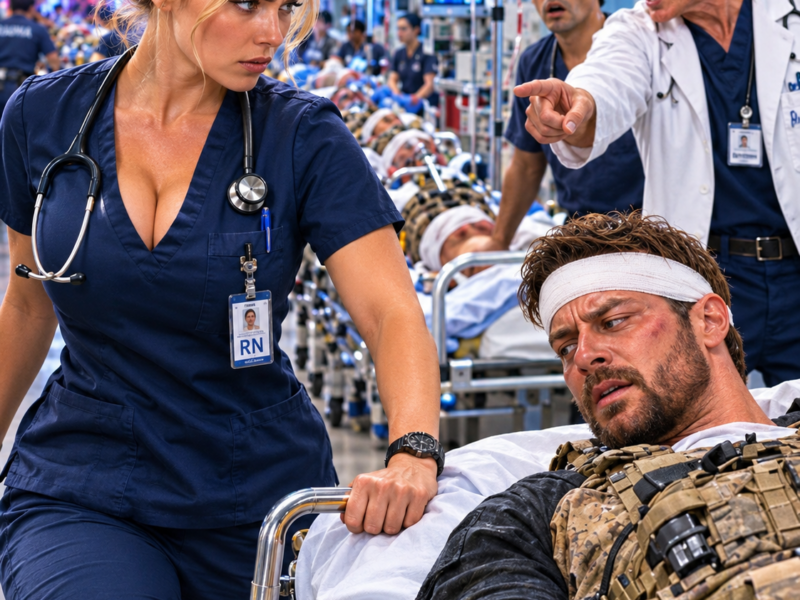
At 2:17 a.m., Harbor Point Medical Center was running out of everything that mattered. Blood supplies were low, two operating rooms were already occupied
Jack Mercer kept staring at the cracked Navy watch beneath Rachel Bennett’s sleeve. His breathing was shallow, and the effort of speaking seemed to hurt, but he refused to look away.
“Evan never told us what happened during his final hours,” he whispered. “My family received a folded flag, a few official documents, and a box of personal belongings. Nobody explained why the medical report changed three times.”
Rachel pulled her sleeve down.
“I treated your brother six years ago,” she said. “I can’t discuss every detail of his medical history without knowing what you’re asking me. But I can tell you that he mattered, and I never forgot him.”
Jack closed his eyes briefly.
“He told me there was something wrong with the air before everything happened.”
Rachel felt the familiar pressure return behind her ribs.
“What did he say?”
Jack struggled to lift his hand. Rachel brought the communication board closer, and he wrote slowly.
He said the warning was ignored.
Rachel stared at the words.
Before she could ask another question, Dr. Grant Whitmore approached.
“Bennett, I need you to explain your connection to this patient.”
Rachel looked up.
“His brother was a patient I treated during a military medical incident six years ago.”
“And you didn’t think that was relevant when you were assigned these seven patients?”
“I didn’t know Jack was related to him until a few minutes ago.”
Whitmore glanced toward the watch.
“Is that why you recognized Senior Chief Hail’s signal?”
Rachel remained quiet for a moment.
“Yes.”
The answer changed Whitmore’s expression.
“Then we need to establish exactly what you know and what you don’t know.”
Rachel nodded.
“Agreed. But we also need to establish what happened inside that simulator.”
She returned to the whiteboard and reviewed the corrected extraction times. The pattern was still there. The men removed later from the enclosed compartment appeared to be experiencing more significant respiratory problems, even when their visible injuries were less severe.
Owen Park joined her with the latest laboratory results.
“The blood gases are becoming more abnormal in three patients,” he said. “Noah, Matteo, and Jack. Their oxygen requirements are increasing despite the initial treatment.”
Rachel looked toward the three beds.
“What about the residue?”
“The preliminary analysis says it’s consistent with a protective coating used inside the simulator’s service compartment. It doesn’t identify the inhaled substance.”
“Then we need separate environmental testing. We also need toxicology involved before we assume this is ordinary smoke inhalation.”
Whitmore listened from behind them.
“Bennett, you are not going to diagnose an unknown exposure based on a few marks on someone’s boots.”
Rachel turned toward him.
“I’m not diagnosing anything. I’m telling you that three patients are worsening in a pattern that doesn’t match their visible injuries.”
Whitmore looked toward Noah Kim.
The young SEAL was breathing faster. The gray color around his lips had returned, and his eyes seemed less focused than they had been ten minutes earlier.
Whitmore stepped closer and examined him.
“Respiratory, prepare for escalation. I want another blood gas and repeat imaging.”
Owen checked the results while Rachel watched Noah’s chest.
His numbers were abnormal, but the way he looked was more concerning than the numbers alone suggested.
Rachel turned toward Whitmore.
“We need to review every patient against the time they spent inside that compartment.”
Whitmore folded his arms.
“You still don’t know what they inhaled.”
“No,” Rachel replied. “And I don’t want anyone pretending otherwise.”
She pointed toward the extraction timeline.
“But we know when each man came out. We know which symptoms are progressing. And we know there was a ventilation warning before the collapse. That is enough to justify investigating a shared exposure.”
Whitmore looked at the board for several seconds.
Then he gave the order.
“Call toxicology. Send the environmental samples for separate analysis. Review all seven patients individually.”
Rachel felt no satisfaction.
Noah was still fighting for every breath.
The next several minutes were spent adjusting respiratory support, repeating assessments, and reviewing the laboratory findings. The toxicologist joined the team remotely and requested additional information about the simulator’s ventilation system.
The early results suggested that the men might have encountered a shared irritant or oxidizing exposure. The exact substance remained unknown, but the combination of respiratory deterioration, environmental residue, and unequal time inside the compartment made the possibility too serious to ignore.
Whitmore revised the treatment priorities.
Instead of treating the seven men as separate trauma cases with unrelated respiratory symptoms, the team began evaluating them as casualties who might have suffered different degrees of exposure during the same event.
Noah’s condition stopped worsening.
Matteo’s breathing stabilized.
Brooks remained under close neurological observation, but his examination no longer deteriorated at the same rate.
Rachel looked at the seven names on the whiteboard.
All seven were still alive.
That was what mattered.
But the mystery was far from over.
A little after 4:00 a.m., Elaine Porter, Harbor Point’s chief operating officer, entered the administrative workroom. She had received an urgent message about the toxicology findings and the possibility of an industrial exposure.
She asked the charge nurse for a summary.
“Seven Navy SEALs were brought in after a maritime training accident,” the nurse explained. “We identified a possible shared inhalational exposure. The clinical team is reviewing the extraction timeline.”
Elaine interrupted.
“Have any environmental samples been sent outside the hospital?”
“Not that I’m aware of.”
Elaine looked toward the conference room.
“Find out before anything else leaves this building.”
Meanwhile, Rachel returned to Noah’s bedside.
He was exhausted, but his breathing had become less frantic.
She picked up the clear belongings pouch containing his daughter’s bracelet.
“Your daughter’s message made it through the night,” she told him.
Noah opened his eyes.
“Still readable?”
Rachel held the pouch where he could see it.
“Every word.”
He gave a weak smile.
“Good. She made me promise.”
Rachel nodded.
“Then you have something important to keep that promise for.”
Across the trauma bay, a transfer coordinator began discussing possible arrangements for moving the SEALs to a military medical facility once they were stable.
Daniel Cruz listened to the explanation, then asked a question.
“Where is Bennett?”
The coordinator looked surprised.
“She’s assigned to the trauma department.”
“Then I want her to explain the plan before I sign anything.”
Rachel came over and reviewed his condition, the treatment he had received, and the risks that still needed monitoring. She explained what the military receiving facility would provide and why a transfer might eventually be appropriate.
Cruz listened carefully.
“That’s what I wanted,” he said. “Someone to explain it instead of handing me a form.”
The same thing happened with Liam Brooks.
Then Matteo Silva asked for Rachel before reviewing his transfer documents.
Finally, Senior Chief Hail lifted his communication board.
He wrote a sentence in large letters.
Bennett stays with the team.
Whitmore read it.
“Senior Chief, she cannot personally accompany every transfer.”
Hail added another sentence.
Ask us before you move us.
Whitmore looked at the board for several seconds.
Then he nodded.
“You’re right. Any transfer discussion will include the patient whenever possible.”
Rachel noticed Owen watching the exchange.
He seemed to be reconsidering more than just her medical judgment.
He was beginning to understand that she had earned the patients’ trust by treating them as people rather than problems to be moved through a system.
At that moment, a woman in Navy uniform entered the department.
Commander Helen Ward carried a medical liaison badge and a secure tablet. She spoke briefly with Whitmore before scanning the seven beds.
Then her eyes stopped on Rachel.
For several seconds, she said nothing.
“Lieutenant Bennett?”
Rachel slowly turned.
“I haven’t held that title for several years, Commander.”
Ward stepped closer.
“Rachel Bennett. Navy Nurse Corps. Expeditionary surgical support. Critical care assignments supporting special operations medical teams.”
The nearby conversations faded.
Whitmore looked toward Rachel.
“You served in the Navy?”
Rachel folded her arms.
“Yes.”
“For how long?”
“Fourteen years.”
Whitmore stared at her.
“You’ve been here six weeks.”
“That part is correct.”
“You never mentioned your military background.”
Rachel met his eyes.
“You never asked why I was qualified. You asked how long I’d worked here.”
The words were quiet, but they landed harder than she expected.
Owen lowered his gaze.
Commander Ward opened her tablet.
“The maritime simulator involved in this accident is operated by Maritech Defense Systems,” she explained. “Our preliminary review shows that Air Loop 3 had repeated ventilation warnings. The system was supposed to be removed from service two weeks ago.”
Whitmore frowned.
“Then why were the men training inside it?”
Ward shook her head.
“That is what we’re trying to establish.”
Matteo, who had been listening, slowly raised his hand.
“They told us the sensor was faulty,” he said.
Ward turned toward him.
“Who told you that?”
“Training control. The warning light flashed. We stopped for a few seconds, then received clearance to continue.”
Rachel looked toward the extraction timeline.
The medical mystery had become something much larger.
The men might have been exposed to a dangerous condition that had been reported before the accident.
And someone had allowed training to continue.
Owen returned to the workstation to review the EMS documentation.
A few minutes later, he called Rachel over.
“Something’s wrong with the original report.”
He placed two versions of the same note on the screen.
The paper handoff stated:
Ventilation alarm active on entry.
The electronic record now read:
Alarm status unknown.
Rachel read both versions carefully.
“Who changed it?”
Owen opened the audit history.
A contract liaison had amended the wording thirty-eight minutes after toxicology began asking questions about the ventilation system.
Rachel looked toward Commander Ward.
“The contractor didn’t witness the rescue. They cannot rewrite what EMS observed.”
Ward examined the records.
“Who authorized this?”
Owen scrolled farther.
“The liaison received clarification from Maritech Defense Systems.”
Whitmore stepped closer.
“Could the contractor simply have corrected inaccurate information?”
Rachel shook her head.
“They can provide equipment records. They cannot change an eyewitness observation without preserving the original wording and documenting the reason.”
Ward’s expression hardened.
“Preserve both versions. Nobody edits anything else until we establish the audit trail.”
Owen nodded.
Then he noticed something else.
The contract liaison had exchanged two calls with a Maritech representative before making the amendment.
The subject line of one recorded communication read:
Loop 3 sample custody.
Rachel looked at the screen.
“How did Maritech know about the samples before we formally notified them?”
Nobody answered.
The laboratory specialist arrived with preliminary environmental results.
The blue-gray residue on the SEALs’ boots was consistent with a protective material used inside the simulator’s service compartment. It did not identify the inhaled substance, but it supported the possibility that the men had entered an area that should have been unavailable for training.
Commander Ward checked the maintenance report again.
“That compartment was listed as restricted.”
Matteo looked toward her.
“We were told it was safe.”
Ward did not answer.
The laboratory specialist recommended immediately verifying the location and custody of every environmental specimen.
Rachel accompanied him downstairs, staying within her nursing responsibilities.
They checked the collection log.
Marcus Hail.
Daniel Cruz.
Liam Brooks.
Noah Kim.
Aaron Price.
Matteo Silva.
Jack Mercer.
The laboratory specialist checked the refrigerator rack.
Then he checked it again.
One position was empty.
Jack Mercer’s environmental evidence bag had been received, cataloged, and placed into secured storage.
Now it was gone.
Rachel stepped back.
“Report exactly what the log shows. Don’t speculate about who moved it.”
The specialist contacted laboratory management immediately.
By the time Rachel returned upstairs, Elaine Porter was waiting with a risk-management attorney and Dr. Whitmore.
“Until we establish what happened to the specimen,” Elaine announced, “Nurse Bennett is being removed from direct patient care.”
Rachel stared at her.
“Why?”
“You were involved in collecting the environmental material. You requested additional testing and personally visited the laboratory shortly before the discrepancy was identified.”
“I went to verify that the samples were accounted for. I never had custody of that bag.”
“We have to protect the integrity of the investigation.”
Rachel looked toward Whitmore.
He avoided her eyes for a moment.
“Bennett, temporary administrative removal is standard procedure while compliance reviews the access records.”
Rachel felt something inside her go cold.
Six years earlier, she had been afraid to challenge a senior physician because she worried that speaking up would damage her career.
Now she had finally spoken, and the hospital was taking away her ability to care for the very patients who had trusted her.
“Are you accusing me of taking the specimen?” she asked.
Elaine shook her head.
“No. We’re removing you while we determine whether professional boundaries were crossed.”
Rachel understood what that meant.
They could damage her reputation without making a formal accusation.
She unclipped her hospital badge and placed it on the table.
“I’ll comply with the suspension,” she said. “But I want one thing documented.”
Elaine looked impatient.
“What?”
“That the missing specimen belongs to the patient whose brother died after another enclosed-air incident. And that the original EMS report was altered before the specimen discrepancy was discovered.”
Elaine said nothing.
Rachel walked out.
When she reached the trauma corridor, Marcus Hail noticed her missing badge.
He lifted his communication board and wrote a question.
Where is Bennett going?
Whitmore approached the patients and explained that Rachel had been temporarily removed during an administrative review.
Daniel Cruz pushed himself higher despite the pain in his chest.
“For what?”
“There’s a question about specimen custody.”
“Did she take anything?” Liam Brooks asked.
Whitmore shook his head.
“There is no evidence that she did.”
Matteo looked toward the doorway.
“Then why is she the one being removed?”
Whitmore had no answer.
Meanwhile, Owen Park had been reviewing the hospital’s access records.
He had discovered that the specimen had not simply disappeared.
It had been transferred.
The access history showed that Jack Mercer’s evidence bag had been moved into a restricted legal-hold storage location by a hospital risk-management account thirty-one minutes before Rachel visited the laboratory.
Owen printed the audit trail.
He knew that accessing those records could create problems for his fellowship. But he also knew what would happen if he allowed Rachel to take responsibility for something she had not done.
He entered the conference room and placed the pages on the table.
“I found the Mercer specimen.”
Elaine turned toward him.
“Where?”
“It was moved into legal-hold storage. The transfer happened before Nurse Bennett entered the laboratory.”
Whitmore picked up the printout.
“Who authorized it?”
Owen pointed to the access code.
“A legal-risk employee. The audit shows the request came through administration.”
Elaine’s expression changed.
“That information was restricted.”
Owen nodded.
“I understand.”
“You were not authorized to access those records.”
“I understand that too.”
He looked toward Whitmore.
“But Rachel did not remove that specimen. The hospital did.”
Commander Ward took the pages and reviewed them.
“Preserve this audit trail immediately. We need an independent review of every access event involving the evidence.”
Whitmore looked at the suspension notice.
For the first time, he seemed to understand that he had allowed procedure to become a weapon against the wrong person.
Downstairs, Rachel was standing near the hospital entrance with her coat folded over one arm.
She could leave.
She could find another hospital, start again, and avoid the memories that had followed her through six years of work.
A nurse hurried toward her.
“Rachel. Jack Mercer is asking for you.”
Rachel shook her head.
“I’m suspended from his care.”
“He knows. He wants to see you as a visitor.”
The nurse handed her a piece of paper.
It contained a signed request from Jack and several of the other patients.
At the bottom, Marcus Hail had written:
She listened to us. Now listen to us.
Rachel stared at the words.
She had spent the night fighting for their right to be heard.
Now they were using that same right to stand up for her.
Commander Ward approached carrying a thin folder.
“The hospital can suspend your badge,” she said. “It cannot decide who a competent patient is allowed to request as a visitor.”
Rachel looked at the folder.
Across its cover were the words:
HARBOR LIGHT — AFTER-ACTION REPORT.
Her hands tightened.
“Why are you showing me this?”
Ward opened it to the final page.
“This was not included in the copy you received six years ago.”
Rachel looked down.
At the bottom of the page was Evan Mercer’s signature.
Her throat tightened.
“What is this?”
Ward sat beside her.
“Your report from Harbor Light was not the only report submitted. Evan left a statement before he died. It was placed in a restricted file because it involved a maintenance failure and an unresolved safety complaint.”
Rachel read the first paragraph.
Then the second.
Her hands began to shake.
Evan had written that the ventilation warning had appeared before the incident. He had also identified a supervisor who told the team to continue because the system had already been cleared for use.
But the most painful part was the final section.
Evan had written that Rachel was the only medical officer who questioned the initial explanation when his breathing began to worsen.
He had asked that his family be told she had done everything she could.
Rachel closed the folder.
For six years, she had believed that she had failed him because she had not challenged the senior physician soon enough.
Now she was learning that Evan had never blamed her.
“Why wasn’t this given to his family?” she asked.
Ward looked down.
“Because the report was restricted while the safety investigation remained open. It should have been reviewed again. It wasn’t.”
Rachel wiped her eyes.
“And now the same thing is happening again.”
Ward nodded.
“That’s why I came.”
The review began shortly after sunrise in a conference room two floors above the emergency department.
Rachel attended without her hospital badge. Commander Ward sat beside her. Whitmore, Owen, hospital compliance, outside legal counsel, and representatives of the Department of Defense Trauma Partnership were also present.
Elaine Porter entered last.
A representative from Maritech Defense Systems joined remotely.
The hospital attorney opened the meeting.
“We need to establish three things: what happened to the seven patients, whether medical or administrative records were improperly changed, and whether anyone exceeded their professional authority during the response.”
The Maritech representative spoke first.
“We must be careful about treating correlation as proof. Nurse Bennett has a personal connection to a previous incident involving the Mercer family. That history may have influenced her interpretation of this accident.”
He paused before adding:
“She also entered an incorrect extraction time during the emergency response.”
Rachel raised her hand.
“That statement is correct.”
The representative looked surprised.
“I entered one time incorrectly while building the timeline. Dr. Park identified the error, and we rebuilt the sequence using the original EMS documentation before relying on it for further clinical decisions.”
She continued.
“My first explanation for one patient’s neurological changes was also incomplete. I was right that he needed earlier reassessment, but I did not correctly identify the entire mechanism.”
Rachel looked around the table.
“I’m not here because I was right about everything. I’m here because seven patients repeatedly stopped matching the assumptions being used to treat them.”
Owen shifted forward.
“I need to add something.”
Whitmore looked at him.
Owen took a breath.
“I delayed Liam Brooks’s reassessment after Nurse Bennett warned me that his neurological examination was changing. I believed medication explained his symptoms, and I treated her concern like inexperience.”
The Maritech representative looked toward him.
“Are you saying your clinical judgment was compromised?”
“I’m saying I made a mistake, and I’m documenting it.”
Owen glanced toward Rachel.
“She asked us to check the patient again before the evidence became obvious. I should have listened sooner.”
Whitmore nodded slowly.
“Dr. Park’s statement will be included in the clinical review.”
Commander Ward opened her secure tablet.
“The Navy has obtained the simulator’s maintenance history. Air Loop 3 was reported for repeated ventilation failures fourteen days before the training exercise. A maintenance restriction was issued, and the system was supposed to remain out of service until inspection and certification were completed.”
The Maritech representative interrupted.
“Our records show the restriction was cleared.”
Ward displayed a second document.
“Your maintenance file shows a clearance request. It does not show a completed safety inspection.”
The representative paused.
Ward continued.
“Furthermore, the training control log shows that the ventilation warning activated before the structural collapse. The team was told to continue.”
Elaine Porter shifted in her chair.
“Who authorized the training session?”
Ward looked at her.
“That is one of the questions being investigated.”
The hospital attorney turned toward Elaine.
“Why was the EMS observation amended?”
Elaine folded her hands.
“The contract liaison received information from Maritech indicating that the alarm status was uncertain. We were trying to ensure the medical record reflected the best available information.”
Rachel leaned forward.
“Then why was the original observation removed instead of preserved with an amendment explaining the conflicting information?”
Elaine did not answer immediately.
“Because the hospital was dealing with an active emergency and a complex contract situation.”
“That doesn’t explain why the original wording disappeared.”
The attorney turned to Owen.
“Can you confirm the timing of the amendment?”
Owen placed his printed audit trail on the table.
“Yes. The electronic note was changed after the toxicology consultation began. The amendment was entered by a contract liaison who was not part of the rescue team. The same account later participated in communications about the environmental samples.”
Ward reviewed the access record.
“And the specimen?”
Owen pointed to another page.
“Jack Mercer’s evidence bag was moved into legal-hold storage by an administrative account. It was never lost from the hospital’s possession. Nurse Bennett had no custody responsibility for it.”
The room became uncomfortable.
Elaine looked toward the attorney.
“The transfer was made to protect potentially sensitive evidence.”
Ward replied immediately.
“Then it should have been documented through a transparent chain of custody. Instead, the clinical team was left believing a specimen had disappeared.”
The Maritech representative leaned toward his camera.
“We cannot accept that the contractor is being blamed for every administrative decision made by the hospital.”
Rachel looked at him.
“I’m not asking you to accept blame. I’m asking you to explain why a system that had repeated ventilation warnings was allowed to remain in use.”
He did not answer.
The attorney asked for the original maintenance records, training control communications, and all messages exchanged between Maritech and Harbor Point before and during the incident.
Commander Ward confirmed that the Navy had already initiated an independent safety investigation.
The meeting continued for nearly two hours.
By the time it ended, several facts had become difficult to dispute.
Air Loop 3 had repeated warnings before the exercise.
The maintenance restriction had not been properly cleared.
The ventilation alarm had activated before the structural collapse.
The seven SEALs had continued training after being told the warning was a sensor fault.
Their exposure times differed, which helped explain why their symptoms developed at different speeds.
The EMS report had been amended after questions about the ventilation system emerged.
And an environmental specimen had been moved into legal-hold storage without the clinical team being informed.
But one question remained.
Who had authorized the system to be used?
The answer came later that morning.
Commander Ward received a secure message from the Navy’s safety investigation team. She read it, then asked everyone to remain seated.
“The training control supervisor has been identified,” she said.
The name appeared on the screen.
The supervisor had received the maintenance restriction and acknowledged it. But two days before the exercise, he had authorized a temporary return to service after Maritech reported that a replacement sensor had been installed.
No complete ventilation test had been performed.
The supervisor had treated a warning as a technical inconvenience rather than a safety condition.
And the contractor had accepted that decision.
Whitmore looked toward Rachel.
“You suspected the patients had been exposed to something before we had the maintenance records.”
Rachel shook her head.
“I suspected the symptoms might share a cause. I didn’t know who was responsible.”
Ward nodded.
“That distinction matters.”
Rachel thought about the seven men.
“They came here because they trusted the people running that exercise to keep them safe.”
Nobody spoke.
“And they trusted us to take care of them when that failed. We can’t let either responsibility disappear behind paperwork.”
The investigation continued over the following days.
The seven SEALs were transferred to a military medical facility once their conditions allowed it. Their transport plans were discussed individually, and each patient received an explanation of the risks and expected care.
Rachel was invited to participate in their final bedside handoffs after her administrative suspension was lifted.
Whitmore personally informed her that the specimen discrepancy had been resolved and that the hospital had no evidence she had mishandled anything.
He also acknowledged that removing her from patient care before reviewing the access records had been premature.
“I should have asked more questions before making that decision,” he said.
Rachel looked at him.
“Yes. You should have.”
Whitmore did not try to defend himself.
“I also owe you an apology for how I treated you when the seven patients arrived. I called you a rookie because you were new to my department. I assumed that meant you were inexperienced.”
Rachel considered his words.
“I was new to Harbor Point. I wasn’t new to medicine.”
“I understand that now.”
She nodded.
“Then make sure the next nurse who raises a concern doesn’t have to prove her entire history before someone listens.”
Whitmore accepted that without argument.
Owen also approached her before the final transfer.
“I was wrong about you,” he said.
Rachel gave him a small smile.
“You were wrong about the patients first.”
He laughed quietly.
“That’s fair.”
Then his expression became serious.
“I’ve been thinking about what you said. About noticing when the patient stops matching the story.”
Rachel looked toward the seven transfer beds.
“Remember that. It will matter long after this night.”
The following afternoon, Commander Ward arranged a private meeting between Rachel and Jack Mercer.
Jack was stable enough to sit upright. His breathing had improved, and the swelling around his face had begun to fade.
Rachel entered carrying the old after-action report.
Jack looked at her wrist.
“You’re still wearing it.”
She nodded.
“Your brother gave it to me after I helped him during Harbor Light. He said I should keep it until I stopped blaming myself for everything that happened.”
Jack looked at the watch for a long moment.
“He told us about you.”
Rachel sat beside the bed.
“He did?”
“He said you were the one person who kept asking questions when everyone else thought they already understood what was happening.”
Rachel looked down at the folder.
“I wish I had asked more questions sooner.”
Jack shook his head.
“You were not the one who ignored the warning. You were not the one who cleared the system. And you were not the one who changed the report.”
Rachel felt her eyes fill.
Jack continued.
“My brother didn’t blame you. He told us you stayed with him until the end.”
For six years, Rachel had carried a watch that felt more like a punishment than a gift.
Now, for the first time, she understood that she had been carrying a reminder of someone who had trusted her.
She took a slow breath.
“Thank you for telling me.”
Jack looked toward the door.
“Senior Chief Hail wants to see you before we leave.”
Rachel stood.
“I’ll go see him.”
Marcus Hail was sitting in a chair near the window when she entered. His shoulder was still immobilized, and his voice remained rough, but he looked far better than he had at 2:17 that morning.
He raised his communication board.
Rachel smiled.
“You don’t need that anymore, Senior Chief. You can speak.”
Hail gave a faint grin.
“Still easier to write when people talk too much.”
Rachel laughed.
It was the first time she had heard him joke.
He held out the board.
On it were four words.
You came back. Thank you.
Rachel looked at him.
“You and your men trusted me when nobody else knew who I was.”
Hail shook his head.
“We didn’t need to know your rank.”
He paused, catching his breath.
“We needed someone who listened.”
Rachel looked toward the window.
For years, she had believed that her worth as a nurse depended on whether she could recognize every danger before it became visible.
That night had taught her something different.
She did not need to know every answer.
She needed to notice when the answers did not fit.
She needed to be willing to speak, even when the person above her did not want to hear it.
And she needed to remember that the people in hospital beds were never just numbers on a monitor.
Several weeks later, the Navy released its preliminary findings.
The maritime training accident had not been caused by a single unexpected mechanical failure. It had followed repeated maintenance warnings, an incomplete safety clearance, and a decision to continue training despite an unresolved ventilation problem.
Maritech Defense Systems was placed under investigation, and the training supervisor was removed from duty pending further proceedings.
The Navy suspended use of the affected simulator until a full safety review was completed.
Harbor Point also changed its internal procedures.
Environmental evidence from mass-casualty incidents would now require independent custody verification. EMS observations could not be amended without preserving the original entry and documenting the source of the correction. Nurses and other clinical staff would have a direct escalation pathway for concerns involving shared exposure patterns.
Whitmore supported the changes.
He also made another decision.
He asked Rachel to lead a new interdisciplinary training program focused on early deterioration, patient communication, and mass-casualty coordination.
Rachel initially hesitated.
“I don’t want this to become a program about one person being right,” she told him.
Whitmore nodded.
“Then make it about a team learning to recognize when someone needs to be heard.”
She accepted.
Owen volunteered to help build the clinical reassessment portion. He included a case study based on the seven SEALs, carefully removing identifying details and focusing on the decisions that had mattered.
During the first training session, he stood before a group of new nurses and residents.
“There’s something I want you to remember,” he said. “A normal monitor reading doesn’t mean a patient is safe. A recent test doesn’t mean the patient’s condition hasn’t changed. And experience doesn’t belong only to the person with the most impressive title.”
Rachel listened from the back of the room.
Owen looked toward her.
“Sometimes the newest person in the department notices something the rest of us have stopped looking for.”
The room turned toward Rachel.
She did not stand or accept applause.
She simply nodded.
A month after the accident, she received a small envelope from Jack Mercer.
Inside was a photograph of Evan standing beside his younger brother. They were both in uniform, smiling in the bright afternoon sun.
On the back, Jack had written:
He always said the best medical people weren’t the ones who promised everything would be okay. They were the ones who stayed honest when it wasn’t.
Rachel placed the photograph inside her locker beside the cracked watch.
Then she returned to the emergency department.
There were new patients waiting. New emergencies. New people whose stories had not yet been understood.
She walked toward the first bed and introduced herself.
“Hi. My name is Rachel Bennett. I’m your nurse. I’m going to explain what we’re doing, and I want you to tell me if something doesn’t feel right.”
The patient nodded.
Rachel checked the monitor, then looked directly at the person in the bed.
The monitor mattered.
The test results mattered.
The paperwork mattered.
But the patient mattered most.
She had learned that lesson in places where mistakes were measured in minutes and sometimes in lives. She had carried it through six years of guilt, into a hospital where people mistook a new employee for an inexperienced one, and through a night when seven wounded men needed someone to notice what the rest of the room had missed.
She had not saved them by knowing everything.
She had helped save them by refusing to stop asking questions.
And when she finally understood what Evan Mercer had wanted her to know, the old watch no longer felt like a weight.
It felt like a promise.
A promise that she would keep listening.
A promise that she would speak when something was wrong.
And a promise that no patient under her care would ever have to wonder whether someone was paying attention.
The End.









