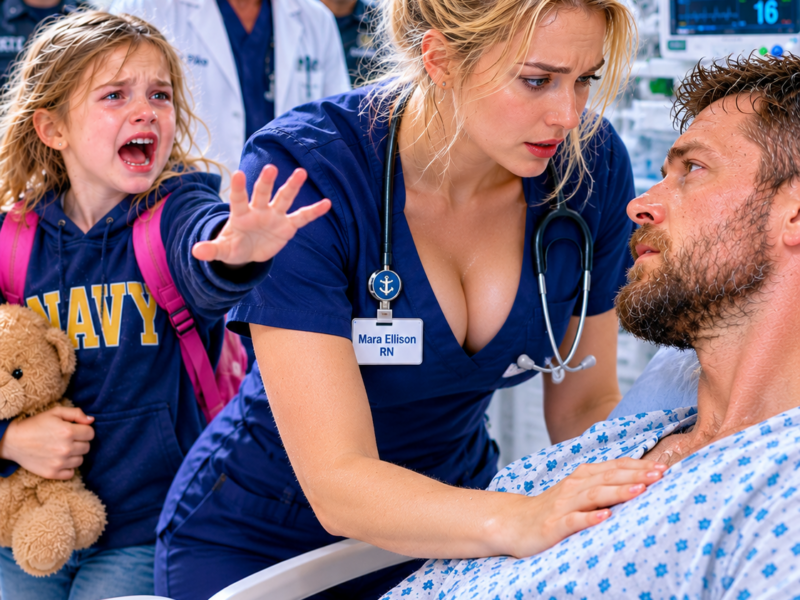
At 2:13 in the morning, Senior Chief Owen Mercer had already ripped out his IV three times.
The first thing I learned about Senior Chief Owen Mercer was that he did not trust anyone who approached him without announcing what they intended to do.
The second thing I learned was that someone had already decided he was too dangerous to be trusted.
And the third thing—the one that would change everything—was that his body was telling a different story from the one written in his medical record.
At 2:13 that morning, I had noticed the discrepancy in his temperature chart. At 2:48, I noticed something else.
His skin was burning.
Not the ordinary warmth of a man recovering from surgery. His face was flushed, sweat gathered along his hairline, and his breathing had become shallow. Every few minutes, his right hand moved toward his injured shoulder before stopping halfway, as if even reaching for it hurt too much.
I checked the monitor.
His heart rate had climbed again.
“Mr. Mercer,” I said from the doorway. “Your heart is working harder than it was twenty minutes ago.”
He stared at me.
I kept my hands visible.
“I want to check your temperature and look at the dressing on your shoulder. I won’t touch you without telling you first.”
His eyes moved toward the door.
Then toward the security officers outside.
Then back to me.
Two taps against the bed rail.
A pause.
One tap.
Then two more.
I remembered Lucy’s explanation.
Look twice.
“I hear you,” I whispered.
I looked twice.
The first time, I saw an injured man who was frightened and angry.
The second time, I saw a man whose condition was deteriorating while everyone around him argued about whether he was cooperating.
“Dr. Pike,” I called.
He appeared almost immediately, followed by two security officers.
“What’s happening?”
“His temperature is rising. His heart rate is increasing, and his blood pressure is trending down. I want a repeat set of vitals, blood cultures, lactate, and an immediate wound assessment.”
Pike glanced at the monitor.
“His last documented temperature was normal.”
“The chart is inconsistent.”
“Again with the chart?”
“Again with the patient.”
His expression hardened.
Then the monitor alarmed.
Owen’s heart rate had crossed another threshold.
Pike stepped into the room.
“Get the equipment,” he ordered.
I approached Owen slowly.
“I’m going to place the thermometer under your tongue. Is that okay?”
For several seconds, he didn’t move.
Then he opened his mouth.
The reading climbed.
102.4.
A few minutes later, it was 103.
Pike’s face changed.
“Get cultures. Start the sepsis protocol. Now.”
The room transformed.
Orders replaced arguments. Equipment replaced assumptions.
When I explained that we needed to inspect his shoulder dressing, Owen looked at the security officers.
“Clear the room,” he rasped.
Pike hesitated.
“Senior Chief, we need to—”
“Clear it,” I repeated. “I’ll stay.”
Pike looked at me, then at Owen.
Finally, he nodded.
The officers stepped outside.
I told Owen exactly what I was going to do before each movement. When I lifted the edge of the dressing, he flinched so violently that his hand grabbed the bed rail.
“I know,” I said. “I’m stopping.”
He breathed through clenched teeth.
When I continued, the smell reached me first.
Then I saw the spreading redness around the wound.
The dressing was soaked with thick drainage. The skin around the incision was swollen, hot, and discolored. There was a faint crackling sensation beneath the tissue that made my stomach tighten.
“Dr. Pike,” I said quietly. “You need to see this.”
He leaned over my shoulder.
For a moment, he said nothing.
Then he stepped back.
“Possible deep surgical-site infection. We need imaging and surgery.”
Owen stared at him.
“Wasn’t in my head,” he whispered.
Pike looked at the wound again.
“No,” he said. “It wasn’t.”
It was the first time that night someone had said those words to him.
And it was not nearly enough to make up for what had happened.
The next three hours were a blur of cultures, antibiotics, imaging, surgical consultation, and repeated reassessments.
Owen’s condition stabilized enough for the surgical team to take him upstairs.
Before they wheeled him away, he caught my sleeve.
I froze.
“Lucy.”
“I’ll make sure she’s okay.”
He shook his head.
“Don’t let her think…”
His voice failed.
I leaned closer.
“She won’t think you abandoned her. I promise.”
He held my gaze for a long moment.
Then he released my sleeve.
I watched the transport team take him through the doors.
Lucy was waiting in a chair outside the trauma wing, her pink backpack beside her. She had fallen asleep sitting upright, one hand wrapped around the two toothbrushes she’d brought from home.
I crouched beside her.
“Lucy?”
Her eyes opened.
“Is Dad coming back?”
“He’s having surgery to treat an infection. The doctors are taking care of him.”
She looked at the hallway.
“Did he get in trouble?”
The question hurt more than I expected.
“No,” I said. “He got sick. And we’re helping him get better.”
She studied my face.
Then she reached into her backpack and pulled out a folded piece of paper.
It was a whale-watching ticket.
“I brought the tickets,” she said. “He promised.”
I took the paper carefully.
“Then we’d better make sure he gets to use them.”
She nodded, but she didn’t smile.
By sunrise, Owen was in recovery.
The surgeon confirmed a deep infection requiring drainage and debridement. The antibiotics were working, but he would need close monitoring and another procedure if the infection failed to respond.
Dr. Pike stood beside the nurses’ station reading the operative report.
“He was hours away from becoming critically unstable,” he said.
I didn’t answer.
He looked up.
“You were right to push for reassessment.”
“I wasn’t trying to be right.”
“I know.”
His expression was tired.
“I should have looked at the whole patient instead of the behavior.”
I wanted to tell him that was exactly what I had been asking him to do.
Instead, I returned to Owen’s room.
His belongings had been placed in a clear property bag.
A cracked black dive watch sat at the bottom.
I recognized it from the first time I had entered his room. Its face was damaged, but a tiny light blinked beneath the glass.
When I picked up the bag, Commander Douglas Kesler appeared at the doorway.
His eyes went immediately to the watch.
“That should have been secured.”
I looked at him.
“It’s listed on his property inventory.”
“It’s operational equipment.”
“Then why was it in his personal belongings?”
Kesler didn’t answer.
He extended his hand.
“I’ll take custody of it.”
“Are you authorized to collect patient property?”
His jaw tightened.
“I’m responsible for the Triton program’s equipment.”
“That doesn’t answer my question.”
For the first time, the calm expression slipped.
“Be careful, Nurse Ellison.”
I looked down at the watch.
Then back at him.
“That’s what everyone keeps telling me.”
I should have reported the exchange immediately.
Instead, I did something that would cost me my access to the trauma floor.
I called Priya Shaw.
Priya was a biomedical engineer who had worked with our department for years. She knew the difference between a damaged medical device and a piece of equipment someone desperately wanted to keep out of sight.
When she arrived, I showed her the watch without opening the property bag.
She studied it through the plastic.
“That’s not a standard dive watch.”
“Can you tell what it is?”
“Not without a read-only diagnostic connection. And I won’t touch it unless property control approves the process.”
“Good.”
She glanced toward the corridor.
“Why does Commander Kesler want it?”
“I don’t know.”
Priya looked at me for a long moment.
“Then let’s find out what it recorded.”
The watch was transferred under documented chain of custody. Priya connected it to a diagnostic reader in the presence of a hospital property officer.
No one altered the device.
No one reset it.
No one removed its data.
The first report appeared forty minutes later.
Priya read it twice.
Then she called me.
“Mara, you need to see this.”
The watch contained internal telemetry associated with a Triton training system.
There were repeated oxygen partial-pressure instability warnings.
Not after the accident.
Before it.
Eleven minutes before the incident that had killed three sailors and injured Owen, the system had recorded its first warning.
Then another.
Then another.
Each warning was followed by a manual reset.
The official incident summary stated that no system anomaly had been detected before the operators lost control.
But the telemetry told another story.
“Could this be a recording error?” I asked.
“Possibly. That’s why we need an independent technical review. But the sequence is internally consistent.”
She pointed at one entry.
“Look at this.”
A warning had appeared.
Then the system had been manually reset.
Then Owen’s assigned operator station had issued an abort request.
The request was not followed.
I stared at the screen.
“Was that Owen?”
Priya nodded.
“His station identification matches.”
For a moment, I couldn’t speak.
Owen had tried to stop the exercise.
And someone had continued.
By noon, the consequences began.
My supervisor called me into her office.
Commander Kesler had filed a complaint alleging that I had interfered with a psychiatric transfer, mishandled restricted information, and improperly involved engineering personnel in an operational investigation.
My clinical access was suspended pending review.
My badge stopped opening the trauma wing doors.
I stood in the corridor holding it against the reader until the red light blinked for the third time.
A young nurse behind me looked uncomfortable.
“Sorry,” she whispered.
I stepped aside.
“It’s not your fault.”
But I knew what the suspension meant.
I could no longer care for Owen.
I could no longer access his chart.
And I could no longer ask the questions that had started this entire chain of events.
When I reached the waiting area, Lucy was sitting beside a woman I recognized from the Navy family support office.
Tessa Grant, the wife of one of Owen’s former teammates.
Tessa had agreed to take Lucy temporarily while Owen remained hospitalized.
Lucy looked up when she saw me.
“Are you leaving too?”
My throat tightened.
“I’m not going anywhere, sweetheart.”
“Then why can’t you go see Dad?”
I looked at the security desk.
“I have some work to do before I can.”
She considered that.
Then she reached into her backpack and pulled out the whale-watching tickets.
“Can you tell him I still have these?”
“I will.”
“And tell him I know he’s here.”
She closed her fingers three times.
The gesture was small and deliberate.
I understood.
When I went to Owen’s room later, I wasn’t allowed inside.
But through the glass, I could see him awake.
He was pale, exhausted, and connected to more equipment than before.
I raised my hand.
Three fingers closed.
Three times.
He watched me.
Then his right hand moved against the bed rail.
Two taps.
I know.
The person who changed everything was not a senior officer or an investigator.
It was Dr. Ethan Park.
Ethan was a young resident who had been present during Owen’s initial assessment. He had laughed nervously when Owen refused to answer questions and had suggested that the patient was deliberately provoking staff.
He had also noticed the discrepancy in the psychiatric documentation.
And he had done nothing.
Until that afternoon.
He found me outside the administrative offices.
“Mara.”
I turned.
His face looked gray.
“I need to tell you something.”
I waited.
“I saw the psychiatric assessment timestamp.”
“The one entered before the psychiatrist arrived?”
He nodded.
“I noticed it at 2:30. I checked the schedule. The psychiatrist didn’t enter the building until later.”
“Why didn’t you report it?”
His eyes dropped.
“Because I was afraid.”
I said nothing.
“My fellowship recommendation is coming up. Dr. Pike has influence. Commander Kesler has influence. I thought if I questioned the documentation, I’d lose everything.”
He swallowed.
“So I told myself it was probably a system error.”
“Was it?”
“No.”
He handed me a printed audit summary.
He had accessed the audit system under his own credentials and traced the record’s origin.
The psychiatric assessment had not been created from the psychiatrist’s workstation.
It had originated from an administrative account associated with the Triton liaison office.
The note had been entered before the psychiatrist arrived.
And the language in the note described Owen as disoriented, threatening, and unsuitable for independent decision-making.
It recommended immediate secure psychiatric transfer.
Ethan looked at me.
“I exported the audit record and sent a formal integrity concern to compliance. I also requested a legal hold.”
“Good.”
“I should have done it earlier.”
“Yes,” I said.
He nodded, accepting the answer.
“I know.”
Then he looked at the audit summary.
“I don’t know if this proves Kesler did it.”
“It doesn’t.”
“But it proves the record wasn’t entered where it should have been.”
“Yes.”
He took a shaky breath.
“I’m going to testify if they ask.”
That was the first time I believed we might uncover the truth.
Not because someone had finally become fearless.
Because someone had finally decided fear was no longer a good enough reason to remain silent.
Two days later, Commander Renee Alvarez from the Naval Inspector General’s office contacted me.
She asked me to preserve every communication, chart observation, and document connected to Owen’s treatment.
I was not permitted to access his medical record, but I could provide my own contemporaneous notes and explain what I had personally witnessed.
The review meeting took place in a secure conference room.
Dr. Pike sat beside hospital counsel.
Ethan sat across from him.
Priya brought the diagnostic report.
Commander Kesler arrived with a Navy attorney.
An independent technical specialist joined remotely.
At the far end of the table sat Rachel Monroe, a Triton safety engineer.
Commander Alvarez opened the meeting.
“We are reviewing two connected concerns. First, whether Senior Chief Mercer received appropriate medical care. Second, whether the records and technical evidence surrounding his condition and the Triton accident were accurately represented.”
She looked at me.
“Ms. Ellison, start with the patient.”
I explained what I had seen.
The behavior.
The fever.
The chart discrepancy.
The deterioration.
The wound infection.
The refusal to allow people near him.
I explained that his resistance had been interpreted as psychiatric instability before his physical condition had been adequately reassessed.
Dr. Pike spoke next.
He admitted that the initial focus had been on staff safety and behavioral management.
“We were dealing with an increasingly aggressive patient,” he said. “But I should have continued evaluating medical causes. His condition was not stable enough for transfer.”
Commander Alvarez nodded.
“Did Nurse Ellison raise that concern?”
“Yes.”
“Was she correct?”
“Yes.”
It was a small admission.
But it mattered.
Then Ethan presented the psychiatric audit.
The room became quiet as he displayed the timestamp and originating account.
The note had been created from an administrative account associated with the Triton liaison office.
It had not originated from the psychiatrist’s workstation.
The psychiatrist later confirmed that he had not written or entered the assessment at the time recorded.
Kesler leaned forward.
“An administrative account can be accessed by multiple personnel. This does not establish who created the entry.”
Commander Alvarez looked at him.
“Correct. That is why we are investigating the account activity and access history.”
Kesler folded his hands.
“I would caution against drawing conclusions from incomplete information.”
“Agreed,” she replied. “We are here to establish facts.”
Then Priya presented the watch telemetry.
The oxygen warnings appeared on the screen.
One after another.
Each followed by a manual reset.
The abort request appeared eleven minutes after the first warning.
Rachel Monroe studied the report without speaking.
Finally, she opened her laptop.
“I have another document.”
She shared an email dated three days before the accident.
It was a technical warning recommending that the Triton field trial be suspended until sensor validation was complete.
The sender was Rachel Monroe.
The recipient was Commander Kesler.
His reply was short.
“Downgrade to advisory. Proceed pending field validation.”
No one spoke.
Rachel continued.
“The warning concerned the same sensor instability reflected in the watch telemetry.”
Kesler’s expression remained controlled.
“The system had undergone validation. The decision to continue was based on the available technical assessment.”
“Your own safety engineer recommended suspension,” Commander Alvarez said.
“I made an operational decision based on the information available.”
“And after the accident, the official summary stated that no system anomaly had been detected before operator failure.”
Kesler looked at the screen.
Then at the table.
“I did not author that report.”
“No one has said you did.”
The silence that followed was different from the earlier silences.
This time, no one was rushing to fill it.
Commander Alvarez closed the meeting by outlining the immediate actions.
Kesler would be removed from Triton program duties pending the formal investigation.
The program would be temporarily suspended for technical review.
The psychiatric record alteration would be investigated separately.
Owen’s competency assessment would be repeated by an independent clinical team.
And the hospital would review how it handled his initial refusal of care.
When the meeting ended, I remained seated.
For six years, I had believed that the worst thing I could do was make a mistake while someone depended on me.
Now I understood that a second mistake could be pretending I had never seen the first one.
Owen woke more fully on the fourth day after surgery.
His fever was coming down.
The infection was responding to treatment.
He still had pain, and the injury to his shoulder would require rehabilitation, but he was no longer fighting for his life.
His independent psychiatric reassessment found no basis for the earlier conclusion that he was incapable of making medical decisions.
His refusal of certain procedures was documented as a boundary requiring communication and informed consent—not proof of mental instability.
When I was finally allowed back into his room, he was sitting upright with a pillow behind his shoulder.
Lucy sat beside him, drawing whales on the back of a hospital menu.
Owen looked at my badge.
“Got your door key back?”
“Eventually.”
He gave a faint smile.
“Good.”
I pulled a chair closer.
“I owe you an apology.”
He frowned.
“For what?”
“For not recognizing sooner how much was happening to you.”
He studied me.
“You saw it.”
“Not soon enough.”
“You came back.”
I looked at his shoulder.
“I should have listened the first time.”
He was quiet for a moment.
Then he tapped the bed rail.
Two taps.
A pause.
One tap.
Two taps.
Look twice.
“I did,” I said.
He shook his head.
“Not just at the chart.”
I understood.
He meant the room.
The security officers.
The way people approached him.
The way he watched every hand.
The way he kept looking toward the door.
He wasn’t only afraid of pain.
He was afraid of losing control again.
“I’m sorry,” I said.
He looked away.
“Three men died.”
His voice was low.
“Three men I was supposed to bring home.”
I didn’t interrupt.
“I saw the warning. I asked to abort. They told us the system was stable. Then everything went wrong.”
He closed his eyes.
“I keep hearing the alarms.”
I waited.
“I know they can’t hear me anymore,” he continued. “But I keep thinking if I had done something differently…”
His voice broke.
I recognized that sentence.
I had been carrying a version of it for six years.
And there was something I still needed to tell him.
“Owen, do you remember Cole?”
His eyes opened.
“Cole?”
“Six years ago. Djibouti.”
He looked at me for a long moment.
Then he nodded.
“I remember.”
I took a breath.
“I’ve thought about that night every day since.”
He said nothing.
“I believed I made the wrong triage decision. I treated another casualty first. Cole died. And I spent years telling myself that if I’d recognized his condition sooner, I could have saved him.”
Owen looked down at his hands.
“Cole was already in bad shape when we got him to you.”
“I know.”
“He’d lost too much blood before he reached the medical station.”
“I know that now.”
He shook his head.
“He woke up briefly. Asked if everyone else had made it inside.”
I felt my chest tighten.
“What?”
“You told him they were safe.”
I couldn’t move.
Owen continued.
“He heard you. He knew the others were accounted for. That was the last thing he asked about.”
My eyes filled.
“You never told me.”
“I didn’t know you were carrying it like that.”
I looked down at my hands.
For six years, I had remembered Cole’s face.
The noise.
The blood.
The decision.
I had never known what he had asked before he died.
“He knew they were safe?” I whispered.
Owen nodded.
“You did what you could with what you had.”
I wanted to believe him.
But I also knew that believing him wouldn’t erase the loss.
“I might still have missed something,” I said.
“Maybe.”
His answer surprised me.
He didn’t offer an easy absolution.
He didn’t pretend every decision had been perfect.
“But that doesn’t mean you killed him,” he continued. “And it doesn’t mean knowing more afterward makes you responsible for everything you couldn’t know then.”
I stared at him.
That was the first time anyone had separated my regret from my guilt.
And perhaps it was the first time I had allowed myself to hear the difference.
Six weeks later, Owen crossed the rehabilitation room using two crutches.
His left leg was still weak, and his shoulder movement remained limited.
But he was walking.
Lucy followed him with a notebook.
“Your handwriting is worse than mine,” she announced.
Owen looked over his shoulder.
“That’s because I’m injured.”
“That’s what you said yesterday.”
“Yesterday I was also injured.”
She laughed.
It was the first time I had heard her laugh without looking toward the hospital doors afterward.
Owen eventually returned to his unit for a modified recovery assignment. He would not return to operational duty until he completed a full medical and psychological evaluation.
The Triton program remained suspended pending technical review.
Commander Kesler was under formal investigation. The available evidence established that he had received a safety warning and had approved continuing the trial, but it did not yet establish criminal responsibility for the accident or the alteration of the medical record.
The hospital also continued investigating how the psychiatric note had been created.
Ethan kept his position.
His fellowship recommendation was delayed, and he had to answer difficult questions about why he waited to report the discrepancy.
He didn’t make excuses.
Dr. Pike helped develop a new clinical review process and acknowledged that he had allowed a difficult patient’s behavior to overshadow his medical responsibility.
And I returned to the trauma floor.
But something had changed.
Three months after Owen’s admission, Naval Medical Center San Diego introduced a new protocol called Second Look Review.
Before a high-risk psychiatric transfer involving an active-duty service member or veteran, an independent medical reassessment would be required to rule out physical causes of behavioral changes.
Psychiatric encounter timestamps would be verified.
High-risk chart changes would be audited.
Families would be invited to provide information about the patient’s normal communication patterns, especially when injury, trauma, or medication made verbal communication difficult.
The protocol did not assume that every angry patient was medically unstable.
It did not assume that every frightened patient was telling the truth.
It simply required us to look again before deciding we had already understood.
Dr. Pike helped write the clinical section.
Ethan testified about the documentation failure.
Priya helped establish procedures for preserving device evidence.
And Lucy’s explanation of her father’s signal became part of a staff training discussion.
Not because it was a medical intervention.
Because it reminded us that patients often communicate long before we understand what they’re trying to say.
A month after the protocol launched, a young Marine arrived after a complicated procedure.
He refused noise-cancelling headphones and became increasingly agitated whenever someone approached his bed.
The security officer asked whether he should be called.
I noticed the Marine tapping two fingers against his thigh.
Not randomly.
In a pattern.
I asked his wife whether he used that signal at home.
She looked surprised.
“He does that when the room gets too loud,” she said. “It means he needs everyone to stop talking for a minute.”
I nodded.
Then I asked the Marine if he wanted the lights lowered and the room cleared.
He stopped tapping.
He didn’t need a security escort.
He needed someone to ask what the tapping meant.
That evening, I amended his chart.
Not as a behavioral warning.
As a communication preference.
It was a small change.
But I knew how much a small change could matter.
Three months after Owen’s accident, I received a message from Lucy.
It contained a photograph.
She was standing on the deck of a whale-watching boat, wearing her oversized navy sweatshirt and holding a pair of binoculars.
Owen stood beside her with a cane.
His shoulder was still stiff, but he was smiling.
Behind them, the ocean stretched into the distance.
The message beneath the photograph read:
WE SAW TWO WHALES. DAD SAID WE SHOULD LOOK TWICE.
I smiled at my phone.
A week later, I visited Cabrillo National Monument.
I hadn’t planned to see them.
But I spotted Lucy first.
She was standing near the overlook, pointing toward the water.
Owen stood beside her, his cane resting against his leg.
He looked healthier.
Not untouched by what had happened.
Not magically healed.
But present.
Lucy spotted me and waved.
“Ms. Ellison!”
I walked toward them.
“Did you use the tickets?”
She nodded enthusiastically.
“We saw two whales. One was really close.”
Owen smiled.
“She means close enough that she nearly dropped the binoculars.”
“I did not!”
“You almost did.”
Lucy turned toward the ocean again.
“Look!”
A dark shape moved across the water.
Then another.
Owen looked at his daughter first.
Only after making sure she was steady did he turn toward the horizon.
I watched him.
The man who had once tracked every hand in a hospital room was now standing beside his child, looking out at something beautiful.
He noticed me watching.
“Funny thing about coming home,” he said. “People think it’s the moment you walk through the door.”
I waited.
“Sometimes it’s the moment you realize someone was waiting for you.”
Lucy slipped her hand into his.
He closed his fingers around hers.
Three times.
She smiled.
And I finally understood something I had spent six years trying to learn.
Medicine is not only about keeping someone alive.
It is about recognizing the person who is still trying to come back.
Sometimes the most important thing a nurse can do is notice the warning hidden beneath anger, the fear hidden beneath silence, or the truth buried under a record that looks perfectly complete.
Sometimes it is as simple as stopping before you decide you already know.
And sometimes, when someone taps twice, pauses, taps once, and then twice again, you have to remember what an eight-year-old girl taught an entire hospital.
Look twice.
Because the person in front of you may be fighting a battle you cannot see.
And because coming home is a mission, too.
The End.









