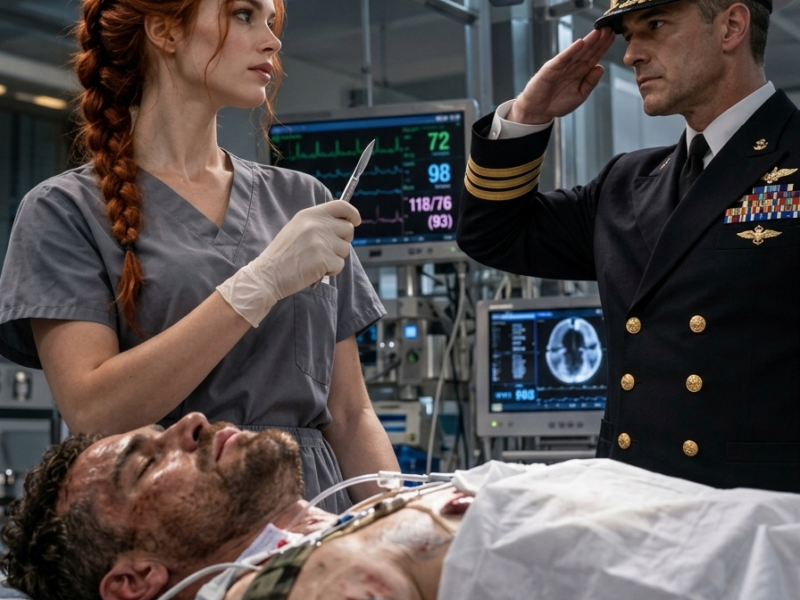
At 2:13 a.m. in a Navy trauma bay at Naval Medical Center San Diego, I watched three doctors fail to stop a SEAL’s bleeding while his commander coldly ordered me away from the table
The fluorescent lights in Trauma Bay Four of Naval Medical Center San Diego hummed with a low, relentless vibration that seemed to buzz right through the soles of my shoes. It was 2:13 a.m. Outside, the Pacific Ocean was a vast, pitch-black void, but inside the bay, the air smelled sharply of iron, iodine, and burnt skin.
“Pressure is dropping! Sixty over forty and sliding!” shouted the charge nurse, her hands covered in dark, slick gloves as she hung another bag of O-negative blood.
On the center gurney lay Ethan Cole. He was twenty-nine years old, built like a wall of solid marble, but right now, he looked entirely hollow. He was a decorated Navy SEAL, rushed in under dark-of-night clearance following what the military liaison had vaguely called a “breach exercise accident” at the amphibious base on Coronado.
Three senior trauma surgeons were huddled over his chest. They were working with frantic, precise violence. Dr. Harrison, a veteran navy surgeon with twenty years of trauma experience, was deep into the wound, his forearms soaked in blood.
“I can’t find the arterial bleed!” Harrison barked, his forehead glistening with sweat beneath the harsh lights. “We cauterized the entry tearing in the left flank. We packed the lower thoracic cavity. Where is the blood coming from?”
I stood frozen beside the crash cart, holding a fresh tray of sterile sponges. My name is Clara Mercer, a civilian trauma nurse assigned to the nighttime military rotation. I had seen plenty of gruesome injuries, but the sheer volume of blood pooling beneath Ethan Cole’s back did not make sense. It wasn’t spurting in rhythm with his failing heartbeat. It was expanding, a dark maroon tide spreading outward across the stark white sheet, coming from somewhere above the primary blast wound.
“He’s going into DIC!” the second doctor yelled, referencing the catastrophic state where the body loses its ability to clot. “He’s bleeding out through every micro-vessel. He’s not going to make it.”
“Give me another four units!” Harrison commanded, his voice cracking. “Now!”
A heavy shadow moved from the corner of the room. Captain Marcus Vance, Ethan’s commanding officer, stepped into the white circle of light. Vance was dressed in crisp service utilities, his face carved from granite, his eyes entirely devoid of panic. He didn’t look like a man watching one of his best soldiers die; he looked like an auditor waiting for an inventory check.
“Doctor,” Captain Vance said, his voice quiet, flat, and absolute. “You’re done here. Step away from the operator.”
Dr. Harrison glanced up, stunned. “Captain, he has minutes left. I can still try an emergency thoracotomy—”
“I said step away,” Vance repeated. He reached out and grabbed my upper arm, his grip like a vise, forcing me backward toward the swinging doors. “All of you. Leave the bay. Naval Intelligence is taking control of this floor.”
“Nurse, step back,” Harrison repeated, his voice deflated, giving up.
I felt Vance’s fingers digging into my arm. I should have obeyed. I should have walked out the door and let the military machine swallow whatever was happening here. But as Vance pulled me away, my eyes locked on the pooling blood beneath Ethan Cole’s shoulder blade.
The blood was dark, almost black. And it wasn’t flowing out—it was displaced. Something beneath his back was raising his left shoulder by a fraction of an inch, creating a localized pocket where fluid was trapped.
“Hold on,” I said.
Captain Vance snapped his gaze to me, his grip tightening instantly to the point of pain. “What did you say?”
“Let go of me,” I said, my voice shaking but loud enough to cut through the hum of the cardiac monitor. “Look at his shoulder. That’s not a thoracic tear. Look at the elevation.”
“He’s dying, nurse. Do not make this harder,” Vance growled, stepping between me and the gurney.
“Why are you standing in front of him?” I demanded, looking Vance straight in the eye. “If he’s dying, why are you trying to stop us from looking at him?”
Silence fell over Trauma Bay Four. Dr. Harrison stopped wiping his forehead. The nurses froze. The only sound was the high-pitched, agonizing beep of the heart monitor: fifty-two beats per minute… forty-eight…
Vance didn’t answer. That silence scared me more than the blood slicking the floor.
I yanked my arm out of his grasp with everything I had, stepped around him, and grabbed a pair of heavy trauma shears from the cart. Before Vance could react, I sliced through the thick, blood-soaked fabric of Ethan’s tactical undershirt, peeling it back from his left shoulder blade.
Embedded deep into the flesh near his spine was a sharp, jagged piece of blackened metal—shrapnel from the blast. But right beneath the metal, sitting directly in the middle of a swollen, lacerated incision that had clearly been made before the explosion, was something else.
It was a tiny, cylindrical plastic capsule, no larger than a flash drive, completely waterproofed and bound with surgical wire to the bone.
The room went dead quiet. Dr. Harrison leaned in, his jaw dropping. “What in the hell is that?”
Captain Vance’s face drained of all color. His stoic demeanor shattered for a fraction of a second, replaced by something cold and murderous. “Leave it alone,” Vance whispered. “That’s classified material.”
“That ‘classified material’ is sitting directly on his subclavian artery branch,” I said, my hands steadying as adrenaline took over. “It’s pressing the vessel open. Every time his heart beats, it pumps blood straight into his shoulder pocket. It’s an internal dam.”
I didn’t wait for permission. I reached in with a pair of long blunt forcep clamps, bypassed the sharp edge of the shrapnel, and gripped the plastic capsule. With a precise, firm pull, I lifted it free from the pocket.
Immediately, the abnormal pressure released. Dr. Harrison dropped to his knees, applying direct pressure to the newly exposed vessel, and instantly snapped a surgical clip into place.
The frantic screaming of the heart monitor slowed. The erratic spiking turned into a rhythm.
Beep… beep… beep…
Blood pressure: eighty over fifty. Ninety over sixty.
“He’s stabilizing,” the charge nurse whispered in disbelief. “His pressure is rising.”
I stood there, holding the blood-stained plastic capsule in my gloved hand. Everyone in the bay was staring at it.
Then, a rough, agonizing gasp tore through the room.
Ethan Cole opened his eyes. They were bloodshot, bright with shock, and unfocused. He didn’t look at his doctor. He didn’t look at his commander. He turned his head slowly, locking his gaze onto me.
He reached out a heavy, trembling hand, his fingers slick with dark blood, and dragged me down until his face was inches from mine.
“Don’t… let them… take that,” Ethan whispered, his voice a raspy shred of breath. “It’s… the entire ledger…”
I looked up toward the foot of the bed.
Captain Marcus Vance was already gone. The swinging doors of Trauma Bay Four were still rocking back and forth in his wake.
Before I could process what Ethan had said, heavy boots echoed down the hallway. Three Armed Forces Military Police officers burst through the doors, weapons at their sides, their faces stern.
“Floor is on lockdown!” the lead officer announced. “Nobody moves!”
“Where is Captain Vance?” Dr. Harrison demanded, stepping forward. “He was just here!”
The officers didn’t answer. They began clearing the room, pushing the junior staff out into the corridor. In the chaos, I backed toward the crash cart, carefully dropping the bloodied plastic capsule into the deep side pocket of my medical scrubs.
As I turned to follow the nurses out, my foot caught on something hard resting on the floor beneath the edge of Ethan’s bed. I looked down.
Half-hidden under the stainless steel wheel was a second plastic capsule. It was identical to the first, except for one detail: wrapped inside the clear outer plastic was a small strip of white medical tape.
Written on the tape, in dark blue ink that had blurred slightly from moisture, was a single word:
CLARA.
My hands were shaking so violently I could barely fit my key into the lock of my staff locker.
The hospital was on a silent lockdown. Military police were stationed at every exit, claiming an “active secure-asset protocol.” They were interviewing every nurse, every technician, every doctor who had been in Bay Four. I had ten minutes—maybe less—before they called me into the supervisor’s office for questioning.
I ducked into the dark, quiet sanctuary of the women’s employee locker room, pulled the door shut, and locked it from the inside.
I sat on the narrow wooden bench, my breath coming in short, jagged gasps. I pulled the two plastic capsules from my pocket and laid them out on a clean paper towel.
The first capsule—the one I had removed from Ethan Cole’s shoulder—contained a tiny, high-density microSD card, wrapped in black electrical tape. It was covered in dark, half-congealed blood.
The second capsule—the one found on the floor with my name on it—contained no technology. Instead, inside the clear plastic was a tightly rolled piece of waterproof synthetic paper.
I unrolled it carefully. The handwriting was jagged, clearly written in haste or in extreme physical distress:
Clara Mercer. If you are reading this, I am either dead or under heavy sedation. Do not trust Vance. Do not trust hospital security. Vance isn’t trying to cover up an accident. He caused it. The blast on Coronado wasn’t a training exercise—it was an execution attempt.
The micro-SD card contains eight years of off-book financial transfers from the Defense Logistics Agency to a private maritime firm called Aegis Vector. Vance runs the board.
They killed my team on Coronado. I survived because I put the drive inside my shoulder before the shockwave hit.
If Vance realizes I am alive, he will finish it in the ICU.
You are the only person in this building who isn’t on his payroll or too terrified to look. Find my locker at the Coronado Marina. Key code is the date my brother died: 0412. Get the hard drive. Get to the press.
I stared at the paper, my blood running cold.
My name was on this note. How did Ethan Cole know my name? I had never met him in my life. I was a civilian night-shift nurse who covered random rotation blocks.
I turned the paper over. On the back were three more lines:
I saw your name tag when you leaned over me in the transport rig outside. You didn’t flinch when the blood covered your hands. You were the only one who looked at my face instead of my rank. Please, Clara.
A heavy knock echoed through the door, making me jump.
“Nurse Mercer?” a harsh voice called out. “This is Sergeant Miller, Naval Security Forces. We need you in the administrative office immediately for debriefing.”
I shoved the capsules, the note, and the microSD card deep into my brassiere, smoothed down my blood-stained scrubs, and wiped my face with a damp paper towel. I took a deep, steadying breath, forced my expression into one of exhausted trauma-nurse fatigue, and opened the door.
Two tall military policemen were standing in the hallway, arms crossed over their tactical vests.
“Is Ethan Cole stable?” I asked, keeping my voice soft and concerned.
“Patient transfer is underway,” Sergeant Miller said impassively. “Captain Vance has ordered his relocation to the Naval Hospital at Camp Pendleton for specialized military care. You need to come with us to sign off on the intake logs.”
Relocation. They were moving him. If Vance got Ethan to a controlled military facility at Camp Pendleton, Ethan would never wake up. An accidental over-dose of sedative, a sudden respiratory failure—it would be effortless.
“Of course,” I said, stepping into the hallway. “Let me just grab my jacket from the nurse’s station.”
“No stops,” Miller said, stepping into my path. “Directly to administration.”
We walked down the long, sterile corridors of the hospital. Every instinct in my body screamed that I was walking into a trap. As we turned the corner toward the administrative wing, the double doors at the end of the hallway burst open.
A team of paramedics was rolling a gurney toward the rear ambulance bay at a dead sprint. On the gurney was Ethan Cole, wrapped in heavy thermal blankets, an oxygen mask strapped to his face. Walking alongside him was Captain Vance, holding an IV bag high above his head.
“Wait!” I blurted out, stepping forward. “He’s not clear for transport! His subclavian artery was just clamped! Any sudden movement could rupture the suture!”
Captain Vance stopped and turned his head. His eyes locked onto mine with a cold, terrifying intensity.
“The patient is military property, Nurse Mercer,” Vance said, his voice dropping to a dangerous whisper as the paramedics pushed the gurney through the rear doors. “His care is no longer your concern. Sergeant, secure her statement. Make sure she understands the non-disclosure agreements regarding active operations.”
Vance turned and walked out into the rain toward a black unmarked military ambulance.
I stood in the corridor, watching the red tail lights of the ambulance disappear into the stormy night. I knew that if I did nothing, Ethan Cole would be dead before sunrise. And once they realized the microSD card wasn’t on his body, they would come back for the only person who had touched his shoulder in Bay Four.
They would come for me.
I looked at Sergeant Miller, who was pulling out a clipboard.
“I need to use the restroom,” I said smoothly, gesturing toward the staff lavatory three feet away. “Unless you need to monitor that too?”
Miller frowned, hesitated, then stepped back. “Two minutes, Nurse. Don’t waste my time.”
I walked into the restroom, locked the heavy metal door, and immediately turned to the small window above the sink that led out to the rear parking lot. It was narrow, designed for ventilation, but I was small enough to squeeze through.
I pulled myself up, shoved my torso through the opening, and tumbled out into the pouring rain, landing hard on the wet asphalt beside the dumpster.
I didn’t stop to feel the pain in my knees. I pulled my jacket tight around my soaked scrubs, ran across the dark parking lot to my beat-up sedan, and started the engine.
My GPS was set for the Coronado Marina.
The rain was coming down in sheets by the time I reached the Navy Yacht Club marina on Coronado Island. The Pacific Ocean was churning wildly against the wooden pilings, sending bursts of salty spray over the dark, empty docks.
It was 3:45 a.m. The marina was silent, save for the rhythmic clattering of boat rigging against aluminum masts in the wind.
I walked down Pier 4, shielding my eyes against the rain, searching for the row of storage lockers used by active-duty SEAL units stationed nearby. My sneakers squeaked softly on the wet wood. Every shadow looked like a soldier; every gust of wind sounded like an approaching engine.
At the far end of the dock, under a flickering yellow security lamp, sat Locker 114.
I knelt before the heavy steel padlock. My fingers were cold and numb, making it almost impossible to turn the dial.
0-4-1-2. April 12th.
The lock clicked open with a heavy metallic snap. I pulled it off, grabbed the latch, and lifted the corrugated door up.
Inside, the locker was bare except for a heavy black tactical duffel bag sitting on a wooden shelf. I reached inside, pulled the bag down, and unzipped it.
Inside was a high-powered encrypted laptop, a satellite phone, two spare magazines for a weapon I didn’t see, and a thick paper binder stamped with red letters: OPERATION SILENT ARCHER – AEGIS VECTOR INTERNAL AUDIT.
I opened the binder. Page after page contained shipping manifests, offshore account numbers, and photographs of unmarked cargo ships docking at private piers in San Diego, Long Beach, and Ensenada.
And then I saw the names.
It wasn’t just Captain Vance. Attached to the wire transfer confirmations were signatures from high-ranking defense officials, private security executives, and two prominent members of the Senate Armed Services Committee. They weren’t just stealing money—they were diverting heavy weaponry, decommissioned naval gear, and tactical drone tech to private buyers in South America and Eastern Europe.
Ethan Cole hadn’t just uncovered a corruption scandal; he had stumbled upon a high-level treason network operating out of the highest offices in the Department of Defense.
“You really shouldn’t have opened that, Clara,” a quiet voice said from behind me.
I froze.
I turned around slowly. Standing under the flickering yellow light, holding a silenced pistol aimed directly at my chest, was Captain Vance. Beside him stood two men in black civilian tactical gear, their faces hidden behind dark masks.
“How did you find me?” I whispered, clutching the binder against my scrub top.
Vance smiled—a bitter, lifeless expression. “Ethan is a brilliant operator, but he’s predictable. He always uses his brother’s death as his key code. And when you disappeared out of the hospital window, it didn’t take a detective to figure out where you’d run.”
“He’s still alive, isn’t he?” I demanded, trying to buy time, looking past him toward the dark waters of the bay. “You haven’t killed him yet.”
“Ethan is currently in an unmarked van parked two hundred yards from here,” Vance said, stepping closer, his boots heavy on the wooden dock. “He was supposed to die in the blast on the training range. The demolition charge was wired to hit his vehicle directly. But he was too fast. He took the shrapnel, hid the digital drive, and managed to stay alive long enough to reach your trauma bay.”
Vance raised the gun until the black barrel was aligned with my eyes.
“Hand over the drive and the binder, Clara. I’ll make sure it’s fast for you. You were just a civilian nurse who got caught in the crossfire of things you can’t possibly comprehend.”
“If you kill me, the evidence doesn’t disappear,” I lied, my voice remarkably steady despite the terror raging through my veins. “I emailed copies of the micro-SD card to three major newsrooms before I left the hospital parking lot.”
Vance paused for half a second. His eyes narrowed. “No, you didn’t. You didn’t have the decryption key. Ethan kept the key hardware on his person.”
He stepped forward, extending his hand for the bag. “Give it to me.”
Before I could answer, a blinding white light cut through the dark rain from the water below.
A high-powered searchlight mounted on an unmarked rigid-hull inflatable boat (RHIB) slammed directly into Vance’s eyes.
“DROP YOUR WEAPONS! NAVAL CRIMINAL INVESTIGATIVE SERVICE! STAY WHERE YOU ARE!” a loudspeaker boomed across the water.
Vance cursed, flinching against the brilliant glare.
In that split second of distraction, I didn’t think. I threw the heavy tactical duffel bag straight into Vance’s face, turned around, and jumped off the edge of Pier 4 into the freezing, dark waters of San Diego Bay.
The hit of the ocean water was like a million needles slamming into my skin at once. The salt burned my eyes and filled my nose, knocking the breath completely out of my lungs.
I went deep, underwater currents tugging at my soaked scrubs, pulling me down into the freezing blackness. Above me, the muted thump-thump-thump of silenced gunfire cut through the surface of the water, hitting the wooden pilings of the pier above.
I kicked with everything I had, fighting the weight of my clothes, swimming horizontally beneath the maze of barnacle-encrusted wooden posts supporting the dock.
I surfaced fifty yards away, hidden under the shadow of a large fiberglass yacht. I gasped for air, clinging to the hull, my teeth chattering uncontrollably as the bitter wind whipped across the dark water.
On the pier above, absolute chaos had erupted. Flashbang grenades detonated with deafening cracks, filling the night air with white light and thick smoke. Federal agents wearing NCIS windbreakers were swarming the dock from both ends, trading gunfire with Vance’s private contractors.
“Secure the perimeter! Don’t let Vance reach the parking lot!” a voice yelled over a bullhorn.
I pulled myself up onto the swim platform at the back of the yacht, slumping onto the wet deck, gasping for breath. My hands were blue from the cold. I reached into my scrub top—the two plastic capsules were still tucked securely into my sports bra. They were safe.
Through the rain and smoke on the pier, I saw Captain Vance backing away toward a dark black SUV parked near the marina gate. He was firing his weapon wildly behind him, using his surviving tactical contractor as a human shield.
He reached the SUV, threw the driver’s side door open, and slammed the vehicle into reverse, tires screeching against the wet pavement as he broke through the security barrier and tore down the road toward the main highway.
NCIS agents were shouting into radios, but their vehicles were blocked by the fallen gate.
He was going to escape.
I scrambled off the back of the yacht onto the low dock, ignoring the searing pain in my legs. I ran toward the parked military transport van Vance had mentioned earlier—the one sitting alone near the marina office.
The driver’s side window was smashed out. I looked inside.
Lying on a fold-out stretcher in the back of the van was Ethan Cole. He was bound with plastic zip-ties, an IV line ripped out of his arm, his chest rising and falling in shallow, desperate breaths. He was conscious, his dark eyes wide with agony as he looked at me through the rain.
I grabbed a discarded tactical knife from the van’s front floorboard, climbed into the back, and sliced through the zip-ties holding his wrists and ankles.
“Clara…” he rasped, coughing up a small spot of blood. “You… you survived…”
“I’m here,” I said, tearing off a strip of my wet scrub top and pressing it against the fresh bleeding on his shoulder. “Vance got away. He’s heading for the highway.”
Ethan grabbed my arm with terrifying strength. His eyes were burning with a fierce, unyielding light that completely defied his body’s physical brokenness.
“He’s not heading for the highway,” Ethan gritted out, forcing himself up into a sitting position despite his agonizing wounds. “He has an emergency escape route. A private airfield at Brown Field near the border. He has a private jet waiting.”
Ethan looked at the van’s dashboard. The keys were still in the ignition.
“Can you drive?” Ethan asked me, his voice dead serious.
I looked at the keys, then at his bloodied chest, then back to the highway where Vance’s SUV tail lights were disappearing into the dark rain.
“I can drive fast,” I said.
The black transit van roared through the rain-slicked streets of San Diego, its tires throwing up massive waves of water as I pushed the engine to its absolute limit.
Beside me in the passenger seat, Ethan Cole was holding a heavy navy-issue pistol he had pulled from the van’s glove compartment. His face was deathly pale, his jaw set in a tight, pain-racked line, but his hands were dead steady as he checked the chamber.
“Two miles to the airfield,” Ethan said, his voice low and calm despite the speed of the vehicle. “The private hangar is on the south perimeter, away from the main terminal. If he reaches that runway, he’s in international airspace in three minutes.”
“How do we stop a plane with a van?” I shouted over the roar of the rain and engine.
“We don’t stop the plane,” Ethan replied, turning his gaze to me. “We stop Vance.”
Up ahead, through the fog and torrential rain, the chain-link perimeter fence of Brown Field appeared. The main access gate had been smashed open—Vance’s SUV had driven straight through it.
I stomped on the accelerator. The van lurched forward, crashing through the ruined gate and tearing across the wide, dark expanse of tarmac.
Near the center of the airfield, a sleek, twin-engine Gulfstream private jet was idling on the runway, its navigation lights flashing red and green through the downpour. The airstairs were down, and standing at the base of the stairs was Captain Marcus Vance, holding a metal briefcase, preparing to climb aboard.
“There!” Ethan yelled.
Vance turned, his eyes widening as the headlights of our van cut through the darkness, blinding him. He pulled his gun and began firing directly through our windshield.
CRACK! CRACK! CRACK!
Glass shattered into a thousand glittering pieces, spraying across my lap. I ducked behind the steering wheel, keeping my foot slammed flat on the gas pedal.
“Clara, swerve right!” Ethan roared.
I yanked the wheel to the right just as Vance dodged out of the way. The van slammed directly into the jet’s lower airstairs, crumpling the aluminum ladder with a terrifying screech of tearing metal and snapping the hydraulic lines in a burst of sparks.
The jet’s escape door slammed shut automatically as the stair mechanism collapsed, trapping the aircraft on the tarmac.
The van ground to a halt, smoking and battered.
I threw open my door and rolled out onto the wet asphalt, taking cover behind the front tire. Through the rain, I saw Vance picking himself up off the ground twenty feet away, his face smeared with grease and blood. His weapon had been knocked from his hand by the impact.
Ethan dragged himself out of the passenger side, using the door for support. He could barely stand, his left arm completely useless, blood soaking through his bandages once again. But he raised the navy pistol with his right hand, pointing it directly at Vance’s chest.
“It’s over, Marcus,” Ethan said, his voice echoing across the empty airfield.
Vance looked at Ethan, then at the ruined airstairs of his jet, then at me. A bitter, desperate laugh escaped his lips.
“You think you’ve won, Ethan?” Vance spat, wiping blood from his nose. “You think taking me down stops this? You’re a foot soldier! You have no idea how deep this goes. You bring this data out, and they will hunt you for the rest of your natural life. They will hunt her too!”
Vance gestured wildly at me.
“She’s a nurse!” Vance yelled. “She has nothing to do with this! Hand over the drive, Ethan, and I’ll make sure she walks away untouched.”
Ethan didn’t hesitate for a single second.
“She saved my life,” Ethan said softly. “And she’s the one who’s going to end yours.”
Ethan looked at me, giving a subtle nod toward the briefcase Vance had dropped near my feet.
Before Vance could react, loud sirens pierced the night air. A dozen blue and red lights flooded the airfield as a convoy of NCIS and Federal Marshal vehicles swept across the tarmac, surrounding the jet, the van, and Vance in a circle of high-intensity light.
Heavy tactical officers leaped out, weapons raised. “HANDS IN THE AIR! DOWN ON THE GROUND NOW!”
Vance looked around at the wall of federal officers, his eyes wild, realizing there was no dark corner left to hide in. Slowly, bitterly, he raised his hands above his head and dropped to his knees in the pouring rain.
An NCIS senior investigator rushed forward, kicking Vance’s discarded weapon away and slamming the steel handcuffs onto his wrists.
I knelt beside Ethan as his knees finally gave out. I caught him before he hit the hard tarmac, lowering him gently into my lap.
“We did it,” I whispered, pulling the two blood-stained plastic capsules from my scrub jacket and holding them up in the flashing police lights. “It’s over.”
Ethan looked up at me, a pale, exhausted smile touching his lips for the first time.
“Not over, Clara,” he whispered, his eyes slowly closing as the medical team rushed toward us with a gurney. “Just… the beginning.”
Three weeks later.
The sun was shining bright over the San Diego bay, reflecting off the deep blue water. The news on the lounge television in the hospital breakroom was playing on mute.
The headline running along the bottom of the screen read: DEPARTMENT OF DEFENSE TREASON SCANDAL: FORMER CAPTAIN MARCUS VANCE AND THREE SENATE AIDES INDICTED ON FEDERAL CHARGES.
I sat by the window, wearing fresh, clean scrubs, drinking a warm cup of coffee.
The door to the breakroom opened softly.
Standing in the doorway, wearing clean civilian clothes and holding a wooden cane, was Ethan Cole. He looked thinner, and his left arm was in a black sling, but his eyes were clear, bright, and strong.
He walked into the room, stopped beside my table, and pulled a small, clean plastic capsule from his pocket, placing it gently on the table beside my coffee cup.
I looked at it, then up at him, raising an eyebrow. “Another one?”
Ethan chuckled, a soft, warm sound. “Open it.”
I unscrewed the cap and pulled out a small slip of paper. Written on it was an address in rural Washington state and a single line of text:
Safehouse confirmed. Fresh start ready whenever you are.
“NCIS cleared my record yesterday,” Ethan said softly, leaning against the table. “And Vance’s associates are all in federal custody. But I promised myself that if I made it out of that bay alive, I’d come back and ask my trauma nurse if she wanted to get out of San Diego for a while.”
I looked at the note, then at the bright blue sky outside the window, feeling the heavy weight of the last three weeks finally lift off my shoulders.
I took a sip of my coffee, smiled at him, and said, “I’ll grab my coat.”
The end.









