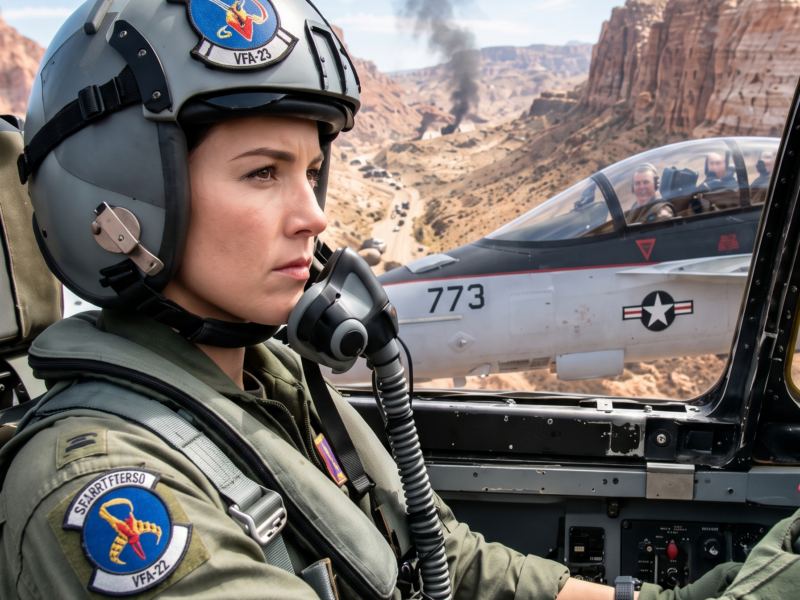
At 18,000 feet above a burning desert, enemy pilots laughed when my battered A-10 limped into their sights, and their commander called me “easy prey”
At 18,000 feet above a burning desert, the air inside my cockpit felt heavy, tasting of ozone, sweat, and leaking hydraulic fluid. The sky was turning a bruised orange, the sun dipping below the jagged horizon and casting long, deceptive shadows across the dunes. My warning receiver screamed a high, continuous tone that vibrated through my helmet.
Three enemy fighters appeared through the clouds like silver knives, their sleek fuselages reflecting the dying light. They were fifth-generation interceptors, built for speed and air superiority. My aircraft was an A-10 Thunderbolt II, a blunt, ugly relic of the Cold War. It was scarred from previous engagements, leaking fuel from the right wing tank, and groaning under the stress of high-altitude flight. I had no business being up here, and I certainly had no business surviving what was about to happen.
“Look at this thing,” an enemy pilot laughed over the open radio frequency, his voice crackling with arrogance. “Did they send us a tractor? What is that museum piece going to do?”
I did not answer. I tightened my grip on the flight stick until my knuckles ached inside my flight gloves. The vibration of the twin turbofan engines hummed through my seat. They thought they had the tactical advantage. They thought I was a stranded, damaged duck waiting to be plucked from the sky. They could not see what I could see below them.
Through the targeting pod, the thermal imaging showed a desperate situation unfolding on the ground. A convoy of American soldiers was trapped inside a narrow, jagged canyon. Plumes of thick black smoke poured from their burning Humvees, obscuring the rock walls. Their only escape route was blocked by a massive rockslide, and a heavily armed enemy ground formation was closing in from the east, deploying mortar tubes and heavy machine guns. The soldiers were pinned down, out of time, and out of ammunition.
Then, command came through my headset. The voice of the AWACS controller was tight, stripped of its usual calm professionalism. “Widowmaker, you are alone. All other assets are tied up in sector four. You have three bogeys closing on your six. Recommend you abort the CAS mission and evade. I repeat, you are alone.”
I stared down at the canyon, watching the tiny heat blooms of enemy mortar fire launching toward the trapped Americans.
“I know,” I replied. My voice was dangerously quiet.
The enemy commander laughed again on the guard frequency. “You really think that flying tank can stop us, American? You are easy prey. Surrender your airspace or burn.”
My eyes moved to the faded, stenciled black widow painted just beneath the rim of my cockpit canopy. Years earlier, my husband, David, had flown this exact same A-10 before a mission he never returned from. The squadron had given his aircraft the name Widowmaker after that battle. It was not because he died. It was because of what happened to the enemy aircraft that tried to bring him down. He had taken three fighters with him into the dirt, fighting like a demon until his engines gave out.
When they assigned me his jet a year later, I almost refused. The memories were too raw, the scent of the cockpit too familiar. But I needed it. I needed to feel what he felt. I kept his jet. I kept his callsign. And now, those same enemy pilots were laughing at the aircraft he had once bled in.
“Last warning,” their commander said, the amusement fading from his tone, replaced by cold intent. “We are locking on.”
I lowered the nose of the A-10, pointing the massive rotary cannon directly toward the earth. The airframe shuddered violently as I pushed it into a steep dive.
“Then come get me,” I said.
The laughter stopped instantly. The enemy fighters dove after me, their afterburners flaring blue in the twilight. They followed, certain they finally had me cornered. They were faster, yes. But they were arrogant. They had not noticed the jagged mountains closing in around them as the altitude dropped. They had not noticed the thick, oily smoke drifting across the ridgeline, blinding the thermal sensors. And they definitely had not noticed that the American soldiers below had stopped moving. The troops were not retreating anymore. They were watching the sky.
I pulled through the canyon at the last possible second, my wings mere feet from the sheer rock walls. The G-force slammed into my chest like an anvil, stealing the breath from my lungs. The A-10 groaned, metal stressing to the absolute limit.
The enemy formation followed too low and too fast. They relied on computers to fly; I relied on the heavy, mechanical feedback of the flight stick. The first fighter realized his mistake too late. He tried to pull up, but the canyon wall caught his right wing. He broke away violently in a ball of expanding orange flame.
The second vanished behind the ridge, desperately pulling high to avoid the same fate, abandoning his attack run completely.
Then, the third pilot—the commander who had been laughing moments before—suddenly keyed his mic. He was alone now, his wingmen gone, my A-10 suddenly behind him in the tight canyon turn.
“Widowmaker,” he whispered. His voice was shaking, stripped of all its previous bravado. “My father told me about you. About that plane.”
For one second, everything went silent. I held him perfectly in my crosshairs, my thumb resting heavily on the weapons release. But before I could fire, he engaged his vertical thrust, his aircraft disappearing straight up into the cloud cover, fleeing the airspace and leaving only a fading white contrail behind.
I leveled out, the threat gone, the canyon clear. I made my strafing run on the enemy ground forces, the heavy depleted uranium rounds from my cannon tearing the earth apart, shattering the ambush and clearing the path for the American convoy.
I climbed back toward the dying sun, taking a deep breath of the stale cockpit air. I expected another order from AWACS, another target, another battle to fight in this endless war. Instead, command said something that made my chest tighten to the point of pain.
“Ma’am, we intercepted and recovered a tight-beam data transmission from that fleeing pilot. He wasn’t talking to his base. He sent it directly to you.”
I swallowed hard, tasting copper. “What did it say?”
There was a long, agonizing pause over the radio network. The controller sounded terrified.
“He said your husband wasn’t killed by the enemy, Widowmaker.”
My hands went completely cold around the flight controls. The desert below me stretched endlessly into the encroaching darkness. And somewhere inside that darkness was a secret my husband had taken to his grave.
Then the radio crackled again.
“Ma’am… there’s more. The pilot attached a data file to the message. It contains a set of coordinates. And an audio recording. Ma’am… it’s your husband’s voice.”
The silence in the cockpit was absolute, broken only by the steady, mechanical thrum of the twin engines and the rush of wind against the canopy. My mind fractured, splitting between the immediate reality of flying a damaged aircraft and the impossible words that had just come through my headset.
David’s voice.
“Send the file to my onboard computer,” I ordered, my voice sounding hollow, like it belonged to someone else.
“Negative, Widowmaker,” the AWACS controller replied, his tone suddenly shifting from shock to strict protocol. “Command is intervening. This data is classified. You are ordered to return to base immediately for debriefing. Turn to heading zero-niner-zero.”
“Send me the file, control,” I repeated, my hand tightening on the throttle.
“Ma’am, I have direct orders from Central Command. You are not to receive that transmission. Your aircraft is damaged. Return to base. If you deviate, you will be considered a rogue asset.”
A rogue asset. The threat was clear. They were already moving to bury whatever the enemy pilot had just handed me. My husband had died three years ago in this very theater. The official report stated he was shot down by a surface-to-air missile over hostile territory. His body was never recovered. Only a piece of the wing had been found, burned and buried in the sand. I had spent three years mourning a man who had died a hero’s death, fighting for a command that was now refusing to let me hear his final words.
I reached forward and disabled the transponder. The digital display on my dash went dark, effectively blinding the AWACS radar from tracking my exact telemetry.
“Widowmaker, what are you doing? Re-engage your transponder immediately!”
I switched my radio frequency to the encrypted channel. “I’m RTB, control. But my comms and nav systems took a hit in the canyon. Experiencing severe technical difficulties. I’ll see you on the ground.”
I didn’t wait for a response. I killed the main radio feed. The silence returned, heavier this time. But I wasn’t entirely blind. I had caught a glimpse of the coordinates the controller had mentioned before they scrubbed my datalink. I punched the numbers into my manual navigation computer. The system calculated the distance. It was two hundred miles north, deep into the forbidden zone—a mountainous region strictly designated as no-fly, even for our own forces, supposedly due to extreme enemy air defenses.
I banked the battered A-10 north. The fuel gauge for the right wing was dropping steadily. I ran a quick calculation in my head. I had just enough fuel to reach the coordinates, but a return trip was mathematically impossible. It was a one-way flight.
As I flew through the darkening sky, the memories I had tried to bury began to surface. I remembered the night before David deployed. We were standing on the tarmac, the wind pulling at his flight suit. He hadn’t been acting like himself. Usually confident and easygoing, he had been distant, his eyes constantly scanning the shadows. He had held me tight, whispering that things were wrong in the squadron, that the targets they were being given didn’t make sense. “If anything happens to me,” he had said, “don’t believe the brass. Look at the flight logs. Look at who profits.”
I had thought it was just pre-deployment paranoia. Now, racing toward a set of rogue coordinates, I realized he had been trying to warn me.
The terrain below shifted from flat desert dunes to jagged, towering mountain peaks. The moonlight cast silver reflections over the snow-capped ridges. My warning receiver remained eerily silent. There were no enemy radars painting my aircraft. The “heavy air defenses” command always warned us about were entirely absent.
At fifty miles out, my radar picked up a faint, rhythmic pulse. It wasn’t a weapon lock; it was a beacon. A localized landing beacon, broadcasting on a frequency the military hadn’t used since the early nineties.
I followed the pulse, weaving through the mountain valleys to avoid detection from overhead satellites. The coordinates led me to a massive, natural gorge. At the bottom of the gorge, obscured by thermal netting and the shadows of the cliffs, was a runway. It was old, cracked concrete, barely long enough for a tactical landing.
“Here goes nothing,” I muttered to the empty cockpit.
I dropped the landing gear. The right wheel protested with a horrific grinding noise but locked into place. I cut my airspeed, bringing the nose up, letting the A-10 fall out of the sky like a controlled brick. The wheels hit the concrete hard. The aircraft bounced, the suspension screaming. I slammed on the brakes, deploying the speed brakes on the wings. The end of the runway was rushing up fast—a solid wall of granite.
The A-10 shuddered, the tires smoking, and came to a violent halt less than fifty feet from the rock wall.
I sat there for a moment, breathing heavily, the adrenaline slowly draining from my system. I shut down the engines. The whine of the turbines spun down into utter silence. I popped the canopy. The mountain air was freezing, sharp with the scent of pine and ancient dust.
I climbed out, drawing my sidearm. The facility looked abandoned. Rusted Quonset huts sat against the canyon wall, and heavy blast doors were built directly into the mountain rock. It looked like an old Cold War staging base.
As I approached the main blast doors, a sudden, blinding spotlight snapped on, pinning me against the dark. I raised my gun, shielding my eyes.
The massive steel doors slowly hissed open. Inside the illuminated hangar, sitting perfectly intact, was a black, unmarked stealth fighter. But that wasn’t what made my heart stop.
Standing in front of the aircraft, holding a weathered flight helmet, was a figure in a faded pilot’s uniform.
The figure stepped out of the glare of the spotlight.
“You’re late, Sarah,” a voice said.
I dropped my gun. It was impossible. It defied every law of reality, every piece of grief I had carried for three years.
Standing there, with gray in his hair and a jagged scar across his jaw, was David.
“David?” I choked out, my knees threatening to give way.
He didn’t smile. He looked exhausted, haunted. “I’m sorry, Sarah,” he said softly. “But we don’t have time for a reunion. They know you’re here. And they are coming to kill us both.”
I couldn’t move. The cold mountain wind whipped around me, but all I could feel was the massive, crushing weight of the impossible truth standing ten feet away. David. My husband. The man I had buried an empty casket for. The man whose dog tags hung around my neck at this very moment.
“You’re dead,” I whispered, the words trembling. “Command said… they found the wreckage.”
David closed the distance between us, his steps heavy. When he touched my arm, his grip was solid, warm, entirely real. “They found what I wanted them to find, Sarah. What I needed them to find so they’d stop hunting me.” He pulled me into a fierce embrace. For a fraction of a second, I let myself melt into him, breathing in the scent of him—machine oil and old leather—but the tactical reality of his words snapped me back.
I pushed away, gripping my sidearm tighter, though I didn’t raise it. “Who is hunting you? What is this place?”
“This is Outpost Echo,” he said, gesturing to the sprawling underground hangar behind him. “An off-the-books black site. Supposedly decommissioned twenty years ago. I’ve been hiding here, trying to piece together enough evidence to blow the lid off what Command is doing.”
He led me inside the massive hangar. The blast doors ground shut behind us, plunging the space into the harsh, artificial glow of fluorescent work lights. The unmarked stealth fighter I had seen was a heavily modified F-117, stripped of its radar-absorbent coating, retrofitted with modern avionics and weapons bays. It was a ghost plane.
Along the walls were servers, tactical maps, and whiteboards covered in flight paths, bank transfers, and encrypted communications logs.
“Three years ago,” David began, walking over to a central console, “my squadron was tasked with taking out high-value insurgent targets. But the intelligence was always too perfect. The timing was always exact. We weren’t hitting terrorists, Sarah. We were hitting rival warlords, clearing the territory so a rogue faction within our own Central Command could monopolize the rare-earth mineral trade in this sector. They were using American airpower as a private assassination squad to secure billions of dollars in off-the-books resources.”
I stared at the maps, the realization settling like ice in my stomach. “You found out.”
“I found a ledger on a downed enemy transport we were ordered to destroy. I didn’t destroy it. I downloaded it,” David said, his voice hardening. “When I tried to report it up the chain, my own wingman locked onto me. Captain Miller. He fired an AIM-9 Sidewinder at my tail. I managed to eject before the A-10 went down in flames. Miller reported I was killed by a surface-to-air missile. I knew if I went back to base, I’d be quietly executed for treason. So, I became a ghost.”
“The enemy pilot today,” I realized, the pieces slamming together. “The one who ran. He sent me coordinates.”
“He’s a defector,” David explained. “His father was one of the local leaders our command had assassinated. We’ve been working together. He was supposed to draw you out, get you away from the AWACS surveillance net so he could transmit the data package to you. The audio file he sent… it was a recording of the General giving the order to have me killed.”
“I never heard it,” I said, a bitter anger rising in my throat. “Command blocked the transmission. They ordered me back to base. When I cut my transponder, they called me a rogue asset.”
David’s face went pale. He turned to the radar console on the desk. “If they blocked the transmission, it means they were monitoring the datalink in real-time. They know the defector transmitted. Which means…”
He rapidly typed on the keyboard. A satellite uplink screen flared to life. A sweeping radar arc illuminated the airspace a hundred miles south of our position.
Three small, rapidly moving red triangles appeared on the edge of the screen.
“Which means they know you’re here,” David finished, his voice dropping to a grim whisper.
I stepped up to the monitor. “Identify the bogeys. Are they enemy interceptors?”
“No,” David said, his jaw tightening. “Look at the speed and the radar cross-section. They aren’t enemy. They’re ours.”
I felt the blood drain from my face. “F-22 Raptors.”
“A kill squad,” David confirmed. “They aren’t coming to arrest us, Sarah. They’re coming to crater this mountain and bury the evidence forever.”
I turned to look at my A-10 sitting outside the hangar doors. “My jet is out of fuel and taking hydraulic damage. It can’t dogfight three Raptors. We’re sitting ducks.”
“We aren’t using the A-10,” David said, tossing me the flight helmet he had been holding. “We’re using the Ghost. I’ve spent three years prepping it for this exact scenario. It’s got a dual-seat cockpit modification. I fly, you manage the electronic warfare suite and the weapons.”
“Where are we going?” I asked, strapping on the helmet.
“We aren’t running,” David said, his eyes burning with a cold, focused fury. “We have the data drive with all the evidence. But we can’t transmit it from down here in the canyon; the rock walls block the signal. We have to punch through the Raptor squadron, get to thirty thousand feet, and broadcast the evidence on the unencrypted global emergency frequency. We let the whole world hear the General’s treason.”
The hangar alarms suddenly blared, flashing red. A mechanical voice echoed over the PA system. Warning. Incoming ordnance detected. Impact in sixty seconds.
“They fired cruise missiles from stand-off range!” David shouted over the siren. “Get in the jet!”
We sprinted across the concrete. I climbed up the ladder and dropped into the rear seat of the stealth fighter, David sliding into the pilot’s seat in front of me. The canopy clamped down, sealing us in.
“Powering up,” David called out, his hands a blur over the switches. The jet’s engines whined, a high, piercing shriek that rattled my teeth.
“Thirty seconds to impact!” I yelled, watching the tactical display in the backseat light up with two incoming missiles.
David slammed the throttle forward. The blast doors were still opening, not even halfway wide. We shot out of the hangar, the wings of the jet sparking against the heavy steel doors as we squeezed through the gap. We hit the cracked runway, accelerating at terrifying speed.
Behind us, the mountain exploded. The cruise missiles slammed into Outpost Echo, instantly vaporizing the hangar and sending a massive shockwave of fire and shattered rock down the canyon. The force of the explosion hit the tail of our jet, throwing us forward. David pulled hard on the stick, and we tore into the night sky, leaving the burning mountain behind.
“Radar warning receiver is active,” I called out, my hands flying over the weapons console. “We have three Raptors dead ahead. They have us locked.”
“Hold on, Widowmaker,” David said over the intercom. “It’s time to show them what this ghost can do.”
The G-force slammed me back into the seat as David threw the modified stealth fighter into a near-vertical climb, trying to outrun the initial shockwave of the blast. The night sky above us was a cold, indifferent black, but the tactical display between my knees was a chaotic swarm of red warnings.
“Missile lock! Missile lock!” the computer voice chimed, a sterile, synthesized panic.
“They fired AMRAAMs,” I shouted into the intercom, my fingers dancing across the electronic warfare panels. “Two birds in the air, tracking fast!”
“Deploying countermeasures,” David replied calmly. The aircraft shuddered as chaff and flares exploded from the tail in a brilliant, trailing fan of light. He wrenched the stick to the right, putting the aircraft into a violent barrel roll that made my vision blur at the edges.
The two AIM-120 missiles blew past us, tracking the flares, detonating uselessly in the empty airspace. The explosions rocked our wings, but the airframe held.
“That was just the greeting,” I said, catching my breath. “We have three F-22s vectoring in. Range twenty miles. They know our exact altitude.”
“They have AWACS support,” David said. “The General’s command plane is orbiting at forty thousand feet, coordinating them. If we want to broadcast this data file, we have to get closer to that AWACS. Their massive antenna arrays can bounce our transmission across the entire global network before the General can shut it down.”
“David, we have to survive the Raptors first. We are outgunned and outnumbered.”
“Not outsmarted,” he said. He abruptly killed the engines and shut off our active radar. The sudden silence in the cockpit was terrifying. We were a ballistic missile now, coasting in a parabolic arc through the dark.
“What are you doing?!” I yelled.
“Going cold. Let’s see how good their pilots really are without computers telling them where we are.”
The stealth fighter, stripped of its engines’ heat signature and electronic emissions, essentially vanished from the sky. We were invisible, dropping rapidly back toward the jagged mountain peaks. I watched the altimeter spin down violently. Twenty thousand feet. Fifteen thousand. Ten thousand.
“Pull up, David!”
“Wait for it,” he muttered.
At five thousand feet, navigating purely by the faint moonlight reflecting off the snowcaps, David reignited the engines. The turbines roared back to life. He leveled out violently, pulling nine Gs. The blood drained from my head, my anti-G suit squeezing my legs to keep me conscious.
We were skimming the valley floor, flying below the radar horizon of the Raptors.
“We’re behind them,” I realized, looking at the passive sensors. The three F-22s were still orbiting high above, searching the airspace where we had just been.
“Arm the weapons, Sarah,” David commanded.
I flipped the master arm switch. “We only have two Sidewinders and the internal cannon.”
“I only need one.”
David pulled back on the stick, executing a high-speed Immelmann turn. We shot straight up out of the canyon, rocketing toward the bellies of the unaware Raptors. We hit them from the blind spot.
“Fox Two!” I yelled, squeezing the trigger.
The Sidewinder leapt from the internal bay, trailing a jagged line of white smoke. It slammed into the wing of the trailing F-22. The explosion ripped the Raptor’s wing completely off. The pilot punched out instantly, his ejection seat rocketing into the dark sky, a parachute blossoming a second later.
“One down,” David said. “Two left.”
But the remaining two Raptors were elite. They reacted instantly, breaking in opposite directions, diving sharply to regain airspeed and tactical advantage. They didn’t panic; they executed a perfect pincer maneuver.
“They’re bracketing us,” I warned. “Left and right. They’re going for a crossfire.”
“Hold tight.” David pushed the throttle to the firewall. Our modified engine screamed, pushing us past Mach 1. The sonic boom rattled the canopy. We shot straight up, aiming directly for the AWACS command plane orbiting miles above.
The AWACS—a massive E-3 Sentry with a rotating radar dome on its back—was suddenly visible on visual, a dark silhouette against the starlight.
“I’m initializing the data transfer protocol,” I said, quickly typing on the keyboard. “I need thirty seconds of uninterrupted proximity to the AWACS to force our signal through their relay.”
“You have fifteen,” David grunted.
The alarm blared again. “Raptors are back on our six. They have missile lock!”
“I can’t break!” David yelled. “If I turn, you lose the uplink connection!”
“Keep it steady!” I shouted, watching the data transfer bar slowly filling on my screen. 20%… 40%…
“Missiles off the rail!” the computer warned.
“We’re going to take a hit,” David said, his voice terrifyingly calm. “Brace yourself.”
I squeezed my eyes shut, my hand hovering over the ejection handle. 60%… 80%…
A massive explosion shattered the night. The impact didn’t hit the cockpit, but the entire aircraft violently shuddered, pitching nose-down. The left engine burst into flames, casting a hellish orange glow over the wing. Alarms screamed in the cockpit, a cacophony of master cautions and system failures.
“Left engine destroyed! Hydraulics bleeding!” David shouted, fighting the stick to keep the plane level.
90%… 95%…
“Transfer complete!” I screamed. “The file is out! It’s broadcasting on all unencrypted frequencies!”
“Eject, Sarah!” David yelled. “The airframe is coming apart!”
“Not without you!” I grabbed the manual override handle.
“The dual eject is jammed by the fuselage damage! Only the rear seat mechanism is green!” David looked over his shoulder at me, his eyes fierce and desperate in the flashing red light of the cockpit. “Go, Sarah! Tell them the truth!”
“No! David!”
He reached forward and pulled the command override on his panel.
The explosive bolts above my head detonated.
The canopy shattered outward into the freezing night air. A split second later, the rockets beneath my seat fired with bone-crushing force, launching me clear of the burning stealth fighter. I was thrown into the chaotic dark, spinning wildly as the rushing wind stole the air from my lungs.
Below me, the burning jet continued its doomed trajectory.
“David!” I screamed into my mask, though the wind snatched the words away instantly.
My parachute deployed with a violent snap, arresting my fall and yanking me upright. I dangled in the harness, swinging over the dark, mountainous terrain. I desperately scanned the sky below, looking for a second chute. There was nothing. Just the fiery comet of the damaged jet spiraling toward the earth.
Then, my helmet headset crackled to life. It was filled with static, then the sound of a voice echoing across the open guard frequency—a frequency monitored by every military aircraft, command center, and civilian air traffic controller in the region.
It was the audio file we had just broadcasted from the AWACS relay.
“I don’t care what he knows, Captain Miller,” a harsh, commanding voice echoed over the radio—General Hayes, the head of Central Command. “Major David Lawson has unauthorized access to the sector financial ledgers. He knows we are redirecting the strike packages to clear the mining zones. If he brings that data back to base, we all hang for treason. You are to shoot him down and blame hostile anti-air. Do I make myself clear?”
“Yes, General,” a second voice replied. Captain Miller.
The audio looped, playing again, crystal clear. We had done it. We had broadcasted the undeniable proof of the conspiracy to the entire theater.
Suddenly, a new voice broke over the frequency. It was one of the F-22 Raptor pilots who had just shot us down. His tone was frantic, horrified. “Command… AWACS control, did you just hear that? Please advise. Did we just fire on a friendly asset?”
There was dead silence from the AWACS controller.
“AWACS, this is Viper One. Respond!” the Raptor pilot demanded. “Who was in that aircraft we just engaged?”
I reached up with trembling hands and keyed my survival radio. “Viper One, this is Captain Sarah Lawson, callsign Widowmaker. You just engaged my aircraft. The man you shot down was Major David Lawson. The man the General ordered killed three years ago.”
The radio went dead silent. Even the wind seemed to stop.
Then, the Raptor pilot spoke, his voice thick with realization and disgust. “Widowmaker… I… Jesus Christ. We were told you were rogue combatants threatening the command plane.”
“We were transmitting the truth,” I said, tears freezing against my cheeks beneath the oxygen mask. “They used you to bury it.”
“Viper One to AWACS,” the pilot barked, his voice turning lethal. “General Hayes, if you are on that command plane, you are now considered a hostile actor under the Uniform Code of Military Justice. Divert your flight path to Anderson Air Force Base immediately and prepare to surrender.”
“This is General Hayes,” the arrogant voice came over the radio, laced with panic. “Viper One, stand down. That transmission is a deepfake. It is enemy propaganda. I am your commanding officer!”
“Not anymore, sir,” the second Raptor pilot chimed in. “We have missile lock on your engines, AWACS. Turn the plane around or we will blow you out of the sky.”
The conspiracy was crumbling in real-time, high above the desert. The pilots had turned on the corrupt command. But it was a hollow victory. I watched in agony as the flaming wreckage of David’s jet slammed into the side of a mountain far below, exploding in a massive fireball that lit up the canyon.
“No,” I choked out, a sob tearing through my throat. I had found him, only to lose him again. He had sacrificed himself to get the truth out. He had saved me.
I drifted downward, the cold mountain air biting through my flight suit. I prepared for a harsh landing on the unforgiving rocks.
“Sarah.”
My breath hitched. I froze in the harness. The voice came through the static of my survival radio. Faint. Breathless.
“David?” I whispered, afraid to even hope.
“Told you… the dual eject was jammed,” his voice crackled. “Didn’t say I couldn’t blow the canopy and jump manually.”
I looked down frantically, squinting into the darkness below the explosion. Drifting just above the tree line, barely visible against the dark rocks, was a second parachute. It was black, a tactical rig, impossible to see unless you knew exactly where to look.
Laughter, genuine and bordering on hysterical, bubbled up from my chest. “You absolute idiot,” I cried, gripping the radio transmission button. “I thought you were gone.”
“Not this time, Widowmaker,” he replied, his voice filled with a weary, profound relief. “Not this time.”
I landed hard on a snowy ridge, the parachute dragging me a few feet before I managed to release the harness. I scrambled to my feet, ignoring the bruising pain in my ribs, and activated my emergency strobe. A few minutes later, David stumbled through the snowdrifts, dragging his own chute.
I ran to him, tackling him into the snow. We held each other as the sound of jet engines roared high above us. The F-22s were escorting the AWACS command plane back to base, not as an escort, but as its captors.
The desert war would continue, and the politics of men would always find new ways to bleed the innocent. But the rogue element within Central Command was finished. The truth was out.
I looked up at the stars, shining brilliantly over the frozen mountains. For the first time in three years, the ghost that had haunted my cockpit, the shadow of the Widowmaker, was finally laid to rest. David took my hand, pulling me up from the snow. We had a long walk ahead of us, but for the first time in a long time, we were walking out together.
The end.









