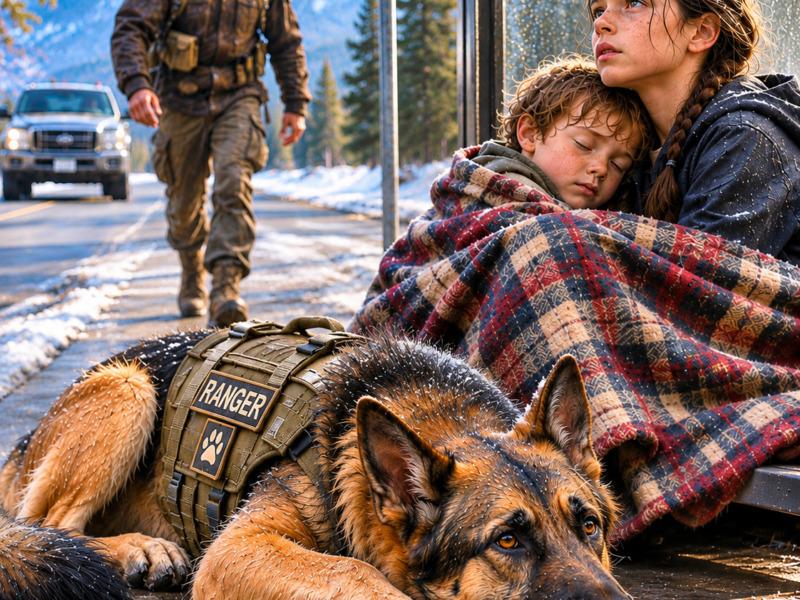
“AT 11:47 ON A NIGHT OF FREEZING RAIN, I FOUND A TEN-YEAR-OLD GIRL IN A WHEELCHAIR SITTING BESIDE HER FOUR-YEAR-OLD BROTHER IN A BROKEN BUS SHELTER
The man outside the community center didn’t move.
He stood beneath the narrow awning, one hand tucked into his coat pocket, watching the window where Chloe sat with Owen.
I didn’t recognize him from the night before.
But I recognized the expression.
It was the look of someone who believed he still controlled the room, even when he was standing outside it.
I stepped between him and the window.
His phone went dark.
Then he smiled.
Not a friendly smile.
A practiced one.
I went outside.
“Can I help you?”
“Grant Maddox?”
“That’s me.”
“Eric Dalton.”
He offered his hand.
I didn’t take it.
His eyes moved past me toward the building.
“I came to pick up the children.”
“They’re warm. They’re being looked after.”
“I appreciate what you did last night, but this has become a misunderstanding.”
“Leaving two children in a broken bus shelter during freezing rain isn’t a misunderstanding.”
His smile tightened.
“I had an emergency.”
“You had a car.”
“I was trying to get them somewhere safe.”
“Then why did you drive south when their aunt lives north?”
For the first time, he looked irritated.
Only for a second.
Then the pleasant expression returned.
“Chloe gets confused. She’s a child. And she’s been under considerable stress.”
“She’s ten.”
“Exactly.”
He glanced toward the entrance again.
“I don’t know what she told you, but her mother has been struggling. I’ve been the only person keeping that household together.”
“Then you should have stayed with the children.”
He lowered his voice.
“Listen. I understand you’re a veteran. I respect that. But you don’t know this family. You don’t know what you’re getting involved in.”
“I know two children were left in the rain.”
“You’re making this worse.”
“I’m not the one who left them there.”
His jaw shifted.
Then he looked over my shoulder.
“Chloe!”
She had appeared inside the doorway.
Owen stood behind her, holding a stuffed dinosaur.
Chloe’s hands were gripping the rims of her wheelchair.
Eric’s expression changed immediately.
“Sweetheart,” he said, suddenly warm. “There you are. I’ve been worried sick.”
Chloe didn’t answer.
“Come on. Let’s get your things. Your mother needs us to come home.”
“She doesn’t know where we are,” Chloe said.
Eric gave a small, sympathetic laugh.
“Of course she does. We talked about it.”
“No, you didn’t.”
The smile disappeared.
“Chloe, don’t start.”
I moved one step closer.
“That’s enough.”
Eric looked at me.
“You should be careful, Maddox. People who insert themselves into family matters sometimes discover they don’t understand the consequences.”
“Are you threatening me?”
“I’m advising you.”
He turned toward his car.
Before getting in, he looked back at Chloe.
“Tell your mother I came.”
Then he drove away.
I watched until his taillights disappeared.
Behind me, Chloe was crying silently.
I turned around.
“He can’t take you anywhere without the proper people knowing,” I told her.
She wiped her face.
“He’ll say I’m lying.”
“Then we’ll make sure the evidence speaks too.”
She looked down at her hands.
“He always says that nobody believes kids.”
I didn’t have a good answer.
So I gave her the only promise I could keep.
“I believe you.”
That afternoon, Sandra arrived with a forensic specialist named Marcus.
They met us in a private room at the center.
Marcus brought an evidence bag, a camera, and a small device for documenting the tablet.
He photographed it before touching it.
Recorded the serial number.
Documented who had possessed it and when.
Then he created a forensic image so the original device could remain untouched.
Sandra watched the process carefully.
“Every step matters,” she told me. “If we find something significant, Eric’s attorney will challenge how it was obtained.”
Marcus nodded.
“Then we’ll give them nothing to challenge.”
While they worked, I called Megan Bennett at the hospital.
She sounded exhausted.
Her voice was weak, but alert.
“Grant? Phyllis said you wanted to speak with me.”
“Yes, ma’am. First, your children are safe.”
I heard her exhale.
“Oh, thank God.”
“Owen is eating enough for three people. Chloe is keeping everyone organized.”
A small laugh came through the phone.
“That sounds like my girl.”
I hesitated.
“Megan, I need to ask about Eric.”
Silence.
“What happened?”
“He left the children at a bus shelter last night. He told them he was taking them to your sister’s house.”
“What?”
“Your sister lives north. He drove south.”
I heard the faint sound of hospital equipment in the background.
“Why would he do that?”
“I don’t know yet. But Chloe showed me some emails on your tablet. They mention financial documents and account transfers.”
Another silence.
Then Megan spoke so quietly I almost missed it.
“He told me he was helping with the bills.”
“Did you sign anything?”
“He helped me refinance my car. He said he could put the household accounts on automatic payment. I was exhausted. Owen was having nightmares, Chloe had been missing school appointments, and I was working extra shifts.”
“Did he explain the documents?”
“He said they were routine.”
“Did you understand what you signed?”
“No.”
I looked at Sandra.
She had stopped writing.
“Megan, I need you to hear something. Signing something you didn’t understand doesn’t make what happened your fault.”
Her voice broke.
“I trusted him.”
“You were trying to keep your family together.”
“I thought he was helping.”
“Then we’ll find out what he was really doing.”
Sandra took the phone from me.
She explained that Megan needed independent legal representation, that she should preserve every document she still had, and that no one should contact Eric about the investigation.
Before hanging up, Megan asked one question.
“Can he take my children?”
Sandra answered firmly.
“Not without a court order. And based on what we’ve learned so far, we have grounds to seek immediate protection.”
The next three days were a blur of paperwork, calls, and evidence.
Sandra filed for an emergency protective order.
She also requested a temporary restriction preventing Eric from contacting or removing the children while the case was reviewed.
But Eric wasn’t sitting quietly.
He had already built a story.
He told neighbors that Megan was too sick to care for her children.
He told people at the church that he had arranged temporary care while handling an emergency.
He told the family services investigator that I had taken advantage of the situation to gain access to the children.
One man even called the community center to ask whether I was some kind of extremist who had “military training and a personal interest in vulnerable families.”
I had spent eleven years in the Navy.
I’d been trained to handle hostile environments.
But nothing in that training prepared me for the way a lie could spread through a small town.
A lie didn’t need to be true.
It only needed to arrive before the facts.
Dale Mercer came back to the center on the fourth morning.
He sat across from me with a folder.
“I want to be clear,” he said. “I’m not accusing you of anything. But I have to document the allegations.”
“Then document them.”
“Mr. Dalton says you encouraged Chloe to make accusations about him.”
“Ask Chloe.”
“I will.”
“He also says you accessed private financial information.”
“The tablet belongs to Megan. We didn’t alter it. Sandra arranged for a forensic image.”
Dale studied me.
“You seem very confident.”
“I am confident about what happened in that shelter.”
He opened his folder.
“There’s something else. Several people independently gave me nearly identical descriptions of Mr. Dalton’s actions that night.”
“What descriptions?”
“That he had arranged transportation, that his phone died, that the children were supposed to be with a trusted adult, and that the situation was caused by a misunderstanding.”
“Nearly identical?”
“Same wording in several statements.”
I leaned back.
“Real people don’t usually remember an event in identical sentences.”
“That’s what concerns me.”
He closed the folder.
“I’ll speak with Chloe again. Separately from you and your attorney.”
“Good.”
Before leaving, he paused.
“Mr. Maddox, I should tell you that the report against you was filed before your account was documented.”
“I know.”
“Mr. Dalton seems to have anticipated an investigation.”
I looked at him.
“He had all night.”
That afternoon, Sandra called.
“Marcus found something.”
I drove to her office.
She had spread printed documents across the conference table.
The forensic report showed forty-three emails between Eric Dalton and Darren Apprentice, a financial consultant in Tacoma.
The correspondence began eleven months earlier.
There were account restructuring plans.
A transfer document signed seven months ago.
Instructions for redirecting payments.
And repeated references to Megan’s medical condition and dependence on Eric.
One sentence had been highlighted.
The client is unlikely to challenge the arrangement while her health and caregiving responsibilities remain unstable.
I read it twice.
Sandra tapped another page.
“There’s more. Eric described Chloe’s disability as a factor that made Megan easier to pressure.”
I felt something cold settle in my chest.
He hadn’t simply taken advantage of a family in crisis.
He had studied their weaknesses.
He had made himself indispensable.
Then he had used that dependence to gain control.
“What about the shelter?” I asked.
Marcus turned his laptop toward us.
“We recovered location data from the tablet. It synced with the family account.”
A map appeared.
The location history showed the vehicle traveling south.
Then stopping near the bus shelter.
Then leaving.
The timestamps placed the children there for almost six hours before I found them.
Marcus enlarged the final section.
“There’s another detail. The tablet connected to the vehicle’s Bluetooth before Eric left them. The location log and connection record are consistent.”
“So he knew they were there.”
“Yes.”
“And he didn’t come back.”
Marcus nodded.
Sandra sat down.
“We have enough to move forward with the financial investigation. I’m contacting the attorney general’s fraud unit.”
I stared at the map.
Six hours.
Six hours in the freezing rain.
A four-year-old boy and his sister waiting for someone who had promised to return.
I thought about Owen asking whether Ranger would bite.
I thought about Chloe putting his feet on her footrests because she had nothing else to keep him warm.
I had seen difficult things during my service.
But cruelty didn’t become easier to understand just because it wore civilian clothes.
When I returned to the center, Chloe was waiting.
“Did you find something?”
“Yes.”
“Was I right?”
I sat beside her.
“You were right to tell us.”
She stared at the floor.
“Mom signed things because she trusted him.”
“Your mother was trying to keep things running while she was sick.”
“She thinks she should have known.”
“Sometimes people who manipulate others are very good at making their victims feel responsible.”
Chloe’s eyes filled.
“I should have told her sooner.”
“You were ten.”
“I still am.”
That stopped me.
She was right.
She wasn’t a grown woman looking back at childhood.
She was still a child trying to understand why the adults around her had failed.
I looked at her.
“You don’t have to carry this alone.”
She nodded, but didn’t seem convinced.
Then she asked something I hadn’t expected.
“Why did you stay?”
“What do you mean?”
“You could have taken us to Phyllis and gone home. You didn’t have to keep helping.”
I glanced through the window.
Ranger was asleep near the heater, one paw twitching.
“Because I spent eleven years doing things that needed doing,” I said. “When I left the Navy, I wasn’t sure what I was supposed to do next.”
“And then you found us?”
“Ranger found you.”
Chloe smiled faintly.
“That’s what you always say.”
“It’s true.”
She looked toward the dog.
“Maybe he knew.”
“Maybe he did.”
For the first time since the shelter, she laughed.
It was a small sound.
But it mattered.
The emergency hearing was scheduled for ten days after Eric filed his custody evaluation motion.
Sandra called me the night before.
“He’s trying to turn the entire situation around,” she said. “His attorney is arguing that Megan’s medical condition makes her unable to provide a stable home.”
“She has a home.”
“Right now, it’s not accessible enough for Chloe’s needs. And she’s still recovering.”
“What do we need?”
“A safe, accessible address. A written return-to-work plan. Medical documentation. And independent testimony about the children’s daily care.”
“I’ll handle the housing.”
“Grant, don’t overstep. We need to do this properly.”
“I understand.”
The next morning, I contacted a local housing coordinator.
By afternoon, we had found a ground-floor apartment on Larkin Street.
Two bedrooms.
An accessible bathroom.
A ramp.
Enough room for Chloe’s wheelchair to turn without hitting the furniture.
It wasn’t perfect.
But it was a beginning.
I helped arrange temporary funding through the community center, while Sandra secured the documentation.
Megan’s supervisor provided a letter confirming her position would remain available when her doctor cleared her to return.
Then Chloe told Sandra about another message she had found.
It was a text synced to the tablet.
Eric had written to Darren Apprentice:
She’s not going to push back. She doesn’t have the resources or the energy. Give it two more months.
Sandra read it carefully.
“Chloe, I need you to tell me exactly where you found this.”
Chloe showed her.
Sandra documented it.
No paraphrasing.
No guessing.
Just the original message and its location on the device.
“Thank you,” Sandra said.
Chloe looked worried.
“Will that help Mom?”
“It may help the court understand what was happening.”
“What if Eric says I’m lying?”
Sandra leaned forward.
“Then we show the court the evidence.”
The morning of the hearing, I arrived early.
Megan was there in a wheelchair borrowed from the hospital, her face pale but determined.
Chloe sat beside her.
Owen held a toy dinosaur in one hand and Ranger’s leash in the other.
Ranger had been allowed to come to the courthouse as part of a support arrangement.
He lay quietly beside my chair.
Eric arrived with his attorney.
He wore a navy suit and carried a leather folder.
He looked rested.
Comfortable.
Like a man who had spent the last week preparing to explain why everyone else was mistaken.
When he saw Megan, he gave her a sad expression.
“I’m glad you’re feeling better,” he said.
She didn’t respond.
His attorney began by arguing that Megan had been medically unstable, that the children had been exposed to an unknown adult, and that the tablet evidence could not be trusted.
Sandra stood.
She addressed the chain of custody.
The photographs.
The evidence bag.
The forensic imaging process.
Marcus’s report.
The location data.
The email correspondence.
Eric’s attorney objected repeatedly.
The judge listened.
Then she looked at Eric.
“Mr. Dalton, your position is that the children were left temporarily in a safe location?”
“Yes, Your Honor.”
“For approximately six hours?”
“I was dealing with an emergency.”
“And you filed a report suggesting that another person had interfered with your arrangements before the children were located?”
“I was concerned.”
The judge turned a page.
“Were you aware that the children’s aunt lived north of the shelter?”
Eric hesitated.
“I don’t recall the exact address.”
“Did you drive south?”
“I had a reason.”
“What reason?”
“I don’t think that’s relevant.”
“It is relevant to whether your account is credible.”
His attorney stood.
“Your Honor, my client was attempting to assist a family in crisis.”
The judge raised one hand.
“Sit down, counsel.”
Megan took the stand.
She looked nervous, but she spoke clearly.
Eric’s attorney asked about her illness, missed work, and financial difficulties.
He asked whether she had signed documents without reading them.
“Yes,” Megan answered.
“Then you agree that you made poor financial decisions?”
“I agree that I trusted someone who told me he was helping.”
“Isn’t it true that you were unable to manage your household accounts?”
“I was struggling to manage them while I was working and caring for two children. That isn’t the same as giving someone permission to take control of them.”
He showed her a document.
“Your signature appears here.”
“Yes.”
“You signed it voluntarily.”
“I signed it because Eric told me it was a routine authorization for automatic bill payments.”
“Are you saying you didn’t understand what you signed?”
“I’m saying he explained it to me in misleading terms.”
Sandra asked permission to show the court the email correspondence.
The judge allowed it.
One message was displayed.
The sentence about Megan being unlikely to challenge the arrangement appeared on the screen.
The courtroom went quiet.
Megan looked at it for a long time.
Then she turned toward Eric.
“You knew I was sick,” she said.
Eric stared at the table.
“You knew I was trying to take care of the children.”
His attorney touched his arm.
Megan continued.
“And you used that.”
The judge called a recess.
During the break, Chloe sat beside her mother.
“You did good, Mom,” she whispered.
Megan kissed her forehead.
“I should have protected you.”
“You did.”
Megan started crying.
Chloe held her hand.
Then the judge returned.
She reviewed the forensic report, the location data, the financial emails, and the independent evaluation prepared by Dr. Shields.
The evaluator had spent fifty-five minutes speaking with Chloe without me, Sandra, or Megan present.
His report described a child who gave detailed, consistent answers and corrected the evaluator twice when he misunderstood her.
He found no evidence that she had been coached.
Eric’s attorney challenged the report.
The judge listened, then asked Dr. Shields to explain his conclusion.
“Children who are coached often repeat recognizable phrases and look to adults for confirmation,” he said. “Chloe did neither. Her account included ordinary details that were not necessary to support her allegations. She also expressed uncertainty where she genuinely did not know something.”
“Could the adults around her have influenced her?”
“It’s possible in any case. But it is not what I found here.”
He paused.
“The instability Mr. Dalton’s filing describes appears to have been deliberately produced by Mr. Dalton’s actions. That is a circular argument, and I believe the court should recognize it as such.”
The judge looked toward Chloe.
“I understand you have asked to speak.”
Eric’s attorney immediately stood.
“Your Honor, she’s only ten.”
The judge looked at him.
“Sit down, counsel.”
Chloe rolled forward.
Her hands were trembling.
Megan reached toward her, but Chloe gave her a small nod.
Then she faced the judge.
“My mom didn’t fail us.”
The courtroom became completely still.
“I know that’s what this is about. I use a wheelchair. That’s not a secret. My mom has spent ten years figuring out what I need. How to make things work. How to help me without pretending I can do everything by myself.”
She swallowed.
“Eric told me in the car before he left us that Mom didn’t want the responsibility of having a disabled daughter.”
Megan covered her mouth.
“I didn’t believe him,” Chloe continued. “Not for one second. Because I know my mother, and he doesn’t.”
She looked directly at the judge.
“My mom didn’t leave us in the rain. She didn’t tell us nobody would believe us. She didn’t take our money. She was sick, and she trusted someone who said he would help.”
Chloe’s voice cracked.
“I just want to go home with her.”
The judge waited until Chloe was back beside her mother.
Then she delivered her decision.
“The emergency custody evaluation motion is dismissed. Megan Bennett retains full custody of both children. There is no basis for an alternative arrangement.”
Megan closed her eyes.
Owen climbed into her lap as far as the wheelchair allowed.
The judge continued.
“The evidence raises serious concerns about Mr. Dalton’s conduct. The financial elements will be referred to the state attorney general’s office. Any further contact with the children must comply with the protective order.”
She looked at Eric.
“Mr. Dalton, I strongly encourage you to consult with your attorney.”
Eric didn’t look at Chloe.
He didn’t look at Megan.
He gathered his papers and left the courtroom.
For the first time since I had met them, the children didn’t have to wonder whether someone would come back.
They knew where they were going.
Home.
The financial investigation took several more months.
The attorney general’s office formally opened a case involving Darren Apprentice and Eric Dalton.
Investigators found that the pair had used misleading financial authorizations to redirect money from several vulnerable clients.
Megan’s accounts were among them.
Eric had not simply made mistakes.
He had participated in a deliberate scheme.
The location records and emails also helped investigators establish that he had knowingly abandoned the children and then attempted to shift responsibility onto someone else.
He was eventually charged with financial fraud, identity-related offenses, and child endangerment.
Darren Apprentice was charged separately.
The case took time.
There were interviews, hearings, and more paperwork than I thought any human being should have to read.
But Megan recovered.
She moved into the accessible apartment.
Her supervisor welcomed her back when her doctor cleared her.
Chloe returned to school.
Owen stopped waking up crying in the middle of the night.
And Ranger became a permanent fixture in their lives.
At first, he was simply the dog who had found them.
Then he became the dog who waited outside Chloe’s bedroom every morning.
The dog who let Owen rest his head against his side during thunderstorms.
The dog who followed Megan from the kitchen to the living room as though he had been assigned to protect her.
One afternoon, Chloe told me she had an idea.
She wanted to create emergency backpacks for families who had to leave their homes unexpectedly.
Not just food and clothing.
She wanted each bag to include practical information.
Accessible transportation contacts.
Emergency housing addresses.
Medical supply resources.
A list of local organizations.
And small things children could use to feel normal when everything around them was falling apart.
“People shouldn’t have to figure everything out when they’re scared,” she explained.
She called it the Open Door Project.
I asked her why.
“Because people need somewhere to go,” she said. “And the door should be open.”
She had written a four-page proposal on her mother’s old tablet.
Sandra helped her make the plan legally and financially sound.
Phyllis offered space at the community center.
A local church donated backpacks.
A medical supply company contributed basic accessibility equipment.
I brought art supplies.
Owen insisted that every backpack needed crayons.
“Because kids get bored,” he explained.
He was four.
He had a point.
The first Open Door event took place on a Saturday morning.
There were folding tables, boxes of supplies, and a hand-painted sign.
Chloe sat at the center table, organizing lists.
Megan stood beside her.
She looked stronger than she had on the night I first heard her voice.
“Grant,” she called when I came through the door.
I lifted a box.
“Where do you want these?”
“By the backpacks.”
Owen ran toward me.
“Did you bring the blue crayons?”
“Two boxes.”
He raised both hands in triumph.
Ranger walked beside him.
Chloe looked up from her work.
“You came.”
“I said I would.”
She smiled.
“There’s something I want you to see.”
She showed me the first completed backpack.
Inside were a rain poncho, a small blanket, a flashlight, a notebook, pencils, crayons, emergency contact cards, and a laminated sheet listing local shelters and accessible transportation services.
There was also a small card.
On it, Chloe had written:
You are not a problem to be solved. You are a person who deserves help.
I read it twice.
“That’s good,” I said.
“Do you think people will understand?”
“I think they’ll remember it.”
She looked toward the other tables.
“Mom says we can’t help everybody.”
“Your mom is right.”
Chloe frowned.
“But we can help someone.”
I smiled.
“She’s right about that, too.”
The event grew beyond what any of us expected.
By the end of the morning, we had distributed thirty backpacks and collected enough donations to prepare another fifty.
A local newspaper ran a short story about the project.
A month later, two nearby towns asked for copies of Chloe’s resource guide.
She was still ten.
But she had already learned something that many adults never do:
Being vulnerable doesn’t mean being powerless.
And receiving help doesn’t mean surrendering your independence.
The criminal case against Eric and Darren eventually went to trial.
The evidence was extensive.
The financial records.
The emails.
The forensic report.
The location history.
The testimony from other clients.
The messages describing Megan’s illness as an opportunity.
Eric’s attorney tried to portray him as a man who had made poor decisions while helping a struggling family.
But the evidence showed a pattern.
The jury found him guilty.
Darren Apprentice was also convicted.
When the verdict was read, Megan didn’t celebrate.
She simply held Chloe’s hand.
Owen leaned against her wheelchair.
Outside the courthouse, a reporter asked Megan how she felt.
She thought for a moment.
“Relieved,” she said. “But mostly, I’m glad my children can stop being afraid.”
I stood a few feet away with Ranger.
Chloe came over.
“It’s over?”
“The trial is over,” I said.
She looked toward her mother.
“Can we just be normal now?”
I crouched beside her.
“You can try.”
She smiled.
“That’s not a very good answer.”
“No,” I admitted. “But it’s an honest one.”
She laughed.
And that was enough.
A few weeks later, Megan invited me to dinner.
It wasn’t a formal occasion.
There were paper plates, chicken casserole, and a stack of school worksheets on the kitchen table.
Owen insisted that Ranger sit beside him.
Chloe was working on a new version of the Open Door resource guide.
Megan brought out a photograph.
It was a picture of the three of them taken at the community center the morning after the shelter.
Owen was holding his dinosaur.
Chloe was wearing a borrowed sweater.
Megan was still in the hospital.
But all three were smiling.
“Phyllis took this,” she said. “She said she wanted us to remember the first morning we knew we were safe.”
I looked at the picture.
“You should keep it.”
“We are.”
Megan hesitated.
“Grant, I don’t know how to thank you.”
“You don’t have to.”
“You stopped when you saw us.”
“Ranger stopped.”
She smiled.
“Then I owe him.”
Ranger lifted his head at the sound of his name.
Owen offered him a piece of bread.
I shook my head.
“He’ll remember that forever.”
“Good,” Owen said. “Then he’ll come back.”
For a moment, nobody spoke.
Then Megan looked at me.
“You know, you don’t have to keep showing up just because you feel responsible for us.”
I understood what she meant.
I had spent months helping with legal meetings, housing arrangements, transportation, and the project.
It would have been easy to convince myself that I was needed.
But that wasn’t what I wanted.
“I know,” I said.
“Then why do you keep coming?”
I glanced at Chloe, who was arguing with Owen about whether a dinosaur could fit inside an emergency backpack.
Then I looked at Megan.
“Because I like being here.”
She smiled.
“Then there’s always a chair at this table.”
I didn’t answer immediately.
For a long time, I had thought leaving the Navy meant leaving behind the only purpose I knew.
I had spent years trying to find something that felt useful enough to replace it.
But perhaps purpose wasn’t something you replaced.
Perhaps it was something you discovered in smaller moments.
A dog stopping on a dark road.
A child asking for help without knowing whether help would come.
A mother getting another chance to raise her children.
A ten-year-old turning a terrible night into a way to help other families.
The following spring, Chloe asked me to visit the farm.
She wanted to see where Ranger lived before he found them.
Owen came too.
Megan drove them out on a clear Saturday morning.
The fields were green, the road was dry, and the old barn needed a fresh coat of paint.
Chloe rolled along the gravel path while I opened the gate.
“Is this where Ranger lives?”
“Most of the time.”
“Does he have a job?”
I looked at the dog.
“He thinks he does.”
“What is it?”
I watched Ranger walk toward her wheelchair and settle beside it.
“Making sure people get home.”
Chloe smiled.
“That sounds important.”
“It is.”
Owen ran across the yard with a red rubber ball.
“Ranger! Fetch!”
The dog looked at me.
I nodded.
He trotted after the ball, picked it up, and brought it back.
Owen laughed so hard he nearly fell over.
Chloe watched them.
Then she looked at me.
“Do you remember what you said the first night?”
“Which part?”
“That you stopped because your dog heard us.”
“I remember.”
She considered that for a moment.
“I think he heard us because we needed someone.”
I looked down at Ranger.
He had dropped the ball at her feet.
She picked it up carefully and held it out.
“Ready?”
Ranger’s ears lifted.
She tossed it.
The ball rolled across the grass.
Ranger ran after it.
Owen cheered.
Megan laughed.
And Chloe, sitting in her wheelchair beneath the spring sunlight, laughed with them.
I stood there watching.
The night I found them, Chloe had been certain nobody was coming.
She had been cold, frightened, and responsible for a little brother who needed her to be brave.
She had believed that the world was a place where adults made promises and disappeared.
I couldn’t change what had happened before I reached that shelter.
I couldn’t give her back those six hours.
But I could remember what came after.
A warm room.
A bowl of soup.
A lawyer who listened.
A judge who believed the evidence.
A mother who got her children back.
A community that opened its doors.
And a dog who never forgot the road where he had found them.
Chloe rolled closer to me.
“Grant?”
“Yeah?”
“Do you think Ranger knew we were going to be okay?”
I looked at the dog.
He had returned with the ball and was waiting patiently for Owen to throw it again.
“I don’t know if he knew,” I said. “But he knew he wasn’t leaving you there.”
Chloe nodded.
“That was enough.”
She was right.
Sometimes the difference between a terrible ending and a new beginning is one person deciding not to drive past.
And sometimes, when that person doesn’t know what to do next, a good dog knows exactly where to stop.
THE END.









