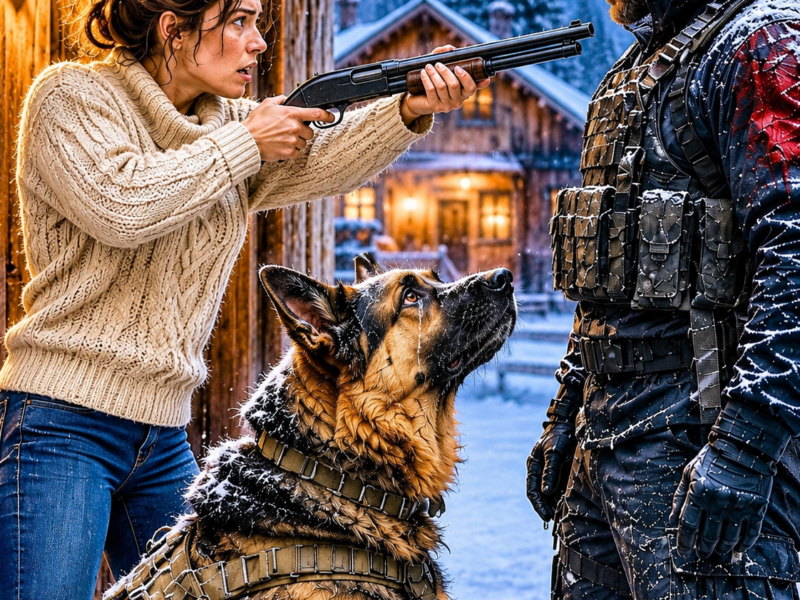
“At 11:41 on a November night, the German Shepherd who hadn’t made a sound in six months suddenly threw himself against my front door
The headlights beyond the barn disappeared.
For three seconds, the only sounds were the wind striking the windows and Bishop breathing against Garrett’s chest.
Then Garrett grabbed my wrist.
“Lock the door, Kelsey.”
I stared at him.
“You just told me not to let them take the dog. Now you’re going to explain who they are.”
“I will. But not while we’re standing in the doorway.”
He tried to get up and nearly collapsed.
I caught his good arm and pulled it over my shoulder. He was heavier than I expected, and his jacket was soaked with melting snow.
Bishop stayed pressed against his leg, moving whenever Garrett moved.
I slammed the door, turned the deadbolt, and helped him into the kitchen.
The moment I switched on the overhead light, I saw how badly he was hurt.
There was a deep cut along his left ribs, a swollen eye, and a split lip. His fingers were so cold they barely moved.
“Sit down,” I ordered.
He lowered himself into a chair.
I retrieved my old paramedic bag from the pantry. I’d kept it stocked even after leaving the city, partly out of habit and partly because I had never learned how to stop preparing for emergencies.
I cut through his jacket and thermal shirt.
The wound along his ribs was ugly, but the bleeding wasn’t arterial. I checked his breathing, listened to his lungs, and pressed carefully around the injury.
“Did the bullet go through?”
“No. Grazed me.”
“That’s not an answer.”
He gave me a tired look.
“Didn’t go through.”
I cleaned the wound and applied a pressure dressing.
Bishop lay beside his chair, his head resting against Garrett’s boot.
Every few seconds, Garrett reached down and touched the fur behind the dog’s damaged ear.
It was such an unconscious gesture that it hurt to watch.
“How long?” I asked.
“Two years, four months.”
“Two years since you were declared dead?”
He nodded.
“And you never tried to contact him?”
His fingers stopped moving.
“I tried every day.”
I tightened the bandage.
“Then why did he end up in a retirement kennel?”
Garrett looked down at Bishop.
“Because I couldn’t get back to him.”
He took a breath.
“Our convoy was carrying supplies overseas. Routine transportation, nothing unusual on the schedule. Medical equipment, replacement parts, that kind of thing.”
He paused.
“Except the cargo manifests were false.”
I pulled a chair closer.
“What was actually in the containers?”
“Military rifles. Hundreds of them. Weapons that had disappeared from American military inventories over several years.”
“Who was moving them?”
“A private logistics company called West Freight. Their vice president of operations was a man named Craig Snider.”
The name sounded familiar.
I had seen it on a plaque in the hospital back in Fernie, where I’d once volunteered during a winter medical drive.
Snider’s company had donated money to rural clinics and emergency services across the region.
“What’s he doing with stolen weapons?”
“Selling them through a network of brokers. Some went overseas. Some went to groups our government had been tracking for years.”
Garrett rubbed his forehead.
“My team discovered the shipment. We photographed the serial numbers and copied the manifests. Before we could report everything, our route was compromised.”
“The ambush.”
He nodded.
“Our vehicle was hit outside the convoy’s designated security perimeter. We lost four men.”
His voice became quieter.
“I was thrown down an embankment. The last thing I remember was Bishop trying to reach me through the smoke.”
I looked at the dog.
He hadn’t moved.
“When I woke up, I was in a village clinic. A family had found me two days later. I couldn’t walk properly, and I had no idea what had happened to the others.”
“Did you contact the military?”
“Eventually. But I learned someone inside our chain of command had sold the route.”
He looked directly at me.
“Whoever did it knew our movements, our equipment, and exactly when we’d be vulnerable.”
I felt the cold settle in my stomach.
“So you disappeared.”
“I couldn’t trust anyone with my location. The people who arranged the ambush believed I was dead. I let them keep believing it.”
“What about Bishop?”
Garrett swallowed.
“I heard he survived. I also heard he wouldn’t leave the wreckage. By the time I could make inquiries, he’d been transferred back to the States.”
He looked down at his hands.
“I tried to reach him through official channels. They told me he was too traumatized to be handled. Then they told me he had been retired.”
“That’s when he came here.”
“I found out about the adoption through a contact at the facility. Frank Perkins wouldn’t tell me your address. He was protecting you.”
I remembered the old chief’s careful expression when he’d handed me Bishop’s papers.
He had known more than he said.
“Why didn’t he tell me?”
“Because he didn’t know whether I was alive. And because he knew what would happen if anyone found out.”
I looked toward the black window.
“How did they find you?”
Garrett reached inside his jacket and removed a small plastic sleeve.
Inside was a photograph of a shipping ledger.
Several rows of numbers ran down the page. Beside them were dates, shipment codes, and company names.
At the bottom was a signature.
Craig Snider.
“This is part of the original accounting record,” Garrett said. “The real one. It connects Snider to the weapons shipments and the money used to pay the people who attacked us.”
“And the pouch?”
“Backup evidence. A storage device, copies of the original records, and a list of accounts.”
“Where’s the rest?”
“Already with Commander Michael Richardson, an investigator I trust. He has been building the case for months.”
“Then why are you here?”
Garrett looked at Bishop.
“Because I needed to see him.”
For a moment, I forgot about the blood, the storm, and the strange headlights outside.
Garrett had spent more than two years believing he would never see this dog again.
And Bishop had spent six months sleeping against my front door.
I reached for my coffee, but my hands were shaking too much to lift the mug.
“How long have they been following you?”
“Since yesterday.”
“How many?”
“Three that I know of.”
I looked at the photograph again.
“Then we call the police.”
“I tried.”
He pointed toward the small phone on the counter.
“They’ve been monitoring the communication channels around my contact. I don’t know whether the local officers are compromised.”
“You’re telling me not to call the RCMP?”
“I’m telling you to be careful about who gets your location.”
I hated that answer.
I had spent years working with people who needed help, and the idea of sitting in my own kitchen while armed men searched the property made my skin crawl.
But I also knew that a wounded man with a bullet injury wasn’t going to survive another confrontation without medical attention.
I picked up my satellite emergency communicator.
It was independent of the cellular network and connected through a service I had used during remote medical calls.
“There’s a difference between being careful and being alone,” I said.
I sent an emergency distress message with our coordinates, requested police and medical assistance, and included a warning that armed suspects might be approaching.
Garrett watched me.
“You just put yourself in the middle of this.”
I met his eyes.
“I was already in the middle when you bled on my kitchen floor.”
He almost smiled.
Then Bishop stood.
His head turned toward the mudroom.
The change was immediate.
His ears flattened, his shoulders tightened, and the soft expression he’d worn since Garrett arrived vanished.
Garrett slowly rose from the chair.
“Lights.”
I switched off the kitchen.
He picked up the rifle I’d seen leaning against the wall near his bag.
“Where did you get that?”
“Your mudroom.”
I stared at him.
“My father’s hunting rifle is in the locked cabinet.”
“Not that one.”
He nodded toward a second weapon I hadn’t noticed beneath his jacket.
“Where did you get that?”
“Long story.”
“You’re going to owe me a very detailed explanation.”
“Fair.”
He checked the weapon, then looked at Bishop.
The dog was standing perfectly still.
“Bishop. Stay close.”
The animal moved to Garrett’s left side.
It was like watching someone switch on a light in a room that had been dark for years.
Garrett didn’t need to point.
He didn’t need to repeat commands.
Bishop simply knew.
We moved behind the stone fireplace.
Through the living-room window, a flashlight swept across the snow.
Then another appeared near the barn.
Garrett leaned close to my ear.
“Three.”
I listened.
A faint metallic click came from the back of the house.
“They’re checking the doors.”
I gripped the shotgun.
“What do we do?”
“Wait for the police. We don’t go looking for them.”
A sudden crash shattered the silence.
Glass broke somewhere down the hallway.
Garrett moved immediately.
“Stay behind the fireplace.”
A dark figure appeared in the bedroom doorway.
I heard Garrett shout.
A gunshot followed, deafening in the confined house.
The figure dropped out of sight.
I pressed my back against the stone and forced myself to breathe.
Another impact shook the mudroom door.
Then came a splintering crack.
A large man pushed through the broken entrance, his face hidden behind a dark covering.
Bishop launched himself forward.
There was no barking.
Only the heavy impact of an animal built for this exact kind of work.
The man stumbled backward, his weapon striking the ceiling.
A second shot rang out.
I ducked.
Garrett moved toward the hallway.
“Bishop! Back!”
The dog released the man’s sleeve and retreated immediately.
The intruder fell against the wall.
For a moment, nobody moved.
Then a voice came from the front porch.
“Garrett!”
It wasn’t one of the men inside.
It was a calm, familiar voice.
“Come out, Owens. This doesn’t need to get any worse.”
Garrett went completely still.
I looked at him.
“Who is that?”
He didn’t answer immediately.
The voice came again.
“You’re making a terrible mistake.”
Garrett’s jaw tightened.
“Craig Snider.”
I felt my stomach turn.
The man whose name appeared on the hospital donor plaque was standing outside my home.
And he knew Garrett was alive.
“Let me handle this,” Garrett whispered.
I shook my head.
“Nobody handles anything alone tonight.”
I moved toward the side of the fireplace, keeping the shotgun ready.
The front door shook once.
Twice.
Then it burst open.
A man in an expensive charcoal coat stepped inside.
He was probably in his fifties, with silver at his temples and the kind of face that looked trustworthy in photographs.
I’d seen him smiling beside politicians.
I’d seen his company’s name on charity banners.
He held a pistol loosely in one hand.
His eyes found Garrett.
For a moment, his expression changed.
Not fear.
Recognition.
Then he smiled.
“Mr. Owens. You’ve caused an extraordinary amount of trouble.”
Garrett kept his rifle trained on him.
“Not as much as you caused four families.”
Snider sighed.
“Those men died in a military operation. You know how these things work.”
“They died because you sold their route.”
“That’s a serious accusation.”
“I have the ledgers.”
Snider’s eyes flickered toward the black pouch on the kitchen counter.
There it was.
The first real crack in his composure.
“Then perhaps we can discuss a solution.”
“There’s no solution.”
“Everyone has a price.”
Garrett looked at him for a long moment.
“That’s what you never understood about them.”
I heard a faint mechanical rumble outside.
It grew louder.
The windows vibrated.
Snider glanced toward the driveway.
His smile disappeared.
A helicopter appeared over the tree line, its searchlights sweeping across the pasture.
A loudspeaker echoed through the storm.
“Royal Canadian Mounted Police! Naval Criminal Investigative Service! Put down your weapons and step away from the building!”
Snider’s face drained of color.
He turned toward the open doorway.
Bishop moved before he could take a step.
The dog stood at the top of the porch stairs, his body positioned between Snider and the darkness outside.
He didn’t bark.
He simply stared.
Snider stopped.
“Call him off.”
Garrett lowered his rifle slightly.
“He’s not taking orders from you.”
Within minutes, armed officers surrounded the house.
The first two came through the doorway with their weapons raised.
They secured Snider and the remaining intruders, then called for medical assistance.
I watched one officer kneel beside the man Bishop had stopped in the mudroom.
Another entered the bedroom and confirmed that the intruder there was alive but injured.
The entire confrontation had lasted less than ten minutes.
It felt like an entire winter.
When the paramedics finally arrived, they took over Garrett’s treatment.
One of them looked at my dressing and nodded.
“Good work. You probably saved him a lot of blood loss.”
I couldn’t answer.
My hands had started shaking again.
I sat on the hearth while an officer wrapped a blanket around my shoulders.
Through the broken doorway, I could see Garrett sitting on the back of an ambulance.
An IV ran into his arm.
Bishop sat beside him.
Not in front of him.
Not watching the driveway.
Beside him.
His head rested against Garrett’s thigh.
For the first time since I’d brought him home, his eyes were almost completely closed.
Garrett noticed me watching.
He raised one hand.
I walked outside.
“He’s okay,” Garrett said.
“I can see that.”
He smiled faintly.
“Thank you.”
I looked down at Bishop.
“You’re welcome.”
Then I glanced at the ambulance.
“Where are they taking you?”
“Calgary. I need surgery to clean the wound properly, and they’ll want a full debrief.”
“And Bishop?”
Garrett looked at the dog.
“The Navy has agreed to transfer him back to me. If everything goes through.”
I nodded.
“Good.”
He looked at the broken front door.
“I don’t have anywhere to take him.”
I wasn’t prepared for that sentence.
He continued.
“I’ve been gone a long time. My apartment is gone. Most of my family moved away. I don’t even know what normal looks like anymore.”
Bishop lifted his head and pressed his nose against Garrett’s hand.
Garrett swallowed.
“I thought I’d have more time to figure it out.”
I looked at the house.
The shattered window.
The damaged doorframe.
The blood on the porch.
Then I looked at the two of them.
“The roof is still on,” I said.
Garrett stared at me.
“The stove works. There’s a spare room. And I’m pretty sure Bishop has already decided where he’s sleeping.”
For the first time that night, Garrett laughed.
It was quiet and exhausted.
But it was real.
“You’re offering us a place to stay?”
“I’m offering you a chance to sleep somewhere without checking every window.”
He looked away.
His shoulders moved once.
When he turned back, his eyes were wet.
“Thank you, Kelsey.”
I reached down and rubbed Bishop behind his good ear.
“Don’t thank me yet. You two are helping repair that door.”
The investigation took months.
The evidence in Garrett’s pouch proved to be only one piece of a much larger case.
Commander Richardson had preserved copies of the original shipping records, but the prosecutors needed the physical documents Garrett had collected to establish the full chain of transactions.
The financial records connected West Freight to several shell companies.
The shell companies connected to overseas weapons brokers.
And the brokers connected to the people who had arranged the ambush.
One of the most damaging discoveries came from a former logistics officer who had secretly sold convoy information to Snider.
He had been paid through an account disguised as a consulting contract.
The same account had transferred money two days before Garrett’s convoy was attacked.
Four servicemen had died.
One dog had waited beside the wreckage.
And one man had spent more than two years trying to prove that their deaths hadn’t been an accident.
Snider’s arrest made national news.
His lawyers tried to argue that the documents were fabricated and that Garrett was a disgruntled former officer seeking revenge.
But the financial records matched.
The shipment numbers matched.
The communications matched.
And the surviving members of Garrett’s unit testified about the missing weapons and the unusual route changes before the ambush.
The trial began in Calgary the following spring.
I attended the final week.
Garrett sat in the front row wearing a plain gray suit.
He looked thinner than the man who had arrived on my porch in November, but his color had returned.
Bishop lay quietly beneath the bench.
The judge read the verdict.
Guilty on all major counts.
Snider stared straight ahead.
For the first time, there were no cameras to smile for and no donors to impress.
His company’s assets were seized.
The investigation uncovered additional crimes, and the court sentenced him to life imprisonment with no possibility of parole for twenty-five years.
As officers approached to escort him away, Snider turned toward Garrett.
“You think this brings those men back?”
Garrett didn’t stand.
“No.”
He looked down at Bishop.
“But you don’t get to profit from what you did to them.”
Snider was led through the courtroom doors.
Bishop lifted his head briefly, watched the man disappear, and settled back down.
That was all.
No growl.
No bark.
No celebration.
I think he had spent enough of his life waiting for bad men to leave.
He didn’t need to follow this one.
By April, the donor plaque bearing Snider’s name had been removed from the hospital in Fernie.
Nobody replaced it.
The same month, Garrett received official confirmation that Bishop’s transfer was complete.
But by then, the dog had already made his decision.
He had a bed beside the fireplace.
A favorite patch of sunlight near the kitchen window.
And a habit of following me into the barn whenever I carried a bucket of feed.
Garrett stayed.
At first, he said it would only be until he finished his medical rehabilitation.
Then it became until he could drive comfortably.
Then it became until the paperwork was settled.
Eventually, neither of us mentioned a departure date.
He helped repair the front door and replace the broken window.
He repaired the fence along the north pasture.
I learned that he made terrible coffee but excellent pancakes.
He learned that I hated being woken before seven and that I always read the last page of a book before deciding whether to finish it.
Some evenings, we sat on the porch without speaking.
It was the kind of silence I’d moved to Montana to find.
Only now, it didn’t feel empty.
One afternoon, I asked him something I’d been wondering for months.
“Did you know Bishop would recognize you?”
Garrett looked across the pasture.
“I hoped.”
“You walked through a blizzard with a bullet wound because you hoped?”
He smiled.
“I’d seen him recognize my footsteps from half a mile away. I’d heard him wake up when I came back from a deployment. He knew my voice before I even opened a door.”
He rubbed the dog’s neck.
“But I wasn’t sure he’d remember me after everything.”
I looked at Bishop.
“Well, I think he remembers.”
Garrett nodded.
Then he said something I never forgot.
“I didn’t realize how much I’d lost until he put his head against my boots.”
I didn’t answer.
I understood.
Sometimes, surviving something was only the beginning of learning how to live afterward.
By May, the snow had finally retreated from the pasture.
The grass turned green, the creek ran high, and wildflowers appeared along the fence.
Garrett was outside repairing a section of railing when I found an old tennis ball beneath the porch.
It was faded and dirty.
I’d bought it six months earlier, thinking Bishop might eventually want to play.
I’d left it outside after he ignored it.
I picked it up and walked into the yard.
“Bishop.”
He turned.
Garrett looked over from the railing.
“What have you got?”
I held the ball in my palm.
Bishop stared at it.
Then he looked at me.
His ears moved forward.
I lowered my hand.
“Want to try?”
He stepped closer and sniffed it.
For a moment, I thought he would turn away as he always had.
Instead, he nudged my fingers.
I smiled.
“Okay, then.”
I threw the ball across the pasture.
It sailed over the grass and landed near the old fence.
Bishop ran.
Not the measured, controlled movement I’d seen when he followed Garrett around the property.
He ran like a young dog.
His ears flattened against his head, his mouth opened, and his paws kicked up little sprays of dirt.
When he reached the ball, he picked it up and turned back.
Garrett had stopped working.
He was watching with one hand resting on the fence post.
Bishop raced toward us and dropped the ball at my boots.
Then he looked up.
His tail moved once.
Twice.
Then it began sweeping from side to side.
Garrett let out a breath that sounded almost like a laugh.
“Six years,” he said quietly.
I turned toward him.
“What?”
“Six years I worked with that dog. Six years of deployments, training, long nights, and everything in between.”
He shook his head.
“I never saw him play like that.”
Bishop nudged the ball toward my foot.
I picked it up and threw it again.
This time, Garrett came over and joined us.
He threw the ball farther than I had.
Bishop chased it with the enthusiasm of an animal who had finally discovered that the world contained something besides danger.
When he returned, he dropped it between us.
Garrett crouched and rubbed both sides of his face.
“Good boy,” he whispered.
Bishop leaned into him.
I watched the two of them in the late afternoon sunlight and remembered the night the dog had thrown himself against my front door.
For six months, I’d believed he was waiting for someone who wasn’t coming back.
I had been wrong.
He hadn’t stopped loving his handler.
He hadn’t forgotten the life he’d lost.
He had simply refused to let go of the possibility that one day, somehow, the promise would be kept.
Garrett stood and looked at me.
“Think he wants another throw?”
I glanced at Bishop.
The dog was already waiting, tail sweeping the grass.
I laughed and raised the ball.
“Looks like he does.”
And as I sent it flying across the green pasture, I realized something about the quiet I’d spent so long searching for.
It wasn’t a house without voices, or a road without visitors, or a life where nothing unexpected ever happened.
Sometimes, peace was hearing the front door open and knowing the person you loved had finally made it home.
That evening, Bishop fell asleep between the fireplace and Garrett’s chair.
His paws twitched occasionally as he dreamed.
For once, he wasn’t watching the road.
He didn’t have to.
The end.









