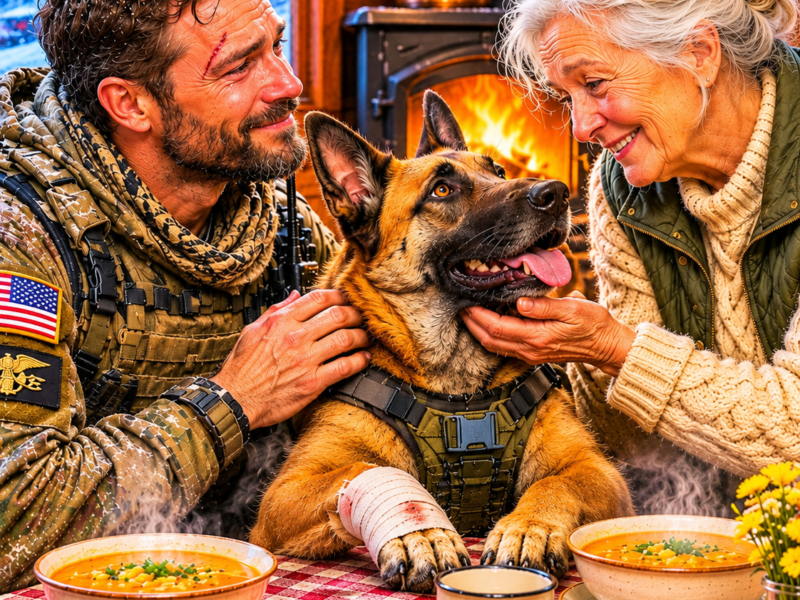
An elderly woman opened her door to a freezing Navy sailor and his injured dog during a blizzard
Aggie had one final request for the sailors before they left.
It was a simple one.
“Next December,” she said, standing on the porch with one hand wrapped around her cane, “you bring everybody back.”
Owen looked at her. “Everybody?”
“Everybody who helped. The families, the children, the dogs. Even that fellow who let Gustav chase him around the barn.”
A few sailors laughed.
Aggie smiled, but her eyes had grown serious.
“I spent forty-one years growing those trees,” she continued. “For a long time, I thought that was what this place was for. Growing trees. Selling trees. Keeping the tradition going. But yesterday reminded me that a farm isn’t much of a farm without people in it.”
Owen nodded.
“I think we can manage that.”
“You’d better,” Aggie replied. “I’ll have soup ready.”
That was how the next Christmas tradition began.
But it hadn’t started with a plan to save a farm.
It had started with a snowstorm, a stranded sailor, and a German Shepherd who refused to leave an old woman’s side.
A year earlier, Owen Kesler had been driving through northern Michigan with his dog, Diesel, riding in the passenger seat.
He was on leave from the Navy, heading through the Upper Peninsula during a winter storm. The snow had started falling lightly in the afternoon, but by evening it had become a wall of white.
The road disappeared beneath the tires.
The wind pushed against the truck hard enough to make the steering wheel tremble.
Owen slowed down, watching the edge of the highway.
Then the truck slid.
He corrected once, then again, but the rear end swung sideways. The tires left the pavement, dropped into a ditch, and stopped against a bank of snow.
For a moment, Owen sat with both hands gripping the wheel.
“Everybody okay?”
Diesel lifted his head.
The dog was a large German Shepherd with a steady gaze and a habit of watching Owen as though he understood every word. He gave a quiet whine, and Owen leaned over to check him.
“Yeah. We’re all right.”
Owen tried his phone.
No signal.
He checked the road through the windshield. Nothing moved beyond the swirling snow. He couldn’t tell how far they were from the nearest town, and the highway closure meant there would be no traffic passing to help them.
He could wait until morning.
But the temperature was dropping, and he wasn’t sure how long the truck would keep them warm.
Then he saw a faint light through the trees.
It wasn’t much. Just a yellow glow, almost swallowed by the storm.
But it was something.
Owen pulled on his coat, clipped Diesel’s leash to his collar, and stepped outside.
The snow reached nearly to his knees in places. He held the leash tightly as they made their way toward the light.
It took longer than he expected.
At last, they reached a farmhouse set back from the road. A wooden porch stood beneath a thick layer of snow. The windows glowed warmly, and smoke rose from the chimney.
Owen knocked.
The door opened after a moment.
An elderly woman stood on the other side, wearing a heavy sweater and an expression that suggested she wasn’t easily impressed.
She looked at Owen, then at Diesel.
“You two look terrible,” she said.
Owen almost laughed.
“Truck went into the ditch. Highway’s closed. We were hoping—”
“Boots off,” she interrupted. “Both of you. Get inside before you freeze.”
That was how he met Aggie.
Aggie lived alone on a Christmas tree farm eleven miles from the nearest town.
She had been there for forty-one years.
When she first bought the property, it was mostly open land. In 1984, she planted twelve little seedlings. She had no grand business plan and no idea that those trees would eventually become the beginning of a tradition known throughout the community.
Now there were nearly two thousand trees spread across the property.
Every December, families came to choose and cut their own Christmas trees. Children ran between the rows. Parents argued over which tree was straight enough. Someone always forgot a saw, and someone else always brought too much food.
The largest tree on the farm was donated to the town square each year. It stood in the center of town, decorated with forty feet of lights.
For Aggie, that tree was more than a decoration.
It was a promise that winter would bring people together.
She had been running the farm for decades, but age was beginning to make the work harder.
Her shoulder hurt. Her eyesight wasn’t what it used to be. Her balance had become unreliable.
The previous winter, she had fallen in the barn and spent six hours on the floor before the mail carrier heard her chicken, Gustav, making enough noise to attract attention.
Her daughter, Diane, had driven nine hours through the snow to get to her.
Diane had been terrified.
She lived in Chicago, worked as a nurse, and called her mother every Sunday. But calls couldn’t help if Aggie fell and couldn’t reach the phone.
Diane wanted her to move into assisted living in Green Bay.
She had already reserved a room for December fifteenth.
Aggie wanted nothing to do with it.
“I have a house,” she told Owen that first night. “I have a farm. I have a chicken with an attitude problem. Why would I move into a building where somebody tells me when I can have breakfast?”
Owen smiled as he sat near the stove.
Aggie had placed Diesel beside the warmth and examined the cut on his paw. Before retiring, she had worked as a veterinarian for thirty years.
She cleaned the wound with practiced hands, wrapped it carefully, and told the dog he was a poor patient.
Diesel seemed perfectly content with her judgment.
Soon the kitchen smelled of Swedish pea soup and fresh bread.
Aggie refused Owen’s offer of money.
“You can pay me by not tracking snow all over my floor.”
He promised to try.
That night, Owen listened to the wind rattle the windows while Diesel slept near the stove.
For the first time in hours, they were warm.
And for the first time in a long while, Aggie had company.
The next morning, the storm had eased enough for Owen to inspect his truck.
The road was still closed, and there was little he could do until help arrived.
Aggie didn’t seem concerned.
She handed him coffee and pointed toward the porch.
“Those steps are getting dangerous,” she said.
Owen looked at them. One board had pulled loose, and the railing shifted when he touched it.
“I can fix that.”
“You a carpenter?”
“No.”
“Then why are you so confident?”
“Because it looks like a loose board.”
Aggie gave him a long look.
“Military confidence,” she muttered. “Always dangerous.”
But Owen fixed it anyway.
He tightened the railing, replaced the loose board, and checked the barn door. It had been sticking for months, so he adjusted the hinge and got it moving again.
Aggie watched him work from the doorway.
“You don’t have to do all that.”
“I know.”
“Then why are you?”
Owen shrugged.
“Somebody helped me last night.”
Aggie didn’t answer immediately.
She only went inside and returned with another cup of coffee.
Over the next day, Owen learned more about the farm.
He learned that Aggie remembered every family who had come to buy a tree over the years. She remembered the little boy who cried because his parents chose a tree without asking him. She remembered the couple who returned every December after moving away. She remembered the families whose children had grown up and eventually brought their own children.
She knew which trees were ready, which rows needed attention, and which corners of the property collected the deepest snow.
She also knew how much she had lost.
Her body no longer allowed her to work the way she once had.
The farm was becoming too much for one person.
And she was beginning to understand that the tradition she loved might not survive another year.
Owen noticed the way she sometimes paused before climbing the porch steps. He noticed how she held the wall when walking through the kitchen.
He didn’t lecture her.
He just made small repairs and offered an arm when the ground became slippery.
Then, during another spell of bad weather, the electricity went out.
Aggie insisted she could get the generator running.
Owen followed her toward the barn, but she was already halfway there.
He heard a sudden thud.
Then Diesel barked.
Owen ran.
He found Aggie on the barn floor, one leg bent awkwardly beneath her. Diesel stood beside her, barking and nudging her hand.
“Don’t move,” Owen said, dropping to his knees.
Aggie looked annoyed more than frightened.
“I wasn’t planning on dancing.”
He checked her ankle and helped her sit up carefully. It was badly sprained, but it didn’t appear to be broken.
He supported her back to the house and settled her into a chair.
For a while, Aggie said nothing.
Then she looked down at her hands.
“I wasn’t afraid of dying,” she said quietly.
Owen waited.
“I was afraid of being found too late again.”
The words stayed with him.
He thought about Diane, nine hours away in Chicago, wondering whether her mother was safe. He thought about Aggie waking up each morning in a house full of memories and no one nearby to notice if something went wrong.
He wanted to promise that he could fix everything.
But he couldn’t.
He was a sailor. He had responsibilities. He would have to leave.
All he could do was make sure she wasn’t alone that night.
When the roads finally reopened, Owen packed his belongings.
Aggie made coffee and wrapped up some meatballs for the trip.
“You’ll need something better than gas station food,” she said.
“I appreciate it.”
She looked at Diesel.
The dog had been following her around the kitchen all morning. When she sat down, he rested his head beside her chair.
Aggie scratched behind his ears.
“Don’t forget me, you big fool.”
Diesel wagged his tail.
Owen clipped on the leash.
For a moment, the dog didn’t move.
Aggie looked at him.
“Go on. Your person needs you.”
Diesel finally stood and followed Owen to the door.
Outside, Owen turned back.
“I’ll call you.”
“You don’t have to.”
“I know.”
Aggie narrowed her eyes.
“Then why are you?”
He smiled.
“Because somebody helped me.”
She shook her head, but she was smiling too.
Owen drove away with Diesel beside him, carrying a container of meatballs and the uncomfortable feeling that he was leaving something unfinished.
He kept his promise.
Every Sunday, he called.
At first, the conversations were short.
He asked how her ankle was healing. She asked whether he was eating properly. He told her about Diesel. She told him Gustav was still behaving like a criminal.
Eventually, the calls became part of both their routines.
Owen learned that Aggie had gone back to tending the farm as much as she could, although she was moving more slowly.
He also learned that Diane had started preparing to sell the property.
The farm would be listed in the spring.
Aggie said it casually, as if she were telling him the weather.
Owen went quiet.
“You okay with that?”
“I don’t have much choice.”
“Is that what you want?”
Aggie took a breath.
“What I want and what I can manage aren’t always the same thing.”
Owen understood more than she probably realized.
He knew she was tired. He knew she didn’t want Diane worrying every day. He also knew that selling the farm meant giving up something she had spent most of her adult life building.
He didn’t want to make promises he couldn’t keep.
But he couldn’t stop thinking about those two thousand trees.
One Sunday, after another call with Aggie, Owen sat with his phone in his hand for several minutes.
Then he contacted Senior Chief Boon Halverson.
Owen told Boon about the storm, the farmhouse, the injured dog, and the woman who had opened her door without asking for anything in return.
He told him about the Christmas tree farm.
He told him about the town tradition and the old woman who was trying to keep it alive.
Then he told him about the sale.
Boon listened without interrupting.
When Owen finished, the senior chief leaned back.
“So, what’s the plan?”
Owen hadn’t expected the question.
“I don’t know yet.”
Boon looked at him.
“You’ve got a whole crew of people who owe you favors. Start there.”
The idea grew quickly.
The sailors were already planning their December leave. Many had spouses and children. Some had dogs. Some had spent previous holidays far from home.
The more Owen explained, the more people wanted to help.
They could spend two weeks at the farm.
They could help harvest the trees, repair the property, and bring families to opening day.
They could make sure the Christmas tradition didn’t end simply because Aggie couldn’t do all the work herself anymore.
Someone suggested a date.
Someone else started organizing trucks.
Boon took charge of coordinating the group.
The plan was to arrive before dawn on December sixth.
They wouldn’t tell Aggie.
Owen called her the following Sunday and kept his voice casual.
“How are preparations going?”
“Not very well,” Aggie said.
“Why?”
“Because I put up a sign saying we’re closed this year.”
Owen felt his stomach tighten.
“Why?”
“Because I can’t do it alone, Owen.”
“Maybe you won’t have to.”
There was a pause.
“I don’t want you worrying about me.”
“I’m not worrying.”
“Liar.”
He laughed.
She did too.
But he could hear the sadness underneath it.
Diane arrived at the farm on Friday.
She had driven from Chicago through cold rain and patches of snow, carrying groceries and the kind of worry that never quite left her face.
She found her mother using a cane.
The porch steps had been repaired. The barn door worked properly. The path to the house was easier to navigate.
Diane noticed all of it.
“Who did this?”
“A sailor.”
“A sailor?”
“A young man who got stuck in the snow last winter. He had a dog.”
Diane stared at her.
“Mom, you let a stranger stay here?”
“I let two strangers stay here. The dog was better company.”
Diane didn’t laugh.
She looked around the property, then back at her mother.
“Did you fall?”
Aggie hesitated.
That was enough.
Diane set down the groceries.
“What happened?”
Aggie explained about the barn, the generator, and the sprained ankle. She told her how Owen had found her and helped her back to the house.
Diane’s face changed.
“You fell again?”
“I’m fine now.”
“Mom.”
“Diane—”
“I can’t do this again.”
Her voice cracked.
She explained what it had been like the previous winter, driving nine hours through snow after hearing that her mother had been found on the barn floor.
She explained how helpless she had felt.
She was a nurse. She spent her days helping people. But when it came to her own mother, she was hundreds of miles away, hoping the phone would ring with good news.
“I can’t keep waiting for another call like that,” Diane said.
Aggie looked down.
“I know.”
“I booked the room because I want you safe. I don’t want to take your home away from you.”
“It feels like you do.”
Diane closed her eyes.
For a long moment, neither spoke.
Then Aggie said something she had been holding back.
“I want one more December.”
Diane looked at her.
“One more opening day. One more chance to see people come here. One more year where the farm feels like a farm.”
“What if nobody comes?”
“Then I’ll know.”
Diane looked out toward the rows of trees.
They stood there together, mother and daughter, surrounded by the work of forty-one years.
Finally, Diane nodded.
“One more opening day.”
She agreed to stay through the weekend.
“If nobody comes,” she said, “we sign the papers.”
Aggie nodded.
She didn’t argue.
But she looked toward the road as if she were waiting for something.
Saturday morning arrived cold and bright.
Aggie woke before sunrise.
She made coffee, checked the kitchen, and walked carefully toward the front window.
Diane joined her a little later.
The farm looked beautiful beneath its fresh layer of snow.
The trees stood in neat rows, their branches heavy with white.
But the parking area was empty.
At seven, there was still no one.
At eight, Diane began helping her mother prepare lunch.
At nine, Aggie walked to the porch and looked down the road.
Nothing.
By ten, Diane was trying not to show her disappointment.
At eleven, Aggie sat near the window with her hands folded around a mug.
“Maybe people have found somewhere else,” Diane said gently.
Aggie nodded.
“Maybe.”
By noon, only four families had arrived.
They chose their trees, thanked Aggie, and left.
Diane watched the last vehicle disappear down the road.
She turned toward her mother.
“Mom, I’m sorry.”
Aggie looked at the empty parking area.
“It’s all right.”
But her voice sounded smaller than usual.
Diane sat beside her.
“We can still make this work. We can find a buyer who understands the property.”
Aggie didn’t answer.
Then, from somewhere outside, came the sound of an engine.
One vehicle.
Then another.
Then several more.
Diane stood.
“What is that?”
Aggie turned toward the window.
A line of trucks appeared at the end of the road.
They moved slowly through the snow, headlights cutting through the winter light.
Behind them were more vehicles.
And more.
A large group began filling the parking area.
Then a familiar German Shepherd jumped out of the first truck.
“Diesel!” Aggie cried.
The dog ran toward the porch, his tail swinging wildly.
Owen climbed out behind him.
“Morning, Aggie!”
She stared at him.
For a second, she seemed unable to speak.
Then the rest of the trucks arrived.
Sailors climbed out wearing winter coats and work boots. Families followed, carrying bags, children, and food. Dogs barked from open truck doors.
Senior Chief Boon Halverson stepped forward.
“Ma’am,” he called, “we heard you needed a little help with opening day.”
Aggie pressed one hand against her mouth.
Owen walked toward her.
“You said you wanted everybody back next December.”
She looked at the crowded parking area.
“You brought everybody?”
“Not everybody,” Owen said. “A few couldn’t get leave.”
Boon shook his head.
“Don’t listen to him. We brought plenty.”
Aggie laughed.
Then she started crying.
Owen climbed the porch steps and gave her a careful hug.
Diesel pressed his head against her leg.
Aggie bent down and rubbed his ears.
“You remembered,” she whispered.
The dog wagged his tail.
The farm changed in minutes.
Sailors unloaded equipment and began organizing the work. Families helped visitors choose trees. Children ran between the rows, laughing and calling out whenever they found a tree they liked.
Someone set up a table for hot chocolate.
Someone else started carrying firewood.
The dogs quickly discovered that the property was full of interesting smells.
Gustav the chicken, who had apparently decided that the newcomers were a personal threat, chased one sailor around the barn.
The sailor ran.
The children cheered.
Aggie laughed so hard she had to sit down.
“I haven’t laughed like that in years,” she told Diane.
Diane stood beside her, watching the scene.
She had come prepared to help her mother close the farm.
Instead, she was watching a parking lot full of people who had driven through winter weather to keep it open.
Owen approached with two cups of hot chocolate.
He handed one to Diane.
“I’m Owen.”
“I know,” Diane said. “I’ve heard about you.”
“Hopefully nothing too bad.”
She smiled.
“Mom says you fixed the porch.”
“Just a board.”
“And the barn door.”
“Small repair.”
“And you found her after she fell.”
Owen glanced toward Aggie.
“Diesel found her. I just helped.”
Diane looked down at the cup in her hands.
“Thank you.”
He nodded.
For a moment, neither spoke.
Then Owen asked a question.
“Can I ask you something?”
“Sure.”
“Why did you want her to move?”
Diane looked at him.
“Because I’m scared.”
He waited.
“I’ve seen what happens when people get hurt and nobody finds them in time. I know what can happen to someone who lives alone. And I know how far away I am.”
She looked toward the farmhouse.
“I don’t want to lose my mother because I was too far away to help.”
Owen nodded.
“That makes sense.”
“But I also know she doesn’t want to leave.”
“Have you asked her what she wants?”
Diane looked at him for a long moment.
“I thought I was doing what was best.”
“Maybe you were trying to keep her safe.”
She glanced toward Aggie again.
“Those aren’t always the same thing, are they?”
Owen shook his head.
“No. But maybe there’s a way to do both.”
By the end of the day, six hundred trees had been sold.
The parking area had been full for hours.
Families came from nearby towns. Some had heard that the farm was open after all. Others had been coming for years and were relieved to find Aggie still there.
The sailors worked steadily.
They helped cut trees, carried them to vehicles, cleared snow, and made sure visitors could move safely around the property.
The children loved Diesel.
The dogs loved the attention.
Gustav remained suspicious of everyone.
And Aggie stood in the middle of it all, watching her farm come alive again.
She had thought she was losing the place.
Instead, she was discovering that she didn’t have to carry it alone.
Later that afternoon, Owen and Boon showed Diane what they had been planning.
They had already discussed a few practical changes.
A safer ramp could be built near the barn.
Lights could be installed along the paths.
An alert bracelet could be set up so that if Aggie fell, Diane would be notified.
A cousin in Marquette had offered to help on weekends and take care of heavier chores like chopping wood.
Diane’s daughter, who attended Northern Michigan University, could visit on Sundays when her schedule allowed.
It wasn’t a promise that nothing bad would ever happen.
It was a plan to make sure Aggie had more support.
Diane listened carefully.
“Who organized all this?”
Boon shrugged.
“People who don’t like leaving a job unfinished.”
Aggie looked at her daughter.
“I don’t need a babysitter.”
“No,” Diane said. “But you might need a little help.”
Aggie narrowed her eyes.
“Careful.”
Diane laughed.
Then her expression softened.
“I’ll cancel the reservation.”
Aggie looked at her.
“You don’t have to do that because of one good day.”
“I’m not doing it because of one good day. I’m doing it because I finally understand that moving you somewhere else isn’t the only way to keep you safe.”
She paused.
“But the bracelet stays. And we’re going to make a schedule. I want to see you more often.”
Aggie reached for her daughter’s hand.
“Come because you’re my daughter,” she said. “Not because I fell.”
Diane squeezed her hand.
“I can do that.”
For the first time in months, neither of them felt as though they were losing.
The sailors stayed for the rest of their leave.
They repaired the barn ramp, added lights along the paths, and made sure the porch was safe.
They helped organize the trees and made the work easier for Aggie.
The cousin from Marquette began visiting on weekends.
Diane arranged her schedule so she could come more often.
And the alert bracelet became a permanent part of Aggie’s routine.
She complained about it regularly.
“This thing makes me look like a walking emergency.”
Diane reminded her that she had agreed to wear it.
“I agreed because I love you,” Aggie replied. “Not because I like jewelry.”
The two of them found a rhythm.
It wasn’t perfect.
Aggie still had difficult days. Her shoulder still hurt. Some mornings, the steps seemed higher than they had the day before.
But she wasn’t trying to manage everything alone anymore.
And she wasn’t being forced to give up the place she loved.
The Christmas tree farm remained open.
The tradition survived.
And Owen kept calling every Sunday.
The following December, the trucks returned.
This time, nobody needed to organize a surprise.
The sailors had made it part of their plans.
Some arrived early. Others came later with their families. A few brought friends who had heard about the farm and wanted to see it for themselves.
Diane had taken three weeks off.
She arrived before the opening day rush and stayed to help her mother prepare the farmhouse.
When Owen stepped onto the porch, Aggie was already waiting.
She had a pot of soup on the stove.
“Boots off,” she called. “Every one of you. Coats on the hook. Soup’s on the stove.”
Owen grinned.
“Yes, ma’am.”
Diesel bounded inside and headed straight for his old place near the stove.
Aggie bent down to greet him.
“Well, look who’s back.”
He leaned against her, tail wagging.
Owen watched them for a moment.
It felt strange how familiar the place had become.
A year earlier, he had arrived here as a stranded sailor with a damaged truck and an injured dog.
Now he was returning to a house where people knew his name, where his dog had a favorite spot, and where the smell of soup meant there was room for him.
Boon came in behind him carrying a box.
“What have you got there?” Aggie asked.
“Something for the farm.”
He set it on the table.
Inside were photographs from the previous year.
There were pictures of the sailors carrying trees, children running between the rows, Diesel lying in the snow, and Gustav chasing a man twice his size.
Aggie picked up one photograph.
It showed her standing between Owen and Diane, smiling with a Christmas tree behind them.
She studied it for a long moment.
“That’s a good picture,” she said.
“Thought you’d like it,” Owen replied.
She placed it carefully on the shelf.
Then she looked around the kitchen.
More people were arriving.
Someone was laughing near the doorway. A child was asking where the chicken lived. Diane was setting out bowls. Diesel was lying by the stove, watching the room fill.
Aggie folded her hands.
“Before everybody starts eating,” she said, “I want to say something.”
The room grew quiet.
She looked at the people gathered around her.
“I used to think this farm was about the trees. I planted them, cared for them, watched them grow. Every year, I worried about the weather, the work, and whether people would come.”
She glanced toward the window.
“But I was wrong about something.”
Her eyes moved from Owen to Diane, then to the sailors and their families.
“The trees were never the most important part. The people were.”
Nobody spoke.
Aggie smiled.
“I thought I was going to spend this winter sitting behind beige walls in a place where somebody else decided when I ate breakfast.”
A few people laughed.
“Instead, I have a house full of sailors, a daughter who comes to visit, a dog who thinks he’s in charge, and a chicken who still hates everybody.”
The room erupted in laughter.
Aggie lifted her cup.
“And there isn’t a single beige wall in sight.”
Everyone raised their cups.
Later that evening, when the work was finished and the visitors had gone, Owen found Aggie standing near the window.
Outside, the trees were dark against the snow.
The lights from the farmhouse reflected in the glass.
“Everything okay?” he asked.
Aggie nodded.
“Just looking.”
“At the trees?”
“At all of it.”
She turned toward him.
“You know, I thought last year might be the end.”
Owen leaned against the wall.
“I know.”
“I was tired. I couldn’t do the work. Diane was worried. And I didn’t know how to ask for help without feeling like I was admitting I couldn’t do anything anymore.”
Owen listened.
Aggie looked back at the window.
“Then you showed up.”
“I got lucky with the light in your window.”
“No,” she said. “You showed up. That’s different.”
He smiled.
She reached for his hand.
“Thank you for coming back.”
Owen glanced toward Diesel, who was sleeping by the stove.
“I told you I would.”
“You did.”
They stood quietly for a moment.
Then Aggie gave his hand a small squeeze.
“Next year, bring more people.”
Owen laughed.
“I thought you were going to ask me to bring fewer.”
“Don’t be ridiculous. There’s always room for more soup.”
The farm continued its December opening days.
The following year, more families came.
Some had heard about the sailors. Others had simply returned because they remembered how welcome they had felt.
The town square tree still came from Aggie’s land.
The forty feet of lights still went up.
And every December, the farmhouse filled with people.
There were always boots by the door, coats hanging from the hooks, and soup on the stove.
Diesel never forgot the way to Aggie’s chair.
Gustav never became friendlier.
Diane kept her promise to visit more often.
And Owen returned whenever his duty allowed.
Aggie never pretended that growing older had become easy. She still needed help. She still had days when her body reminded her that time was moving forward whether she liked it or not.
But she had stopped believing that needing help meant losing her independence.
The farm was still hers.
The choices were still hers.
And the people who cared about her had found a way to stand beside her without taking those things away.
One December evening, as snow settled over the rows of trees, Aggie stood on the porch watching a family load their Christmas tree into the back of a truck.
A little girl waved at her through the window.
Aggie waved back.
Then she looked at Owen, who was carrying another tree toward the parking area.
“Hey, sailor!”
He turned.
“What?”
“Don’t forget your soup!”
Owen laughed and walked toward the house.
The lights on the porch glowed warmly against the snow.
For forty-one years, Aggie had believed she was growing Christmas trees.
Now she understood what those trees had really been growing all along.
Memories.
Friendships.
A reason for families to return.
And a place where a stranger could knock on a door during the worst night of winter and find someone willing to let him in.
Sometimes, saving a place doesn’t mean building something new.
Sometimes, it means showing up before the lights go out.
And sometimes, the smallest act of kindness—a warm meal, a safe place to sleep, a little help with a broken porch step—can bring an entire community back together.
Every December, the road to Aggie’s farm filled with headlights.
And every December, she opened the door, looked at the people standing outside, and said the same thing:
“Boots off. Coats on the hook. Soup’s on the stove.”
The end.









