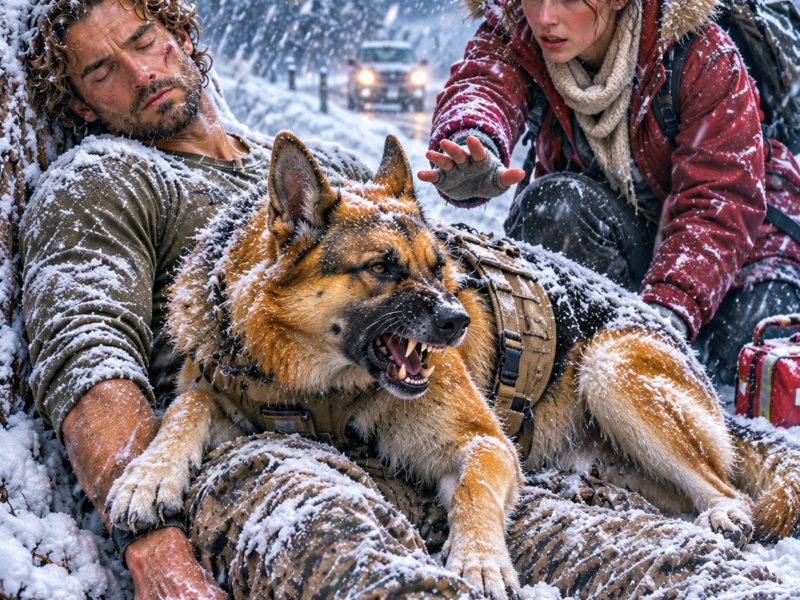
“An eighty-year-old woman dragged an unconscious Navy SEAL and his wounded German Shepherd out of a freezing creek in rural Montana
The ambulance had barely reached the end of Margaret’s driveway when she noticed something lying in the snow.
It was a small black object, half buried near the tire tracks.
She walked toward it, still holding James’s dog tag in her trembling hand.
The object was a military GPS tracker.
Its casing was cracked, and a strip of black tape covered the serial number.
Margaret picked it up and turned it over.
Someone had scratched three letters into the back.
J.E.
James Ellis.
She looked toward the road.
The ambulance was already gone.
For seven years, she had been told her son was dead.
Now a wounded Navy SEAL had arrived at her farmhouse wearing James’s name, carrying a dog that seemed willing to die protecting him, and claiming her son had sent him.
Margaret went inside and locked the door.
She didn’t know who to trust anymore.
But she knew one thing.
She wasn’t going to bury her son twice.
The hospital in Kalispell called shortly after midnight.
The wounded soldier had regained consciousness.
His name was Staff Sergeant Michael Carter, a Navy SEAL who had been part of a classified recovery operation in Montana.
The nurse explained that he had a fractured rib, a concussion, and a deep wound in his left shoulder.
The German Shepherd was receiving treatment in a separate veterinary unit.
“Can I speak to him?” Margaret asked.
“He’s asking for you, ma’am.”
She drove through the snow with James’s dog tag in her coat pocket.
When she entered Michael’s room, he was sitting upright, his arm wrapped in a thick bandage.
He looked younger than she had expected.
There were dark circles beneath his eyes, and his right hand kept moving toward an empty space beside the bed.
“Where’s the dog?” he asked immediately.
“He’s being treated. They say he’ll be all right.”
Michael closed his eyes.
“Thank God.”
Margaret pulled a chair beside him.
“Now tell me about my son.”
Michael studied her face.
For several seconds, he seemed to be searching for the right words.
Then he reached beneath his hospital gown and removed a thin chain.
Attached to it was a small silver pendant.
Margaret recognized it instantly.
She had given it to James when he graduated from high school.
It was a little compass with a dent on the left side.
She had accidentally dropped it while wrapping his graduation present.
James had laughed and told her the dent made it more valuable.
Margaret reached for it.
“Where did you get this?”
Michael placed it in her palm.
“James gave it to me.”
Her fingers closed around the pendant.
“Where is he?”
Michael looked down.
“I don’t know exactly where he is right now.”
“Is he alive?”
“Yes, ma’am.”
The answer came without hesitation.
Margaret covered her mouth.
A sound escaped her that was somewhere between a sob and a laugh.
She had imagined this moment a thousand times during seven lonely years.
In every version, she ran to her son and held him.
But now, with a stranger sitting in front of her, she could barely breathe.
“Why didn’t he come home?”
Michael looked toward the window.
“Because someone made sure he couldn’t.”
He explained that seven years earlier, James had been assigned to a small intelligence support team operating near Kandahar, Afghanistan.
His official military role had been listed as communications support.
But James had discovered that military equipment and weapons supposedly destroyed during operations were being diverted through private contractors.
The shipments were being moved under falsified reports.
Several officers knew about it.
Some were involved.
Others were being manipulated into signing documents they didn’t understand.
James had collected evidence.
He had photographs, radio logs, shipping records, and names.
Then one night, his team was ambushed.
The official report stated that James had died during the attack.
His body was never recovered.
Margaret had received the folded flag six weeks later.
Michael paused.
“James wasn’t in that vehicle when it exploded.”
Margaret looked at him.
“Then whose body did they bury?”
“Nobody’s. The casket was empty.”
She stared at him.
The funeral had been real.
The military honor guard had stood beside her.
The flag had been folded with such care that she had kept it untouched in a glass cabinet.
And the casket had contained nothing.
“Who ordered that?”
“I don’t know everyone involved. But I know the man who signed the report.”
Michael named a retired Navy commander, Robert Harlan.
Margaret remembered the name.
He had visited her house after James’s death.
He had sat at her kitchen table, accepted a cup of coffee, and told her that her son had served with extraordinary courage.
He had even offered to help with the paperwork.
Margaret had thanked him.
She had cried when he left.
Now she remembered something else.
Before leaving, Harlan had asked whether James had ever mentioned a small silver compass.
At the time, she hadn’t thought anything of it.
She looked at Michael.
“Why did he ask about the compass?”
Michael’s expression changed.
“Because James hid a key inside it.”
Margaret examined the pendant.
She had never noticed anything unusual about it.
Michael explained that the compass had a removable back plate.
James had hidden a tiny memory chip inside the casing.
It contained a portion of the original evidence.
The rest had been stored somewhere only James knew.
Margaret looked at the pendant again.
“Why did he give it to you?”
“Because he trusted me.”
“How did you meet him?”
Michael smiled faintly.
“He saved my life.”
The first time Michael met James was during a night operation outside Kandahar.
Michael had been injured when an armored vehicle overturned after an explosion.
His radio was damaged, and the rest of his team had been forced to withdraw.
James found him while searching for survivors.
He was supposed to return to the extraction point.
Instead, he stayed.
He dragged Michael behind a concrete wall, treated his injuries, and waited until a rescue team reached them.
When Michael later asked why James had risked missing the extraction, James had shrugged.
“Because I wasn’t leaving another man behind.”
They became close after that.
Michael learned about James’s mother, the old farmhouse in Montana, and the one birthday cake she supposedly made every year even though James was too old to enjoy it.
“He talked about you constantly,” Michael said.
Margaret smiled through her tears.
“He hated my chocolate frosting.”
“He said it was the best frosting in America.”
“That boy never knew how to lie convincingly.”
For the first time that night, Michael laughed.
Then his expression grew serious again.
“James found evidence that the diverted weapons were being supplied to a network that had connections to a private defense contractor. When he tried to report it, someone inside the operation warned the people involved.”
“Who?”
“That’s what we’re trying to prove.”
Margaret held the compass.
“How did he survive the ambush?”
“Someone helped him escape. A local interpreter named Farid. He hid James in a remote village while the people responsible searched for him.”
“Why didn’t James contact me?”
Michael hesitated.
“At first, he tried.”
Margaret’s eyes lifted.
“What do you mean?”
“He sent a message through an intermediary. But the message never reached you.”
“How do you know?”
“Because James kept a copy.”
Michael explained that the same people who falsified the death report had monitored his communications.
When James attempted to contact his family, someone intercepted the message.
He was warned that if he tried again, Margaret would become a target.
So he disappeared.
For the next several years, James moved between safe houses with help from people who had quietly opposed the operation.
He collected evidence.
He waited.
And he tried to find a way home that wouldn’t put his mother in danger.
Margaret looked down at her hands.
“Seven Christmases.”
Michael said nothing.
“Seven birthdays. Seven years of visiting a grave that never held my boy.”
Her voice broke.
“Do you know what it’s like to put away your child’s bedroom because someone tells you he isn’t coming back?”
Michael lowered his head.
“No, ma’am. I don’t.”
She looked at him.
“Then don’t tell me he was protecting me as if that makes those years easier.”
“I won’t.”
That answer mattered more than any explanation he could have given.
Margaret placed the compass on the bedside table.
“Where is he now?”
Michael took a slow breath.
“He was supposed to meet us three days ago.”
“Where?”
“An old ranger station north of here.”
Margaret frowned.
“Montana?”
He nodded.
“James had been living under a different identity for the last year. We arranged to meet after I recovered the last piece of evidence.”
“Then what happened?”
“Someone found out.”
Michael described the drive through the mountains.
He and the dog had been transporting a small case containing copies of the original records.
A vehicle had followed them.
When they reached the creek, someone fired at their truck.
The vehicle went off the road.
Michael remembered crawling through broken glass, searching for the dog.
Then he saw the German Shepherd lying beside the water.
He had managed to free him from the wreckage before losing consciousness.
“Why did the dog have James’s name on his tag?”
Michael looked at her.
“Because his name is Shadow.”
Margaret blinked.
“Shadow?”
“James trained him after the operation. He found him abandoned near one of the villages where he was hiding.”
Michael smiled.
“James said the dog had the same problem he did. Neither one knew how to stay out of trouble.”
Margaret almost smiled.
“That sounds like my son.”
Michael reached toward the bedside table.
“There’s something else.”
He pointed at the pendant.
“The chip inside that compass isn’t the only copy of the evidence. James kept the original somewhere in Montana.”
“Where?”
“At your house.”
Margaret stared at him.
“My house?”
“He told me the safest place was somewhere nobody would think to search.”
She thought about the farmhouse.
The old barn.
The cellar.
Her husband’s workshop.
Then she remembered a small wooden box beneath the floorboards of James’s old bedroom.
She hadn’t opened it since the day she packed his belongings.
“His room,” she whispered.
Michael nodded.
“That’s what he told me.”
The next morning, Margaret returned to the farmhouse with Michael’s instructions written on a piece of paper.
Shadow was still at the veterinary clinic.
His injuries were serious but not life-threatening.
The veterinarian had said he would need several weeks of rest.
Margaret visited him before going home.
When she entered the recovery room, the dog lifted his head.
She sat beside him.
“Your friend is going to be all right, sweetheart.”
Shadow gently placed his muzzle on her knee.
She stroked his ears.
“Now, let’s see what that boy of mine left us.”
James’s bedroom was exactly as she had left it.
A blue quilt covered the bed.
His old baseball glove sat on the shelf.
A faded photograph showed him at twelve years old, holding a trout almost as big as his arm.
Margaret stood in the doorway for a long time.
Then she crossed the room and knelt beside the bed.
The floorboard beneath the window had always been loose.
James used to hide comic books there when he was a teenager.
She lifted it with a screwdriver.
Beneath it was a small wooden box wrapped in an old sweatshirt.
Inside were three notebooks, a USB drive, several photographs, and a letter.
The letter was addressed to her.
Her name was written in the familiar handwriting she had once seen on birthday cards and school permission slips.
Margaret sat on the edge of the bed before opening it.
“Mom,
If this reaches you, it means Michael found his way back to you.
I know you probably have a thousand questions.
I wish I could have answered them myself.
I’m sorry I wasn’t there for your birthday. I’m sorry I missed Dad’s anniversary. I’m sorry you had to hear from strangers that I was gone.
I need you to know that I never stopped thinking about home.
I kept the picture of you standing beside the old red truck. The one you hate because your hair was a mess.
I carried it everywhere.
There were nights when I thought I would never see you again.
But I couldn’t let the people who did this keep hurting other families.
I found the records they wanted destroyed.
The truth is in the box.
If I can’t come home, please don’t spend the rest of your life waiting for me.
You have already given enough.
I love you, Mom.
James.”
Margaret pressed the letter against her chest.
She had imagined hearing those words from her son again.
She hadn’t imagined finding them in a box beneath his childhood bedroom floor.
For several minutes, she sat without moving.
Then she opened the notebooks.
They contained names, dates, shipment numbers, and copies of official reports.
The evidence showed that a private contractor had been moving military equipment through a network of shell companies.
The equipment was supposed to have been destroyed.
Instead, it had been sold to unauthorized buyers.
James had also documented payments made to several officers who approved the false reports.
One name appeared repeatedly.
Robert Harlan.
The commander who had visited Margaret after the funeral.
She picked up the USB drive.
There was a small label on it.
“THE ORIGINAL REPORT.”
She called Michael.
He answered immediately.
“I found it.”
“Is everything there?”
“Enough to prove somebody lied.”
“Don’t connect that drive to your computer.”
“Why?”
“Because if the people involved are still monitoring the old network, they may be able to trace it.”
Margaret glanced toward the window.
A dark pickup truck was parked across the road.
It had been there when she arrived.
She hadn’t noticed it before.
“Michael?”
“Yes?”
“There’s a truck outside.”
He went quiet.
“Describe it.”
She did.
He exhaled sharply.
“Don’t go outside. Lock every door.”
Margaret moved toward the front window.
The driver hadn’t moved.
Then the truck’s headlights came on.
It pulled away slowly.
A moment later, her phone rang.
Unknown number.
She answered without speaking.
A man’s voice greeted her.
“Mrs. Ellis. I believe we need to talk.”
She recognized it immediately.
Robert Harlan.
He arrived twenty minutes later.
He wore a dark wool coat and carried no visible weapons.
He looked exactly as he had seven years earlier when he stood in her kitchen and offered condolences.
“Margaret,” he said warmly. “It’s been a long time.”
She didn’t invite him inside.
“What do you want?”
His eyes moved past her toward the hallway.
“I heard there was an accident near your property. A Navy SEAL and a military working dog were involved.”
“How did you hear that?”
“People talk.”
“People also lie.”
His smile disappeared.
“I understand you’re confused.”
“My son is alive.”
Harlan’s expression barely changed.
“Your son died seven years ago.”
“Then why did he send me a letter?”
For the first time, his eyes shifted.
It was a small movement.
But Margaret saw it.
He looked toward the bedroom.
“You found something.”
She held his gaze.
“I found my son.”
Harlan sighed.
“Mrs. Ellis, James was involved in matters he didn’t understand. He made decisions that put people at risk.”
“Did you sign his death certificate?”
“I signed the report.”
“Was there a body?”
He didn’t answer.
Margaret felt her hands begin to tremble.
But she didn’t step aside.
“You came to my house and watched me bury an empty casket.”
“I was following orders.”
“Whose orders?”
“That is not something you need to know.”
She looked at him for a long moment.
Then she said, “You sat at my kitchen table and drank coffee while I cried over my boy.”
Harlan looked away.
“I regret that.”
“No. You regret that I found the truth.”
He took a step closer.
“Give me the box, Margaret.”
She didn’t move.
“I don’t have anything for you.”
“Don’t make this harder than it needs to be.”
“You already made it hard seven years ago.”
Harlan reached toward the door.
Margaret stepped back and closed it.
She locked the deadbolt.
For several seconds, they stared at each other through the glass.
Then Harlan pulled out his phone.
He made a call.
Margaret heard only one sentence.
“She’s got it.”
She stepped away from the window.
Michael’s warning came back to her.
Don’t go outside.
She called 911.
Then she called Michael again.
“He’s here.”
“Who?”
“Harlan.”
“Get away from the windows.”
“I already called the sheriff.”
“Good. Stay on the line.”
A sound came from the back of the house.
A door handle rattled.
Margaret turned toward the hallway.
Harlan wasn’t alone.
Two men had entered through the old kitchen porch.
One carried a flashlight.
The other held a small black case.
Margaret moved toward James’s bedroom and locked the door.
Her hands were shaking, but she managed to call the sheriff’s office again and give her location.
The men moved through the hallway.
One stopped outside the bedroom.
“Mrs. Ellis, we don’t want to hurt you.”
She recognized Harlan’s voice.
“Then leave.”
“Just give us the box.”
Margaret looked at the old wooden dresser.
James’s letter lay beside the notebooks.
She picked up the USB drive and slipped it into the pocket of her cardigan.
Then she noticed the old landline telephone.
It was still connected.
She lifted the receiver and dialed the number of the neighbor who lived two miles away.
He answered on the fourth ring.
“Margaret?”
“Tom, I need you to call the sheriff. There are men in my house.”
His voice changed immediately.
“Are you safe?”
“I’m in James’s room.”
“Stay there.”
A heavy thud struck the bedroom door.
The lock held.
Then came another sound.
A dog barking.
Margaret knew that bark.
Shadow.
The dog had somehow gotten out of the veterinary clinic.
She heard the men shouting in the hallway.
Then a crash.
Harlan yelled, “Get that animal away from me!”
Margaret opened the bedroom door.
Shadow stood in the hallway, his injured leg wrapped in a bandage.
He was trembling, but he had positioned himself between the men and the bedroom.
He wasn’t attacking.
He was protecting.
One of the men raised his arm.
“Get back!”
Shadow barked again.
Then headlights flooded the front windows.
The sheriff’s vehicles had arrived.
Within minutes, officers entered the farmhouse and detained Harlan and the two men.
The black case they carried contained equipment used to remove electronic storage devices and destroy physical records.
Harlan insisted he had come to retrieve classified government property.
But the USB drive was already in Margaret’s pocket.
And Michael had already sent copies of the evidence to the independent investigator.
For the first time, Harlan had no way to make the story disappear.
The following week brought more answers than Margaret had expected.
Investigators confirmed that James Ellis had been officially declared dead without the recovery of identifiable remains.
The death report had been falsified.
Several officers had signed documents they knew were inaccurate.
Others had been paid through contractor accounts.
The original investigation had been manipulated to protect a weapons diversion network.
Robert Harlan was arrested on charges related to conspiracy, evidence tampering, and obstruction.
The two men who entered Margaret’s house were identified as private security contractors.
They eventually agreed to cooperate with investigators.
The case expanded beyond Montana.
Federal agents recovered additional records from former military offices and private facilities.
The name Black Ridge appeared in dozens of documents.
It was not a military unit, as Margaret had once assumed.
It was the name of the operation used to move the stolen equipment.
James had discovered it.
Michael had helped preserve the evidence.
And Shadow had carried the final clue back to the woman James had trusted most.
But one question remained.
Where was James?
Michael was discharged from the hospital three weeks later.
His shoulder was healing, though he still had difficulty lifting his arm.
He visited Margaret every afternoon.
He helped repair a loose section of the barn roof, carried groceries, and spent hours sitting on the porch with Shadow.
The dog had become deeply attached to him.
Sometimes Margaret caught Michael talking to Shadow as though the animal were an old friend.
One evening, she placed two cups of coffee on the porch table.
“Michael, I need you to tell me something.”
He looked up.
“Of course.”
“Do you know where James is?”
Michael lowered his cup.
“I have an idea.”
“An idea isn’t enough.”
“I know.”
He reached into his jacket and removed a folded photograph.
It showed a small cabin surrounded by pine trees.
On the back was a handwritten date and a set of coordinates.
Margaret recognized the handwriting immediately.
James.
“Where is this?”
“Near the Canadian border. It’s a place he used while moving between safe locations.”
“Is he there now?”
Michael hesitated.
“I received a message yesterday.”
Margaret stopped breathing.
“What did it say?”
Michael turned the photograph over.
There were only six words.
“Tell Mom I’m coming home soon.”
Margaret sat down slowly.
She touched the words with her fingertip.
For seven years, she had prayed for a message like that.
Now that it had finally arrived, she was almost afraid to believe it.
“How soon?”
Michael looked at her.
“He didn’t say.”
She nodded.
Then she asked the question that had been troubling her since the creek.
“Why did you risk your life bringing that dog here?”
Michael glanced at Shadow.
“Because James made me promise.”
“What did he say?”
Michael smiled.
“He told me that if anything happened to him, Shadow would know where to go. He said the dog had a better memory than most people and a stronger sense of home.”
Margaret reached down and scratched Shadow behind the ears.
“Your boy knew what he was doing.”
Michael nodded.
“He also said you made the best chocolate frosting in Montana.”
Margaret laughed.
“That boy was a terrible liar.”
For the first time in a long while, the sound of laughter filled the farmhouse.
Six weeks later, Margaret was standing in the kitchen when she heard a vehicle pull into the driveway.
It was early morning.
Snow was melting along the fence, and the first sunlight was touching the tops of the pine trees.
Shadow jumped up from his bed.
He ran toward the front door, barking.
Margaret wiped her hands on a dish towel.
“Easy, sweetheart.”
She opened the door.
A man stood beside an old pickup truck.
He was thinner than she remembered.
His beard was longer, his hair had begun to gray at the temples, and there was a pale scar along his jaw.
But his eyes were the same.
The eyes of the little boy who used to run through the yard holding a fishing pole.
“Hi, Mom.”
Margaret dropped the dish towel.
For a moment, she couldn’t move.
Then she crossed the porch and wrapped both arms around him.
James held her tightly.
Neither spoke.
There were too many years between them, too many birthdays, too many holidays, too many unanswered phone calls.
Margaret pressed her face against his shoulder.
“You’re real.”
James closed his eyes.
“I’m real, Mom.”
She pulled back and touched his face.
“I buried you.”
“I know.”
“I visited your grave.”
“I know.”
“I talked to you every Sunday.”
His eyes filled.
“I know, Mom.”
She struck his chest lightly with her fist.
“Seven years, James.”
He lowered his head.
“I’m sorry.”
She wanted to ask a hundred questions.
She wanted to know where he had slept, what he had eaten, who had helped him, and how many times he had nearly given up.
But instead, she took his hand.
“Come inside. You’re freezing.”
Shadow reached them first.
The dog circled James, whining and wagging his tail so hard his whole body moved.
James dropped to his knees.
“Hey, buddy.”
Shadow pressed his head against James’s chest.
James buried his face in the dog’s fur.
“I missed you.”
Margaret watched them from the doorway.
She had thought the greatest miracle would be seeing her son walk up the driveway.
She hadn’t realized how much it would mean to see him kneel down and become himself again.
The truth came out gradually over the next several months.
James had spent years collecting evidence and helping investigators build a case against the people who had falsified his death.
He had not been hiding because he wanted to abandon his family.
He had been trying to keep the people responsible from using his mother as leverage.
The independent investigation eventually led to multiple convictions.
Robert Harlan received a lengthy prison sentence.
Several contractors lost their licenses and faced criminal charges.
The Navy formally corrected James’s military record.
His death designation was withdrawn.
A review board also issued an official apology to Margaret for the way she had been treated.
She accepted the apology.
But she didn’t forgive the people who had made her mourn a living child.
That was something they would have to live with.
James spent the next year recovering.
He met with doctors, testified before investigators, and slowly rebuilt his life.
Some nights were difficult.
He sometimes woke from dreams that left him sitting on the edge of his bed, staring at the dark window.
Margaret never demanded that he explain.
She simply left a light on in the hallway.
Michael became a regular visitor.
He and James often sat outside with Shadow between them, talking about the men they had lost and the things they couldn’t change.
One afternoon, James found Margaret in the garden.
She was planting the first flowers of spring.
He crouched beside her and picked up a small gardening tool.
“Need help?”
She handed it to him.
“You always did make a mess of my flower beds.”
He smiled.
“I learned from the best.”
She looked at him.
“James?”
“Yes?”
“Why didn’t you tell me the truth sooner?”
He set the tool down.
“Because I was afraid they’d hurt you.”
Margaret pressed the soil around a small plant.
“You should have trusted me to decide what risks I was willing to take.”
He looked at her for a long time.
Then he nodded.
“You’re right.”
She placed her hand over his.
“I would rather have lived with fear knowing you were alive than spent seven years believing you were gone.”
James lowered his head.
“I know that now.”
She didn’t tell him everything was forgiven.
Some wounds needed more than one conversation.
But she squeezed his hand.
And he stayed beside her.
On the anniversary of the day she found Michael and Shadow in the creek, Margaret prepared a large dinner.
She made roast chicken, mashed potatoes, and a chocolate cake.
James complained about the frosting.
Michael took a second slice.
Shadow slept beneath the table, his injured leg fully healed.
After dinner, James handed his mother a small wooden frame.
Inside was a photograph she had never seen.
It showed James, Michael, and Shadow standing outside the old cabin near the Canadian border.
They were smiling.
On the back, James had written:
“To Mom. Thank you for keeping the light on.”
Margaret held the photograph against her chest.
Then she looked at the old silver compass on the table.
The dent was still visible on its left side.
She had once believed it was only a keepsake from a boy who would never come home.
Now she understood that it had carried a promise across seven years of silence.
James reached across the table and took her hand.
“I can’t give you those years back.”
Margaret looked at him.
“No, you can’t.”
He swallowed.
“But I can give you the ones I have left.”
She smiled through her tears.
“Then don’t waste them.”
Outside, the Montana wind moved gently through the trees.
Shadow lifted his head when James stood, then followed him toward the porch.
Margaret watched her son open the door and step into the evening sunlight.
For seven years, she had kept his bedroom untouched because letting go felt too much like losing him a second time.
Now she walked down the hallway, opened the window, and let the spring air fill the room.
She didn’t need to preserve the past anymore.
Her son was home.
And this time, when she heard his footsteps crossing the floor, she knew they weren’t a memory.
The End.









