“Ammo check,” I said into the radio. The silence that followed was worse than the mortar fire. One second.
The first thing I heard was the radio.
“Ghost Six, Reaper. I have your smoke. I am inbound hot. Keep your heads down.”
For a moment, nobody moved.
We had been waiting eleven minutes for that voice. Eleven minutes while the enemy closed in, while mortar rounds shook the ridge, while Danny Ray fought to stay conscious with a tourniquet tight around his thigh.
Now the voice was real.
And somewhere above the clouds, an A-10 was coming for us.
I looked toward the eastern wall of the valley, but all I could see was gray.
The weather had swallowed the mountains. Clouds pressed against the ridgelines, and the wind carried a cold mist across our position. I couldn’t see more than a few hundred feet in any direction.
“Where is she?” Kimbell whispered.
I didn’t answer.
Then the clouds moved.
At first, I thought it was another dark shape passing through the mist. Then came a sound so deep and unmistakable that I felt it in my chest before I understood what I was hearing.
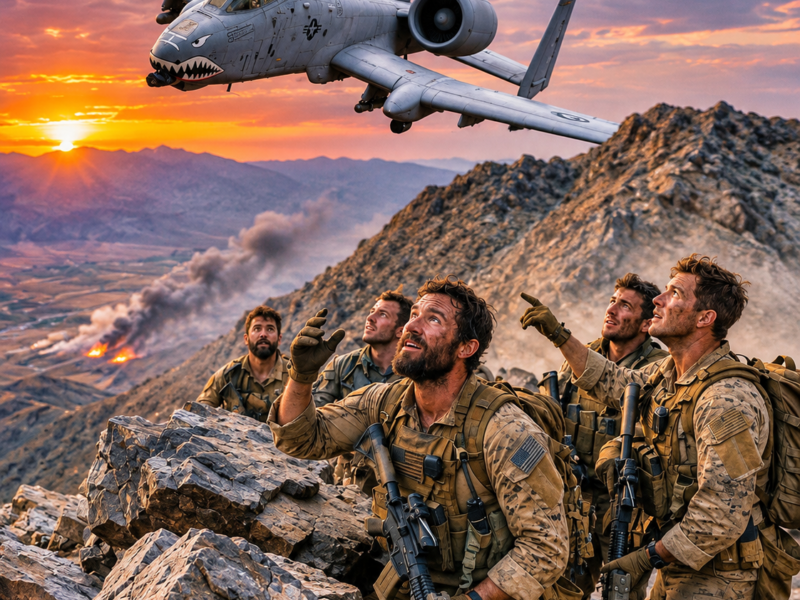
The A-10 Thunderbolt II emerged from the gray.
It appeared low over the ridge, its broad wings cutting through the cloud like something that had no business being there. The aircraft looked almost too large for the narrow valley, and yet it moved with a confidence that made the impossible seem ordinary.
For the first time that morning, I saw the insurgents hesitate.
They had been advancing for nearly an hour. They had surrounded our position, pushed us back behind broken rocks, and used the weather to keep us isolated.
Now they were looking up.
The aircraft passed over the ridge, and its engines swallowed every other sound.
I pressed myself against the ground as the first strike hit the enemy positions.
The mountain shuddered.
Dust and fragments rose into the air. The insurgents scattered, their organized advance breaking apart as they scrambled for cover.
I couldn’t see exactly what was happening beyond the smoke and the shifting clouds, but I could see the effect.
The pressure on our position eased.
“Reaper, Ghost Six,” I called into the radio. “We have visual. Your strikes are effective. Enemy assault is breaking.”
“Copy, Ghost Six. Stay under cover. I’m coming around.”
The A-10 disappeared behind the ridge.
For several seconds, there was only wind and the distant sound of fighting.
Then the aircraft returned.
The second pass sent the remaining attackers scrambling away from the exposed ground. Their mortar fire stopped, and the steady stream of incoming rounds that had kept us pinned down finally ended.
Kimbell stared into the sky.
“She’s actually doing it,” he said.
I looked at Ray.
His face was pale beneath the dirt. His eyes were half-open, and his breathing had become shallow. He was still conscious, but I could tell he was running out of strength.
“Stay with me, Danny,” I said.
He gave me the smallest nod.
“Is the plane still there?”
“She’s still here.”
“Good.”
He closed his eyes again.
I leaned closer.
“Don’t you dare go to sleep on me.”
“Wasn’t planning on it, Chief.”
His voice was weak, but it was still his.
I turned back toward the ridge.
The A-10 was circling somewhere beyond the clouds, fighting the same weather that had turned two helicopter crews away. Every pass meant another risk. Every minute she stayed meant less fuel and fewer options for getting home.
I knew that.
I also knew we were not safe yet.
A few minutes later, Kimbell caught movement through the smoke.
“Chief. Southeast.”
I raised my binoculars.
The insurgents had not disappeared. A group of them was gathering farther down the slope, trying to organize again. They were smaller in number now, but they still had enough men to threaten our position.
I counted as best I could.
About fifteen.
They were moving carefully, using the broken terrain to hide their approach.
“Reaper, Ghost Six,” I said. “We have approximately fifteen enemy fighters regrouping to the southeast. They’re trying to come back.”
Her response came through a burst of static.
“Copy. I see movement.”
I glanced at the clouds.
They were closing.
The narrow opening Mara had used to reach us was already beginning to disappear. The mountain had become a wall of gray again, and the wind was growing stronger.
“Reaper, what’s your fuel state?” I asked.
There was a pause.
“Ghost Six, I have fuel for one more pass. After that, I need to leave.”
One more.
That was all she had.
I looked at the men around me. Kimbell was nearly out of ammunition. Ray could barely move. The others were exhausted, bruised, and trying to stay alert.
If the enemy regrouped, we would have no way to stop them.
“Understood,” I replied.
I hesitated before continuing.
“One final pass. Danger close.”
The words felt heavier than they should have.
I knew what I was asking. I knew there was almost no margin for error in the weather, and that our position was dangerously close to the enemy.
But I also knew what would happen if those men reached us.
“Copy, Ghost Six,” Mara replied. Her voice remained calm. “One final pass. Keep your people covered.”
I lowered the radio.
“Everybody down,” I ordered. “Stay behind the rocks. Nobody moves until I say.”
Kimbell looked at me.
“Chief, she’s coming back?”
“She’s coming back.”
The A-10 appeared again through the cloud.
This time, I could see the strain of the weather in the way it moved. The aircraft seemed to fight the wind as it crossed the valley, but it held its course.
The insurgents looked up.
Some began to run.
Then the final strike came.
The sound rolled through the mountains, followed by a burst of dust and smoke across the enemy’s position. Their attempt to regroup collapsed. The remaining fighters scattered into the broken terrain, abandoning the advance.
I watched for movement.
Nothing came toward us.
The radio crackled.
“Ghost Six, Reaper. That’s my last pass. Confirm your status.”
I pressed the transmit button.
“Reaper, Ghost Six. Enemy contact has ceased. Repeat, enemy contact has ceased. All four survivors are alive. One urgent casualty requires immediate evacuation.”
“Copy all. Medevac is being coordinated. Estimated arrival approximately twenty minutes, weather permitting.”
Twenty minutes.
I looked down at Ray.
He had gone quiet again.
“Danny,” I said, touching his shoulder. “Help is coming.”
His eyes opened slowly.
“Real help?”
I almost laughed.
“Real help.”
He gave me a faint smile.
“Good. I’m getting tired of this place.”
I looked toward the sky.
The A-10 was already turning away.
“Reaper, Ghost Six,” I called. “You got us out of here.”
Her answer came after a moment.
“Negative, Ghost Six. You held long enough for me to get there. That’s what saved you.”
Then the radio went quiet.
I watched the aircraft disappear into the clouds.
For a few seconds, I could still hear its engines.
Then even that sound was gone.
I sat back against the rock and realized my hands were shaking.
The ridge was still dangerous. We still had a wounded man to evacuate, and the weather could turn against us at any moment.
But we were alive.
All four of us.
And for the first time since the ambush began, I believed we might actually make it home.
The next twenty minutes felt longer than the entire firefight.
We checked the perimeter, counted our remaining supplies, and kept Ray as comfortable as we could. Kimbell stayed beside him while I tried to raise Overwatch again.
The response was brief.
A helicopter crew was preparing to launch as soon as the weather allowed. They had received our location and understood the urgency.
I looked at the clouds.
The opening in the eastern wall had disappeared completely.
The same weather that had nearly killed us was now deciding whether we would get out.
“Chief,” Kimbell said.
I turned.
Ray was looking at me.
“Can I ask you something?”
“Depends what it is.”
“When we get back, can you tell medical I want the good painkillers?”
“You can tell them yourself.”
“Right.”
He swallowed and looked toward the ridge.
“Do you think the pilot made it out?”
I understood what he meant.
The A-10 had gone back into the same clouds that had nearly swallowed it on the way in. She had been low on fuel, and the opening was closing.
“She knows her aircraft,” I said.
It was the only answer I had.
A little later, the radio came alive.
“Ghost Six, Overwatch. Medevac is moving. Weather window has opened along the southern approach. Stand by.”
Kimbell let out a breath.
I looked at Ray.
“That’s your ride.”
He nodded, but I could see the effort it took.
The helicopter appeared several minutes later, emerging beneath the clouds with its rotors beating against the cold mountain air.
It landed on a relatively clear patch of ground about two hundred meters from our position.
The crew chief jumped out and waved us forward.
Kimbell and I got under Ray’s arms.
He tried to stand, but his injured leg buckled immediately.
“Easy,” I told him. “We’ve got you.”
“I can walk.”
“No, you can’t.”
“I could if you stopped carrying me.”
“Then I guess you’ll have to forgive me.”
We moved slowly across the ground.
Every step seemed to take more strength than the last. Ray’s face tightened with pain, but he didn’t complain again.
The crew chief met us halfway and helped guide him into the helicopter.
Once Ray was secured, Kimbell climbed aboard.
I turned toward the ridge for one last look.
The smoke was thinning. The enemy had withdrawn, and the mountain was quiet again.
It was difficult to believe that less than an hour earlier, the same ground had been covered with incoming fire.
I climbed into the helicopter.
As the aircraft lifted, I looked down at the rocks where we had spent the morning.
Four men had gone into that position.
Four men were leaving it.
That was all that mattered.
Ray shifted on the stretcher.
“Chief?”
“Yeah?”
“When we get back, I owe somebody a beer.”
I glanced at him.
“Somebody?”
He managed a tired smile.
“Reaper.”
Kimbell laughed.
“Make it two. She earned them.”
I looked out through the open side of the helicopter.
The clouds were beginning to close behind us.
“Make sure you get the chance to buy them,” I said.
Ray nodded.
“I plan on it.”
The flight back was quiet.
Nobody celebrated. Nobody tried to turn what had happened into a story while we were still in the air.
We were too tired.
We were alive, and for that moment, it was enough.
I didn’t see Mara Delgado land that afternoon.
I learned later what had happened after she left our valley.
She had followed the same narrow opening along the eastern wall, climbing through rough air while the clouds pressed closer around her.
The passage was narrower than it had been on the way in.
Her fuel was low enough that every extra minute mattered.
But she kept the aircraft steady and made it through.
When she finally reached clearer air, she reported her fuel state and requested permission to recover at base.
The landing was uneventful.
At least, that was how she described it afterward.
Colonel Ashworth was waiting near the runway.
He had been watching the weather reports and listening to the updates from our rescue operation. By the time Mara shut down the aircraft, he knew the mission had succeeded.
He also knew how close it had come to ending very differently.
He walked toward her as she climbed down from the cockpit.
“All four?” he asked.
“All four made it out,” Mara replied.
“Casualty?”
“Alive. Medevac got him.”
Ashworth nodded.
“The medical team says he’ll need surgery, but they expect him to keep his leg.”
For the first time that day, Mara looked relieved.
Ashworth studied her for a moment.
“You had no business flying into that weather.”
“I know, sir.”
“Two Apache crews turned back.”
“I know.”
“Fixed-wing support was grounded.”
“I know that too.”
He paused.
“Do you understand what could have happened?”
Mara looked back at the A-10.
“Yes, sir.”
Ashworth’s expression softened slightly.
“Then tell me why you did it.”
She was quiet for a moment.
“Because four men were still up there.”
“That isn’t an answer.”
“It was the only one I had.”
Ashworth looked at her for a long time.
Then he nodded.
“Get some rest, Captain.”
“Yes, sir.”
He started to walk away, then stopped.
“And Delgado?”
She turned.
“Bring the aircraft home next time too.”
Mara gave him a tired smile.
“That was the plan, sir.”
Three days later, Kimbell and I were sitting in a hospital waiting room.
Ray was in surgery for a follow-up procedure. The doctors had told us the damage was serious, but they were optimistic about his recovery.
He had lost a lot of blood on the mountain. The next few weeks would be difficult, and his rehabilitation would take time.
But he was alive.
That was the only report I cared about.
Kimbell sat across from me, holding a paper cup of coffee.
Neither of us had said much since arriving.
Finally, he broke the silence.
“You ever hear anything about the pilot?”
“Her name is Mara Delgado. Call sign Reaper.”
“I know that much.”
“She’s back at her squadron.”
Kimbell stared into his coffee.
“I keep thinking about that sound.”
I knew exactly what he meant.
The A-10 coming over the ridge.
That deep, unmistakable roar cutting through the clouds.
We had spent the morning believing nobody could reach us. We had watched the weather close around the mountains and listened as every possible rescue option disappeared.
Then, somehow, one aircraft had come through.
“I thought it was another mortar round at first,” Kimbell said.
“I did too.”
He looked up.
“Then I saw the wings.”
I nodded.
For a while, neither of us spoke.
The hospital doors opened, and a doctor stepped into the waiting room.
He looked at us and gave a small nod.
“Your friend is out of surgery. Everything went as expected.”
Kimbell stood immediately.
“How is his leg?”
“We’re optimistic. He’ll need rehabilitation, but the procedure went well.”
I closed my eyes for a second.
Then I stood.
“Can we see him?”
“Briefly. He’s still recovering.”
We followed the doctor down the hallway.
Ray was awake when we entered, though he looked exhausted. His leg was elevated, and a monitor beside the bed tracked his heartbeat.
He turned his head toward us.
“Look at that,” he said weakly. “The whole gang.”
Kimbell pulled a chair closer.
“You gave us a scare.”
“Didn’t mean to.”
“You’re going to owe us for that.”
Ray smiled.
“Put it on my tab.”
I stood beside the bed.
“How are you feeling?”
“Like somebody tried to remove my leg.”
“Somebody did try.”
“Did they succeed?”
“No.”
He looked relieved.
“Good.”
We stayed with him for a while.
Before we left, he asked again about Mara.
“Did anybody get her contact information?”
I shook my head.
“Not yet.”
“Find it.”
“Why?”
He looked at me as though the answer should have been obvious.
“I owe her a beer.”
Kimbell leaned back in his chair.
“Two beers.”
Ray considered that.
“Fine. Two.”
Two weeks later, the squadron arranged a small gathering so we could meet the pilot who had flown into the mountains.
It wasn’t a formal ceremony.
There were no speeches, no cameras, and no large crowd. Just a few people in a quiet room at the base, a table with coffee, and four men who had been given a second chance.
Ray arrived in a wheelchair.
His injured leg was still elevated, and he moved slowly, but he was in good spirits.
Kimbell pushed him through the doorway.
I was standing near the table when Mara entered.
She was smaller than I had imagined.
There was nothing dramatic about her appearance. She wore her uniform, carried herself with quiet confidence, and looked like someone who had spent too many hours awake.
She glanced at us and smiled.
“Ghost Six?”
I stepped forward.
“Captain Delgado.”
“Master Chief Whitfield.”
We shook hands.
For a moment, neither of us seemed to know what to say.
Then I looked her in the eye.
“You brought us home.”
She shook her head.
“You kept your team together until help arrived.”
“We were running out of time.”
“I know.”
She looked toward Ray.
“How’s the leg?”
Ray raised a hand.
“Still attached.”
Mara laughed.
“That’s good news.”
“Doctor says I’m going to keep it.”
“Even better.”
Ray leaned forward slightly.
“Captain, I believe I owe you a beer.”
Mara looked at him.
“I’ve heard about that.”
“Two beers, actually.”
She smiled.
“I think we can arrange that.”
Kimbell stepped forward.
“I was there too. I saw the whole thing.”
“Then you get one as well,” Ray said.
“That wasn’t the agreement.”
“You want to negotiate with a wounded man?”
Mara laughed again.
It was the first time I had seen her laugh.
The tension that had followed us from the mountain seemed to loosen.
We talked for nearly an hour.
We asked her about the flight, about the weather, and about what it had been like to approach the valley when the mountains were hidden.
She didn’t make the mission sound heroic.
She described the turbulence, the limited visibility, and the uncertainty of finding the opening she had studied on the map.
She explained that she had spent weeks looking at the valley before the original mission was postponed.
The terrain had stayed in her mind.
When the call came, she remembered the eastern wall and the narrow break in the clouds.
“I knew there might be a way through,” she said.
“You weren’t certain,” I replied.
“No.”
“Then why take the chance?”
She looked down at her coffee.
“Because you were still there.”
Nobody spoke for a moment.
Ray broke the silence.
“Well, I’m glad you did.”
Mara smiled at him.
“I’m glad you’re recovering.”
Before we left, I asked her one more question.
“Were you afraid?”
She didn’t answer immediately.
Then she nodded.
“Of course.”
I had expected her to deny it.
Instead, she continued.
“Anyone who tells you they aren’t afraid in that kind of weather is either lying or not paying attention.”
“Then what made you go?”
She looked at the four of us.
“I knew what would happen if nobody went.”
There was no grand speech after that.
No attempt to make the decision sound easier than it had been.
She had understood the risk, accepted it, and flown anyway.
That was enough.
Ray kept his promise.
When he was finally cleared to leave the hospital, he arranged to meet Mara and Kimbell for a quiet dinner.
His leg was still healing, and he walked with a cane, but he insisted on paying.
He raised his glass when the drinks arrived.
“To Reaper,” he said.
Mara lifted hers.
“To the four men who held on.”
Kimbell added, “And to the A-10 that found us.”
We drank.
I watched Mara for a moment.
She looked uncomfortable with the attention, so I changed the subject.
We talked about ordinary things after that.
The food, the weather, the ridiculous stories people tell when they have been away from home too long.
For a few hours, we were not a rescue mission or a combat report.
We were simply people sharing a table.
Later, when I returned to my unit, younger operators sometimes asked me about that day.
They wanted to know what it was like to be surrounded on a mountain, with the weather closing in and no clear way out.
They asked about the fighting.
They asked how long we had held.
And eventually, they always asked about the aircraft.
I told them about the clouds.
I told them about the radio call that said no aircraft could reach us.
I told them about the eleven minutes we spent waiting, and the sound that came out of the gray when we had almost stopped believing help would arrive.
I told them about Captain Mara Delgado, call sign Reaper.
But I never described her as fearless.
That would have been wrong.
She had been afraid. She had understood the danger. She had known there was a chance she might not make it back.
What mattered was that she went anyway.
I also told them about Ray.
About the way he kept talking when he was losing strength.
About Kimbell refusing to leave his side.
About the four of us climbing into that helicopter when the mountain finally gave us a chance.
Because the pilot was only one part of the story.
We had held on.
She had come through.
And a helicopter crew had carried us the rest of the way home.
Years from now, people might remember the mission differently.
They might remember the weather, the aircraft, or the moment the A-10 appeared over the ridge.
They might turn it into a story about a pilot who flew where nobody else would.
But when I think about that morning, I remember something simpler.
I remember four men on a mountain.
I remember the radio going quiet.
I remember the clouds swallowing every possible route out.
And I remember hearing a voice say, “I have your smoke. I am inbound.”
For eleven minutes, we had believed we were alone.
We were wrong.
Somewhere beyond those mountains, a pilot had looked at the same impossible weather everyone else had seen.
She had looked at the map, remembered the narrow opening, and made a choice.
She never called it courage.
She never called it a miracle.
When someone asked her later why she had gone, she gave the same answer every time.
“There were four men up there.”
And to her, that was reason enough.
The end.









