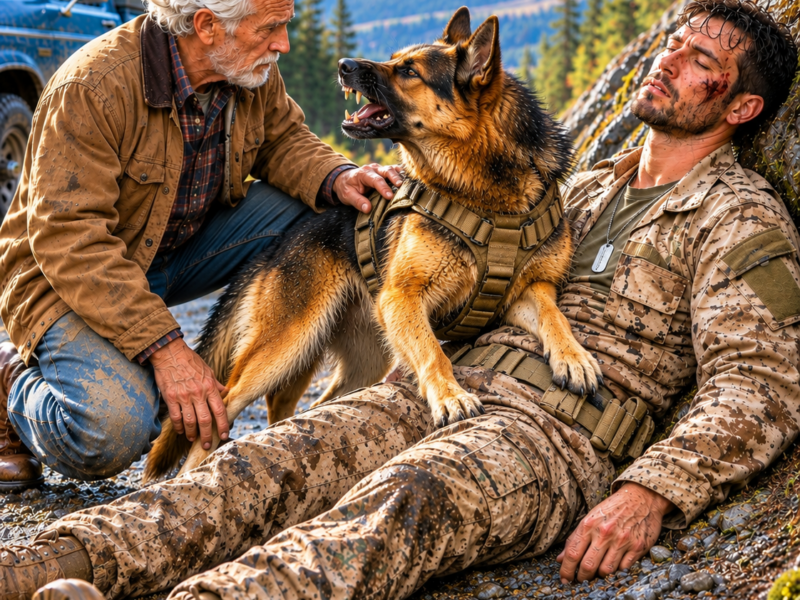
“After dozens of drivers passed a helpless Marine lying unconscious in the mud along a remote Montana road
The headlights remained fixed at the end of my driveway.
I stood beside the kitchen window, one hand resting against the cold glass, watching the beams cut through the darkness.
Behind me, Nathan sat at the table with Ranger pressed against his leg.
The name he had written on the scrap of paper lay between us.
Colonel Richard Voss.
I had never heard of the man, but the way Nathan looked at those two words told me everything I needed to know.
“Is he the one who did this to you?” I asked.
Nathan rubbed his thumb across the edge of the paper.
“I don’t know if he ordered it,” he said quietly. “But he was the last person I trusted before everything fell apart.”
Outside, the engine continued idling.
Ranger lifted his head.
A low growl moved through his chest.
“Stay here,” I told Nathan.
He started to rise.
“Mr. Walter, don’t.”
I looked back at him.
“Son, I’m seventy-eight years old. My knees complain every time I climb the porch steps, and I haven’t won an argument with a jar lid in years. But I still know how to answer my own front door.”
Despite everything, the corner of Nathan’s mouth moved.
It was the smallest smile I had seen from him.
I reached for the old flashlight hanging beside the back door and stepped onto the porch.
The night air smelled of wet pine and cold earth.
The vehicle was a dark SUV, parked just beyond the reach of my porch light.
Its windows were tinted.
I couldn’t see the driver.
“Can I help you?” I called.
For several seconds, nothing happened.
Then the driver’s window lowered halfway.
A man’s voice came through the darkness.
“Evening. We’re looking for someone.”
“Then you’ve come to the wrong driveway. Nobody here is missing.”
The man paused.
“We have reason to believe a former Marine may have come through this area.”
I kept the flashlight pointed toward the ground.
“There’s a clinic in town. If somebody needs medical help, that’s where I’d start.”
“We aren’t looking for medical help.”
“Then I suppose I can’t help you.”
The window rose.
The SUV remained still for another moment before the engine grew louder.
It backed onto the road and disappeared between the trees.
I didn’t move until the sound was gone.
When I returned inside, Nathan was standing near the table.
Ranger was beside him, ears forward.
“Did they say anything?” Nathan asked.
“Only that they were looking for a former Marine.”
Nathan lowered his eyes.
“They found me.”
“Maybe. Maybe they were looking for someone else.”
He shook his head.
“They don’t come this far into Montana by accident.”
I picked up the scrap of paper.
“Then we’d better find out why they’re looking for you before they decide to come back.”
Nathan looked toward the window.
For the first time since I had brought him into my home, I saw something in his expression that frightened me more than anger.
It was shame.
“They’ll hurt you because of me.”
I placed the paper back on the table.
“Listen carefully, Nathan. You didn’t bring trouble into my house. You brought yourself and that dog in from a road where both of you might have died. There’s a difference.”
He looked at me for a long moment.
Then he sat down.
And for the first time, he began telling me what had happened.
It started six months earlier at a military logistics facility in Virginia.
Nathan had spent twenty-two years in the Marine Corps, much of that time overseeing equipment inspections and supply operations.
His unit had been assigned to verify a shipment of protective equipment intended for Marines preparing for deployment.
The paperwork looked ordinary.
The delivery schedules were correct.
The manufacturer certificates carried the proper signatures.
But during a routine inspection, Nathan noticed something wrong.
Several protective plates were lighter than the approved specifications.
At first, he assumed it was a manufacturing variation.
Then he tested another batch.
The same problem appeared.
He requested independent testing and discovered that the plates did not meet the required ballistic standards.
They looked almost identical to the approved equipment, but they offered significantly less protection.
A soldier wearing one of those plates could believe he was protected when he wasn’t.
Nathan immediately suspended the shipment.
Two days later, a senior officer called him into a private office.
Colonel Richard Voss.
According to Nathan, Voss had been a mentor during the early years of his career.
He had recommended Nathan for promotions, defended his decisions, and once helped him through a difficult period after a deployment.
Nathan believed he could speak honestly with him.
“I told him the plates were defective,” Nathan said. “I showed him the test results and asked him to help me stop the shipment.”
“What did he say?”
“He told me to be careful about accusing people without understanding the entire procurement process.”
Nathan paused.
“Then he asked me to sign a revised inspection report.”
The revised report stated that the equipment had passed.
Nathan refused.
Within days, his access credentials were suspended.
His original inspection records disappeared from the shared system.
The laboratory results were suddenly classified as incomplete.
And the company responsible for the shipment submitted a new certification claiming the earlier test had been performed incorrectly.
Nathan appealed through the proper channels.
He sent copies of his findings to an internal review office.
He also kept a handwritten record of dates, shipment numbers, and conversations because he no longer trusted the electronic system.
Then came the night everything changed.
He had been ordered to report to a temporary administrative facility outside the main base.
The message came through an official channel and carried the appearance of a routine interview.
Nathan arrived shortly after sunset.
Instead of the expected review officer, two men were waiting.
They told him there had been a security concern involving classified material.
They asked him to surrender his phone and identification.
He refused to hand over his personal notebook.
One of the men reached for it.
Nathan pulled away.
A struggle followed.
He was struck from behind and woke later in the back of a vehicle with his hands restrained.
He could not identify the men.
He remembered fragments of conversation, a sharp smell of fuel, and the sound of rain against metal.
When the vehicle stopped, he managed to escape through an unsecured rear door.
Ranger had been transported separately in a kennel vehicle.
Nathan found him near a service road several hours later.
The dog was frightened but unharmed.
Together, they disappeared into the forest.
Nathan had spent the next several days avoiding roads, towns, and anyone who might recognize his uniform.
He had no phone, no money, and no way to know whether the people searching for him were military investigators or the men who had taken him.
Eventually, hunger and exhaustion brought him to the road where I found him.
When Nathan finished, the kitchen had grown quiet.
The refrigerator hummed softly.
A clock ticked above the doorway.
I looked down at his hands.
They were clasped so tightly that his knuckles had turned pale.
“Why didn’t you go to the police?” I asked.
“I didn’t know who I could trust.”
“Not even the sheriff?”
Nathan shook his head.
“Someone had already filed an unauthorized absence report. They were telling people I had abandoned my post with sensitive information.”
I remembered the short announcement I had heard on the radio a few days earlier.
A missing serviceman.
A possible security matter.
The announcer had moved on to the weather before I had finished my coffee.
I hadn’t thought much about it.
Now I understood why the details had sounded strangely incomplete.
“Do you have proof?” I asked.
Nathan looked toward the backpack beside his chair.
“Some.”
He opened it carefully.
Inside were a few folded documents, a small notebook, and a plastic sleeve containing a damaged memory card.
He placed them on the table.
“I kept the original shipment numbers and the laboratory results. I also copied a few messages before my access was removed.”
“Is that enough?”
“Maybe not by itself.”
He touched the memory card.
“But there is something on here I haven’t been able to verify.”
“What?”
“A recording.”
He explained that, shortly before his disappearance, he had activated the recording function on his phone during a meeting with a procurement representative.
He had not intended to record a criminal confession.
He had simply wanted an accurate account of what was said after the representative insisted that the equipment had already been approved.
The recording captured a conversation between two men.
One of them mentioned the shipment.
The other used a phrase Nathan remembered clearly.
“Voss has already taken care of the inspection.”
Nathan had not recognized the second man’s voice.
But he believed the recording could establish that someone had interfered with the inspection process.
“Why haven’t you given it to anyone?” I asked.
“Because I don’t know if it’s complete. The card was damaged when we crossed the river.”
He looked at me.
“And if I hand it to the wrong person, they’ll know exactly what evidence I still have.”
I leaned back in my chair.
I was not a detective.
I was not a soldier.
I was an old carpenter who knew how to measure a board and recognize when a man was carrying more pain than he could manage.
But I knew one thing.
A person who had spent twenty-two years serving his country deserved more than a rumor written in a file.
“We’ll find someone who can examine it properly,” I said.
Nathan looked unconvinced.
“Who?”
I thought about the sheriff.
I thought about the clinic.
Then I remembered a woman who had moved to Red Willow three years earlier.
Her name was Helen Mercer.
She had worked as a physician in a larger town before returning to Montana to care for her aging mother.
She was careful, practical, and not easily intimidated.
More importantly, she knew how to listen.
“We’ll start with the person who helped keep you alive,” I said.
The following morning, I drove Nathan back to the clinic.
Ranger rode in the back seat, his head resting near Nathan’s shoulder.
Dr. Mercer examined Nathan again and was unhappy with the swelling in his feet.
She ordered another round of tests and told him he needed to stop pretending that rest was optional.
Nathan apologized twice.
She ignored both apologies.
When she finished, I asked whether she knew anyone who could help us contact an independent federal investigator.
Her expression changed.
“Is this about the equipment shipment?” she asked.
Nathan looked at her sharply.
“How do you know about that?”
Dr. Mercer closed the examination room door.
“Because someone called the clinic yesterday asking whether we had treated an unidentified man with military injuries.”
Nathan’s face tightened.
“What did you tell them?”
“That I don’t discuss patient information with strangers.”
She studied him.
“They claimed to be conducting an official inquiry, but they couldn’t provide a case number or the name of the supervising agency.”
Nathan glanced at me.
The headlights from the previous night had not been a coincidence.
Dr. Mercer lowered her voice.
“There’s something else. They asked whether you had brought a dog.”
Ranger’s ears moved.
Nathan rested a hand on his neck.
“They know about him.”
“Yes,” she said. “And I don’t like the way they asked.”
For a moment, nobody spoke.
Then Dr. Mercer walked to her desk and took out a business card.
“Several years ago, I treated a federal investigator after an accident during an assignment. Her name is Emily Carter. She works with military criminal investigations, and she was one of the most thorough people I’ve ever met.”
She turned the card over and wrote a number on the back.
“I can’t promise she’ll be able to help. But I trust her judgment.”
Nathan stared at the number.
“How do we know she’s not connected to Voss?”
“We don’t,” Dr. Mercer answered. “That’s why you should not send her the evidence until you know who she is.”
Nathan nodded slowly.
He understood the caution.
So did I.
That afternoon, I went home and found Margaret Ellis waiting on my porch.
She was seventy-two, a widow, and one of the few people in Red Willow who could make a simple visit feel like a family gathering.
She had brought bread, stew, and a small apple pie.
“You’re looking pale,” she told me.
“I’m old. That’s the color I come in.”
She gave me a look that suggested she had heard better excuses from much more difficult men.
Then she noticed Nathan standing in the doorway.
“Well,” she said warmly, “I brought enough for three.”
Nathan thanked her.
Margaret placed the food on the table and noticed Ranger watching her carefully.
She crouched a little, keeping her hands close to her body.
“Hello there, handsome.”
Ranger sniffed the air.
Margaret did not reach for him.
She simply set a small piece of bread on the floor and stepped back.
The dog looked at Nathan.
Nathan gave a quiet nod.
Only then did Ranger approach.
Margaret smiled.
“He’s a polite one.”
“He has his reasons for being careful,” Nathan replied.
“Most of us do,” she said.
There was no pity in her voice.
That was why Nathan liked her.
After supper, Margaret left us with the dishes and a promise to return the next day.
I noticed Nathan watching her truck disappear down the road.
“She reminds me of someone,” he said.
“Who?”
“My mother.”
He looked down at the table.
“I haven’t spoken to her in months.”
“Why not?”
Nathan took a long breath.
“Because I told her everything was fine.”
He explained that his mother lived in Ohio.
She was getting older, and he had always tried to protect her from the difficult parts of his work.
When he disappeared, she had been told he was under investigation.
He had no idea what she believed.
I didn’t tell him what to do.
I only placed the telephone beside his hand.
He stared at it for a while.
Then he dialed.
The call went to voicemail.
Nathan closed his eyes.
“Mom, it’s me. I’m alive. I’m safe for now. I can’t explain everything yet, but I wanted you to hear my voice.”
He paused.
“I should have called sooner.”
His voice broke slightly.
“I love you.”
When he ended the call, he kept the phone in his hand.
Ranger placed his head on Nathan’s knee.
I turned toward the sink and pretended to be busy.
Some moments are best left without an audience.
Two days passed.
Nathan’s strength began returning, but the uncertainty around him grew heavier.
The dark SUV did not return.
That did not make us feel safer.
It made us wonder what the men inside it were doing instead.
On the third morning, I found an envelope pushed beneath my workshop door.
There was no stamp.
No return address.
Only my name written in black ink.
Inside was a single photograph.
It showed Nathan standing beside a military transport vehicle, wearing his uniform.
On the back, someone had written:
“An old man should not get involved in matters he cannot understand.”
I carried the photograph into the house.
Nathan read the message without speaking.
His face had gone pale.
“I’m sorry,” he said.
I placed the photograph on the table.
“You keep apologizing for things other people are doing.”
“They know where you live.”
“Yes. They have eyes. That doesn’t make them right.”
Nathan stood and began pacing.
“I should leave.”
“Where would you go?”
“Anywhere away from here.”
“And take Ranger into the forest again? With your feet still healing?”
He stopped.
“I can’t let them hurt you.”
I looked at him.
“Then help me make sure they don’t.”
That afternoon, Nathan agreed to contact Emily Carter.
He did not send the evidence.
He sent only a short message asking whether she was investigating his disappearance and whether she could verify her identity through an official channel.
The response came the following morning.
It contained a case number, a secure contact procedure, and a request for a live conversation.
Nathan checked the details twice.
Then he called.
The woman who answered had a calm, measured voice.
“Master Gunnery Sergeant Cole?”
“Yes.”
“My name is Special Agent Emily Carter. I’ve been trying to locate you for several months.”
Nathan looked at me.
“How do I know you’re really Emily Carter?”
She did not sound offended.
She gave him the name of the office handling the inquiry, the case number, and the name of the official who had authorized her assignment.
Nathan checked each detail against the information he had received.
Only after that did he speak.
“Are you investigating my disappearance?”
“I’m investigating the circumstances surrounding your disappearance, the missing inspection records, and the unauthorized changes made to your personnel file.”
Nathan closed his eyes.
“What about Colonel Voss?”
There was a pause.
“We have questions about his role. But I don’t want you to make accusations without evidence.”
Nathan looked down at the notebook.
“That’s what I was trying to do from the beginning.”
“I know,” Emily said. “And I want to hear your account in person.”
They arranged a meeting for the following afternoon at the clinic.
Emily would arrive with identification and an independent witness.
She also agreed that Nathan would not be asked to surrender his original notebook or memory card until he understood how the evidence would be handled.
For the first time in weeks, Nathan seemed to breathe more easily.
But the relief did not last.
That evening, Margaret called.
Her voice was unusually tense.
“Walter, there’s a man sitting outside my house.”
I stood up.
“Are you all right?”
“I think so. He came by earlier asking whether the young man staying with you had been at my place.”
I glanced at Nathan.
“Did you tell him anything?”
“No. I told him I had no idea what he was talking about.”
“Lock your doors, Margaret. I’m coming over.”
Nathan reached for his jacket.
“I’m coming too.”
I started to object, but he was already standing.
Ranger followed him.
We drove to Margaret’s house together.
The man was gone when we arrived.
Margaret was waiting behind the locked screen door.
She looked frightened, though she tried to hide it.
Nathan checked the yard and the road.
There were fresh tire tracks near the mailbox.
He crouched to examine them.
Then he noticed something caught beneath the edge of the porch.
A small black device.
He picked it up with a handkerchief.
It was a tracking tag.
Margaret stared at it.
“What is that?”
Nathan examined the casing.
“Something someone placed here to follow a vehicle or a person.”
He looked toward my pickup.
“They may have put one on your truck too.”
We returned home and found another device attached beneath the rear bumper.
Nathan removed it.
Neither of us spoke for a while.
Then he looked at me.
“They’re trying to find out where I go.”
“Well, now they know where I live.”
He shook his head.
“They want to know who helps me.”
That night, I moved the important documents from the house to the workshop.
I placed them inside an old metal toolbox beneath a loose floorboard.
Nathan insisted that I take a photograph of every page before storing it.
He also made copies of his handwritten notes.
We were careful.
Not because we knew how to investigate a conspiracy, but because we had finally understood that someone was watching our movements.
The next afternoon, Emily Carter arrived at the clinic.
She stepped out of a government SUV carrying a leather document case.
She was in her early forties, with short chestnut hair and thoughtful hazel eyes.
Her manner was composed, but she did not mistake politeness for trust.
She showed Nathan her credentials.
Then she asked to speak with him privately.
I remained in the waiting room with Ranger.
Through the closed door, I heard voices but could not make out the words.
After nearly an hour, Emily came out.
She looked serious.
“Mr. Walter, may I speak with you?”
I followed her into the examination room.
Nathan was sitting beside the desk.
Emily placed several documents on the table.
“Some of what Nathan has told me is consistent with evidence we’ve already collected,” she said. “The inspection records were altered after he filed his report. Several access logs were deleted. And a witness who worked for the equipment supplier has confirmed that pressure was placed on the testing team.”
“Does that mean Nathan was telling the truth?”
“It means his account deserves a full investigation.”
She turned toward him.
“We also recovered a copy of a message sent from Colonel Voss’s office shortly before your disappearance.”
Nathan leaned forward.
“What did it say?”
Emily opened the folder.
“It instructed personnel to transfer the inspection file to a restricted archive and suspend your access pending a security review.”
Nathan frowned.
“That doesn’t prove he ordered anyone to take me.”
“No,” Emily said. “It doesn’t.”
She turned another page.
“But the timing is significant.”
Nathan looked at the document.
For a long moment, he said nothing.
Then he asked the question that had been troubling him since the night he escaped.
“Was I officially listed as absent without authorization before or after the security review?”
Emily met his eyes.
“Before the review was completed.”
Nathan slowly sat back.
“So they decided I had deserted before they finished investigating what happened.”
“Yes.”
The answer seemed to take something out of him.
He had spent months believing that the truth would eventually be enough.
Now he was learning how easily a lie could become official when the people responsible controlled the paperwork.
Emily continued.
“We need the original evidence you retained. Especially the recording.”
Nathan reached into his bag.
He placed the damaged memory card on the table.
Emily did not touch it immediately.
“Is this the only copy?”
“Yes.”
“Then we’ll make a verified forensic copy before anyone attempts to repair it.”
She looked at Nathan.
“And I need you to understand something. This investigation may take time. There may be people who will try to discredit you. There may be questions about your decisions, your movements, and why you did not report sooner.”
Nathan nodded.
“I’ve been expecting that.”
Emily’s expression softened slightly.
“Being questioned doesn’t mean you’re being accused. It means we’re trying to establish what happened.”
For the first time, Nathan seemed to understand that someone was asking him for facts rather than demanding a confession.
He handed over the card.
Emily documented the transfer and gave him a receipt.
Then she asked about the name he had written on the scrap of paper.
“Colonel Richard Voss,” Nathan said.
Emily nodded.
“We’ve already spoken to him.”
Nathan’s jaw tightened.
“What did he say?”
“He denied knowing anything about your disappearance. He also claimed you had become increasingly unstable after the inspection dispute.”
Nathan looked down.
Emily continued carefully.
“He says you were obsessed with the equipment shipment and refused to accept that the laboratory results were inconclusive.”
Nathan gave a short, humorless laugh.
“Of course he does.”
“There’s one more thing,” Emily said. “He claims you stole a confidential file before leaving the facility.”
Nathan looked up.
“I never took a confidential file.”
“Do you know what file he means?”
Nathan thought for several seconds.
Then his expression changed.
“There was a second inspection report.”
Emily leaned forward.
“What second report?”
“The independent laboratory sent two versions. The first contained the full test results. The second was a summary prepared for the procurement office.”
“Did you see both?”
“Yes. But the original disappeared from the system before I could download it.”
He paused.
“I think someone printed it.”
Emily wrote that down.
“Who had access?”
Nathan looked toward the window.
“Colonel Voss. The procurement director. And one civilian contractor.”
“Name?”
“Martin Hale.”
Emily stopped writing.
For the first time since she had arrived, her composure seemed to shift.
“Martin Hale is already part of our inquiry.”
Nathan stared at her.
“Why?”
“Because he was the representative who approved the revised certification.”
Nathan slowly shook his head.
“He was at the meeting I recorded.”
Emily closed the folder.
“Then we may finally have a way to connect the altered inspection report to the people who authorized it.”
The next few weeks were not dramatic.
They were difficult in a quieter way.
Emily arranged for the memory card to be examined by a forensic laboratory.
Nathan gave a formal statement.
He answered questions about dates, procedures, and the men who had handled the shipment.
Some questions were repeated.
Some were uncomfortable.
He did not always remember every detail.
When he couldn’t remember, he said so.
That seemed to matter to Emily more than any perfect speech could have.
The laboratory recovered part of the recording.
It was damaged, but several sections were clear.
One voice belonged to Martin Hale.
The other could not be identified immediately.
The recovered audio did not contain a direct order to falsify the inspection.
But it included a discussion about replacing the original results with a summary that would allow the shipment to proceed.
Hale referred to someone who had already approved the change.
The name was partly obscured by static.
Nathan listened to the recovered section in Emily’s office.
When it ended, he sat very still.
“That’s his voice,” he said.
“Whose?”
“Martin Hale.”
Emily nodded.
“And the other speaker?”
Nathan closed his eyes.
“I think it’s Voss. But I can’t swear to it.”
Emily made a note.
“Then we won’t claim that you can.”
She paused.
“There’s another development. The original laboratory technician has agreed to testify.”
Nathan looked up.
“Why now?”
“Because he received a subpoena. And because he kept a personal copy of the test results.”
The technician’s copy showed that the plates had failed the required standard.
It also showed that the results had been changed after the original report was submitted.
The shipment had been approved despite the failed tests.
Investigators began tracing the payments connected to the supplier.
They found consulting contracts that had no clear business purpose.
They found invoices for services never performed.
And they found messages showing that Hale had coordinated with a procurement manager to keep the defective equipment moving through the approval process.
The evidence against Voss was more complicated.
He had not signed the altered laboratory report.
He had not personally approved the supplier’s payments.
But messages showed that he had been informed of the failed tests and had directed staff to treat the matter as an administrative issue rather than a safety concern.
That distinction mattered.
It did not make him innocent.
But it meant the investigators had to prove what he knew, when he knew it, and what he had done with that knowledge.
Nathan struggled with that part.
One evening, I found him sitting alone in the workshop.
The old notebook was open in front of him.
He had written the same sentence several times.
“I trusted him.”
I sat on the stool opposite him.
“That must be hard.”
Nathan nodded.
“I keep thinking about the times he helped me. The recommendations. The conversations. The things he said about protecting the men under our command.”
He rubbed his face.
“Was any of it real?”
I looked around the workshop.
A half-finished chair stood beside the workbench.
One of its legs was slightly uneven.
I had been meaning to fix it for three days.
“Do you remember the first chair you tried to build?”
Nathan glanced at it.
“The one I ruined?”
“You didn’t ruin it. You cut one leg too short.”
He gave a faint smile.
“I remember.”
“At first, you wanted to throw the whole thing away.”
“I did.”
“But we fixed it.”
Nathan looked at the chair.
“That doesn’t mean the wood was never damaged.”
“No,” I said. “It means the damage doesn’t get to decide what the whole thing becomes.”
He lowered his eyes.
For a while, we listened to the wind moving through the trees outside.
Then he closed the notebook.
“I don’t know if I can forgive Voss.”
“You don’t have to decide that tonight.”
“I don’t know if I even want to.”
“Then don’t.”
Nathan looked at me.
I shrugged.
“Forgiveness isn’t a bill someone else gets to hand you.”
He sat quietly with that.
The following morning, he received a call from his mother.
She had heard from the investigators that he was alive.
She wanted to speak to him.
This time, Nathan answered.
The conversation lasted nearly forty minutes.
I did not hear what they said.
I only saw him standing by the kitchen window, one hand resting against the wall, his eyes closed.
When he finally ended the call, he looked exhausted.
But something in his face had softened.
“She’s angry,” he said.
“That sounds reasonable.”
“She said I made her believe I was dead.”
I nodded.
“She has a right to be angry.”
Nathan swallowed.
“She also said she kept my old baseball glove.”
He smiled faintly.
“I haven’t thought about that thing in twenty years.”
“Maybe you should visit her when you’re ready.”
He looked toward Ranger.
“We will.”
The investigation reached its turning point six weeks later.
Emily arrived at my house on a gray morning.
She did not bring her usual folder.
Instead, she carried a single sheet of paper.
“We have enough to move forward,” she said.
Nathan stood in the doorway.
“What happened?”
“Martin Hale has agreed to cooperate.”
Nathan’s expression tightened.
“Why?”
“Because the financial records and the recovered recording place him in the middle of the certification scheme. He’s decided that protecting himself is more important than protecting the people above him.”
Emily explained that Hale had provided investigators with messages and meeting records showing that Colonel Voss had been informed of the failed inspection.
He had also confirmed that Voss ordered the original results removed from the procurement file.
More importantly, Hale identified the second voice on Nathan’s recording.
It was Voss.
The evidence did not stop there.
A separate investigation had traced payments from the equipment supplier to a consulting company controlled by a relative of one of the procurement managers.
The payments were disguised as legitimate fees.
The company had no employees and performed no verifiable work.
The defective plates had been approved anyway.
Nathan listened without interrupting.
Then he asked, “What happens now?”
“Federal charges are being prepared against Hale and the procurement manager. Voss is under investigation for obstruction and conspiracy. The command has also agreed to reopen your personnel case.”
Nathan looked down.
“Does that mean the desertion accusation goes away?”
“It means the evidence supporting it has collapsed. The formal correction still has to go through the review process.”
He nodded.
He seemed relieved, but not happy.
I understood why.
There was no satisfaction in discovering that a person you trusted had helped put others in danger.
There was only the knowledge that the truth had finally become difficult to hide.
Emily looked toward the workshop.
“There’s something else I’d like you to consider.”
Nathan raised his eyes.
“The military wants you to return for a formal interview and review. You will have legal representation. You won’t be required to make any public statement.”
Nathan took a long breath.
“I’ll go.”
Emily nodded.
“But not because I want my old life back,” he added. “I want the record corrected. I want the people who wore those plates to know what happened. And I want to make sure the next shipment gets tested properly.”
“That’s exactly why your testimony matters.”
After she left, Nathan walked outside.
Ranger followed him across the yard.
The dog had changed during those weeks.
His coat had grown cleaner and thicker.
He no longer startled at every passing vehicle.
Sometimes he even slept in the sun with his paws stretched out, as if he had finally decided the world could wait until he woke up.
Nathan stood beside the fence and watched him.
I joined him.
“You’ll be leaving soon,” I said.
He nodded.
“Probably.”
“Then I suppose I should finish teaching you how to build that chair.”
Nathan smiled.
“I thought I was doing all right.”
“You still sand like you’re trying to punish the wood.”
He laughed.
It was a real laugh this time.
The kind that begins in the chest instead of the throat.
We spent the next several days in the workshop.
Nathan repaired a small table Margaret had brought over.
He learned how to sharpen a chisel without taking too much metal from the edge.
He also learned that a board could be crooked without being useless.
I never told him that I was teaching him more than carpentry.
I suspected he already knew.
One afternoon, Margaret came by with a letter.
It was from Nathan’s mother.
She had written to thank me for looking after her son.
The last line was simple.
“Please tell him he still has a home waiting for him.”
Nathan read it twice.
Then he folded the letter carefully and placed it inside his notebook.
He did not say anything.
He didn’t need to.
A week later, Emily returned with the formal notice.
Nathan’s personnel record had been corrected.
The unauthorized absence designation was withdrawn.
The investigation had established that he had been taken against his will and that the original accusations were unsupported.
Hale and the procurement manager had been charged.
Voss had been relieved of his duties pending further proceedings.
The command had also issued a notice acknowledging that the equipment inspection had been compromised.
It was not a perfect ending.
There were still legal proceedings ahead.
There were still people who would have to answer questions under oath.
And there were families who would never know how close their loved ones had come to being sent into danger wearing inadequate protection.
But the official lie had finally been challenged by evidence.
Nathan read the notice at my kitchen table.
When he finished, he placed it beside his coffee.
“Twenty-two years,” he said.
I waited.
“Twenty-two years of service, and for a while, all anyone saw was one accusation.”
He rubbed the edge of the paper.
“I thought getting my name cleared would feel different.”
“How does it feel?”
He considered the question.
“Like being able to breathe without waiting for someone to tell me I don’t deserve to.”
I nodded.
“That’s a good place to start.”
A few days later, Nathan traveled to the military installation with Emily.
He wore a clean uniform that had been brought to him by the investigators.
Ranger went with him.
Before leaving, Nathan stood in the workshop doorway.
“I don’t know how to thank you,” he said.
I looked at the dog sitting beside his boots.
“You can start by bringing Ranger back before he forgets where I keep the biscuits.”
Nathan smiled.
Then his expression grew serious.
“You gave me a place to recover when I had nowhere else to go.”
I wiped my hands on my apron.
“Your dog did most of the work. He was the one who convinced me you were worth stopping for.”
Nathan glanced down at Ranger.
The shepherd leaned against his leg.
For a moment, neither man nor dog moved.
Then Nathan extended his hand.
I shook it.
“Go tell the truth,” I said.
He nodded.
The review at the installation lasted several hours.
Emily presented the evidence.
Nathan answered questions.
The altered inspection records were examined.
The recovered recording was authenticated.
The original laboratory results were entered into the official record.
Some of the people in the room avoided Nathan’s eyes.
Others looked ashamed.
A few approached him afterward and apologized for believing the original report.
Nathan accepted their words without pretending that the months of suspicion had been easy.
He did not ask anyone to admire him.
He only asked that the equipment failures be taken seriously and that the men who had been placed at risk receive proper information.
When he returned to Red Willow, it was late afternoon.
I was repairing the hinge on the workshop door.
Ranger jumped out of the vehicle before Nathan had fully opened it.
The dog ran toward me, tail moving so hard that his whole body seemed to sway.
I crouched slowly and rubbed his neck.
“Well, look who’s decided I’m worth visiting.”
Nathan laughed from the driveway.
“They said the personnel review is complete.”
I stood.
“And?”
“My record is clean. The command issued a formal acknowledgment of the wrongful accusation.”
He paused.
“They also offered to put me forward for a commendation.”
“Are you taking it?”
“I don’t know.”
We went inside.
Nathan sat at the workbench and looked at the chair he had been building.
It was nearly finished.
One leg still sat a little unevenly.
He ran his hand over the seat.
“I think I’d like to stay here for a while.”
I pretended to examine the chair.
“That sounds like a terrible plan. The coffee is weak, the weather is unpredictable, and the old man who owns the place is impossible to work with.”
Nathan smiled.
“I’ve noticed.”
He stayed.
The legal case continued over the following months.
Hale eventually entered a cooperation agreement and testified about the altered certification process.
The procurement manager was convicted of fraud-related offenses.
Voss faced a separate trial for obstruction and conspiracy.
The evidence established that he had knowingly suppressed the failed inspection results and helped create the false narrative surrounding Nathan’s disappearance.
He was convicted.
Nathan did not celebrate when the news arrived.
He read the report, folded it, and placed it in a drawer.
Later that evening, he walked to the hill behind my house.
I found him there after sunset.
He was standing beneath the pine trees with Ranger beside him.
“Thinking about him?” I asked.
Nathan nodded.
“I keep remembering the things he taught me.”
“Some of them may have been good.”
“Does that make what he did worse?”
I looked across the valley.
“Maybe it makes it harder to understand.”
Nathan was quiet.
Then he said, “I don’t want to spend the rest of my life carrying his name around in my head.”
“You don’t have to.”
He looked down at Ranger.
The dog leaned against him.
Nathan rested one hand on his back.
“I think I’m ready to go see my mother.”
I nodded.
“Then go.”
He smiled faintly.
“But I want to come back.”
I looked toward the workshop.
“There’s a chair that still needs finishing.”
That was enough.
Before he left, Nathan asked whether he could use the workshop for a small project.
He wanted to build a sturdy bench for the clinic waiting room.
Dr. Mercer had mentioned that older patients often struggled with the narrow chairs near the entrance.
Nathan spent three days measuring, cutting, sanding, and fitting the pieces together.
He did not rush.
He checked every joint twice.
When the bench was finished, he carved a small inscription underneath the seat.
“Made in Red Willow.”
He delivered it to the clinic with Ranger beside him.
Dr. Mercer ran her hand over the smooth wood.
“It’s beautiful,” she said.
Nathan shook his head.
“It’s just a bench.”
She smiled.
“Sometimes that’s exactly what people need.”
After that, the requests began.
A neighbor needed a broken porch step repaired.
Margaret wanted a loose cabinet door fixed.
The church needed a new handrail.
Nathan helped with all of them.
He never charged much.
Sometimes he refused payment altogether.
I told him he was going to put me out of business.
He said I had been out of business for years.
I told him that was a rude thing to say to an old man.
He agreed.
For the first time in a long while, my workshop was filled with conversation.
One evening, Nathan found me looking at an old photograph on the shelf.
It showed my son, Daniel, in his uniform.
He had been twenty-six when he died.
I rarely spoke about him.
Nathan had never asked.
But that evening, he stood beside me and looked at the photograph.
“Was he a Marine?” he asked.
“No. Army.”
Nathan nodded.
“Did he like it?”
“He liked helping people. The uniform was just the way he found to do it.”
I put the photograph back.
“For a long time, I thought losing him meant I had lost the right to be useful.”
Nathan turned toward me.
“What changed?”
I looked at the workshop.
At the tools.
At the half-finished pieces of wood.
“One day, I realized I could still help someone else’s son.”
Nathan lowered his eyes.
He understood.
The morning he finally left for Ohio, the sky was clear.
His mother had sent him a photograph of the old baseball glove she had kept.
He carried it in his bag beside his notebook.
Ranger waited by the passenger door.
I stood on the porch with my hands in the pockets of my denim jacket.
Nathan walked toward me.
“I’ll be back in a few weeks.”
“Take your time.”
He looked toward the workshop.
“Can I borrow that old hand plane?”
I laughed.
“You’re asking permission now?”
“I’ve learned something about borrowing tools from an old carpenter.”
“What’s that?”
“Return them sharper than you found them.”
I nodded.
“Then maybe there’s hope for you.”
Nathan shook my hand.
Ranger came over and pressed his head against my leg.
I rubbed the familiar patch of fur behind his ears.
“Take care of him,” I whispered.
Nathan looked down at the dog.
“He takes care of me.”
Then they climbed into the vehicle and drove toward the highway.
I watched until the dust settled.
The workshop felt quiet after they were gone.
But it wasn’t the same kind of quiet I had known before.
A few weeks later, Nathan returned.
He had spent time with his mother.
They had talked about the years he had been away, the things they had never said, and the ordinary moments they had nearly lost.
He told me she wanted to visit Red Willow in the spring.
I said I would make sure the guest room was ready.
Nathan went back to work the next morning.
The chair he had started months earlier stood beside the window.
He examined the uneven leg, measured the gap, and fitted a narrow piece of oak beneath it.
He did not try to hide the repair.
He left the seam visible.
When he finished, he placed the chair beside the workbench.
I sat down and tested it.
It held.
Nathan watched me.
“Good enough?”
I rocked once, then twice.
“Better than good enough.”
He smiled.
Outside, Ranger was lying in the sunlight near the open workshop door.
A group of children passed on their way home from school.
One of them called his name.
The dog lifted his head, then trotted toward them without waiting for Nathan’s command.
Nathan watched him go.
There was no tension in his shoulders.
No urgency in his eyes.
For the first time since I had found him on that muddy road, he did not seem to be waiting for the next danger.
He was simply watching a dog enjoy an ordinary afternoon.
I returned to my workbench.
The old hand plane rested beside a fresh piece of cedar.
Nathan picked it up and began smoothing the rough edge.
The sound was gentle and steady.
Outside, the children laughed.
Ranger barked once, happily.
And in that little workshop in Red Willow, a man who had spent twenty-two years learning how to survive the worst parts of the world began learning how to live in the quiet parts again.
The End.









