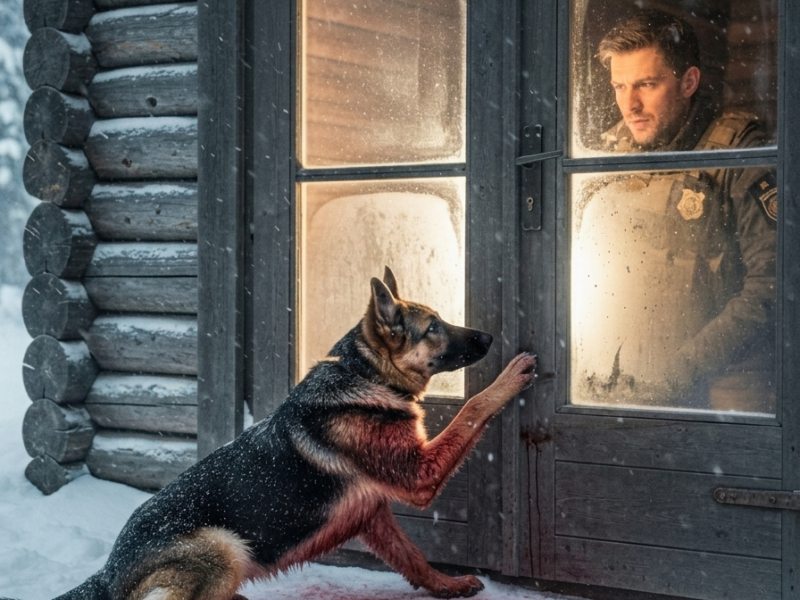
A wounded German Shepherd puppy collapsed on my Tennessee doorstep, crying so desperately that my retired Navy SEAL K9, Rex, shattered a window trying to reach him
The autumn rain in the foothills of East Tennessee did not merely fall; it hammered against the cedar siding of my cabin with a relentless, violent fury. It was past midnight, the kind of dead hour where the mountain silence usually settled heavy and thick, punctuated only by the steady dripping of water from the eaves.
I was sitting in my favorite armchair by the stone hearth, a cup of cold black coffee growing forgotten on the side table, when the sound cut through the roar of the storm.
It wasn’t the wind. It was a sharp, pathetic cry—small, fragile, and choked with pain.
Before my brain could fully register the noise, Rex was on his feet.
My retired military working dog had been fast asleep on the woven rug by the fire, but at the very first sound, his ears snapped forward and his entire seventy-pound body stiffened into rigid tension. Rex had survived IED blasts in the Hindu Kush, sniper fire in the valleys, and the grueling transition back to civilian life with me. He was a veteran of a hundred silent conflicts, a dog who rarely made a sound unless danger was absolute.
“Easy, boy,” I murmured, standing up and grabbing my heavy canvas jacket from the back of the chair.
I pulled the heavy oak front door open, stepping out barefoot onto the covered porch while the cold wind whipped rain across my face. I expected to find a raccoon, maybe an injured opossum caught in the storm.
Instead, I found him.
Curled tightly against the bottom of my wooden welcome mat was a tiny ball of sodden black-and-tan fur. A German Shepherd puppy, barely eight weeks old. His fur was plastered to his skinny ribs, which shuddered with every agonizing, rattling breath. One of his front paws was swollen, dark with dried blood, and caked in forest mud.
“Hey, little guy,” I whispered, dropping to my knees on the wet wood, ignoring the water soaking through my jeans. “Who did you run from?”
He tried to lift his head, his wide amber eyes locking onto mine with an expression of pure, desperate terror. Then his small body went limp, and he collapsed against the floorboards with a weak whimper that tore straight through my chest.
Behind me, Rex stepped out onto the porch.
He didn’t charge or bark aggressively. He walked slowly, his movements measured and careful, his graying muzzle lowering until it hovered just inches from the puppy’s shivering body. Rex let out a low, deep sound—not a growl, but a rumble that sounded almost like a sigh of profound disbelief.
Then, gently, he nudged the puppy’s forehead with his nose.
The little dog’s eyes flickered open. Without hesitation, the puppy dragged his battered body forward and pressed his face directly against Rex’s thick chest, seeking warmth, safety, and an anchor in the dark.
Something inside my chest cracked open.
For the past three years since leaving the Navy SEAL teams, my life had been defined by a hollow, ringing quiet. The house was too big, the nights were too long, and the memories of friends left behind in the dust were too sharp. Rex had been my only constant, the living link that reminded me I hadn’t come home entirely alone. Seeing him look down at this broken, abandoned puppy as if abandoning him was simply not an option made the knot in my throat tighten until it hurt.
“Come on,” I muttered, scooping the puppy up into my arms with infinite care. “Let’s get inside where it’s warm.”
We hurried back into the cabin, shutting out the storm. I laid the puppy down on a clean, soft flannel blanket near the hearth. Rex immediately settled down beside him, curling his massive body into a protective crescent shape to shield the little dog from the draft.
I grabbed my phone and dialed Dr. Aaron Vance, our local veterinarian and a trusted friend who knew better than to ask questions about my background. While his phone rang to voicemail, I grabbed my medical kit from the shelf—gauze, saline, antiseptic wipes, and heavy-duty antibiotic ointment.
“Hang on, little buddy,” I murmured, gently taking the puppy’s injured front paw.
The puppy flinched violently, letting out a sharp yelp as my fingers brushed near his wrist. Instantly, Rex shifted his weight, placing his heavy paw over my hand with a gentle but unmistakable warning pressure.
“Easy, Rex,” I said, looking into my dog’s steady, intelligent eyes. “I’m trying to help him. I’m not going to hurt him.”
Rex stared at me for three long seconds, studying my face, before slowly lifting his paw and resting it back down beside the puppy.
As I gently wiped away the mud and dried blood around the puppy’s leg, my fingers brushed against something hard and metallic hidden beneath the frayed nylon collar circling his tiny neck.
It wasn’t a standard rabies tag.
It was a small, cylindrical military-style brass capsule, scratched, dented, and caked in dried mud, sealed tightly with a tiny brass clasp.
My brow furrowed. I unlatched the clasp with the tip of my pocketknife, tipped the capsule over, and slid out a small, folded piece of waterproof paper protected inside a plastic sleeve.
I unfolded it under the bright light of the kitchen counter. My hands went completely cold.
There were only eight handwritten words scrawled across the paper in rushed, jagged ink:
“Please find Rex. He knows where my son is.”
I stared at the words, my heart hammering against my ribs.
Please find Rex.
How was that possible? Rex was my dog. He had been my dog since his retirement from military service five years ago. He had lived with me in this remote cabin in the Tennessee mountains, far away from my old unit, far away from my past. Nobody outside my former command even knew Rex’s name.
Before I could process the shock, a sudden flash of light swept across the front windows of the cabin.
Headlights.
I looked up sharply. A heavy, matte-black SUV had pulled off the gravel road and stopped right at the end of my long, dark driveway, its high beams cutting through the driving rain and illuminating my porch.
No doors opened. No one stepped out into the storm.
Rex was on his feet in a fraction of a second. He moved with silent, tactical precision, positioning himself directly between the puppy and the front door, his spine stiff, his teeth bared in a low, vicious growl that vibrated through the floorboards.
I flicked off the kitchen light, plunging the cabin into darkness except for the flickering amber glow of the fireplace.
The black SUV sat motionless at the end of the driveway for nearly sixty agonizing seconds. Then, its reverse lights flashed white, and it backed slowly down the narrow gravel road, disappearing into the dark mountainside without a sound.
My phone buzzed on the counter. An unknown, unlisted number.
I picked it up and unlocked the screen. A single text message glowed in the dark:
“Keep the puppy, Captain. But stay away from his father.”
I stared at the screen, the breath trapped in my lungs. They knew my military rank. They knew where I was.
Then a second text message pinged through:
“If Rex recognizes him, he already knows where the boy is buried.”
Outside, through the sound of the rain, Rex suddenly let out a sharp, piercing bark toward the dark window.
And somewhere out in the freezing mountain night, a second dog answered.
The morning sun broke over the Tennessee ridge in a brilliant explosion of gold and amber, burning away the mist that clung to the pine trees, but the cold knot in my stomach remained untouched.
Dr. Aaron Vance’s veterinary clinic sat just off the main highway in a converted stone barn, smelling of antiseptic, cedar shavings, and warm animal feed. Aaron was a tall, broad-shouldered man with silver-streaked hair and calm, observant eyes that had seen everything from farm accidents to tactical working dogs patched up off the books.
He stood beside the stainless-steel examination table where the little German Shepherd puppy lay resting under a soft fleece blanket. Rex sat stoically on the floor right beside the table, his head resting on his paws, his eyes never leaving the puppy.
“Well, Captain,” Aaron said, adjusting his stethoscope around his neck as he looked up from the chart. “Physically, he’s going to make it. He’s severely malnourished, dehydrated, and that front paw has a deep puncture wound consistent with a snare trap or a dog bite. But he’s a fighter. Eight weeks old, maybe nine. Strong bone structure.”
“Is he chipped?” I asked, leaning my hands against the edge of the metal table.
“That’s the interesting part,” Aaron replied, his expression turning grave. He reached over, gently lifting the puppy’s thick fur just behind his left shoulder blade. “When I shaved the area to clean the bite, I found this.”
He pointed to a small, dark blue identification tattoo inked into the skin: K9-049-DELTA.
My stomach tightened into a hard knot. “Delta? That’s not a civilian registration.”
“No,” Aaron said quietly, glancing at Rex before looking back at me. “That’s a classified military working dog lineage mark. Specifically, from the private canine tactical breeding and training facility operated out of Fort Campbell before it was decommissioned five years ago. The program was classified under a Department of Defense black-budget contract.”
I stared at the tiny mark. “Fort Campbell. That’s less than three hours from here.”
“Not just any facility, Jack,” Aaron said, lowering his voice so the receptionist couldn’t hear from the front room. “That facility was commanded by Colonel Thomas Vance—no relation to me, unfortunately. He ran the K9 tactical integration unit during your deployment. When the program was shut down amid congressional inquiries into experimental canine neural-conditioning, half the dogs were retired, and the rest… well, the official records say they were transferred. But a lot of handlers whispered that dogs from the Delta line were used for private security contracts.”
I reached into my jacket pocket and pulled out the small brass capsule and the folded paper I had found the night before. I laid them flat on the examination table.
“Read this, Aaron.”
Aaron picked up the note, reading the handwritten words aloud: “Please find Rex. He knows where my son is.”
He looked up slowly, his brow furrowed in deep concern. “Jack… who wrote this? And what does it have to do with Rex?”
“I don’t know,” I said honestly. “Someone left this puppy on my porch last night. And within ten minutes of his arrival, an unmarked black SUV was parked at the end of my driveway. Someone is watching us, Aaron. And whoever sent these text messages thinks Rex has answers to a missing person case.”
Before Aaron could answer, the door to the examination room swung open.
A young veterinary technician stepped inside, holding a small digital tablet. “Dr. Vance, you’ve got an urgent dispatch transfer coming through from the state police wire. They’re broadcasting an amber alert for a missing child out of Montgomery County—a six-year-old boy named Leo Vance. Son of retired Colonel Thomas Vance.”
The air in the room instantly turned to ice.
I looked at Aaron. Aaron stared at me, his face turning pale.
“Colonel Thomas Vance,” I said slowly, the name clicking into place with horrifying clarity. “The man who commanded the Delta K9 unit.”
“Yes,” Aaron whispered, his hands trembling slightly as he set the chart down. “And according to the broadcast… the boy went missing three days ago from a private estate outside Clarksville. The local police searched the property, but found nothing except…” He swallowed hard. “…except a bloody collar belonging to a military-grade German Shepherd.”
On the examination table, the puppy stirred. He let out a soft whine, opened his eyes, and instinctively reached out with his good paw, patting the metal table until his small foot touched Rex’s nose.
Rex stood up instantly, lifting his head and letting out a low, protective huff.
My phone buzzed in my hand. Another text message from the unknown sender. I unlocked the screen and held it up so Aaron could read it:
“The puppy’s name is Apollo. He is the son of Titan—the dog your brother-in-arms left behind in the desert. If you want to find Colonel Vance’s son before the snow sets in, check the coordinates hidden inside Apollo’s collar capsule.”
My breath caught in my throat.
Titan.
Titan wasn’t just any military working dog. Titan was the legendary tactical shepherd who had served alongside my brother-in-arms, Marcus, during our final tour in Afghanistan—the dog that Marcus had reportedly ordered put down in the field before our extraction.
And now, his puppy had crawled onto my porch in the middle of a torrential rainstorm, carrying a coded message from a ghost.
“We need to check that capsule again,” I said, my voice dropping into the cold, flat register I used when a mission went sideways in hostile territory.
I reached back onto the examination table, picked up the brass military capsule, and shook it upside down. Out fell the folded note, but as I examined the interior lining under the clinic’s overhead magnifying lamp, I noticed something else—a thin, translucent slip of micro-film rolled tightly and jammed into the bottom threading of the cap.
Using a pair of fine surgical tweezers, Aaron carefully extracted the micro-film and placed it under the veterinary microscope.
“Well, I’ll be damned,” Aaron murmured, adjusting the focus knob. “It’s not just text. It’s a military grid coordinate overlay paired with a digital data stream.”
He read off the numbers: 36.5291° N, 87.8924° W — SECTOR 7: OLD FORT CAMPBELL FIRING RANGE.
“That’s federal government land,” Aaron looked up at me, his eyes wide with alarm. “The old live-fire artillery range behind the abandoned barracks. It’s restricted property, patrolled by private military contractors hired by Vance Enterprises. Civilians aren’t even allowed within five miles of that perimeter.”
“Good thing I’m not just a civilian,” I said quietly, sliding my hand into my jacket pocket to feel the solid, comforting weight of my old tactical folding knife.
“Jack, listen to yourself,” Aaron said, grabbing my arm. “This is a trap. You got a text message from an unknown number telling you to go to a restricted military zone where a retired colonel with a private security army is operating. You walk in there, and you won’t walk out.”
“I didn’t ask for this, Aaron,” I replied, looking down at the little puppy, who was now sitting up on the blanket, his dark amber eyes staring straight into mine with an intelligence that felt almost human. “That puppy walked onto my porch for a reason. And Rex knows something about this. Look at him.”
I turned toward my dog.
Rex wasn’t looking at the door or the window. He was standing directly in front of the examination table, his ears pinned back, his tail tucked slightly—not out of fear, but out of deep, agonizing recognition. He had recognized the scent on the puppy the moment he smelled the blood on the porch last night.
He knew whose blood it was. He knew whose son was missing.
“I’m taking Apollo,” I said, gently lifting the puppy into my arms and tucking him securely against my chest under my jacket.
“And Rex?” Aaron asked.
“Rex goes where I go.”
I turned toward the door, but before my hand touched the handle, the clinic’s heavy wooden front door burst open.
Two men in civilian tactical gear—black body armor, Oakley sunglasses, and suppressed M4 carbines held at a low ready—stepped into the reception room. They didn’t look like local sheriff deputies. They looked like professional private military contractors.
“Dr. Vance?” the lead operative asked, his voice flat, cold, and utterly devoid of warmth. “We’re with Vance Enterprises Security. We received a report that an injured K9 unit was brought into this facility.”
Aaron froze behind the counter, his face turning pale. “I… I haven’t logged any intakes this morning—”
“Don’t lie to us, Doctor,” the second operative interrupted, stepping past the reception desk and kicking open the door to the examination room.
His eyes locked instantly onto me, onto Rex, and finally, onto the small puppy tucked inside my jacket.
“Well, well,” the operative smiled coldly, raising his rifle barrel toward my chest. “Looks like the stray found his way home. Hand over the puppy, Captain Roberts. And step away from the dog.”
The space inside the examination room shrank to the size of a postage stamp. The air grew so thick you could cut it with a knife.
“I don’t know who you boys are working for,” I said, keeping my voice dangerously calm as I shifted my weight onto my back foot, sliding my hand inside my jacket to grip the handle of my knife, “but you’re trespassing in a state-licensed veterinary facility.”
“We’re operating under federal executive authority, Captain,” the lead operative sneered, taking another step forward, his finger resting lightly on the trigger of his M4. “Colonel Vance wants his property back. And the dog with him.”
“Rex isn’t property,” I snapped.
Before the operative could squeeze the trigger, Rex moved with the blinding, feral speed of a combat-trained weapon.
He didn’t bark. He launched his seventy-pound frame directly across the room, hitting the lead operative square in the chest with a force that shattered the man’s tactical vest and sent him crashing backward through the wooden door of the supply closet.
“FIRE!” the second operative screamed.
CRACK! CRACK!
Two suppressed rounds punched through the drywall above my head, showering plaster down onto the exam table.
I dropped to the floor, pulling the puppy tightly against my chest as glass shattered from the clinic’s front windows. Aaron yelled in terror from behind the counter, diving for cover.
The second operative swung his rifle toward me, but Rex was already back on his feet. With a vicious snarl, the German Shepherd leaped across the examination table, sinking his powerful jaws into the operative’s forearm just above the tactical glove.
The man shrieked in agony, dropping his rifle as blood spurted onto the stainless steel. He swung his free fist, striking Rex across the head, but the dog didn’t let go. I scrambled forward, swept the man’s legs out from under him with a textbook combat takedown, and slammed the back of his head hard against the concrete floor.
He went limp instantly.
From the supply closet, the first operative stumbled out, drawing a 9mm pistol from his hip holster, his face twisted in rage.
Before he could raise the barrel, a heavy ceramic oxygen tank flew across the room, thrown with pinpoint accuracy by Aaron Vance, catching the operative squarely in the ribs and knocking him back into the dark recess of the closet.
“Get out! Both of you! Now!” Aaron yelled, grabbing a shotgun from his back office.
I didn’t hesitate. I scooped up the puppy, whistled sharply for Rex, and bolted through the shattered front window of the clinic into the crisp mountain air.
Rex leaped through the glass behind me without a scratch, landing gracefully on the gravel parking lot.
My old Ford pickup truck was parked by the side of the barn. I yanked the driver’s side door open, tossed the puppy onto the passenger seat, and yelled, “Truck, Rex! Up!”
Rex vaulted through the window into the cab, panting heavily, his amber eyes locked on the rear highway.
I jumped behind the wheel, turned the ignition key, and slammed my foot on the gas. The truck’s tires spun wildly on the gravel before catching traction, throwing a cloud of white dust into the air as we tore out onto the highway, heading south toward the old Fort Campbell firing range.
My phone rang loudly on the dashboard. I glanced down at the screen.
It was an incoming video call from an unknown, encrypted satellite relay.
I hit the speaker button with one hand while steering the truck around a sharp mountain curve at seventy miles per hour.
The screen flickered, and then a face appeared.
It was an older man with iron-gray hair, sharp, unforgiving eyes, and the crisp, immaculate uniform of a retired Army colonel. Colonel Thomas Vance.
“Captain Roberts,” the Colonel’s voice boomed through the truck’s speakers, cold and sharp as glass. “I see you’ve decided to play hero. A very dangerous game for a man trying to live a quiet life in the mountains.”
“Where is the boy, Colonel?” I shouted over the roar of the truck engine and the howling wind. “Where is Leo?”
Vance chuckled softly—a dry, chilling sound. “You’re holding his insurance policy right in your truck, Captain. That puppy—Titan Junior—is the key to everything. His father knew where the research files were hidden before he was put down. And now, my grandson is paying the price for his father’s betrayal.”
“You’re holding your own grandson?” I demanded, my blood boiling with cold fury.
“I’m securing national security assets,” Vance replied coldly. “You have exactly forty-five minutes to bring that puppy and Rex to Sector 7 of the old firing range. If you’re late… you won’t find a boy. You’ll find a grave.”
The video call abruptly cut to black.
Beside me on the seat, little Apollo let out a soft whine, pressing his warm head against my thigh. Rex looked up from the floorboards, letting out a low, resolute growl.
We were driving straight into a military fortress controlled by a madman. But as I checked the magazine of my service pistol in the glove box, I knew one thing with absolute certainty:
We weren’t coming back without the boy.
The old Fort Campbell live-fire artillery range looked like a scar carved into the heart of the Tennessee mountains. The perimeter was secured by double-stacked chain-link fences topped with razor wire, rusted watchtowers, and iron gates guarded by private military gun turrets.
I cut my truck lights a mile back, parking the vehicle deep inside a dense grove of pine trees.
“Stay here, boy,” I whispered, looking down at Apollo, who curled up obediently on the seat. Then I looked at Rex. “You with me?”
Rex stood up, letting out a sharp, affirmative huff, his muscles coiled like steel springs.
We moved through the thick forest brush like ghosts, utilizing every shadow, every ditch, and every fallen log. My years as a SEAL weren’t forgotten; my body remembered the angles of approach, the rhythm of breathing, and the exact moment to strike.
We reached the perimeter fence at a blind spot behind an abandoned munitions bunker where the security cameras had been rusted out for a decade. Using my heavy wire cutters, I snipped through the rusted chain-link in less than thirty seconds, sliding through the gap with Rex right on my heels.
Inside the compound, the rusted barracks loomed like decaying skeletons under the gray mountain sky. In the center of the live-fire impact zone stood Bunker 4—a massive, reinforced concrete structure built into the side of the mountain, surrounded by four armed guards patrolling with assault rifles.
We moved silently along the concrete foundation of the bunker until we reached a heavy steel utility door left slightly ajar for ventilation.
I slipped inside, with Rex sliding through the gap like a shadow.
The interior was cold, smelling of stale gunpowder, damp concrete, and old iron. A dim red emergency light illuminated a long concrete corridor leading down into a subterranean communications bunker.
From somewhere deep down the hall, I heard a child’s weak, muffled cry.
“Leo!” I called out softly.
“Who’s there?!” a terrified little voice answered from behind a heavy steel security door at the end of the hall.
Before I could reach the door, heavy combat boots echoed down the corridor from the opposite end.
“Halt right there, Captain!”
I spun around. Standing twenty feet away was Colonel Thomas Vance himself, flanked by two heavily armed guards with their weapons raised. Vance looked older than he did in his official portraits, his eyes hollowed out by paranoia and unyielding ambition.
“End of the line, Roberts,” Vance sneered, resting his hand on a heavy silver detonator box sitting on a metal crate beside him. “You walked right into the trap.”
“Let the boy go, Thomas,” I said, stepping forward, keeping my hands visible but my body positioned to shield Rex. “This is between you and the military. The child has nothing to do with your black-budget experiments.”
“The child has everything to do with it!” Vance shouted, his voice echoing off the concrete walls. “Titan knew where the server banks were buried in the desert before he was slated for termination! And this puppy—his direct genetic clone—holds the neural-mapping encryption keys in his collar capsule! With those keys, I can reboot the entire Delta project and secure my legacy!”
He reached out his thumb toward the silver detonator box. “And if I can’t have it… nobody will.”
“Now, Rex!” I roared.
The command didn’t need to be repeated. Rex exploded forward like a tactical missile.
He didn’t aim for the guards; he launched his seventy-pound body directly at Colonel Vance, knocking the silver detonator box out of the old man’s hands as they both crashed hard onto the concrete floor.
CRACK!
The two guards swung their rifles toward Rex, but I drew my pistol in a fluid motion and fired two precise warning shots that sparked off the concrete floor between their boots.
“Drop your weapons! DO IT NOW!” I commanded, my voice carrying the absolute, chilling authority of a combat veteran who had nothing left to lose.
The guards hesitated, looked at each other, and slowly let their rifles drop to the floor, raising their hands.
On the floor, Colonel Vance struggled beneath Rex, whose powerful jaws were clamped firmly around the sleeve of the Colonel’s tactical jacket, pinning him completely immobile.
I sprinted past them, reached the heavy steel security door at the end of the hall, and threw the manual emergency latch.
The heavy door swung open.
Inside the small, windowless supply room, huddled in the corner beneath a surplus army blanket, was a little six-year-old boy with big, frightened eyes and dark hair matching Elizabeth Whitmore’s old photographs.
“Are you… are you here to help?” little Leo whispered, trembling from head to toe.
I dropped to my knees, wrapped my arms gently around the little boy, and lifted him up into my arms.
“Yeah, buddy,” I choked out, a hot tear finally breaking free and rolling down my scarred cheek. “I’m here. And we’re going home.”
Three days later, the mountain cabin was warmer, brighter, and infinitely less quiet.
The federal investigation into Vance Enterprises had swept through Fort Campbell like a hurricane, resulting in the arrest of Colonel Vance and the permanent dismantling of the illegal black-budget canine programs. Leo Vance was safely reunited with his extended family, and the dark cloud that had hung over the valley for three years was finally lifted.
Out on the front porch, the afternoon sun cast a golden glow across the wooden floorboards.
Little Apollo—fully cleaned up, his injured paw bandaged and healing nicely—was tumbling clumsily over the rug, chasing a pinecone that rolled across the porch.
Rex sat upright beside my rocking chair, watching the puppy with the quiet, dignified patience of a veteran mentor.
I sat back in my chair, holding a cup of hot coffee, watching the two dogs play in the mountain air. The house wasn’t quiet anymore. It was filled with the patter of small paws, the steady breathing of a loyal companion, and the promise of a new dawn.
“Good dogs,” I whispered, smiling as Rex gently nudged the puppy back toward the sunlight.
And for the first time in a very long time, I knew we were finally home.
The end.









