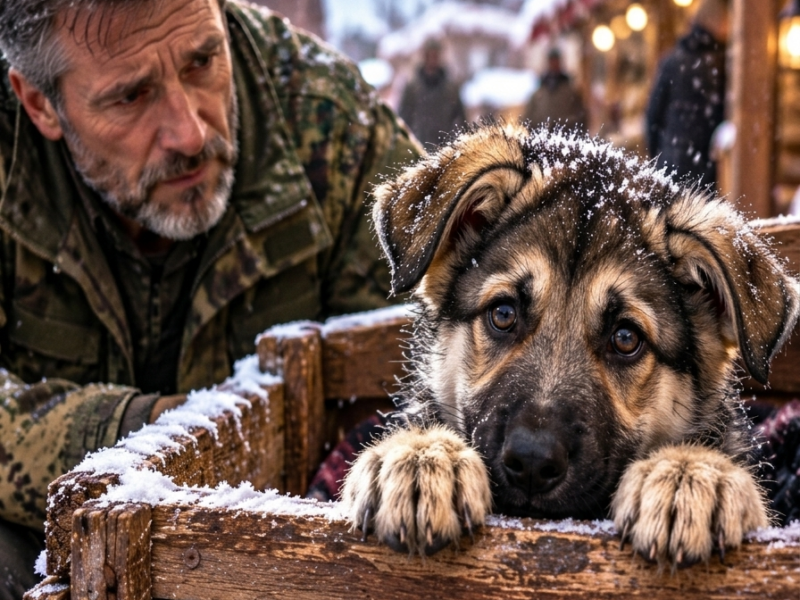
A Veteran Found a German Shepherd Puppy Hiding in a Wooden Crate
The headlights of the black SUV cut through the falling Montana snow like twin blades, casting long, frantic shadows across the cracked pavement of the abandoned gas station. In the rearview mirror, the figure stepped away from the vehicle. Even shrouded in a heavy winter parka, his silhouette was unmistakable: broad shoulders, a tactical stance, and on his left shoulder, the darkened shoulder patch of the 75th Ranger Regiment—my old unit.
My heart hammered against my ribs, a familiar, toxic surge of adrenaline flooding my veins. It was the same biological alarm that used to hit me in the dust-choked alleys of Kandahar.
Beside me, the German Shepherd puppy stirred. He didn’t whine or shrink back into my jacket. Instead, his small body went entirely rigid. His dark eyes locked onto the rear window, a low, guttural growl vibrating deep inside his tiny chest—a sound far too mature, far too instinctual for a dog that couldn’t have been more than eight weeks old.
“Quiet, buddy,” I breathed, sliding my hand inside my coat to grip the cold, textured grip of my concealed SIG Sauer P226. Seven years of civilian life hadn’t erased the muscle memory.
My phone vibrated violently against my thigh. Another message from Margaret Reed flashed across the screen: RUN.
The man approached the driver-side window of my truck. Snow dusted his brimmed hat, but as he leaned down, the faint glow of the gas station’s broken neon sign caught his face. He was in his mid-forties, with a jagged scar running from the corner of his right eye down to his jawline. I didn’t recognize his face, but I recognized his eyes. Cold. Calculating. The eyes of a hunter.
He tapped on my window with a gloved knuckle.
I rolled the glass down an inch, letting the freezing mountain air rush into the warm cab. “Can I help you?”
“Rough night to be out on Route 83, son,” the man said. His voice was a low, raspy gravel. “Highway patrol says the pass is about to be closed down for a blizzard.”
“Thanks for the heads-up,” I replied, keeping my voice level, steady, hiding the tremor in my hands. “I’m just pulling out.”
The man’s eyes drifted down, past my shoulder, landing precisely on the wooden crate resting in the footwell, and then onto the sleeping form wrapped inside my tactical jacket. His expression didn’t change, but his right hand slid subtly toward the edge of his coat.
“That’s a fine-looking pup,” he remarked casually. “Funny thing… a friend of mine lost a dog matching that exact description a few miles back. Mind if I take a closer look?”
“He’s mine,” I said cold. “And I’m late.”
“I don’t think you are, Captain Miller,” the man said quietly, using my old military rank.
The air in the cab seemed to freeze instantly.
Before he could draw his weapon, I jammed the truck into reverse and slammed my foot onto the accelerator. The tires squealed, spraying gravel and slush into the air as the heavy Ford F-150 leaped backward. The man lunged for the door handle, but the sudden backward momentum threw him off balance, sending him tumbling into the snowbank.
I slammed the brakes, shifted into drive, and stomped the gas. The truck roared forward, fishtailing onto the icy two-lane highway.
In the rearview mirror, the black SUV’s high beams flickered to life. The vehicle swung around with terrifying speed, its tires gripping the ice with specialized winter treads, roaring into pursuit.
“Hang on!” I barked to the puppy.
The snow was coming down thicker now, turning the world into a blinding white vortex. High-walled pine forests closed in on both sides of the highway, trapping us in a narrow corridor of ice and darkness. I pressed the accelerator harder, pushing eighty miles an hour on roads that demanded thirty.
My phone rang over the truck’s Bluetooth speaker. I hit the steering wheel button. “Margaret!”
“Michael! Are you safe?” her voice crackled over the poor cell reception, laced with panic.
“I’ve got company,” I yelled over the roar of the engine. “A black SUV. A guy wearing Ranger insignia. Who the hell are these people, Margaret? And what did you mean Daniel is alive?”
“Listen to me!” Margaret pleaded, her voice trembling. “After the ambush in the Korangal Valley… Daniel didn’t die. The military reported him dead because they needed him dead. He found something, Michael. Something inside the intelligence network that went all the way to the top of his command chain. A shadow program operating under the guise of private contractor security.”
I ducked instinctively as a metallic THUD echoed through the truck. The SUV had slammed into my rear bumper, sending the truck sliding toward the guardrail. I fought the wheel, counter-steering until the tires regained traction with a violent jerk.
“Where is he?” I shouted into the phone. “Where is Daniel?”
“He’s been hiding in the Swan Range mountains for seven years!” Margaret sobbed. “He couldn’t reach out to you directly—they monitored everyone from his old unit. But last week, he sent a messenger. That dog… Michael, that dog was bred from Daniel’s old military working dog, Major. Daniel trained him. He put that tag around his neck and sent him down the mountain when the contractors closed in on his hideout!”
“A puppy navigated thirty miles of wilderness in a blizzard?” I demanded, disbelieving.
“He didn’t walk! Someone brought him down to the valley—a local logger who was helping Daniel! But they caught the logger, Michael! The dog escaped!”
A heavy impact rattled the driver’s side of my truck. The SUV was driving parallel to me now, trying to force me off the road into a five-hundred-foot ravine. I glanced over. The driver raised a suppressed handgun toward my window.
In that split second, I didn’t think. I slammed on my brakes.
The SUV shot ahead, its driver caught off guard. As it surged past, I cut my wheel hard to the right and slammed my heavy steel bumper straight into its rear quarter panel. The PIT maneuver was textbook. The SUV spun out of control, hitting the icy bank, flipping once, twice, and smashing sideways into a massive Douglas fir tree with a sickening crunch of metal and shattering glass.
Silence fell over the highway, broken only by the whistling wind and the idling thrum of my truck engine.
I sat there, chest heaving, hands frozen to the steering wheel. Beside me, the puppy let out a soft whine.
I looked down at him. His small paws were dug into the fabric of my coat. The brass dog tag around his neck glimmered beneath the dashboard lights.
SERGEANT DANIEL REED.
I reached out with trembling fingers and picked up the tiny piece of plastic-wrapped paper I had pulled from behind the tag. I looked closer at the three hand-written words again: TRUST NO ONE.
Then I noticed something else. On the reverse side of the paper, faint indentations had been pressed into the fiber, invisible unless held up to the light. It was a set of geographic coordinates.
Coordinates deep within the dense, uninhabited wilderness of the Montana mountains.
The wreckage of the SUV caught fire behind me, a brilliant orange glow spreading across the snow. I looked at the puppy. “Looks like we’re going hiking, little guy.”
He barked once—a clear, sharp sound that echoed with uncanny authority.
The blizzard raged with unforgiving fury as I turned off the main highway onto an unmarked logging road. Snow was already accumulating thick on the windshield, the wipers struggling to clear the heavy white sheets. My truck was a 4×4, but even rugged machinery had its limits against a Northern Rockies winter.
The coordinates led into the heart of the Flathead National Forest. As the truck climbed higher into the elevations, the temperature dropped to single digits. The radio died, replaced by static. Cell service was entirely gone. We were off the grid, stripped of technology, moving blind into a trap or a salvation—I wasn’t sure which yet.
I looked down at the puppy nestled in the passenger seat. He was surprisingly calm for a dog that had spent the night in a wooden crate. He kept his eyes fixed on the dark tree line passing outside the window, ears pricked, alert to every snap of a branch.
“I need to give you a name,” I said softly, the sound of my own voice comforting in the suffocating silence of the cab. “Can’t just keep calling you ‘buddy’.”
He turned his head, his deep brown eyes meeting mine with an intelligence that felt unnervingly human.
“How about Scout?”
He gave a slight tilt of his head, resting his chin on my leg. Scout it was.
Three miles up the mountain, the logging road abruptly ended at a washed-out wooden bridge spanning a frozen gorge. Black water rushed beneath thick plates of ice thirty feet below. There was no driving past this point.
“End of the line,” I muttered, killing the engine.
The sudden silence was deafening. I gathered my gear from the back seat: a heavy-duty tactical backpack, a thermal sleeping bag, water, rations, a high-powered LED flashlight, my SIG Sauer, and a spare magazine. I wrapped Scout securely inside my heavy shearling-lined coat, zip-tying a small pouch around my chest so he could ride against my body heat without falling out. Only his head poked out, sheltered against my chin.
Stepping out of the truck into the blizzard felt like walking into a wall of broken glass. The wind howled through the pine needles, biting through my layers.
I took out my handheld GPS device—a military-grade unit that didn’t rely on cell towers—and entered the coordinates from Daniel’s note. The red arrow pointed straight up into the steep, snow-choked ridges of the mountain ahead. Distance: 4.2 miles. Altitude gain: 2,500 feet. In these conditions, it would take hours.
“Let me tell you something about Daniel,” I whispered to Scout as I trudged into the deep snow, my boots sinking six inches with every step. “Seven years ago, in a village named Sangin, my squad got pinned down by heavy machine-gun fire inside a mud-brick compound. I got hit in the thigh. Shrapnel. Couldn’t stand.”
Scout whimpered softly, his small nose pressing against my neck.
“Everyone was pulling back,” I continued, pacing my breath against the steep incline. “The radio was screaming that air support was five minutes out and dropping 500-pound bombs on our grid. I told them to leave me. But Daniel… Daniel didn’t listen. He ran back through a hail of bullets, threw me over his shoulder like a sack of grain, and carried me two hundred yards to safety. He took a bullet to his shoulder doing it. Never even complained.”
I paused, breathing heavily, resting my back against the trunk of a massive pine tree. The memory burned hot in my mind—the smell of cordite, the deafening roars, the blood on Daniel’s uniform.
“Two weeks later,” I murmured, “his unit went dark. They told us his humvee hit a heavy IED. Said there was nothing left to bury. I carried that guilt for seven years, Scout. I moved to Montana, bought an isolated cabin, stayed away from people… because I was the one who was supposed to die over there, not him.”
Scout suddenly stiffened against my chest. His nose twitched, and his ears flattened.
I froze. My hand dropped instantly to my side-arm.
The wind had shifted. Through the whiteout, roughly fifty yards ahead on the trail, I saw faint blue lights flickering. Not headlights—tactical flashlights. Flashlights equipped with night-vision compatible filters.
They had a perimeter.
“They were waiting for someone to track those coordinates,” I realized with a cold chill. The contractors hadn’t just been chasing me on the highway; they already knew the general area of Daniel’s hideout.
I backed away slowly, stepping precisely in my own footprints to hide my tracks, but a dry branch beneath the snow snapped with a loud CRACK.
“Movement at twelve o’clock!” a harsh voice barked ahead.
Instantly, bright beams of white light cut through the storm, blinding me.
“Drop your gear and put your hands up! Now!”
There were at least three of them. I didn’t wait to negotiate. I threw myself sideways behind a massive boulder just as a burst of suppressed automatic gunfire tore through the air, chewing up the snow and wood bark right where I had been standing.
Scout let out a sharp Yip, terrified by the sudden violence.
“Hold on, Scout!” I yelled, pulling my SIG Sauer from its holster.
I popped up from behind the rock, firing three quick shots toward the nearest flashlight beam. A grunt of pain echoed through the trees, and one light dropped to the ground, spinning wildly in the snow.
“He’s armed! Flank him from the right!”
I didn’t stay to fight a three-on-one battle in the open snow. I turned and sprinted off the trail, plunging headlong down a steep, wooded slope into the pitch-black wilderness. Trees whipped past my face, snow blinded my eyes, and my feet slipped on invisible rocks beneath the powder.
Behind me, shouting men and crunching snow signaled that they were in fast pursuit.
“Over here!” a voice called from the darkness to my left.
I checked my run, bringing my gun up, expecting another contractor.
Instead, a hand reached out from behind a thick cluster of spruce trees, grabbing my coat collar and hauling me violently into a hidden fissure in the rock face.
The hidden crevice was barely wide enough for two men, completely obscured from the outside by dense, snow-heavy pine branches.
I spun around, leveling my pistol directly at the chest of the man who had pulled me in.
“Put that away, Mike,” a rough, familiar voice whispered in the darkness. “You always were too slow on the draw.”
The man pulled back his hood. He wore a heavy thermal mask, but when he lowered it, my breath caught in my throat.
He was older, his face lined with deep, weathered scars. A thick silver beard covered his jaw, and his left eye was cloudy, blinded by trauma. But the eyes—the fierce, unyielding intensity in those eyes—were unmistakably those of Sergeant Daniel Reed.
I stood frozen, my gun lowering inch by inch. “Daniel?”
“In the flesh, brother,” Daniel gritted out. A rare, faint smile touched his cracked lips.
Before I could process the impossibility of the moment, Scout squirmed wildly inside my jacket. He let out a series of ecstatic, high-pitched barks. Daniel dropped to his knees, his rugged face softening instantly as he pulled the puppy out of my coat and held him tight against his chest.
“You made it, little man,” Daniel whispered, pressing his forehead against the dog’s head, exactly as Scout had done to my hand hours earlier. “Good boy. You brought him.”
“Daniel…” I choked out, my voice cracking under the weight of seven years of unearned grief. “How? We buried your dog tags. We held a service.”
“You buried a lie, Mike,” Daniel said grimly, his demeanor shifting back to tactical vigilance. He peeked through the pine branches, listening to the crunching boots of the contractors searching the woods fifty yards below us. “Keep your voice down. Those aren’t federal agents. They’re mercenaries working for Vanguard Global—a private defense contractor.”
“What do they want with you?”
“Seven years ago, my unit uncovered a massive smuggling operation in Afghanistan,” Daniel explained quickly, his voice clipped and precise. “Vanguard wasn’t just providing security for military bases; they were using military transport planes to traffic black-market weapons and stolen antiquities worth hundreds of millions. When I found the manifest files, my commanding officer—Colonel Vance—tried to have me executed. They staged the ambush. They blew up my vehicle.”
“Colonel Vance?” I repeated, horror dawning on me. “Vance is a General now. He’s running regional operations out of Joint Base Lewis-McChord!”
“Exactly,” Daniel said. “I survived the blast, but I was captured by local insurgents. It took me three years to escape back across the border. By the time I made it back to the States, Vance had built an impenetrable wall around himself. He used his authority to wipe my existence from every military database. If I walked into a federal building, I’d be dead before I reached the lobby.”
“So you hid here?”
“I gathered evidence,” Daniel said, patting a small, heavy waterproof hard drive attached to his tactical vest. “For four years, I worked from the shadows, hacking their encrypted servers, gathering bank statements, audio recordings, casualty reports of soldiers Vance sacrificed to protect his empire. Everything is on this drive.”
“Why didn’t you call me earlier?” I asked, hurt mixed with anger.
“Because the moment I reached out to you, Vance’s men would target you,” Daniel said, looking me dead in the eye. “I only called when they found my cabin three days ago. They trapped me up here. I knew Scout could get down the mountain through the drainage tunnels I trained him on—he was my only courier. I attached your name and the coordinates to his collar because… because you were the only man on this earth I knew couldn’t be bought.”
A harsh beam of light swept across the rock face above our hiding spot.
“They’re circling back,” I whispered, gripping my gun. “We can’t stay here. My truck is disabled at the bridge, and they have at least four men out there.”
“They have more than four,” Daniel corrected. “Vance sent a full strike team. They know if that drive gets to the Department of Justice, Vance spends the rest of his life in a supermax prison.”
Daniel looked down at Scout, then at me. “My main shelter is half a mile up the ridge. It’s fortified, got communications equipment, and an emergency snowmobile. But we have to break through their perimeter to get there.”
“Then we fight through,” I said, racking the slide of my pistol. “Just like Sangin.”
Daniel grinned, a shadow of the unstoppable soldier he used to be. “Just like Sangin. Cover my left.”
We moved like ghosts through the blizzard, using the deep snow banks and howling wind as natural concealment. Daniel led the way with the quiet precision of a veteran hunter, Scout tucked safely back into my zip-up jacket, keeping his head low.
The storm was reaching its peak. Visibility was down to less than ten feet. The sub-zero wind felt like needles driving into exposed skin, but the heat of survival kept my blood boiling.
As we reached a narrow ridge trail bordering a steep cliff, a flare suddenly hissed into the sky above us, bursting into a brilliant, blinding crimson light that illuminated the entire hillside.
“CONTACT!” a voice shouted.
Gunfire erupted from three directions at once. Suppressed rounds cracked through the cold air, snapping pine branches and throwing up showers of ice.
Daniel slammed his shoulder into a fallen log, bringing up a heavy modified M4 carbine he had slung across his back. He fired back in disciplined two-round bursts, suppressing the shooters on our left flank.
“Move, Mike! Go for the high ground!” he roared.
I sprinted toward a rocky outcropping, ducking as bullets chewed into the snow at my feet. I leaned around the rock and fired four rounds at a mercenary advancing up the slope, hitting him in the chest plate. He went down, slipping backward into the ravine.
“Behind you!” Daniel yelled.
I spun around just as a heavy-set contractor lunged at me from behind a snow-covered bush, knocking my gun from my hand. We crashed onto the hard, frozen earth.
The man was larger, heavier, and possessed ruthless tactical training. He pinned my right arm, driving his forearm against my throat, cutting off my air supply. Spots danced before my eyes as I clawed wildly at his tactical vest, struggling to breathe.
Suddenly, a ferocious snarling sound erupted from my coat.
Scout wriggled his way free, baring his tiny puppy teeth, and bit down with all the strength in his jaw onto the contractor’s exposed ear.
The man screamed in rage and pain, breaking his grip on my neck to swat the puppy away.
That brief second was all I needed. I drove my fist upward into his solar plexus, twisting my body to reverse our positions. I drew my tactical combat knife from my boot and struck with brutal efficiency.
The contractor collapsed into the snow, motionless.
“Scout!” I gasped, pulling the little dog back into my coat. He was shaking, but unharmed, licking my cheek with fierce loyalty. “Good boy… brave little guy.”
“MIKE! MOVE!”
Daniel was forty yards ahead, firing frantically down the hill. A second wave of mercenaries was advancing, led by the scar-faced man who had ambushed me at the gas station. He was barking orders into a radio, moving with relentless determination.
We scrambled up the remaining steep grade of the ridge, reaching a heavy reinforced wooden cabin built directly into the side of the mountain face. It was invisible from the air, covered by thick camouflage netting and heavy snow drifts.
Daniel punched a code into an electronic keypad on the reinforced steel door. The heavy lock disengaged with a loud pneumatic hiss.
We threw ourselves inside, and Daniel slammed the door shut, throwing two massive steel deadbolts into place just as a barrage of bullets slammed harmlessly against the heavy exterior plate.
Inside, the cabin was dark, smelling of pine wood, gun oil, and woodsmoke. A bank of computer monitors flickered in the corner, displaying live camera feeds from around the mountain perimeter.
“They’re surrounding the cabin,” I panted, leaning against the wall, catching my breath. “That steel door won’t hold forever if they have thermal explosives.”
“It doesn’t have to,” Daniel said, stepping over to a central console. He pulled the hard drive from his vest and slotted it into a satellite transmission terminal. “I don’t need to escape this mountain, Mike. I just needed enough time to transmit the decrypted files to the Federal Bureau of Investigation and the Inspector General.”
The monitor lit up with a progress bar: UPLOADING ENCRYPTED DATA… 12%… 24%…
“Transmission takes four minutes,” Daniel said, looking at the door as a heavy explosion rattled the entire structure, sending dust cascading from the wooden rafters. “We give it four minutes.”
The cabin shook again as a second blast blasted the steel door frame. The metal buckled inward, revealing a glowing red crack around the edges. They were using breaching charges.
UPLOADING ENCRYPTED DATA… 58%… 72%…
“They’re coming through on the next charge!” I shouted, picking up the fallen contractor’s assault rifle from the floor. “Daniel, we need an exit route!”
“Behind that tarp,” Daniel gestured to the back of the room. “There’s a tunnel carved through the rock. It exits into a hidden ravine six hundred yards down the mountain. A snowmobile is parked at the entrance.”
“Then let’s go!”
“Not until this file hits one hundred percent,” Daniel said with absolute iron resolve, his cloudy eye fixed on the screen. “If I cut the link now, the encryption resets. Seven years of waiting… seven years of living like a dead man… ends right now.”
UPLOADING ENCRYPTED DATA… 89%… 95%…
A deafening boom shattered the front of the cabin. The steel door gave way, blown inward off its hinges, crushing a wooden table beneath it.
Smoke and fire poured into the room. Through the haze, the scar-faced contractor stepped into the threshold, his weapon raised.
“End of the line, Sergeant Reed,” he sneered, raising his rifle toward Daniel.
I didn’t hesitate. I leaned out from behind the central pillar and emptied the entire magazine of my rifle toward the doorway. The gunfire echoed like thunder inside the confined space. The scar-faced man was driven backward out the door by the force of the hits, collapsing into the snow outside.
UPLOADING ENCRYPTED DATA… 100%. TRANSMISSION COMPLETE.
“IT’S DONE!” Daniel roared.
He grabbed the satellite terminal, slammed a heavy iron hammer down onto the hard drive, destroying the physical drive into a thousand useless pieces.
“GET TO THE TUNNEL!”
We bolted for the back of the cabin, tearing aside the heavy canvas tarp. A dark, stone-walled tunnel stretched into the mountain’s depths. Daniel shoved me and Scout through first, then slammed a heavy iron security gate shut behind us, locking it from our side.
“Daniel! What are you doing?!” I yelled through the iron bars.
“The snowmobile only carries two safely in a blizzard!” Daniel shouted over the sound of approaching footsteps outside the cabin. “Take Scout and get down to the valley! The FBI will have that file in five minutes. It’s over!”
“I’m not leaving you again!” I screamed, pulling on the lock. “We pull through together! That was the rule!”
Daniel looked at me through the steel grates. The harsh, bitter cold of his seven-year exile seemed to melt away from his eyes, replaced by the warmth of the brother-in-arms I had known in Afghanistan.
“You didn’t leave me, Mike,” Daniel said softly. “You saved me tonight. You brought my boy home.”
He reached his gloved hand through the bars, touching Scout’s head one last time, then gave me a crisp, sharp military salute.
“Now execute the mission, Captain. Take care of my dog.”
Before I could reply, Daniel pulled a manual detonator from his belt and flipped open the plastic safety cover. He had rigged the cabin with demolition charges to destroy his surveillance equipment and collapse the entrance.
“RUN!” he shouted.
I turned and ran down the dark tunnel with everything I had, clutching Scout tight against my chest.
Ten seconds later, a deep, rumbling explosion shook the earth beneath my feet. The mountain echoed with the roar of collapsing rock, sealing the tunnel behind us forever, burying the cabin and everyone inside beneath thousands of tons of stone and snow.
Tears stung my eyes, freezing against my cheeks as I burst out of the tunnel mouth into the blinding white storm lower down the mountain.
The snowmobile was parked beneath a wooden shed, exactly as Daniel had said. I mounted the machine, placed Scout securely inside my zippered coat, and kicked the engine to life. The engine roared, and I accelerated down the mountain path, riding through the blizzard toward the valley below.
Two hours later, as dawn began to break over the Montana horizon, the storm finally began to clear.
The first rays of golden sunlight crested the snow-capped peaks of the Swan Range, illuminating a fleet of federal vehicles—FBI and State Police—their red and blue lights flashing as they blocked the main highway below.
I pulled the snowmobile to a stop at the edge of the tree line.
A high-ranking FBI field agent walked up to me, surrounded by armed officers. He looked at my frozen face, then down at the little German Shepherd puppy sitting proudly inside my coat.
“Michael Miller?” the agent asked softly. “We received an encrypted transmission one hour ago from a Sergeant Daniel Reed. The evidence attached has already resulted in the arrest of General Vance and twelve executives at Vanguard Global.”
I didn’t say a word. I just nodded, looking back up at the majestic, silent mountain peaks behind us.
The agent looked toward the summit. “Is… is Sergeant Reed coming down?”
“He already came down,” I said quietly, my voice steady and filled with pride. “He made sure his mission was finished.”
I reached into my pocket and pulled out the old, silver military dog tag. I fastened it securely around Scout’s neck. The brass tag shimmered brightly under the morning sun.
Scout looked up at me, his brown eyes clear, alert, and unbroken. He let out a strong, confident bark that echoed across the valley.
I patted his head, pulled him close, and walked toward the light. We had survived the dark. And Daniel Reed’s legacy would live on—unforgotten, undefeated, and forever free.
The end.









