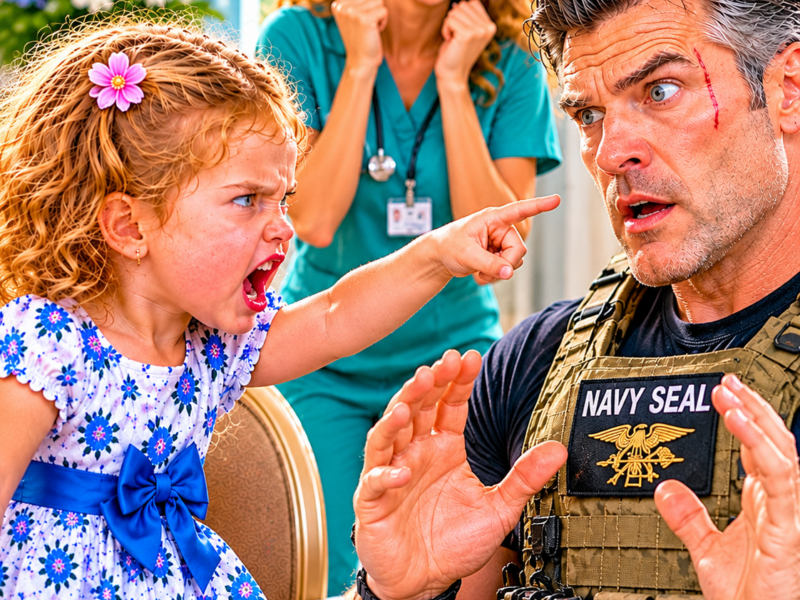
A three-year-old girl was copying her father’s angry face. It was so perfect that the nurse couldn’t stop laughing
At 9:40 on a Wednesday night, Tessa Moran was laughing so hard she had to put the medication tray down.
“Stop,” she wheezed. “Poppy, that’s perfect.”
Poppy Rourke, age three, did not stop.
She stood beside her father’s hospital bed in pink star pajamas, a toy stethoscope hanging around her neck. Her little arms were folded tightly across her chest. Her chin was tucked down, her brow pulled low, and her lower lip pushed out in a furious pout.
She was glaring at her father with the intensity of a drill instructor.
Her father, Senior Chief Caleb Rourke, glared right back.
He was a big man with a close-cropped dark head, broad shoulders, and a face that seemed permanently carved into a scowl. Even in a gray hospital gown, with an IV taped to his arm, he looked like someone who could make a room stand at attention without saying a word.
His teammates called him Sergeant Scowl.
Poppy had apparently decided that if she couldn’t be a Navy SEAL, she could at least look like one.
“She’s been practicing all day,” Caleb said.
His voice was low and rough, but there was something almost affectionate beneath it.
“It’s the best impression I’ve ever seen,” Tessa replied. “Poppy, do it again.”
Poppy repeated the performance.
Arms crossed. Chin tucked. Brow lowered. Lip pushed out.
Tessa laughed again.
Then she stopped.
It happened so gradually that she almost didn’t recognize the moment. Her smile faded. Her eyes narrowed. She looked at Poppy, then at Caleb, then back at Poppy.
Something was wrong.
Not with the little girl.
With the face she was copying.
Poppy’s scowl was crooked. The left side of her face scrunched up hard, her cheek rising and the corner of her mouth pulling sideways. But the right side remained strangely smooth. The right corner of her mouth barely moved.
At first, Tessa thought it was simply a toddler’s imperfect imitation.
Then she looked at Caleb.
The same unevenness was there.
His left cheek tightened when he frowned. His left eyebrow pulled down. But the right side of his face seemed to lag behind, as though the muscles had forgotten what they were supposed to do.
Tessa had been a nurse on the neurotrauma unit for only three weeks, but she had already learned to pay attention to faces.
Sometimes a patient could tell you everything with a single expression.
“Chief,” she said carefully.
Caleb looked at her.
“Could you smile for me?”
He stared at her as if she had asked him to perform a magic trick.
“I don’t smile on command, Nurse.”
“Humor me.”
He sighed.
Then he smiled.
Only the left side of his mouth lifted.
The right side stayed almost perfectly still.
Tessa felt a cold sensation settle in her stomach.
“Is something wrong?” asked Marisol, Caleb’s wife.
She had been resting in a recliner near the window, but now she was sitting upright. Her eyes moved from Tessa to her husband.
Tessa didn’t answer immediately.
She wanted to be certain.
“Chief, I’d like to do a quick neurological check.”
“I had one at eight.”
“I know. I’d like to do another.”
“I’m being discharged in the morning. I’m fine.”
His tone was not angry exactly. It was the tone of a man who had spent six days in a hospital and was determined not to spend a seventh.
Marisol stood.
“Caleb, let her.”
He looked at his wife. Something passed between them, something Tessa couldn’t quite understand.
Then he exhaled.
“Two minutes.”
Tessa began the examination.
She asked him his name, the date, and where he was. He answered correctly, although one word sounded slightly slurred.
She asked him to raise his eyebrows. Both moved.
She asked him to close his eyes tightly. Both closed.
Then she asked him to show his teeth.
His left side pulled upward.
His right side barely moved.
Tessa kept her expression calm.
“Now hold both arms straight out in front of you. Palms up. Close your eyes and keep them there.”
Caleb obeyed.
At first, both arms remained steady.
Then, six seconds later, his right arm began to drift downward. His palm slowly turned inward.
He caught himself and lifted it again.
“Tired,” he said.
Tessa looked at him.
“Have you been having headaches?”
A pause.
“A few.”
“Are they getting worse?”
Another pause.
“Some.”
“Any nausea? Trouble finding words? Unusual sleepiness?”
“I’m fine, Nurse.”
“Caleb,” Marisol said.
Her voice trembled.
“Tell her.”
Caleb stared at the wall.
For several seconds, he said nothing. His jaw worked, and his eyes shifted toward Poppy, who had climbed onto the foot of the bed and was listening to the blanket with her toy stethoscope.
Finally, he spoke.
“My right hand’s been weird since yesterday. And I keep losing words.”
Tessa waited.
“My head feels like somebody’s tightening a belt around it.”
“Why didn’t you tell anyone?”
He looked down.
“If I tell them, that’s it.”
“What do you mean?”
“They write it down. I’m medically disqualified.”
He shook his head.
“Twenty years. Done.”
Tessa understood that his career was more than a job. It was the life he had built, the people he trusted, and the identity he had carried for most of his adult life.
But she also understood that something was happening to him.
“I understand,” she said. “But I need to call the doctor.”
“The doctor said I’m fine on Monday.”
“Then I’ll tell him what I’m seeing now.”
She picked up her phone.
Caleb leaned back against the pillow, visibly frustrated.
Poppy climbed higher onto the bed and placed her toy stethoscope against his chest.
“Daddy,” she whispered, “your heart is loud.”
He glanced at her.
“That’s because you’re sitting on me, troublemaker.”
Poppy smiled.
Tessa stepped into the hallway and called Dr. Gregory Halvorson.
She had rehearsed what she needed to say while walking to the nurses’ station. She kept her report brief and factual.
“Dr. Halvorson, this is Tessa Moran on Five East. I’m concerned about Senior Chief Rourke in room 512. He has a new right lower facial droop, forehead spared, right pronator drift at six seconds, mild word-finding difficulty, and worsening headache.”
There was a pause.
“He had a clean CT on Monday,” Halvorson said.
“Yes, sir.”
“And a clean neurological exam at eight tonight.”
“Yes, sir, but I’m seeing new findings now.”
“Blast concussion can cause mood changes, fatigue, and word-finding problems. He’s been irritable and minimizing symptoms since admission. We’ve discussed it in huddle.”
“Sir, his face is different.”
“He’s been scanned twice. He’s being discharged tomorrow morning. Continue routine observation and call if anything changes.”
Tessa tightened her grip on the phone.
“It has changed.”
“Document it, Nurse Moran.”
The call ended.
For a moment, Tessa stood motionless.
The hallway continued around her. A monitor beeped somewhere behind a closed door. A cart rolled past. A call light chimed.
The hospital seemed determined to remain ordinary.
But room 512 was not ordinary anymore.
Imani Brooks, the night charge nurse, had been standing nearby.
“He said no?” she asked.
Tessa nodded.
“Tell me what you saw. All of it.”
Tessa repeated the findings, including the coffee, the dropped pen, the crooked smile, and the arm drift.
Imani listened without interrupting.
When Tessa finished, she took off her reading glasses and cleaned them with the edge of her scrub top.
“You know what I like about this?” she asked.
Tessa looked at her.
“You described it like a nurse. Findings, timing, trend. Not like someone who got scared because a patient looked strange.”
“He still said no.”
“He said no once.”
Imani put her glasses back on.
“The resident on call tonight is Dr. Shah. She’s good. She listens. Call her.”
“Is that allowed?”
“It’s not going around him. It’s going up and sideways. That’s what the chain of command is for.”
Imani’s expression softened.
“Don’t ask whether you’re allowed to be right, Moran. Ask whether you’re willing to be wrong in the right direction.”
Tessa took a breath.
Then she picked up the phone again.
Dr. Anita Shah arrived four minutes later.
She was young, quick, and still carrying half a sandwich. Her white coat was wrinkled, and her hair was tied into a messy ponytail.
She didn’t waste time with introductions.
“Where?”
“Room 512.”
She walked straight in.
Caleb was sitting upright, his arms folded, his expression suspicious.
“Senior Chief,” Dr. Shah said. “I’m Anita Shah. I’d like to examine you.”
“The nurse already did.”
“I’d like to see for myself.”
Caleb looked at Tessa.
She didn’t look away.
Dr. Shah began the examination. She checked his smile, eyebrows, grip strength, and arm movement. She asked him to repeat a tongue twister.
His words came out unevenly.
She pressed his right hand, then his left. The difference was unmistakable.
Then she noticed Poppy.
“Hello,” she said. “Are you a doctor, too?”
Poppy held up her pink stethoscope.
“I listen to Daddy.”
“I bet you’re very good at it. What do you hear?”
Poppy thought about the question.
Then she put the stethoscope against her father’s chest. After a moment, she climbed down, folded her arms, tucked her chin, and made her familiar scowl.
Dr. Shah went still.
She looked at Poppy’s face.
Then she looked at Caleb.
Then she looked at Tessa.
“That’s what I saw,” Tessa said quietly. “She’s been copying it all day.”
Dr. Shah studied the two faces again.
“She isn’t doing it wrong,” she murmured.
“No,” Tessa replied. “She’s doing it exactly right.”
Dr. Shah turned toward Caleb.
“Senior Chief, I’m going to be honest with you. I think there’s a real chance something is happening inside your head that wasn’t visible on Monday’s scan.”
Caleb’s expression hardened.
“The scan was clean.”
“It was clean on Monday. That doesn’t guarantee it’s clean tonight.”
She explained that after a blast injury, a small blood vessel could tear and bleed slowly. The blood could accumulate over several days. A scan performed earlier might not show anything, even if a serious problem developed afterward.
“If that’s what this is,” she continued, “it can become dangerous quickly.”
“And if I say no to another scan?”
“Then that’s your right. I’ll document your refusal, and we’ll keep checking you closely.”
She paused.
“But I’d rather you said yes.”
Caleb looked away.
“My career isn’t your brain,” Dr. Shah added gently. “And a symptom that gets treated early is not the same as one that stays hidden until it becomes an emergency.”
Marisol moved closer to the bed.
“Caleb, please.”
He looked at his wife.
Then he looked at Poppy.
The little girl had stopped playing. She was watching him with serious blue eyes.
She climbed onto his lap, carefully avoiding the IV line, and placed one tiny hand on each side of his face.
“Daddy,” she whispered.
He looked at her.
“Wake up your face.”
For a moment, nobody moved.
Caleb’s expression broke. The left side of his mouth trembled. The right side seemed to struggle, then followed just a little.
He closed his eyes.
“Okay,” he whispered.
He looked at Dr. Shah.
“Scan me.”
They moved quickly.
Tessa walked beside the stretcher with one hand on the rail. Dr. Shah walked on the other side, speaking with radiology.
Marisol followed with Poppy asleep against her shoulder. The little girl had finally grown tired of the hospital’s strange lights and unfamiliar sounds.
“Stay with me, Chief,” Tessa said.
“I’m here.”
His voice sounded slower now.
“What’s your daughter’s middle name?”
“Grace.”
“Poppy Grace. Good. What’s your wife’s name?”
“Marisol.”
He paused.
“Beautiful name.”
“Thank you.”
“What day is it?”
Caleb frowned.
“Wednesday.”
Then his eyes shifted.
“Thursday?”
Tessa’s hand tightened on the stretcher rail.
Dr. Shah looked up.
“Let’s move.”
The CT scanner hummed in the cold room. The technicians transferred Caleb onto the table, and the machine began its work.
Tessa and Dr. Shah stood behind the glass.
Marisol waited in the doorway, one hand over her mouth and the other supporting Poppy’s head.
The images appeared on the screen.
At first, Tessa didn’t understand what she was seeing.
Then Dr. Shah leaned forward.
Along the left side of Caleb’s brain was a pale, crescent-shaped area where nothing should have been. The tissue beneath it was being pushed toward the center.
“Subdural,” Dr. Shah said quietly. “Left side. Fairly large. There’s midline shift.”
Tessa stared at the screen.
“It wasn’t there Monday.”
“It wasn’t visible Monday,” Dr. Shah replied.
She was already reaching for her phone.
“Neurosurgery. This is Dr. Shah on Five East. I need Dr. Okonkwo urgently. Delayed subdural after blast injury. Midline shift. New right-sided weakness and declining mentation.”
She listened.
“Yes. Stat.”
She hung up and turned toward Tessa.
“You were right.”
Tessa swallowed.
“Please don’t say that yet.”
Dr. Shah looked at her.
“Say it after.”
The neurosurgical team was on its way.
The man who arrived last was Dr. Halvorson.
He came down the hallway at 1:50 in the morning, wearing jeans and a wrinkled polo shirt. His hair was flattened on one side, and his phone was still in his hand.
He stopped in front of Tessa.
“Show me.”
She led him into the imaging room.
He stared at the scan for a long time.
The pale crescent was unmistakable.
“The Monday scan,” he said finally.
“It was clean,” Dr. Shah replied.
“I reviewed it myself.”
“It developed afterward.”
Halvorson took off his glasses and pressed his fingers against his eyes.
He looked at the image again.
Then he looked at Tessa.
“He would have gone home at nine.”
No one answered.
His wife would have driven him. Poppy would have been in the back seat. They might have been halfway down the highway when his symptoms worsened.
He didn’t finish the thought.
Instead, he asked Tessa to explain everything from the beginning.
She told him about the coffee. The pen. The crooked smile. The arm drift. The headaches. The words Caleb couldn’t find.
Then she explained how Poppy had imitated her father’s expression.
Halvorson listened without interrupting.
When she finished, he looked down at the floor.
“I dismissed you,” he said.
Tessa didn’t respond.
“I made an assumption. I put it in the chart, and the chart became the story.”
He took a slow breath.
“That was a mistake.”
He looked at the scan again.
“Thank you for being annoying.”
It wasn’t quite an apology.
But it was the closest thing Tessa had heard from him.
“Thank you for coming in, sir,” she said.
He nodded once, then turned toward the operating room.
The surgery began shortly afterward.
Marisol waited in the surgical lounge with Poppy asleep across her lap. The room had cheap chairs, a dead plant, and a clock that ticked far too loudly.
Tessa had technically finished her shift, but she couldn’t bring herself to leave.
She sat beside Marisol with a paper cup of coffee she wasn’t drinking.
For a long time, neither woman spoke.
Finally, Marisol looked at the floor.
“I’m supposed to be the strong one.”
Tessa turned toward her.
“Caleb is the one in the uniform. He’s the one who goes out and does dangerous things. But he’s always the one who refuses to say when something hurts.”
She rubbed her hands together.
“I have to remind him to tell doctors things. I have to ask him whether his head hurts, whether he’s dizzy, whether he feels strange. He always says he’s fine.”
“You did tell him tonight,” Tessa said.
Marisol looked up.
“You told him to let us examine him. You helped him make the decision.”
A small, shaky laugh escaped her.
“He’s going to be so annoyed with all of you.”
Tessa smiled.
“He can scowl at me all he wants.”
Marisol wiped her eyes.
“Did you see Poppy’s face? She was so proud of herself. She’s been practicing for days.”
“I saw.”
“She kept saying, ‘Daddy’s mad face, Mommy. Watch.’”
Her voice cracked.
“I thought it was the cutest thing in the world.”
Tessa looked down at her coffee.
“It was.”
She hesitated.
“And it helped us see something we might have missed.”
Marisol stroked Poppy’s curls.
“How did you know?”
Tessa thought about the question.
“I almost didn’t. I was looking at Caleb all week. I saw him every day. But when you look at someone every day, changes can happen so slowly that you don’t notice them.”
She glanced toward the operating room.
“Poppy wasn’t looking at him that way. She was copying him. She had no assumptions about what his face was supposed to look like. She just reproduced what she saw.”
Marisol looked down at her daughter.
“A little mirror.”
Tessa nodded.
“A mirror that couldn’t lie.”
The clock continued ticking.
The coffee grew cold.
At 4:15 in the morning, the operating room doors opened.
Dr. Okonkwo stepped into the waiting room wearing surgical scrubs and a cap. His expression was calm, but his eyes were tired.
Marisol stood so quickly that Poppy stirred in her lap.
“Doctor?”
“He’s out of surgery.”
Marisol covered her mouth.
“We drained the bleed,” Dr. Okonkwo continued. “The pressure is coming down, and the brain is already beginning to re-expand. That’s what we wanted to see.”
“Is he going to be okay?”
“He’s going to need time. He’ll be sore, groggy, and probably very cranky.”
A faint smile crossed the surgeon’s face.
“But he has a very good chance of recovering well. He’ll need rehabilitation and careful follow-up.”
Marisol began to cry.
She folded forward over Poppy, her shoulders shaking.
Tessa placed a hand gently against her back.
She didn’t say anything.
There was nothing useful left to say.
For the first time that night, everyone could breathe.
Caleb woke at 6:20 in the recovery unit.
A white dressing covered part of his head. An IV ran into his arm, and a monitor beeped steadily beside him.
Tessa was standing at the foot of the bed.
She had not gone home.
His eyes opened slowly. They moved around the room before settling on her.
After a long moment, he spoke.
“Nurse?”
“Senior Chief.”
“Am I going home today?”
“Not today.”
He closed his eyes.
“I’m annoyed.”
“I’m sorry to hear that.”
“I’m annoyed I was right.”
Tessa smiled.
“I think you have a right to be annoyed.”
He opened his eyes again.
“I knew something was wrong,” he whispered. “I just wanted it to be not wrong.”
Tessa pulled a chair closer.
“That’s a very human thing.”
A small sound came from the doorway.
Marisol stood there with Poppy on her hip. The little girl was wearing yesterday’s pink star pajamas. Her curly hair was tangled from sleep, and she held her toy stethoscope in one hand.
“Daddy?”
Caleb turned toward her.
“Hi, Poppy girl.”
The little girl stared at him.
For a moment, she seemed to be studying his face.
Then her expression brightened.
“Daddy woke up his face!”
Caleb tried to smile.
The left side lifted first. The right side followed, slowly but unmistakably.
It wasn’t a perfect smile.
But it was his.
He reached out with his right hand, carefully, and Poppy leaned forward to take it.
“Come here, troublemaker.”
Marisol brought her closer.
Poppy rested her head against his shoulder.
Tessa watched from the foot of the bed.
She had seen patients wake after surgery before. She had seen families cry, laugh, and hold hands. But there was something about this moment that stayed with her.
A little girl had spent days copying her father’s face.
Now she was seeing it move again.
And she knew the difference.
The following days were difficult.
Caleb was impatient with the monitors, the repeated examinations, and the restrictions placed on him. He wanted to sit up before he was cleared. He wanted to walk before the therapists thought he was ready. He complained about the hospital food and asked more than once when he could return to work.
The doctors reminded him that recovery was not a race.
He did not enjoy hearing that.
His speech improved gradually. His right hand became stronger. The weakness in his face began to ease.
Marisol stayed with him whenever she could. Poppy visited in short stretches, bringing drawings, stickers, and increasingly elaborate reports about her toy stethoscope.
Every time she entered the room, Caleb tried to give her the same stern expression.
And every time, she copied him.
The first few attempts were still uneven.
But the difference grew smaller.
By the time Caleb moved to the rehabilitation unit, he could hold a pen without dropping it. His speech was clearer, and his smile was stronger.
He still had a long way to go.
The doctors told him he would need months of careful monitoring and rehabilitation. They also explained that hiding symptoms had nearly cost him far more than his career.
This time, he listened.
Ten days after surgery, the rehabilitation unit held a small celebration in the family lounge.
There was a sheet cake with one slice already missing and a banner made from construction paper. Poppy had written the word DADDY in large, uneven letters with a purple crayon.
Caleb sat in a wheelchair near the window, wearing a baseball cap over his healing scalp.
His speech was almost back to normal. His right hand could hold a pen. His smile was nearly symmetrical.
Tessa had come in on her day off.
She brought a small gift wrapped in pink paper.
Poppy tore it open.
Inside was a new pink toy stethoscope.
“For the head of diagnostics,” Tessa said.
Poppy accepted it with great seriousness.
She placed it around her neck, folded her arms, tucked her chin, and gave Tessa the full Sergeant Scowl.
This time, both sides of her face moved.
Tessa burst out laughing.
“That,” she said, wiping her eyes, “is the most beautiful face I’ve ever seen.”
Across the room, Caleb raised his eyebrows.
Then he slowly folded his own arms, tucked his chin, pushed out his lower lip, and scowled at them both.
It was symmetrical.
It was magnificent.
And it was entirely, wonderfully, terrifyingly even.
Marisol laughed.
The sound turned into a tearful breath, and Caleb reached out with his right hand to take hers.
Dr. Halvorson was standing beside the cake with a paper plate.
“I’ve added a line to the discharge checklist,” he said.
Imani, who had just arrived, looked at him.
“What line?”
“Ask the family what looks different.”
Imani nodded.
“That’s a good line.”
Halvorson took a bite of cake.
“I just wrote it down.”
Tessa stood near the window, watching Caleb and his family.
She had spent the previous three weeks wondering whether she was good enough to be a nurse. She had questioned her instincts, her experience, and her right to challenge someone with more authority.
That night had changed something.
She understood that being a good nurse didn’t mean always knowing the answer.
Sometimes it meant noticing the question everyone else had stopped asking.
Sometimes it meant being willing to make another call, even after someone told you to wait.
And sometimes it meant paying attention to a three-year-old who was simply trying to be like her father.
“Nurse Moran.”
Caleb’s voice brought her back.
She turned.
“Senior Chief?”
“Come here.”
She walked over.
He held out his right hand. The hand that had dropped the pen. The hand that had drifted downward when she asked him to hold it steady.
He placed a small brass coin in her palm.
It was worn smooth, heavy, and clearly important.
Tessa looked down at it.
“Chief, I can’t take this.”
“I don’t give these out.”
He closed her fingers around it.
“It’s not for you.”
She looked up.
He smiled, both corners of his mouth rising together.
“It’s for the next time somebody tells you it’s probably nothing.”
Tessa’s eyes filled.
She tried to answer, but no words came.
Poppy tugged at Marisol’s sleeve.
“Mommy?”
“Yes, sweetheart?”
“Nurse Tessa is crying.”
“Happy crying,” Tessa managed.
Poppy considered that.
Then she folded her arms, tucked her chin, and gave Tessa the gentlest scowl she could manage.
Both sides moved.
The room filled with laughter.
Caleb reached for his daughter, and she climbed into his lap.
He rested his cheek against her hair.
For a moment, he closed his eyes.
He had spent twenty years learning how to endure pain without showing it. He had learned to keep moving, keep working, and keep his fears to himself.
But he was beginning to understand that strength did not always mean refusing help.
Sometimes it meant letting someone notice.
Sometimes it meant trusting another person enough to say, “Something is wrong.”
And sometimes it meant listening when a little girl placed her hands against your face and asked you to wake it up.
Tessa looked at the brass coin in her palm.
She would remember the coffee spilling from the corner of Caleb’s mouth. The pen falling to the floor. The strange hesitation in his smile.
But most of all, she would remember Poppy standing beside the hospital bed, trying so hard to copy her father.
A child had not known what a facial droop was. She had not understood the danger of a delayed bleed or the importance of a neurological examination.
She had simply noticed her father’s face.
And because she noticed, Tessa looked again.
Because Tessa looked again, she called the doctor.
Because she kept calling, Caleb received the scan he needed.
And because someone refused to accept that everything was fine, a little girl got to go home with her father.
The hospital would eventually return to its usual rhythm. New patients would arrive. Old ones would leave. Nurses would answer call lights, doctors would review scans, and families would wait anxiously for news.
But one small line would remain on the discharge checklist:
Ask the family what looks different.
It was a simple question.
Yet sometimes, the answer could change everything.
And somewhere in the rehabilitation lounge, a three-year-old girl with a pink stethoscope around her neck was still practicing her father’s famous scowl.
Only now, when she did it, her father could copy her right back.
THe end.









