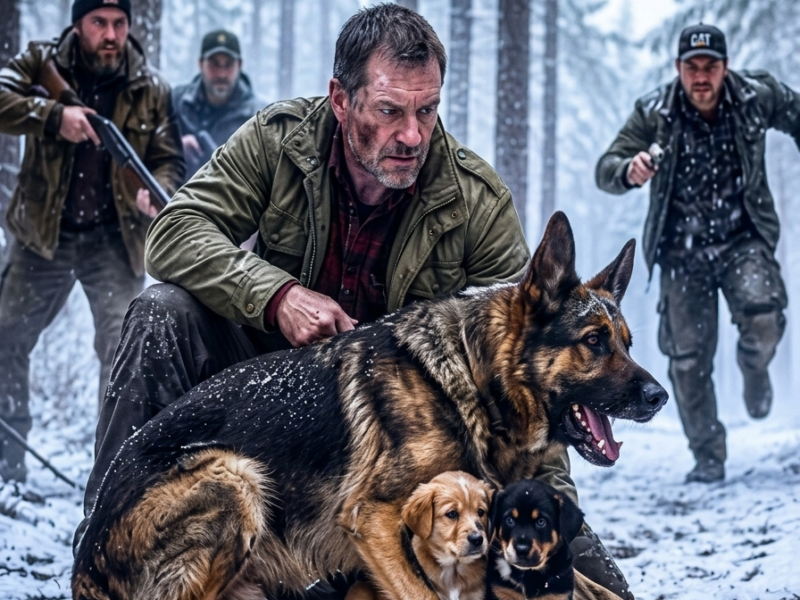
A Retired Navy SEAL Found an Injured K9 Protecting Two Helpless Puppies From Ruthless Hunters
The snow crunched beneath my boots as I stepped out from behind the towering pine trees, the freezing Montana wind whipping across my face.
“Put the guns down,” I ordered.
The taller hunter laughed, lowering his rifle just enough to look at me with arrogant amusement. “Keep walking, old man. This isn’t your business.”
I was fifty-two years old, retired from two decades of service with the Navy SEALs, and carrying enough physical and emotional scars to know when a man was dangerous. I knew these two weren’t professional soldiers—they were hired muscle, sloppy and overconfident. But what made my blood run cold wasn’t the rifles aimed in my direction.
It was the German Shepherd lying in the packed snow ten yards away.
Blood darkened the thick tan fur along her flank, pooling into the snow beneath her, and her breathing came in short, painful gasps. Yet despite her agonizing injuries, she refused to shift an inch away from the two tiny, trembling puppies pressed against her belly. Every time one of the hunters stepped closer, she lifted her heavy head, bared her red-stained teeth, and let out a low, vibrating growl. The puppies were so young they were barely old enough to open their eyes.
I recognized that kind of courage. I had seen it in teammates who kept firing their weapons long after they had taken mortal hits, holding the line so others could survive.
“Last warning,” I said, my voice dropping into the quiet, lethal register I hadn’t used in three years.
The shorter hunter sneered and swung his weapon’s barrel toward my chest.
I moved before his finger could even tighten on the trigger.
Closing the gap in two explosive strides, I drove my palm upward into his wrist, sending the rifle spinning into the air. Before he could react, I slammed an elbow into his jaw and swept his legs out from under him. He hit the frozen ground with a hollow thump, his breath leaving him in a white cloud. I caught the falling rifle, racked the bolt to clear the chamber in one fluid motion, and hurled the weapon forty yards into the deep powder.
The taller hunter stumbled backward, his bravado instantly evaporating as he realized the gray-haired stranger standing in front of him was anything but an easy target.
“Who sent you?” I demanded, stepping between him and the injured dog.
Neither man answered. The short one groaned, clutching his shattered jaw in the snow.
The taller hunter glanced nervously toward the bleeding Shepherd and muttered, “We were just told to finish the job. Clean up the loose end.”
Those words chilled me far more than the sub-zero mountain wind.
I ignored them, kneeling slowly beside the wounded dog. I lowered my center of gravity, making myself small, and extended an open, uninjured hand. “It’s okay, girl. Easy. I’m not going to hurt you.”
She bared her teeth at first, a warning rumble shaking her chest. But as I leaned closer, her nose twitched. She smelled the familiar scent of military oil, gun cleaning solvent, and something instinctual. Her eyes locked onto the faded, weathered Navy SEAL trident patch sewn onto the shoulder of my tactical jacket.
Her entire expression changed. The hostile posture vanished, replaced by a heartbreaking look of desperate recognition. She crawled toward me, dragging her useless hind leg through the snow, trembling violently, and pressed her cold, wet muzzle directly into my palm.
I looked down at her collar. Tucked beneath her frozen, matted fur was a tarnished brass tag.
My heart stumbled against my ribs as I wiped away the grime to read the engraving: K9 RANGER — U.S. NAVY.
My breath caught in my throat. I knew that name.
Three years earlier, Ranger had been assigned to my Special Operations unit during a clandestine raid in the mountains of Eastern Europe. She had saved my life when a rogue artillery strike collapsed a mortar building on top of me, digging through burning rubble with raw, bloody paws until the extraction team could pull me out.
But our official after-action report claimed Ranger had been killed during the emergency evacuation. I had personally attended her memorial service at the base chapel. I had held her photo in my hands, blamed myself for her death, and carried that quiet guilt into my sudden retirement.
Now here she was, bleeding to death in the middle of the Montana wilderness, shielding two helpless puppies from men who had been ordered to erase her from existence.
“I’ve got you, Ranger,” I whispered, tears threatening to freeze on my eyelashes. I carefully reached down to lift her into my arms. She whimpered softly from the searing pain in her side, but she didn’t resist.
When I reached down to collect the two shivering puppies, Ranger suddenly caught the heavy canvas of my sleeve between her teeth, pulling hard, dragging me toward a narrow, obscured game trail that disappeared into the thick timber.
“Easy, Ranger. I’m getting them.”
She released my jacket, looked deep into my eyes, and did something that turned my blood to absolute ice. She dragged her broken body several feet forward onto the hidden trail, collapsed beside a half-buried, snow-draped military rucksack, and began frantically scratching at its heavy nylon straps.
I rushed to her side and unbuckled the main compartment. Inside, wrapped securely beneath a bloodstained thermal blanket, I found a heavy, waterproof document pouch bearing the classified emblem of my former unit—Naval Special Warfare Group 2.
My hands trembled uncontrollably as I broke the plastic seal and pulled out the contents.
The first page was an unredacted tactical mission report dated three years earlier—the very night of our disastrous final operation. The second page contained a high-resolution surveillance photograph of Ranger resting inside a hidden cabin, standing beside a man whose face was etched into my soul. A man I had watched get carried away in a fireball after an insurgent RPG struck our lead vehicle.
Lieutenant David Cole. My best friend. My second-in-command. Declared dead on that same tragic night.
At the bottom of the classified page, written in jagged, frantic black ink, was a single handwritten sentence: If Ranger made it back, David is still alive.
A dry pine branch snapped sharply behind me.
I spun around, dropping my hand instinctively to the SIG Sauer P226 holstered at my hip. The two hunters were nowhere to be seen—they had fled into the forest.
In their place stood a third man, wearing a high-end black tactical jacket, night-vision mounts on his helmet, and holding a suppressed 9mm pistol pointed directly at my chest. His posture was military, his eyes completely devoid of human warmth.
He looked down at the waterproof envelope in my trembling hands, then lifted his eyes to meet mine. A faint, cruel smile touched his lips.
“Commander Miller,” he said quietly, his voice calm and icy. “You were never supposed to find that dog.”
Ranger growled, struggling with every ounce of her remaining strength to drag herself back up between us, her injured body shaking violently as she attempted to shield the puppies one last time.
The man raised his pistol, taking precise aim at my forehead.
And then, from somewhere deep within the dense, dark shadows of the forest behind him, a voice rang out through the freezing air—a voice I had buried alongside my best friend three years ago.
“Drop the weapon, Lawson,” the voice echoed, crisp and commanding. “Or I blow your head off right now.”
The man in the black tactical jacket—Lawson—didn’t flinch, but his eyes narrowed. “You’re outnumbered, Cole. You know how this ends.”
“Maybe,” David’s voice drifted from the thick timber to our left, sounding entirely calm, entirely detached. “But you won’t live long enough to see it.”
Before Lawson could react, a deafening crack shattered the silence of the mountain. A high-caliber sniper round tore through the air, striking the snow six inches from Lawson’s front boot, showering his legs in frozen debris. The shockwave of the bullet echoed off the surrounding granite cliffs like thunder.
Lawson cursed under his breath, realizing he was caught in an open field of fire. He backed away slowly, keeping his suppressed pistol trained on me, before diving into the cover of a dense thicket of fir trees. “This isn’t over, Commander!” he shouted as his footsteps receded rapidly into the forest.
I stood frozen in the snow, my heart pounding violently against my ribs.
From the shadow of a massive, snow-laden Douglas fir, a figure stepped forward into the pale winter sunlight. He wore a patched tactical smock, a worn wool cap, and carried a suppressed Remington M24 sniper rifle slung over his shoulder. He walked with a heavy, pronounced limp, his face marred by deep burn scars that stretched from his left jawline up to his temple.
But beneath those horrific scars, the piercing green eyes were unmistakable.
“David?” My voice was barely a whisper, swallowed up by the vastness of the wilderness.
David Cole offered a weary, lopsided smile—the same quiet grin he used to give me before we jumped out of C-130s into contested airspace. “You look old, Marcus.”
“You’re dead,” I breathed, taking a hesitant step forward. “I saw the vehicle explode. I saw the casualty report. I signed the paperwork, David. I carried your casket.”
“You carried an empty box, brother,” David replied, his voice dropping into a somber register. He walked over to where Ranger lay panting in the snow and dropped heavily to his knees. He ignored me for a moment, gently cupping the dog’s bloody face in his gloved hands. “Good girl, Ranger. You did it. You brought him back.”
Ranger let out a soft, contented sigh, leaning her heavy head against David’s chest.
“What is happening here?” I demanded, my shock turning into a surge of protective anger. “Who was that guy? Why were those hunters trying to kill Ranger? And why the hell have you been hiding in the Montana mountains for three years while your family thought you were burned to ash?”
David looked up at me, his green eyes dark with an ancient, unbearable weight. “Because three years ago, our unit didn’t walk into an insurgent ambush, Marcus. We walked into a hit orchestrated by our own chain of command.”
The air in my lungs felt suddenly toxic. “What are you talking about?”
“Operation Ironclad,” David said quietly. “We thought we were securing an illegal weapons cache in Eastern Europe. But the shipment wasn’t weapons. It was four hundred million dollars in unindexed federal bearer bonds—off-the-books black budget money being laundered through a private defense firm called Apex Sentinel.”
I stared at him, my mind racing back to that terrible night. “Admiral Vance was the operational commander for Ironclad.”
“Vance ran the whole show,” David confirmed, his jaw tightening. “When our team stumbled on the bonds instead of the weapons, Vance realized his retirement plan was exposed. He ordered an artillery strike on our position to bury the evidence and kill every operator who saw those crates. You survived because you were inside the stone bunker. I survived because Ranger pulled me out of the flaming humvee before it detonated.”
“If Vance wanted us dead, why didn’t he come after me?”
“Because you retired immediately after the memorial,” David explained, gesturing toward the rucksack in my hands. “You dropped off the grid, moved to this cabin, and stopped asking questions. Vance thought you were broken and harmless. But I didn’t stop. I spent two years tracking Vance’s money trail from the shadows. Six months ago, Apex Sentinel finally located my primary hideout in Idaho. I’ve been running ever since.”
David looked down at Ranger, his hands gently feeling along her wounded flank. “Three days ago, they cornered us in the valley. I got hit in the shoulder, and Ranger took a round to the side shielding me. I knew I couldn’t outrun a full Apex strike team while carrying her and the pups. So I gave her my old beacon tag, wrapped the intelligence drive in that pouch, and sent her down the mountain. I knew her instincts would drive her toward the only other person on earth she trusted.”
“She brought them to me,” I said softly, looking at the two puppies who were now sleeping soundly against my boot.
“She knew you’d protect them,” David said, his voice cracking slightly. “She brought you the key to burning Vance to the ground.”
“We need to get her out of the cold,” I said, setting aside my shock and letting twenty years of tactical discipline take over. “Her breathing is shallow. She’s losing too much blood, and those puppies won’t survive another hour in this blizzard.”
“My secondary camp is a mile up this ridge,” David said, trying to stand, but his burned leg buckled beneath him with a sharp gasp of pain. He caught himself on my shoulder.
“You’re in no shape to hike, Lieutenant,” I said firmly, slinging his sniper rifle across my back and scooping Ranger gently into my arms. “Lead the way. But you’re going to tell me everything that’s on that drive.”
David looked at me, a mixture of gratitude and dread in his eyes. “You don’t understand, Marcus. Once you read what’s on that drive, there’s no going back. You won’t just be a retired veteran anymore. You’ll be a traitor to the United States military in the eyes of the men hunting us.”
I adjusted my grip on the wounded dog and looked my dead best friend in the eye. “I’ve been dead inside for three years anyway, David. Let’s go finish the job.”
David’s secondary hideout was a masterclass in military concealment. Nestled beneath an overhang of jagged granite deep within a narrow choke-point canyon, the shelter was virtually invisible from both the ground and the air. Camouflage netting draped in heavy pine branches blocked thermal signatures, and a small, wood-burning stove vented smoke through a subterranean pipe that dispersed the ash across half a mile of snow.
The moment we stepped inside the warm, dark cabin, I laid Ranger down on a thick stack of wool blankets near the stove.
“Hold her down,” I instructed David, pulling a field surgical kit from my backpack.
For the next forty-five minutes, the cabin was silent except for the crackle of the wood stove and Ranger’s shallow breathing. Using my basic combat medic training, I cleaned her deep entrance wound, cauterized the bleeding vessels, and stitched the damaged tissue together with practiced precision. The bullet had passed through her flank without hitting any vital organs or shattering bone, but the blood loss had brought her dangerously close to death.
As I finished wrapping her torso in sterile bandages, the two puppies crawled over to their mother, whining softly until Ranger lifted her tired head and began licking them gently.
“She’s stable,” I declared, washing the blood from my hands with rubbing alcohol. “She needs rest, food, and antibiotics, but she’s going to make it.”
David sat at a rough-hewn wooden table in the corner, a glowing laptop casting a harsh blue light over his scarred face. “I wish I could say the same for us.”
I walked over and stood behind his shoulder, looking down at the screen. The waterproof envelope I had recovered from Ranger’s rucksack was now open, its digital storage drive plugged directly into the laptop.
The screen displayed an intricate network of shell corporations, offshore bank accounts, and tactical deployment manifests spanning a decade. Names of active-duty Admirals, Generals, and high-ranking defense contractors flickered in long, damning columns.
“This is bigger than Vance, isn’t it?” I asked quietly.
“Vance is just the regional manager,” David said, pointing to a highlighted node at the top of the organizational tree. “The company funding Apex Sentinel is called Aegis Holdings. They’ve been using private military contractors to stage false-flag operations in war zones, creating artificial crises to secure multi-billion-dollar government defense contracts. They’ve assassinated inspectors, bribed congressmen, and eliminated any soldier who tried to blow the whistle.”
He clicked on a folder labeled PROJECT CLEAN SWEEP.
“What’s that?” I asked.
“The kill list,” David said, his voice cold. “Every member of our old unit was on it. After they staged the ambush three years ago, the other six guys in our team died in ‘accidents’ over the following eighteen months. Car crashes, drug overdoses, suicides. Vance was systematically erasing every witness.”
My fists clenched so hard my knuckles turned white. “And Lawson?”
“Lawson is Apex’s chief of security—a former Delta operator who went merc ten years ago. He commands a specialized hunter-killer team. They’ve been tracking me across three states.” David looked up at me, his eyes filled with grim realization. “When Lawson saw you with Ranger, he realized you were connected to me. They won’t just come for us, Marcus. They’ll burn your cabin down, search the surrounding town, and execute anyone who’s ever spoken to you.”
“Then we don’t give them the chance,” I said, my voice hardening like tempered steel. “We upload these files directly to the Department of Justice and the Inspector General.”
David shook his head bitterly. “I tried that six months ago. The encryption key requires an active biometrical hand-scan from a high-ranking military authority to bypass the military firewall. If I attempt to upload it without the key, the entire drive self-encrypts and wipes itself permanently.”
“Who has the key?”
David clicked a final image onto the screen. It was an official military profile photograph of a three-star Admiral standing on a podium at Naval Air Station Whidbey Island, Washington.
Admiral Thomas Vance.
“Vance keeps a secure mobile command server at his private estate near Flathead Lake, forty miles from here,” David said. “That’s where he authorizes Apex operations. If we want to unlock this drive and send the evidence to the federal courts, we have to get inside that estate and use Vance’s own biometric terminal.”
I stared at the photograph of the man who had ordered my team executed, the man who had stolen three years of my life and left my best friend living like a hunted animal in the mountains.
“Forty miles,” I murmured. “In a blizzard.”
Suddenly, a red warning light on David’s console began to flash frantically. An audible electronic beep filled the cabin at two-second intervals.
David lunged for the keyboard, his fingers flying across the keys. “Thermal perimeter alarm at the ridge entrance! They found the snow trail!”
I walked over to the cabin’s small observation slit and pulled back the canvas cover.
Through the thick, swirling white snow of the gathering blizzard, several dark figures were moving down the canyon wall in tactical formation. They were equipped with snowmobiles, heavy automatic weapons, and thermal imaging gear.
At the head of the formation rode Lawson.
“How long until they reach the choke point?” I asked, pulling my SIG Sauer from its holster and checking the magazine.
“Five minutes,” David replied, pulling a heavy tactical vest over his injured shoulders. “Marcus, you need to take Ranger, the puppies, and the drive, and leave through the rear escape tunnel. I’ll stay here and draw their fire.”
I turned around and grabbed David by the front of his tactical vest, pulling him up until his face was inches from mine. “Three years ago, I thought I left you behind to die, David. I carried that burden every single day of my life. I am not leaving you behind again. We fight together, or we die together. Is that clear?”
David stared at me for a long moment, the haunted look in his eyes slowly dissolving into the fierce, unyielding resolve of a Navy SEAL.
“Crystal, Commander,” David said, a ghost of a smile appearing on his face. “So what’s the plan?”
I looked toward the corner where Ranger was watching us with bright, intelligent eyes, her puppies tucked safely against her side.
“We stop running,” I said. “And we turn this mountain into a graveyard.”
The blizzard hit the canyon with apocalyptic force, turning the world into a howling vortex of ice and blinding white snow. Visibility was down to less than ten feet, but for two former Special Operations veterans, the storm wasn’t an obstacle—it was the ultimate force multiplier.
“Lawson’s team has six men including himself,” David whispered, crouching behind a parapet of frozen rock thirty feet above the canyon floor. He adjusted the night-vision scope on his M24 sniper rifle. “They’re using thermal optics, so they’ll see our body heat if we stay in the open.”
“Then we make sure they look at the wrong thermal signatures,” I replied.
Ten minutes earlier, I had set up three improvised heat decoys along the floor of the canyon—road flares wrapped in aluminum foil and buried inside old tactical coats. On thermal imaging gear, they would look exactly like three men crouching in defensive positions.
Below us, the high-pitched whine of snowmobile engines cut through the roaring wind.
Two tactical snowmobiles rounded the bend of the narrow canyon, their heavy halogen headlights cutting yellow beams through the whiteout. Four men walked behind them on foot, moving in a tight wedge formation with suppressed rifles raised.
Lawson was in the center, holding a handheld thermal monitor.
“I’ve got three thermal signatures near the cabin door!” one of the mercenaries called out over his radio, his voice picked up by the directional microphone David had set up along the rocks. “Looks like they’re preparing an ambuscade!”
“Take them out! Move in!” Lawson ordered.
The two lead snowmobiles accelerated down the center of the canyon, opening fire with mounted machine guns. Tracers lit up the blizzard, chewing into the snow banks where my decoys were buried. Heavy rounds tore through the tactical coats, igniting the hidden road flares in a sudden, blinding flash of magnesium fire.
“It’s a trap!” Lawson screamed, realizing his mistake instantly. “Pull back! High ground!”
“Now!” I barked.
David squeezed the trigger of his sniper rifle. The suppressed round made a soft thwack, and the driver of the lead snowmobile slumped forward, his vehicle veering wildly out of control and slamming at forty miles an hour into a granite boulder. The snowmobile exploded in a brilliant fireball, illuminating the canyon walls.
I leaned over the ledge with my assault rifle and fired controlled, three-round bursts into the second snowmobile’s engine block. The engine seized instantly, throwing its rider over the handlebars into the deep powder.
“Return fire! Upper ridge!” Lawson roared, dropping behind a rock and blind-firing his automatic rifle upward.
Bullets pinged off the rock face above us, showering us with stone splinters and ice.
“I’m moving down to cut off their retreat!” I yelled to David over the deafening noise. “Keep them pinned behind those rocks!”
“Go!” David shouted, cycling the bolt of his rifle and dropping another mercenary who tried to break for cover.
I dropped down a hidden ice chute at the back of the ridge, sliding fifteen feet down into the canyon floor behind the enemy formation. The snow was knee-deep, muffling my footsteps completely.
Through the swirling smoke and snow, I spotted two Apex mercenaries huddled behind the burning wreckage of the snowmobile, frantically reloading their weapons.
I advanced rapidly from their blind spot. I hit the first man with a heavy butt-stroke from my rifle to the back of his helmet, knocking him unconscious into the snow. The second man spun around, raising his sidearm, but I seized his wrist, twisted it violently to break his grip, and drove my combat knife deep into his tactical vest plate, sweeping his leg to take him down.
Within thirty seconds, four of the six mercenaries were neutralized.
“Marcus! Look out!” David’s voice crackled over my tactical earpiece.
A heavy impact slammed into my back, throwing me headfirst into the freezing snow. Lawson had flanked around my position, using the smoke from the burning vehicle as cover.
My rifle flew from my grip, disappearing into the powder.
Before I could recover, Lawson drove his heavy tactical boot into my ribs, sending a searing wave of pain through my side. He lunged downward, plunging a serrated combat knife toward my throat.
I caught his wrist with both hands inches from my neck, the razor-sharp blade hovering agonizingly close to my skin. Lawson grinned down at me, his eyes bloodshot with adrenaline and rage.
“You should have stayed retired, Commander,” Lawson growled, putting his full body weight behind the blade. “You’re old. You’re slow.”
“Maybe,” I gasped, fighting the downward pressure with everything I had left. “But I’m not alone.”
From out of the blinding white haze of the blizzard, a golden streak shot across the snow.
A low, terrifying roar echoed through the canyon as Ranger—her side still heavily bandaged, her eyes blazing with fierce, protective fury—leaped through the air. She didn’t hesitate. She locked her powerful jaws directly onto Lawson’s right forearm, the arm holding the knife.
Lawson screamed in agonized shock as the hundred-pound German Shepherd dragged him violently off me. The knife tumbled harmlessly into the snow.
“GET THIS DAMN DOG OFF ME!” Lawson shrieked, striking wildly at Ranger’s side with his left fist.
Ranger refused to let go, shaking her head with ferocious strength, pinning Lawson’s arm to the frozen ground.
I scrambled to my feet, grabbed a heavy granite rock from the snowbank, and drove it with all my strength into the side of Lawson’s helmet.
The mercenary’s eyes rolled back, his body going completely limp in the snow.
Silence returned to the canyon, broken only by the howling wind and Ranger’s heavy, victorious panting.
David limped out from the shadow of the rocks above, holding his sniper rifle at his hip, his jaw dropping in disbelief as he looked down at Lawson’s unconscious body, then at Ranger.
“I thought I locked her inside the back room of the cabin,” David said, stunned.
I dropped to my knees, pulling Ranger into a fierce, tearful embrace, being careful of her wounded side. She buried her cold nose against my neck, tail thumping weakly against the snow.
“You can’t lock up a Navy SEAL, David,” I said softly, looking up at him with a grin. “Especially not a four-legged one.”
Twelve hours later, as the storm finally broke and the first golden light of dawn crested the majestic snow-capped peaks of the Montana Rockies, a convoy of four unmarked black SUVs pulled up to the gated perimeter of Admiral Thomas Vance’s private sixty-acre estate on the shores of Flathead Lake.
Inside the estate’s lavish, glass-walled study overlooking the frozen lake, Admiral Vance stood before his mahogany desk, pouring himself a crystal glass of scotch. He was a tall, distinguished man in his late fifties, wearing a sharp military uniform adorned with ribbons and stars.
His encrypted satellite phone rang on the desk. He picked it up on the second ring.
“Report, Lawson,” Vance said calmly. “Is the dog dead?”
“Lawson isn’t coming to the phone, Admiral,” a cold, familiar voice replied over the speaker.
Vance froze, the crystal glass stopping inches from his lips. His political composure cracked for a fraction of a second. “Marcus?”
“I’m standing in your driveway, Vance,” I said softly. “And I brought a few old friends.”
Vance smashed the phone onto the desk and lunged for the intercom button to alert his private security detail. “Security team one and two, breach in the front driveway! Eliminate all intruders!”
Static crackled over the intercom speaker. Then a different voice answered—the calm, authoritative voice of the Director of the Federal Bureau of Investigation.
“Stand down, Admiral Vance,” the voice announced over the estate’s PA system. “Your security team has already been disarmed and taken into custody. Federal agents have secured the perimeter of your home.”
Vance stumbled back against his mahogany desk, his face draining of all color. “What… what is this?”
The heavy double oak doors of his study were thrown wide open.
I walked into the room first, wearing my tactical jacket, my SIG Sauer holstered at my hip. Beside me walked David Cole, leaning on a wooden cane but standing tall, his green eyes fixed on the man who had ordered his death three years earlier.
And walking proudly between us, her head held high and her tail wagging slowly, was Ranger. The two puppies rode safely inside a fleece-lined pouch strapped across David’s chest.
Behind us stood a dozen heavily armed FBI tactical agents, their weapons trained on Vance.
“Cole?” Vance whispered, his voice trembling violently as he stared at the scarred face of the soldier he thought he had murdered. “You’re… you’re dead.”
“I was,” David said, stepping forward until he stood three feet from the desk. “Unmarked grave in Afghanistan. No name. No memorial. Just like you planned.”
David reached into his coat, pulled out the waterproof drive, and slammed it onto the mahogany desk in front of Vance.
“Put your hand on the biometric scanner, Admiral,” David ordered, his voice carrying the weight of six murdered teammates. “Unlock the firewall.”
Vance looked at the drive, then at the FBI agents surrounding him. He knew it was over. The private contractors were gone. The cover-up had collapsed. His empire of greed and blood had reached its final, unavoidable wall.
With shaking fingers, Vance reached down and pressed his right palm against the glowing blue scanner attached to the drive’s casing.
A soft chime echoed through the room: BIOMETRIC IDENTITY CONFIRMED. DECRYPTION COMPLETE. TRANSMITTING FILES TO FEDERAL GRAND JURY.
A senior FBI agent stepped forward, pulling a pair of steel handcuffs from his belt. “Admiral Thomas Vance, you are under arrest for high treason, conspiracy to commit murder, and misappropriation of federal defense funds. You have the right to remain silent.”
As the agents slapped the cold steel cuffs around Vance’s wrists and led him out of the room, the disgraced Admiral turned to look at us one last time. His eyes lingered on Ranger, who sat beside my leg, her dark brown eyes watching him with quiet, unyielding judgment.
“That damn dog,” Vance muttered under his breath, his voice laced with bitter disbelief. “A multi-million-dollar operation… destroyed by a stray dog.”
“She was never a stray, Vance,” I said, stepping between him and the dog. “She’s a Navy SEAL. And she never leaves a man behind.”
Three months later, the spring sun shone warm and bright across the green, rolling hills of my Montana ranch.
The air was fresh, filled with the scent of pine needles and melting snow. A newly constructed wooden porch ran the entire length of my cabin, overlooking a wide, fenced pasture where two energetic, three-month-old German Shepherd puppies were chasing a red rubber ball through the tall grass.
Ranger lay in a patch of warm sunlight on the porch, her side fully healed, her coat thick and glossy once again. She watched her puppies with lazy contentment, letting out a soft, satisfied sigh.
The screen door opened, and David stepped out onto the porch, carrying two steaming mugs of coffee. His leg had healed significantly with physical therapy, and the dark shadow that had haunted his eyes for three years was finally gone. Full federal pardons had been issued, Vance and his co-conspirators were facing life sentences in federal prison, and David’s military record had been fully restored with high honors.
He handed me a mug and leaned against the wooden railing, looking out over the mountains.
“Federal Inspector called this morning,” David said, taking a sip of coffee. “They’re officially naming the new K9 training facility at Naval Special Warfare Group 2 after Ranger.”
I looked down at the old Shepherd resting at our feet. “It’s about time she got the recognition she earned.”
Ranger lifted her head, her ears pricking up at the sound of her name. She stood up slowly, walked over to where David and I were standing, and pressed her soft muzzle first against David’s hand, then against mine.
I knelt down, wrapping my arm around her shoulder and running my hand along her back, feeling the solid, reassuring rhythm of her breathing.
We had lost a lot of good men in the shadows of forgotten wars. We had carried scars that time would never fully erase. But as I looked out across the sunny Montana valley, watching the puppies play under the watchful eye of the dog who had saved us all, I knew the long night was finally over.
We were home. And we were free.
The end.









