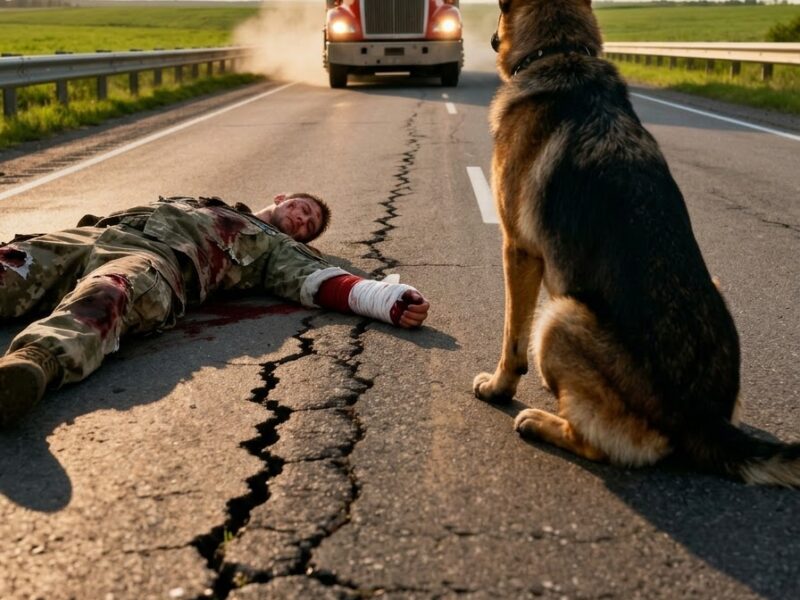
A German Shepherd suddenly threw himself into the middle of a busy highway in Denver, forcing cars to screech to a stop while his owner lay trapped somewhere nearby
The twilight over Denver was not a soft transition; it was a brutal bruise of violet and ash. Winter was settling into the bone of the Front Range, bringing with it a biting, dry wind that swept off the Rockies and scoured the concrete of Interstate 70.
I was forty minutes into my commute home, driving my beat-up F-150 with the heater blasting a feeble stream of lukewarm air against my boots. The traffic was the usual evening monster—a dense, aggressive river of steel, headlights cutting through the descending gloom, exhaust fumes hanging like gray ghosts in the freezing air. My mind was miles away, weighed down by the quiet, heavy monotony of a long workweek.
Then, the world shattered into red tail lights and screaming tires.
Fifty yards ahead of me, a dark sedan violently swerved into the shoulder, its tires kicking up a cloud of gravel and sparks. The SUV in front of me slammed on its brakes, the smell of burning rubber immediately filling my cab as my own tires locked up. I threw my hands against the steering wheel, bracing for impact, my heart hammering against my ribs like a trapped bird.
We stopped inches from the bumper in front of us.
“What the hell?” I muttered, leaning forward, my breath fogging the windshield.
Honking exploded down the line—a chorus of furious, impatient horns echoing through the cold evening air. Drivers were leaning out of their windows, shouting curses into the dusk. But as the traffic slowed to a agonizing crawl, the reason for the chaos revealed itself.
Standing dead center in the middle lane was a dog.
He was a massive German Shepherd, his thick, dark coat matted with burs and streaks of dry mud. He wasn’t running. He wasn’t cowering. He stood perpendicular to four lanes of lethal traffic, his broad chest rising and falling in heavy, desperate heaves. Cars roared past him, missing his tail by inches, the wind of their passage blowing his fur flat against his sides. Yet he remained anchored to the asphalt, utterly fearless, or perhaps simply past the point of caring about his own survival.
“Get out of the road, idiot!” a trucker yelled, blasting a air horn that vibrated through the frame of my truck.
The dog didn’t even flinch. His head snapped toward my high beams.
Through the cracked glass of my windshield, our eyes met. It was an terrifyingly intelligent look—not the panicked, glassy gaze of a lost stray, but a desperate, furious demand. He locked his sight onto my face, took three heavy steps toward my front bumper, and barked. It wasn’t a warning growl; it was a rough, tearing sound that rattled through the icy air.
He ran three yards toward the dark, wooded shoulder of the highway, stopped, spun around, and looked back at me. When I didn’t move, he charged back to my driver’s side door, his black nose pressing against the glass.
“Hey! Buddy, what’s wrong with you?” I rolled the window down a crack, the sub-zero wind biting my cheek. “Get off the highway! You’re gonna get killed!”
He didn’t bark this time. Instead, he reared up, planting two massive, muddy paws onto the door frame. He thrust his muzzle through the narrow opening of the window, grabbed the rough canvas of my heavy work jacket in his jaw, and pulled.
The sheer strength of the animal rocked the truck. He let go, landed back on the pavement, and let out another raw, agonized bark, sprinting toward the tree line before turning once more to check if I was following.
Something cold settled in the pit of my stomach. This wasn’t rabies. This wasn’t a stray playing in traffic. This was a tactical maneuver.
“Damn it,” I swore aloud.
I threw the truck into park, slammed on the hazard lights, and stepped out into the freezing night. The moment my boots hit the crunching gravel of the shoulder, the dog was at my side. He didn’t bite now. He shoved his massive head against my thigh, physically pushing me toward the steep, pitch-black embankment that sloped down from the highway into a dense wall of scrub oak and pine.
The traffic behind us continued to roar, a blur of yellow and red lights, but as I stepped off the shoulder and into the shadows, the noise of the highway began to muffle. The air grew instantly colder, thick with the scent of damp earth, pine needles, and something else—something sharp and metallic.
“Where are we going, boy?” I whispered, my breath visible in the dark.
The dog didn’t hesitate. He plunged down the steep slope, his powerful body slipping through the brush with practiced ease. I slid down after him, my heels digging into the freezing mud, grabbing at frozen branches to keep from tumbling head over heels into the blackness below.
Ten feet down. Twenty feet. The highway was gone now, replaced by the towering dark silhouettes of trees and the whistling of the mountain wind.
Then, the dog stopped. He sank low to the ground, his ears flattened, and released a low, continuous whine that sounded hauntingly human.
I froze, listening through the roar of the wind in the pine needles.
At first, there was nothing. Just the cold.
Then, beneath the rustle of dry leaves, I heard it. A sound so faint, so delicate, it made the hair on the back of my neck stand up.
A sharp, gasping sob. Followed by the wet, rhythmic crying of a baby.
I dropped to my hands and knees in the mud, pushing through a dense thicket of wild rose bushes, ignoring the thorns tearing at my jacket. The ground gave way to a steep, rocky ravine. At the very bottom, smashed upside down against the massive trunk of a fallen Douglas fir, was the crushed, dark wreckage of a full-sized SUV.
The vehicle was almost unrecognizable. The roof had been flattened down to the window line, the frame twisted like a discarded aluminum can. Steam was still hissed lazily from the shattered radiator, rising into the freezing night air like a ghost. One headlight was cracked but still flickering faintly, throwing long, terrifying shadows across the crumpled steel and shattered glass scattered across the ravine floor.
“Hey!” I screamed, my voice cracking as I half-slid, half-fell down the final rocky descent. “Is anyone in there? Can you hear me?”
The German Shepherd was already down there. He didn’t bark now. He scrambled over the broken glass, ignoring the jagged metal tearing at his paws, and thrust his upper body through the shattered driver’s side window. He began licking frantically at the exposed, blood-streaked face of a man slumped over the deflated airbag.
I reached the wreck, my hands trembling violently as I pulled my phone from my pocket. No service. One bar flickering, then dying completely in the depth of the ravine.
“No, no, no, come on,” I muttered, moving toward the front seat.
I leaned through the destroyed window frame. The odor inside the cabin was terrifying—a mixture of copper, spilled gasoline, and hot engine oil.
The driver was a man in his early thirties, his face pale beneath streaks of dark, drying blood. His legs were pinned beneath the crushed dashboard, his body twisted at an unnatural angle.
“Sir! Sir, can you hear me?” I reached in, pressing two fingers against his neck. His skin was ice cold, but his pulse was there—faint, fast, and thready.
At the sound of my voice, his eyelids fluttered open. His eyes were unfocused, glassy with severe shock. He looked at me, then at the German Shepherd whose wet nose was pressed against his cheek.
“P-Please…” the man gasped. The breath rattled in his chest like loose stones. “The… the back…”
“Don’t talk. I’m getting help,” I said, turning to look at the passenger side.
A woman was slumped against the door, her head tilted back at an awkward angle against the B-pillar. She was completely unresponsive, her face ghostly white, a thin line of blood trickling from her hairline down her pale throat. I reached over the console, checking her wrist. Her pulse was barely noticeable, fluttering like a dying moth.
Then, the sound came again from the back seat.
A high-pitched, frantic wail.
My heart slammed against my ribs. I scrambled around the side of the overturned vehicle, pulling at the rear door handle. It was locked, the metal fused together by the violent force of the impact.
“Hang on!” I roared, picking up a heavy, sharp rock from the ravine floor. I struck the rear quarter-panel window three times before the safety glass spiderwebbed and caved in.
I cleared the sharp edges with my gloved hand and shone my phone’s dim flashlight into the cavernous, inverted rear compartment.
Suspended upside down in a heavily reinforced car seat was an infant—a baby no more than six months old, strapped tight, crying frantically with a face flushed bright red. The car seat had saved the child’s life; the roof had crushed downward, but stopped just inches from the plastic shell.
“I see you, little one. I see you,” I breathed, tears pricking my eyes from the sheer adrenaline and relief.
I hauled myself up the steep embankment, scrambling on all fours until my phone caught two weak bars of cellular signal near the lip of the ridge.
“911, what is your emergency?”
“I have a major rollover accident off I-70, about two miles past Exit 254!” I yelled into the receiver, my voice raw. “A car went down the ravine! Three trapped—two adults, one baby! They’re crushed in there! Send heavy rescue! Send everyone!”
“Sir, stay calm. First responders are being dispatched. Are you with the victims?”
“Yes! Hurry! It’s freezing out here, and the car is leaking gas!”
I shoved the phone into my pocket and slid back down into the pit. The German Shepherd was standing guard by the driver’s side, his massive head resting on the chest of the dying man. Every few seconds, the dog would let out a low, mournful whine, nudging the man’s chin with his nose, fighting to keep his master conscious.
“Hold on, buddy,” I whispered to the man, taking off my heavy work jacket and draping it gently over the shattered driver’s side door to block the freezing wind that was whipping down the canyon. “Help is coming. Just hold on.”
Ten long, agonizing minutes passed. The woman’s breathing grew shallow. The baby’s cries in the back began to fade from a roar to a raspy, exhausted whimpering that broke my heart.
Above us, the night suddenly exploded with color. Red and blue strobes bathed the tops of the pine trees in pulsating light. The sound of heavy diesel engines and blaring sirens cut through the wilderness.
“Down here!” I screamed, waving my flashlight wild into the darkness. “Down in the ravine!”
Flashlights pierced the gloom above. A team of four firefighters, laden with heavy ropes, medical kits, and hydraulic tools, dropped over the edge, scrambling down the loose dirt toward the crash site.
“Got a male driver, trapped! Unresponsive female! One infant in the rear!” I shouted to the lead paramedic as he reached the wreck.
“Good job, man. Step back, let us work,” the paramedic said, immediately ducking his head into the front cabin to assess the victims.
The rescue operation was frantic. The incline was too steep, the mud too slick. The fire chief was up on the ridge shouting orders over a radio, calling for a heavy winch truck to secure the wreckage so it wouldn’t slide further down into the riverbed below.
The paramedic stepped back out, his face grim. “Female is slipping fast. Internal bleeding. We need the jaws of life down here right now!”
Just as two more firefighters began hauling a heavy hydraulic pump down the slope, a sudden, sharp movement caught my attention.
The German Shepherd had snapped his head toward the deep, pitch-black woods further down the ravine—away from the crash, away from the flashing lights, deeper into the dense, untouched wilderness.
He raised his snout, his nostrils flaring wild.
Then, without a sound, he turned his back on his dying owners and bolted directly into the blackness.
“Hey! Dog! Come back!” I screamed, taking a step toward the treeline.
“Leave him!” one of the firefighters yelled above the deafening roar of the hydraulic generator starting up on the ridge. “We need to clear this door! Stand back!”
“He’s running off!” I shouted, but the crew was already fully engaged. The metallic screeching of the hydraulic jaws biting into the SUV’s door frame drowned out my voice.
I looked toward the black wall of trees where the dog had disappeared. Why would he leave now? He had risked his life standing in traffic to bring me here. He had stayed by his master’s side like a statue until the medics arrived. A trained, fiercely loyal dog wouldn’t just abandon his family in their final moments—not unless something else was desperately wrong.
I grabbed my flashlight from the mud and stepped away from the blinding red lights of the rescue scene.
“Bear!” I called out, using the generic term, my voice swallowed by the thick evergreen branches. “Hey, boy!”
Nothing. Only the howling of the wind through the high canopy and the distant crunch of steel being pried apart behind me.
I pushed deeper into the brush, stepping blindly through snowdrifts and frozen mud. The light from the crash site faded into faint, flickering shadows behind me.
Fifty yards away from the wreck, deep in the absolute pitch of the woods, I heard it.
A bark. Short, sharp, and frantic.
“Bear!” I ran, tripping over a buried root and slamming my knee into a rock. I scrambled up, ignoring the sharp pain, and shone my narrow beam of light forward.
The German Shepherd was standing near the base of a massive, rotted oak tree that had collapsed years ago, creating a small hollow beneath its trunk. He was digging feverishly at the dirt and frozen snow, his front paws moving like pistons, sending clouds of icy debris flying behind him.
“What do you have, boy?”
He stopped digging, jammed his snout beneath the log, and grabbed something soft in his jaws. He pulled backward with extreme, delicate care.
I rushed forward, dropping to my knees beside him, sweeping my flashlight beam over the ground.
The dog dropped his cargo gently onto a bed of dry pine needles.
My breath caught in my throat. My hands went completely numb.
It was a small, pink fleece blanket, thoroughly soaked with mud and snow. Wrapped tightly inside it was a second infant—a baby barely smaller than the one still trapped in the back seat of the car. Twins.
The baby was completely still. Its face was pale, its lips a sickening shade of blue from the exposure to the freezing mountain air.
“Oh God, no,” I whispered, my fingers trembling as I reached down.
The impact must have ejected the portable infant carrier through a shattered window during the rollover, sending it tumbling dozens of yards into the deep woods. The dog had found the baby, worked the child free from the plastic shell, and dragged the bundle beneath the log to shield it from the wind.
I ripped off my sweater, wrapping it instantly around the frozen blanket, pulling the tiny body tightly against my chest to share my own body heat.
“Firefighter! Paramedic!” I screamed at the top of my lungs, turning back toward the crash site. “I need a medic down here! NOW!”
The dog didn’t wait for them. The moment he saw me cover the second baby, he let out a low, anxious huff, turned around, and began sprinting deeper into the dark canyon.
“Wait! No! Bear!” I yelled, struggling to stand with the baby clutched against my chest.
Through the trees, I saw his dark silhouette bounding through the deep snow, moving parallel to the path the SUV must have taken as it vaulted off the highway.
A firefighter came crashing through the thicket behind me, his heavy boots crushing the brush. “What’s going on? What did you find?”
“A second baby!” I cried, handing the wrapped bundle into his arms. “Take it! Get it to the heated rig right now! It’s severe hypothermia!”
The firefighter looked down at the tiny face, his eyes widening in absolute shock. “Jesus Christ… the driver never said there were twins!”
“He couldn’t speak! He’s in shock!” I gasped, turning back toward the pitch-black wood. “There’s something else! The dog is still hunting!”
“Sir, wait! Don’t go deeper out there without a radio!” the firefighter shouted, but I was already running.
The adrenaline coursing through my veins burned away the freezing cold. My flashlight beam danced wildly over trunks, boulders, and deep snowdrifts. I followed the fresh tracks of the Shepherd—deep, desperate paw prints plunging into the untouched snow.
He was heading toward the lowest point of the ravine, where a frozen creek bed cut through jagged granite boulders.
“Bear!” I shouted, my lungs burning with the thin mountain air.
Up ahead, a low, continuous whining sound echoed off the rock walls.
I burst through a thick patch of icy briars and stopped dead.
The German Shepherd was lying completely flat on his side in a deep snowdrift at the base of a giant boulder. He had thrown his heavy, warm body over a small, motionless form in the snow, his head resting over the child’s chest, his warm breath puffing over a tiny face.
It was a young girl. No more than four years old.
She was wearing a bright red winter coat, her blonde hair matted with leaves and frozen mud. She had been thrown clear of the vehicle as it tumbled down the slope, landing far from the main wreckage.
She was completely unconscious.
I fell to my knees beside the dog.
“Good boy… good boy, Bear,” I sobbed out, my hands flying over the little girl’s body, checking frantically for a pulse, terrified of what I would find.
Her skin felt like marble. Her eyes were closed tight, her long eyelashes dusted with frost. I pressed two trembling fingers against the side of her tiny neck.
For three agonized seconds, there was nothing.
Then—thump. A faint, sluggish beat.
“She’s alive,” I breathed, tears streaming down my face, freezing on my cheeks. “She’s alive!”
The Shepherd lifted his head slowly, letting out a soft, exhausted sigh. He leaned his face against mine, nudging my cheek with his wet nose before turning his focus back to the little girl, resuming his relentless licking of her small, frozen hands. He had been lying on top of her, using his own heavy fur and body warmth to keep her core temperature from plummeting to absolute zero in the sub-freezing night.
“Hang on, sweetheart. Stay with me,” I whispered, carefully shifting her small frame into my arms, keeping her wrapped tightly alongside the dog’s body.
“Over here!” I roared toward the distant lights of the main crash site. “I need a full rescue team at the creek bed! Fast!”
Flashlights illuminated the woods as three paramedics and two state troopers crashed through the brush, carrying trauma kits and an emergency backboard.
When the lead paramedic saw the little girl cradled between me and the massive German Shepherd, he froze in sheer disbelief.
“Is that… a third kid?” the trooper gasped, dropping his heavy torch.
“A four-year-old girl. She was thrown clear!” I said, my voice shaking uncontrollably. “Hypothermic, but she has a pulse! Get her warm!”
The medical crew sprang into action with practiced, military precision. They slid an insulated heated blanket around her small body, gently transferring her onto the backboard while affixing an oxygen mask over her small face.
Throughout it all, Bear refused to give up his post. He walked alongside the stretcher as the troopers slowly hauled it up the treacherous, muddy incline, his head pressed close to the girl’s hand, his dark eyes never leaving her face.
By the time we finally scrambled back up to the shoulder of Interstate 70, the scene looked like a war zone.
Four ambulances, three fire engines, and a dozen police cruisers blocked all four lanes of traffic. The air was thick with the smell of diesel, exhaust, and flashing red lights that turned the falling snow into a brilliant, swirling fire storm.
The rescue team had finally cut the driver and the mother from the crushed SUV.
I stood on the icy pavement, shivering violently in just my thin work shirt, watching as the stretchers were loaded one by one into the back of the waiting emergency vehicles.
The mother was hooked up to IV lines, her face still pale, but a paramedic signaled a thumbs-up to the chief—she had stabilized. The first infant was crying loudly now in the back of the second ambulance—a glorious, beautiful sound that meant his lungs were working. The second infant and the four-year-old girl were loaded together into an advanced life-support unit, surrounded by heating pads and thermal blankets.
Finally, they wheeled the driver up the slope on a gurney.
He had a thick neck brace securing his head, his face heavily bandaged, an oxygen mask clamped over his nose and mouth. But he was conscious. His glassy eyes swept wildly across the chaos of flashing lights and shouting paramedics, filled with sheer, unadulterated terror.
“My… my family…” he choked out through the mask, his voice barely audible over the idling engines.
“They’re safe, sir,” the lead paramedic said, leaning down close. “All of them. Your wife, both babies, and your daughter. They’re all alive.”
The man’s eyes swelled with huge, heavy tears that spilled over his bloodied cheeks. “Three… there were three kids in the car…” he sobbed out, his hand shaking violently as he tried to lift it from the gurney. “How… how did you find them?”
The paramedic stepped aside.
Standing on the shoulder of the highway, shivering in the freezing wind, his fur soaked with mud and blood, was the German Shepherd.
The dog walked slowly toward the gurney. He placed his massive forepaws gently onto the edge of the metal frame, leaning over to press his forehead against the man’s chest.
“Bear…” the driver choked out, his hand trembling as he buried his fingers deep into the dog’s thick coat. “You saved them… oh God, Bear… you saved my babies…”
I watched from a few feet away, my hands thrust deep into my pockets, tears slipping silently down my face.
A state trooper walked up beside me, drapes a heavy wool emergency blanket over my bare shoulders.
“You did a hell of a thing tonight, son,” the trooper said softly, looking at the dog. “Most people would have kept driving.”
“I didn’t do anything,” I answered truthfully, watching the shepherd gently lick his master’s blood-stained knuckles. “He forced me to stop. He did all of it.”
The paramedic leaned down to secure the driver for transport. “We’re moving him to Denver Health Trauma Center. Who’s taking the dog?”
The trooper looked around. “Animal control will have to come pick him up until the family recovers.”
“No,” I spoke up immediately, stepping forward. “He’s not going to a shelter. I’ll take him to the hospital myself. He stays with them.”
The trooper looked at me, then down at Bear, who was staring up at me with those steady, incredibly intelligent brown eyes.
“Alright,” the trooper nodded softly. “Follow the ambulance.”
The waiting room at Denver Health was vast, sterile, and smelled heavily of antiseptic and industrial floor wax. The harsh fluorescent lighting beat down on the linoleum, casting long, tired shadows across the vinyl chairs.
It was 3:00 AM.
Bear was lying flat on the cold floor right beside my chair, his dark head resting heavily across the steel toes of my boots. A nurse had kindly brought us a large bowl of water and a stack of clean towels, which I had used to scrub the mud, snow, and dry blood from his thick coat. Every time a door opened or a shoe squeaked down the hallway, his ears would swivel, his muscles tensing, ready to leap into action.
“He hasn’t left your side,” a quiet voice said.
I looked up. A doctor in blue scrubs, looking utterly exhausted with deep dark circles beneath his eyes, was standing in the doorway of the trauma bay.
“How are they?” I asked, sitting up straight, my heart racing.
The doctor let out a long, weary breath, a faint smile breaking through his exhaustion. “It’s a miracle. I don’t use that word often, but it applies tonight. The mother has a fractured pelvic bone and a severe concussion, but no permanent brain damage. She’s stable. The twins suffered mild hypothermia, but their core temps are back up to normal. The little girl—the four-year-old—has a broken collarbone, but she’s going to make a full recovery.”
I let out a massive sigh of relief, dropping my face into my hands. “And the father?”
“He’s in the ICU. Crushed femur, internal bleeding, three broken ribs. We just finished surgery to stabilize his leg. He’s awake now. He’s demanding to see his dog.”
The doctor looked down at Bear, shaking his head in absolute wonder. “The state troopers told me what happened on the highway. If that dog hadn’t stopped you… if he hadn’t covered that little girl in the snow… those kids wouldn’t have survived another thirty minutes out there in those temperatures.”
“Can he go in?” I asked, looking down at the dog.
“Technically? Absolutely not,” the doctor said, glancing down the empty hallway before winking. “But I think the hospital policy can make an exception tonight. Follow me.”
Bear immediately stood up, his tail giving a single, heavy thump against the floor.
We walked down the long, quiet corridors of the ICU, the soft padding of Bear’s paws echoing against the pristine white walls. The doctor stopped outside Room 412 and gently pushed the heavy glass door open.
The room was quiet, filled with the rhythmic, comforting beep… beep… beep… of the heart monitor.
The father lay in the center of the room, surrounded by wires, monitors, and an IV tree. His face was pale, his right leg encased in a massive white cast suspended by traction ropes. But his eyes were open, clear, and fixed on the door.
The moment he saw the German Shepherd, his chest heaved with a quiet sob.
“Bear…” he whispered, his voice raspy and broken.
The shepherd didn’t rush. He walked over to the side of the bed with a solemn, gentle dignity, rearing up slowly on his hind legs to rest his chin gently on the edge of the mattress, right beside the man’s uninjured arm.
The father reached out his trembling, IV-strapped hand and buried his face into the dog’s thick neck, crying silently as the dog pressed his body tightly against the side of the bed.
I stood in the doorway, feeling like an intruder on a sacred moment, my throat tight with emotion.
After a few long minutes, the man lifted his head. He wiped his nose with the back of his hand and looked across the room at me.
“You’re the man from the truck,” he said, his voice thick with tears.
“I’m David,” I said softly, taking a step into the room. “I was driving behind you when… when everything went down.”
“David…” the man swallowed hard, clutching Bear’s fur. “My name is Mark. I… I don’t know how to ever repay you. The doctors told me… they said you hauled my babies out of the dark.”
“Don’t thank me, Mark,” I said, gesturing to the heavy shepherd. “He pulled me off that road. He led me straight to the wreck. He stayed on top of your daughter until the medics came. I just followed instructions.”
Mark looked down at the dog. He ran his hand over Bear’s broad head, his eyes clouding over with a strange, deep emotion—not just gratitude, but a profound, overwhelming shock that seemed to transcend the wreck itself.
“He’s an extraordinary dog,” I added softly, smiling. “You trained him remarkably well.”
Mark was silent for a long moment. The heart monitor beeped steadily in the background.
He stared at the dog’s deep brown eyes, his fingers trembling as he traced the scar tissue near Bear’s ears.
When Mark spoke again, his voice was barely a whisper, so low and heavy that the entire room seemed to drop in temperature.
“I didn’t train him, David,” Mark said softly, his voice trembling. “And… Bear wasn’t supposed to be in that car tonight.”
I blinked, confused. “What do you mean?”
Mark took a shaky breath, looking up at me with eyes wide with an uncanny terror.
“Bear isn’t my dog,” Mark whispered, tears welling up in his eyes once more. “We don’t own a dog. Bear belonged to my elder brother, Thomas.”
I frowned, stepping closer to the bed. “Your brother? Where was he?”
Mark swallowed, a single tear cutting a path through the dried blood on his cheek.
“Thomas died three years ago, David. He was killed in a car crash… on that exact same stretch of Highway 70.”
Silence fell over Room 412, absolute and suffocating.
I turned my head slowly to look at the German Shepherd standing beside the hospital bed.
Bear didn’t move. He stood tall, his dark eyes locked gently onto Mark’s face, his tail resting still, surrounded by the quiet hum of the heart monitor, watching over the family he had returned from the shadows to save.
The end.









