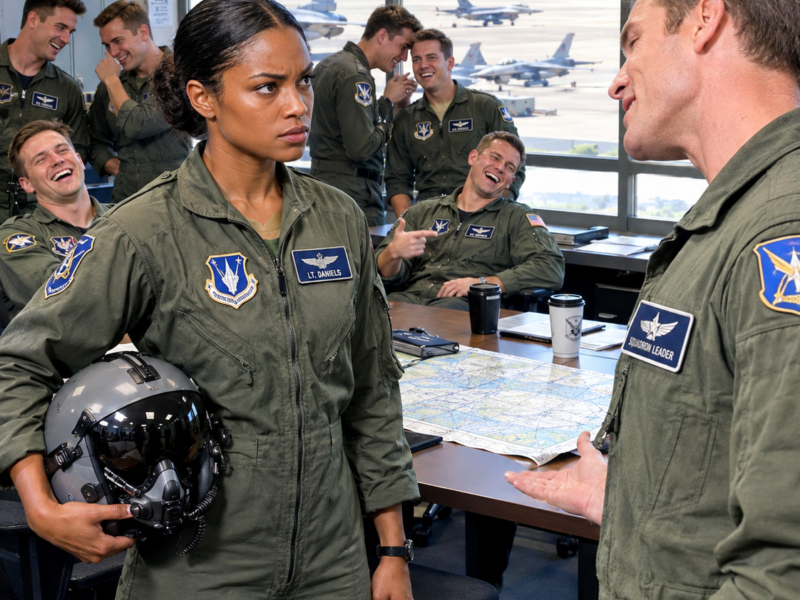
“When Squadron Leader Richard Hayes called me ‘Nobody’ in front of forty pilots at an airbase in England
The first thing I saw beneath the clouds was a thin ribbon of black smoke rising from the coastline.
I banked left, fighting the turbulence as rain swept across my canopy. The sea flashed into view beneath me, dark and restless, with white waves breaking against a line of jagged cliffs.
Then I saw him.
Hayes’s aircraft was skimming low over the water, one wing dipping dangerously toward the surface. Its propeller turned in uneven jerks, and a trail of smoke streamed from the engine cowling.
He was still airborne, but barely.
“Hayes, this is Brooks. I have visual contact. Can you hear me?”
Static.
I adjusted my heading and descended a little, careful not to let the wind push me too close to the cliffs.
“Hayes, respond.”
A burst of crackling noise filled my headset.
Then his voice came through.
“Brooks?”
“I’m here.”
“My engine’s gone. I’ve got no power, and the controls are getting heavy.”
I looked at the coastline, then at the dark water ahead of him.
“What’s your altitude?”
“Eight hundred feet. Maybe less.”
“Can you reach the beach?”
He gave a short, bitter laugh.
“Which beach? I can’t see anything through this mess.”
I could barely see his aircraft through the rain myself.
“Listen to me,” I said. “You’re heading toward the cliffs. Turn east, gently. Don’t pull hard on the stick.”
“I know how to fly an aircraft, Lieutenant.”
“Then fly it. But do what I’m telling you.”
The silence that followed told me he was deciding whether to argue.
For a moment, I thought he would.
Then his aircraft shifted east.
“Better,” I said. “Keep that heading.”
I searched the coastline for somewhere he could put the aircraft down. The cliffs were too steep, the fields beyond them hidden beneath low cloud, and the sea was too rough for a landing on the water.
Then I spotted a narrow strip of grass beyond a disused coastal radar station.
It wasn’t much of a runway. It was barely a field, really, bordered by a stone wall on one side and a line of trees on the other.
But it was flat.
And it was long enough, if he approached it correctly.
“Hayes, I have a possible landing site two miles ahead of you. You’re going to have to put it down on grass.”
“That’s impossible.”
“No, sir. It’s difficult.”
“My aircraft won’t hold a steady descent.”
“Then we’ll make the descent as steady as we can.”
I heard him breathing through the radio.
“Brooks, I can’t see the ground.”
I glanced at my instruments and began calculating our relative positions.
“You’re going to have to trust me.”
The words escaped before I could consider their irony.
For three weeks, Hayes had refused to trust me with a simple weather report. Now he was somewhere inside a storm, with a failing aircraft and a few minutes left, depending on the voice of the woman he had called Nobody.
“Give me your heading,” I said.
He did.
“Good. Reduce your turn. You’re drifting south.”
“I can’t hold it.”
“Use your rudder. Small correction. Don’t fight the aircraft.”
Another violent gust hit my plane, throwing me sideways. I gripped the controls and steadied the wings.
My father had once shown me how to correct for a crosswind in a battered training aircraft at a small airfield in Ohio. We’d spent an entire afternoon practicing approaches while he sat beside me, calm as if we were driving down a quiet road.
“Don’t wrestle with the wind, Danny,” he’d said. “Read what it’s doing. Then work with it.”
I breathed out slowly and made the correction.
Ahead, Hayes’s aircraft emerged from the clouds.
“There’s the field,” I said. “Do you see it?”
“Negative.”
“Look just to your right. Beyond the radar station.”
“I see the station.”
“There’s a green strip behind it. That’s where you’re going.”
“I can’t make that turn.”
“You don’t need a sharp turn. Keep your nose level and let the aircraft settle.”
His engine coughed again.
A dark puff of smoke burst from beneath the cowling.
“Brooks, I’m losing her.”
“You’re not losing anything yet. Keep talking to me.”
I guided him toward the field, calling out corrections as the ground rose through the rain.
He was coming in too fast.
“Reduce your descent. You’re carrying too much speed.”
“I have no engine!”
“You still have your controls. Use them.”
His aircraft crossed the outer wall, one wheel clipping the top of a wooden post. The impact twisted him sideways.
For one awful second, his left wing dropped.
“Hayes, level your wings!”
He corrected, but the aircraft was already sinking.
The wheels struck the grass.
The plane bounced once, lifted a few feet, then slammed back onto the field. It skidded across the wet ground, tore through a wooden fence, and disappeared behind a cloud of mud and broken timber.
I pulled up hard to avoid the trees.
My aircraft shuddered as I climbed away from the field, and the coastline vanished beneath my wings.
“Hayes!”
No answer.
I circled once, trying to see through the rain.
“Hayes, respond!”
Nothing.
I began another pass, my hands tightening around the controls.
Then I saw a flash of movement near the wreckage.
A figure had climbed out of the cockpit.
He staggered several steps, fell to one knee, and struggled back to his feet.
“Control, this is Brooks,” I said, forcing my voice to remain steady. “Hayes is down. I have visual confirmation that he’s alive. Requesting emergency ground support at the coastal radar station.”
The response came through with a burst of static.
“Brooks, confirm your own aircraft condition.”
“Operational.”
“Return to base immediately.”
I looked down at the tiny figure beside the wreckage.
“Negative. I’m remaining overhead until ground support arrives.”
“Lieutenant, you have already violated a direct order. Return to base.”
I watched Hayes stumble toward the remains of his aircraft, one hand pressed against his side.
“Then you can add another violation to my record.”
I turned away before the controller could answer and began the long flight back once I was certain Hayes had reached shelter near the radar station.
By the time I landed, the storm had moved east, leaving the runway slick and shining beneath the late-afternoon light.
I taxied to the hangar and shut down the engine.
For several seconds, I sat in the cockpit, listening to the ticking metal as the engine cooled.
My hands were trembling.
I pressed them against my thighs until they stopped.
When I climbed down, Eddie was waiting beside the aircraft.
He took one look at me and hurried forward.
“Are you hurt?”
“No.”
“Where’s Hayes?”
“Alive. His aircraft went down near the coast.”
Eddie stared at me.
“You went after him?”
“Yes.”
“Command ordered you back.”
“I heard them.”
He looked toward the operations building, where several officers were already gathering near the entrance.
“Danielle, they’re going to come after you for this.”
I unfastened my flight helmet.
“Then I suppose they’d better come after me for something I actually did.”
Eddie didn’t smile.
“They’re saying you abandoned your assignment and endangered another aircraft.”
I looked at him.
“I was the other aircraft.”
“I know.”
His voice softened.
“That’s why I’m telling you.”
I walked toward the building, my boots leaving damp prints on the concrete.
Inside, Squadron Leader Hayes’s empty chair stood at the head of the briefing table.
Captain James Walker, the squadron’s operations officer, was waiting with two senior officers. One of them held a clipboard against his chest.
“Lieutenant Brooks,” Walker said. “Sit down.”
I remained standing.
“Is Squadron Leader Hayes receiving medical treatment?”
“He’s been transported to the station infirmary. His injuries appear manageable.”
“Good.”
The older officer glanced at Walker before addressing me.
“You were given a direct order to return to base.”
“Yes, sir.”
“And you disobeyed it.”
“Yes, sir.”
“You understand that your decision could have resulted in the loss of another aircraft?”
“I do.”
He seemed surprised that I wasn’t arguing.
“Then perhaps you can explain why you believed your judgment was superior to that of the commanding officer.”
I thought of the smoke trailing from Hayes’s engine. I thought of his voice asking whether anyone could hear him.
“I didn’t believe my judgment was superior, sir. I believed he was still alive, and I had a chance to reach him.”
“You had no authorization to conduct a rescue.”
“There was no time to obtain it.”
“That is not your decision to make.”
I held his gaze.
“With respect, sir, the aircraft was going down while we were discussing authorization.”
Walker lowered his eyes to the papers on the table.
The older officer’s jaw tightened.
“You’re relieved of flight duty pending a formal review. Surrender your flight authorization and report to administration at eight hundred tomorrow.”
I felt the words settle over me like a heavy coat.
“Understood, sir.”
I placed my authorization card on the table.
As I turned toward the door, Walker spoke quietly.
“Lieutenant.”
I stopped.
He looked as though he wanted to say something more, but the older officer was watching him.
“Report on time tomorrow,” he said.
“I will.”
I walked out.
That evening, I sat alone in my quarters, staring at the flight authorization card I’d been given when I joined the squadron.
Without it, I couldn’t fly.
Without flying, I wasn’t certain what the next few months of my life would look like.
I had spent years proving I belonged in a cockpit, only to have that future suspended because I had refused to leave a man behind.
A knock sounded at my door.
I opened it to find Eddie holding two mugs of coffee.
“I thought you could use this.”
“Does the coffee come with a legal defense?”
“Only if you drink it before it gets cold.”
I stepped aside to let him in.
He set the mugs on my desk and noticed the authorization card.
“That bad?”
“They’ve grounded me pending review.”
Eddie pulled out the chair.
“Hayes will tell them what happened.”
I looked at the window.
“Will he?”
Eddie didn’t answer.
Neither of us needed him to explain what we already knew.
Hayes had spent three weeks making it clear that he didn’t want me in his squadron. He could tell the truth, or he could protect his reputation by claiming I’d made an unauthorized and reckless decision.
I couldn’t force him to do either.
The next morning, I reported to administration.
I expected a disciplinary hearing.
Instead, I found Hayes sitting at the end of a long table, his left arm in a sling and a bandage running along his hairline.
He looked older than he had the day before.
A doctor had cleared him to attend, though not to fly. His flight suit had been replaced with a clean uniform, and his hands rested motionless on the table.
When I entered, his eyes met mine.
For a moment, neither of us spoke.
Then he looked down at the documents in front of him.
The senior officer from the previous evening sat opposite him.
“Lieutenant Brooks, we’re conducting a preliminary review of yesterday’s incident. Squadron Leader Hayes has submitted his account of the emergency.”
I took my seat.
The officer opened the report.
“According to this statement, you ignored repeated orders to return to base, abandoned your assigned formation, and pursued an aircraft without clearance.”
“That is correct, sir.”
Hayes shifted in his chair.
The officer continued.
“Squadron Leader Hayes states that he did not authorize you to guide his aircraft to the landing site.”
I turned toward Hayes.
He wouldn’t look at me.
The officer folded his hands.
“Lieutenant, did you or did you not instruct the squadron leader to attempt an emergency landing at an improvised site?”
“I did, sir.”
“And did you have any assurance that the site was suitable?”
“I observed the field from the air. It was the only viable landing area within reach.”
“That is a subjective assessment.”
“Yes, sir.”
The officer leaned back.
“Your actions were unauthorized and may have placed both aircraft at unnecessary risk. We will consider whether your conduct warrants further disciplinary action.”
I looked at Hayes again.
He was staring at a small scratch in the tabletop.
Something inside me went quiet.
I had not expected gratitude. I had not even expected an apology.
But I had thought that a man who had trusted me with his life might at least have the courage to tell the truth about it.
“Is that all, sir?” I asked.
“For now.”
I stood.
As I reached the door, Hayes spoke.
“Lieutenant Brooks.”
I turned.
His face had gone pale beneath the bandage.
“Could you wait outside?”
The senior officer looked annoyed, but after a moment he nodded toward the corridor.
I stepped outside and closed the door behind me.
Through the narrow glass panel, I could see Hayes speaking with the officers, his hands moving as he described the landing.
Ten minutes passed.
Then fifteen.
When the door finally opened, Hayes came out alone.
He stood a few feet away from me, his injured arm held close to his body.
“I need to speak with you,” he said.
I waited.
He glanced toward the offices, then back at me.
“Not here.”
“Then where?”
He looked down the corridor toward the flight line.
“The hangar.”
I should have refused.
I had nothing to gain by giving him another opportunity to humiliate me, and I had no reason to believe he wanted to do anything except protect himself.
But something in his expression stopped me.
It wasn’t gratitude.
It wasn’t guilt, exactly.
It was fear.
I followed him to the hangar.
The building was quiet, with only a mechanic working beneath the wing of a training aircraft at the far end. Hayes led me to a small maintenance room and shut the door.
For several seconds, he stood with his back against it.
Then he reached into his uniform pocket and pulled out a folded sheet of paper.
“I need you to look at this.”
I didn’t take it.
“What is it?”
“Something I found after the crash.”
“Then give it to the investigators.”
“I can’t.”
“Why not?”
His eyes moved toward the door.
“Because I don’t know who I can trust.”
I studied him carefully.
This was the same man who had called me Nobody in front of forty pilots, who had dismissed my warnings, and who had sat through a hearing while his report made me sound reckless.
Now he was asking me for help.
“Why me?” I asked.
He unfolded the paper.
It was a maintenance record for his aircraft, dated three days before the mission.
A handwritten note had been added beneath the routine inspection entries.
FUEL FEED ASSEMBLY—UNSTABLE PRESSURE UNDER LOAD. FURTHER INSPECTION REQUIRED BEFORE NEXT FLIGHT.
The note carried a mechanic’s initials.
E. Miller.
Eddie.
I looked up sharply.
“Why do you have this?”
“It was tucked behind a panel near the instrument housing. I found it while the rescue team was examining the wreckage.”
“That doesn’t make sense. Eddie said he entered the problem in the maintenance log.”
“He did.”
Hayes unfolded a second sheet.
It was a copy of the official maintenance record.
The warning was gone.
In its place was a typed entry stating that the fuel-feed assembly had been inspected, tested, and cleared for service.
I read it twice.
The aircraft that had nearly killed Hayes had been cleared to fly despite a documented mechanical warning.
“Who signed this?” I asked.
Hayes tapped the bottom of the page.
The signature belonged to Captain James Walker, the operations officer who had sat through my disciplinary review.
I stared at the name.
“Have you shown this to anyone else?”
“No.”
“Why?”
“Because Walker told me the original warning had been a routine notation and that the aircraft had passed inspection.”
“Did you believe him?”
Hayes looked at the floor.
“I wanted to.”
The answer was so quiet that I almost missed it.
He pulled a chair away from the wall and sat down, wincing as his injured arm shifted.
“Brooks, I know what I wrote in that report this morning.”
“Then you know what you did.”
“Yes.”
He rubbed his forehead with his good hand.
“I was angry that you disobeyed me. I was embarrassed that you had to tell me how to land my own aircraft. And I was afraid that if I admitted what happened, everyone would know I had ignored a warning that could have saved me.”
“That doesn’t explain why you let them blame me.”
“No,” he said. “It doesn’t.”
He looked up at me.
“I have spent years believing that being in command means never letting anyone see you doubt yourself. I thought if I gave you an inch, the squadron would question every decision I made.”
“So you decided I was Nobody.”
He flinched.
“Yes.”
The room was silent except for the distant sound of a wrench striking metal.
I looked again at the altered maintenance record.
“Why are you showing me this now?”
“Because I don’t think the engine failure was an accident.”
The words landed between us.
I read the two documents again, looking for something I might have missed.
“You’re saying someone deliberately altered the record?”
“I’m saying the warning was removed, the aircraft was cleared, and Walker signed the clearance.”
“That proves the records were changed. It doesn’t prove why.”
“I know.”
For the first time since I’d met him, Hayes didn’t try to make his uncertainty sound like someone else’s problem.
He folded the papers carefully and placed them in my hands.
“I need you to help me establish what happened before anyone destroys the original records.”
I looked at the documents, then at him.
“You want my help after putting my career at risk.”
“I know.”
“You could have told the truth at the hearing.”
“I should have.”
I waited for him to offer another explanation, but none came.
He stood slowly.
“I can’t undo what I said to you. I can’t pretend that yesterday made me a better man. But I can stop lying about what happened.”
I held the papers tightly.
“And if the evidence shows that Walker made a mistake rather than deliberately tampering with the record?”
“Then we tell the truth about that, too.”
I looked at the maintenance note bearing Eddie’s initials.
My friend had warned us. Someone had removed the warning. And now the man responsible for my suspension was asking me to help uncover the truth.
I didn’t trust Hayes.
But I trusted the evidence enough to know we couldn’t ignore it.
“I’ll help you find out what happened,” I said. “That doesn’t mean we’re friends.”
He nodded.
“I wouldn’t ask you to be.”
When I left the maintenance room, I went straight to Eddie.
I found him in the engine bay of a transport aircraft, his sleeves rolled up and his hands covered in grease.
He saw my expression and put down his wrench.
“What’s happened?”
I showed him the two records.
He read the original warning first, then the altered clearance.
The color drained from his face.
“Where did you get this?”
“Hayes found it in the wreckage.”
Eddie looked over his shoulder toward the open hangar doors.
“Danielle, we need to talk somewhere private.”
We walked to the small office behind the tool room. He shut the door and sat down without taking off his gloves.
“I did report that fault,” he said. “I remember it because the pressure reading dropped twice during the test. I didn’t think the aircraft was ready to fly.”
“Did Walker tell you it had been cleared?”
“He said he’d arrange a second inspection.”
“Did you see the second inspection?”
“No.”
Eddie’s jaw tightened.
“The next morning, the maintenance log showed the aircraft had passed. I assumed someone had run the test while I was off shift.”
“Did you sign the clearance?”
“No. My initials are on the warning, not the clearance.”
I watched him closely.
“Who had access to the records?”
“Maintenance staff, the operations office, and anyone authorized to review the aircraft’s service history.”
“Could someone have changed the record without you knowing?”
“Yes.”
He removed his gloves and rubbed his palms together.
“But there’s something else.”
I waited.
“The fuel-feed assembly wasn’t the only aircraft component flagged that week. Two other planes had pressure irregularities. Both were cleared after Walker reviewed their reports.”
“Did either of them have engine trouble?”
“One had to abort a training flight. The pilot reported a sudden loss of power, but the engine recovered before he landed.”
A cold feeling settled in my stomach.
“Was that incident investigated?”
“Not beyond the standard maintenance review.”
I looked at the documents again.
One altered record might have been negligence. Three warnings followed by questionable clearances suggested a pattern.
But a pattern still wasn’t proof of intent.
“We need the original logs,” I said.
Eddie nodded.
“They’re kept in the records office. The daily sheets should show who accessed each file.”
“Can we get them?”
“Not without authorization.”
I almost laughed.
Authorization had become the word that stood between a man and a functioning engine, between a pilot and a rescue, between evidence and the people who needed to see it.
“Then we’ll request them,” I said.
Eddie looked doubtful.
“And if Walker refuses?”
“Then we’ll have to find out why.”
That afternoon, Hayes and I submitted a written request for the maintenance records. He signed his name beneath mine, accepting responsibility for the investigation.
Walker denied the request less than an hour later.
His response was brief: the records were under routine administrative review and could not be released until the review was complete.
I read the letter in the corridor outside his office.
“He knows we’re looking,” I said.
Hayes stood beside me, his injured arm still in a sling.
“Yes.”
“Then we need to be careful.”
He looked toward Walker’s closed door.
“I’ve spent years thinking that caution meant keeping quiet.”
“And now?”
“Now I think it might mean making sure we can prove what we say before we say it.”
That evening, Eddie found us in the empty briefing room.
He carried a small notebook filled with dates, inspection numbers, and handwritten observations.
“I’ve been keeping my own notes,” he said. “Not because I thought anyone was doing anything wrong. I just wanted to keep track of recurring faults.”
He opened the notebook to a page marked with a strip of tape.
Three aircraft identification numbers appeared beside three dates.
Hayes leaned forward.
“Those are the aircraft with the pressure problems?”
“Yes. I wrote down the inspection dates, the original readings, and who was assigned to each check.”
I traced the entries with my finger.
The dates matched the altered maintenance records.
Then I noticed a fourth number written in the margin.
Hayes’s aircraft.
Beside it, Eddie had added a short note.
SECOND TEST REQUESTED—CANCELED BY OPERATIONS.
“Who canceled it?” I asked.
Eddie hesitated.
“Walker.”
“Did he give a reason?”
“He said the first test was sufficient.”
Hayes closed his eyes for a moment.
When he opened them, he looked less angry than ashamed.
“I knew Eddie had raised a concern,” he said. “I told him to stop worrying about it.”
Eddie stared at him.
“You did more than that, sir. You told me the paperwork mattered more than my judgment.”
Hayes accepted the accusation without protest.
“I was wrong.”
Eddie’s expression didn’t soften.
“That doesn’t make the aircraft any safer.”
“No,” Hayes said. “It doesn’t.”
We spent the next two hours comparing Eddie’s notebook with the copies of the maintenance records. We found discrepancies in the inspection dates and two signatures that appeared on days when the named inspectors had been assigned elsewhere.
It was enough to justify a formal inquiry.
It wasn’t enough to establish who had altered the records, or why.
Before we left, Hayes took the notebook and made a written statement describing the engine failure, the warning he had dismissed, and his decision to submit an incomplete account at the preliminary hearing.
He signed every page.
Then he handed the statement to me.
“If Walker has altered the records, he’ll try to discredit Eddie. He may try to discredit you, too.”
“He already has.”
Hayes looked at me for a long moment.
“Then I won’t let him do it again without telling the truth about my part in it.”
I took the statement.
“Let’s see if you can keep that promise.”
The following morning, an investigator from the regional command arrived at Fairford.
His name was Major Charles Bennett. He was a compact, silver-haired man who spoke very little and listened carefully.
He interviewed Eddie first, then Hayes, then me.
I described the weather briefing, the engine failure, and the decision to pursue Hayes despite the order to return. I didn’t soften my own actions, and I didn’t exaggerate his.
When Bennett asked whether I believed Walker had deliberately altered the maintenance records, I told him what I knew and what I didn’t.
“I believe the records were changed,” I said. “I can’t yet prove who changed them or what they intended.”
Bennett nodded and wrote something in his notebook.
“That’s a useful distinction, Lieutenant.”
He requested the original maintenance files, access logs, and inspection reports for all three aircraft.
Walker objected, arguing that the records were being handled through the normal chain of command.
Bennett listened without interrupting.
Then he produced a written order authorizing the records to be secured for the inquiry.
Walker’s face tightened.
“Of course, Major.”
He handed over the keys.
For the first time, I saw him look uncertain.
The investigation took four days.
During that time, I remained grounded. I spent my mornings answering questions and my afternoons reviewing copies of records with Bennett’s team.
Hayes was also barred from flying until the medical officer cleared him.
He came to the inquiry room every day, even when no one had asked him to attend.
He corrected his own earlier statements, acknowledged that he had ignored Eddie’s warning, and admitted that he had treated my concerns differently because I was a Black woman in a squadron where he expected every pilot to fit a narrow idea of authority.
He didn’t make a speech about it.
He simply answered the questions, even when the answers made him look bad.
On the fourth day, Bennett called us into the conference room.
A stack of documents lay in front of him.
“We’ve established that the maintenance records for three aircraft were altered after their initial inspections,” he said. “The original warnings were removed from the active service files, and the aircraft were subsequently cleared without the required second tests.”
Eddie sat very still.
Bennett continued.
“Access records show that Captain Walker’s credentials were used to amend two of the files. The third amendment was entered under a maintenance clerk’s account.”
“Does that prove Walker changed all three?” Hayes asked.
“Not by itself.”
Bennett turned a page.
“But the clerk has provided a statement that Captain Walker instructed him to remove the unresolved warnings and replace them with the standard clearance entries. The clerk says he believed the instructions were authorized.”
Hayes’s face went pale.
“Why would Walker do that?”
“We’re still examining the motive.”
Bennett paused.
“There is, however, evidence that Captain Walker was under pressure to keep the squadron’s aircraft availability rate above a required threshold. Aircraft awaiting additional inspections would have been listed as unavailable, affecting the squadron’s readiness figures.”
“So he cleared aircraft that weren’t safe to fly,” I said.
“The evidence indicates that he knowingly bypassed required checks. Whether he anticipated a serious accident is a separate question.”
I thought of Hayes’s aircraft dropping toward the sea, the engine coughing smoke, and his voice breaking through the static.
The distinction mattered. A man didn’t have to intend a death to make choices that put someone in danger.
Bennett closed the file.
“Captain Walker has been removed from operational duties pending further proceedings. The maintenance records will be reviewed across the squadron, and no aircraft with unresolved fuel-feed warnings will be cleared until the inspections are complete.”
Eddie let out a breath he’d been holding for days.
“What happens to the pilots?” he asked.
“That depends on the findings of the flight safety review.”
Bennett turned to me.
“Lieutenant Brooks, the inquiry also examined the order you disobeyed during the emergency.”
I straightened in my chair.
“Yes, sir.”
“The evidence confirms that you maintained visual search after being ordered to return. It also confirms that your actions were instrumental in locating Squadron Leader Hayes and guiding him to a viable landing site.”
He glanced down at his notes.
“Given the circumstances, no disciplinary action will be taken for that decision.”
I felt my shoulders loosen.
Bennett continued.
“Your flight authorization will be restored once the medical and operational checks are completed. The incident will be recorded as an emergency recovery, not an act of misconduct.”
For several seconds, I couldn’t find anything to say.
Then I nodded.
“Thank you, sir.”
The inquiry wasn’t the end of everything.
Walker still faced formal proceedings, and the squadron had to rebuild its maintenance procedures from the ground up. Pilots who had trusted the clearance records learned that they would need to verify more than a signature before climbing into an aircraft.
Eddie was asked to help review the new inspection process. He accepted only after insisting that mechanics be allowed to flag unresolved concerns without pressure from operations.
As for Hayes, he was cleared to return to flying several weeks later.
Before he resumed command, he asked to address the squadron.
I stood near the back of the briefing room, uncertain whether I wanted to hear what he had to say.
Forty pilots sat in rows before him. The same officers who had laughed when he called me Nobody were now watching him in silence.
Hayes rested his uninjured hand on the lectern.
“I owe this squadron an explanation,” he began. “During the emergency over the coast, I ignored a maintenance warning that should have kept my aircraft grounded. After the crash, I submitted an account that failed to acknowledge the full extent of my own responsibility and placed Lieutenant Brooks under suspicion for doing what I could not do alone.”
He paused.
“I also treated Lieutenant Brooks as though her presence in this squadron needed to be justified in a way that no one else’s did. I dismissed her professional judgment, ridiculed her in front of this room, and made it harder for her to do the work she had been assigned to do.”
No one moved.
“She warned me about the weather. She warned me about the conditions. When my engine failed, she came after me despite knowing that doing so could end her career.”
His gaze found mine.
“I called her Nobody because I thought I could decide how much she mattered.”
He swallowed.
“I was wrong.”
The room remained quiet.
“I won’t ask her to forgive me. I won’t ask this squadron to forget what happened. I can only make sure that my decisions from this point forward reflect what I have learned, and accept the consequences if they don’t.”
He stepped away from the lectern.
There was no applause.
I was grateful for that.
An apology wasn’t a performance that needed a standing ovation. It was a promise, and promises were measured by what came after the room emptied.
Later that afternoon, Hayes found me beside my aircraft.
My flight authorization had been restored that morning, and I was completing the final checks before a scheduled training flight.
He stopped a few feet away.
“Lieutenant Brooks.”
“Sir.”
He looked at the aircraft, then at the checklist in my hands.
“I wanted to thank you.”
“You already did.”
“Not properly.”
I waited.
He took a breath.
“When I was coming down, I heard your voice telling me to keep the wings level. I remember thinking that if I followed your instructions, I might survive. If I ignored you, I’d die.”
He looked toward the runway.
“I wish I’d understood sooner that respect shouldn’t require a crisis.”
I closed the checklist.
“That would have saved us both a great deal of trouble.”
A faint, uncomfortable smile crossed his face.
“Yes. It would have.”
He hesitated.
“There’s one more thing. The squadron is reviewing call signs. I’d like you to choose your own, if you want one.”
I looked at him.
“Why?”
“Because you should have been given that choice from the beginning.”
For a moment, I thought about my father’s garage in Ohio, the smell of oil and hot metal, and the way he’d smiled when I first managed to start an engine without his help.
I thought about the coast, the storm, and the voice of a frightened man asking whether anybody could hear him.
Then I looked back at Hayes.
“I’ll think about it.”
He nodded and left me to my aircraft.
I flew that afternoon under a pale blue sky, climbing above the airfield until the hangars and roads below looked like lines drawn on a map.
The controls responded cleanly. The engine held steady. The horizon stretched wide and bright ahead of me.
For the first time in weeks, I could hear my own breathing without the memory of static filling my ears.
When I returned, Eddie was waiting beside the hangar.
“How was she?”
“Beautiful.”
He grinned.
“Knew you’d say that.”
I climbed down and handed him my helmet.
A few pilots stood nearby, talking quietly. One of them, Thomas Reed, approached with his hands tucked into his jacket pockets.
“Lieutenant Brooks?”
“Yes?”
He looked embarrassed.
“I was there the day Hayes called you Nobody. I laughed.”
I said nothing.
“I shouldn’t have,” he continued. “I knew it was wrong, but I didn’t want to be the next person he singled out.”
He looked down at his boots.
“I’m sorry.”
I studied him for a moment.
“Next time you know something is wrong, don’t wait for someone else to say it first.”
He nodded.
“I won’t.”
I couldn’t know whether he would keep that promise. I only knew that he’d finally made it.
Weeks later, when the squadron’s new call signs were being entered into the flight roster, I submitted one word.
Northstar.
Not because I thought I could lead everyone home, and not because I’d become fearless. I had been afraid over the coast, and I knew I would be afraid again.
I chose it because a fixed point could be useful when the weather turned and the horizon disappeared. It didn’t need to be the brightest thing in the sky. It only needed to remain where it was, steady enough for someone else to find their way.
The first time Hayes used it over the radio, his voice was calm and professional.
“Northstar, confirm your position.”
I glanced at my instruments, then out toward the open sky.
“Position confirmed,” I replied.
There was no laughter on the channel.
No one questioned whether I belonged there.
And when I guided the formation home that evening, I thought of my father, who had once told me that machines didn’t care who I was.
He had been right about the machines.
People were harder.
But as the runway lights appeared beneath my wings, I understood something I hadn’t fully understood when I first arrived at Fairford: I had never needed Richard Hayes to tell me I belonged in the sky.
I had only needed to keep flying long enough to prove to myself that he could never take it away.
THE END.









