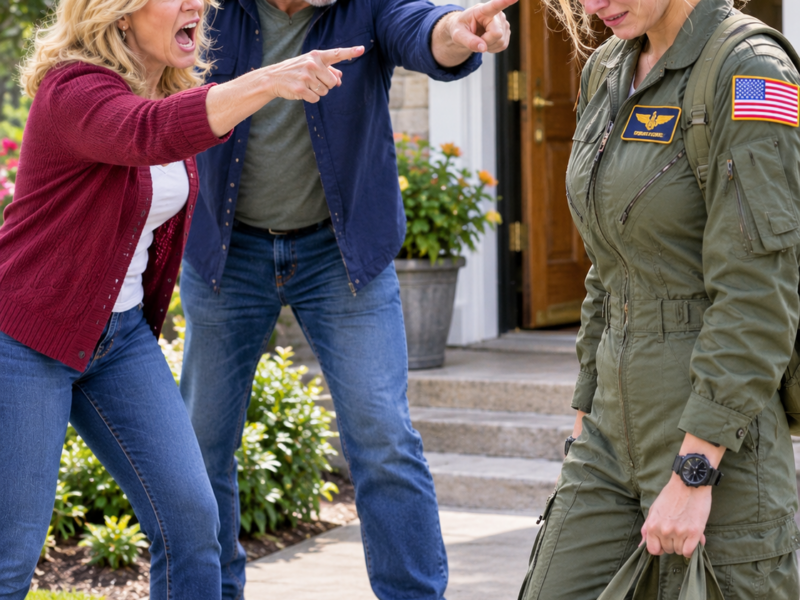
“When I returned from nine months overseas, I found everything I owned stuffed into garbage bags inside my own house
“Does this belong to you?”
I reached for the document.
The first page was titled Irrevocable Family Trust Amendment and Property Protection Agreement.
Beneath my grandfather’s signature was a date from nearly six years earlier, shortly before his death.
I read the first paragraph twice.
Then I looked at Dalton.
“What am I looking at?”
He pulled his chair closer.
“Your grandfather anticipated that someone might try to pressure you into transferring this property. He made arrangements to prevent that from happening.”
I turned the page.
There were three names listed as interested parties: my father, Richard; my mother, Evelyn; and my sister, Chloe.
My stomach tightened.
“Why are their names here?”
Dalton pointed to a paragraph near the bottom.
“Your grandfather specifically prohibited them from receiving ownership or financial benefits from this property without your independent, documented consent. He also appointed an independent trustee to oversee any attempted transfer.”
“Who is the trustee?”
Dalton turned another page.
“That’s what I wanted you to see.”
A name appeared beside the signature.
Margaret Ellis.
I recognized it immediately.
Margaret had been my grandfather’s longtime attorney. I’d met her twice as a child, usually during holidays when she visited his house and brought him thick folders of paperwork.
“Is she still alive?”
Dalton nodded.
“Very much so. And according to this agreement, she’s still serving as trustee.”
Captain Morales folded her hands.
“So the proposed transfer your father wants cannot simply be completed with a signature?”
“Not legally,” Dalton replied. “Especially not under these circumstances.”
He looked directly at me.
“There’s another provision. If anyone attempts to obtain the property through fraud, coercion, or misuse of financial authority, the trustee is required to investigate and protect the beneficiary’s interest.”
I thought about Dad’s warning the previous afternoon.
His connections.
My promotion.
The casual confidence with which he’d asked me to give away a house he didn’t own.
“Can we contact Margaret?”
Dalton nodded.
“I’d strongly recommend it.”
He made the call from his office.
A woman answered after three rings.
“Margaret Ellis.”
“Margaret, this is Daniel Dalton. I’m calling regarding the Walter Bennett Family Trust.”
There was a pause.
“Is this about his granddaughter?”
I leaned forward.
“Yes,” Dalton said. “She’s sitting right here.”
“Put her on the phone.”
I took the receiver.
“This is Claire.”
Her voice softened.
“Claire, sweetheart. I wondered when you’d come home.”
Something about the way she said it made my throat tighten.
“You knew about the house?”
“I knew your grandfather wanted it to be your safe place. I also knew he was worried about your parents’ attitude toward your inheritance.”
I stared at the document.
“What did he tell you?”
“He told me he loved your parents, but he didn’t trust them to respect your decisions when money was involved.”
I closed my eyes.
Then Margaret said something I hadn’t expected.
“He also left a sealed letter for you. He instructed me not to give it to you until you returned from active deployment or until someone attempted to take the property from you.”
I glanced at Dalton.
“Someone tried.”
“I know. Your grandfather’s agreement requires me to review any suspicious transfer request. I received an inquiry about the property three weeks ago.”
My grip tightened around the phone.
“From whom?”
“Your father.”
For several seconds, I couldn’t speak.
Margaret continued.
“He represented that you had agreed to transfer the house to your sister. He asked whether the trust could process the paperwork before your return.”
“But I never agreed to anything.”
“I know, Claire. I requested written authorization from you. None was provided.”
I looked at the forged power of attorney on Dalton’s desk.
“Did he send you any documents?”
“Yes. A preliminary transfer proposal and a copy of a financial authorization bearing your signature.”
Captain Morales looked up sharply.
Dalton motioned for me to put the call on speaker.
Margaret agreed.
“I’m afraid there’s more,” she said. “Your grandfather anticipated the possibility of unauthorized access to your finances. He established a separate protection clause requiring an audit if a family member attempted to use your inheritance or accounts for personal benefit.”
“An audit of what?”
“Everything connected to the property and the trust.”
Dalton exchanged a glance with Captain Morales.
Then Margaret added quietly, “Claire, I think you should know that your father has been trying to sell something that doesn’t belong to him.”
I felt the room grow still.
“What?”
“The property.”
She explained that a real-estate broker had contacted her office after receiving an inquiry about listing the house. The proposed asking price was substantially below market value.
The broker had been told that the owner was preparing to relocate and wanted a quick sale.
I stared at the wall.
My father wasn’t simply trying to give Chloe my house.
He had been exploring ways to sell it.
“Did he find a buyer?”
“Not yet. I stopped the listing before it became public.”
I pressed my fingers against my forehead.
“Why would he do this?”
Margaret was silent for a moment.
“Your grandfather once told me that people who feel entitled to something often become angry when they discover they cannot take it.”
That afternoon, Dalton arranged for Margaret to meet us.
She arrived carrying a leather briefcase and a large envelope with my name written across it.
She was in her late sixties, with silver hair and the same calm expression I vaguely remembered from my childhood.
When she saw me, she stood.
“You look so much like Walter.”
I managed a small smile.
“People always say that.”
“He would have been proud of you.”
She placed the envelope on the table.
“He wanted you to have this.”
Inside was a handwritten letter.
I recognized my grandfather’s handwriting immediately.
The letters leaned slightly to the right, and his capital W always looked like two mountains.
I unfolded the paper.
*My dearest Claire,*
*If you’re reading this, I hope you’ve returned safely from wherever duty has taken you.*
*I bought that house because I wanted you to have a place where nobody could make you feel like a guest. You have spent enough of your life being told to make room for everyone else.*
*I know your parents love you in their own way. But love should never require you to surrender your future to keep someone else comfortable.*
*Your sister has always been given more than she knows how to appreciate. That is not your responsibility to repair.*
*Keep the house. Not because it is valuable, but because it represents something I want you to remember.*
*You are allowed to have something that belongs to you.*
*You are allowed to say no.*
*Love always,*
*Grandpa.*
I read the letter again.
Then I folded it carefully and placed it back inside the envelope.
For the first time since returning home, I allowed myself to cry.
Not loudly.
Not dramatically.
Just enough that Margaret quietly moved the tissue box closer.
When I finally looked up, Dalton was waiting.
“What happens now?”
He opened his legal pad.
“First, we formally notify your parents that they have no authority to transfer or sell the property. Second, we preserve the evidence relating to the forged financial authorization. Third, we investigate the missing money.”
Captain Morales nodded.
“And we make sure the financial records are properly documented.”
I looked at the statements.
“Can we get the money back?”
“Possibly,” Dalton said. “But we need to establish where it went.”
Margaret opened her briefcase.
“I may be able to help with that.”
She removed a printed email chain.
The first message was dated two months after my deployment began.
It came from my mother.
She had asked Margaret whether the trust could release funds for necessary household repairs.
Margaret had refused.
The next email was from my father.
He claimed that I had verbally authorized him to manage certain financial matters.
Margaret had requested signed documentation.
Then came a message from Chloe.
She asked whether the house could be transferred into her name because she and Vance were planning to have a child and needed a permanent home.
I read the message twice.
There was no mention of asking me.
No suggestion that they would wait until I returned.
They had already made plans around something they didn’t own.
“Where did the forty-five thousand dollars go?” I asked.
Dalton pointed to the transaction records.
“We need the bank to trace the destination accounts. The money may have passed through several accounts.”
I gave written authorization for the investigation.
By the end of the afternoon, the bank’s fraud department had opened a formal case.
And Margaret sent a letter to my parents.
It was short and unmistakable.
The property belonged to me through the trust. No sale, transfer, mortgage, or other disposition could proceed without the required legal authorization.
Any attempt to obtain my signature through deception or pressure would be documented.
I returned home just before sunset.
The barbecue decorations were still scattered across the patio.
A half-empty bottle of soda sat on the outdoor table.
Chloe was in the kitchen, preparing dinner.
She looked up when I walked in.
“Where have you been all day?”
“Handling paperwork.”
She rolled her eyes.
“Dad said you were being difficult about the house.”
I set my keys on the counter.
“Did Dad tell you he was trying to sell it?”
Her hand stopped over the cutting board.
“What?”
“He contacted a real-estate broker.”
She looked toward the living room.
“I don’t know anything about that.”
“Did you know he wanted me to sign the property over to you?”
“Of course. It’s not like you’re using it.”
I studied her face.
“Did you know my money was missing?”
Her expression changed.
“What money?”
“Forty-five thousand dollars.”
She put down the knife.
“Claire, I don’t know what you’re talking about.”
Before I could answer, Dad walked into the kitchen.
“What’s going on?”
I turned toward him.
“Margaret Ellis contacted me.”
His face changed.
Only for a second.
But I saw it.
“Why would you contact Margaret?”
“Because she’s the trustee.”
He looked at Chloe.
Then back at me.
“You’ve been talking to lawyers?”
“Yes.”
He laughed without humor.
“You’ve been home for one day and you’re already trying to turn this into a legal fight?”
“I didn’t start it.”
He stepped closer.
“You’re making a mistake.”
I reached into my bag and placed a copy of the trust agreement on the counter.
“You have no authority to transfer or sell this house.”
His jaw tightened.
“That’s not what your grandfather intended.”
“Then why did he put my name on the deed?”
He didn’t answer.
Mom appeared in the doorway.
“Please. We don’t need to do this in front of Chloe.”
I looked at her.
“You moved my belongings into garbage bags.”
“We were making room.”
“You used my money.”
“We were trying to help the family.”
“By taking forty-five thousand dollars?”
Mom looked down.
Dad interrupted.
“That’s enough.”
“No,” I said. “It isn’t.”
For the first time, I didn’t lower my voice or apologize.
“Tomorrow, the bank will continue its investigation. The attorney has the trust documents. And nobody is signing anything over to Chloe.”
Dad stared at me.
“You think you can threaten your own family?”
“I think you should stop treating my silence like permission.”
I picked up my bag and went downstairs.
Behind me, I heard Chloe ask what was going to happen.
Dad didn’t answer.
The next three days were difficult.
My parents stopped speaking to me unless they needed something.
Mom began telling relatives that I had become cold and selfish after returning from deployment.
Dad made several calls outside the house.
I didn’t ask whom he was calling.
I was busy gathering documents and meeting with the bank’s fraud investigator.
On Thursday morning, the investigator called.
“Ms. Bennett, we’ve traced the transfers.”
I sat down at the small table in the basement.
“Where did the money go?”
“Some went to an account belonging to your mother. The remainder was transferred into a joint account held by your sister and her husband.”
I closed my eyes.
“How much went to each?”
“Twenty-eight thousand dollars to your mother’s account. Seventeen thousand to the joint account.”
I looked at the wall.
“Can you tell what the money was used for?”
“Some of the transactions appear to cover household expenses. We also found payments toward a vehicle loan and a credit card.”
“Whose vehicle?”
“Your sister’s.”
I thanked him and ended the call.
For a long time, I sat without moving.
I remembered sending my mother money years earlier when Dad had been between jobs. I remembered paying Chloe’s car insurance during her first year of college. I remembered telling myself that family helped family.
But this wasn’t help.
They had accessed my accounts while I was thousands of miles away, unable to monitor what was happening at home.
That afternoon, Dalton called with another development.
“The bank has requested the original power of attorney. We also have a copy of the document your father submitted to the trustee.”
“Is it the same one?”
“Almost. There are differences in the dates and wording.”
“Can they prove it was forged?”
“The bank is arranging a handwriting examination. We also have your deployment records showing you were overseas when the document was supposedly notarized.”
I looked at the calendar.
The date on the document was a Tuesday.
I remembered that Tuesday.
I’d been on a remote assignment with limited communications.
There was no way I’d been in a Florida notary’s office.
“What’s next?”
“The bank will continue its fraud review. We are also preparing a formal demand for repayment. If they refuse, we can pursue civil action.”
I thanked him.
Then he said something else.
“Claire, your father has contacted the trustee again.”
“What did he want?”
“He requested a meeting.”
I almost laughed.
“Did Margaret agree?”
“She did. But only with you present.”
The meeting was scheduled for Saturday morning at Margaret’s office.
I arrived early.
Dalton was already there, along with Margaret.
My parents arrived ten minutes later.
Chloe and Vance came with them.
Dad looked irritated.
“Why are all these people necessary?”
Margaret gestured toward the chairs.
“Because this is a formal trust matter, Richard.”
He sat down.
Mom kept her purse on her lap.
Chloe avoided looking at me.
Margaret opened the meeting by reviewing the trust agreement.
She explained that the property had been legally transferred into the trust years earlier, with me as the sole beneficiary entitled to occupy and ultimately receive the property under its terms.
She also explained the restrictions on family members attempting to transfer or dispose of the house without my informed consent.
Dad interrupted.
“Walter never intended this to become a weapon against his family.”
Margaret looked at him.
“Your father never intended his granddaughter to be pressured into giving away her home.”
The room went quiet.
Dad turned toward me.
“Claire, let’s be reasonable. Chloe and Vance need stability.”
I looked at my sister.
“Did you know Dad was trying to sell the house?”
She shook her head.
“I knew he was talking about transferring it.”
“Did you know he contacted a broker?”
She looked at Dad.
He answered for her.
“That was exploratory.”
“Did you know he used my money to pay your car loan?”
Chloe’s face went pale.
“What?”
Dad shifted in his chair.
“That’s not relevant.”
“It is when seventeen thousand dollars went into your joint account.”
Vance leaned forward.
“Seventeen thousand?”
Chloe looked at him.
“I thought Mom and Dad were helping us.”
I watched her face.
For the first time, she seemed genuinely confused.
“Claire, I didn’t know it was your deployment money.”
I believed she might be telling the truth.
But that didn’t change what had happened.
“Did you know they were trying to get the house transferred before I came home?”
She didn’t answer immediately.
Then she whispered, “Yes.”
The word hurt more than I expected.
I looked down at the table.
“Why didn’t you call me?”
She wiped her eyes.
“I thought you’d say no.”
There it was.
Not a misunderstanding.
Not an accident.
She had known I would object, and she had allowed them to proceed anyway.
Margaret closed the folder.
“Regardless of what anyone believed, the property cannot be transferred under the circumstances presented.”
Dad pushed his chair back.
“So that’s it? My daughter gets everything and the rest of us get nothing?”
I met his eyes.
“Grandpa gave me one house. You and Mom had a home for years. Chloe had your help. I never asked you to give me anything.”
“You were always the favorite,” he snapped.
Margaret’s expression hardened.
“Richard, this meeting is about legal ownership and unauthorized financial transactions. Personal grievances do not change the documents.”
Dad stood.
“This is ridiculous.”
He reached for the folder.
Dalton moved it away.
“Those documents remain with the trustee.”
Dad looked at me.
“You’re going to regret this.”
I stood too.
“No. I regret waiting so long to protect myself.”
The meeting ended without an agreement.
But something important had changed.
Chloe no longer looked at me with the confidence she’d had when I first returned.
And Vance had begun asking questions about the money.
Two weeks later, the handwriting examiner completed the preliminary report.
The signature on the power of attorney was not mine.
The bank suspended the disputed authorization and continued its fraud investigation.
The matter was referred to the appropriate authorities for further review.
My parents were served with a formal demand for repayment.
They had thirty days to respond.
During those thirty days, Mom called me almost every evening.
Sometimes she cried.
Sometimes she became angry.
Sometimes she said she didn’t understand why I was doing this to the family.
I stopped answering most of the calls.
One evening, I finally picked up.
“Claire, please. Your father is under a lot of pressure.”
“So am I.”
“We can work something out.”
“Then tell me where my money went.”
She was quiet.
“We used some of it for the house.”
“Which house?”
“Our expenses. The repairs. Your sister needed help.”
“Did you ask me?”
“No.”
“Did you tell me?”
Another silence.
“Your father said you’d understand.”
I looked at the photograph of Grandpa on my desk.
“I would have understood if you’d asked.”
Mom began crying.
“I didn’t think you’d say no.”
I closed my eyes.
“That doesn’t give you the right to say yes for me.”
She didn’t respond.
For the first time, I ended the call without trying to comfort her.
A week later, Chloe came to the basement.
She stood at the bottom of the stairs, looking at the boxes.
“Can I talk to you?”
I put down the book I was reading.
“Sure.”
She sat on the old couch.
For a while, neither of us spoke.
Then she looked around.
“I didn’t realize how much of your stuff was down here.”
I glanced at the garbage bags.
“Neither did I.”
She rubbed her hands together.
“Vance and I are going to move out.”
I looked at her.
“Why?”
“Because this isn’t our house.”
She swallowed.
“I should have told you what Dad was planning.”
“Yes.”
“I thought you would always give in eventually. You usually did.”
I didn’t know what to say.
She looked at me with wet eyes.
“I’m sorry.”
I believed she was sorry.
But I also knew that an apology didn’t automatically repair what had happened.
“I need you to understand something, Chloe. I love you. But I’m not going to keep paying for your choices.”
She nodded.
“I know.”
She stood, hesitated, and then picked up one of the garbage bags.
“Let me help you move your things upstairs.”
I watched her for a moment.
Then I took the bag from her.
“Not today.”
She nodded again.
And this time, she didn’t argue.
By the end of the month, Chloe and Vance had moved into a rental apartment across town.
My parents remained in the house temporarily while arranging their own living situation.
They were no longer permitted to access my accounts or make decisions regarding the property.
The bank’s investigation continued, and the repayment demand became a formal civil claim.
Eventually, my mother and sister repaid the money that had been transferred into their accounts. The repayment was documented, and the disputed power of attorney was formally withdrawn.
My father refused to acknowledge any wrongdoing.
He maintained that he had acted for the family.
I stopped trying to make him understand the difference between helping someone and taking something from them.
Several months later, the property was finally quiet.
I had the locks changed, repaired the leaking basement pipe, and brought my furniture back into the rooms where it belonged.
I put my grandfather’s wooden clock on the mantel.
The first time it chimed, I was standing in the kitchen making coffee.
For a moment, I could almost hear him telling me to stop worrying and eat something.
I found his photograph among the belongings in the garbage bag.
The crease across the middle was still there.
I placed it in a new frame and set it beside the clock.
My promotion to major came through later that year.
When I received the news, I stood in the driveway holding my phone, staring at the familiar front door.
I thought about my father’s threat.
He had tried to make me believe that protecting my own property would destroy my career.
Instead, I had followed the proper channels, preserved the evidence, and allowed the truth to speak for itself.
That evening, I invited a few friends over.
We ate takeout at the kitchen island because I hadn’t bothered buying a dining table yet.
Someone asked whether I planned to sell the house now that everything was settled.
I looked toward the living room.
“No,” I said. “I’m keeping it.”
A few weeks later, Mom sent me a letter.
It wasn’t an apology exactly.
She wrote that she’d been afraid of disappointing Dad, that she had convinced herself the money would be replaced, and that she’d never expected the situation to become so serious.
She said she missed me.
I read it twice.
Then I put it in a drawer.
I wasn’t ready to forgive her, but I wasn’t going to spend the rest of my life carrying the argument either.
As for Chloe, we slowly began speaking again.
Not every day.
Not about money.
Sometimes she called just to tell me something funny Vance had said. Sometimes I called her when I wanted to know how she was doing.
Our relationship wasn’t what it had been before.
Perhaps it couldn’t be.
But for the first time, I wasn’t pretending that everything was fine just to keep the peace.
One Sunday afternoon, I stood in the doorway of the main bedroom.
The room had been cleaned and repainted. Sunlight fell across the floor where my old bed used to sit.
I had replaced it with a simple wooden frame and white sheets.
There was nothing extravagant about the room.
But it was mine.
I opened the drawer of my nightstand and took out Grandpa’s letter.
I had read it so many times that the paper was beginning to soften along the folds.
*You are allowed to have something that belongs to you.*
I sat on the edge of the bed.
For years, I’d believed that being a good daughter and sister meant making myself smaller whenever someone else wanted more.
I’d confused peace with silence.
I’d confused generosity with surrender.
And I’d allowed people I loved to treat my boundaries as temporary inconveniences.
I folded the letter and placed it back in the drawer.
Outside, the afternoon breeze moved through the trees Grandpa had planted along the driveway.
The house was quiet.
No one was waiting for me to give up my room.
No one was deciding what I needed.
For the first time in a long time, coming home actually felt like coming home.
The end.









