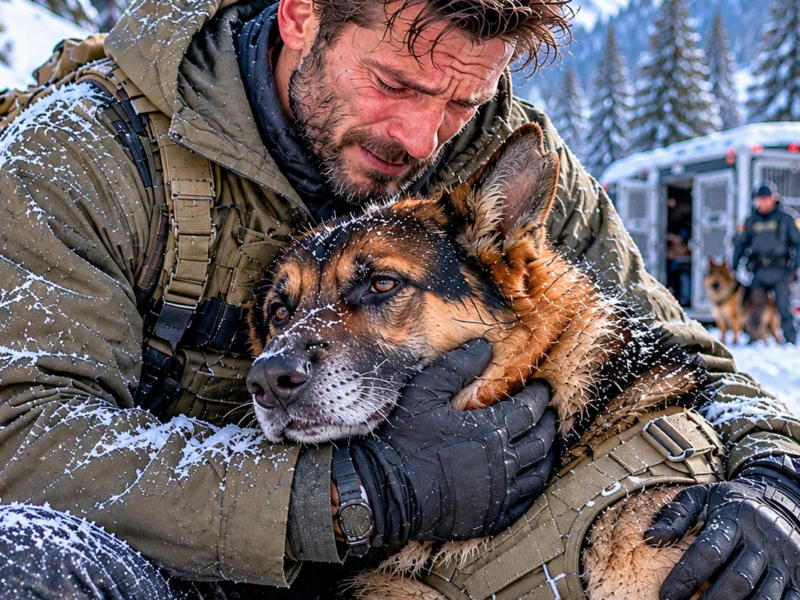
“Three years after my K9 partner vanished during a classified Navy SEAL mission, I heard his bark in a snowstorm
Three years ago, I watched a military helicopter disappear over a mountain ridge, carrying the last hope I had of finding my K9 partner.
Now, standing in a Colorado snowstorm with Rex collapsing in my arms, I realized the nightmare had never really ended.
And the men surrounding us knew exactly why.
My name is Daniel Carter. I served as a Navy SEAL for eleven years, and for most of that time, Rex was beside me.
He was a German Shepherd trained to detect explosives, track people, and protect his handler. But those were just the things written in his military record.
To me, Rex was family.
When I found him near the abandoned gas station, he weighed far less than he should have. His paws were cracked, his coat was dirty, and his breathing sounded painfully weak.
I could feel his heartbeat against my arm.
“Stay with me, boy,” I whispered. “We’re going home.”
The man in the tactical jacket stepped closer.
“Give him to us. You’re making a mistake.”
I looked at the two men who had arrived in the white SUV.
One was carrying a medical case. The other had his hand inside his jacket.
I had no weapon, no backup, and no idea how many people were involved.
But I had one advantage.
They were more interested in Rex than they were in me.
I slowly shifted my body to shield him.
“You’re going to tell me who you are.”
The man in the tactical jacket sighed.
“My name is Victor Shaw. I work with a private security contractor. That dog was transferred into our custody after your deployment.”
“Transferred by whom?”
“That’s classified.”
I almost laughed.
“He’s a military working dog. If he was transferred, there should be a record.”
Victor glanced at the metal tag beneath Rex’s collar.
“Not anymore.”
That answer told me more than he intended.
Someone had deliberately erased Rex’s history.
I pulled out my phone and called the emergency veterinary clinic in town.
The receptionist answered immediately.
I explained that I had found an injured German Shepherd in the snow and needed urgent help.
She told me to bring him in.
Victor stepped forward.
“Cancel that call.”
I ignored him.
Then he made a mistake.
“Commander Hayes won’t appreciate you interfering.”
I stopped moving.
“How do you know Commander Hayes?”
Victor’s expression changed.
For a second, he looked like a man who had said something he shouldn’t have.
“Everyone in this line of work knows his name.”
“No,” I replied. “Not everyone knows he signed Rex’s death report.”
Victor didn’t answer.
I looked at the two men behind him.
Neither seemed comfortable anymore.
Then Rex moved.
His eyes opened slightly, and he lifted his head toward Victor.
A low growl escaped his throat.
It was weak, but unmistakable.
Victor stepped backward.
That was when I knew Rex remembered him.
I didn’t wait for another explanation.
I lifted Rex into my arms, carried him to my truck, and locked the doors.
The first man rushed toward me, but I started the engine before he reached the handle.
Victor shouted something I couldn’t hear over the wind.
I pulled onto the highway.
In the rearview mirror, I saw the black pickup following.
I drove directly toward the veterinary clinic.
For the next twenty minutes, I kept one hand on the steering wheel and the other near Rex’s neck.
“Stay with me, partner.”
He opened his eyes once.
Then he placed his paw against my wrist.
It was such a small movement.
But I remembered it.
He used to do that whenever I was injured during training. He would rest his paw against my arm until I looked at him.
I swallowed hard.
“Yeah, buddy. I know. I’m here.”
When I reached the clinic, two veterinary technicians rushed outside with a stretcher.
A woman named Dr. Laura Bennett took one look at Rex and immediately ordered an examination.
“He’s severely dehydrated,” she said. “His body temperature is dangerously low. We need to stabilize him.”
I followed them inside.
A technician asked whether Rex had any medical history.
I explained his military service and mentioned the tracking device beneath his collar.
Dr. Bennett examined it without removing it.
“That’s not a standard identification tracker,” she said.
“What does that mean?”
“It may be transmitting more than a location.”
She looked toward the clinic entrance.
“Daniel, I think you should call the police.”
Before I could respond, headlights swept across the waiting room windows.
The black pickup had arrived.
Victor stepped out.
I moved toward the examination room door.
Dr. Bennett noticed my expression.
“Are those people following you?”
“Yes.”
She immediately locked the front entrance and called the county sheriff.
Victor walked up to the glass door and knocked.
He didn’t look angry anymore.
He looked impatient.
“Daniel!” he shouted. “We can settle this without involving law enforcement.”
I stood on the other side of the glass.
“Then explain why my dog was missing for three years.”
He stared at me.
Then he said something I will never forget.
“Because he wasn’t supposed to survive.”
The room went silent.
Dr. Bennett stopped moving.
I felt the air leave my lungs.
“What did you do to him?”
Victor looked away.
Before he could answer, the sheriff’s vehicle pulled into the parking lot.
He stepped back from the entrance.
The two men from the SUV were nowhere to be seen.
Within minutes, Sheriff Miller arrived and separated us.
Victor showed him identification from a private security company called North Ridge Strategic Services.
He claimed Rex was company property and accused me of stealing classified equipment.
I showed the sheriff my military discharge papers, Rex’s old service photographs, and the metal identification tag.
Sheriff Miller examined the tag carefully.
“Commander Hayes,” he said. “I’ve heard that name.”
“He’s a retired Navy officer?”
The sheriff nodded.
“He’s been living outside town for about six months.”
That surprised me.
“Here?”
“About twenty miles north. Big property near the old mining road.”
I looked toward the examination room.
“Then I need to speak with him.”
Sheriff Miller shook his head.
“Not until the veterinarian tells us your dog is stable.”
I understood.
For the first time in three years, I had Rex back.
I wasn’t going to risk losing him again just to satisfy my anger.
The next few hours were the longest of my life.
Dr. Bennett discovered multiple untreated injuries, severe malnutrition, and signs that Rex had been kept in poor conditions for an extended period.
He also had an old surgical scar beneath his chest.
The veterinarian studied it carefully.
“Someone operated on him before,” she explained. “Not recently. But the procedure wasn’t recorded in his military medical history.”
“What kind of operation?”
“I can’t tell without additional imaging.”
She paused.
“There’s something else. His body reacts strangely when that tracking device is near certain electronic equipment.”
I looked at the small black device.
“Can you remove it?”
“Not until we understand what it’s doing. If it contains a battery or a component connected to something implanted, removing it carelessly could hurt him.”
I nodded.
“Do whatever you need to keep him safe.”
Just after midnight, Rex finally opened his eyes.
I sat beside his kennel.
He looked around slowly until he found me.
His tail moved once.
I placed my hand against the metal bars.
“Hey, old friend.”
He pressed his nose against my fingers.
I couldn’t hold back my tears.
“Three years, Rex. Three years.”
He made a quiet sound.
Then he shifted his head toward the collar lying on the examination table.
I followed his gaze.
The little metal tag was still there.
I picked it up.
“Commander Hayes,” I whispered.
Rex barked once.
It was the first strong sound he had made since I found him.
Dr. Bennett looked at me.
“Does that name mean something?”
I explained that Hayes had commanded the operation three years earlier. He had been responsible for the mission report and had personally informed our team that Rex was presumed dead.
I also told her something I had never shared with anyone outside the military.
The night Rex disappeared, our mission had included retrieving a small encrypted data drive from the abandoned compound.
According to the briefing, the drive contained information about illegal weapons transfers.
We recovered it.
But the report later claimed the drive had been destroyed in the explosion.
I never believed that explanation.
Now I wondered whether Rex had been carrying something that night.
Something someone had spent three years trying to recover.
At two in the morning, Sheriff Miller returned.
He had spoken with a federal contact and received an unexpected response.
North Ridge Strategic Services had no legal ownership record for Rex.
In fact, the company had never received authorization to take custody of any military working dog.
The sheriff also discovered that Victor Shaw had used several different names during the past five years.
“He’s not who he says he is,” Miller told me.
“Can you arrest him?”
“Not yet. We need evidence.”
I looked toward Rex.
“Then let’s find it.”
The following morning, Dr. Bennett gave Rex permission to leave the intensive treatment area for a short walk.
I took him into the small enclosed yard behind the clinic.
He moved slowly, leaning against my leg.
Snow covered the grass.
For a moment, everything felt peaceful.
Then Rex stopped.
His ears lifted.
He looked toward the fence and began sniffing the ground.
“What is it, buddy?”
He moved toward a snow-covered wooden bench and scratched beneath it.
I knelt down.
There was a small piece of fabric caught between two boards.
It was dark blue and smelled faintly of oil.
Rex sniffed it again and looked at me.
I recognized the material.
It came from the tactical uniforms used by North Ridge.
I called Sheriff Miller.
He arrived within minutes and photographed the fabric before placing it in an evidence bag.
“Your dog may be identifying something connected to those men,” he said.
I looked down at Rex.
He wasn’t simply reacting to strangers.
He was remembering something.
That afternoon, I decided to visit Commander Hayes.
Sheriff Miller insisted on accompanying me.
We drove north along a narrow mountain road until we reached a large property surrounded by tall pine trees.
A wooden sign near the entrance read:
HAYES RANCH.
A man in his early sixties answered the door.
He was taller than I remembered, but his face was unmistakable.
Commander Thomas Hayes.
He looked at me.
Then his eyes moved to Rex.
His expression drained of color.
“Daniel,” he said quietly.
I stepped forward.
“You told me he was dead.”
Hayes looked down at the dog.
“I thought he was.”
“No. You signed a report saying he was presumed dead. You told our entire team there was no chance he survived.”
Hayes rubbed his forehead.
“Come inside.”
I didn’t move.
“First, tell me why his identification tag has your name on it.”
He stared at the tag in my hand.
Then he opened the door wider.
“Because three years ago, I made a decision that cost that dog everything.”
We entered the house.
Hayes sat at a wooden table and began explaining.
According to him, the mission had never been about recovering an ordinary weapons database.
The encrypted drive contained evidence of a criminal network operating through several private military contractors.
Some individuals had been using military equipment and classified transportation routes to move weapons illegally.
North Ridge was one of the companies involved.
The operation had been compromised before our team arrived.
When the explosion occurred, Rex had disappeared with the encrypted drive attached to his tactical harness.
Hayes claimed he later received information that the dog had been captured by the people behind the network.
He wanted to launch a recovery operation.
But someone higher in the chain of command ordered him to stop.
“If I had told the truth,” he said, “they would have known Rex was alive and would have killed him to recover the drive.”
I stared at him.
“So you told us he was dead.”
Hayes nodded.
“I believed it was the only way to keep him alive.”
I felt anger rising inside me.
“You let me spend three years thinking my partner was buried under a collapsed building.”
Hayes lowered his head.
“I know.”
“No, you don’t.”
He didn’t argue.
Then he opened a locked cabinet and removed a thick folder.
Inside were photographs, handwritten reports, and copies of communications between North Ridge employees.
One photograph showed Rex standing inside a metal enclosure.
His coat was dirty, but his eyes were unmistakable.
On the back, someone had written a date from two years earlier.
I felt sick.
“Where was this taken?”
“An isolated facility near the Wyoming border,” Hayes replied. “They moved him several times.”
“Why didn’t you tell me?”
“Because I was being watched.”
He handed me another photograph.
This one showed a small metal container attached to Rex’s harness.
The same type of container our team had used to carry encrypted mission equipment.
Hayes pointed to it.
“The drive was never destroyed. Rex carried it out of the compound. He kept it hidden even after they captured him.”
I looked at the old surgical scar on Rex’s chest.
“Did they operate on him to find it?”
Hayes nodded.
“They believed he had swallowed a storage capsule. They searched his body, but they never found it.”
I closed my eyes.
The little black tracking device suddenly made sense.
It wasn’t simply monitoring Rex.
It was helping them locate whatever he had been carrying.
But there was something Hayes still wasn’t telling me.
“Why did Victor say I shouldn’t let anyone scan the device?”
Hayes looked toward Sheriff Miller.
Then he spoke quietly.
“Because it contains a remote signal. If it detects certain equipment, it transmits a location to whoever is monitoring it.”
Sheriff Miller immediately stood.
“Then we need to secure that device.”
Hayes nodded.
“But there’s another problem.”
He opened the folder to its final page.
A list of names.
Several were former military personnel.
One was a retired intelligence officer.
And the final name was Commander Thomas Hayes.
I looked up.
“You’re on the list.”
Hayes didn’t answer.
Then I understood.
He wasn’t simply a witness.
He had once been part of the operation that allowed North Ridge to take control of Rex.
“Tell me everything,” I said.
Hayes leaned back.
“I was ordered to approve a temporary transfer of military working dogs for a classified security project. I believed the program was legitimate. When I discovered what they were doing, I tried to stop it.”
“Did you know they were holding Rex?”
“Not at first. When I found out, it was too late.”
His voice cracked.
“I failed him, Daniel.”
For several seconds, nobody spoke.
Then Rex walked toward Hayes.
He sniffed the man’s hand.
Hayes looked down.
“I don’t deserve your forgiveness, old boy.”
Rex didn’t growl.
He simply turned and returned to my side.
That small movement said more than any speech could have.
We left the ranch with copies of the evidence and returned to the clinic.
Sheriff Miller contacted federal investigators.
This time, they took the situation seriously.
The tracking device was examined by a specialist, who confirmed that it had been transmitting location data to an external server.
The device also contained a record of several previous locations.
One of them matched the abandoned facility near the Wyoming border.
Another matched a warehouse outside a small industrial town.
Investigators obtained a warrant.
The warehouse was raided two days later.
Inside, they found stolen military equipment, false identification documents, medical supplies, and records showing that North Ridge had been holding several military working dogs without authorization.
They also found the encrypted drive.
It had been hidden inside a sealed metal container.
The information on it revealed years of illegal weapons transfers, fraudulent contracts, and payments to individuals who had helped conceal the operation.
Victor Shaw was arrested while attempting to leave the state.
Two employees were taken into custody at the warehouse.
Additional arrests followed as investigators traced the financial records.
But the discovery that mattered most to me was in a separate room.
A storage area filled with old dog equipment.
Rex’s original harness was hanging from a hook.
His name was still written on the inside.
I stood there for a long time.
Three years of my life had been spent believing that harness was buried somewhere beneath the ruins of a foreign compound.
I reached out and touched it.
Then I heard a familiar sound.
A soft bark.
Rex was standing in the doorway.
He had insisted on following me inside.
I knelt down and held his face between my hands.
“Look what we found, buddy.”
His tail moved slowly.
For the first time, I felt that the past was finally becoming something I could live with.
The investigation continued for months.
Commander Hayes cooperated fully with federal authorities and admitted his role in approving the original transfer.
He faced disciplinary proceedings and lost his security clearance.
He also gave testimony that helped investigators identify the officials who had protected the operation.
He never asked me to forgive him.
I never promised that I would.
But I understood something important.
His decisions had hurt us both.
And whatever his intentions had been, Rex had paid the price.
As for Rex, his recovery was slow.
The veterinarian discovered that he had suffered an old leg injury that had never healed properly.
He needed medication, physical therapy, and months of careful rehabilitation.
Some nights, he woke suddenly from nightmares.
He would pace around the room, breathing heavily, until I sat beside him.
I never forced him to settle down.
I simply stayed.
Because he had done the same for me countless times.
Three months after I found him, Rex was strong enough to walk through the snow without assistance.
One morning, I took him to a quiet trail overlooking the mountains.
The sky was clear, and sunlight reflected off the fresh snow.
I removed his old collar and placed a new identification tag around his neck.
It read:
REX
UNITED STATES NAVY
RETIRED
HOME.
He sniffed the tag, then looked up at me.
I smiled.
“That’s right, partner. You’re home.”
He leaned against my leg.
I sat beside him and watched the mountains.
For three years, I had imagined finding Rex again.
I had imagined running toward him, hearing his bark, and holding him in my arms.
But I had never imagined how much pain would come with that reunion.
I had also never understood how much courage it would take for him to trust people again.
The following spring, I began volunteering with a veterans’ organization that helped retired military working dogs find homes.
I used my experience to help handlers understand that service dogs didn’t stop needing love when their missions ended.
Rex became the unofficial greeter.
He would lie near the entrance and gently approach every veteran who came through the door.
Some people arrived carrying the weight of memories they couldn’t explain.
Rex seemed to understand them.
He didn’t ask questions.
He simply sat beside them.
One afternoon, a young veteran approached me while Rex rested at my feet.
“How long did you have him?” the man asked.
“Almost five years before he disappeared. Then I got him back after three years.”
The veteran looked surprised.
“How did you know he was still alive?”
I looked down at Rex.
“I didn’t. I just never stopped hoping.”
The young man crouched and gently scratched Rex behind the ears.
“He’s lucky to have you.”
I smiled.
“No. I’m lucky he found his way back.”
That evening, as the sun disappeared behind the mountains, I walked home with Rex beside me.
The snow had melted from the trail, and the air smelled like pine trees and fresh earth.
He stopped once to sniff something near a tree.
Then he looked back to make sure I was still there.
I laughed softly.
“I’m right behind you, buddy.”
He continued walking.
And for the first time in three years, I wasn’t thinking about the mission, the explosion, or the people who had taken him.
I was thinking about tomorrow.
About breakfast.
About long walks.
About quiet mornings with an old friend sleeping near the fireplace.
Rex had spent years protecting me from dangers I could see and others I couldn’t.
Now it was my turn to give him something he had never been allowed to have.
A peaceful life.
A place where nobody would take him away.
A home where he would never have to wonder whether his handler was coming back.
Because the greatest reward a military dog can receive isn’t another medal, another mission, or another command.
It’s knowing that when the fighting is over, someone will still be there.
And when I looked down at Rex walking beside me, I finally understood that we hadn’t simply found each other again.
We had both found our way home.
The end.









