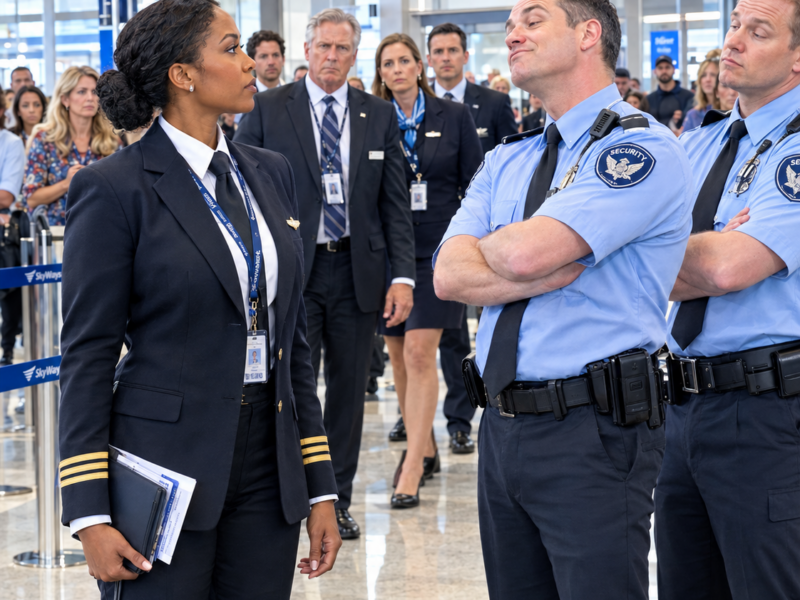
“They ordered me to wait outside because a Black woman, they claimed, couldn’t possibly be the captain of their aircraft
The first person the independent safety team asked to identify the crew was me.
I stepped forward before anyone could answer for me.
“Captain Naomi Brooks,” I said. “Assigned captain of Flight 728, scheduled service to Chicago. I was removed from the aircraft by Station Manager Richard Cole before departure.”
The lead investigator, a woman with silver hair and a navy aviation safety jacket, glanced at the tablet in her hand. Her name badge read ELENA VOSS — INDEPENDENT FLIGHT SAFETY OVERSIGHT.
She looked at my credentials, then at the men standing behind her.
“Captain Brooks,” she said, “please tell me exactly what happened. Start from the moment you arrived.”
I had rehearsed the explanation in my head a dozen times while standing outside the terminal operations office. I had expected anger to take over when someone finally listened. Instead, my voice came out calm.
I told her about the flight assignment, the attendant who mistook me for cleaning staff, the first officer who questioned my position, and Richard Cole’s insistence that I wait outside the crew area. I explained the revised flight release, the altered route, the questionable maintenance sign-off, and the form I had refused to sign.
Voss interrupted only twice.
The first time, she asked, “Did you personally verify the aircraft’s maintenance status?”
“No. I attempted to verify the record. The electronic approval appeared to carry the credentials of an engineer who, according to the maintenance directory, was no longer authorized to certify that aircraft.”
“And the route?”
“The revised route passed through a restricted weather corridor. The alternate airport was changed despite severe crosswinds at the new destination. I did not have enough verified information to determine whether the aircraft could safely operate under those conditions.”
“Did you refuse to fly?”
“No,” I said. “I refused to certify a flight release I could not verify.”
Voss held my gaze for a moment.
“That distinction matters.”
Behind her, another investigator was already speaking with airport operations. A third was collecting the crew manifest and the electronic records associated with Flight 728.
Richard Cole stood several yards away, his arms folded tightly across his chest. First Officer Daniel Mercer was beside him, looking at the floor.
Neither man appeared amused anymore.
Voss turned toward the aircraft windows.
“Captain, would you accompany us to the gate?”
“I would.”
“Good. We need your help identifying the people involved. No one is to delete, modify, or overwrite any operational records until our team has secured them.”
She raised her voice enough for the nearby staff to hear.
“That includes dispatch messages, maintenance approvals, crew scheduling notes, and any communication concerning the removal of Captain Brooks from this flight.”
For the first time that morning, Richard Cole looked genuinely frightened.
Not angry.
Not offended.
Frightened.
And I knew then that the story he had told himself about me—that I was an inconvenience he could move out of his way—was beginning to collapse.
At Gate 42, Flight 728 sat motionless beneath the terminal lights.
Passengers had been told there was an operational delay. Some were irritated. Others had begun recording the activity through the windows. The cabin door remained closed, and the ground crew had stopped all further departure preparations.
Voss entered first.
I followed her onto the jet bridge, where an airline supervisor approached us with a clipboard.
“Captain Brooks,” he said uncertainly, “we were told you were no longer assigned to this flight.”
“I was assigned to it,” I replied. “Then I was removed.”
He looked toward Voss.
“Please preserve that distinction,” she said.
Inside the aircraft, the cabin crew had gathered near the forward galley. One attendant, a young woman with a polished bun and a silver name badge reading Tessa, stared at me.
Her face changed when she realized who I was.
“Captain Brooks,” she whispered.
I recognized her immediately. She was the attendant who had asked whether I was there to clean the cabin.
She swallowed.
“I’m sorry.”
I didn’t answer immediately. Not because I wanted her to suffer, but because I needed to understand what she was apologizing for.
“For what?” I asked.
“For what I said earlier. I thought you were—”
“You thought I didn’t belong here.”
Her eyes filled with tears.
“Yes.”
The cabin fell quiet.
I could have humiliated her in front of everyone. I could have reminded her that I had spent fifteen years in aviation, that I had flown through thunderstorms, diversions, medical emergencies, and nights when the horizon disappeared completely.
But I had not come aboard to prove that I deserved to be there.
I had come aboard because a potentially unsafe aircraft had nearly departed without a proper review.
“An assumption can be corrected,” I told her. “What matters is what you do after you learn it was wrong.”
She nodded, wiping her cheek.
Voss asked the crew to remain available for interviews. She then requested the flight deck records and the original release documents.
Daniel Mercer appeared in the cockpit doorway.
“Captain Brooks,” he said, “can I speak with you privately?”
Voss looked at me.
“Only if you’re comfortable.”
I nodded.
We stepped into the forward galley while the investigators worked.
Mercer rubbed both hands across his face.
“I need to tell you something.”
“I’m listening.”
“When the revised release came through, I noticed the route change.”
“Why didn’t you say anything?”
“I asked Cole about it. He told me dispatch had approved it and that I should stop making problems.”
“Did you independently verify the approval?”
“No.”
“Did you verify the maintenance record?”
His silence answered me.
I felt something colder than anger settle in my chest.
“Daniel, you were the first officer. You had a responsibility to question anything that didn’t look right.”
“I know.”
“Then why did you help remove me?”
He looked toward the cockpit, where Voss’s team was photographing the flight paperwork.
“Cole said you were being difficult. He said you’d already been warned about being a poor fit with the local crew. He told me the airline wanted the flight to leave on time, and that if I backed you, I could lose my upgrade.”
There it was.
Not a technical explanation.
Not a genuine belief that I was wrong.
Fear.
Fear of losing a promotion. Fear of challenging a manager. Fear that standing beside a Black woman who had refused to accept an unsafe order might cost him something he wanted.
“So you chose your career over your responsibility,” I said.
He flinched.
“Yes.”
I let the silence remain between us.
“I can’t decide what happens to you,” I told him. “But I hope you understand that the next time something looks wrong, silence will not make you safer.”
He nodded slowly.
“I do.”
“Then tell the investigators everything. Not the version that protects you. The version that protects the passengers.”
He agreed.
When he walked away, I wondered how many disasters began with someone noticing one small thing and deciding it was easier to say nothing.
The investigation moved quickly.
By 9:15 a.m., the original and revised flight releases had been secured. By 9:40, the airline’s central operations center had confirmed that the revised routing had not been approved through the normal authorization process.
At 10:05, a maintenance records specialist arrived with a laptop and a sealed evidence drive.
She examined the electronic signature attached to the aircraft’s maintenance status.
Then she examined it again.
“This credential was used at 5:42 a.m.,” she told Voss. “But the engineer associated with it was removed from active certification duties two weeks ago.”
“Could another authorized person have used the account?”
“Not under the documented procedure. The access log shows a login from a terminal assigned to station operations, not the maintenance department.”
Voss asked her to confirm the finding independently.
She did.
The maintenance entry was not a harmless clerical error. Someone had used a credential that should not have been available to approve a record that required legitimate authorization.
Meanwhile, the route change had been traced to an internal account associated with the station’s dispatch liaison.
The revised flight plan had directed Flight 728 through a corridor that had been restricted because of rapidly developing weather. The alternate airport had also been changed to one facing severe crosswinds.
The route might not have guaranteed an accident. Aviation safety rarely works that way. It works through layers of protection, each designed to prevent one mistake from becoming a catastrophe.
But those layers had been deliberately weakened.
A questionable release. An unauthorized maintenance entry. A changed route. A captain removed after raising concerns.
Each failure made the next one more dangerous.
At 10:32, Voss asked me to review the timeline.
I studied the records on her screen.
“There’s something else,” I said.
She leaned closer.
“The revised release arrived after I questioned the first version. The timestamps show the route was changed while the crew was already being assembled.”
“What does that suggest?”
“That the change wasn’t a routine update that happened overnight. Someone made it after the flight process was underway. I can’t tell you why from this record alone, but I would want to know who requested it and who benefited from the departure.”
Voss made a note.
“That’s exactly what we’re investigating.”
At noon, the airline’s deputy chief operating officer, Martin Shaw, arrived at the gate with two members of corporate compliance.
He found me in a small conference room overlooking the tarmac.
“Captain Brooks,” he said, “I owe you an apology.”
I waited.
“We have confirmed that you were removed from the flight without a valid operational basis. The station manager’s report described you as unwilling to cooperate with crew coordination. It did not mention your concerns about the release or the maintenance record.”
“Did anyone ask why I was unwilling to cooperate?”
“Not before the flight was pushed back.”
“Then your process failed before I ever reached the aircraft.”
He accepted the criticism without defending himself.
“Yes. It did.”
He sat across from me.
“I also want to assure you that you will not face retaliation for raising a safety concern.”
I looked directly at him.
“I don’t need an assurance that sounds good in a meeting. I need it documented. I want the original assignment preserved, the removal form preserved, and every message concerning my alleged incompatibility with the crew retained for the investigation.”
Shaw nodded to the compliance officer.
“Put that in writing.”
“And I want to know whether anyone tried to change my assignment after I refused to sign the step-aside form.”
“We’ll determine that.”
“No,” I said quietly. “You’ll check the records. That’s how you’ll determine it.”
He paused, then nodded again.
“You’re right.”
For years, I had watched people mistake a calm voice for a lack of conviction. They assumed that if I didn’t shout, I could be persuaded to accept whatever explanation was most convenient.
I had learned that the strongest thing I could do was keep asking precise questions.
And now, for once, someone in senior management was writing down the answers.
The first major break came shortly after one o’clock.
A dispatch supervisor named Paul Danner requested an interview through the compliance office. He had been responsible for transmitting the revised release to the gate.
At first, Danner claimed the route change had been routine. He said he had assumed the approval came from the appropriate department and had simply forwarded the document.
Then the investigators showed him the access log.
His story changed.
He admitted that Richard Cole had called him shortly before the revised release was sent. Cole had told him the aircraft needed to depart on schedule and that a “temporary routing adjustment” had already been cleared.
Danner said he had hesitated because the approval reference looked incomplete.
Cole allegedly told him not to worry.
When Danner asked whether the maintenance record had also been verified, Cole said the technical team had “taken care of it.”
“Did you see proof of that?” Voss asked.
“No.”
“Did you contact maintenance?”
“No.”
“Why not?”
Danner stared at the table.
“Because he was the station manager. He told me it had been handled.”
Voss leaned back.
“Authority does not turn an unverified record into a verified one.”
Danner nodded, visibly shaken.
He then disclosed a detail that changed the direction of the investigation.
Two days earlier, Cole had sent a message to the station team warning that another departure delay would trigger a formal performance review. Flight 728 was already under scrutiny because of previous scheduling problems.
The message had included a phrase that the investigators highlighted in their notes:
No more unnecessary holds.
It did not prove that Cole had knowingly attempted to launch an unsafe flight. But it established a troubling pressure on staff to prioritize departure time over careful verification.
Then the investigators examined the communications connected to the routing change.
They found a second message.
It had been sent from Cole’s account to a regional operations coordinator late the previous evening.
The message referred to a “clean departure” and warned that “another public delay will raise questions.”
The investigators did not yet know which questions Cole feared.
But they were beginning to understand why he had wanted the aircraft to leave before anyone looked too closely.
At 2:20 p.m., Martin Shaw returned to the conference room.
“Captain Brooks, the airline is suspending all departures handled by the station’s current dispatch approval process until we complete a system review. We’re also removing Cole from operational authority while the investigation continues.”
“That’s a start,” I said.
He glanced at the files.
“We’ve also discovered that the revised route was not the only flight affected by questionable release changes.”
I felt my shoulders tighten.
“How many?”
“Three additional flights are under review. Two have already landed safely. One was delayed before departure after a separate crew member raised a concern.”
“Were those crews investigated?”
“Not properly. Their concerns were classified as scheduling disputes.”
I looked at Voss.
She had stopped writing.
“How many people reported problems,” I asked, “and were told they were the problem?”
No one answered.
The silence was more disturbing than any number they could have given me.
By late afternoon, the airport terminal had become a maze of interviews, locked offices, and restricted workstations.
The airline’s internal announcement arrived at 4:10 p.m.
Richard Cole had been suspended pending the investigation. The dispatch supervisor’s access had been temporarily restricted, and the maintenance record associated with Flight 728 had been referred for a full technical audit.
The airline had also suspended Daniel Mercer from flight duty while his role was examined.
Tessa, the flight attendant who had initially mistaken me for cleaning staff, was removed from the Flight 728 roster for the day but was not accused of tampering with any records. She had cooperated with investigators and acknowledged her conduct toward me.
I did not ask for her to be fired.
I wanted the truth, not a collection of convenient sacrifices.
But the inquiry was far from finished.
At 6:30 p.m., Voss asked me to join a final briefing before I was released from the airport.
A screen displayed a timeline assembled from electronic records, witness statements, and the original flight assignment.
The most important discovery was not one dramatic document. It was the pattern.
A departure target had created pressure. The revised route had been transmitted without the expected authorization. A maintenance entry had been submitted using credentials that should not have been active. When I questioned those irregularities, I was removed from the flight and described as a personnel problem.
The crew’s discomfort with me had been used to make the removal sound reasonable.
The paperwork had been used to make the departure sound legitimate.
And the schedule had been used to make every objection seem inconvenient.
“Captain Brooks,” Voss said, “we cannot yet establish every person’s motive. But we have sufficient evidence that Flight 728 was pushed toward departure without the required verification, and that your removal followed your attempt to stop that process.”
“Was the aircraft actually unsafe?”
“The aircraft’s true technical condition cannot be established from the false or questionable entry alone. The maintenance team is conducting an independent inspection. What we can say is that the documentation required for a safe release was not reliable. The aircraft should not have departed until that was resolved.”
I nodded.
That was the answer I had wanted all day.
Not an exaggerated claim that catastrophe had been certain.
Not a heroic story built on speculation.
A clear statement that the safeguards had failed and that someone had to stop the process before the consequences became irreversible.
Voss continued.
“Your decision to report the issue was appropriate. The aircraft returned to the gate because the operational review was mandatory. Your actions ensured the discrepancies were examined before the flight could continue.”
For the first time since dawn, I felt the tension in my chest loosen.
I had not been imagining the irregularities.
I had not been difficult simply because I refused to obey an order.
And I had not been wrong to stand alone.
The next morning, the airline’s chief executive called an emergency meeting.
I attended by secure video link from my home. I had slept for barely three hours. My uniform lay over the back of a chair, and my flight bag sat untouched beside the door.
The chief executive, Evelyn Price, appeared on the screen with the deputy COO, Martin Shaw, and representatives from compliance, human resources, and flight operations.
She began without a prepared statement.
“Captain Brooks, our company failed you yesterday. More importantly, our company failed its own safety obligations.”
I listened.
Price announced that the airline had suspended the managers responsible for the unauthorized operational decisions while the investigation proceeded. The dispatch process at Westbridge would be independently audited. All flight-release changes made during the preceding month would be reviewed, along with the related maintenance records and any reports of crew members being removed after raising safety concerns.
She then addressed the discriminatory treatment I had experienced.
“We have also confirmed that you were questioned about your position in a way that would not have been acceptable if you had been treated with the respect owed to any captain. We are investigating whether bias influenced the decisions made about you, and we will not treat that question as separate from the broader operational failures.”
I appreciated the words.
But I had spent enough years in aviation to know that an apology could be delivered in a minute while meaningful change took months.
“What happens to the people who reported concerns before me?” I asked.
Price glanced at her notes.
“We will contact them directly, review their cases, and ensure no one is penalized for good-faith safety reporting.”
“And what happens when a captain refuses to sign an unverified release next month, when no executive is watching?”
That question changed the meeting.
Shaw leaned toward the camera.
“We’re creating a protected escalation path that bypasses local station management. A captain or first officer will be able to contact the central safety office directly, and the report will be preserved outside the local management chain.”
“Will the system automatically preserve the original records?”
“Yes.”
“Will the person making the report receive a case number?”
“Yes.”
“Will local management be able to change that person’s roster while the report is under review?”
“Not without documented approval from flight safety and compliance.”
I held his gaze.
“Put it in the procedure. Don’t leave it as a promise.”
Price nodded.
“It will be written into the revised policy.”
Then she said something I had not expected.
“Captain Brooks, the company has also decided to terminate Richard Cole’s employment following the initial findings.”
The formal investigation had established that Cole directed staff to proceed without proper verification, misrepresented the status of the revised release, and participated in my improper removal from the flight. Additional findings concerning his conduct and the handling of other departures supported the decision.
The dispatch supervisor’s employment was also terminated after the inquiry found that he had knowingly transmitted a release he had not verified and had misrepresented the approval process to investigators.
The maintenance access issue was referred to the relevant technical and regulatory authorities, who would determine the full extent of the credential misuse and any further disciplinary or legal consequences.
Price continued.
“Daniel Mercer will not return to flight duty until the review of his actions is complete. His failure to independently challenge the irregularities was serious. His cooperation with the investigation has been considered, but it does not erase that responsibility.”
I understood.
He had not created the entire problem, but he had helped it move forward. He had noticed enough to ask questions, then stopped when the answers came from someone with more authority.
That was precisely how a dangerous system protected itself.
I did not celebrate anyone losing a job. People had families, bills, and futures that could be damaged by a single decision.
But a position of authority was not a shield against accountability.
If a manager used that authority to suppress a safety concern, the consequences had to be real.
By the end of the meeting, Price confirmed that Westbridge’s station leadership team would be replaced while the operational review continued. Several managers and supervisors were placed on leave or reassigned pending individual findings. Others were required to undergo new safety and reporting assessments.
The headline that appeared later that afternoon was blunt:
AIRLINE DISMISSES STATION MANAGER AFTER FLIGHT SAFETY INVESTIGATION; MULTIPLE DEPARTURES UNDER REVIEW.
Some outlets called it a scandal. Others described it as a near miss.
The truth was more complicated.
There had been no crash. No passenger had been injured. The aircraft had returned to the gate.
But that did not mean nothing had happened.
The system had come close to allowing an unverified release to pass through multiple layers of authority. It had treated the person who raised the concern as the obstacle rather than treating the concern itself as the priority.
The fact that the plane never left the ground did not make the failure less serious.
It meant the warning had arrived in time.
Three weeks later, I returned to Westbridge International.
The same glass doors reflected the morning sunlight. The same baggage carts moved across the ramp. The same overhead announcements drifted through the terminal.
But the operations office had changed.
A new safety officer stood near the entrance, checking the day’s briefing documents. The revised escalation policy was posted on the wall, including a direct reporting number and instructions to preserve original flight-release records.
A small sign beside the office read:
SAFETY CONCERNS ARE NOT PERFORMANCE FAILURES. REPORT THEM.
I stopped to read it.
It wasn’t a grand gesture. It wouldn’t undo what had happened to me, and it wouldn’t guarantee that no one would ever be treated unfairly again.
But it was a beginning.
Martin Shaw met me before the crew briefing.
“Your assignment has been restored,” he said. “Your personnel record has been corrected, and the original allegation that you were removed for incompatibility has been withdrawn.”
“Good.”
“Your next assignment is Flight 614 to Denver. You’re captain. Everything has been independently verified.”
I checked the release myself.
The route, weather, alternate airport, aircraft status, and crew details were all consistent. The required approvals were present. I reviewed each item without rushing.
Not because I had become paranoid.
Because the responsibility had always been mine, and I intended to honor it.
When I entered the crew room, the conversation quieted for a moment.
Some people looked embarrassed. Others looked curious. A few offered greetings that felt more careful than natural.
Then I noticed Daniel Mercer sitting at the far end of the table.
He was no longer on flight status. He had been assigned to additional training and was waiting for the results of his final review. When he saw me, he stood.
“Captain Brooks,” he said.
“Daniel.”
“I wanted to apologize in person. Not because the airline told me to. Because I should have stood beside you when you raised the concern.”
I studied him.
“Do you understand what you should have done?”
“Yes. I should have stopped, verified the release independently, and contacted flight safety when the answers didn’t add up. I shouldn’t have let a manager’s pressure decide what I was willing to question.”
“Will you do it differently next time?”
“Yes.”
“Then make sure your actions match your answer.”
He nodded.
I couldn’t promise him that he would return to the flight deck. That decision belonged to the review process. But I could recognize that he had finally understood the difference between regretting a consequence and accepting responsibility.
As I turned toward the briefing table, Tessa approached me.
She had written a short note and held it in both hands.
“I know an apology doesn’t fix what I did,” she said. “I just wanted you to know that I’ve been thinking about it.”
I accepted the note.
“I hope you have.”
She looked down.
“I treated you like you didn’t belong before I even asked who you were. I’ve been trying to understand why I made that assumption so quickly.”
“Understanding it matters,” I told her. “Changing what you do next matters more.”
She nodded and stepped aside.
There was no dramatic reconciliation. No one applauded. No one delivered a speech about how the world had changed.
Real accountability rarely arrives with music in the background.
Sometimes it looks like corrected records, revised procedures, independent audits, and people learning that they cannot use authority to silence a legitimate concern.
Sometimes it looks like a young attendant deciding to question her assumptions before speaking.
And sometimes it looks like a first officer learning that the most dangerous phrase in an operations room is, “The manager said it’s fine.”
At 6:10 a.m., I walked toward my aircraft.
A ground engineer checked my credentials, then greeted me by my title.
“Good morning, Captain Brooks. Aircraft is ready for your inspection.”
“Good morning. Thank you.”
The words were ordinary.
That was what made them meaningful.
No one asked whether I was cleaning the cabin. No one told me to wait outside. No one treated my presence in the crew area as a mystery requiring explanation.
I boarded the aircraft, placed my bag in the cockpit, and began the preflight review.
The instruments came alive. The displays completed their checks. The first officer assigned to the flight introduced himself, and we went through the departure briefing together.
When we reached the section on operational concerns, I looked at him.
“If anything doesn’t look right, we stop and verify it. Schedule pressure doesn’t change that. Neither does seniority.”
“Agreed, Captain.”
We completed the checks and contacted ground control.
Outside, the airport was waking up. Aircraft moved along the taxiways. The first pale light of dawn spread across the runway, turning the terminal windows gold.
Before requesting taxi clearance, I paused over the flight release one final time.
Everything was correct.
I signed the required documents, closed the checklist, and rested my hands on the controls.
For a brief moment, I remembered standing outside Gate 42 while men who had never bothered to understand my qualifications decided I did not belong beside my own aircraft.
I remembered the laughter, the order to wait outside, the form pushed toward me, and the threat hidden inside the phrase crew compatibility concerns.
I also remembered the sound of the emergency review being announced, the aircraft returning to the gate, and the investigators asking for the truth.
They had tried to turn me into a problem because I had refused to let a problem pass.
But I had never needed their permission to be a captain.
I needed my training, my judgment, my discipline, and the courage to say no when the evidence demanded it.
The tower cleared us to taxi.
I released the brakes.
As we began moving toward the runway, the morning sun appeared above the horizon. The aircraft rolled steadily beneath us, and the terminal slipped farther behind.
I did not feel victorious.
I felt responsible.
Because the lesson of Flight 728 was not that one Black woman had defeated a group of people who underestimated her. It was that an aviation system could only protect its passengers if the people inside it were willing to question authority when authority stopped serving safety.
The crew had thought I was the problem.
The records proved otherwise.
The airline had wanted an on-time departure.
The investigation forced it to confront what that demand had nearly cost.
And the next time a pilot, engineer, dispatcher, or flight attendant noticed something wrong, there would be a written procedure, a protected reporting channel, and a record that could not quietly disappear into a local manager’s inbox.
That was the change I cared about most.
The aircraft lined up with the runway.
I advanced the thrust, felt the engines respond, and watched the speed increase.
At rotation, the nose lifted.
The wheels left the ground.
Below us, Westbridge International grew smaller, its runways stretching across the landscape like lines on a map. The city opened beneath the early light, and the aircraft climbed into clear air.
I had been ordered to wait outside because someone decided that a Black woman could not possibly be the captain.
Now I was doing exactly what I had been trained to do.
Flying the aircraft.
Protecting the passengers.
And making sure that no one else’s silence would be mistaken for safety.
THE END.









