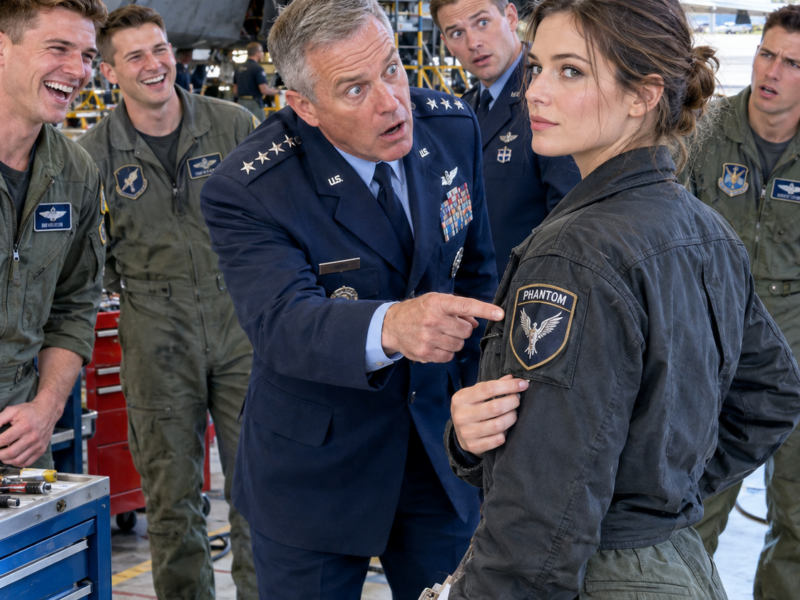
“They laughed when the quiet woman walked into the hangar wearing an ordinary mechanic’s uniform
The radar contact kept moving toward Falcon Ridge.
I stared at the monitor, recognizing the pattern of its turns before the system could calculate its speed. Three short corrections. A shallow descent. A sudden climb that should have been impossible for an aircraft flying that close to the mountains.
It was a maneuver I had learned from someone who was supposed to be dead.
“Colonel,” I said, “you need to clear the runway.”
Marcus Hayes did not move. “You just told me a classified unit that officially never existed is connected to an unauthorized aircraft. Now you’re asking me to clear the runway without telling me why.”
“Because if that pilot wants to land, nobody on this base will be able to stop them. And if they don’t want to land, the runway won’t matter.”
His expression hardened. “Who is flying that aircraft?”
I looked at the radar again.
“Call sign Wraith.”
The colonel’s face changed.
He reached for the secure handset beside the monitor and ordered the tower to halt all departures and clear the active runway. Then he turned to me.
“Three years ago, Wraith was the last call sign transmitted by the Phantom team before they disappeared.”
“I know.”
“Then you understand why I’m asking you to explain yourself.”
I did understand. Colonel Hayes had spent three years carrying the weight of a failed operation, answering questions from families, senior officers, and investigators who wanted to know why six highly trained personnel had vanished without leaving a trace. He had been the operations commander responsible for approving the mission.
But there was one thing he didn’t know.
The mission had not failed because we were careless.
It had failed because someone had sold us out.
And the person who arranged it had been sitting much closer to the command chain than anyone wanted to believe.
“Sir,” I said, “the aircraft approaching us is carrying the last person who can identify the man responsible for Phantom’s disappearance.”
“Who?”
Before I could answer, the radar screen flashed.
The contact had vanished.
The warning siren continued to howl. Outside, ground crews ran toward the hardened shelters while security vehicles raced along the perimeter road. Rain began striking the hangar roof, first in scattered taps, then in a steady roar.
Hayes watched the empty radar sector.
“Where did it go?”
“Below the ridge line. The terrain masks the signal.”
“How can you possibly know that?”
“Because I helped design the flight profile.”
His eyes narrowed.
I reached into my toolbox and unfolded an old paper map, its corners darkened by oil and age. I placed it beside the monitor and pointed to a narrow strip of ground beyond the northern perimeter.
“There’s an abandoned service runway on the far side of the ridge. It was built for emergency operations decades ago. It’s not on the current base navigation charts.”
Hayes studied the map.
“Who gave you this?”
“My team.”
“Your team is dead.”
“No, sir. My team was declared dead.”
The distinction seemed to strike him harder than I expected.
He looked at the flight recorder on the table, then back at me. “Start talking, Cross. Every detail. No more half answers.”
I drew a slow breath.
“My name is Elena Cross. That part is real. I worked as an aircraft technician before I joined Phantom. I was selected because I understood the aircraft’s control systems, especially the experimental navigation suite we were testing.”
“Phantom wasn’t a maintenance unit.”
“No. It was a six-person covert aviation team tasked with retrieving sensitive equipment and personnel from locations where conventional air support couldn’t operate without exposing the mission.”
“And you were a technician?”
“I was the team’s systems specialist. When we flew, I was responsible for navigation integrity, electronic countermeasures, and emergency recovery. If the aircraft lost its instruments, I was the person who had to find a way home.”
Hayes sat down slowly.
“Why weren’t you listed among the missing?”
“Because someone made sure my name never appeared on the final mission roster.”
I unwrapped the recorder.
Three years earlier, Phantom had been assigned to retrieve a scientist and a data package from a remote airfield. The scientist had discovered that a supposedly secure military communications system could be manipulated to redirect aircraft, falsify navigation information, and conceal unauthorized flight paths.
Our task was to extract him before the data fell into hostile hands.
We never reached the airfield.
Our navigation systems began feeding us conflicting positions. The communications channel filled with false instructions. One aircraft lost power after a sequence of electronic failures that the flight computers insisted were impossible.
Then the ambush began.
We had been guided into a corridor where hostile forces were waiting.
Our team leader, Major Adrian Cole, ordered us to scatter. Two aircraft were forced down. Another vanished from radar while attempting to climb over the mountains. The rest of us followed a prearranged emergency route toward a remote landing zone.
But the landing zone had already been compromised.
“Who knew the route?” Hayes asked.
“Everyone on the approved command list. The mission planners, the communications officers, the senior operations staff.”
“Including me.”
I didn’t answer immediately.
Hayes looked away.
“I approved that mission,” he said. “I reviewed the risk assessment. I was told the navigation suite had passed every test.”
“It had.”
“Then what happened?”
“Someone installed a hidden relay in the system. It altered our navigation data and transmitted our position to the people waiting for us. The system wasn’t failing. It was doing exactly what it had been modified to do.”
He looked at the recorder.
“Why didn’t you report this?”
“I tried.”
I reached into my jacket and removed a folded sheet of paper. It was a copy of a message I had sent three years earlier through the official investigative channel.
The request had been marked received.
The investigation had been closed two days later.
Hayes read the document twice.
“Who signed the closure?”
“Brigadier General Victor Sloane.”
His face grew rigid.
Sloane was the director of strategic operations at Falcon Ridge. He had been one of the officers who accompanied Hayes into the hangar that morning.
“General Sloane told us the team had been lost due to hostile action,” Hayes said. “He presented the review to command. He said the navigation failures were consistent with enemy interference.”
“He knew about the relay,” I replied. “He had authorized its installation.”
Hayes stood so quickly his chair scraped across the floor.
“That is an extraordinary accusation.”
“Then listen to the recorder.”
I connected the damaged flight recorder to a diagnostic unit in the hangar office. The screen flickered as the system attempted to reconstruct the corrupted audio. Most of the recording was noise, broken by bursts of cockpit alarms and clipped radio transmissions.
Then a voice emerged.
“Phantom One, abort the approach. Your extraction route has been compromised.”
Major Cole’s voice answered. “Command, confirm authentication. We are receiving conflicting navigation data.”
A second voice interrupted.
“Proceed to the revised corridor. This is an authorized command update.”
Cole hesitated.
“Identify the officer issuing the update.”
The reply came through clearly.
“General Victor Sloane. Execute immediately.”
Hayes went completely still.
The recording continued. There was a burst of static, a warning tone, then Cole’s voice again.
“That’s not our route. Someone has changed the corridor. Cross, verify the coordinates.”
I heard my younger self answer, frightened but trying not to show it.
“The coordinates are false. We’re being redirected toward the eastern ridge.”
“Can you correct it?”
“Trying now.”
A sharp alarm sounded.
Then came the words I had heard in my nightmares for three years.
“Phantom Two is hit. Phantom Two is hit. We have incoming fire!”
The recording broke into static.
Hayes leaned against the console.
For a long moment, neither of us spoke.
Finally, he whispered, “Why did you wait three years to bring this to me?”
I looked at him.
“Because the first time I tried to report it, the report disappeared. The second time, the officer who agreed to meet me never arrived. The third time, someone tried to kill me.”
Hayes turned toward me sharply.
“When?”
“Two weeks after I escaped the landing zone. I was taken to a field hospital under a false identity. When I woke up, I was told the other survivors had died. The next night, a man entered my room and tried to remove the IV line keeping me alive.”
“Who was he?”
“I never saw his face. I broke a window and escaped through the service corridor. By morning, my medical records had been altered, and the hospital had no record of admitting me.”
“And you’ve been here for three years?”
“I returned to the military under a different administrative designation. I worked in maintenance because it gave me access to aircraft records without attracting attention. I needed to know whether the same people were still controlling the system.”
Hayes stared at me as if he were trying to reconcile the quiet technician with the person described by the recorder.
“You could have come to me.”
“I didn’t know if I could trust you.”
The words landed harder than I intended.
He looked down at the map.
“I was the commander who approved the mission,” he said. “If you had come to me with this evidence, I might have been able to help.”
“Or you might have handed me back to Sloane.”
He didn’t argue.
Outside, the siren changed pitch. The tower announced that the unidentified aircraft had reappeared west of the perimeter, descending toward the abandoned service runway.
I grabbed the map.
“We have to get there.”
Hayes reached for his sidearm and checked the magazine.
“Not without security.”
“Security reports to Sloane.”
“Not all of it.”
He picked up the secure handset and dialed a number from memory.
“Major Patel, this is Colonel Hayes. I need a team at the northern service road. No radio traffic on the base network. Use the independent channel we discussed during the readiness review.”
He paused, listening.
“Because I have reason to believe the command network is compromised.”
He hung up.
“Major Patel runs the base’s independent security detachment,” he explained. “She reports directly to the regional command oversight office for certain emergency situations. Sloane doesn’t control her deployment.”
It was the first piece of good news I had heard all morning.
We left the hangar through a maintenance corridor and crossed the vehicle yard as the storm thickened. Hayes drove a utility truck while I sat beside him, the flight recorder secured against my chest. The northern road wound through a series of low hills, eventually reaching an old gate that had been sealed for years.
Beyond it lay the abandoned runway.
As we approached, headlights appeared through the rain.
A small aircraft sat at the far end of the strip, its engines winding down. It was a battered twin-engine transport, painted in a dull gray that swallowed the light. Its side door opened.
A figure climbed out.
He was tall and limped badly, using one hand to steady himself against the fuselage. His hair was almost entirely gray, and a deep scar crossed his cheek.
But I recognized him immediately.
“Adrian,” I whispered.
Major Adrian Cole looked toward the truck.
For a second, neither of us moved.
Then he raised one hand in a familiar signal: two fingers to his forehead, then down toward the heart.
The Phantom greeting.
I ran.
He met me halfway, and when I reached him, I wrapped my arms around him so tightly that he grunted in pain.
“You’re supposed to be dead,” I said.
“So are you.”
I pulled back and struck his shoulder.
He winced. “I deserved that.”
“You let me believe you were gone.”
“I had to.”
“You had three years to find me.”
“I spent three years trying to keep you alive.”
The anger that had carried me through so many lonely nights suddenly had nowhere to go. I stared at the man I had watched disappear into smoke and falling debris, the man whose voice had followed me through every nightmare.
“How did you survive?” I asked.
Cole glanced at Hayes.
“Perhaps we should do this somewhere that isn’t exposed to the weather.”
We moved beneath the aircraft’s wing. Cole explained that his fighter had been damaged during the ambush, forcing him to eject over a remote mountain range. He had been recovered by a local resistance network that had been helping the scientist we were supposed to extract.
The scientist had survived too.
His name was Dr. Samuel Voss, and he had spent the last three years assembling proof of the covert communications operation. The network had moved him between safe locations while Cole recovered from his injuries and worked to identify the people responsible.
“Why come back now?” Hayes asked.
“Because Sloane is preparing to move the system,” Cole replied. “The original relay is still active, and he’s using it to manipulate flight corridors for an unauthorized transfer scheduled tonight.”
“What transfer?”
“Aircraft components, encrypted navigation modules, and a data archive that links the operation to senior personnel. He’s moving everything out before the independent audit begins.”
Hayes’s expression darkened. “The audit starts tomorrow morning.”
“Which is why tonight is his last chance.”
Cole turned to me.
“When you found the anomalies in the hangar, you triggered a security alert. Someone noticed that you were examining the old telemetry patterns. I knew you were alive before today, but I couldn’t reach you without exposing the investigation.”
“So you sent the aircraft.”
“I sent a message the only way I could. I knew you’d recognize the approach pattern.”
I shook my head. “You could have simply called.”
“On a secure line that Sloane controls?”
He had a point, and I hated that he did.
Before I could answer, Hayes’s phone vibrated.
He checked the screen, and his expression changed.
“What is it?” I asked.
“An order from General Sloane. He has directed all personnel to return to the main hangar. He claims the unidentified aircraft is a hostile infiltration attempt.”
Cole gave a bitter laugh.
“Of course he does.”
Hayes looked at me. “If he knows we’re here, he’ll move the evidence before we can reach it.”
“Then we don’t give him time,” I said.
I spread the map across the aircraft’s wing. The old service runway connected to a maintenance tunnel that ran beneath the northern ridge. The tunnel had once been used to move equipment between the airfield and a storage facility. According to the records I had found, the facility was now listed as inactive.
Cole tapped the map.
“That’s where the relay is housed.”
Hayes nodded slowly.
“If Sloane is moving the archive, he’ll need to disable the relay first. Otherwise, the transfer will leave a trace.”
“Which means the facility is our best chance to catch him,” I said.
A set of headlights appeared beyond the gate.
Then another.
Major Patel’s security vehicles rolled onto the runway. She stepped out before the first vehicle had fully stopped, her rain jacket pulled tight around her shoulders.
“Colonel, I brought six people,” she said. “The rest are securing the base perimeter. What’s the situation?”
Hayes gave her a concise explanation, showing her the flight recorder and the copied report.
Patel listened without interrupting. When he finished, she looked at Cole, then at me.
“Phantom?”
I nodded.
She straightened.
“My brother was an aircraft controller on the night your team disappeared. He was removed from duty three days later for raising concerns about the radar logs.”
I had not known that.
“He never stopped saying the official report was wrong,” she continued. “He left the service believing he’d failed your team.”
“He didn’t fail us,” I said. “The system was designed to mislead him.”
Patel’s jaw tightened.
“Then let’s make sure the people who designed it answer for what they did.”
We divided into two teams. Patel would secure the service tunnel and establish a perimeter. Hayes would take Cole and me into the relay facility to recover the original logs and prevent Sloane from removing them.
The rain had become a hard, relentless sheet by the time we reached the tunnel entrance. Rusted gates hung open, and the old warning signs had been removed. Fresh tire tracks led inside.
Someone had been using the facility recently.
We moved through the tunnel with our lights dimmed. The walls were lined with abandoned cable trays and water pipes. Ahead, a mechanical hum grew louder with every step.
At the end of the passage stood a reinforced door with a modern electronic lock.
I knelt beside the access panel.
“Give me thirty seconds.”
Cole kept watch while I opened the panel and examined the wiring. The system had been installed after the facility was officially decommissioned. It was connected to a separate power source and a secure data line.
“That’s not a storage door,” I whispered. “It’s a control room.”
I bridged two contacts with a short wire from my kit. The lock clicked.
Inside, racks of communications equipment glowed in the darkness. A bank of monitors displayed flight corridors, aircraft identifiers, and live telemetry from several military bases. In the center of the room stood a large server cabinet, its status lights blinking in a steady sequence.
The relay was active.
And someone was working at the main console.
Brigadier General Victor Sloane turned as we entered.
For a moment, he looked genuinely surprised.
Then he smiled.
“Colonel Hayes. I wondered how long it would take you to make a mistake.”
Hayes raised his weapon. “Step away from the console.”
Sloane glanced at me.
“And Elena Cross. The ghost returns.”
I felt a chill crawl down my back.
“You knew I survived.”
“Of course. We received reports from the hospital. But by then, you had disappeared again. You were remarkably difficult to locate.”
“You tried to kill me.”
“I tried to contain a problem that should have been resolved three years ago.”
Cole stepped forward.
“You sent us into an ambush.”
“I authorized an operation. The intelligence was compromised. Difficult decisions were made.”
“You altered our flight path,” I said. “You gave the enemy our coordinates.”
Sloane’s smile vanished.
“You have no idea what was at stake.”
“Then explain it.”
For a moment, I thought he might. His gaze shifted toward the monitors, where flight paths continued to move across the screens.
“The system was developed to protect our aircraft from hostile interference,” he said. “It could detect threats, reroute flights, and conceal sensitive operations from unauthorized surveillance. But the people who funded it wanted something more. They wanted control over every aircraft that depended on it.”
“So you sold access,” Hayes said.
“I secured the resources necessary to keep the program alive.”
“You sold flight data to hostile forces.”
“I provided selected information to selected partners. The arrangement was supposed to prevent a larger conflict.”
“By sacrificing our team?” Cole demanded.
Sloane’s expression hardened.
“Your team discovered a system they were never authorized to examine. If you had completed the mission as instructed, none of this would have happened.”
“That is your defense?” I asked. “That we should have died quietly?”
“My defense is that the country cannot be governed by people who believe every classified decision must be explained to them.”
He pressed a key on the console.
A countdown appeared on the largest monitor.
DATA PURGE INITIATED — 04:00.
“He’s deleting the archive,” I said.
Hayes moved toward the console, but Sloane drew a pistol from beneath his jacket.
“Don’t.”
We stopped.
Sloane held the weapon steady. “I have spent twenty years building this program. You will not destroy it because one covert team was unlucky.”
“Turn it off,” Hayes ordered.
“Or what? You’ll shoot a senior officer in a classified facility with no witnesses?”
I glanced at the countdown. Three minutes and thirty seconds.
The server cabinet was connected to a secondary diagnostic terminal on the far wall. If I could access it, I might be able to copy the original logs before the purge completed.
But Sloane was watching me.
“You’re very quiet, Elena,” he said. “You always were. That’s why you were useful. Everyone thought you were a technician who happened to be present. No one suspected you understood the system better than the people who designed it.”
“That’s why you left me alive,” I said. “You thought no one would believe me.”
“I left you alive because you were already buried. Your identity had been removed from the official records. You could have lived quietly if you’d understood the kindness of that arrangement.”
I looked at the countdown.
Two minutes and fifty seconds.
“Your kindness nearly killed my team.”
“Your team was a liability.”
Cole moved suddenly.
Sloane fired.
The shot struck a metal rack beside Cole’s shoulder, sending sparks across the room. Hayes lunged for cover, and I dropped behind the console as a second shot shattered a monitor.
The alarm sounded.
The countdown continued.
I crawled toward the diagnostic terminal while Hayes shouted for Sloane to put down the weapon. Cole had taken cover behind the server cabinet, his injured leg dragging as he moved.
I reached the terminal and pulled the access cable from my kit.
The login screen demanded an administrator credential.
I tried the maintenance code.
Denied.
I tried the emergency override.
Denied.
One minute and forty seconds.
My eyes swept across the panel. The relay had been built using the same architecture as the experimental navigation suite. I recognized the diagnostic port, the backup power connection, and a tiny service switch hidden behind the lower panel.
I remembered the original design documents.
The purge process required continuous power from the main controller. If the system detected a sudden loss of power, it would abort the deletion and lock the archive in a protected state.
I couldn’t shut down the whole facility.
But I could interrupt the controller.
I pulled the service switch.
The lights flickered.
The countdown froze at one minute and twelve seconds.
Then the screen went black.
For one breathless moment, nothing happened.
A new message appeared.
PURGE INTERRUPTED. ARCHIVE LOCKED.
I exhaled.
“Got it!”
Hayes looked toward me.
Sloane turned, his face twisted with fury.
“You have no idea what you’ve done!”
He rushed toward the terminal. Hayes tackled him before he could reach it, and the pistol skidded across the floor. Cole emerged from behind the cabinet and helped force Sloane to the ground.
The general fought hard, but the years of command had not prepared him for a struggle on a wet concrete floor with two men who had survived his betrayal.
Within seconds, Hayes had secured his hands behind his back.
The door burst open.
Major Patel entered with her team, weapons raised. She surveyed the scene, then lowered her rifle when she saw Sloane restrained.
“General Sloane,” she said, “you are being detained pending investigation into the compromise of classified military systems, unlawful transfer of operational data, and the deliberate endangerment of personnel.”
Sloane looked at her with contempt.
“You have no authority to detain me.”
Patel held up a secure order on her tablet.
“Regional command oversight has suspended your access and issued the detention authorization. Your communications have been monitored since the first archive transmission.”
His expression changed.
That was when I understood the final piece of the puzzle.
My first emergency signal had not merely alerted Collins. It had triggered the independent oversight channel that had been waiting for credible evidence of corruption. The archive had given them the proof they needed to act.
Sloane had believed he controlled every channel.
He had forgotten that the system was never supposed to belong to him.
By dawn, the relay facility had been secured, its records copied to independent servers, and its access points sealed. Investigators arrived from outside the base’s command structure. Sloane was escorted away under guard, no longer able to order anyone to silence the people he had endangered.
The next few days passed in a blur of interviews, technical examinations, and sworn statements. The original logs confirmed the recorder’s testimony. Financial records revealed unauthorized transfers. Messages recovered from Sloane’s private terminal linked the operation to a network of intermediaries who had paid for classified flight information.
The official inquiry also uncovered something I hadn’t known.
Colonel Hayes had challenged the original loss report three times. Each time, Sloane had assured him that the investigation was complete and that the available evidence supported the conclusion that Phantom had been destroyed by hostile action.
Hayes had trusted the chain of command.
That trust had been exploited.
When he came to see me after the first round of hearings, he looked older than he had in the hangar.
“I owe you an apology,” he said.
I sat across from him in a quiet room overlooking the flight line.
“For what, sir?”
“For accepting the report without demanding more answers. For allowing the people who betrayed your team to define what happened. And for looking at you this morning and seeing a maintenance technician before I saw the person who had survived what the rest of us couldn’t understand.”
I considered his words.
“You couldn’t have known everything.”
“I could have asked more questions.”
That, at least, was true.
I looked through the window at the aircraft on the flight line. The maintenance crews were working through the grounded fleet, checking every system that might have been touched by the relay. No one was joking about my notes anymore.
“Then ask them now,” I said. “Ask what the reports don’t explain. Ask who benefits when an aircraft is declared unfit, or when a pilot is blamed for a failure that wasn’t theirs.”
Hayes nodded.
“I intend to.”
The official review eventually restored the names of the Phantom team members to the military record. The two pilots who had died during the ambush were honored in a formal ceremony. Their families received the truth about the mission, along with an explanation of why the original investigation had failed.
Major Adrian Cole returned to active duty after a long medical evaluation. He was not cleared for combat flying, but he accepted a position training specialist recovery teams. He said he wanted to make sure that no one else spent three years believing their teammates had been erased from the world.
As for me, the military offered to restore my original identity and place me in a senior technical role. I accepted the position, with one condition: every aircraft assigned to the experimental navigation program would receive an independent systems audit before it could be cleared for flight.
The condition was approved.
A few weeks later, I walked into the hangar where it had all begun. The same overhead lights hummed above the aircraft. The same smell of fuel and metal filled the air. The same tool carts stood in neat rows beneath the wings.
Staff Sergeant Miller was checking a panel when he noticed me.
He straightened immediately.
“Captain Cross.”
I stopped.
“It’s still Elena,” I said.
“Yes, ma’am.”
He glanced at my wrist. I had removed the black band during the investigation, but I wore it again now, its silver crescent catching the light.
“I owe you an apology,” he said. “For the things I said. For treating you like you didn’t know what you were doing.”
I studied him for a moment.
“Then do better with the next person you underestimate.”
He nodded, unable to meet my eyes.
I didn’t need him to feel ashamed forever. I needed him to remember that competence did not always announce itself, and that a quiet person could be carrying knowledge no one else in the room possessed.
Captain Reeves also faced a review for his handling of the maintenance discrepancies. Investigators found that he had received instructions from an intermediary connected to Sloane to delay the reports. He claimed he had not understood the larger scheme, but he had knowingly suppressed information that could have grounded the affected aircraft sooner.
His career would be decided by the inquiry.
I did not take pleasure in that.
The point had never been to punish every person who had doubted me. The point was to stop a system that rewarded silence when people should have spoken.
On the morning the grounded aircraft were finally cleared for limited operations, Colonel Hayes met me beside the hangar doors.
“Ready to see if the flight line is safe?” he asked.
I picked up my toolbox.
“Ready to see what the tests tell us.”
He smiled faintly. “Fair answer.”
We walked between the aircraft as the crews began their inspections. This time, the diagnostic records were being transmitted to an independent system. Every adjustment was logged. Every discrepancy required a second review. No one could quietly alter a report and pretend the problem had never existed.
Near the far wall, a new plaque had been installed. It bore the names of the six members of Phantom, including the two who had died and the four whose fates had been concealed.
I stopped in front of it.
For three years, I had believed that surviving meant carrying the past alone. I had thought my duty was to remain invisible until I could find enough evidence to prove what had happened.
But the truth had never been mine alone to carry.
Cole had survived. Hayes had finally listened. Patel had acted. Collins had helped get the first message to the right people. And the men who had been told they were untouchable had discovered that no amount of rank could make the evidence disappear forever.
I touched the black insignia on my wrist.
The Phantom symbol had once been a reminder of everything I had lost. Now it meant something else.
Not secrecy.
Not revenge.
A promise that the people who served in silence would not be erased when their stories became inconvenient.
From the runway, the sound of an engine rose into the morning air. I turned toward it and watched a fighter taxi into position, its crew working carefully through the checklist.
No one laughed when I walked past.
But that wasn’t what mattered.
What mattered was that the aircraft had been inspected honestly, the records could be trusted, and the people responsible for its safety were finally being heard.
I had returned to Falcon Ridge as a quiet woman in a mechanic’s uniform, carrying a secret everyone believed had died three years earlier.
I left the hangar that day with my head held high, not because the colonel had recognized the Phantom insignia, but because the truth behind it had finally come into the light.
And when the first aircraft lifted into the sky, I knew that Phantom had come home at last.
THE END.









