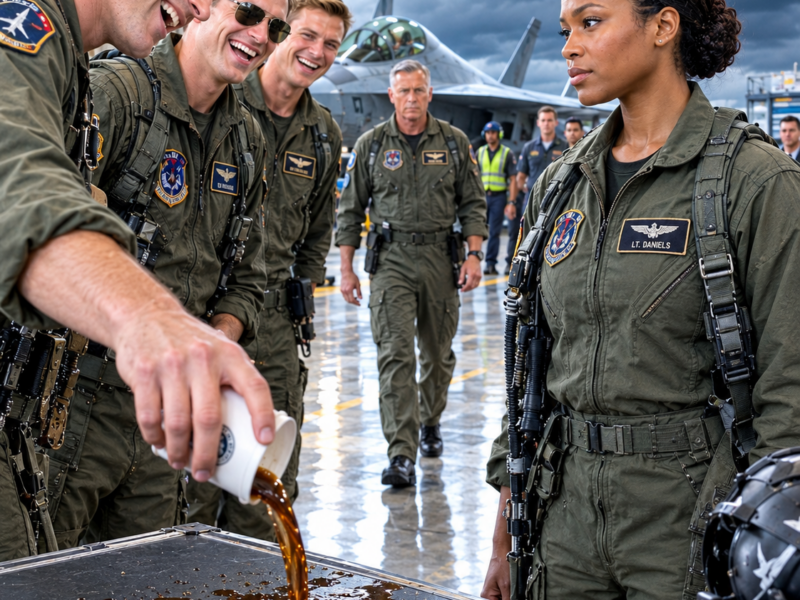
“They called me a quota hire, laughed as they dropped my pilot wings into a cup of coffee, and told me the squadron would be safer if I stayed on the ground
The beacon disappeared, and for three seconds, nobody in the command center moved.
I stared at the empty patch of the map where Commander Nathan Hayes’s signal had been blinking.
Three seconds was nothing in ordinary life.
In a cockpit, three seconds could mean the difference between recognizing a problem and watching it become an emergency.
“Try the emergency frequency again,” Major Ellis ordered.
The communications officer adjusted his headset. “Commander Hayes, this is Redstone Command. If you can hear us, transmit your position. Over.”
Static.
“Commander Hayes, acknowledge.”
Nothing.
The weather officer leaned over the console, his face pale beneath the fluorescent lights.
“The northern corridor is closing faster than predicted. The latest model puts the strongest cells across the ridge in less than twelve minutes.”
“Can we get another satellite update?” Ellis asked.
“Not quickly enough to affect the launch decision.”
I looked at the map again.
The corridor was no longer a corridor. It was a narrow, irregular opening between two developing storm cells, with a ridge on one side and a valley filled with low cloud on the other.
If Hayes was still airborne, he had limited options.
If he had lost power, those options were shrinking by the second.
“Captain Brooks,” Ellis said, “give us your assessment.”
I stepped closer to the display.
“His last transmission mentioned terrain ahead and unstable engine indications. We don’t know whether he has lost an engine, lost electrical power, or both. The beacon disappearing doesn’t necessarily mean the aircraft has crashed. It could be a signal failure, terrain masking, or a damaged transmitter.”
“Agreed,” the communications officer said.
“If he was trying to avoid the strongest weather, he may have moved north. The last transmission is consistent with that. I recommend we use the northern relay to try to reacquire him while the search team works the last confirmed position.”
Ellis studied me.
“And the flight?”
I knew what he was asking.
Could I reach Hayes?
Could I find him?
Could I bring him home?
I could calculate fuel, review aircraft limitations, estimate weather movement, and prepare alternate routes. I could evaluate risks, identify decision points, and establish conditions under which I would turn back.
What I could not do was promise that a storm would cooperate.
“I recommend a launch only if we can establish a safe operating window and maintain reliable communications,” I said. “If the corridor closes, if the aircraft exceeds its weather limitations, or if we lose the ability to navigate safely, I will abort. We need a recovery team ready at the alternate field, and we need a second crew monitoring the weather continuously.”
Blake let out an irritated breath.
“So we’re sending her out there with a list of reasons to turn around?”
I looked at him.
“No. We’re sending a qualified pilot out there with a plan for deciding when the mission can no longer be completed safely.”
“That’s a nice way to dress up uncertainty.”
“Uncertainty is what we’re dealing with. Pretending otherwise won’t make it disappear.”
Major Ellis raised a hand before Blake could respond.
“Enough. We are not making this decision based on personalities.”
He turned toward the senior flight officer.
“Confirm the aircraft status, mission equipment, and weather limits. I want the final assessment in five minutes.”
The room erupted into activity.
I moved to the planning table and pulled up the aircraft’s available performance data. Every number mattered now. Fuel endurance. Navigation capability. Radio coverage. The weather forecast along the route and at the recovery field. The time required to reach the search area and return.
I forced myself to work methodically.
There was a voice in the back of my mind telling me to hurry, that every second we spent at the base was another second Hayes spent alone in the storm.
I acknowledged that voice and ignored its demand.
Urgency was not permission to be careless.
I had learned that lesson the hard way, years before I earned my wings.
My first instructor had once told me that the most dangerous phrase in aviation was, “We don’t have time to check.”
He had made me repeat it until I understood.
We always had time to check.
Sometimes we did not have time to make the flight.
The distinction could save a life.
“Captain.”
I looked up.
The weather officer had brought me a revised projection.
“The northern opening is still there, but it may not be there when you arrive. There’s also a report of strong crosswinds near the alternate field.”
“How strong?”
He gave me the figures.
I studied them and recalculated our options.
“We need a different recovery plan,” I said. “If those winds increase, the alternate may not remain suitable. Can we confirm the conditions at the southern field?”
“I’m checking.”
“Also, I want the rescue team to consider ground access from the east. If Hayes has reached the lower valley, the western approach may be blocked by the storm.”
The weather officer nodded and hurried away.
Behind me, Blake muttered, “She’s acting like she’s running the whole operation.”
I didn’t turn around.
I was not running the operation.
I was doing the job I had been asked to do.
There was a difference, and I was not going to let Blake drag me into a fight while a man was missing.
A moment later, Major Ellis returned with the senior flight officer.
“Captain Brooks, the aircraft is available, and the mission equipment has been checked. Weather remains marginal. We have enough information to authorize a limited search under the current plan, provided you accept the established abort conditions.”
I looked at the updated route.
“Understood.”
“You will not continue into conditions that exceed the aircraft’s approved limits. If you cannot maintain safe navigation or communications, you will return. No improvising beyond the plan.”
“Yes, sir.”
He paused.
“And Captain? This is a search, not a competition. You are not required to prove anything to anyone tonight.”
I met his eyes.
“I know, sir.”
I wished I had believed it as completely as I sounded.
The base commander arrived beside the map, listened to the briefing, and gave the final authorization.
“Launch when ready. Keep the command center updated. If the weather deteriorates beyond the approved limits, the mission is terminated.”
I nodded.
Then I turned toward the door.
Blake was waiting in the corridor.
For a second, I thought he might step aside.
Instead, he planted himself in my path.
“You can’t be serious about doing this.”
“I’ve been serious since the commander went missing.”
“You know what that storm is doing?”
“Yes.”
“You know what happens if you lose the route?”
“Yes.”
“And you still want to go?”
I held his gaze.
“I want to bring our commander home. I will make that attempt if the conditions permit it. If they don’t, I will come back and we will find another way.”
He shook his head.
“You’re going to get yourself killed.”
“Then I will follow the same rules I expect every pilot to follow. I will assess the conditions, make decisions based on evidence, and refuse to let pride choose my route.”
His jaw tightened.
“Easy to say when you’re trying to prove a point.”
I stepped closer, not threatening him, but refusing to let him make me smaller.
“Blake, listen carefully. If I wanted to prove a point, I would stay here and wait for you to be wrong. But there’s a man out there who may be running out of time. This is not about the coffee. It’s not about the things you’ve said. It’s not about you.”
He looked away.
For the first time, I saw something in his expression that might have been uncertainty.
I walked past him.
At the hangar, the night air smelled of wet concrete and aviation fuel. Ground crews moved beneath bright work lights, checking the aircraft and preparing it for departure. Rain had begun to tap against the hangar doors.
A crew chief approached me with a clipboard.
“Captain Brooks, the preflight checks are complete. We have the latest weather package and the updated navigation data.”
“Any changes to the aircraft status?”
“None reported.”
“Good. Let’s go through the final checks.”
I moved around the aircraft with the crew chief, examining the surfaces, checking the equipment, and reviewing the details that could be verified on the ground. I had learned not to treat familiarity as a substitute for attention. An aircraft could look ready and still have a problem that mattered.
The crew chief watched me finish.
“Captain, if I may?”
“Go ahead.”
“Some of the guys have been talking.”
I knew exactly which guys he meant.
“About what?”
“About whether you should be the one flying this mission.”
I closed the checklist.
“And what do you think?”
He hesitated.
“I think the weather doesn’t care who people think belongs in that seat.”
For the first time that night, I smiled.
“That’s a good answer.”
He nodded toward the aircraft.
“Bring yourself back, Captain.”
“I intend to.”
I climbed aboard, secured my equipment, and began the cockpit checks.
Every switch had a purpose. Every indication had to be understood. I checked the navigation systems, communications, fuel, and the instruments required for the planned route. I reviewed the emergency procedures and the points at which the mission would have to be abandoned.
I read each item aloud.
Not because I didn’t know the checklist.
Because I did.
Because the moment you believe you are too experienced to verify the basics is the moment experience starts working against you.
When the aircraft was ready, I contacted the tower.
“Redstone Tower, this is Captain Brooks, requesting clearance for the authorized search mission.”
The response came through clearly.
“Captain Brooks, clearance approved. Wind and weather information follows.”
I copied the information and repeated the instructions.
Then I taxied toward the runway.
Rain glistened beneath the taxi lights. Beyond the perimeter, the sky was a solid black wall, with occasional flashes illuminating the underside of the clouds.
I had flown at night in difficult weather before.
I had never liked it.
Anyone who said they enjoyed flying into a storm was either lying or had not yet understood the danger.
At the runway threshold, I paused for the final checks.
My hands rested lightly on the controls.
I thought about my mother, who had driven me to my first flight lesson in a car that rattled whenever we went over forty miles per hour. She had waited outside the small flight school for three hours because she could not afford to pay for another lesson if I missed the one I had booked.
I thought about the first time I had walked into an officers’ briefing room and realized that everyone else had already formed an opinion about me.
I thought about the coffee cup.
Then I put those memories away.
They were real, but they did not belong in the cockpit with me now.
The tower cleared me for departure.
I advanced the power and began the takeoff roll.
The aircraft gathered speed, the runway lights streamed beneath me, and the wheels lifted from the ground.
Redstone fell away into darkness.
I was alone with the instruments, the storm, and the mission.
And somewhere ahead, Commander Hayes was waiting for a chance he might not have much longer to find.
The first part of the route was manageable.
I followed the authorized navigation plan, checked my position at the designated intervals, and kept the command center updated. The weather was deteriorating, but the conditions remained within the limits established for the mission.
“Redstone Command, Captain Brooks. I am approaching the northern observation point. Current conditions are consistent with the latest report. Request the newest storm update.”
The weather officer responded with a revised picture.
The main system was moving faster than expected.
“Captain, the northern corridor remains open, but the usable area is narrowing. We recommend maintaining the planned search boundary and reassessing before proceeding farther.”
“Understood. I will reassess at the next decision point.”
I kept flying.
The terrain ahead was hidden beneath layers of cloud. Lightning flashed in the distance, briefly illuminating the ridgeline and then plunging it back into darkness.
My aircraft’s instruments showed what they could show. They could give me information about my position, attitude, and performance. They could not turn a dangerous route into a safe one merely because I needed to complete a mission.
I reminded myself of that every time the urge to press farther grew stronger.
“Captain Brooks, this is Redstone Command. We have no confirmed contact with Commander Hayes. The rescue team is continuing its ground search from the eastern access road.”
“Copy. Any new reports from the emergency beacon?”
“Negative.”
I checked the map.
The last known position remained uncertain. The signal had been too brief to establish a precise location, and the terrain complicated every estimate.
I had to consider the possibility that Hayes had been carried farther from the reported position than we thought.
I also had to consider that he might no longer be airborne.
That possibility tightened my chest, but I did not let it change the calculations.
“Command, I recommend shifting the search emphasis slightly north within the approved boundary. His last transmission suggested he was dealing with terrain ahead and trying to avoid the strongest weather. The northern valley remains a plausible option.”
There was a pause.
“Your recommendation is noted. Maintain the current limits. We are cross-checking your assessment against the latest weather reports.”
I acknowledged and continued monitoring.
A sudden gust shook the aircraft.
I checked the indications, confirmed that the aircraft remained within its limits, and adjusted as required.
The turbulence eased.
Then it returned harder.
The aircraft jolted, and a warning light illuminated briefly before going dark.
I reviewed the instruments.
No persistent fault.
I did not assume that meant everything was fine. I checked the relevant indications again and compared them with the aircraft’s behavior.
“Redstone Command, I am encountering increased turbulence in the northern sector. I am holding at the current boundary while I reassess.”
“Understood, Captain. Weather update incoming.”
The new report confirmed what I had already suspected.
The corridor was closing.
I looked at the projected route and the remaining time before the storm reached the next decision point. If I continued, I might reach the search area before the opening disappeared. I might also find myself committed to a route that could no longer be flown safely.
There was no guarantee that turning back now would save the mission. There was no guarantee that continuing would accomplish anything.
I needed more information.
“Command, request updated observations from the northern relay. Is there any evidence that Commander Hayes reached the valley beyond the ridge?”
The communications officer replied.
“Negative at this time. We have received an unconfirmed report of a brief radio transmission from the eastern side of the ridge, but it has not been authenticated.”
“Can you provide the time?”
He gave me the timestamp.
I compared it with the previous transmissions.
The timing was significant.
If the report was genuine, Hayes might have been farther east than our search plan assumed.
I marked the location and checked the route against the weather picture.
“Command, I recommend verifying the eastern transmission before adjusting the search pattern. If confirmed, it may indicate that Commander Hayes crossed the ridge before losing contact.”
“Copy. We are attempting verification.”
A minute passed.
Then another.
I kept the aircraft on the safe side of the boundary while I waited.
My hands were steady, but my mind kept returning to the same question.
How long could Hayes survive without reliable power, navigation, or communications?
I could not answer it.
I could only keep the search organized and make sure I did not become another missing pilot.
The radio crackled.
“Captain Brooks, this is Redstone Command. The eastern transmission is likely authentic. The voice pattern matches Commander Hayes, but the message was too brief to establish his condition or position.”
I leaned forward slightly.
“Did it contain any identifiable landmarks?”
“Negative. The transmission included the phrase ‘lower ridge’ and what may have been a reference to a creek.”
I looked at the terrain map.
There was a narrow drainage channel east of the ridge, partly concealed by the terrain and crossed by an old service road. If Hayes had made it there, he might have found a place to land or an area where he could transmit without the ridge blocking the signal.
It was a possibility, not proof.
But it was the first new lead we had.
“Command, I recommend focusing the ground search on the eastern drainage channel and the adjacent service road. We should also try the emergency frequency again at scheduled intervals.”
“Understood. The ground team is being redirected.”
I checked the weather once more.
The northern opening was smaller now.
I could continue along the approved search boundary for a short period, but I could not safely push beyond it to chase a weak signal.
The decision was becoming clear.
I could turn back, report the new lead, and allow the ground team to approach from the east.
Or I could risk continuing in worsening weather, hoping to find a pilot whose exact location remained unknown.
The second option felt more heroic.
It was also less defensible.
I pressed the communications switch.
“Redstone Command, Captain Brooks. The weather is approaching the established limit for this sector. I am terminating the airborne search and returning according to the approved plan. The eastern drainage channel should remain the priority for the ground team.”
I waited for the acknowledgment.
“Captain Brooks, command understands. Return to base. We will continue coordinating the ground search.”
I turned away from the storm.
The choice hurt more than I expected.
It felt as if I were abandoning Hayes in the dark, even though I knew the alternative could place another pilot in danger without giving the rescue team a better chance of success.
I kept repeating the facts to myself.
A search pilot who became a second casualty did not improve the mission.
A route that could not be flown safely was not a route worth taking.
And turning back did not mean the search was over.
As I followed the return plan, I continued to monitor the radio.
At first, there was nothing but static and routine communications.
Then, just as I reached a safer stretch of airspace, a faint voice emerged.
“Redstone… this is Hayes…”
I straightened in my seat.
“Redstone Command, I have a possible transmission from Commander Hayes. Stand by.”
I changed to the designated frequency and listened.
The voice returned, weak and distorted.
“…east… lower ridge…”
Then silence.
I called command immediately.
“Redstone, did you receive that?”
The response came back almost at once.
“Affirmative. We received a partial transmission. It is consistent with Commander Hayes. The ground team is being directed toward the eastern drainage channel.”
I watched the storm recede behind me.
For the first time that night, I felt something other than fear or concentration.
Hope.
It was small, and it came with no promise of success.
But it was there.
When I landed back at Redstone, the rain had become heavier.
Ground personnel guided the aircraft to its parking position, and I completed the shutdown procedures before climbing down.
Major Ellis was waiting near the hangar.
“How bad was it?” he asked.
“Worse than the initial forecast. The corridor closed quickly, and the turbulence increased near the northern boundary. I terminated the search when the conditions approached the established limit.”
He nodded.
“Good.”
I blinked, surprised by how quickly he said it.
“Sir?”
“You followed the plan. You made the decision before the weather forced it on you. That’s exactly what we needed you to do.”
I looked toward the command center.
“Any news from the ground team?”
“Not yet. They are working their way along the eastern service road. The terrain is difficult, and the rain has reduced visibility.”
I removed my helmet and handed it to the crew chief.
“Can I assist with the search from the command center?”
“That’s where I need you.”
We hurried inside.
The room had grown more crowded. Several officers were tracking the ground team’s progress, while the communications officer tried to establish a more stable link with Hayes.
Blake stood at the rear of the room, staring at the map.
He looked at me as I entered.
For once, he did not make a joke.
I joined the planning table and reviewed the latest position reports.
The ground team had reached the service road, but a fallen tree blocked part of the route. They were attempting to find a way around it without sending vehicles into unstable ground.
“Can they continue on foot?” I asked.
“The team leader believes so, but the terrain is slippery. There are steep drops near the drainage channel.”
I studied the map.
“Tell them to avoid the lower bank. If Hayes landed near the creek, the ground may be saturated. The old maintenance track should provide a safer approach, even if it adds distance.”
The operations officer relayed the recommendation.
A few minutes later, the ground team confirmed that they had reached the track and were proceeding on foot.
The communications officer tried the emergency frequency again.
“Commander Hayes, this is Redstone Command. If you can hear us, transmit twice.”
Static.
“Commander Hayes, this is Redstone Command. We are conducting a ground search from the eastern access route. If you can hear us, transmit twice.”
A pause.
Then two faint clicks.
Everyone in the room leaned toward the speakers.
“Signal confirmed,” the communications officer said. “Very weak, but confirmed.”
Major Ellis gripped the edge of the table.
“Can we establish a location?”
“Not yet. We need another transmission.”
I looked at the map, thinking through the possible positions.
The terrain could mask a signal from a person only a short distance away. If Hayes was beneath the ridge, the ground team might be close without knowing it.
“Try asking him to transmit in short bursts,” I suggested. “And have the ground team pause periodically to listen. They may be able to determine the direction more accurately if they reduce their own radio traffic.”
The communications officer relayed the instruction.
The room waited.
Seconds passed.
Then the radio clicked twice again.
The ground team reported hearing the signal faintly through their portable equipment.
They changed direction.
I followed their progress on the map, comparing the reports with the terrain and the likely landing area.
The route narrowed toward a bend in the drainage channel.
“That’s it,” I whispered.
Major Ellis looked at me.
“What?”
“If Hayes is where I think he is, the aircraft may have come down near the bend. There’s a small clearing beyond the service track. It’s one of the few places in that area with enough room for a forced landing.”
“Can we confirm it?”
“Not from here. But the ground team is moving in the right direction.”
A new message came through.
The search team had found fresh debris beside the road.
Not an aircraft.
A broken piece of equipment, possibly torn from a panel.
The commander might be nearby.
The ground team slowed its approach and began checking the area carefully.
I watched the map, barely breathing.
Then the team leader’s voice came over the radio.
“Command, we have visual evidence of an aircraft off the service track. We are moving to inspect.”
Major Ellis closed his eyes for one brief moment.
“Copy. Proceed with caution. Report immediately.”
The next transmission took longer.
The weather had made the ground team’s progress painfully slow. Rainwater ran down the slope, and visibility remained poor. They could see only a few yards ahead in places.
I tried not to imagine what they might find.
Finally, the radio came alive.
“Command, we have located Commander Hayes. He is alive.”
Someone in the room let out a shout.
Another officer covered his mouth with both hands.
I felt my knees weaken, and I reached for the edge of the table.
“Repeat,” Major Ellis said, his voice suddenly rough. “Confirm the commander’s condition.”
“He is conscious, but injured. We believe he has a leg injury. He is sheltering beside the aircraft. We are beginning medical assessment.”
“Understood. Request medical support and advise if additional extraction equipment is needed.”
The team leader replied that Hayes was alert and able to communicate, though he appeared exhausted and was struggling with the cold. They were stabilizing him and preparing to move him away from the wreckage.
I bowed my head.
For the first time since the beacon disappeared, I allowed myself to feel the fear I had kept under control.
Hayes was alive.
He had not vanished into the mountains.
The search had not ended in silence.
I breathed out slowly and looked toward the window, where rain ran down the glass in silver lines.
Blake was standing a few feet away.
His face had lost its usual expression of easy superiority.
“You found him,” he said.
“The ground team found him.”
“But you gave them the location.”
“I gave them a possible location. They did the difficult part.”
He looked at the map.
“You could have kept going.”
“Yes.”
“You could have pushed farther north.”
“Yes.”
“Why didn’t you?”
I studied him.
“Because the weather was telling me it wasn’t safe. If I had ignored that, I might have become another pilot the ground team needed to find.”
He looked down.
For several seconds, neither of us spoke.
Then he said, almost too quietly to hear, “I thought turning back would mean you’d failed.”
I considered that.
“So did I.”
He looked up, startled.
“I wanted to keep going,” I admitted. “I wanted to be the person who found him. I wanted to prove that all the things you said about me were wrong. But wanting something doesn’t make it the right decision.”
Blake’s jaw moved, but he did not answer.
I turned back toward the command center.
There was still a rescue to coordinate.
The ground team stabilized Commander Hayes as best they could in the conditions and prepared him for evacuation.
He had managed to bring the aircraft down in the clearing, but the landing had been hard. One landing gear had collapsed, and the aircraft had slid off the service track before coming to rest near the drainage channel.
Hayes had suffered a serious leg injury and several cuts, but he was conscious and able to answer questions. His emergency transmitter had been damaged, and the terrain had blocked most of his attempts to communicate.
The two short bursts we had received were all he had been able to manage.
Medical support was dispatched, but the storm continued to make the evacuation difficult.
The command center coordinated with the ground team, medical personnel, and the receiving facility. I stayed beside the map, helping interpret the terrain reports and identify the safest route for the rescue vehicles.
The commander was alive, but we could not afford to treat that as the end of the problem.
The ground team reported that the service road was becoming slick and unstable. They would need to move Hayes carefully, and the evacuation vehicle could not reach the clearing directly.
“Can they move him to the upper track?” I asked.
The medical officer considered the terrain report.
“Possibly, but we need to avoid aggravating the leg injury.”
“Could they use the maintenance track to reach the wider section near the ridge? It will take longer, but the slope is less severe.”
The team leader checked the route.
“That’s feasible. We’ll need to secure the path and move slowly.”
“Do that,” Major Ellis ordered. “No unnecessary risks.”
The next hour was a series of short updates.
The rescue team secured the area.
They moved Hayes away from the aircraft.
They stabilized his leg and wrapped him against the cold.
They reached the upper track.
The evacuation vehicle approached.
Each message brought a little more relief, followed by another wait.
At 0510, the team reported that Hayes had been loaded into the vehicle.
At 0524, they confirmed they were moving toward the receiving facility.
At 0538, the medical team reported that he was stable enough for transport.
I sat down for the first time in hours.
My body had begun to tremble now that the immediate crisis was over. I placed my hands flat on the table and waited for them to settle.
Major Ellis came over with two cups of coffee.
He set one in front of me.
For one strange second, I stared at it.
The cup was ordinary. White paper. Black lid. No silver wings floating in the liquid.
Ellis followed my gaze.
“I heard what happened in the briefing room yesterday,” he said.
I looked up.
“Sir?”
“The coffee. The comments. The way you were treated.”
I felt the familiar instinct to minimize it.
“It didn’t affect my flying.”
“That’s not the point.”
He pulled up a chair.
“I should have noticed the pattern earlier. You shouldn’t have had to report it twice before anyone took it seriously. And you shouldn’t have been left to handle it on your own.”
I didn’t know what to say.
It was the first time a senior officer had acknowledged the situation without telling me to be patient, to be tougher, or to consider how the others might feel.
“I appreciate that, sir.”
He nodded.
“The investigation will proceed through the proper channels. I won’t promise you a particular outcome. But I will make sure the behavior is documented and addressed.”
“Thank you.”
He glanced at the map.
“And for what it’s worth, your decision to terminate the airborne search was the right one.”
I wrapped both hands around the cup.
“I wasn’t sure it would feel right at the time.”
“Good decisions don’t always feel good when you make them.”
He stood and returned to the operations desk.
I took a sip of coffee.
It was too hot, too bitter, and exactly what I needed.
Commander Hayes was transferred to a medical facility shortly after sunrise.
By the time the first pale light reached the base, the storm had moved east and the search area was beginning to clear. The ground team returned exhausted but safe. The damaged aircraft would be recovered later, once the conditions allowed specialists to reach it.
I finally went back to my quarters and slept for three hours.
When I returned to the squadron building, the story had already spread through the base.
The same people who had watched Blake drop my wings into coffee now knew that I had volunteered for the search, followed the approved plan, and turned back when the weather exceeded the safe limits. They knew that the ground team had found Hayes after using the location clues I had helped identify.
Some looked at me differently.
Some avoided looking at me at all.
I didn’t need either reaction.
I needed the squadron to understand that professionalism was not a performance, and that no pilot should have to fight prejudice while also trying to earn the trust of a team.
At 0900, Major Ellis called the squadron together.
The briefing room was full.
Blake sat near the front, his hands clasped on the table. The other pilots looked tired. The events of the night had stripped away some of their usual swagger.
Ellis stood beside the main display.
“Commander Hayes is alive and receiving medical care. The search and recovery teams performed well under difficult conditions. The flight crew’s assessment, the communications team’s work, and the ground team’s response all contributed to the outcome.”
He paused.
“I want to make one point clear. The fact that a mission ends well does not mean every decision made along the way was automatically correct. We evaluate the process, the evidence, and the risks. We do not judge a pilot’s worth by whether they were lucky.”
He looked around the room.
“And we do not tolerate conduct that undermines the trust required to operate as a squadron.”
Nobody moved.
Ellis continued.
“Professional disagreement is allowed. Questions about qualifications and decisions are allowed. Harassment, humiliation, and discriminatory behavior are not. These are not matters of personal preference. They affect the integrity of the team.”
His eyes settled briefly on Blake.
“An investigation into the incident involving Captain Brooks is underway. Everyone involved will have an opportunity to provide a statement. Until that process is complete, I expect every member of this squadron to maintain professional conduct.”
He closed the folder in his hands.
“Dismissed.”
Chairs scraped across the floor.
People began gathering their belongings.
I was halfway to the door when Blake spoke.
“Captain Brooks.”
I turned.
He stood near the table, looking as though he had rehearsed what he wanted to say and was now struggling to remember any of it.
“Can I talk to you?”
I glanced at the clock.
“I have a debrief in fifteen minutes.”
“It won’t take long.”
I considered refusing.
Part of me wanted to walk away and let him sit with the discomfort he had created. Another part knew that avoiding the conversation would not change what had happened.
“All right,” I said. “Talk.”
He looked around the room.
“Not here.”
We moved into the empty corridor.
For several seconds, he said nothing.
Then he exhaled.
“I owe you an apology.”
I waited.
He rubbed the back of his neck.
“What I did with your wings was wrong. The things I said were worse. I knew you had earned your place here, but I kept acting as if you hadn’t because I didn’t want to admit I was wrong about you.”
“Why?”
He looked toward the windows.
“I don’t have a good answer.”
“Try a truthful one.”
His jaw tightened.
“Before you arrived, I was considered one of the strongest pilots in the squadron. I was on track for a leadership position. Then you came in with better evaluations, more disciplined briefings, and a reputation for being good at the things I thought I was best at.”
“So you decided to make me look unqualified.”
He flinched.
“When you put it that way…”
“That’s what you did.”
He nodded.
“Yes.”
I folded my arms.
“And the comments about my race?”
He looked at the floor.
“I told myself they were jokes. That I was just giving you a hard time. But I knew exactly what I was saying.”
“Why?”
He swallowed.
“Because I thought if I could make everyone else see you as an outsider, I wouldn’t have to feel threatened by you.”
The honesty was ugly.
It was also the first thing he had said that sounded real.
“You didn’t just insult me, Blake. You tried to make the squadron believe that my qualifications were negotiable. You made people question whether I belonged in a cockpit where everyone depends on each other.”
“I know.”
“Do you? Because when the commander went missing, you weren’t worried that I would fail because the weather was dangerous. You were worried that I might succeed.”
He didn’t answer.
I let the silence remain.
Finally, he said, “You’re right.”
I had expected defensiveness. An excuse. A speech about how he was not a bad person and had never meant to cause harm.
Instead, he stood there and accepted the words.
It did not undo what he had done.
But it was a beginning.
“I can’t tell you that I forgive you,” I said. “Not today.”
“I understand.”
“And I won’t protect you from the investigation.”
“I wouldn’t ask you to.”
“Good. Because if you want to become a better officer, you need to understand that being sorry is the beginning of accountability, not the end.”
He nodded slowly.
“I understand.”
I started toward the briefing room.
“Captain?”
I stopped.
He looked at me, his face drawn with exhaustion.
“When you turned back last night, I thought you had failed.”
“And now?”
“Now I think I might have made the same mistake if I had been in your position.”
I studied him for a moment.
“Then learn from it.”
I left him standing in the corridor.
The official review took several weeks.
I gave my statement, provided the relevant flight documentation, and answered questions about the search plan and my decision to return to base. The review examined the weather conditions, the mission authorization, the communications, and the reasons for terminating the airborne search.
It found that the flight had remained within the authorized operating area and that my decision to return had been consistent with the established safety criteria.
The review also concluded that the ground search had benefited from the updated location assessment and the communications procedures used to confirm Hayes’s position.
I was relieved, but not surprised.
I had not flown perfectly.
No pilot does.
I had made decisions under pressure, checked my assumptions, listened to new information, and changed the plan when the conditions demanded it.
That was what the review was supposed to examine.
The separate investigation into Blake’s conduct took longer.
Several pilots gave statements. Some admitted they had laughed when he made comments about me. Others said they had heard the remarks but had not wanted to become involved. A few initially claimed the coffee incident had been harmless, then changed their accounts when the evidence made clear what had happened.
The investigation did not treat the incident as an isolated prank.
It examined the pattern of comments, the attempts to undermine my credibility, and the way the behavior had continued after I reported it.
Blake was removed from certain duties while the matter was reviewed and required to complete formal conduct and leadership training. He also received an official reprimand, and his consideration for a leadership assignment was suspended.
Some people thought the consequences were too severe.
Others thought they were too lenient.
I did not participate in the debate.
I had given the truth. The command had to decide what accountability required.
What mattered to me was that the squadron could no longer pretend nothing had happened.
The change was not immediate.
People who had once laughed at Blake’s jokes began to hesitate before speaking. Some apologized to me privately. One pilot admitted that he had seen the coffee incident coming and had stayed silent because he feared becoming the next target.
“I should have said something,” he told me.
“Yes,” I said.
He looked disappointed that I had not softened the answer.
“But you can choose differently next time,” I added.
He nodded.
That was all I could offer him.
I was not responsible for making everyone feel comfortable about what they had done.
I was responsible for doing my job and refusing to accept the idea that dignity was something I had to earn from people who had already decided to deny it.
Commander Hayes called me from the medical facility two days after the rescue.
His voice was tired, but strong enough to sound like himself.
“Captain Brooks, I hear I owe you a thank-you.”
“You owe the ground team a thank-you, sir. They were the ones who reached you.”
“I intend to thank every person involved. But Major Ellis tells me your assessment helped them find the right area.”
“It helped narrow the search. The ground team confirmed the location.”
He laughed softly, then winced.
“Doctor says I shouldn’t laugh yet.”
“Then I’ll keep this brief, sir.”
“No, stay with me for a minute. I have something important to say.”
I sat down.
“Go ahead.”
“I heard about the incident with your wings.”
I closed my eyes.
Of course he had.
“Sir, I don’t want to distract from your recovery.”
“I’m recovering. And this is relevant.”
He paused.
“When I selected you for this squadron, I did so because your performance and judgment met the standard. I did not do you a favor. I assigned a qualified pilot to a qualified position.”
“Thank you, sir.”
“I should have been clearer about that from the beginning. I should have made sure the squadron understood that you were there because you had earned it, and that your treatment was not something you had to manage alone.”
I looked out the window at the base, where ground crews were preparing another aircraft for a routine sortie.
“I appreciate you saying that.”
“There’s something else. I understand you turned back when the weather became unsafe.”
“Yes, sir.”
“Good.”
His answer surprised me.
“Some people might say I should have wanted you to keep searching.”
“Some people don’t understand command responsibility. If you’d continued into conditions beyond the safe limits, I would have had two people to rescue instead of one.”
I felt the tension leave my shoulders.
“I wanted to find you.”
“I know. But wanting to find me was not the only responsibility you had.”
He paused.
“A good commander wants a pilot who can bring the aircraft home, Captain. Not someone who will gamble everything because they’re afraid of being called a coward.”
I thought about Blake’s words in the corridor, and the fear I had felt when I made the decision to turn back.
“Thank you, sir.”
“When I return, I want you to help lead a review of how we conduct weather-related search missions. Your assessment was thorough, and I think the squadron can learn from it.”
“I’d be glad to help.”
“Good. And Brooks?”
“Yes, sir?”
“Keep those wings clean.”
I laughed before I could stop myself.
He laughed, too, and immediately regretted it.
“Doctor’s going to kill me,” he muttered.
We ended the call.
For the first time since I had arrived at Redstone, I felt that I was no longer fighting simply to be seen.
I was being asked to contribute.
There was a difference.
Three weeks later, Commander Hayes returned to the base on crutches.
The squadron gathered in the briefing room to welcome him back. He was thinner than before, and his leg was secured in a brace, but his eyes were bright and alert.
He thanked the rescue team, the communications staff, the weather officers, and everyone who had helped coordinate the operation.
Then he turned toward me.
“Captain Brooks.”
I stood.
“Sir.”
“I’ve reviewed the mission report. You identified a plausible search area, provided the ground team with useful information, and terminated the airborne search when the conditions approached the approved limits. That combination of judgment and discipline is exactly what I expect from a captain.”
He paused.
“I also understand that, the day before the mission, someone thought it was appropriate to put your wings in a cup of coffee.”
A few people shifted uncomfortably.
Hayes looked around the room.
“Those wings represent qualification, responsibility, and the trust placed in an officer. They are not a decoration that the rest of us get to approve or revoke because we like someone.”
His voice hardened.
“Your qualifications are determined by your performance and the standards of the service. Your dignity is not up for a vote.”
The room became completely still.
“Captain Brooks did not save me by proving that she was better than anyone else. She helped save me by doing her job, respecting the limits of the mission, and giving the people on the ground information they could use. That is what professionalism looks like.”
He looked at me again.
“Thank you, Captain.”
I saluted.
“Welcome home, sir.”
The room applauded.
I had never needed applause to do my job.
But after months of whispers, jokes, and quiet attempts to make me doubt myself, hearing that room acknowledge my work felt like a door finally opening.
After the meeting, Blake approached me.
He was no longer grinning. He no longer carried himself as though every room belonged to him.
“Captain, can I say something?”
I looked at him.
“Go ahead.”
“I’ve been thinking about what you said. About learning from it.”
I waited.
“I’ve spent a lot of time telling myself that I was protecting standards. That if someone didn’t fit what I expected a pilot to look like, I was entitled to question whether they belonged.”
He looked down at his hands.
“But I wasn’t protecting standards. I was protecting my own ego.”
I said nothing.
“I can’t undo what I did. I know that. And I don’t expect you to forgive me because I finally understand it.”
“That is correct.”
He nodded.
“But I want you to know I’m trying to change. Not because I want my leadership assignment back. Because I don’t want to be the kind of officer who would rather humiliate someone than learn from them.”
For a moment, I saw the young man he might have been before fear and pride had become excuses.
“Then keep trying,” I said. “Not when people are watching. Not when you’re worried about your reputation. Keep trying when nobody is there to reward you for it.”
“I will.”
“And Blake?”
He looked up.
“Don’t make me responsible for your growth. You chose how you treated me. You have to choose what kind of officer you become.”
He nodded.
“I understand.”
He walked away without asking for anything else.
I watched him go, then returned to my office.
I did not feel triumphant.
I felt tired, relieved, and quietly hopeful.
Forgiveness was not a switch I could flip. Trust was not a prize I could hand someone because they had finally said the right words.
If Blake changed, it would have to show in his actions over time.
Until then, we would work together professionally, and nothing more would be required of me.
The following month, the squadron held a training session on decision-making under pressure.
Commander Hayes asked me to present the search mission as a case study. I prepared a briefing that covered the initial information, the changing weather, the uncertainty surrounding the commander’s position, the decision points, and the reasons for terminating the airborne search.
I included the mistakes we had made, too.
The initial search assumptions had been too narrow. The emergency communications plan had depended too heavily on a beacon that could be blocked or damaged. The team had not immediately considered every possible landing area east of the ridge.
I did not want the squadron to leave believing that the rescue had succeeded because one person had been unusually clever.
It had succeeded because people continued to gather information, question assumptions, and adjust the plan.
I began the presentation with a simple question.
“What is the difference between persistence and stubbornness?”
The room remained quiet.
“Persistence means continuing to work toward the mission while the conditions allow it. Stubbornness means continuing because you have become emotionally attached to the outcome.”
I displayed the weather map.
“When I launched, I believed there was a reasonable opportunity to reach the search area within the approved limits. As the storm developed, that opportunity narrowed. At a certain point, continuing would have added risk without providing enough additional information to justify it.”
I paused.
“Turning back was difficult. It felt like failure. But the feeling was not evidence.”
Several pilots began taking notes.
I continued through the timeline, explaining how the eastern transmission changed our assessment and why the ground team’s route mattered more than another airborne attempt once the weather became unsafe.
Then I opened the final slide.
It showed the last confirmed beacon location, the area we had initially searched, and the place where the ground team had found Hayes.
“The lesson is not that the first plan was wrong or that the final plan was perfect. The lesson is that a plan must be allowed to change when the evidence changes.”
I looked around the room.
“And a pilot must be allowed to raise concerns without being treated as disloyal, inexperienced, or unqualified simply because someone else dislikes hearing them.”
My eyes met Blake’s.
He was listening.
He did not look away.
After the session, a young pilot approached me.
“Captain Brooks, can I ask you something?”
“Of course.”
“When you decided to turn back, how did you know you weren’t just being afraid?”
I considered the question carefully.
“I didn’t know that I wasn’t afraid,” I said. “I was afraid. I was worried about the commander, about the mission, and about what people might say if I came home without finding him.”
She nodded.
“But I didn’t use those feelings to make the decision. I looked at the aircraft’s limits, the weather, the information we had, and the risks of continuing. Fear can tell you that something matters. It cannot tell you whether a route is safe.”
She thought about that.
“So being brave doesn’t mean ignoring fear?”
“No. Sometimes being brave means admitting that you cannot safely do what you want to do.”
She smiled.
“Thank you, Captain.”
As she walked away, I realized how much I wished someone had told me that when I was younger.
I had spent so many years believing I had to be twice as good and twice as unshakable to earn the same respect others received automatically. I had confused strength with endurance, and endurance with silence.
But silence had not protected me.
It had only made it easier for people to pretend the problem did not exist.
I could be disciplined without accepting humiliation. I could be confident without pretending I never felt fear. I could respect the chain of command without surrendering my right to speak honestly.
And I could belong to the squadron without asking everyone in it for permission.
Several months after the storm, I stood beside my aircraft before a routine training sortie.
The sky was clear, the wind was light, and the forecast was stable. A crew chief completed the final checks while I reviewed the mission brief.
Blake approached from the hangar.
He had been assigned to a different training rotation while his leadership review continued. Since our conversation, he had made a visible effort to treat every member of the squadron with professionalism. He listened more carefully during briefings and had begun asking questions instead of making assumptions.
He was not suddenly my friend.
He was not transformed into a perfect officer.
But his behavior had changed, and I was willing to acknowledge that.
“Captain Brooks,” he said.
“Lieutenant.”
“I wanted to let you know the new emergency communications checklist is ready for review. The operations team incorporated the changes from your case study.”
“Good. Did they include a backup procedure for when the beacon is unavailable?”
“Yes. They also added a requirement to reassess search boundaries when terrain masking affects the signal.”
“Excellent. Send me the draft, and I’ll review it.”
He nodded, then hesitated.
“One more thing.”
I waited.
“I’ve been thinking about the day I put your wings in the coffee.”
I glanced at the silver wings pinned to my uniform.
“I remember.”
“I used to think that if I could make you feel like you didn’t belong, that would make my own position more secure.”
“And did it?”
“No.” He gave a faint, embarrassed smile. “It made me look smaller than I thought I was.”
I said nothing.
He continued.
“I can’t ask you to forget it. I just want to tell you that I know what I did was wrong, and I’m not going to make excuses for it anymore.”
“Then don’t.”
He nodded.
“I won’t.”
He stepped back to let the crew chief pass.
“Have a safe flight, Captain.”
“Thank you, Lieutenant.”
I climbed into the cockpit and secured my harness.
The familiar checks began: instruments, communications, navigation, fuel, control surfaces. The same careful sequence I had followed on the night Hayes disappeared.
The same discipline that had helped me decide when to launch and when to return.
I paused briefly before the final item.
My wings caught the light.
They were clean now, but I no longer thought of them as something I had to protect from other people’s opinions.
They represented the work I had done, the standards I had met, and the responsibility I had accepted.
No one in that squadron had given them to me as a favor.
No one could take them away with a joke.
I completed the checklist and contacted the tower.
“Redstone Tower, Captain Brooks, ready for departure.”
The controller cleared me to proceed.
I taxied toward the runway, watching the aircraft ahead of me turn onto the taxiway. Ground crews moved in the distance, small figures beneath the bright morning sky.
For years, I had imagined that the moment I finally earned respect would feel like a victory.
I thought there would be a speech, an apology, or some unmistakable sign that everyone had changed their minds about me.
Instead, respect came in smaller pieces.
A junior pilot asking for my advice.
A colleague listening when I raised a concern.
A commander acknowledging a decision made correctly under pressure.
A checklist improved because someone was willing to admit the old one could be better.
None of those things erased what had happened.
But together, they made the future different from the past.
I reached the runway threshold and completed the final checks.
The aircraft was ready.
The weather was good.
The mission was clear.
I advanced the power and began the takeoff roll.
As the wheels lifted from the ground, the base fell away beneath me.
For a moment, I thought about the storm, the disappearing beacon, and the commander who had waited in the darkness while we tried to find him.
I thought about the people who had helped bring him home, each doing a different job, each contributing something the others could not.
Then I thought about the cup of coffee.
I could still picture my wings floating in the dark liquid, the laughter around the table, and the way everyone had waited to see whether I would break.
I had not broken.
But the most important thing I had learned was not that I could endure humiliation.
It was that I did not have to.
I could challenge it. I could report it. I could insist on being treated as a professional without becoming cruel in return.
And when the moment came to make a decision that mattered, I could set aside the need to prove myself and do what the mission required.
That was what my wings meant to me now.
Not that I was better than Blake.
Not that I was stronger than every person who had doubted me.
Not even that I had saved a commander who might otherwise have been lost.
They meant that I had earned the right to sit in that cockpit, to make decisions based on evidence, and to accept responsibility for the consequences.
They meant that I belonged there.
The radio crackled with the tower’s final instruction.
I acknowledged it and continued climbing into the clear morning air.
For the first time in a long while, I wasn’t flying to prove that I deserved to be there.
I was flying because I was a pilot.
And that had always been enough.
THE END.









