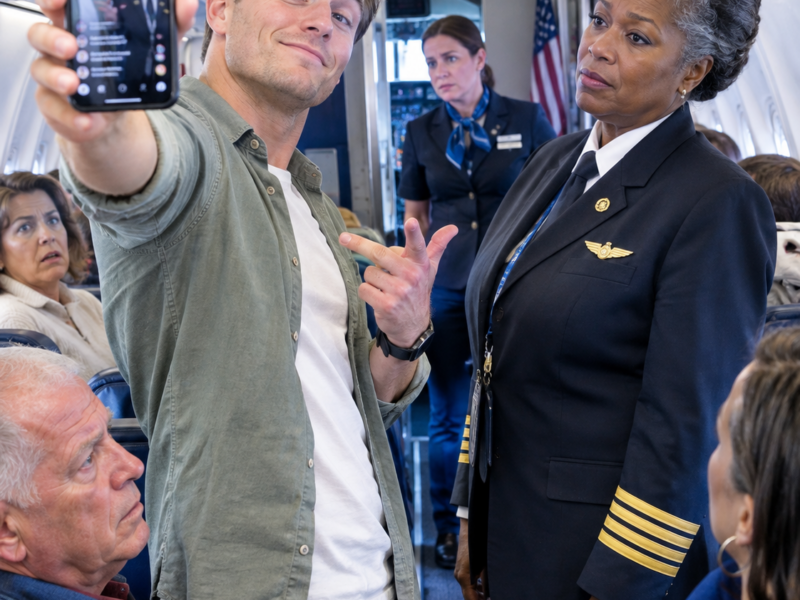
“The young co-pilot laughed at my gray hair on a livestream watched by nearly 200,000 people, calling me a relic who should have retired years ago
The voice came through the radio again, broken by static but unmistakable.
“Margaret Collins. If you can hear me, do not take the western corridor. Repeat, do not take the western corridor.”
For one suspended second, I forgot the storm, the alarms, and the aircraft trembling beneath my hands.
I had not heard that voice in twenty years.
“Who is this?” I keyed the microphone. “Identify yourself.”
A burst of static swallowed the reply.
Beside me, Tyler Brooks had gone completely still. His phone was still mounted near his knee, its screen filling with comments from thousands of people watching our cockpit livestream. A moment earlier, those comments had been laughing at me. Now they were arriving so quickly that the screen looked like it was shaking.
“Captain,” Tyler said, his voice thin. “People are saying the storm is worse than the radar shows.”
“Put the phone away.”
“But someone just sent—”
“Tyler.” I kept my eyes on the instruments. “We are flying an aircraft through severe turbulence. Your audience is not part of this crew. Secure that phone and help me fly this airplane.”
He obeyed.
It was the first time since we had met that morning that he did not argue.
Flight 482 bucked hard enough to make my shoulder press against the seat belt. Loose papers fluttered near the center console, and the cockpit filled with overlapping warnings. The weather radar showed a dense red mass ahead, with yellow and orange bands spreading around it like bruises. Our planned route was no longer an option.
“Autopilot disconnected,” Tyler announced.
“I have control.”
The yoke fought against my hands. I held the wings as level as the conditions allowed, resisting the temptation to chase every sudden movement. An airplane in turbulence did not need a frightened pilot making abrupt corrections. It needed steady hands, patience, and a clear understanding of what the aircraft could tolerate.
I had learned that lesson long before Tyler was born.
“Contact air traffic control,” I told him. “Request the latest weather picture and available deviations.”
He reached for the radio.
“Seattle Center, Flight 482. We’re encountering severe turbulence and embedded thunderstorms. Request immediate deviation options.”
Static answered.
He tried again. This time, a faint voice came through, fragments of instructions buried beneath interference.
I studied our instruments. Our fuel was sufficient for a diversion, but every minute spent searching for a safe corridor mattered. The storm had developed faster than the forecast suggested, and the radar was struggling to show us what lay behind the strongest cells.
Then the radio crackled again.
“Margaret, if that’s really you, listen carefully. This is Daniel Mercer.”
My fingers tightened around the controls.
Daniel.
The name opened a door I had spent two decades keeping shut.
Twenty years earlier, Daniel Mercer had been my instructor, my mentor, and the most gifted pilot I had ever known. He had taught me to respect weather more than schedules, judgment more than pride, and the quiet warning in a pilot’s instincts when the instruments did not tell the whole story.
He had also been the last person to fly with me before the accident that nearly ended my career.
“Daniel?” I whispered.
Tyler looked at me. “You know him?”
I ignored the question and keyed the microphone. “Daniel, where are you transmitting from?”
“Ground-based relay station near Spokane. I’m working with a regional emergency weather team. We’ve lost part of our radar picture, and our latest atmospheric readings show a rapidly intensifying cell directly along your western deviation.”
I looked at the map.
The western corridor was precisely where our flight computer had suggested we turn.
“How do you know our flight number?” I asked.
“Because your aircraft is one of the flights still approaching the affected area. And because someone watching your livestream recognized the location of the storm system in the background.”
I glanced at Tyler’s phone.
The screen had gone dark, but notifications continued appearing.
Daniel’s voice returned. “Margaret, there’s more. We have reports of severe wind shear near the southern edge of the system. The safest option may be a longer diversion north, but I need you to verify it against your aircraft systems and coordinate with air traffic control. I can give you observations. I cannot clear your route.”
That was the answer I needed. Not a miracle. Not a stranger who could magically see through the storm. Information from another source, imperfect but potentially valuable.
“Understood,” I said. “Keep transmitting what you have.”
I turned to Tyler. “Find the last reliable weather report from Seattle Center. Then calculate our fuel remaining against a northern diversion and a possible alternate airport.”
He nodded and began working.
The young man who had spent the morning performing for strangers now focused on the instruments and charts with an intensity I had not seen before.
“Captain,” he said after a moment, “we have enough fuel for the northern route and a diversion, but not enough to waste time testing every opening.”
“Correct.”
“I’m sorry.”
The words were so quiet I almost missed them.
“This is not the time.”
“I know. I just—”
“Then help me get these people on the ground.”
He swallowed and returned to his calculations.
I adjusted our heading slightly, following the safest available guidance while maintaining a conservative airspeed. The airplane shuddered again, but the wings remained controllable. I watched the attitude indicator, airspeed, vertical speed, and engine indications, checking each against the others rather than trusting a single display.
The cabin crew reported that several passengers had been injured by the turbulence. One flight attendant had fallen while securing a service cart. No life-threatening injuries had been reported, but the captain’s responsibility had never felt more immediate.
“Tell the cabin crew to remain seated and secured,” I said. “No one moves until we have a stable interval.”
Tyler relayed the message.
A few minutes later, the radio cleared enough for Seattle Center to respond. They confirmed the storm’s unexpected expansion and coordinated a northern deviation. Daniel’s reports supported the decision, but the final route was ours to fly, guided by official instructions and the information available in our cockpit.
Then another warning sounded.
The aircraft jolted downward.
For a heartbeat, the altimeter unwound faster than I liked. The airspeed shifted, and the wind buffeted the wings from side to side.
“Vertical speed increasing,” Tyler called.
“I see it. Maintain the attitude. Don’t chase the altitude.”
He followed my instruction, monitoring the instruments while I kept the aircraft within its safe operating limits. We had no business trying to overpower the storm. Our job was to avoid the worst of it, preserve control, and give the airplane time to carry us through.
The next several minutes stretched into something outside ordinary time.
I heard every warning tone. Felt every shudder through the seat. Watched the radar picture change as our route took us away from the strongest returns.
Gradually, the turbulence began to ease.
The violent jolts became smaller bumps. The wings steadied. The warning tones stopped one by one.
Tyler let out a breath he seemed to have been holding for an hour.
“Captain, the radar is clearing ahead.”
“Keep monitoring it.”
“I am.”
I looked toward him briefly. His face was pale, and his hands trembled slightly over the controls and switches. But he was doing his job.
That mattered more than whether he had finally learned to respect me.
“Seattle Center,” he said, “Flight 482 is clear of the strongest turbulence and proceeding on the assigned deviation. Request updated conditions and diversion options.”
The controller responded with a revised route and an instruction to prepare for a possible diversion if the storm continued to close around our destination. We acknowledged and began working through the options.
Then the radio crackled one more time.
“Margaret?”
Daniel’s voice was weaker now, but clearer.
“I’m here.”
“I need to tell you something. I should have told you years ago.”
My stomach tightened.
“Not now, Daniel.”
“I know. But you deserve to hear it from me.”
I kept my eyes forward. “You can tell me when the passengers are safe.”
There was a long pause.
“Fair enough,” he said.
For the first time since the storm began, I allowed myself a full breath.
We had survived the most dangerous part, but the flight was not over. We still had injured passengers, an uncertain destination, and a cabin full of people who had no idea how close the weather had brought us to a much worse outcome.
And I still had no idea why Daniel Mercer had returned to my life through a radio filled with static.
The cabin crew reported that the injured passengers were stable. One had a suspected wrist fracture, and another had a cut above the eye. The flight attendants had improvised bandages and kept everyone seated. Their calm work was as important as anything happening in the cockpit.
I asked Tyler to make a brief announcement once the aircraft was stable enough.
He picked up the microphone, paused, and looked at me.
“What should I say?”
“The truth. We encountered severe weather. We’re clear of the strongest area, and we’re coordinating with air traffic control. Don’t promise anything you can’t guarantee.”
He nodded.
“Ladies and gentlemen, this is your first officer. We’ve experienced a period of severe turbulence, and I want to apologize for the distress it has caused. The aircraft remains under control, and we are working with air traffic control to determine the safest way to complete the flight. Please remain seated with your seat belts fastened. Our cabin crew is checking on anyone who needs assistance.”
His voice was still young, but it no longer carried the easy confidence of someone performing for a camera.
When he finished, he set the microphone down carefully.
“I should have listened to you from the beginning,” he said.
“Yes.”
“I thought the livestream would make me look confident. I thought people liked a pilot who wasn’t afraid to challenge the old rules.”
“Some rules exist because people died before we learned them.”
He looked down.
“I know that now.”
I wanted to tell him that knowing it now was not enough. That he had compromised cockpit discipline, distracted himself during a dangerous situation, and exposed passengers and crew to unnecessary risk. But the flight still demanded our attention, and there would be time for accountability on the ground.
The weather remained unsettled, so we prepared for a diversion rather than pressing toward Seattle simply to keep the schedule. Seattle Center coordinated our route toward an airport outside the worst of the storm, and we reviewed landing performance, fuel, and the latest weather observations.
As the aircraft descended toward clearer air, the clouds began to thin. Gray layers opened into patches of pale afternoon light. The ground appeared beneath us in broken glimpses: dark forests, ribbons of road, and distant buildings washed by rain.
I had seen that kind of view thousands of times.
I had never been more grateful for it.
The landing was firm but controlled. The tires struck the runway, the aircraft decelerated, and the reversers roared. When we finally turned off the runway, I felt the tension leave my shoulders so suddenly that my hands seemed unfamiliar resting on the controls.
We taxied to a stand where emergency medical personnel were waiting.
Only after the aircraft was parked, the engines were shut down, and the checklist was complete did I unfasten my harness.
Tyler remained seated for several seconds.
Then he looked at me.
“Captain, I need to tell you something before we leave this cockpit.”
I waited.
“The livestream was still running when the turbulence started. I tried to stop it, but I didn’t know whether I had actually ended it. People saw everything.”
“Then we will report it accurately.”
“I deserve to lose my job.”
“That decision belongs to the company. My job is to report what happened, not decide your punishment.”
He nodded, his eyes wet with exhaustion and shame.
“I really thought you were past your prime,” he said. “I thought the years made you slow.”
“Experience doesn’t make someone infallible,” I told him. “And youth doesn’t make someone reckless. But arrogance can make either one dangerous.”
He took that without defending himself.
When we finally stepped into the terminal, I was met by a company safety officer, a representative from the airport, and a woman carrying a tablet who introduced herself as part of the regional weather response team.
“Captain Collins?” she asked. “We’d like to thank you for coordinating with our team. Your decisions helped keep the situation manageable.”
“I made decisions based on the information available to me,” I replied. “Your reports helped.”
She nodded, then added, “The person who relayed those observations is waiting in the operations office. He said you would recognize him.”
I knew before she said the name.
Daniel Mercer stood beside a window overlooking the wet apron. His hair had gone almost entirely silver, and his shoulders seemed narrower than I remembered. But his eyes were the same: alert, steady, carrying more feeling than he ever let his voice reveal.
For a moment, neither of us spoke.
Then he said, “You look exactly like the pilot I remember.”
“I’m not that pilot anymore.”
“No,” he said. “You’re better.”
I had imagined seeing him again many times over the years. In some versions, I shouted at him. In others, I walked away before he could speak. Sometimes I asked the questions that had kept me awake for months after our last flight together.
Now, after a storm that had nearly taken a hundred people into danger, all I could manage was the simplest question.
“Why did you disappear?”
Daniel lowered his eyes.
“Because I was a coward.”
The answer was so direct that it hurt more than an excuse would have.
Twenty years earlier, I had been a first officer flying with Daniel on a cargo route through a fast-moving storm. I had questioned our planned approach after noticing that the weather reports were changing faster than expected. Daniel had been the captain, and the final decision had been his.
He had continued toward the destination.
The weather deteriorated. We encountered severe turbulence and a sudden loss of reliable instrument information. Daniel took control as the aircraft began to deviate from the intended flight path. We recovered, but the event was serious enough to trigger an investigation and end his flying career.
I had given a statement describing the warnings I raised and the decisions he made. The report concluded that our crew had continued too far into deteriorating conditions before diverting. Daniel accepted responsibility publicly, but afterward he stopped answering my calls.
I had always believed he blamed me for telling the truth.
“I didn’t disappear because you reported what happened,” he said now. “I disappeared because you were right, and I couldn’t bear to face the person who had seen me fail.”
I stared at him.
“You told me you would stand by me.”
“I should have. Instead, I let shame turn into anger, and then I let the anger become silence. You were a young pilot who did exactly what a good first officer should do. You questioned a decision that needed questioning.”
“You let me think I had destroyed your career.”
“I know.” His voice cracked. “And I am sorry.”
For twenty years, I had carried a version of that night in which I had lost a mentor and a friend because I had chosen honesty over loyalty. I had told myself that it was the price of becoming a captain, that responsibility meant accepting the loneliness that came with difficult decisions.
I had never considered that Daniel’s silence had been his failure, not mine.
“I waited for you to call,” I said.
“I know.”
“I thought if you ever did, you would tell me I was wrong.”
“I was wrong.”
The words did not repair the missing years. They did not return the birthdays, the holidays, the quiet moments when I had wished I could ask him a question only he would understand. But they loosened something I had been carrying for so long that I had mistaken its weight for part of myself.
I looked out at the rain streaking the window.
“Why were you monitoring the storm today?”
Daniel explained that he had retired from flying after the investigation, but eventually returned to aviation in a different role. He now worked with a regional team that compared ground observations, pilot reports, and weather data during severe events. When the storm intensified unexpectedly, their team began warning flights in the affected area.
A viewer watching Tyler’s livestream had recognized the storm’s location from the shifting cloud formations visible beyond the cockpit windows. The viewer sent a message to the stream, which another person forwarded to a local aviation weather group. That message prompted Daniel’s team to review the latest reports more urgently.
They had not known our exact position from the livestream alone, nor could they see inside our aircraft’s systems. But the timing had helped them focus on a developing hazard, and Daniel had used an approved communication relay to pass along the information.
“The livestream didn’t save you by itself,” he said. “Your crew’s decisions did. Our observations gave you another piece of the picture.”
I appreciated that he understood the difference.
“What about the call sign?” I asked. “How did you know we were in trouble before the official reports came through?”
“Your flight was already on the weather team’s list of aircraft approaching the system. When the viewer’s message arrived, we cross-checked it against our reports. Then we tried to contact your flight through the appropriate channel.”
I nodded slowly.
The mystery had not been a miracle. It had been a chain of people paying attention, passing along information, and trusting trained professionals to evaluate it.
It was less dramatic than a stranger possessing secret knowledge.
It was also more believable, and more important.
Daniel glanced toward the terminal doors.
“I heard the way your first officer spoke to you before the storm got bad,” he said. “The team saw some of the stream. I’m sorry you had to deal with that on top of everything else.”
“Tyler will answer for his choices.”
“And you?”
I frowned. “What about me?”
“Are you going to keep pretending you have nothing left to prove?”
I felt my expression harden.
“I have never needed to prove anything to Tyler.”
“I wasn’t talking about Tyler.”
I turned away.
Daniel had always been good at finding the question I did not want to answer.
After the accident twenty years earlier, I had rebuilt my career one flight at a time. I studied harder, prepared more carefully, and made sure no one could accuse me of being careless. Over time, that discipline had become part of me. So had the need to anticipate every doubt before anyone voiced it.
I had learned to carry responsibility.
I had not learned how to put down the burden of being judged.
“I’m fifty-seven,” I said. “People see the gray hair before they see the logbook.”
“Some people do.”
“They assume I’m slow. Outdated. A risk.”
“Then let them be wrong. But don’t let their ignorance become the voice in your own head.”
I had no answer.
He continued, gently now. “You were never valuable because you were young. You were valuable because you paid attention, admitted what you didn’t know, and made decisions when they mattered. You did that twenty years ago. You did it today.”
I looked at him, and for the first time since the radio call, I allowed myself to feel the exhaustion underneath the adrenaline.
“I was scared,” I admitted.
“Of course you were.”
“I didn’t want anyone to know.”
“Being a captain doesn’t mean you don’t feel fear, Margaret. It means you don’t let fear make the decisions for you.”
I remembered his voice from my earliest days in the cockpit, telling me that a good pilot did not need to be fearless. A good pilot needed to recognize danger honestly and respond to it with discipline.
Some lessons took decades to return to the person who had first taught them.
Before we left the operations office, Daniel asked if I would have coffee with him sometime.
I looked at him for a long moment.
“I can’t promise everything will go back to the way it was.”
“I’m not asking for that.”
“And an apology doesn’t erase twenty years.”
“I know.”
I thought about the unanswered calls, the silence, and the young pilot I had been when his absence first began to hurt. I thought about the man standing in front of me now, finally taking responsibility without asking me to make him feel better.
“Coffee,” I said. “One cup.”
His eyes glistened.
“One cup,” he agreed.
The airline investigation began the next morning.
I gave a complete account of the flight, including the weather conditions, our communications with air traffic control, the external observations we received, and the decisions made in the cockpit. The company reviewed the livestream, the crew’s actions, and the sequence of events leading to the diversion.
Tyler did not try to blame the storm, the audience, or me.
He admitted that he had streamed from the cockpit without authorization and had continued using his phone when he should have been focused on his duties. He also acknowledged that his mocking comments had undermined professional respect and distracted him from the seriousness of his role.
The company removed him from flight duty while the investigation proceeded and required him to complete additional training and a formal review before any decision about his future.
I did not ask them to fire him.
I did not ask them to spare him, either.
Accountability had to mean more than revenge, and more than forgiveness.
Several weeks later, I was called into a meeting with the airline’s chief pilot and safety director. They told me that the review had found no evidence that I had mishandled the aircraft or violated procedure. Our diversion had been appropriate, our communications had been documented, and the external weather observations had been treated as supplemental information rather than a substitute for official clearance.
They also thanked me for remaining calm under pressure.
I accepted their words, then asked what changes the airline planned to make to prevent cockpit livestreaming and improve crew reporting when weather conditions changed unexpectedly.
The safety director looked surprised, then began taking notes.
It was the only response I cared about.
By the end of the month, the company had issued a clearer reminder of cockpit device restrictions and reinforced the process for reporting unauthorized recording. The safety team also began reviewing how pilot reports and regional weather observations could be shared more efficiently during rapidly developing storms.
Tyler sent me a letter after his review.
He did not ask me to put in a good word for him. He did not explain how his followers had encouraged him or how he had believed that mocking me would make him seem fearless. He wrote that he had mistaken attention for respect and confidence for competence.
He ended with one sentence: I hope one day I can be the kind of first officer you deserved that day.
I folded the letter and placed it in my desk.
I did not know whether he would become a better pilot. That would depend on what he did after the embarrassment faded and the audience moved on to something else. But for the first time, he seemed to understand that the cockpit was not a stage and that the people in the cabin were not an audience.
They were people who had trusted us with their lives.
Daniel and I met for coffee on a cold Saturday morning.
One cup became two. We talked about aviation, the people we had lost touch with, and the years neither of us could recover. He did not ask me to forget what he had done. I did not pretend that hearing his apology had erased the hurt.
We started with the truth and allowed the rest to take whatever time it needed.
A few months later, I returned to the cockpit for another ordinary flight.
The aircraft was clean, the weather was stable, and the new first officer beside me was young enough to have been Tyler’s classmate. During the preflight briefing, she asked thoughtful questions and listened carefully to the answers. When we discussed the weather, she pointed out a potential change along our route that I had not yet noticed.
I thanked her and revised our plan.
There was no embarrassment in learning something from someone younger. There was no weakness in changing course when new information arrived.
As we climbed above the clouds, the morning sun spread across the horizon, turning the tops of the clouds gold.
I thought about the storm, the voice on the radio, and the years I had spent trying to prove that age had not taken anything essential from me.
The truth was simpler.
My gray hair had not flown Flight 482 to safety. My years of experience had not made me invincible. No single person had saved that flight alone. The cabin crew had cared for injured passengers. Tyler had eventually focused on his duties. Air traffic control had helped us find a safe route. Daniel’s team had shared useful observations. And I had used the training, judgment, and discipline I had spent a lifetime building.
That was what a crew was supposed to do.
I rested my hands lightly on the controls and looked ahead.
I no longer needed to prove that I could fly like someone younger.
I only needed to keep flying like the captain I had worked so hard to become.
THE END.









